Home
/
Blog
/
Hackathons
/
11 Best Hackathon Platforms for Enterprise Innovation in 2026

11 Best Hackathon Platforms for Enterprise Innovation in 2026

Author
Vikas Aditya
Calendar Icon
January 27, 2026
Timer Icon
3 min read
Share

Explore this post with:

  • Hackathon software has evolved into full-featured platforms that streamline events, manage teams, and turn ideas into actionable projects.
  • Companies using these platforms see 35-50% higher participation and operational efficiency, making hackathons a measurable innovation engine.
  • Platforms like HackerEarth connect organizers with global developer communities, support large-scale challenges, and provide built-in evaluation and analytics tools.
  • Modern hackathon tools also track progress, foster collaboration, and sustain post-event innovation, ensuring ideas don’t get lost after the event ends.

Hackathon software has rapidly evolved from simple coding challenge tools into sophisticated platforms that empower enterprises to drive innovation, recruit talent, and manage large‑scale ideation programs. In fact, companies that leverage dedicated hackathon platforms report a 35-50% increase in participation rates and operational efficiency. 

In this guide, we’ll explore the top 11 hackathon platforms that are setting the standard in enterprise innovation management in 2026. You’ll also learn how they compare across features, pricing, community reach, and strategic value.

Why Use Hackathon Software in 2026?

Before we explore the platforms, here’s why hackathon software has become a necessity:

  • Streamline management: Hackathon software automates many logistical tasks, including registration, team formation, and final submissions.
  • Scale operations: Hackathon software efficiently manages registration, submissions, teams, judging, and communications, even for large, global events with hundreds or thousands of participants.
  • Support diverse formats: Modern hackathons include coding, product design, AI/ML prototypes, marketing ideas, business models, and UX. Platforms support multiple formats, including code submissions, design entries, idea submissions, and voting.
  • Enable global collaboration: Software schedules activities, manages collaboration, and centralizes submissions and judging for participants across different time zones, geographies, and backgrounds.
  • Track projects: Organizers monitor project progress, assign tasks, and ensure participants meet deadlines.
  • Generate ideas: Features such as brainstorming sessions, voting tools, and idea repositories capture and refine innovative concepts.
  • Provide data and analytics: Companies measure participation, engagement, idea quality, and follow-up outcomes. Analytics help assess ROI, identify trends, and guide future hackathons.

📌Suggested read: 6 Reasons: Why Companies Conduct Hackathons

Hackathon Platform Decision Matrix

With so many virtual hackathon platforms available, comparing them side by side helps you pick the one that matches your event goals and team needs. Here’s a quick breakdown of the top options.

Tool Name Best For Key Features Pros Cons G2 Rating
HackerEarth Developer-centric hackathons and talent acquisition Hackathon hosting, global developer community, challenge workflows, submissions, judging, analytics Deep analytics and integrations; robust hackathon and assessment tools Not ideal for non-technical assessment needs; limited deep customization; no low-cost, stripped-down plans 4.5
Devpost Public and internal hackathons with broad developer engagement Submission gallery, built-in judging, project showcase, community access Large developer ecosystem; scalable for public events; proven across thousands of hackathons Less customizable for non-code formats N/A
Eventornado Standalone hackathon execution Event page, team formation, chat, feedback, mentor involvement Simple browser-based setup; flexible workflow; good for hybrid events Smaller ecosystem compared to Devpost and HackerEarth N/A
InspireIP Continuous innovation and hackathon management Enterprise hackathon workflows, analytics, modular innovation apps, reporting Strong enterprise focus; connects hackathons to long-term innovation pipelines More complex for single standalone events 4.8
IdeaScale Idea crowdsourcing and innovation programs Idea capture, analysis, voting, project planning, ROI dashboards Excellent for broad ideation beyond events; high collaboration support Can feel overwhelming initially; setup complexity 4.5
Brightidea Enterprise innovation programs and hackathons Automated event scheduling, analytics dashboards, collaboration rooms Strong analytics; integrates well with corporate tools; highly scalable Enterprise pricing; heavier feature set than SMB tools 4.3
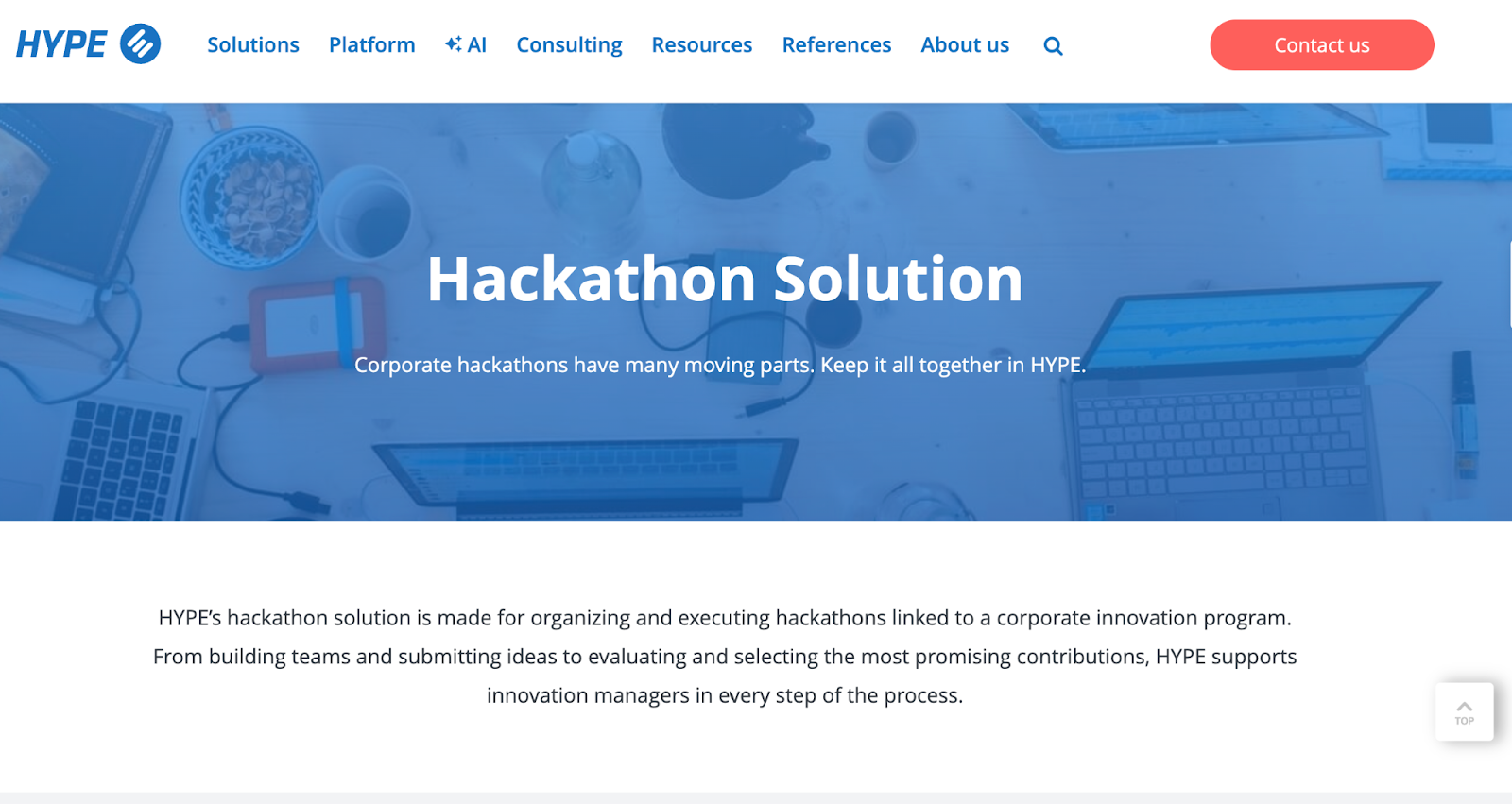
HYPE Innovation Corporate innovation and hackathon campaigns Team building, idea capture, evaluation workflows, dashboards All-in-one innovation and event support; automated evaluation May be complex for small or one-off events 4.8
InnovationCast Long-term idea pipelines with hackathon support Challenge campaigns, idea improvement, evaluation, impact tracking Strong post-event tracking into implementation Broader innovation focus requires substantial setup N/A
Hackathon.com General hackathon discovery and organization Central event listings, basic management tools, community reach Easy event exposure; broad community visibility Limited enterprise-grade analytics and controls N/A
Ideanote Lightweight hackathons and ongoing ideation Idea capture, automated workflows, collaboration tools, integrations Clean UI; great for SMBs and teams; strong automation Not designed for very large enterprises 4.7
Agorize Hackathons and open innovation programs Challenge builder, mentor engagement, evaluation dashboards Strong idea scouting and talent discovery capabilities Event timelines can be longer to execute 4.4

📌Also read: 10 Things to Keep in Mind While Conducting a Hackathon

Top 11 Hackathon Software Platforms

Discover how the top 11 online hackathon platforms help you run events, track projects, and engage participants.

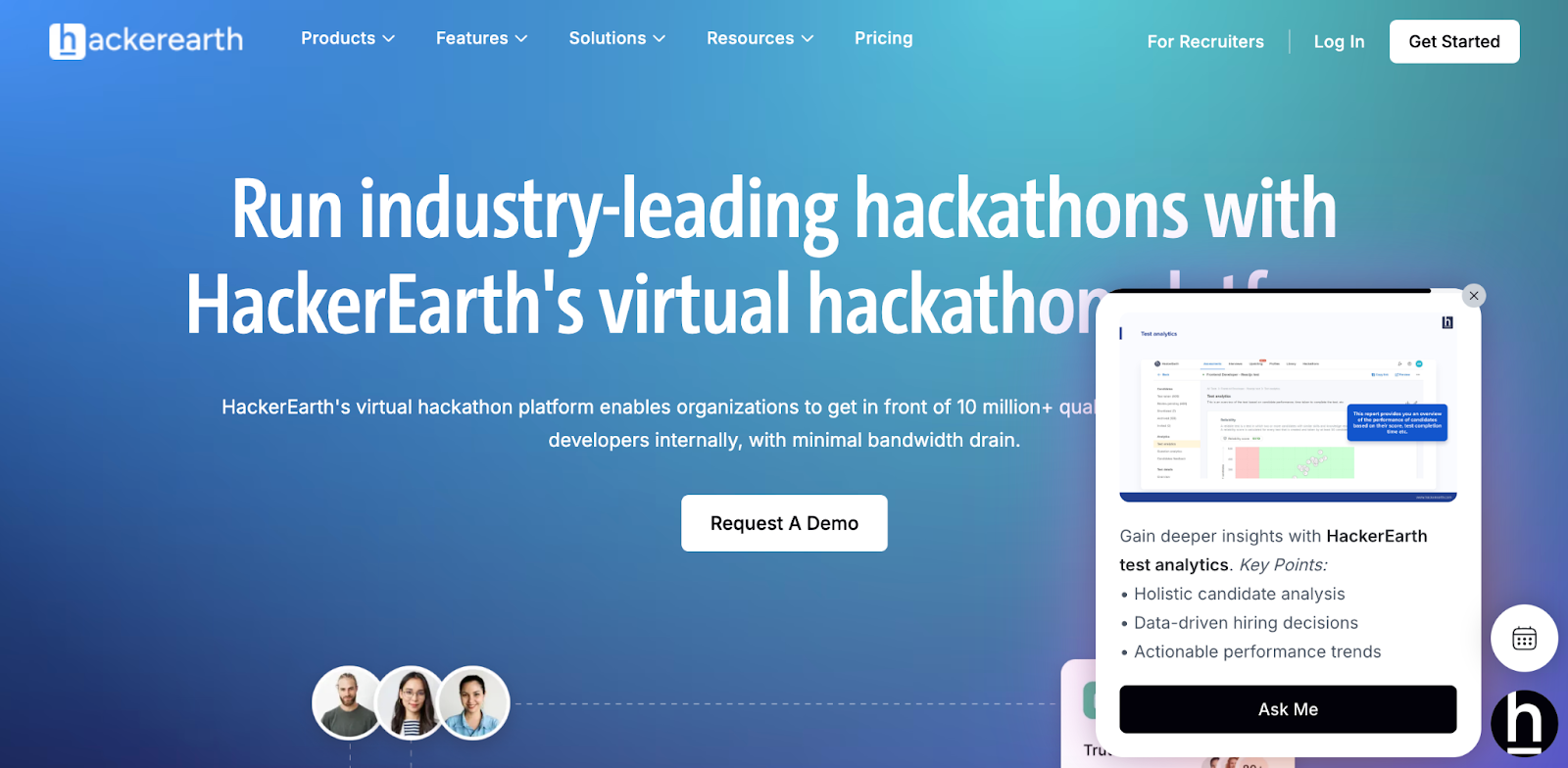
1. HackerEarth

HackerEarth provides a complete platform for hosting technical hackathons and measuring real-world skills in a single, easy-to-use solution. You can create project-based tasks, coding challenges, and hackathons that test candidates across full-stack development, DevOps, machine learning, data analytics, and GenAI skills. The platform includes over 40,000 questions covering more than 1,000 technical areas, allowing recruiters and organizers to measure applied skills accurately.

All HackerEarth hackathons include fully managed services, so organizers can focus on outcomes rather than administrative tasks. The platform provides real-time team creation, idea shortlisting, project evaluation, and advanced plagiarism detection to keep events secure and fair. A dedicated process management team handles creative support, evaluation guidance, and organic promotion to increase engagement and participation across internal or external audiences.

You can reach over 10 million developers in 133 countries and 450 global universities while running global, internal, hybrid, or in-person events. Internal hackathons help teams collaborate across departments, spark creativity, and turn ideas into actionable results. External hackathons and innovation challenges allow organizations to crowdsource solutions and discover top-tier talent in real-world problem-solving scenarios.

HackerEarth also offers the FaceCode platform for live coding interviews with HD video, AI assistance, structured evaluation, and performance summaries. Recruiters can score code for correctness, readability, security, and maintainability while automating over five hours of technical evaluation per hire. 

The platform uses an AI Interview Agent to run realistic interviews that assess technical and soft skills, while AI Screening Agents identify top candidates early, remove up to 80% of unqualified applicants, and allow recruiters to focus only on the most promising talent. With 15+ ATS integrations, GDPR compliance, and ISO 27001 certification, HackerEarth ensures reliable, secure, and scalable hiring for large-scale programs.

Key features

  • 40,000+ questions across full‑stack, DevOps, data, ML, and GenAI skills
  • Automated evaluation and scoring with intelligent insights
  • Access live collaborative coding with HD video and AI support via the FaceCode Interview platform
  • Continuous proctoring with tab‑switch detection, audio monitoring, and bot/tool usage flagging
  • Engaging talent through innovation‑focused hackathons and hiring challenges
  • Connect with 15+ systems, including Greenhouse, Lever, Workday, SAP
  • GDPR compliance, ISO 27001 certification, reliability for scale

Pros

  • Make assessments with varied question types 
  • Give teams a largely intuitive interface that reviewers appreciate
  • Provide deep reporting and analytics that recruiters find helpful
  • Offer wide language support and real coding environments 

Cons

  • Does not offer low-cost or stripped-down plans
  • Fewer customization options at entry-level pricing

Pricing

  • Growth Plan: $99/month per user (10 credits)
  • Scale Plan: $399/month (25 credits)
  • Enterprise: Custom pricing with volume discounts and advanced support

Best for: Enterprises and growing companies seeking end-to-end hackathon management with integrated technical assessment, talent acquisition, and innovation capabilities. Ideal for organizations running both internal innovation challenges and external public hackathons.

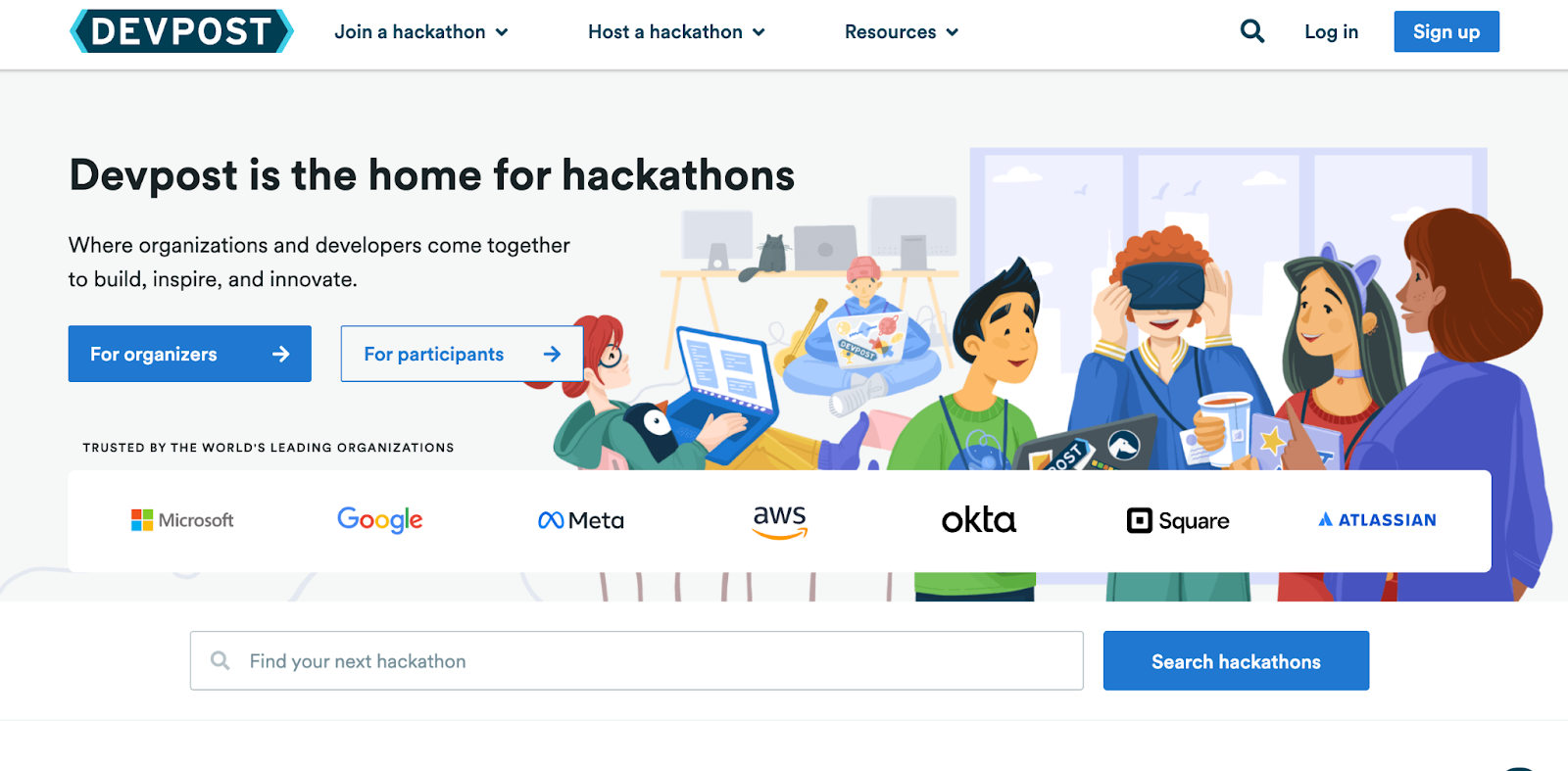
2. Devpost

Devpost provides organizations with a platform where developers can participate in hackathons, build real projects, and showcase their skills to recruiters. You can host branded coding events, engage global developer communities, and create high-visibility experiences that highlight your company culture and technical challenges.

The platform lets organizers review submissions, assess project outcomes, and invite top performers into hiring pipelines while maintaining seamless event management for large-scale online competitions. 

Key features

  • Host branded hackathons and coding challenges to attract developers
  • Review participant submissions and portfolios to assess project skills
  • Integrate participant data and results with ATS or CRM systems

Pros

  • Reach developers who demonstrate skills through live, public hackathon challenges
  • Strengthen employer branding through community engagement and project visibility
  • Get access to over 4 million developers, offering instant, built-in marketing

Cons

  • Requires participants to engage in timed events, which may reduce candidate availability
  • Relies on developers’ willingness to submit projects publicly for evaluation

Pricing

  • Custom pricing

Best for: Large-scale online hackathons, global developer challenges, and organizations seeking maximum visibility and participant reach.

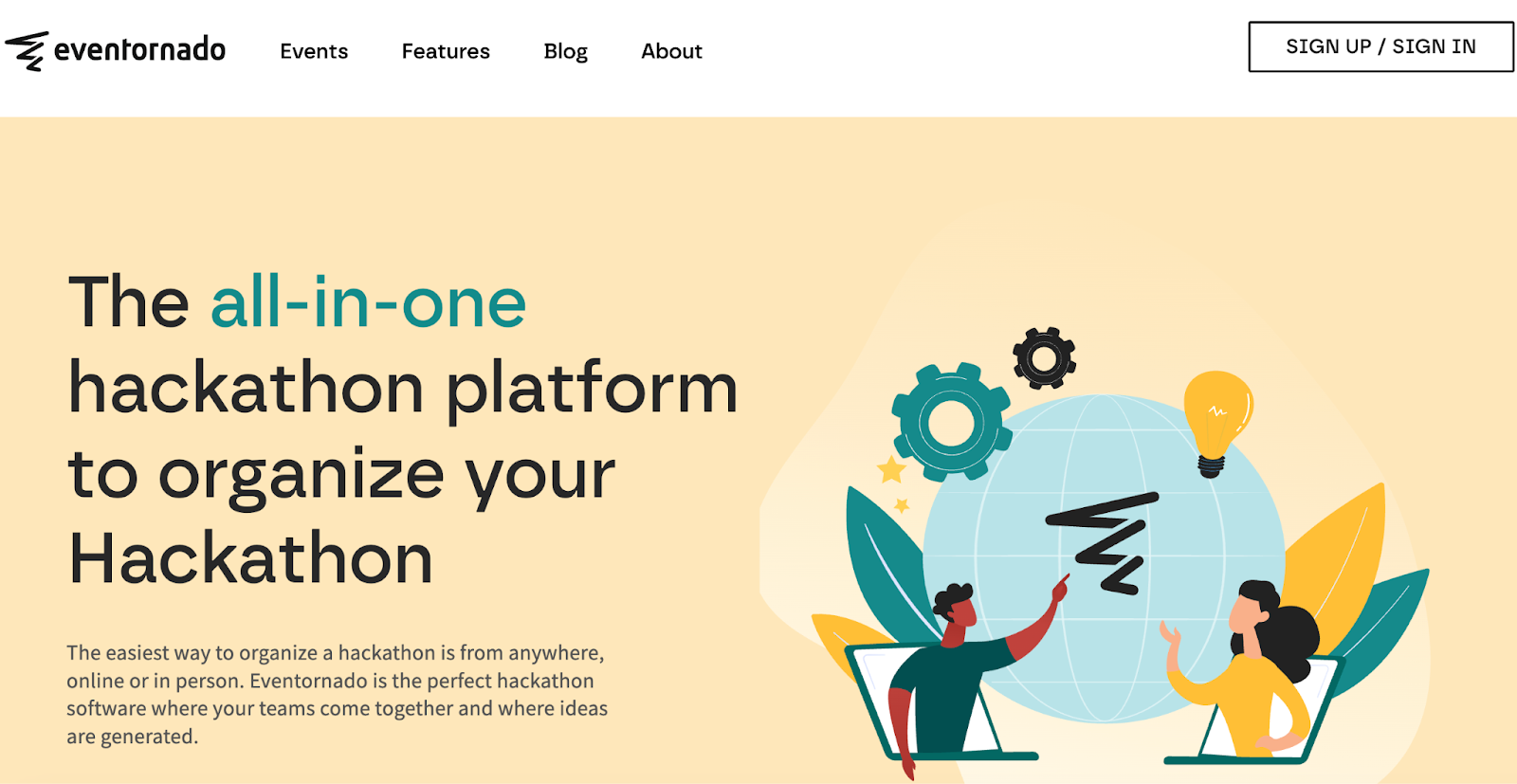
3. Eventornado

Eventornado gives organizations a platform built specifically for running hackathons, where every stage, from registration to results, happens in one place. You can create custom event pages, collect ideas and applications, let participants form teams, support collaboration with built-in chat, and run judging workflows with clear audit trails. 

The platform works in a browser, so no installation is needed. Plus, it scales from small internal hackathons to global hybrid events with thousands of participants.

Key features

  • Launch a customizable event landing page for hackathons
  • Collect registrations and detailed idea submissions
  • Help participants form or join teams based on skills

Pros

  • Enable real-time chat for collaboration and mentor feedback
  • Run judging and score submissions with audit trails
  • Publish hackathon results and analytics to stakeholders

Cons

  • Advanced customization and integrations are limited
  • Organizations looking for deep analytics or third-party tool integrations may find fewer built-in options than larger enterprise innovation platforms

Pricing

  • Custom pricing

Best for: Organizers wanting fast setup, modern UX, and purpose-built hackathon functionality for virtual/hybrid events.

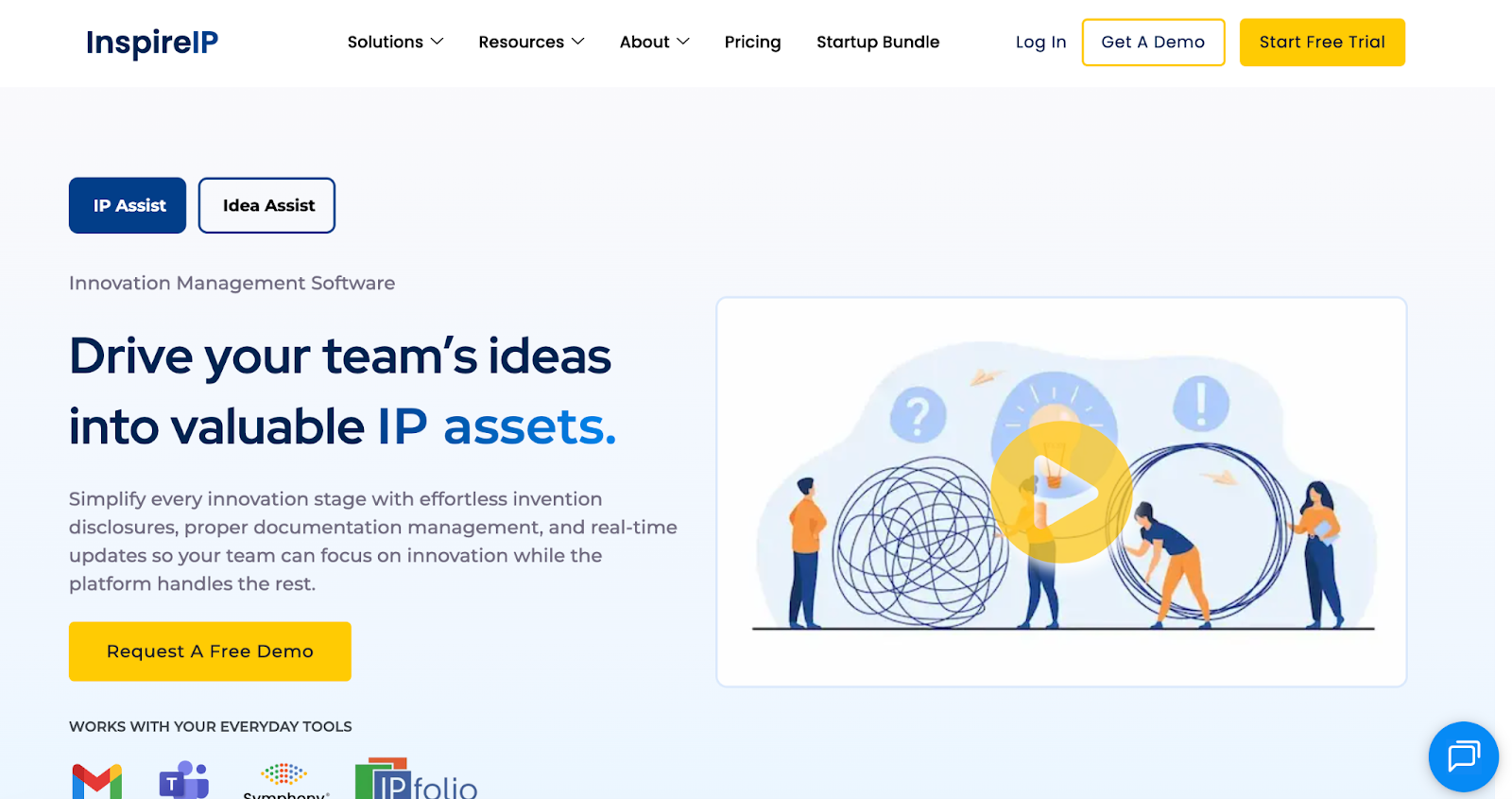
4. InspireIP

InspireIP helps hackathon teams carry ideas forward after the event ends. The platform moves each submission through clear stages, including validation, evaluation, prioritization, and follow-up development. 

Organizers customize workflows, judging criteria, and templates to align with hackathon goals. Participants collaborate through comments, updates, and shared workspaces without extra tools. Built-in analytics show engagement, idea quality, and progress, while enterprise integrations connect hackathon outcomes to real project execution.

Key features

  • Move hackathon submissions through validation, evaluation, and follow-up development
  • Customize workflows to match your hackathon phases and goals
  • Collaborate with participants through comments and shared workspaces

Pros

  • View engagement and idea progress with built-in analytics
  • Connect hackathon outcomes to real project execution via integrations
  • Real-time collaboration and smooth communication features

Cons

  • Heavier interfaces can interrupt idea flow during large hackathon campaigns
  • Advanced customization and admin controls can take time to learn

Pricing

  • Custom pricing

Best for: Organizations focused on post-hackathon innovation tracking and idea lifecycle management.

5. IdeaScale
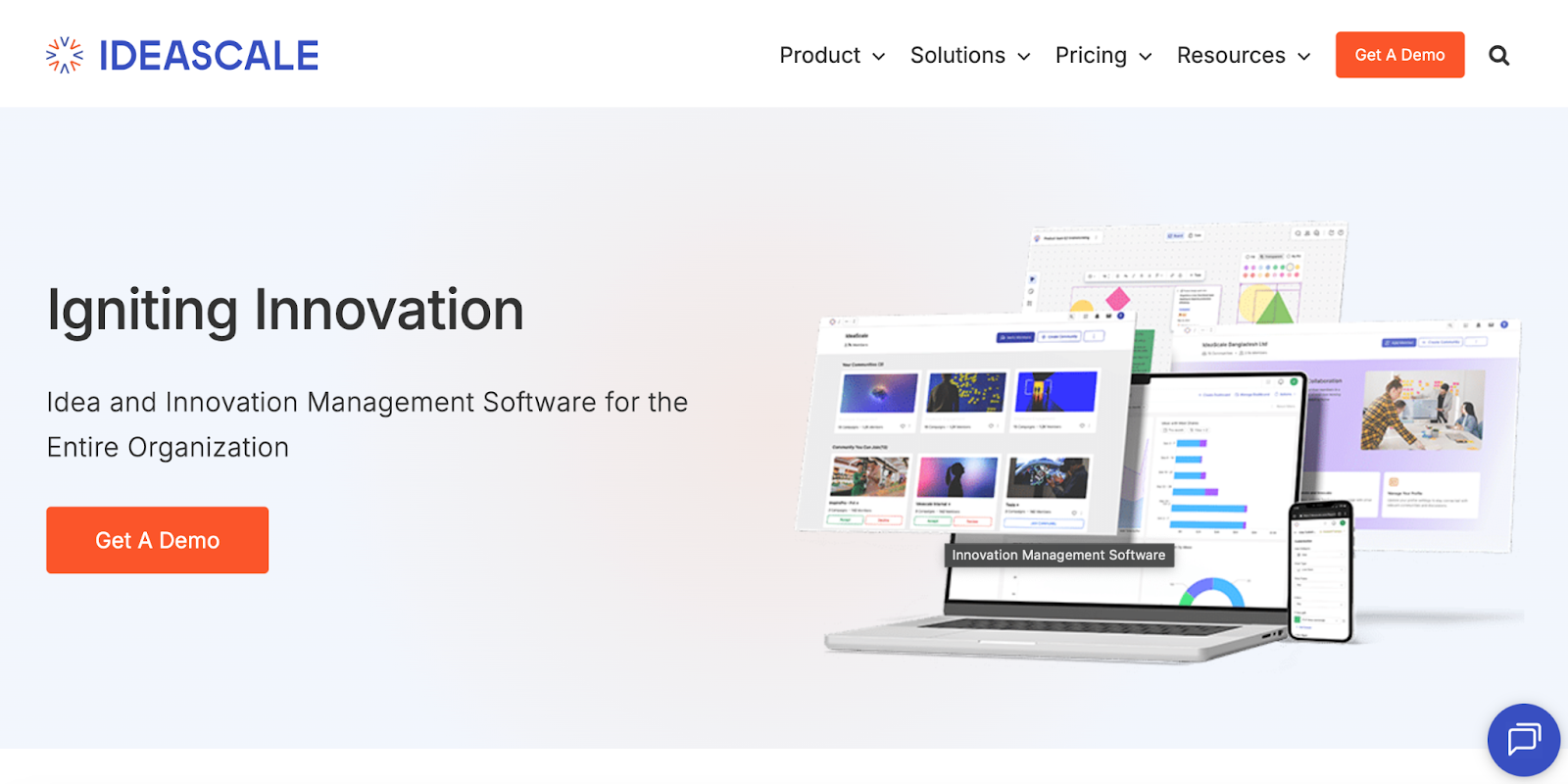
IdeaScale provides organizations with a platform to run hackathons that capture, evaluate, and implement ideas from participants through a central system. You can collect submissions, foster collaboration on concepts, and move promising projects toward execution while tracking engagement across teams and stakeholders. 

The platform supports real-time feedback, voting, and idea refinement, so hackathon organizers can prioritize contributions that matter most to their goals. You can also use customizable tools to build workflows that guide ideas from submission to measurable results.

Key features

  • Capture ideas and organize submissions from hackathon participants
  • Collaborate with teams to refine and strengthen proposed solutions
  • Use analytics to track participation, idea performance, and outcomes

Pros

  • Strong customer support and responsive service
  • Foster broad participation and get support for decision-making 
  • Manage portfolios from early ideas to implementation stages

Cons

  • The platform’s backend and administrative features are harder to learn
  • Advanced customization options and integrations with other business systems are limited

Pricing

  • Custom pricing

Best for: Enterprises, governments, and universities running continuous innovation programs with hackathons as one component.

6. Brightidea
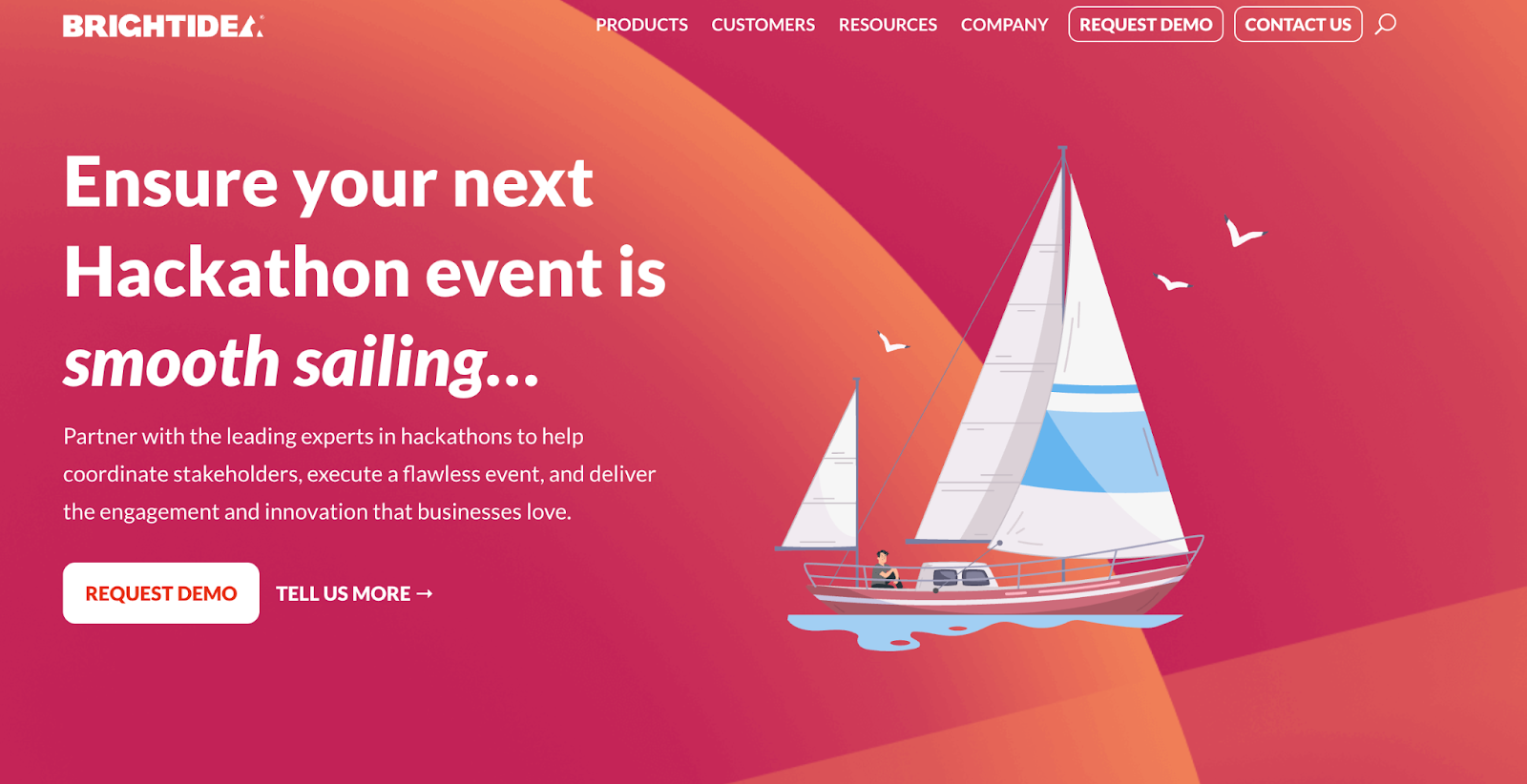
With Brightidea, you can customize support levels with expert consultants, coordinate stakeholders, and execute events that maximize engagement across internal teams and external participants. 

The platform centralizes project development, team formation, judging, and analytics to deliver measurable impact while maintaining security and compliance. Hackathons run smoothly with guided workflows, automated scheduling, and tools to help every participant contribute and collaborate effectively.

Key features

  • Automate event scheduling for streamlined hackathon management
  • Manage project development and collaboration in real-time
  • Guide participants through registration and team formation

Pros

  • Connect participants with teammates based on skills and interests
  • Evaluate submissions with mobile-friendly judging tools
  • Track engagement, participation, and ROI with analytics dashboards

Cons

  • Require some training for teams unfamiliar with full-featured platforms
  • Higher cost may limit access for smaller internal hackathons

Pricing

  • Custom pricing

Best for: Large enterprises with complex, multi-department innovation programs requiring governance and ROI tracking.

7. HYPE Innovation

HYPE Innovation provides organizations with a platform to manage hackathons where participants submit ideas, build teams, and collaborate on real problems, all in one system. You can run online or in-person hackathons with tools that help participants find teammates, comment on ideas, vote, and work with mentors throughout the event. 

Judges can score submissions using built-in evaluation tools, and organizers can monitor progress with campaign dashboards that show live metrics for engagement and activity. After the event, participants can return to view winning ideas and track their development within the same platform.

Key features

  • Capture and display idea submissions for all participants to explore
  • Help teams form before and during hackathon events with search tools
  • Encourage interaction among participants, mentors, and project teams

Pros

  • Score and select top ideas using flexible built-in evaluation tools
  • Monitor hackathon progress through a central campaign dashboard
  • Showcase winning ideas and follow progress after hackathons conclude

Cons

  • Some users report that configuration flexibility can be limited without help
  • Performance issues, such as slow loading or clarity problems in the backend, can occur for complex projects

Pricing

  • Custom pricing

Best for: Global enterprises and R&D-heavy companies needing strategy-driven innovation programs with consulting support.

8. InnovationCast
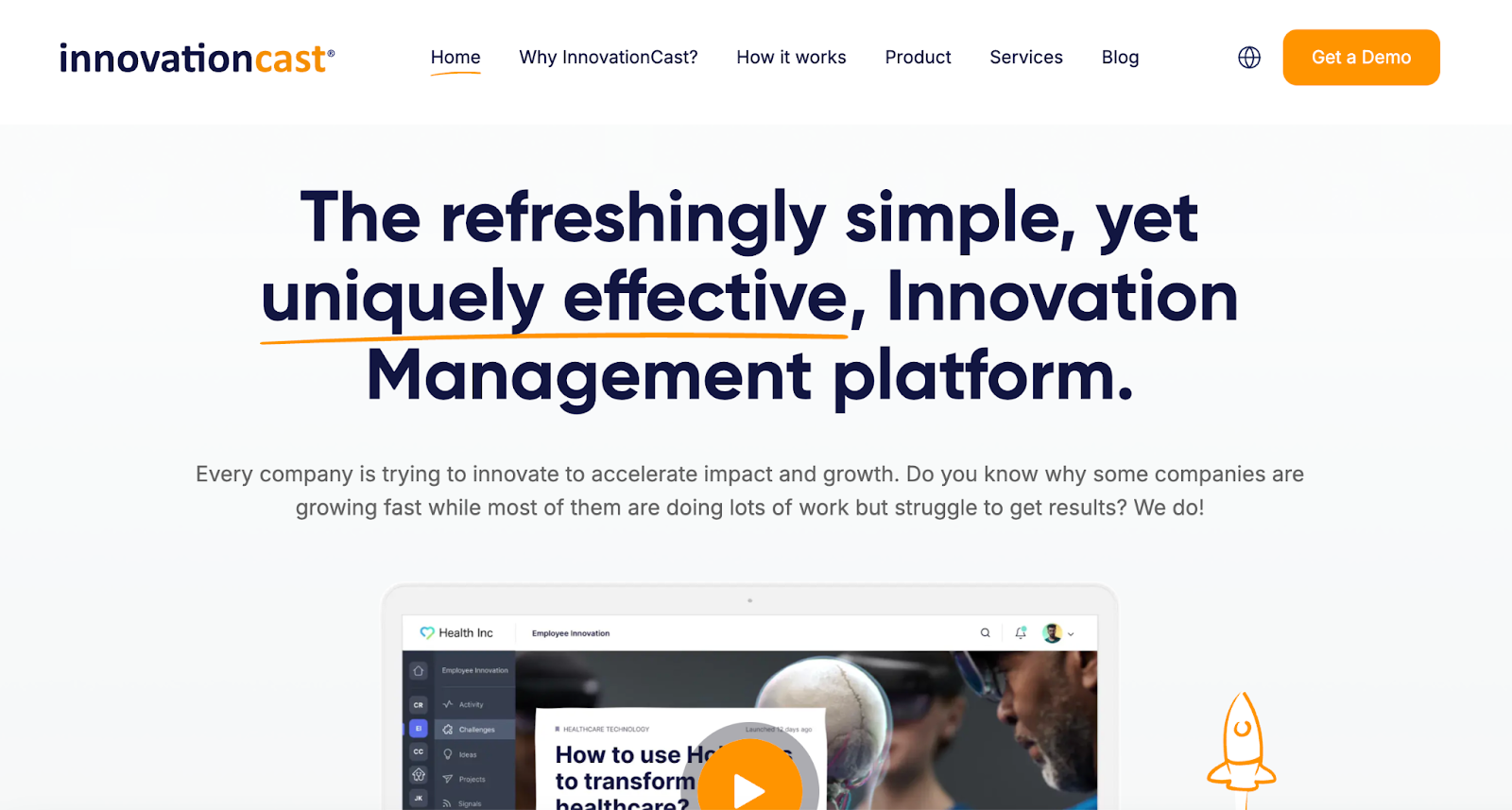
InnovationCast helps organizations run hackathons that capture ideas, solve real problems, and engage teams globally with collaborative campaigns. You can launch time-bound innovation challenges in minutes, manage submissions, and encourage teams to co-create solutions across departments. 

The platform continuously collects ideas, surfaces opportunities that may not otherwise appear, and tracks all contributions so that every vote, comment, and edit builds measurable insight. You can run internal and external competitions, recognize contributors, and manage the full idea lifecycle to drive meaningful results.

Key features

  • Capture challenge-driven ideas for strategic opportunities
  • Collaborate across teams with multiple participation options
  • Co-create solutions in a shared idea environment

Pros

  • Distribute idea management across teams and categories
  • Organize portfolios with custom processes for each type
  • Use feedback-based voting to improve idea quality

Cons

  • Limited advanced hackathon or automation features
  • Basic analytics and reporting compared with other platforms 

Pricing

  • Custom pricing

Best for: Organizations seeking collaborative, end-to-end innovation management to support hackathons and beyond.

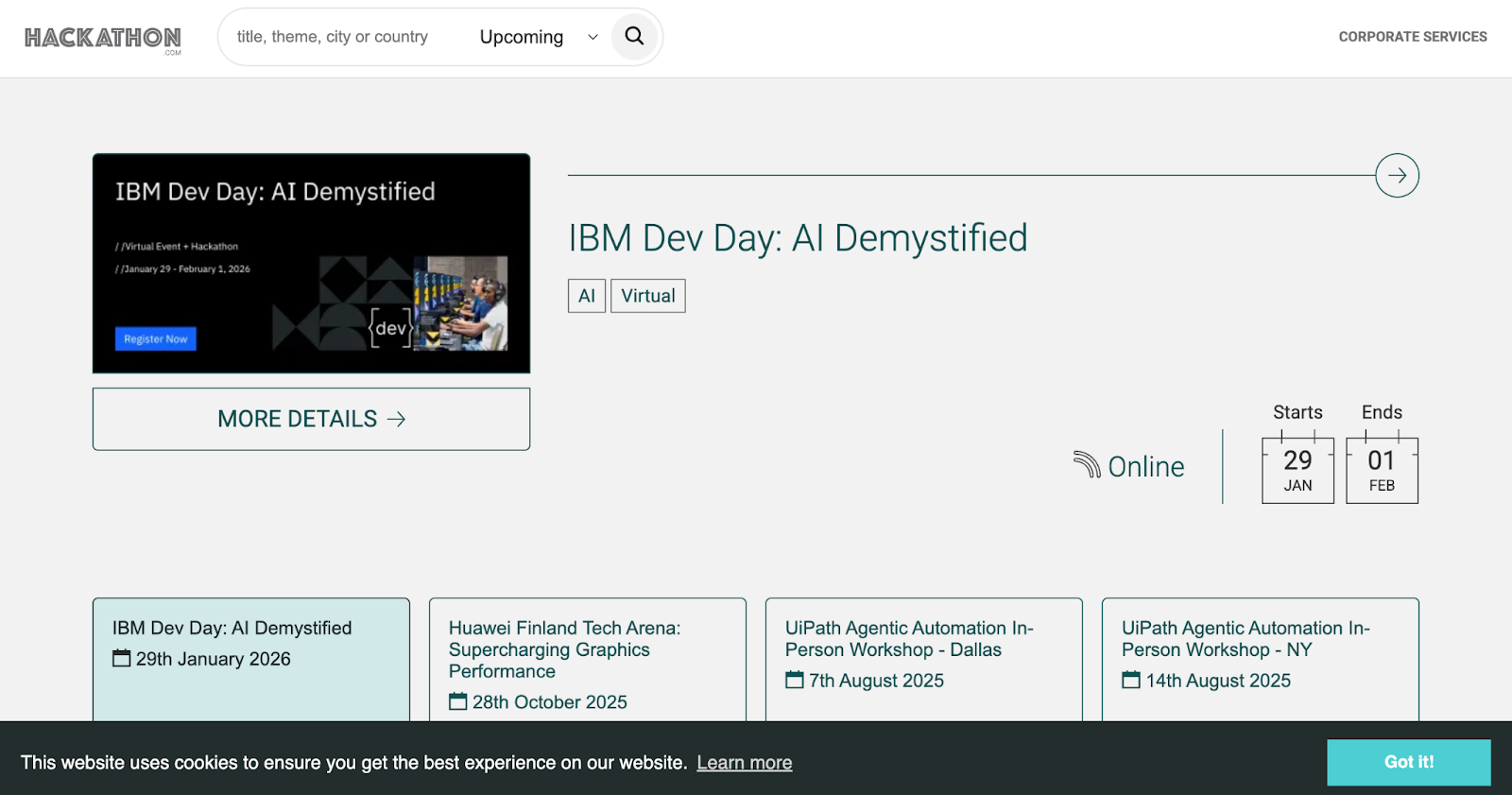
9. Hackathon.com

Hackathon.com gives organizations access to the largest global community of hackathon participants who build real projects and share them with organizers worldwide. You can list your event for free or use the platform’s hackathon management tools to organize challenges, manage teams, and collect submissions from a wide network of developers, designers, entrepreneurs, and other innovators. 

The platform supports online, hybrid, and in-person hackathons and helps you boost event visibility, attract relevant participants, and tap into a community spanning 10+ million innovators across 40 countries.

Key features

  • Connect with a global database of developers and innovators
  • Host free or managed hackathon listings to reach broad audiences
  • Support team formation and real-time collaboration tools

Pros

  • Get access to a very large global community of 10 million innovators willing to join hackathons and collaborate on projects
  • List events for free or use its tools to manage hackathons with customizable pages, communication tools, and live engagement features
  • Use analytics to monitor engagement and project success metrics

Cons

  • Limited built‑in judging and submission management tools
  • The platform lacks the same level of backend tools that more specialized enterprise hackathon solutions provide

Pricing

  • Custom pricing

Best for: Smaller events, beginner organizers, community-driven hackathons, and non-profits.

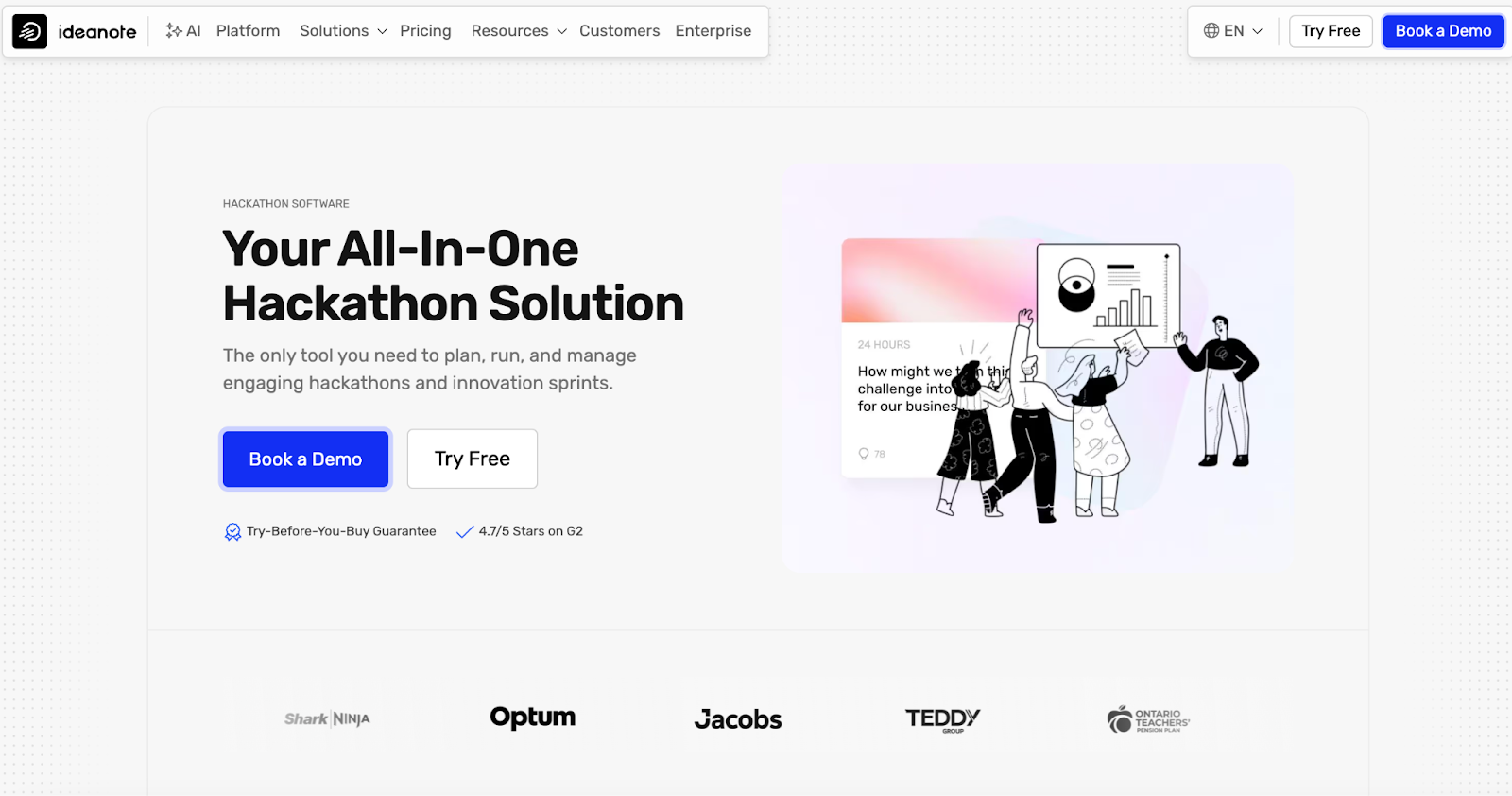
10. Ideanote

Ideanote gives hackathon organizers one place to plan, run, and manage idea-driven events without switching between tools. You can capture ideas in real time, guide teams through refinement, and move promising concepts toward implementation after the event ends. 

The platform keeps collaboration active by letting participants co-own ideas, share feedback, and track progress across phases.

Key features

  • Collect ideas from participants during hackathons
  • Let participants comment and vote on each other’s ideas
  • Show idea progress from initial draft to refined submission

Pros

  • Provide tools for group feedback and refined evaluations
  • Support templates that match specific hackathon challenge goals
  • Provide responsive customer support 

Cons

  • Occasional feature gaps compared with broader innovation suites
  • Onboarding may take time for new users 

Pricing

  • Free
  • Scale Plan: $7/month per user
  • Ultimate Plan: Custom pricing

Best for: SMBs and digital-first organizations that prioritize continuous ideation through lightweight hackathons.

11. Agorize
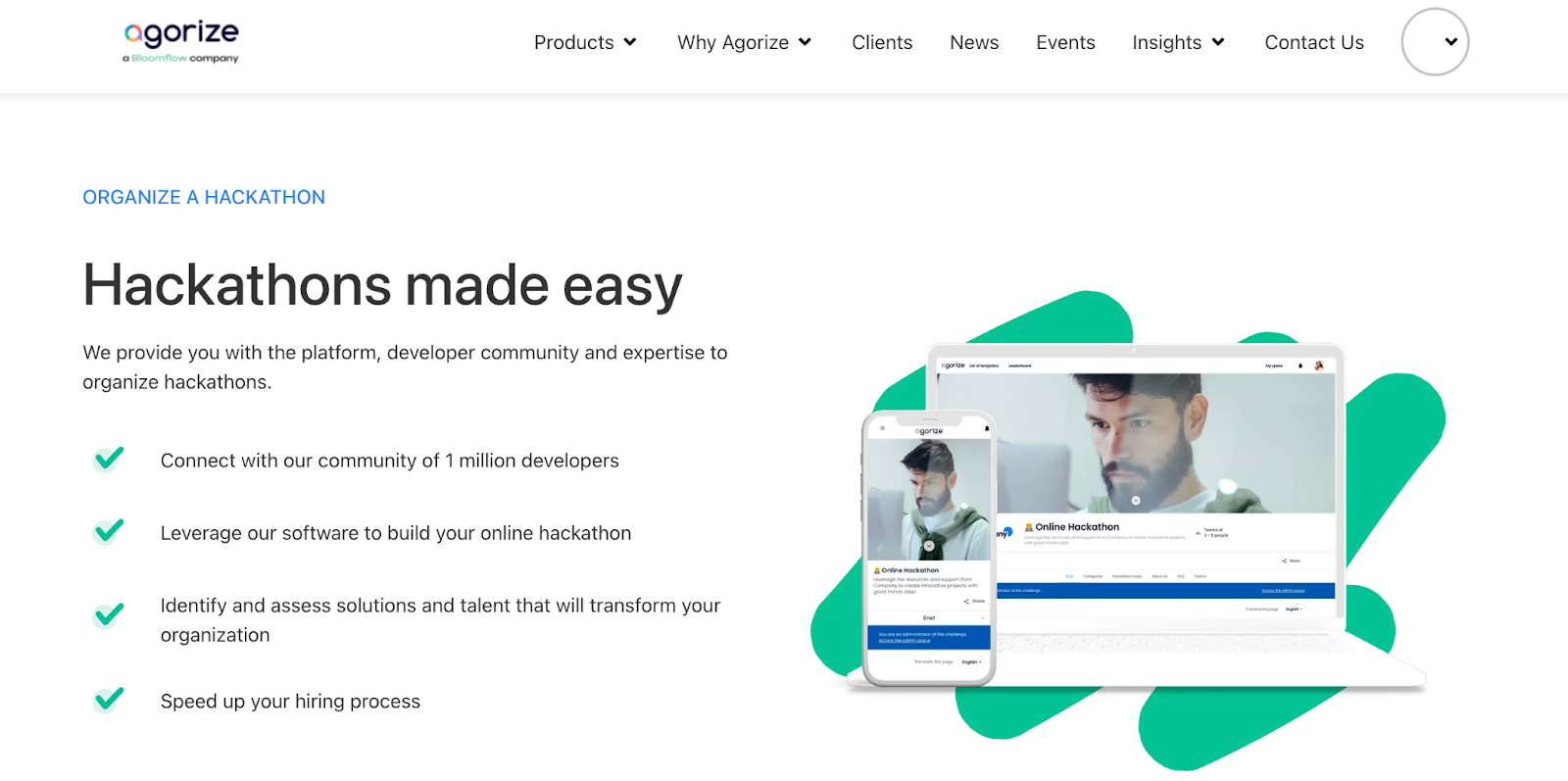
Agorize gives organizations a platform to host hackathons with built-in tools to create challenge forms, assign mentors, and evaluate participant solutions all in one place. You can attract developers with profiles and skills that go beyond traditional resumes. 

The platform also helps participants develop solutions through webinars, chat, and mentor support throughout the event. You can also monitor hackathon KPIs on real-time dashboards, export results with a single click, and manage roles for multiple stakeholders, so teams and organizers remain coordinated from start to finish.

Key features

  • Create hackathon challenges with customizable application forms
  • Assign mentors and engage participants through chat and webinars
  • Evaluate participant solutions centrally with grading, commenting, and likes

Pros

  • Attract tech profiles beyond traditional corporate recruitment pipelines
  • Monitor hackathon completion with real-time KPI dashboards
  • Export performance data for reporting and post-event analysis

Cons

  • Customization options for event layouts and advanced features can be limited
  • The back-end interface can be confusing and less responsive on certain screen size

Pricing

  • Custom pricing

Best for: Open innovation challenges targeting external developer communities and startup engagement.

How to Choose the Right Hackathon Platform

Choosing the right hackathon platform starts with understanding your goals, audience, and event needs. Here’s how to approach it:

  • Clarify your primary goal: Start by narrowing it down. If you want to focus on talent acquisition, HackerEarth and Devpost give you access to developer communities and recruitment pipelines. For internal innovation, consider HackerEarth, Brightidea, or HYPE to engage employees and manage idea development. If your goal is community engagement, Devpost and Hackathon.com help connect with external innovators and build visibility.
  • Map your event flow: Match platform capabilities to each stage of your hackathon. Look for tools that handle registration, team formation, idea submission, judging, and post-event follow-up so nothing slows down participation.
  • Consider your audience:  Internal teams benefit from HackerEarth or Brightidea, while external developers can thrive on Devpost or HackerEarth. If your hackathon targets both audiences, HackerEarth offers flexibility to accommodate participants of different types.
  • Evaluate scalability needs: Think about scalability. Small internal hackathons with 50 to 200 participants run smoothly on Eventornado or Ideanote. Medium-sized events with 200 to 2,000 participants are supported by most platforms. Large global events with 2,000 or more participants are best handled by HackerEarth or Devpost.
  • Assess post-hackathon requirements: For one-off events, Devpost or Eventornado work well. For continuous innovation and idea development, InspireIP, IdeaScale, or Brightidea help sustain momentum long after the event ends.
  • Review integration requirements: Always request demos and, if possible, run pilot hackathons before committing to a platform so you can evaluate usability, engagement, and reporting firsthand.

Run Your Next Hackathon with HackerEarth

Hackathon software is now essential for driving repeatable, measurable innovation in enterprises. Whether your focus is talent acquisition, internal ideation, or global developer engagement, there’s a platform tailored to your needs.

HackerEarth remains the top choice for organizations seeking a comprehensive solution that combines innovation, execution, and talent discovery. It supports large‑scale internal and external hackathons while offering integrated evaluation, dedicated process support, and access to a broad global developer community. Companies use it to crowdsource solutions to real challenges, connect with skilled technologists, and accelerate innovation with data‑driven workflows and structured execution. 

Join thousands of companies that trust hackathon platforms to advance innovation and uncover top talent. Request your free demo with HackerEarth today!

FAQs

What is hackathon software, and why do organizations need it?

Hackathon software helps organizations plan, run, and manage them by handling registration, idea submission, team collaboration, judging, and communication. Teams use it to stay organized, manage scale, and keep participants engaged throughout the event.

What’s the difference between hackathon software and hackathon platforms?

Hackathon software usually focuses on event logistics and execution, while hackathon platforms often add communities, talent networks, project visibility, and post-event follow-up. Platforms support both event delivery and longer-term outcomes.

What features should teams prioritize when selecting hackathon tools?

Teams should prioritize easy idea submission, team collaboration, judging workflows, progress tracking, and reporting. Tools should also support different challenge formats and scale smoothly as participation grows across teams, regions, or departments.

Can hackathon platforms support virtual and hybrid events?

Yes, many hackathon platforms, including HackerEarth, support virtual and hybrid events by offering remote collaboration, online submissions, mentor access, and digital judging. These tools let participants join from different locations while keeping the event structured and interactive.

How do hackathon platforms help with talent acquisition?

Hackathon platforms such as HackerEarth help recruiters spot talent by showing real project work, team collaboration, and problem-solving skills. Companies use results to identify strong performers, review portfolios, and invite participants into hiring pipelines.

Subscribe to The HackerEarth Blog

Get expert tips, hacks, and how-tos from the world of tech recruiting to stay on top of your hiring!

Author
Vikas Aditya
Calendar Icon
January 27, 2026
Timer Icon
3 min read
Share

Hire top tech talent with our recruitment platform

Access Free Demo
Related reads

Discover more articles

Gain insights to optimize your developer recruitment process.

HR Hiring Tools: The Essential Tech Stack for Modern Recruitment Teams

Are your HR systems actually helping your team move faster, or quietly slowing everything down behind the scenes? If your tech feels more like a burden than a boost, you’re far from alone. 

In fact, only 35% of HR leaders say their current approach is truly benefiting the business. This means the majority are dealing with tools that promise efficiency but deliver complexity instead. And the consequences are expensive, frustrating, and hard to ignore. 

Here’s what’s really happening within HR teams today:

Your HR tech stack doesn't have to be fragmented or underutilized. Simplify your systems and bring your processes together with solutions that actually fit how your team works.

In this article, we’ll break down exactly what these HR hiring tools are, why modern teams depend on them, and how you can choose the right ones.

What are HR Hiring Tools and Why Do You Need Them?

HR hiring tools are software products designed to support teams in finding, attracting, selecting, and hiring talent. These tools replace manual spreadsheets and repetitive admin work with structured workflows. They pull data from multiple sources, automate repetitive tasks, and give hiring teams insights they couldn’t see before.

Some tools help broadcast job postings widely. Others score candidate skills, schedule interviews painlessly, or help teams make decisions using analytics. When your recruiting team uses hiring tools for HR, they gain speed without losing control.

The benefits of using HR hiring tools

In 2025, nearly 7 in 10 employers reported difficulty filling full‑time roles. Top AI-powered hiring tools for HR help teams overcome these challenges through structured, predictable workflows.

Here’s what the best employee hiring HR tools help you accomplish:

  • Eliminate repetitive manual work for recruiters: From interview scheduling to follow-ups and candidate communication, automation handles administrative tasks that previously took hours. 
  • Reduce time-to-hire: AI-powered hiring tools automate the most time-consuming stages of recruitment, from resume screening to interview scheduling, significantly cutting hiring timelines. What once took weeks now happens in minutes, helping teams move faster in competitive talent markets without sacrificing quality.
  • Screen and shortlist candidates at scale: Instead of manually reviewing hundreds of resumes, AI tools instantly parse, rank, and shortlist candidates based on role-specific criteria. 
  • Improve quality of hire with data-driven matching: Modern hiring tools use skills-based and contextual analysis to match candidates more precisely to roles. For example, over 36% of organizations say using AI in recruiting helps reduce hiring and interviewing costs, and 24% report it improves their ability to identify top candidates.
  • Deliver a consistent and engaging candidate experience: AI chatbots and automated workflows ensure candidates receive timely responses, status updates, and interview coordination, 24/7. This reduces drop-offs, improves engagement, and creates a more professional, structured hiring journey.
  • Reduce bias and improve hiring fairness: When implemented correctly, AI hiring tools standardize evaluation criteria and minimize unconscious bias in early-stage screening. 
  • Lower cost per hire and improved efficiency: Automation reduces dependency on manual effort, external agencies, and prolonged hiring cycles, bringing down cost per hire by up to 30%. At scale, this translates into significant operational savings for HR teams.

Top HR Hiring Tools Every Recruitment Team Needs

Your technology setup shapes every outcome that matters for your agency. According to Deloitte, 56% of organizations see AI as a way to improve productivity and efficiency in talent acquisition, highlighting how critical the right tech has become.

A strong tech stack gives you the foundation for data-driven decisions by helping you track the full candidate journey from first contact to successful placement, so you can clearly see what is working and where you are losing momentum.

Here are some of the top HR hiring tools every recruitment team needs:

1. Candidate sourcing and job posting tools

These tools help you find and attract talent from multiple channels. And yes, HackerEarth is definitely one of the platforms that belongs on this list, especially if you are serious about reaching high-quality technical talent where they already are.

HackerEarth

HackerEarth's homepage
Assess technical and soft skills

HackerEarth is an enterprise-grade platform built to help tech recruiters source, assess, and interview technical talent with both precision and scale. It goes beyond simple sourcing, bringing everything into one place so you can move from finding candidates to evaluating them and running interviews without switching tools. This makes a real difference for teams that are hiring fast but still care deeply about quality.

The platform comes with a library of over 40,000 questions across 1,000+ technical skills and more than 40 programming languages. You can assess candidates across roles like software engineering, full-stack development, data science, and machine learning. It also connects with ATS systems, so once you find the right candidates, you can move them forward without extra manual work.

HackerEarth also puts a strong focus on fair and secure assessments. It uses AI-powered proctoring features such as smart browser monitoring, tab-switch detection, and audio and video checks to reduce the risk of cheating. The AI Interview Agent takes the process a step further. It runs structured interviews using clear rubrics, adjusts questions based on candidate responses, and keeps the experience consistent for everyone. It also hides personal details so evaluations stay focused on skills, helping reduce bias naturally.

LinkedIn Recruiter

LinkedIn Recruiter homepage for sourcing candidates
LinkedIn Recruiter helps businesses find and hire top talent fast

LinkedIn Recruiter remains one of the most widely used sourcing platforms due to its massive candidate database. Recruiters can search through millions of active and passive professionals, apply advanced filters, and reach out directly using InMail. 

Many teams start with LinkedIn Recruiter as their first sourcing tool, though it is not as specialized for technical roles.

ZipRecruiter

Connect people to their next great opportunity
Make the right hire with ZipRecruiter

ZipRecruiter is a popular job board and recruiting platform that distributes your job openings to more than 100 partner job sites once you post them. Recruiters can use customizable job posting templates and then let their AI‑driven matching technology scan thousands of resumes and invite candidates who fit the role to apply right away. 

The platform includes features like TrafficBoost for urgent or hard‑to‑fill roles, and higher‑tier plans integrate with your existing ATS so candidate status stays up to date across systems. It also gives you access to hundreds of job templates if you want help writing good job descriptions quickly.

2. Applicant tracking systems (ATS)

Looking to keep track of your job applicants and stay on top of every step in the hiring process? An ATS can do that and a lot more. It helps recruiters organize applications, filter candidates, and review records so every decision feels clear and manageable.

These tools can help you with all of that:

Greenhouse

Save more and hire with confidence with Greenhouse
Save time, cut costs, and hire top talent confidently with Greenhouse

Greenhouse is a powerful ATS that works well for teams spread across countries and time zones. Recruiters use it to create structured interview plans and schedule interviews automatically, keeping everything aligned no matter where candidates or interviewers are located. 

Its integration with onboarding platforms allows candidate profiles to sync securely, reducing repetitive work while keeping information accurate and up to date.

Lever

Lever recruitment platform homepage showcasing AI-powered tools
Lever's AI-powered platform streamlines sourcing, tracking, and relationship building

Lever is an ATS and CRM tool designed for remote hiring teams that want to track, engage, and move candidates forward, no matter where they are. It helps with automated sourcing, structured interviews, and the management of candidate relationships, so teams can connect with talent more effectively.

The platform gives you a searchable talent database, AI-powered recommendations, and real-time analytics to help you make informed hiring decisions across distributed teams. It also supports remote and video interviews, so hiring teams can evaluate candidates without bringing them on site.

3. Candidate screening and assessment tools

Screening and assessment tools help you see what candidates can actually do before you bring them into interviews. 

These tools give recruiters clear insights into skills and problem-solving so the hiring process feels smarter and more focused.

Codility 

Codility platform homepage showcasing developer assessments
Revolutionize your recruitment process with Codility

Codility lets you evaluate developers with real engineering challenges that show how they debug, build, and improve code. Its task library includes algorithms, bug fixing, and domain-specific problems so you can get a full picture of a candidate’s technical ability. 

The platform runs in a secure browser-based IDE and provides detailed analytics on correctness, performance, and code quality. Additionally, automatic scoring saves time and helps recruiters maintain a high level of assessment rigor.

HackerRank

HackerRank technical assessment landing page
HackerRank certified assessments validate candidate coding skills 

HackerRank offers a library of more than 1,000 curated coding challenges across multiple difficulty levels, covering algorithms, data structures, SQL, and AI-related tasks. The platform provides automated scoring, detailed candidate performance reports, and AI-driven shortlisting to quickly highlight top performers. 

Live coding interviews can be conducted through CodePair’s collaborative IDE, and advanced proctoring monitors browser activity and flags suspicious behavior. It also integrates with major ATS systems, which helps streamline high-volume technical hiring.

TestGorilla

TestGorilla tech hiring homepage featuring AI assessments
Get hundreds of validated tests, AI scoring, and a global talent pool

Similarly, TestGorilla has a broad library of over 400 pre-validated tests covering technical, cognitive, and behavioral skills. You can combine up to five tests per assessment and add custom question types such as video, essay, multiple-choice, or file uploads. 

Its AI scoring accelerates evaluation, while anti-cheating measures such as webcam snapshots, full-screen monitoring, and audio recording keep tests fair. These features make it easier to filter candidates early and focus live interviews on those who truly fit the role.

4. AI-powered recruitment tools

These tools help hiring teams with data and insights while keeping the process fair, fast, and human. 

Each of the platforms below brings a different strength, from intelligent interviews to soft skills assessments and global talent matching.

HireVue

HireVue technical hiring platform featuring skills-first assessments
Streamline tech recruiting with AI

HireVue brings AI into conversations in ways that feel natural and human. Its AI Interviewer uses voice and data to help highlight candidates who can actually do the work you are hiring for. Recruiters often report big improvements in efficiency, such as around 60% less time spent screening and around 90% faster time to hire, and some teams see significant savings in cost per interview and annual hiring costs.

The platform’s agents support skills‑based hiring at scale for every role. Candidates also get a more respectful experience because the technology engages with them in a way that feels personal and adaptive rather than robotic.

Pymetrics

Log in to Pymetrics with username or email
Access your Pymetrics account 

Pymetrics uses neuroscience‑based, gamified assessments to measure factors such as risk tolerance, attention, and decision‑making. The results feed into AI‑powered matching that lines up candidate strengths with job profiles. 

Recruiters appreciate it because it helps broaden the range of talent they consider and brings forward people who may not show their potential on a resume alone.

Eightfold.ai

Explore Eightfold.ai’s AI talent platform shaping the future of work
Discover how Eightfold.ai pairs people’s potential with agentic AI

Calling itself a Talent Intelligence Platform, Eightfold AI uses a “Talent Intelligence Graph” to look across billions of career data points to match people to roles. You can use it to find external candidates and assess internal talent for reskilling and growth opportunities. 

Many companies use Eightfold’s platform for long‑term workforce planning and technical hiring because it can reveal patterns and potential that go beyond simple keyword matching.

5. Interviewing and assessment platforms

These tools let you move past resumes and see how candidates actually perform in real work scenarios. 

FaceCode (HackerEarth)

Run structured, collaborative interviews with FaceCode
Collaborate inside a shared code editor and connect via HD video

As part of the HackerEarth ecosystem, the FaceCode module lets you run structured coding sessions with real-time collaboration, notes, and auto-generated summaries. Diagram boards make system design discussions visual and easier for everyone to follow, and the platform supports panel interviews with up to five interviewers so teams can discuss both technical depth and teamwork without switching between tools.

FaceCode also records sessions and generates transcripts, which allows teams to revisit specific moments and compare candidates with a richer context. The ability to mask personal information adds a level of fairness that supports more inclusive hiring.

On the other hand, it fits into your existing workflows with integrations for tools like Greenhouse, Lever, Workday, and SAP, and it meets compliance standards such as GDPR and ISO 27001. HackerEarth also connects you to a global developer community of over 10 million, letting you use hackathons and hiring challenges to build a pipeline of engaged talent and reduce the time and cost of hiring.

Codility Live

Support standardized and free-flowing workflows with Codility Live
Expedite your hiring process with Codility Live

Codility Live gives you a space for seamless technical interviews that bring candidates and interviewers together in one session. The environment combines video chat, an IDE, pair programming, and whiteboard tools, enabling candidates to show their skills naturally.

Interviewers get features that support a smooth process while still letting them dig into logic, communication, problem-solving, and system design. It also comes with auto‑generated feedback reports that help hiring teams share thoughts quickly and stay aligned. You can even turn on AI support to observe how candidates work with generative tools in real time. 

6. Onboarding tools

Is getting new hires set up feeling messy and overwhelming? Onboarding tools simplify forms, compliance, and introductions so everything flows smoothly for HR and employees.

WorkBright

Onboard candidates in a quick, compliant, and 100% remote process
Streamline employee onboarding processes for businesses

WorkBright helps HR teams handle I‑9 verification and automated E‑Verify to get new employees started easily. The platform keeps all compliance documents in one place, which helps reduce manual work and keeps records audit‑ready.

Recruiters and HR pros can access a wide library of federal and state forms that update as regulations change. This means your team spends less time searching for the right paperwork and more time helping new hires feel welcome. WorkBright also includes guided error correction that fixes issues before forms are submitted and fraud detection that flags suspicious documents early.

BambooHR

BambooHR platform homepage offering comprehensive HR tools
BambooHR provides an all-in-one solution for HR management

BambooHR brings onboarding into an all‑in‑one HR experience that includes recruiting, employee records, and administration. It’s especially popular with small and mid‑sized teams because it keeps applicant tracking and onboarding under a single platform you can learn quickly. 

The interface is clean and easy to navigate, so HR teams and new hires feel confident moving through each step.

How AI-Powered HR Hiring Tools are Changing Recruitment

According to a BCG survey of chief human resources officers in 2024:

  • If a company is experimenting with AI or GenAI, 70% of them are doing so within HR.
  • Within HR, the top use case for AI or GenAI is talent acquisition.

Most organizations already see the impact. For example, nearly 92% say they are getting real benefits from using AI in HR, and more than 10% report productivity improvements of 30% or more. It reflects real hours saved and real pressure lifted off teams that used to spend days sorting resumes and coordinating interviews. 

Julie Bedard, a managing director and partner at BCG who specializes in talent strategies, points out that AI frees recruiters to spend more time building relationships and expanding talent pools. She also emphasizes the risk of a negative candidate experience if companies neglect the human side of hiring.

This balance between efficiency and experience sets the stage for how AI is reshaping the actual steps in recruitment. 

Automating candidate screening

AI can quickly scan resumes and applications, highlighting the most relevant candidates. It identifies patterns and skills that match the job, helping recruiters focus on applicants with the strongest potential. 

If you’re wondering if it replaces human judgment, it doesn’t. Instead, it removes the burden of manual filtering and gives hiring teams a head start. As a result, recruiters can spend more time connecting with people rather than sorting documents.

AI for interviewing

Similarly, AI-driven platforms can schedule interviews, suggest questions tailored to candidates, and even analyze responses for consistency and key skills. This creates an improved experience for candidates and a clearer picture for recruiters. 

The technology helps uncover strengths and potential that may not appear on paper, while letting recruiters focus on meaningful conversations rather than logistics.

Predictive analytics for better hiring decisions

At a LinkedIn Talent Connect session late last year, one of the speakers said this about talent data and AI: 

“Real‑time signals can help you spot the next big skill before it’s trending on TikTok and build a shortlist faster than you can say Boolean search.” 

That comment came from professionals who work with LinkedIn’s own talent insights, and it reflects what recruiters are starting to see in their day‑to‑day work.

The idea here is simple but meaningful. Predictive analytics finds patterns in a constantly updating stream of talent data, helping hiring teams identify people with emerging skills and actual potential. Those insights give recruiters something concrete to work with early in the process, rather than sending dozens of generic messages.

How to Choose the Right HR Hiring Tool for Your Team

Picking a tool works best when it feels intentional rather than random. Start by asking a few questions to guide your decision.

Key considerations when selecting HR hiring tools

These aspects can help you focus on the features and qualities that really make a difference for your team.

  • Scalability: Look for a tool that grows with your company. If you are hiring hundreds of people each month, you need technology that keeps up without slowing your team down.
  • Customization: Different departments have different needs. A tool that adapts to each workflow makes it easier to manage multiple roles and teams at once.
  • Integration with existing HR tools: Your hiring platform should integrate with your HR systems, including payroll, calendar, and communication tools. Tools that work together reduce repetitive tasks and help your team stay organized.
  • Ease of use: Complex tools create friction. Recruiters adopt tools faster when they are intuitive and enjoyable to use.

Evaluate based on features and budget

Once you have a sense of your team’s needs, shortlist a few tools and test them with real recruiting scenarios. Look at speed, candidate experience, outcomes, and cost. 

When features align with your team’s goals, the platform becomes a long-term asset.

The Hiring Advantage Your Team Needs

Great hiring is not an accident. It happens when you equip your team with the right HR manager tools for hiring that address every stage of the candidate journey. These tools help you reach more candidates, assess them fairly, interview with insight, and onboard new hires smoothly.

For teams looking to combine efficiency, fairness, and meaningful hiring insights, HackerEarth sets itself apart. Here’s why it works so well:

  • Comprehensive assessment library: 40,000+ coding questions across 1,000+ technical skills and 40+ programming languages
  • Structured interviewing with FaceCode: Real-time collaboration, interviewer notes, auto-generated summaries, and masked candidate info for fair evaluations
  • AI-powered evaluation: Instant scoring, detailed skill-wise analytics, and proctoring features to prevent cheating
  • Seamless integration: Works with Greenhouse, Lever, Workday, SAP, and other ATS platforms
  • Scalable at enterprise level: Supports 100,000+ concurrent assessments with 24/7 support
  • Engaging candidate experience: Hackathons, challenges, and interactive assessments to attract and evaluate talent effectively

Take the next step and see how HackerEarth can transform your hiring process. Book a demo today!

FAQs

What are HR hiring tools, and why are they essential for recruitment?

HR hiring tools are software systems that help recruiters attract, evaluate, and hire talent. They speed up workflows, improve candidate experience, and reduce manual work, so teams can focus on meaningful interactions that lead to better hiring decisions.

How do AI‑powered HR hiring tools improve the recruitment process?

AI‑powered hiring tools remove repetitive screening tasks and quickly highlight qualified candidates. These tools give recruiters fair insights into skills and fit across large candidate pools, which shortens time to hire and improves hiring outcomes compared with traditional manual approaches.

What features should I look for in HR hiring tools?

Look for features that support sourcing, screening, interviewing, evaluation, and analytics. Additionally, prioritize tools that integrate with your existing systems, scale with demand, and provide clear dashboards for hiring progress and outcomes.

Can HR hiring tools integrate with my existing ATS?

Yes, many modern solutions, including HackerEarth, support integration with existing applicant tracking systems (ATS), such as Greenhouse, Lever, Workday, and SAP. When your sourcing, screening, and onboarding tools integrate with your ATS, data flows smoothly, and teams avoid duplicate work across systems.

How do I choose the best HR hiring tools for my company?

Start by evaluating the specific challenges your recruitment team faces. Identify the areas where your current process slows down or creates errors. Next, match those needs to the strengths of potential HR hiring tools. Test a few shortlisted options using real hiring scenarios to see how they perform in practice. Consider your budget, how easy the tool is to use, and whether it integrates with your existing HR systems. Finally, choose the tool that improves both hiring speed and the overall candidate experience.

HackerEarth vs TestGorilla: Which Assessment Platform Fits Your Hiring Needs?

Imagine you need to hire five developers and three business analysts in the next 30 days. You want tools that reveal true skills beyond what resumes show. 

Traditional interviews and resumes alone rarely expose real ability. Hence, companies use assessment platforms to filter and select top talent at scale. These tools help hiring teams reduce bias, speed up screening, and find the best candidates faster than ever before. HackerEarth and TestGorilla are two of the most popular online assessment platforms at the forefront of this shift. 

But which platform best fits your hiring needs? This deep comparison breaks down both so you can choose with confidence.

What are Assessment Platforms and Why They Matter

Assessment platforms are tools that help recruiters evaluate candidate skills and potential before making hiring decisions. They assess technical skills, cognitive ability, personality traits, and job‑specific capabilities. 

These insights let hiring teams understand how a candidate performs on tasks similar to real job challenges. 

Here are the main types of assessment platforms you’ll run into:

Tech assessment platforms

These tools focus on evaluating technical skills like programming, systems design, and engineering logic. They use real tasks and challenges to see how well a candidate performs in true‑to‑role scenarios.

Online assessment platforms

Online hiring assessment platforms provide a broad set of tests that companies can run remotely. Recruiters send candidates links and get scored results back quickly. They often cover multiple skill areas and integrate with other HR systems.

Code/Coding assessment platforms

Coding assessment platforms are a subset of tech tools built specifically for developers and engineers. They use problem sets, live coding environments, and benchmarking to test programming ability.

Virtual assessment platforms

These platforms move live evaluation into digital spaces. They might use video responses, AI analysis, or virtual interviews alongside traditional tests. They help hiring teams assess skills and fit without in‑person meetings.

📌Suggested read: Top Technical Skills Assessment Test Tools in 2026

Overview: HackerEarth vs TestGorilla

The use of virtual assessment platforms is growing rapidly. In fact, the global market for talent assessment platforms reached roughly $30 billion in 2026 and is projected to nearly double to $65.29 billion by the mid-2030s. More than 78% of large enterprises now include assessments in hiring and internal development processes. AI-driven scoring and analytics are becoming more common, helping teams review candidate performance quickly and consistently.

With this growth, many companies are turning to platforms that can combine assessments with practical recruiting tools. Let’s take a closer look at two of the most talked-about platforms: HackerEarth and TestGorilla.

What is HackerEarth?

Image Source

As one of the best TestGorilla alternatives, HackerEarth offers a mix of coding tests and interview tools. It combines coding assessments with virtual interviews through FaceCode, reporting dashboards, and structured analytics. The platform guides candidates from the first test to live interviews and final reviews. It also prioritizes simplicity for both recruiters and applicants.

Some of the main features include:

  • FaceCode interviews: Browser-based coding challenges with live audio and video interaction
  • ATS integration: Connects with applicant tracking systems (ATS) to help recruiters follow candidates easily
  • Analytics dashboards: Show structured insights on test results and interview outcomes
  • Customization: Create tailored assessments with over 40+ programming languages supported

The platform works well for small and mid-sized teams that want clear, organized pipelines from test invitations to completed interviews.

What is TestGorilla?

Image Source

TestGorilla is a pre-employment assessment platform that evaluates candidates using skill-based tests rather than relying on resumes alone. It helps companies reduce bias, improve candidate quality, and speed up the hiring process. The platform covers technical, cognitive, and soft skills.

Some of its key features include:

  • Broad test library: More than 350 assessments, including coding, numerical and verbal reasoning, leadership, and personality tests
  • Customization: Employers can add video responses, essays, and file upload questions
  • Anti-cheating measures: Tracks full-screen activity and takes webcam snapshots during tests
  • Evaluation metrics: Automatically ranks candidates based on their performance

It suits teams that want a wide range of assessment options and structured scoring for faster, fairer hiring decisions.

Deep Dive: HackerEarth Features for Technical Assessments

To help you decide which platform fits your hiring needs, we will explore HackerEarth’s key features in detail.

1. Live coding with FaceCode

HackerEarth offers Interview FaceCode, a live coding tool that allows recruiters to conduct real-time coding interviews. It provides a collaborative code editor where candidates can code while interviewers watch and interact. FaceCode includes HD video chat, a diagram board for system design, and a built-in question library. Teams can run live coding interviews with panels of up to 5 interviewers, which allows technical skills to be assessed thoroughly in a single session.

FaceCode also provides AI-powered interview summaries. After each session, the platform generates detailed reports covering technical performance and behavioral insights, including communication, problem-solving approach, and collaboration style. Interview recordings and transcripts are stored indefinitely, so teams can revisit them at any point in the hiring process. Recruiters can also hide candidate information to maintain unbiased evaluation.

Scheduling interviews is simple. All recruiters need to do is invite candidates with branded messages, creating a smooth and professional experience from the very beginning.

2. Rich tech assessment library

HackerEarth’s coding assessments feature a library of over 40,000 questions across more than 1,000 skills, including emerging AI skills. Recruiters can quickly create role-specific tests or upload a job description to automatically generate assessments. The platform supports project-type questions that simulate real on-the-job challenges. Leaderboards help identify top candidates instantly, and automated evaluation ensures objective results.

The platform also includes advanced proctoring with SmartBrowser technology. This prevents impersonation, tab switching, copy-pasting, and other forms of cheating. Recruiters can adjust proctoring levels depending on the assessment’s needs.

Additionally, developers can code in over 40 programming languages, use Jupyter Notebook integration, and access a real-time code editor. 

3. AI-assisted evaluation

On HackerEarth, AI assessments support test creation, automated evaluation, and the recommendation of role-specific questions. It also monitors assessments for bias, offensive language, or irregularities. AI generates insights on candidate performance and skill recommendations, helping hiring teams quickly identify top talent for roles such as AI engineers, ML engineers, or data scientists.

The platform also includes AI-driven scoring, automated evaluation for subjective questions, and deep reporting tools. This allows teams to make data-informed decisions without manual scoring.

4. Seamless workflow for hiring teams

The platform also integrates with popular ATS, including Greenhouse, LinkedIn Talent Hub, Lever, iCIMS, Workable, JazzHR, SmartRecruiters, Zoho Recruit, and Recruiterbox. These integrations allow recruiters to create assessments, invite candidates, and view results without leaving their existing tools.

For custom workflows, HackerEarth offers a Recruit API. Teams can manage assessments, invites, and results from internal systems. Webhook-style event flows let coding tests and live interviews become part of a company’s broader HRIS workflow.

Deep Dive: TestGorilla Capabilities

Now that we are familiar with HackerEarth’s features, let’s walk through what TestGorilla offers and how it supports hiring teams. TestGorilla provides a comprehensive code assessment platform that gives hiring teams a way to see candidates demonstrate their skills early in the process. 

Broad skill coverage

TestGorilla’s library of assessments includes more than 350 validated tests that cover cognitive skills, technical ability, language proficiency, personality traits, and cultural fit. These tests help evaluate candidates from multiple angles so hiring teams get a complete picture of each person’s strengths. The range includes problem-solving and numerical reasoning alongside job‑specific skills for roles in accounting, marketing, sales, customer support, and more. 

The platform also offers tests for technical and programming skills, including new assessments that target software fluency and the skills needed in an AI‑augmented workplace. Personality and culture tests help teams understand how a candidate might align with the company's values. Meanwhile, language tests check grammar, vocabulary, and comprehension in professional settings.

Custom test builder

TestGorilla lets hiring teams create custom assessments that match the exact needs of their roles. Recruiters can start with a job description and then choose tests from the library that match the skills they care about most. They can add custom questions in many formats, including video responses, essays, multiple choice, file uploads, and coding. 

The platform’s AI can also suggest relevant tests and questions based on the role’s requirements, so teams spend less time building assessments and more time reviewing results.

Easy to use for non‑tech roles

TestGorilla’s assessments are built for all kinds of roles, not just technical jobs. Teams hiring for operations, customer service, sales, or creative roles can pick tests that measure the specific skills needed for success. 

The system is browser‑based, so candidates can take assessments on any device without installing software. Clear instructions guide candidates through each part of the assessment, so even non‑tech applicants feel comfortable completing tests.

Candidate experience

TestGorilla focuses on making the experience straightforward for candidates. Each person receives a direct link to their assessment and sees clear directions for every test and question. The interface is simple, and candidates can focus on showing what they know without friction. 

After tests are completed, teams can see the scored results presented side‑by‑side with percentile rankings and insights to quickly compare candidates. This gives candidates a fair chance to show their abilities in a way that goes beyond a resume. 

A Side-by-Side Feature Comparison

This section compares HackerEarth and TestGorilla across key capabilities to show how each platform performs in real hiring workflows.

Technical assessments

A candidate’s real skills often show up only when they’re solving actual problems. Coding tests, simulations, and skill-based assessments reveal how people think, problem-solve, and handle real-world tasks.

Here’s how HackerEarth and TestGorilla put candidates’ abilities to the test:

HackerEarth

HackerEarth provides a dedicated coding assessment platform that focuses on technical evaluation and developer screening. The platform lets recruiters build coding tests from a large library of more than 40,000 questions covering over 1,000 skills. This broad library includes core programming concepts and emerging tech topics, and you can design tests that match specific job needs. HackerEarth also lets you upload a job description and generate coding tests in minutes. 

Assessments produce an automated leaderboard after every test for recruiters to see top performers right away. You can create project‑style questions that feel like real work tasks and listen to detailed reports that show how each candidate approached problems and wrote code. The system supports coding in over 40 languages and integrates with tools such as Jupyter Notebooks, so candidates can work in familiar environments. 

Additionally, proctoring features monitor test conditions and prevent common forms of cheating while HackerEarth records candidate sessions for later review. All of this gives hiring teams a structured way to see real coding ability in action.

TestGorilla

TestGorilla offers a wide range of skill tests that cover technical, cognitive, communication, language, and job‑specific abilities. Teams can pick from more than 350 scientifically validated tests and mix them to match the skills needed for a role. TestGorilla includes technical and programming assessments, as well as other test types that measure workplace skills and thinking. 

The platform lets recruiters add custom questions to assess problem-solving, critical thinking, and role‑based tasks, with formats such as video responses and written answers. AI‑guided setup uses your job description to recommend tests so you get relevant evaluations quickly. 

After candidates complete assessments, TestGorilla provides side‑by‑side results and percentile rankings for each skill, helping teams compare performance across multiple dimensions. This approach gives a structured view of candidate strengths without focusing only on coding.

🏆Winner: HackerEarth

HackerEarth is better suited for deep technical and coding evaluations, and its coding library and session replay give teams a richer view of developer skills. TestGorilla offers a broader set of skills, but HackerEarth offers greater depth for technical assessments.

Platform capabilities

A strong assessment platform gives teams the tools to manage assessments, track performance, and make hiring decisions faster.

Let’s see how HackerEarth and TestGorilla equip recruiters with these capabilities:

HackerEarth

HackerEarth is built around technical assessment and developer hiring. It gives recruiters tools to run coding tests, generate automated leaderboards, replay candidate coding sessions, and drill into question‑level performance. 

The platform integrates testing with interview workflows, so live-coding interviews can sit alongside on-demand problems. Recruiters can tailor difficulty levels for different roles and review detailed insight into candidates' work styles. HackerEarth also supports integrations with applicant tracking systems so assessment results appear inside existing recruiting workflows.

TestGorilla

TestGorilla helps teams assess a broader range of skills beyond technical tests. Its platform includes cognitive ability tests, communication and language tests, personality and culture-fit assessments, and role‑specific skill tests for roles ranging from marketing to customer support. 

It also offers automated scoring for video interview responses, AI resume scoring that ranks applicants against job descriptions, and qualifying screening questions that filter candidates early. Analytics give teams a view of candidate progress through each stage of assessment, and recruiters can compare candidates across multiple tests in a single dashboard.

🏆Winner: TestGorilla

TestGorilla’s broader set of assessment options makes it more flexible for general hiring needs, while HackerEarth is most powerful for developers.

Use case fit

Different roles demand different skills, and no single platform fits every hiring scenario. Some excel at developer hiring, others at evaluating broader talent.

We’ll compare how HackerEarth and TestGorilla match specific job types and hiring needs:

HackerEarth

HackerEarth is ideal for teams hiring developers or for technical roles where deep coding skills matter. The platform tests critical programming abilities and simulates real engineering challenges. 

Recruiters can see how candidates solve real problems and how their coding style unfolds in a shared environment. Developers and technical hiring teams like this because it feels closer to real work.

TestGorilla

TestGorilla works well for roles that need a mix of skills. Teams looking for talent in sales, marketing, operations, customer service, or hybrid jobs get assessments that cover critical thinking, communication, and role‑specific abilities. 

Because the tests include personality and language skills too, TestGorilla gives teams a way to assess candidate fit across many job types with context‑rich scoring. This makes it a strong choice for general hiring needs.

🏆Winner: Tie

For technical roles, the edge goes to HackerEarth, and for broader talent evaluation, the edge goes to TestGorilla.

How to Choose the Right Assessment Platform

Vendor demos often show perfect scenarios, but hiring in the real world is rarely so neat. Asking the right questions helps uncover what the tool actually measures and how it performs when candidates are doing real work.

On AI and scoring methodology

How a platform scores candidates can change how you interpret the results. Some use transcript-based analysis, which focuses on reasoning and knowledge while avoiding bias from appearance or voice. Others use multimodal scoring, which captures more signals but adds complexity. 

You also want to know if the AI provides explanations that you can review. Without context, scores are just numbers. HackerEarth’s AI complements code assessments by highlighting problem-solving steps and coding patterns. Similarly, TestGorilla uses AI to analyze multi-skill assessments and video interviews, helping teams quickly compare cognitive, personality, and job-specific traits. 

On candidate experience

A positive candidate experience flows naturally from an assessment design that aligns with the role’s demands, helping you measure skills accurately without causing unnecessary frustration. HackerEarth suits developers who are comfortable with live coding and detailed programming tests, as the tools allow them to demonstrate their reasoning in real time. 

TestGorilla fits roles where broad skills matter, offering video responses, cognitive assessments, and shorter tests that candidates can complete easily on mobile. 

On integration

Integration determines how smoothly assessment results flow into your workflow. If results land as structured fields in your ATS, your team can act on them without switching platforms or re-entering data. Automated triggers for sending assessments save time and reduce human error. 

HackerEarth works well for engineering teams that need tightly integrated coding assessments and live interview data inside the ATS. TestGorilla fits organizations that hire across many functions and need flexible integration to track a variety of skills. The platform you choose should align with how your team works, so that assessments enhance rather than slow down your process.

Found Your Perfect TestGorilla Alternative?

If you are considering a strong alternative to TestGorilla for technical assessments, HackerEarth is worth a closer look. 

Here’s a quick rundown of what makes HackerEarth the best fit:

  • Deep technical assessment: HackerEarth specializes in tech assessment and coding assessment platforms, offering live coding, algorithm challenges, and AI‑assisted evaluation for developers. 
  • Rich question library: With over 40,000+ pre‑built tech assessment questions, it covers multiple programming languages and frameworks, making it ideal for high‑volume developer hiring.
  • Seamless workflow: HackerEarth integrates with hiring systems to streamline candidate tracking and scoring and supports virtual assessment platforms for remote teams.
  • Candidate experience: Interactive coding sessions and clear scoring improve engagement while keeping the evaluation fair and transparent.

Final Verdict: Find the Assessment Platform That Fits Your Team

Ultimately, the choice between HackerEarth and TestGorilla comes down to focus.

HackerEarth offers a strong tech assessment experience and unmatched depth for developer hiring. TestGorilla, in contrast, offers broader skills testing that helps teams screen candidates for diverse roles. Each platform has clear strengths, and your unique needs should guide your choice.

Ready to transform your hiring? Try HackerEarth today and discover how live coding and AI‑assisted evaluation can help you identify top talent faster than ever.

FAQs

What is the best alternative to TestGorilla for technical assessments?

HackerEarth is often considered a strong alternative for technical assessments because it offers extensive coding evaluation tools, live coding interviews, and an expansive question library for developer roles.

How do tech assessment platforms differ from traditional testing?

Code assessment platforms focus on real skills like coding, problem solving, and role‑relevant tasks, whereas traditional testing often relies on resumes and interviews that may not reveal actual ability.

Does TestGorilla offer live coding interviews?

TestGorilla supports video interview questions and recorded responses, but it does not provide an interactive live coding environment like some other platforms.

Can HackerEarth replace TestGorilla for coding challenge tests?

Yes, HackerEarth can replace TestGorilla for coding challenge tests and live technical interviews because it has a deep focus on developer screening and coding workflows.

What should I consider in TestGorilla pricing before choosing a platform?

Look at your hiring volume, the mix of technical and non‑technical roles, and credit or subscription costs to find the most cost‑effective plan for your needs.

HackerEarth vs Codility: A Side-by-Side Comparison for Tech Recruiters

It is easy to feel overwhelmed by how fast tech hiring is changing. New AI recruitment tools promise to screen candidates faster, smarter, and with less bias. It almost sounds like recruiters might be replaced.

But humans and technology make a great team, especially in hiring.

Codility is often the first choice for many teams. It is familiar, reliable, and widely used. But as hiring needs grow, recruiters start exploring Codility alternatives that offer more flexibility and better candidate experiences. At the same time, AI recruitment tools are changing how hiring works, helping teams move faster while making smarter decisions.

HackerEarth and Codility are two platforms that often come up in this conversation. This comparison will help you understand how they differ and which one best fits your hiring needs.

Overview of HackerEarth and Codility

Is there a way to see what a developer can actually do without sitting through endless interviews?

Resumes and phone screens can only tell so much, and even coding exercises on their own can miss how someone thinks and solves problems in real time. Luckily, the best developer assessment tools have made this process much easier. They give recruiters a way to see candidates’ actual skills without spending hours evaluating them. 

HackerEarth and Codility help recruiters do exactly that. Both combine coding assessments, interview tools, and analytics to give a clear picture of a candidate’s capabilities.

What is HackerEarth?

Image Source

HackerEarth is an all-in-one AI tool for recruitment that combines coding tests with virtual interviews. It guides candidates from their first test to live interviews and final reviews, keeping the process simple for both recruiters and applicants.

Some of its main features include:

  • Assessments: Pre-built or customizable coding tests with high reliability for large-scale hiring
  • AI Proctoring: Smart Browser, webcam monitoring, audio tracking, and screen locking to maintain integrity
  • FaceCode: Live video interviews with a built-in IDE for collaborative coding and system design tasks
  • Question Library: Over 40,000+ questions covering multiple programming languages, full stack, SQL, and AI-driven tasks
  • Analytics & Reports: Deep insights into candidate performance, plagiarism checks, and benchmarking

HackerEarth works well for small and mid-sized teams looking for a clear, organized recruitment pipeline.

What is Codility?

Image Source

Codility helps companies build and grow AI-enabled teams through skills-based technical assessments. It gives recruiters a structured way to evaluate candidates’ engineering skills, map team capabilities, and spot skill gaps.

Its features focus on practical, real-world evaluation:

  • Screen: Asynchronous, role-specific coding assessments to qualify top candidates efficiently
  • Interview: Structured technical interviews to see how candidates perform in real-time
  • Skill Mapping: Tools to identify skill gaps within teams and support targeted development or AI upskilling

Codility also brings AI tools for recruitment into the process, helping teams measure skills reliably and make faster hiring decisions. It combines assessment science with practical workflows to give data-driven insights without slowing down the hiring process.

Feature Comparison: HackerEarth vs Codility

Before we dive deeper, here’s a side-by-side comparison between HackerEarth and Codility across the features that actually shape your hiring process:

Category HackerEarth Codility
Question Library 40,000+ questions, including Selenium 850+ tasks with limited Selenium coverage
Skills Supported 1,000+ skills 90+ skills
Programming Languages 40+ languages 30+ languages
Test Creation Skill-based, role-based, job description upload, manual Skill-based, role-based, job description upload, manual
Question Types MCQ, programming, full stack, data science, ML, SQL, DevOps, Selenium, subjective, diagram, front end, essay MCQ, programming, full stack, data science, ML, SQL, DevOps, Selenium limited, subjective, diagram, front end, essay
Proctoring Capabilities Smart Browser, AI snapshots, surprise questions, audio proctoring, tab tracking, copy-paste control, IP restriction, photo ID verification Video proctoring, tab tracking, copy-paste control, IP restriction, photo ID verification
AI Detection Layer Detects external AI tools, dual screens, screen sharing patterns Limited detection signals
Auto Evaluation for Subjective Answers Yes, AI compares responses with benchmark answers Not available
Jupyter Notebook for Data Science Fully integrated Not available, only R simulator
Question Insights Available Not available
Code Quality Analysis Available Not available
Leaked Question Indicator Yes Yes
Pooling Yes Yes
Candidate Limit No restriction No restriction
Enterprise Dashboard Yes Yes
Code Player (Replay) Yes Yes
Proctored Interviews Yes Not available
Automated Interview Summary Yes Not available
Import Candidate Submissions Yes Not available
Whiteboard Sessions Not available Available
Diagram Board Available Available

Key Benefits of HackerEarth and Codility for Tech Recruiters

To help you decide which platform best fits your hiring needs, we will explore the key features of both Codility and HackerEarth in detail.

Benefits of HackerEarth for tech recruiters

HackerEarth is built for teams that need a complete view of a candidate’s technical abilities without adding friction to the hiring process. It combines coding assessments, live interviews, proctoring, and analytics for technical screening into one platform, giving recruiters clear, actionable insights at every stage.

Here’s how:

Real-time, AI-assisted coding interviews

FaceCode is HackerEarth’s live coding interview tool. It allows recruiters to set up interviews, invite candidates, and collaborate on a real-time code editor. Each session automatically generates detailed reports that include technical performance as well as communication, problem-solving approach, and teamwork skills.

Recruiters can conduct panel interviews with up to 5 interviewers at once. FaceCode supports more than 40+ programming languages, making it easy to evaluate candidates regardless of their technical background. 

At the same time, features like diagram boards let candidates walk you through system design thinking, which adds another layer to the evaluation. Then when the interview wraps up, recordings and transcripts stay accessible, so even if you revisit a profile days later, the full context is still right there waiting for you.

Customizable coding tests

HackerEarth’s recruitment assessment tool allows recruiters to design coding tests that match specific job roles. Recruiters can choose from a library of over 40,000 pre-built questions, covering programming languages, full-stack development, SQL, and AI-driven tasks. 

As candidates start taking these tests, leaderboards automatically rank performance, so strong profiles start standing out almost immediately. This naturally leads to faster shortlisting, since you are no longer manually going through every submission.

What makes this even more useful is how closely these tests can mirror real work. Project-based questions let you see how someone approaches actual problems, not just textbook scenarios. Additionally, advanced proctoring ensures fair assessments, monitoring candidate activity to prevent impersonation, tab switching, or copy-pasting. 

As results come in, detailed reports and code replays help you understand what the candidate wrote and even how they got there. 

Seamless integrations

Once assessments and interviews start moving, the last thing you want is to keep switching between tools just to track progress. HackerEarth integrates with your existing workflow, so everything stays connected.

It integrates with major applicant tracking systems (ATS) such as Lever, Workable, JazzHR, Keka, and LinkedIn Talent Hub. This allows recruiters to send assessments, track candidate progress, and view performance reports directly within the ATS. The platform also provides robust APIs for custom integrations, enabling secure data transfer and flexible workflows.

Benefits of Codility for tech recruiters

If your hiring process needs consistency across roles, teams, or even regions, Codility leans heavily into structured evaluation.

Here are some of the features it provides:

Standardized assessments

Codility’s skills-based framework gives you a consistent way to evaluate candidates, which makes comparisons feel fair instead of subjective. As candidates move through screening and interviews, the platform keeps the same structure intact to connect every decision back to measurable skills.

This approach also extends beyond hiring. You can map skills across your existing teams, identify gaps, and plan training with the same data you used during recruitment.

Automated grading

The platform’s automated grading system evaluates candidate code for correctness, efficiency, and performance using hidden test cases. It instantly generates detailed reports with scores, time complexity analysis, and plagiarism detection. This eliminates the need for manual grading, allowing recruiters to assess large volumes of candidates without losing accuracy.

The platform also includes AI-assisted assessments that evaluate skills related to generative AI and modern engineering practices. This makes it easier to hire developers who can work with emerging technologies and build AI-ready teams.

Scalable solutions

With Codility, recruiters can test thousands of candidates at once and run remote interviews without compromising assessment quality. The platform supports performance-based evaluations that measure how well code handles large datasets and real-world conditions.

It includes enterprise-ready features such as ATS integrations, anti-plagiarism checks, and the AI assistant Cody, which helps recruiters assess how candidates collaborate with AI tools. These capabilities make Codility a strong solution for organizations that need to hire efficiently while preparing teams for future technology demands.

📌Suggested read: FaceCode vs. Traditional Coding Interviews: Why Live Code Testing Wins

Codility Alternatives: How HackerEarth Stands Out

Recruiters looking beyond Codility often find that HackerEarth offers more flexibility, smarter assessments, and a better candidate experience.

How does HackerEarth compare to Codility’s alternatives?

Here’s how HackerEarth compares to Codility's assessment features:

1. Proctoring that actually covers the full environment

Most platforms talk about proctoring, but HackerEarth goes deeper into how candidates behave during a test. It combines Smart Browser, AI snapshots, and surprise questions to keep a constant check on the environment without interrupting the flow.

This setup helps flag things like external AI tool usage, dual screens, or screen sharing as they happen. Codility offers proctoring, too, but it relies more on standard snapshots and video monitoring, which may miss certain unusual testing scenarios.

2. A much deeper question library

The difference in scale becomes obvious the moment you start building tests. HackerEarth gives you access to over 40,000 questions, including a strong set for niche areas like Selenium.

Codility, in comparison, offers around 850 tasks, which can start to feel limiting when you are hiring across multiple roles or seniority levels. This naturally affects how varied and role-specific your assessments can get over time.

3. AI evaluation for subjective answers

HackerEarth’s AI model evaluates long-form answers by comparing them against benchmark responses that you define. This means you can assess thought process, clarity, and depth without manually reviewing every response.

Codility does not support automated evaluation for subjective answers, which adds more manual effort as your hiring volume grows.

4. Better experience for data science roles

For data-heavy roles, the interface itself can shape how candidates perform. HackerEarth integrates Jupyter Notebook directly into the assessment environment, so candidates can work the way they normally would.

This makes the experience feel natural and reduces friction during the test. Codility offers an R-based simulator that works for specific use cases but lacks the flexibility needed for modern data science workflows.

📌Also read: Top 6 Online Technical Interview Platforms to Use in 2026

How to Choose the Right Technical Assessment Platform for Your Organisation

If you pick a recruitment AI tool only by ticking boxes on a feature list, you might miss how well it fits into your team’s workflow and hiring experience.

The right choice becomes clearer when you look at these practical areas:

Customization needs

Every role asks for something slightly different, and your assessment platform should reflect that without slowing you down. When you create automated assessments, you should be able to build them around real job requirements instead of adjusting roles to fit pre-built tests.

HackerEarth lets you pull from a large question library, tweak difficulty levels, and even add project-based tasks that mirror actual work. This makes your hiring process feel more aligned with the role, which naturally leads to better candidate evaluation.

Live vs. asynchronous assessments

Hiring rarely happens in one format, and your platform should support both without friction. At times, you want asynchronous tests to quickly screen a large pool, and at other times, you need live interviews to understand how a candidate thinks in real time.

HackerEarth bridges this gap through its assessment platform and FaceCode interviews, where candidates can code, explain, and collaborate in the same space. This continuity makes the transition from screening to interviews feel natural. For teams using recruitment tools for HR, this flexibility reduces back and forth and helps keep candidates engaged throughout the process.

Scalability

As your hiring needs grow, the process that once felt simple can become complicated. A good platform grows with you, so it should handle high candidate volumes without compromising evaluation quality.

HackerEarth supports large-scale assessments with automated ranking, detailed reports, and proctoring layers that stay consistent across all candidates. This helps your team focus on decision-making rather than on managing the process itself.

Similarly, built-in technical screening analytics give you a clearer view of your hiring funnel, which helps you refine your approach with every hiring cycle.

Integrations

Finally, the right platform should connect smoothly with your existing systems, especially your ATS. HackerEarth integrates with tools like Lever and Workable, which means you can create automated assessments, send them to candidates, and review results without leaving your core workflow. 

This keeps everything in sync and reduces manual updates across systems.

📌Bonus read: How to Choose the Best Sourcing Tools for Your Recruitment Process

Which Platform Works Better for Your Team: HackerEarth or Codility?

In the end, the choice between HackerEarth and Codility comes down to how much depth and control you want in your hiring process.

HackerEarth brings together everything you need to create automated assessments, run live coding interviews, and evaluate candidates with AI-backed insights. In contrast, Codility offers a structured, consistent approach to technical screening that works well for teams seeking standardized evaluations across roles. Each platform brings value, though the experience they offer feels quite different once you start using them day-to-day.

If you are ready to rethink how you hire, now is a good time to explore what HackerEarth can actually do in a real hiring setup. Book a demo today and see for yourself!

FAQs

How does FaceCode by HackerEarth compare to Codility’s live coding interviews?

FaceCode by HackerEarth creates a more complete interview experience where candidates can code, explain, and collaborate in the same space. It adds AI-generated summaries and interview recordings, which help you revisit decisions later. In comparison, Codility also supports live coding, though it offers fewer insights after the session ends.

What are the benefits of using HackerEarth over Codility for coding assessments?

HackerEarth gives you a rich library of 40,000+ questions, deeper proctoring, and AI-based evaluation that goes beyond basic scoring. This helps you understand how candidates think, not just what they submit. Codility handles structured assessments well, though it offers less flexibility for role-specific or project-based evaluations.

Does Codility support AI-powered candidate matching like HackerEarth?

HackerEarth uses AI to evaluate responses, generate interview summaries, and add more context to each candidate profile. This makes it easier to compare candidates across multiple dimensions. Codility focuses more on structured scoring and performance analysis, and it does not offer the same level of AI-driven candidate evaluation or matching.

How does the pricing of HackerEarth compare to Codility?

HackerEarth offers clear monthly tiers, starting at $99, which makes it easier for smaller teams to get started and scale gradually. Codility follows a higher annual pricing model, starting at $1200 per user, which can feel more rigid for growing teams.

What types of coding assessments does HackerEarth support?

HackerEarth supports a wide range of assessments, including programming challenges, full-stack tasks, data science problems, machine learning, SQL, DevOps, and Selenium testing. It also supports subjective and project-based questions that help you evaluate real-world problem-solving and technical accuracy.

Top Products

Explore HackerEarth’s top products for Hiring & Innovation

Discover powerful tools designed to streamline hiring, assess talent efficiently, and run seamless hackathons. Explore HackerEarth’s top products that help businesses innovate and grow.
Frame
Hackathons
Engage global developers through innovation
Arrow
Frame 2
Assessments
AI-driven advanced coding assessments
Arrow
Frame 3
FaceCode
Real-time code editor for effective coding interviews
Arrow
Frame 4
L & D
Tailored learning paths for continuous assessments
Arrow
Get A Free Demo