How to evaluate AI recruitment vendors: the buyer's checklist for 2026
Estimated read time: 12 minutes
Meta title: AI recruitment vendor evaluation: buyer's checklist 2026 (56 characters)
Meta description: How to evaluate AI recruitment vendors in 2026: a 10-step buyer's checklist covering bias audits, EU AI Act compliance, ATS fit, and pilots. (143 characters)
Primary audience: Head of Talent Acquisition (primary); Engineering Managers and CHROs (secondary).
To evaluate AI recruitment vendors in 2026, treat procurement as a compliance, integration, and candidate-experience exercise — not a software demo. The single biggest mistake teams make is scoring vendors on feature lists before defining their own hiring bottleneck, and the second is signing without a structured pilot. This guide walks through a ten-step framework you can run with TA, engineering, IT, legal, and finance in the room.
AI systems carry regulatory, ethical, and candidate-experience implications that standard SaaS procurement was never designed to evaluate. Learning how to evaluate AI recruitment vendors with that lens is now table stakes, because the regulatory clock is running. Under the EU AI Act, full enforcement for high-risk AI systems — which explicitly includes employment AI — takes effect August 2, 2026. NYC Local Law 144 has been in force since July 5, 2023; per the NYC DCWP, civil penalties begin at $500 for a first violation and can reach $1,500 for subsequent violations, with each day of non-compliance treated as a separate violation — buyers should confirm current penalty figures with counsel before relying on them in procurement. If your evaluation process does not include compliance gatekeeping, you are collecting demos, not evaluating vendors.
This buyer's guide gives procurement teams, TA leaders, and engineering managers a shared AI recruitment vendor checklist they can work through together.
Step 1 — Define your hiring pain points before you shop
Defining your own bottleneck before vendor conversations is the single most important step in any AI recruitment vendor evaluation. Skipping it is how teams buy tools that solve the vendor's problem, not theirs. A sound recruitment technology evaluation starts with your own hiring data, not a vendor's feature list.
Map your current workflow gaps
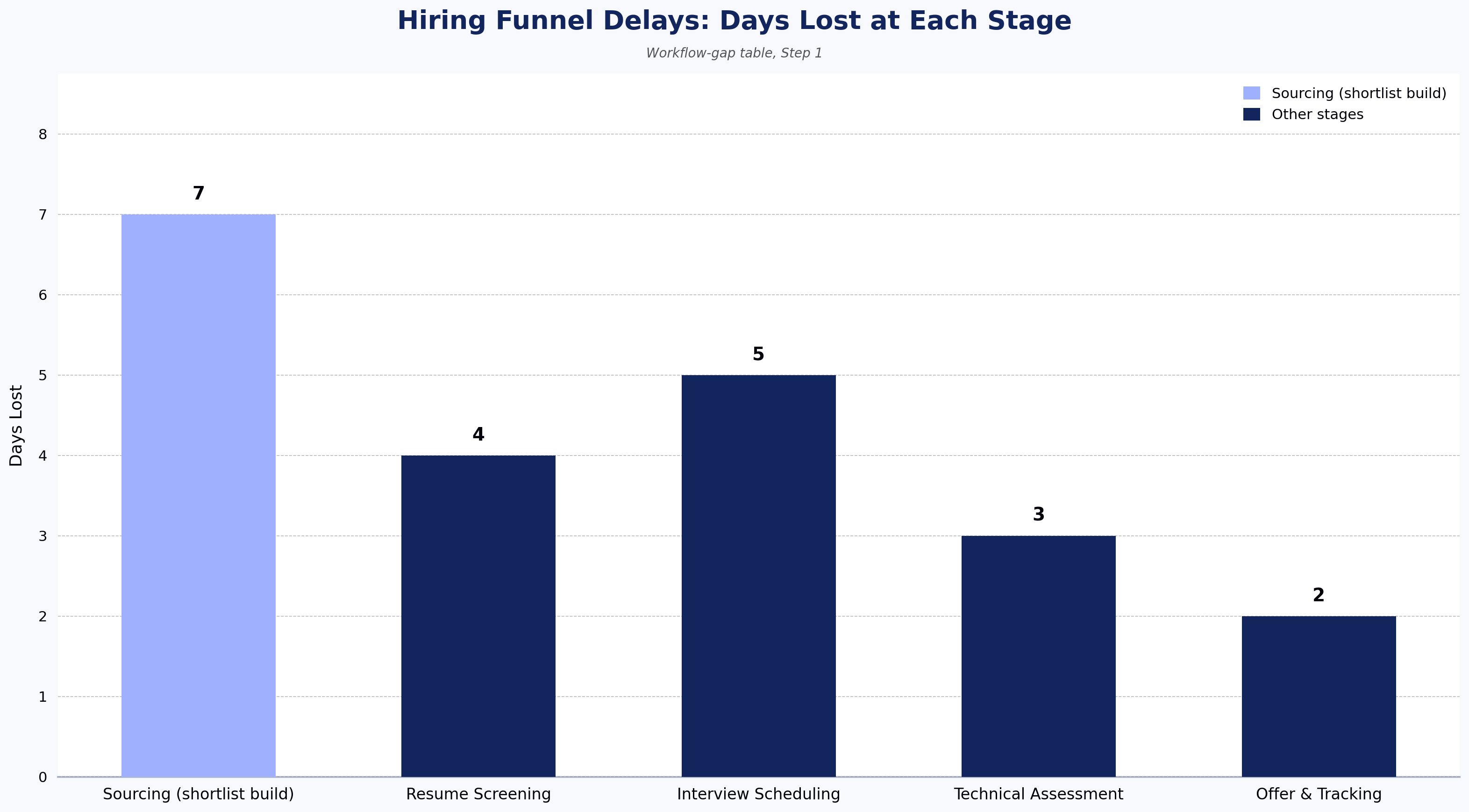
Fill in this table before your first vendor call. The gaps you identify should drive every scoring decision that follows:
| Funnel Stage | Current Tool or Process | Observed Gap or Delay | Impact |
|---|---|---|---|
| Sourcing | LinkedIn Recruiter, job boards | 7+ days to build shortlists for technical roles | Slow top-of-funnel; passive candidates missed |
| AI candidate screening | Manual resume review | 3–5 days; inconsistent criteria across recruiters | Quality varies; bias risk unquantified |
| Technical assessment | Ad hoc whiteboard or take-home | No standardized scoring; senior engineer time consumed | Inconsistent data; interviewer time wasted |
| Interview scheduling | Email coordination | 4–6 days of back-and-forth per candidate | Time lost; candidates drop off during wait |
| Offer | Manual tracking | Slow turnaround; no pipeline visibility | Competitive candidates accept elsewhere |
Set measurable goals for AI recruitment
Goals set before vendor conversations make hiring vendor selection defensible to finance and give you a real basis for pilot evaluation. Agree on these across HR, engineering, and finance before any demo is scheduled:
- Reduce time-to-hire for software engineering roles from 45 days to 30 days within two quarters
- Increase technical assessment completion rate from 62% to 85% within 90 days
- Cut cost-per-qualified-candidate by 40% for roles requiring coding evaluation
- Achieve SOC 2 Type II compliance for all candidate data processed by the new vendor within 60 days of contract signing
Step 2 — Understand the AI recruitment vendor landscape
The AI recruitment vendor landscape splits into five distinct categories, and scoring across categories without acknowledging that is how procurement teams end up comparing tools that don't do the same job. Running an effective AI recruitment software comparison requires knowing which category each vendor belongs to before you score them — comparing a sourcing tool against an assessment platform is like scoring a plumber and an electrician on the same rubric.
Categories of AI recruitment tools
The vendor landscape breaks into five segments. Most AI recruiting tools occupy one or two of these; very few cover all of them at depth:
- AI sourcing tools: Find and surface passive candidates from databases and code repositories.
- AI screening and assessment platforms: Evaluate candidate qualifications through resume scoring, skills tests, or cognitive assessments.
- AI interview platforms: Conduct, record, transcribe, or score interviews.
- AI scheduling and workflow automation (also called recruitment automation platforms): Handle calendar coordination and candidate communications.
- Full-stack AI recruitment suites: Attempt to cover multiple stages.
When you evaluate recruitment technology, your pain points from Step 1 should map to one or two of these segments, not all five.
Full-stack platforms vs. point solutions
The full-stack vs. point-solution decision is the one most procurement teams get wrong — usually by defaulting to a suite when a focused tool would outperform it at the specific stage that actually needs fixing:
| Factor | Full-Stack Platform | Point Solution |
|---|---|---|
| AI depth per function | Often broad but shallow | Deep in one area |
| Integration overhead | Lower (single vendor) | Higher (multiple vendors to connect) |
| Data continuity | Unified pipeline data | Fragmented across tools |
| Vendor dependency risk | High (single point of failure) | Distributed |
| Time to value | Longer (more to configure) | Faster for targeted problem |
| Cost at scale | Higher license cost | Can be modular and lower entry |
Step 3 — Evaluate core AI capabilities
The technical interrogation of an AI recruitment vendor — training data, update cadence, documented error rates — is what separates a real evaluation from a demo review. Skip it and teams discover post-contract that AI recruitment platform features that looked impressive in a demo do not hold up under real conditions. Knowing how to evaluate AI recruitment vendors at this layer means pressing on each of those dimensions explicitly.
Assessment and screening accuracy
"AI-powered" on a vendor's website means nothing without validation data behind it. Ask directly: what is the model trained on, when was it last updated, and what is the documented false-positive rate? Request specific benchmark data from each vendor in writing — the best AI recruitment platforms 2026 can produce these benchmarks on request; those that cannot should not advance past the RFP stage. HackerEarth's Skill Assessments use rubric-based scoring with role-based assessment design, which is the difference between an assessment that predicts job performance and one that measures interview prep.
AI interview and coding evaluation
When evaluating AI interview platforms, require candidates to demo the actual coding environment on real data, not a recorded walkthrough. Questions that separate real capability from polished demo:
- Does the platform execute code in a real runtime environment, or does it only analyze syntax?
- How many programming languages does it support natively versus through workarounds?
- Does AI scoring operate autonomously, or does it assist a human reviewer?
- Are transcripts and scoring rationale exportable for compliance audit?
- Can the interview AI adapt to candidate responses, or does it follow a fixed script?
Fixed-sequence interview AI can function like a test with a publicly available answer key. For a broader comparison of interviewing tools and approaches, see HackerEarth's overview of FaceCode, the interviewer-led technical interview platform.
Candidate matching and ranking algorithms
Black-box ranking is a compliance liability, not just a technical shortcoming. Any AI talent acquisition vendor that cannot explain why their algorithm ranked one candidate above another — in terms a hiring manager can read and defend — is handing you a legal risk alongside their platform license. Require end-to-end documentation of matching logic before any contract advances.
Step 4 — Audit for bias, fairness, and compliance
Any AI hiring platform that cannot produce independent bias audit documentation in 2026 should be eliminated before the scorecard is built. This step is the regulatory gate that everything else depends on.
Bias testing and audit documentation
Require vendors to produce their bias audit methodology, not just a claim that testing was done. The documentation must include adverse impact ratios for Title VII-protected groups, the auditor's name and independence from the vendor, and the dataset used. NYC Local Law 144 sets the operational benchmark: annual independent bias audits, public results, and 10-business-day advance notice to candidates. Penalty figures previously cited in this article — first-violation and subsequent-violation amounts under the law — should be confirmed against current NYC DCWP guidance before relying on them in procurement. Enterprise buyers increasingly expect bias audit documentation as part of procurement diligence.
AI Act compliance for recruitment
The EU AI Act classifies employment AI as a high-risk system, which creates specific documentation, transparency, and human-oversight obligations for any vendor whose tool touches EU candidates. Buyers should require evidence that the vendor has mapped their product to the Act's high-risk requirements ahead of the August 2, 2026 enforcement date — including risk management documentation, data governance records, and post-market monitoring plans. US-headquartered companies using AI tools to assess candidates physically located in the EU are generally in scope; confirm specific applicability with counsel.
Bias audit documentation requirements
A defensible bias audit produces, at minimum: the auditor's identity and independence statement, the dataset and time window audited, adverse impact ratios broken out by protected category, and the remediation actions taken since the prior audit. Vendors who provide only a summary score — or who treat the audit as proprietary — are not meeting the documentation bar that current and proposed regulations expect. Request the full report under NDA if needed, not just an executive summary.
Regulatory compliance checklist
The following items form the core AI recruitment RFP criteria. Vendors who cannot confirm all applicable items in writing should not advance to demo:
- GDPR: Data processing agreement provided; data subject rights confirmed
- EEOC: Adverse impact compliance documentation; awareness of current EEOC technical assistance on AI and Title VII
- NYC Local Law 144: Audit capability and candidate notification support confirmed
- Illinois AIVIA: Consent mechanism and AI disclosure for video interview tools — verify current obligations with counsel
- Colorado AI Act (SB 24-205): Risk assessment documented for high-risk AI systems — verify applicability and current enforcement timeline with counsel
- SOC 2 Type II: Current certification available on request
- Data residency: Storage location confirmed; regional options available
- Penetration testing: Most recent test date and scope documented
Step 5 — Assess integration and technical compatibility
Integration architecture, not feature depth, is the single biggest predictor of whether an AI hiring platform actually works inside your stack. The most technically impressive tool becomes a liability if it cannot sync with the systems your team already uses — and most post-implementation complaints trace back to integration decisions made too late in procurement.
ATS and HRIS integration
For each ATS on your list — Greenhouse, Lever, Workday, iCIMS, SAP SuccessFactors — require the vendor to demonstrate bi-directional data sync, not describe it. A one-way CSV export is not an integration; it is a workaround that creates reconciliation work every time it runs. Four questions to confirm before any contract is signed:
- How long does implementation take for each ATS you are connecting?
- What data syncs in each direction?
- What happens to in-flight candidates if the integration fails?
- Is the integration native or middleware-dependent?
API flexibility and data portability
Treat API documentation quality as a proxy for vendor maturity — if it is not publicly available before the demo, that tells you something. More critically: confirm you can export all assessment data and candidate records in a structured, machine-readable format if you decide to leave. If you cannot, the vendor owns your data, not you. Build export rights and format specifications into the contract before signing.
Step 6 — Evaluate the candidate experience
Candidate experience is the side of an AI recruitment platform that procurement teams most often miss — which is how they end up buying tools their candidates abandon.
Interface usability for candidates
Run the candidate-side demo on a mobile device. Practitioner observation suggests a meaningful share of early-stage assessment completions happen on mobile, so a platform that is not genuinely mobile-responsive will show up in your completion rates — verify against your own data before relying on any external figure. Long assessments also contribute to drop-off in many teams' experience, so evaluate time-to-complete explicitly and keep assessments as short as the role allows. WCAG 2.1 AA is the minimum accessibility standard to require. For guidance on building a stronger candidate process alongside the tool, see HackerEarth's guide to improving the candidate experience.
Communication and feedback loops
Ghosting a candidate after a 45-minute AI assessment is a recruiting brand problem, not a feature gap. Evaluate what automated communications the platform sends post-completion, whether recruiters can personalize them, and whether candidates can receive any performance feedback. Sharing summary results with candidates is sometimes associated with stronger reapplication rates and employer-brand outcomes in practitioner reports, but this is a hypothesis to test, not an established finding — request vendor-specific data before assuming it applies to your pipeline.
Step 7 — Analyze pricing models and total cost of ownership
The license fee is almost never the largest cost of an AI recruitment platform — which is why buyers who model only the headline price end up explaining surprises to finance 12 months later.
Common pricing structures
| Pricing Model | How It Works | Best Fit | Watch For |
|---|---|---|---|
| Per assessment | Fixed fee per candidate (market ranges vary widely) | Variable or seasonal hiring volume | Costs scale unpredictably at high volume |
| Per seat / per user | Monthly or annual fee per recruiter | Stable team size, high assessment volume | Unused seats; overage charges |
| Platform license | Annual flat fee within defined limits | Large-volume, enterprise programs | Scope limits; steep renewal increases |
| Per hire | Fee per successful placement | Early-stage teams paying on outcomes | Incentive misalignment with vendor |
For teams hiring at higher volumes, per-assessment pricing can become more expensive than a platform license over time — model both against your projected annual volume before deciding.
Hidden costs to watch for
Build this calculation before comparing vendors: (Annual license fee + implementation cost + integration development + training and onboarding + premium support tier + bias audit fees + overage charges) divided by expected hires per year = platform cost per hire. ATS integration scoping can vary widely depending on complexity and the ATS involved — request written scoping estimates from each vendor. Always negotiate auto-renewal clauses out of the initial contract, or require at minimum 90-day written notice before any renewal.
Step 8 — Run a structured pilot or proof of concept
A structured pilot is the only reliable way to predict how an AI recruitment platform will behave on your real data — demo environments are always clean, and yours is not.
Design a pilot framework
Run the pilot alongside your current process, not in place of it, so you have a real baseline to measure against. Practitioners commonly recommend these parameters as a rough guide:
- Duration: 30 to 60 days minimum
- Volume: 50 to 100 completed assessments as a rough guide for meaningful signal
- Role type: One role type you hire frequently, run concurrently with your existing process
- Ownership: A named recruiter on your team and a named technical contact at the vendor available within 24 hours
Metrics to track during the pilot
Establish baselines for these metrics before the pilot starts, not during:
- Assessment completion rate (in our experience, some practitioner teams target 80% or higher; calibrate to your own historical baseline)
- Candidate satisfaction score via post-assessment survey
- Time-to-shortlist from role opening to a ranked candidate list
- Hiring manager satisfaction with candidate quality
- False-positive rate from assessment to next human review stage
- Integration reliability: sync failures between the platform and your ATS
- Technical support responsiveness against the vendor's stated SLA
Build a shared tracking dashboard — even a simple spreadsheet — visible to both your team and the vendor. Resistance to transparent pilot metrics is useful information about what post-contract accountability will look like.
Step 9 — Verify vendor support, security, and scalability
Support quality, security certification, and scalability are the procurement criteria most often deferred and most often regretted — the day after contract signing is when these gaps become real.
Onboarding and ongoing support
The gap between a strong demo and a successful implementation is almost always a support problem, not a product problem. Confirm whether the vendor provides a dedicated customer success manager or pool-based ticket support, whether the SLA is in the contract or verbal, and what implementation milestones the vendor is contractually accountable for. Find current customers through LinkedIn or G2 — not vendor-provided references — and ask specifically about support quality six months post-implementation.
Data security and certification
Required baseline for any enterprise AI hiring tool that processes candidate PII:
- SOC 2 Type II: Current certification; report available on request. SOC 2 Type I is generally insufficient for enterprise procurement, though some vendors in active certification may be considered case-by-case.
- Encryption at rest and in transit: AES-256 or equivalent
- Data residency: EU data residency option for European candidates
- Penetration testing: Annual third-party test; most recent report available under NDA
- Incident response plan: Breach notification process documented within GDPR's 72-hour requirement
HackerEarth's remote proctoring for online assessments generates plagiarism detection logs, behavioral monitoring records, and tab-switch audit trails — which serve double duty as compliance documentation.
Scalability for enterprise growth
Ask vendors for uptime SLAs and peak-load benchmark data from their largest customers. Some enterprise buyers target 99.9% uptime as a baseline and treat anything below 99.5% as a negotiation point, in line with widely used hyperscaler SLA benchmarks (e.g., AWS and Azure service-level commitments) — calibrate to your own risk tolerance. Confirm whether pricing changes materially at 10x your current volume before the contract is signed, not after.
Step 10 — Build your final vendor scorecard and get buy-in
A weighted scorecard is the discipline that prevents a vendor evaluation from defaulting to whichever demo felt most polished.
Weighted scoring criteria
Apply weights that reflect your organization's priorities from Step 1. These are suggested defaults, not fixed values:
| Evaluation Category | Suggested Weight | Rating Scale |
|---|---|---|
| AI accuracy and capability depth | 25% | 1 = no validation data; 5 = third-party validated benchmarks |
| Bias and compliance documentation | 20% | 1 = no documentation; 5 = independent audit with demographics |
| ATS and HRIS integration | 15% | 1 = CSV only; 5 = native bi-directional sync |
| Candidate experience quality | 15% | 1 = poor mobile/accessibility; 5 = full WCAG 2.1 AA, mobile-first |
| Pricing transparency and TCO | 10% | 1 = opaque custom-only; 5 = clear published model, no hidden fees |
| Support quality and SLAs | 10% | 1 = ticket-only; 5 = dedicated CSM, SLA in contract |
| Scalability and security | 5% | 1 = no SOC 2; 5 = SOC 2 Type II, documented pen testing |
Any vendor below 65 requires specific risk acknowledgment before advancing. Any vendor that cannot produce bias and compliance documentation is eliminated regardless of score elsewhere.

Stakeholder alignment and sign-off
The RACI structure below distributes accountability so every critical risk has a named owner before the purchase. R = Responsible, A = Accountable, C = Consulted, I = Informed:
| Evaluation Activity | TA Leadership | Engineering / Hiring Managers | IT and Security | Procurement and Legal | Finance |
|---|---|---|---|---|---|
| Define hiring pain points and goals | A | C | I | I | C |
| Evaluate AI capability and accuracy | A | R | I | I | I |
| Review bias audits and compliance docs | A | I | R | R | I |
| Assess ATS integration architecture | C | I | A | I | I |
| Run candidate-side demo review | A | R | I | I | I |
| Review pricing model and TCO | R | C | C | R | A |
| Conduct pilot and measure results | A | R | C | I | C |
| Contract review and final sign-off | R | I | C | A | R |
The goal is not consensus — it is ensuring every critical risk has a named owner before the purchase.
Where HackerEarth fits in your AI recruitment evaluation
HackerEarth is a technical hiring platform, not a full-stack recruitment suite — and that focused scope is exactly what makes it worth putting on your shortlist if technical assessment and interviewing quality is where your process breaks down.
Against the criteria in this guide, HackerEarth's Skill Assessments provide role-based assessments and rubric-based scoring across 1,000+ skills and 40+ programming languages, with custom assessment content creation available to cover non-technical roles such as sales, customer support, and finance. HackerEarth offers two distinct interview products that buyers should evaluate separately: FaceCode, the interviewer-led platform, gives interviewers direct in-session access to HackerEarth's question library during live interviews. OnScreen, HackerEarth's AI-led interviewing product (