Nischal V Chadaga

Author
Nischal V Chadaga

Blogs
Nischal is a former product marketer with a love for growth loops and developer communities. Now, they decode hiring challenges with the same curiosity they brought to GTM plans.
author’s Articles

Insights & Stories by Nischal V Chadaga

Nischal V Chadaga's content is built for talent leaders who want results—fast. Actionable, relevant, and packed with real-world learnings from the frontlines of growth.
Clear all
Thank you! Your submission has been received!
Oops! Something went wrong while submitting the form.
Filter
Filter

Best Offboarding Software in 2025

Offboarding is as important to an organization’s talent management system and strategy as onboarding is. An effective offboarding process is how employees are let go in the most efficient manner possible without damaging the employer’s brand. Offboarding software for 2024 is taking a new turn on how organizations should deal with exits, making it easier for the employees and the HR department.

In this blog, we will focus on the top offboarding software available in 2024, what they include, and how different companies are implementing the software.

What Is Offboarding Software?

Offboarding software is a unique tool that helps manage the termination of employment. These tools range from the management of papers and the recovery of company property to interviews and compliance. They are all time-saving tools, effective means of communication, and additions to the general offboarding system.

Why Is Offboarding Software Important?

Ensures Compliance

Offboarding software allows organizations to maintain legal requirements regarding labor laws and legal documents since the paperwork is handled automatically.

Protects Employer Brand

Creating a positive exit experience means that the employee leaves with a positive attitude toward the organization and does not become a negative influence on other potential clients.

Recovers Company Assets

This is explained by the fact that automated workflows help to ensure that assets such as laptops, access cards, and software licenses are returned on time.

Gives Information through Exit Surveys

These tools collect useful data from employees leaving to enhance retention strategies and foster a positive organizational culture.

Complements Predictive Hiring Techniques

Offboarding software information can be used to make hiring decisions based on patterns that cause employee turnover. Find out more about turnover in The Impact of Talent Assessments on Reducing Employee Turnover.

Top Features to Look for in Offboarding Software

When selecting the best offboarding software, consider these key features:

Workflow Automation

Eliminate paperwork, generation, and clearance of documents, notifications, etc.

Asset Management

Organization and retrieval of company assets.

Customizable Exit Surveys

Collect valuable data using specific exit questionnaires.

Interface with other Systems

It should integrate with the Human Resource management systems, Payroll systems, and Information technology platforms.

Analytics and Reporting

Give information regarding the tendencies of exits, the causes of turnover, and possible advancements.

Compliance Management

Automate the creation of last bills and statements containing non-disclosure agreements (NDAs) and tax returns.

Best Offboarding Software in 2024

Offboarding refers to managing the end of an employee’s lifecycle within their organization and is critical to managing the separation process. On the other hand, offboarding determines how professional the company is and also its employer brand. By 2024, organizations can use offboarding software to help manage the exit process and collect useful data. Here are some of the best offboarding software that you can use:

HackerEarth (Talent Assessment Focus)

Even though HackerEarth does not provide offboarding-specific solutions and tools, it is valuable in enhancing talent management and recruitment systems.

Key Features:

  • Detailed evaluation of developers for employment.
  • Recruitment analysis to enhance the process of integrating talents into the organization.
  • Resources to assist with the hiring process.

Case Study: A major firm used HackerEarth’s assessment tool to find talented employees and minimize turnover due to employee and employer fit. Though directly related to the offboarding process, solutions offered by HackerEarth complement the approach to employee lifecycle management by increasing the rate of correct hiring and reducing the attrition rate.

If you would like to know more about tools that can help make recruitment more effective, you might also want to read The Impact of Talent Assessments on Reducing Employee Turnover.

BambooHR

BambooHR has an easy-to-use offboarding module will help small to medium businesses streamline the exit process.

Key Features:

  • Clearance and paperwork that are either automated.
  • Customizable exit surveys.
  • Returns are made easy with asset tracking.

Why Choose BambooHR: It is also easy to use and relatively cheaper than most competitors, especially for growing businesses.

Sapling

Sapling understands the life cycle of an employee and offers solutions for both the onboarding and offboarding processes.

Key Features:

  • Efficient procedures for asset accumulation and release.
  • Integration with various other Human Capital Management (HCM) solutions.
  • Analyzing the exit trends from the perspective of advanced analytics.

Case Study: One of the tech startups employed Sapling to cut the offboarding cycle in half while redirecting the HR team’s focus to more value-added activities.

Workday

Workday is a broad human capital management (HCM) system with rich offboarding functions.

Key Features:

  • Automated documentation and compliance tracking is another feature of the software.
  • Knowledge of the extent of the turnover rates.
  • With the functionality of payroll and IT systems.

Why Choose Workday: Most suitable for organizations that manage many complicated human resource systems.

Gusto

Gusto has specialized in payroll and HR services, which includes a perfect offboarding feature.

Key Features:

  • Ad hoc computations of final pay.
  • Tax form generation.
  • Customizable exit interviews.

Case Study: A retail chain used Gusto’s offboarding tools to reduce its exits across all of its stores while increasing compliance with them by 30%.

Zenefits

Zenefits has an impressive offboarding suite designed for small and medium-sized organizations.

Key Features:

  • Digital asset recovery practices.
  • Personalized exit surveys.
  • Linkages with benefit and payroll systems.

Why Choose Zenefits: Its integrated HR management system makes offboarding easy while generating important data on employee engagement.

Rippling

In essence, rippling is an integrated HR and IT solution based on automation.

Key Features:

  • Automated blocking of employee profiles.
  • Real-time monitoring of the asset returns.
  • In-depth analysis for human resource summary.

Case Study: A marketing agency utilized rippling for IT offboarding to cut off security threats by freezing the accounts of employees who resigned within a few hours.

Namely

Namely, it integrates a human resource management system with effective offboarding solutions.

Key Features:

  • Tightly coupled and configurable offboarding processes.
  • Sanctioned legal compliance aids.
  • Survey at the end of employment to collect feedback.

Why Choose Namely: Due to its simplicity and the principle of putting employee experience first, it is suitable for mid-sized organizations.

ClearCompany

ClearCompany provides fully customizable offboarding tools to help improve the employee experience.

Key Features:

  • Combination of turnover trends for analytics.
  • Computerized clearance processes.
  • Exit survey templates.

Why Choose ClearCompany: It performs the best in providing useful information that can come in handy when developing retention measures.

How Offboarding Software Supports Recruitment Strategies

Offboarding gives information that can enrich the recruitment procedures. Here’s how:

  • Identifying Turnover Trends: This way, exit data must be analyzed to identify patterns and, therefore, determine the causes.
  • Improving Employer Brand: A positive exit experience creates advocates among employees exiting the organization.
  • Enhancing Predictive Hiring: Offboarding data should be used to adjust the hiring criteria and determine candidates that are more aligned with company values.

Read more on the recruitment KPIs in The Role of Recruitment KPIs in Optimizing Your Talent Strategy.

Future Trends in Offboarding Software

AI-Driven Analytics

Sophisticated AI applications will process exit data in real time, gaining a richer understanding of the reasons for turnover and possible remedies.

Virtual Offboarding

In the new work-from-home era, virtual offboarding will entail online contract signing, virtual exit interviews, and retrieval of assets.

Enhanced Employee Experience

Exit tools will focus more on the departing employee and include a survey and alumni toolkit.

Integration with Talent Pipelines

Offboarding tools will integrate with talent pipelines to enable companies to keep in contact with alumni, who can be hired again if they perform well. Explore this concept in Virtual Recruitment Events: Maintaining the Communication with the Best Candidates.

Conclusion

The best offboarding software in 2024 is not just about transitioning and offboarding – it is about turning that transition and offboarding into an optimal, effective, and informative experience for the company and the employees. Employers should seek to put their money where their mouth is and buy the right tools to improve compliance, brand integrity, and data for optimized future recruitment and retention.

Are you able to take your offboarding program to the next level? Check out these advanced applications and learn how they can help your organization.

Whiteboard Interviews: Why They’re Bad For Technical Interviewing

Whiteboard interviews have traditionally been a go-to method for evaluating technical candidates. However, as hiring practices evolve, more companies are questioning their validity and fairness. While these interviews aim to test a candidate’s problem-solving and coding abilities, they often fail to reflect real-world scenarios and can create unnecessary barriers for talented professionals.

Here’s a detailed look at why whiteboard interviews are falling short, supported by alternative methods that deliver better results for technical hiring.

Why whiteboard interviews will always fall short

1. Lack of real-world relevance

Whiteboard interviews often focus on theoretical questions that do not reflect the practical challenges developers face in their daily work. For example, while solving algorithmic puzzles might demonstrate logical thinking, it doesn’t showcase skills like debugging, optimizing performance, or integrating APIs. These are far more relevant in a real-world tech role.

Illustration: A company might ask candidates to write a quicksort algorithm on a whiteboard, but in reality, most developers would use pre-built library functions for such tasks and focus their time on solving more complex application-specific problems.

Whiteboard interviews also fail to consider the collaborative nature of modern software development. Engineers work in teams, consult documentation, and use advanced tools to troubleshoot and innovate—none of which are accounted for in a whiteboard setting.

2. Encourages rote memorization

Instead of evaluating problem-solving skills or creativity, whiteboard interviews tend to reward candidates who can recall academic concepts under pressure. This approach prioritizes “textbook” knowledge over practical application.

Example: A front-end developer might ace a whiteboard question on JavaScript promises but fail to demonstrate their expertise in real-world scenarios like debugging asynchronous behavior in a live application.

3. Bias in evaluation

Whiteboard interviews often amplify implicit biases in hiring. For instance, a candidate who performs confidently in a live, high-pressure environment may appear more competent, even if their technical skills are weaker than another candidate who struggles with anxiety in the same situation.

Bias also creeps in during subjective evaluations. Interviewers might unconsciously favor candidates whose thought processes align with their own, penalizing those who approach problems differently but could bring unique perspectives to the role.

Case in point: Studies show that women and candidates from underrepresented groups often underperform in whiteboard interviews due to heightened stress or lack of familiarity with the format, even when they possess exceptional technical abilities.

4. Misses soft skills and collaboration

Whiteboard interviews completely ignore critical soft skills like communication, teamwork, and adaptability—traits that are vital for success in modern tech environments. Technical brilliance is rarely enough; candidates must also demonstrate the ability to work cohesively with diverse teams and adapt to rapidly changing project requirements.

5. Lack of iterative problem-solving

In real-world development, engineers solve problems iteratively, relying on feedback and testing their solutions. Whiteboard interviews, however, demand perfect solutions in one attempt, disregarding how candidates approach debugging or refining their work.

Better alternatives to whiteboard interviews your team needs to use now

Modern hiring practices focus on assessing candidates in realistic environments, ensuring evaluations are fair, inclusive, and relevant to the role. Here are some effective alternatives:

1. Hands-on coding assessments

HackerEarth’s coding assessments allow candidates to solve real-world problems in a familiar coding environment. Recruiters can test skills like debugging, optimizing algorithms, or building scalable solutions, providing a clearer picture of job readiness.

Example: Instead of asking candidates to write pseudocode for a sorting algorithm, HackerEarth enables recruiters to test how candidates optimize database queries or fix broken code in real time.

2. Take-home projects

Assigning take-home assignments allows candidates to solve problems on their own time using the tools they’re accustomed to. These projects simulate actual job responsibilities and give recruiters a better sense of a candidate’s technical depth.

3. Pair programming interviews

Pair programming sessions involve working collaboratively on a coding task with an interviewer. This method assesses not only technical skills but also a candidate’s ability to communicate, accept feedback, and collaborate in real-time.

4. Virtual hackathons

Hackathons hosted on platforms like HackerEarth engage candidates in problem-solving while mimicking real-world challenges. They provide insights into creativity, teamwork, and technical expertise, all while offering a more enjoyable candidate experience.

Case study: A tech startup used a HackerEarth hackathon to replace traditional interviews. Candidates worked in teams to solve live problems, and the top performers were hired for their ability to think critically and collaborate effectively.

5. Role-specific assessments

Instead of relying on generic whiteboard tasks, focus on role-specific challenges. For example, assess a backend developer’s ability to design scalable APIs or a front-end developer’s expertise in creating responsive UI components. HackerEarth’s assessment platform allows recruiters to customize tasks for any technical role.

The role of HackerEarth in skill-first tech hiring

HackerEarth enables organizations to move beyond outdated hiring methods like whiteboard interviews by adopting a skill-first hiring philosophy—a process that focuses on what candidates can do rather than how they perform under artificial, high-stakes scenarios.

Skill-first hiring with HackerEarth

  1. Real-world simulations:
    HackerEarth provides coding assessments that mimic actual job responsibilities, allowing candidates to demonstrate their skills in solving real-world problems. For example, a back-end developer might be tasked with designing a scalable API, while a DevOps candidate could work on a task requiring CI/CD pipeline configuration.
  2. Diverse assessment types:
    From debugging challenges to take-home projects, HackerEarth allows recruiters to evaluate candidates holistically. By incorporating tests for coding, database management, or even domain-specific tasks, HackerEarth ensures candidates are assessed on what truly matters.
  3. Bias-free evaluations:
    HackerEarth’s anonymized assessments remove identifiers like name, gender, and educational background, ensuring that hiring decisions are based solely on skill and performance. This approach promotes diversity and inclusion, helping companies build stronger, more innovative teams.

Empowering collaboration and adaptability

HackerEarth also supports collaborative hiring practices, such as pair programming assessments and virtual hackathons, where candidates solve challenges in a team environment. This not only highlights their technical expertise but also evaluates how well they communicate, adapt to feedback, and contribute to group problem-solving—critical traits for thriving in modern tech roles.

Case Study: L&T Infotech leveraged HackerEarth to conduct collaborative assessments for their global tech hiring drive. By testing candidates in realistic scenarios, they identified top talent faster and achieved a 40% improvement in time-to-hire.

Data-driven hiring insights

HackerEarth’s platform provides detailed performance analytics, allowing recruiters to pinpoint a candidate’s strengths and areas for improvement. Metrics like code efficiency, logical thinking, and adaptability are captured, ensuring that the most qualified candidates are selected for the role.

Beyond coding: soft skill assessment

HackerEarth doesn’t stop at technical skills. It also enables recruiters to assess communication, critical thinking, and leadership potential through non-coding challenges and custom evaluations. This holistic approach ensures that candidates meet both the technical and cultural requirements of the role.

HackerEarth is leading the transformation of technical hiring by eliminating outdated practices like whiteboard interviews. Its tools and methodologies focus on skill-first hiring, ensuring candidates are evaluated in environments that reflect actual work conditions. By integrating HackerEarth into their recruitment process, companies have been able to hire faster, reduce biases, and build teams that are not only technically competent but also equipped to collaborate, adapt, and succeed.

So, if you too are ready to improve your TTH and adopt a skill-first hiring strategy, book your demo here!

How to Assess Troubleshooting Skills During Tech Hiring

Troubleshooting is a critical skill in tech roles, where professionals frequently encounter complex issues requiring quick thinking and effective problem-solving. Whether it’s debugging code, resolving infrastructure issues, or addressing production outages, strong troubleshooting skills directly impact business continuity and success.

Assessing troubleshooting abilities, however, requires a structured approach to evaluate how candidates perform under pressure, analyze problems, and apply solutions. In this guide, we’ll explore actionable strategies for identifying troubleshooting skills during tech hiring and how HackerEarth can simplify this process.

Why are troubleshooting skills essential in tech?

Troubleshooting goes beyond technical knowledge—it’s about adaptability, logical reasoning, and collaboration. According to LinkedIn data, 65% of employers rank problem-solving as one of the most sought-after skills, and in tech hiring, troubleshooting is often a deal-breaker for high-stakes roles.

For instance:

  • A backend developer must identify and resolve database errors causing performance issues.
  • A DevOps engineer must diagnose and fix infrastructure bottlenecks impacting deployment pipelines.
  • A tech support specialist must quickly assess and resolve user-reported software bugs to ensure customer satisfaction.

Strong troubleshooting skills allow teams to minimize downtime, maintain efficiency, and deliver consistent results under challenging circumstances.

Key metrics for assessing troubleshooting skills

When evaluating troubleshooting abilities, focus on metrics that reveal both technical competency and approach. Here’s what to assess:

1. Problem Analysis

Definition: The ability to break down complex problems into smaller, manageable components.

Example: A candidate diagnosing a system outage should methodically isolate potential causes, such as server misconfigurations, network issues, or software bugs, rather than guessing solutions.

How to assess:

  • Present a real-world scenario like a broken API or slow-loading web application.
  • Observe how candidates analyze logs, identify patterns, and prioritize potential causes.

2. Logical thinking

Definition: Using structured reasoning to find the most efficient path to a solution.

Example: In debugging, a candidate must decide whether to review recent code changes, test dependencies, or analyze error messages. Logical thinking ensures they avoid trial-and-error approaches.

How to assess:

  • Use coding challenges with intentionally embedded bugs.
  • Evaluate whether candidates take a step-by-step approach to resolve issues systematically.

3. Technical knowledge

Definition: Applying the right tools, frameworks, or languages to fix specific issues.

Example: An engineer troubleshooting a Kubernetes pod failure should know how to check resource limits, examine container logs, and test DNS configurations.

How to assess:

  • Conduct hands-on assessments that mimic real job challenges, such as server misconfigurations or deployment errors.
  • Use HackerEarth’s role-specific assessments to measure candidates’ proficiency in tools like Kubernetes, Docker, or Python.

4. Stress management

Definition: Staying calm and focused while troubleshooting high-pressure issues.

Example: During a production outage, a site reliability engineer (SRE) must prioritize fixes, communicate effectively with stakeholders, and implement temporary workarounds while investigating root causes.

How to assess:

  • Simulate high-pressure scenarios, such as resolving a critical bug in a limited timeframe.
  • Observe how candidates balance urgency with accuracy, communicate updates, and avoid panic-driven decisions.

5. Collaboration

Definition: Effectively working with teammates or stakeholders to resolve problems.

Example: A full-stack developer working on a complex bug may need input from database administrators or UX designers to address dependencies and align solutions.

How to assess:

  • Incorporate team-based problem-solving tasks into your hiring process.
  • Use HackerEarth’s virtual hackathons to evaluate how candidates collaborate in real-time to resolve shared challenges.

Effective methods to assess troubleshooting skills

1. Real-world simulations

Create hands-on tasks that mirror the challenges candidates would face in the role. For example:

  • Ask a DevOps candidate to debug a CI/CD pipeline failure.
  • Assign a frontend developer a task to fix performance issues on a web page.

HackerEarth’s customizable assessments allow recruiters to design problem-solving scenarios tailored to specific roles, ensuring candidates are tested on relevant troubleshooting tasks.

2. Case studies

Present candidates with a technical issue and ask them to outline their thought process for resolving it. Case studies reveal their analytical approach, logical reasoning, and technical understanding.

Example: “Your team discovers that a recently deployed feature caused a spike in server load. How would you investigate and address the issue?”

3. Pair programming

Pair programming sessions are an excellent way to observe how candidates troubleshoot collaboratively. During these sessions:

  • Provide candidates with a buggy codebase and ask them to work through solutions alongside an interviewer.
  • Evaluate how well they communicate their thought process and adapt to feedback.

HackerEarth’s FaceCode platform enables real-time coding interviews and collaborative problem-solving, providing interviewers with detailed insights into candidates’ performance.

4. Debugging challenges

Introduce deliberate bugs into code or system configurations and ask candidates to identify and fix them. Debugging challenges test both technical knowledge and structured troubleshooting approaches.

HackerEarth’s coding assessments come equipped with debugging tasks designed for multiple tech stacks, allowing recruiters to assess candidates’ skills efficiently.

5. Behavioral interviews

Ask candidates about past experiences with troubleshooting, such as:

  • “Describe a time when you resolved a critical issue under a tight deadline. What was your approach?”
  • “How do you prioritize tasks when facing multiple problems at once?”

Behavioral interviews offer insights into candidates’ problem-solving mindset and adaptability.

How HackerEarth supports troubleshooting skill assessment

HackerEarth’s platform is purpose-built to help recruiters evaluate troubleshooting skills with precision:

  • Role-specific tests: Design tailored assessments for DevOps, software development, QA, and more.
  • Real-time simulations: Use HackerEarth’s hands-on environments to replicate real-world challenges like debugging, system outages, or performance optimization.
  • AI-driven insights: Gain detailed analytics on how candidates approach problem-solving, including time taken for each step.
  • Live interviews: Conduct collaborative troubleshooting exercises with coding tools, whiteboarding, and replay options.

Conclusion

Troubleshooting is an indispensable skill for tech professionals, and hiring the right talent can mean the difference between quick resolutions and costly downtime. By using structured assessments, real-world simulations, and HackerEarth’s innovative tools, recruiters can identify candidates who excel under pressure, think critically, and resolve complex issues effectively.

With HackerEarth, you can build a robust hiring process that ensures your tech team has the problem-solvers they need to succeed.

Best Leadership Assessment Tests & Tools (2026)

Best Leadership Assessment Tests for Executives (2026)

Most leadership assessments sold to enterprises today were designed before remote work, before AI-augmented decision-making, and before the half-life of "strategic skills" reportedly shrank from a decade to about five years, according to the World Economic Forum's Future of Jobs Report 2023. The frameworks still hold up. The way you should use them does not.

This guide covers the seven leadership assessment tests that still produce defensible signal in 2026 — what each measures, where it fails, and how to combine them without overspending or over-testing your bench. It is written for CHROs, Heads of People Analytics, and L&D leaders running succession planning, executive hiring, or capability programs at scale — focused on program design, defensibility, and tiering rather than instrument-by-instrument administration detail.

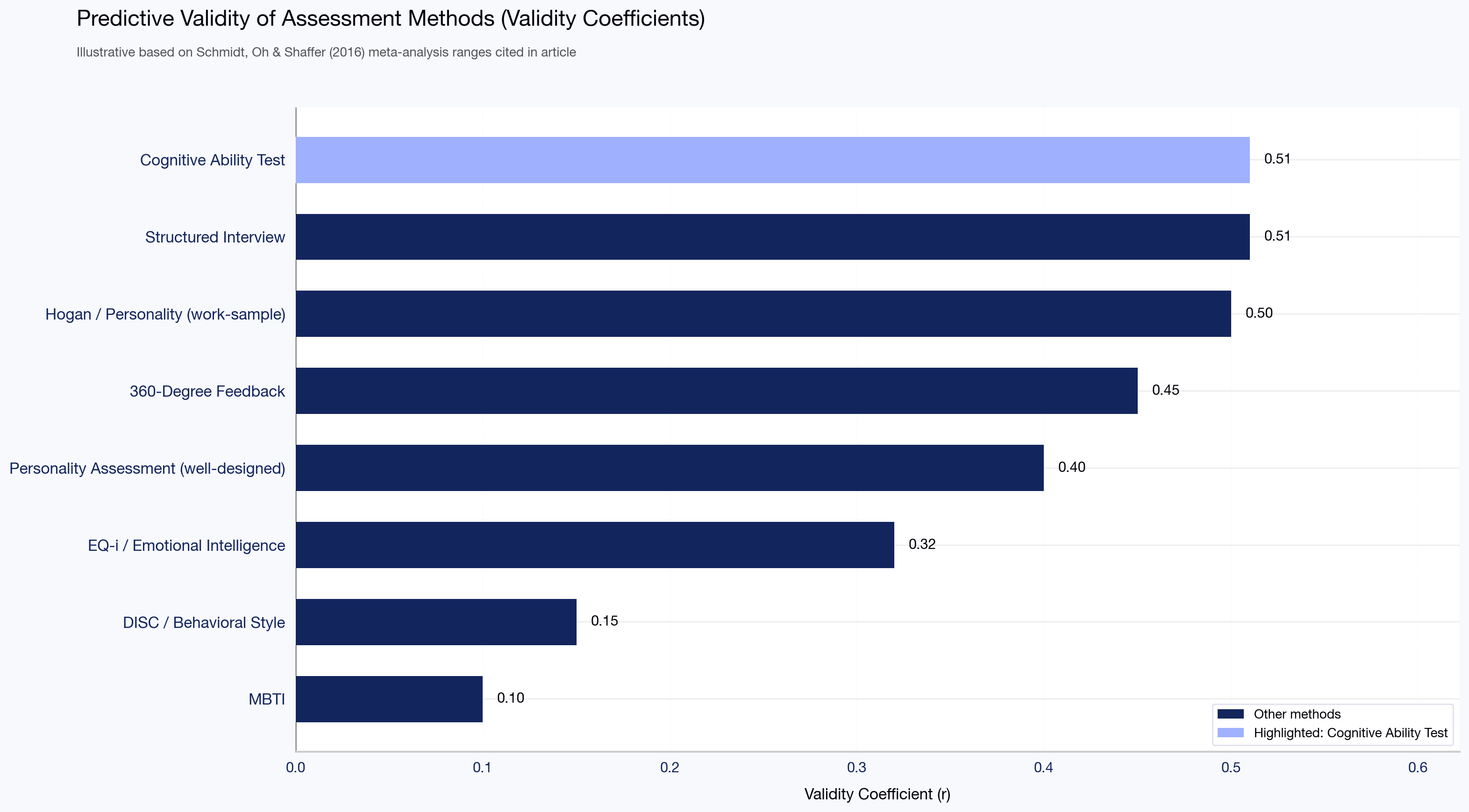
A working assumption before we start: no single leadership assessment test predicts leadership success on its own. Research on validity coefficients is reasonably consistent — well-designed assessments typically correlate with on-the-job performance in the 0.3 to 0.5 range, per the Schmidt, Oh, & Shaffer (2016) update to the classic Schmidt & Hunter meta-analysis. That is useful signal, not certainty. Programs that treat any one score as a verdict end up defending decisions they cannot defend.

What a leadership assessment test actually measures in 2026

A leadership assessment test is a structured evaluation — typically combining self-report, multi-rater feedback, and situational judgment — that produces comparable data about how a person leads, where they will struggle, and what they value. The strongest leadership assessment tests measure traits and behaviors that are stable enough to predict future performance but specific enough to coach against.

What has changed since 2020 is the surrounding context. Three shifts matter for how CHROs and program owners should select and tier these tests:

  • Multi-rater data is no longer optional for senior roles. Self-report alone, especially at the executive level, is the weakest version of these tools. Pair every personality-based instrument with structured feedback.
  • Derailment risk has overtaken "potential" as the dominant question. Boards now ask "what could go wrong with this leader" more than "is this leader high potential." Assessments that surface dark-side traits earn more budget than those that don't.
  • Skills-based mobility puts pressure on assessment cost-per-head. If you are running leadership programs across thousands of mid-managers, executive-grade instruments are too expensive to scale. You need a tiered approach — a question the skills-based hiring approach is increasingly built to answer.

The seven instruments below are the ones that hold up under both scrutiny and scale.

__wf_reserved_inherit

1. The Hogan Leadership Forecast Series

The Hogan Leadership Forecast Series is a three-part personality assessment designed for senior leadership selection and succession planning, and the reason it remains defensible is unfashionable: it measures what goes wrong. The series covers the Hogan Personality Inventory (HPI), the Hogan Development Survey (HDS), and the Motives, Values, Preferences Inventory (MVPI). Together, these cover everyday strengths, derailment risks under stress, and underlying values.

What it measures well: - Bright-side traits (HPI) that predict day-to-day effectiveness - Dark-side traits (HDS) that emerge under pressure — the "derailers" - Value alignment (MVPI) with organizational culture

Where it falls short: - Cost. Enterprise pricing for the full Hogan battery with a certified debrief varies by vendor and region and is not published publicly; CHROs evaluating it should request a direct quote from Hogan Assessments or an authorized distributor. It is not a tool for the broader manager population at scale. - Time. Typically two to three hours of candidate time plus a debrief, depending on which sub-instruments are administered. - It produces a long report. Without a trained debriefer, the data does not become decisions.

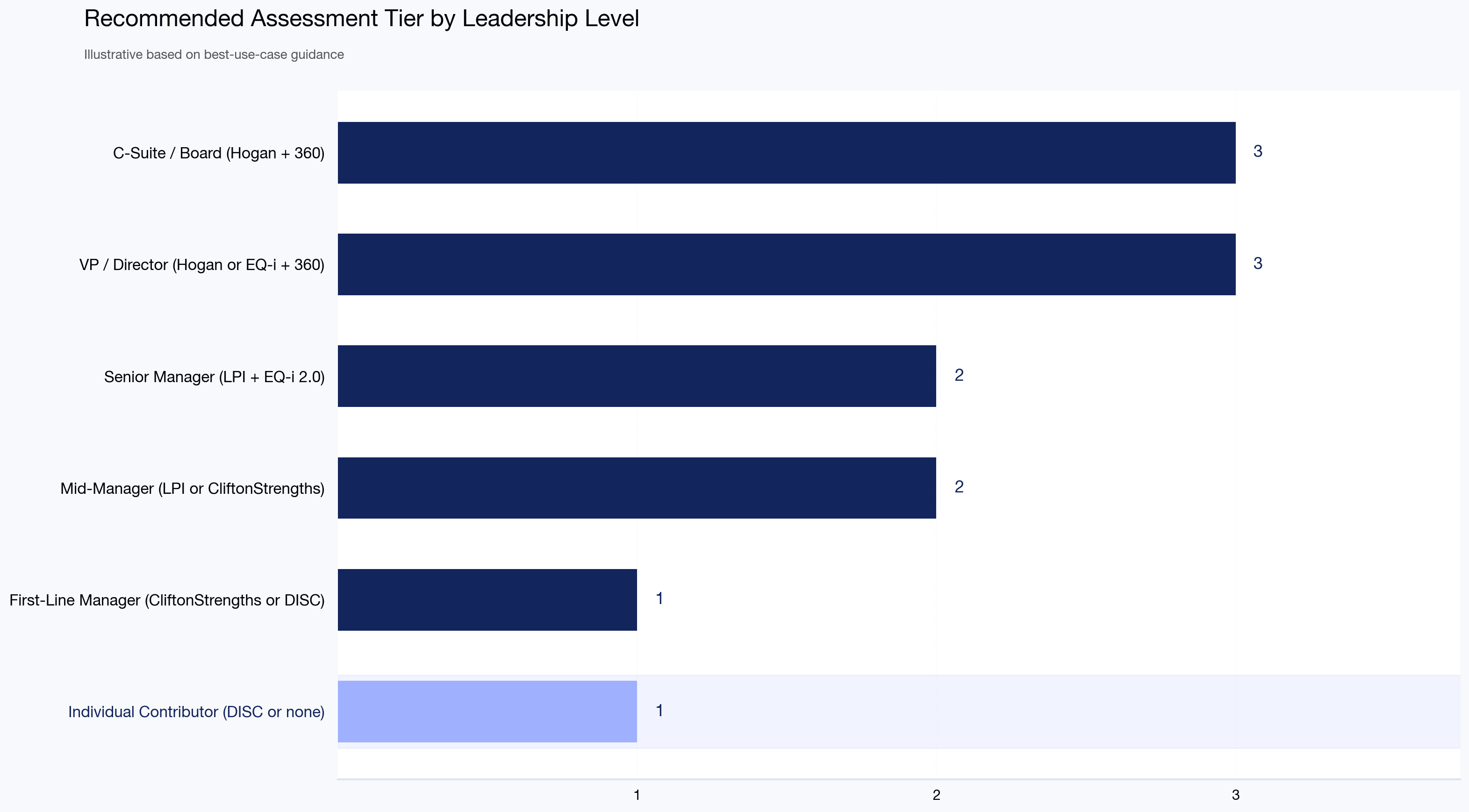
Best use case in 2026: Pre-promotion assessment for VP and C-suite roles, succession-planning slates for the top three layers, and post-hire executive coaching. Hogan is over-specified for first-line manager decisions.

Recommended Assessment Tier by Leadership Level
Source: Illustrative based on best-use-case guidance

2. The Leadership Practices Inventory (LPI)

The Leadership Practices Inventory (LPI), developed by Kouzes and Posner, is a 360-degree leadership assessment test that evaluates behavior against five practices: Model the Way, Inspire a Shared Vision, Challenge the Process, Enable Others to Act, and Encourage the Heart. The self-score is meaningless without the rater scores.

What it measures well: - Observable leadership behavior, not personality traits - Gap between self-perception and how others experience the leader - Concrete coaching targets ("you are scoring low on recognition — here is what that looks like in a one-on-one")

Where it falls short: - It assumes the person is already in a leadership role with raters who can evaluate them. Not useful for first-time-manager identification. - The five practices skew toward inspirational and people-centric leadership. Operating leaders running technical functions sometimes score artificially low without that being a real problem.

Best use case in 2026: Cohort-based leadership development for mid-level managers, with a re-assessment 9–12 months later to measure behavior change. The before/after delta is what makes the budget defensible to a CFO.

3. The DISC Personality Assessment

DISC is a behavioral-style assessment that categorizes people across Dominance, Influence, Steadiness, and Conscientiousness, and is best treated as a vocabulary tool rather than a selection instrument. It is the most over-used assessment in this list — most organizations would get the same value from a one-hour team conversation. The instrument's real strength is accessibility, not depth.

What it measures well: - Communication style differences within teams - Quick self-awareness for entry-level and mid-level managers - Conflict-pattern recognition in working sessions

Where it falls short: - Negligible predictive validity for leadership performance - Easily gamed — candidates know what the "right" answers look like for the role - The four-quadrant simplicity flattens real differences between people

Best use case in 2026: Workshop scaffolding and team-building, not selection or succession. If you are using DISC scores in a promotion decision, stop.

4. The EQ-i 2.0 Emotional Intelligence Assessment

The EQ-i 2.0 is a self-report emotional intelligence assessment developed from Reuven Bar-On's model (often confused with Daniel Goleman's separate framework). It measures EI across self-perception, self-expression, interpersonal skills, decision making, and stress management. Some research suggests a link between EI scores and leadership effectiveness — for example, Miao, Humphrey, & Qian's (2018) meta-analysis in the Journal of Organizational Behavior on EI and transformational leadership — though the construct remains contested in academic psychology (see critiques from Locke, 2005, and Antonakis and colleagues).

What it measures well: - Self-awareness and impulse control under pressure - Empathy and interpersonal effectiveness - Coachability — leaders who score low on self-perception often resist development

Where it falls short: - Self-report instrument with predictable social-desirability bias - Does not measure cognitive ability or strategic judgment - The construct of "emotional intelligence" remains contested — treat scores as one input, not a verdict

Best use case in 2026: Executive coaching engagements, M&A leadership integration, and roles where the previous leader failed on interpersonal grounds. The 360 version reduces self-report bias materially.

5. The CliftonStrengths Assessment

CliftonStrengths is a strengths-based development assessment from Gallup that surfaces a leader's top five themes from a list of 34. It is the most positively framed instrument on this list and the most useful for retention conversations — but it is not a selection tool.

What it measures well: - Natural patterns of thought and behavior the leader gravitates to - Vocabulary for development conversations and team composition - Engagement and self-direction inputs

Where it falls short: - By design, it does not surface weaknesses or risks. A leader can be a strong Strategic-Achiever-Learner-Focus-Responsibility and still derail spectacularly under pressure. - Themes are stable but the "top five" framing can lock people into identity claims that limit growth. - Validity for selection is weak. Gallup itself positions the tool for development, not hiring.

Best use case in 2026: Internal mobility conversations, team composition exercises, and onboarding for newly promoted managers. Pair it with a derailer-focused instrument like Hogan for any senior decision.

6. The MBTI (Myers-Briggs Type Indicator) leadership test

The MBTI is a personality preference assessment that sorts people into 16 types across four dichotomies. It is the most popular assessment in this list and the most criticized. The academic consensus is that MBTI has limited test-retest reliability — some studies have found a meaningful share of respondents receive a different type on retest over short time periods — and limited predictive validity for job performance.

It appears here because practitioners still encounter it widely and because the conversations it generates often produce value the instrument itself does not.

What it measures well — with caveats: - A vocabulary for individual differences that non-HR audiences accept - Self-reflection prompts in coaching settings - Surface-level team communication patterns

Where it falls short: - Type boundaries are arbitrary — small score differences flip people between types - Not appropriate for selection, succession, or any high-stakes decision - Reinforces fixed-identity thinking ("I'm an INTJ, that's why I don't do feedback") that good development work tries to dismantle

Best use case in 2026: Informal coaching conversations and self-reflection workshops. If your leadership program's centerpiece is MBTI, your program is dated.

7. The 360-Degree Leadership Feedback Assessment

A 360-degree leadership assessment is a method, not a single instrument — it gathers ratings from the leader's manager, peers, direct reports, and sometimes external stakeholders. It produces the most actionable single source of leadership data when done well, and the most damaging data when done badly.

What it measures well: - Behavior as experienced by the people who actually work with the leader - Self-awareness gaps (where the leader's self-rating diverges from rater scores) - Specific incidents and patterns that anchor coaching

Where it falls short: - Rater bias, recency effects, and workplace politics all contaminate the data - Anonymous comments can be weaponized when the relationship is already broken - Without a trained debriefer, leaders read the report defensively and learn nothing

Best use case in 2026: Annual development for senior leaders, post-promotion check-ins at 6 and 12 months, and any executive coaching engagement that lasts longer than three months. Use a validated instrument (Korn Ferry Voices, Center for Creative Leadership Benchmarks, or the LPI 360) rather than a bespoke survey — internal questions will not have the validity work behind them.

Choosing the right leadership assessment

Assessment Best for What it measures Where it fails
Hogan Leadership Forecast Executive hiring, succession planning Personality, derailers, values Cost, time, requires trained debriefer
LPI Mid-manager development cohorts Observable leadership behavior Not for selection or potential ID
DISC Team workshops, communication training Behavioral style Low predictive validity
EQ-i 2.0 Executive coaching, interpersonal failure modes Emotional intelligence Self-report bias, no cognitive measure
CliftonStrengths Mobility conversations, team composition Natural talent themes Does not surface risks
MBTI Self-reflection workshops Personality preferences Weak reliability, not for selection
360-degree feedback Senior development, coaching engagements Rater-observed behavior Bias, requires structured debrief

A practical rule: use no more than two instruments per decision. Stacking five assessments on one candidate produces report fatigue and rarely improves the call. Combinations commonly reported in enterprise practice include Hogan plus 360 for executive decisions, LPI plus EQ-i 2.0 for mid-manager development, and CliftonStrengths plus a structured manager conversation for internal mobility. As one anonymized example, a BFSI client running a top-three-layer succession program reported a measurable reduction in first-year executive derailment after layering a Hogan-plus-360 design over their existing internal slate review.

Predictive Validity of Assessment Methods (Validity Coefficients)
Source: Illustrative based on Schmidt, Oh & Shaffer (2016) meta-analysis ranges cited in article

Where leadership assessment fits into broader skills strategy

For CHROs and Heads of People Analytics running skills-based organization rollouts, leadership assessment data is only useful when it joins the rest of the workforce data. A Hogan report that lives in a coaching folder and never connects to the skills inventory does not help the board answer "do we have the leadership capability to deliver this strategy."

This is where leadership assessment intersects with workforce skill intelligence. HackerEarth's SkillsMap benchmarks workforce capability across 1,000+ skills using 150M+ assessment signals — including leadership and managerial competencies — so that individual assessment data rolls up into a defensible workforce view. For organizations running AI-readiness or skills-based hiring programs, that aggregation turns scattered assessment reports into strategic input.

For technical leadership specifically — engineering managers, staff-plus engineers moving into management — leadership instruments alone underweight the technical-judgment dimension. Pair a leadership assessment with a structured technical evaluation using a skills assessment platform calibrated to the role's actual demands.

Common pitfalls to avoid with leadership assessment tests

A few patterns worth flagging:

  • Using personality assessments as selection tools without local validation. Most vendors will sell you the instrument; few will help you build the validity study that makes it defensible under audit. For BFSI and regulated industries especially, an un-validated assessment is a litigation risk, not an asset.
  • Skipping the debrief. Reports without conversations are wasted budget. A Hogan report is worth more in a 90-minute debrief than three reports without one.
  • Treating assessments as one-shot events. The value compounds when you re-assess. We recommend treating a 360 done once as information, and a 360 done annually as a development arc.
  • Confusing popularity with validity. MBTI is the most popular instrument on this list and the least defensible for high-stakes decisions. Popularity is not evidence.

Frequently asked questions about leadership assessment tests

Are leadership assessment tests legally defensible? Leadership assessment tests can be legally defensible when they are job-related, locally validated against the role, and applied consistently across candidates. In the United States, the EEOC's Uniform Guidelines on Employee Selection Procedures set the standard. Un-validated, off-the-shelf assessments used in high-stakes selection are the most common source of litigation risk.

How many leadership assessment tests should you use per hire? A common approach is no more than two instruments per decision — typically one personality or derailer-focused assessment paired with a 360 or structured interview. Stacking three or more rarely improves predictive accuracy and adds report fatigue.

What is the difference between a personality assessment and a leadership assessment test? A personality assessment measures stable traits (e.g., Hogan HPI, MBTI). A leadership assessment test evaluates leadership-relevant behaviors, judgment, or outcomes — often by applying a personality instrument plus multi-rater feedback, situational judgment, or simulation data to a leadership context. All leadership assessments draw on personality data; not all personality assessments are leadership assessments.

Which leadership assessment test is most accurate? Accuracy depends on the decision. For senior selection and succession, Hogan paired with a validated 360 is widely considered among the most defensible combinations. For mid-manager development, the LPI is well-evidenced. No single test is "most accurate" across all use cases.

How long does a leadership assessment test take? Administration time varies. DISC and MBTI typically take 15–30 minutes. CliftonStrengths takes around 30–45 minutes. The EQ-i 2.0 takes roughly 20–30 minutes. A full Hogan battery typically requires two to three hours plus a debrief. A 360 process usually spans two to four weeks end-to-end, depending on rater response time.

Conclusion

Leadership assessment in 2026 is less about picking the perfect instrument and more about building a tiered, defensible system: heavyweight assessments for senior decisions, lighter tools for development, and an aggregation layer that connects individual data to workforce-level capability. The seven leadership assessment tests covered here address most of what enterprises need. The trick is using them where they earn their cost and not using them where they don't.

If your current leadership program is built on one assessment used for everything from first-line manager development to C-suite succession, you are over-relying on the instrument and under-investing in the surrounding process. The fix is rarely a different test. It is a better system.

Next steps

See how SkillsMap connects individual assessment data to workforce-level capability — explore HackerEarth's skills intelligence platform or talk to our team about leadership skill benchmarking.

Intake Meetings - What Are They and How to Use Them Effectively?

Intake meeting is a crucial part of the hiring process and the unspoken partnership between the hiring managers and the recruiters. Although this step is often neglected, it can make or break the hiring process by providing the foundation of clarity, alignment, and efficiency. Whether you are looking for one candidate or building teams, a proper intake meeting can help start the process on the right note.

In this blog, you will learn about intake meetings, why they are important, how to organize them, and how to apply them in the hiring process.

What Is an Intake Meeting?

Intake meeting refers to a discussion between the recruiter and the hiring manager during recruitment. The goal is to agree on what is expected of the candidate, employer, and overall employment process. You can consider it a guide to the recruitment advertising process, the roadmap to a good recruitment campaign.

This meeting ensures:

  • Unclarity in the job description.
  • Employer and candidate’s consent is required regarding the qualifications of the candidate and general necessary and desirable skills and knowledge.
  • Aligns with the hiring timeline.
  • Opportunities to learn the hiring manager’s preferences and the team’s working environment.

Why Are Intake Meetings Important?

Failure to attend an intake meeting results in misunderstanding, loss of time, and disappointed candidates. Here are the key benefits of conducting intake meetings:

1. Sets Clear Expectations

Recruiters and hiring managers get to build a common understanding of the role and hiring objectives.

2. Speeds Up the Process

This way, recruiters can proceed with candidates’ screening faster, as they know the crucial attributes on must-have and nice-to-have lists.

3. Reduces Miscommunication

An elaborate description reduces misunderstandings concerning the position in a way that saves time on unsuitable candidates.

4. Improves Candidate Experience

When recruiters are clear with the concerned role, they can, in turn, explain the expectations to the candidates, which improves the worth of their experience.

To get more details about how to enhance the recruitment process, read Why Recruiting Analytics Is Critical for Hiring Success in 2024.

How to Conduct an Effective Intake Meeting

To make the most of an intake meeting, follow these actionable steps:

1. Prepare Thoroughly

  • Preparation is key. The recruiter should:
  • Discuss the position and data gathered from previous employee hires for the position.
  • Compare data about similar roles in the same industry.
  • Be conversant with the hiring manager’s expectations.

2. Set a Clear Agenda

When a meeting is properly structured, all the important issues are addressed. Here’s a sample agenda:

  • Job overview.
  • Special requirements – education, experience, and licenses.
  • Team culture and dynamics.
  • Candidate screening criteria.
  • Schedule to recruit employees and processes of interviews.

3. Ask the Right Questions

Effective intake meetings are built on asking the right questions, such as:

Job-Specific Details:

  • What are the details of the job description?
  • What are the essential success factors in this role?

Candidate Requirements:

  • Technical skills are important to a position, and personal or interpersonal skills are needed to perform a role successfully.
  • Should the candidate come from a particular industry or company?

Team Dynamics:

  • To whom will the candidate be reporting?
  • How does the team work on projects?
  • Process Details:
  • How quickly do you want a candidate to start?
  • Which people will be part of the interview?

4. Define Success Metrics

Objectives must also be established to assess the effectiveness of employee recruitment. Examples include:

  • Time-to-fill targets.
  • Number of candidates that met qualifications presented.
  • Offer acceptance rate.

5. Leverage Technology

With RMS or interview-as-a-service platforms, managing the intake meeting phase should be easier. For instance, Interview-as-a-Service can be useful in the subsequent candidate assessment after the interview intake.

Case Studies: Real-World Examples of Successful Intake Meetings

Case Study 1: The Role Clarity Framework of Google

  • Challenge: Google’s recruiters often found defining specific positions’ roles challenging.
  • Solution: They put in place concrete initial interviews during which both the recruiters and the hiring managers jointly defined the roles.
  • Outcome: Better match of candidates and a 20% reduction of the time to fill specialized positions.

Case Study 2: Data Used by IBM in Intake Meetings

  • Challenge: IBM had some problems with candidate matching for technical positions.
  • Solution: They incorporated recruiting analytics into the intake meetings to determine key competencies and selection methods.
  • Outcome: Efficient screening procedures and a 25% increase in quality of hire.

Common Challenges in Intake Meetings and How to Overcome Them

1. Misalignment Between Teams

The conflict of expectation when the hiring managers and recruiters differ is counter-productive.

Solution: During the meeting, it is important to follow a certain set of points so that all issues are discussed.

2. Lack of Preparation

When not well prepared, intake meetings can turn out to be unfruitful.

Solution: Provide all participants a list of things to do before the meeting.

3. Changing Priorities Midway

These changes can easily complicate the whole hiring process.

Solution: Daily follow-ups should be done to accommodate changes and alter the hiring plan.

How Intake Meetings Improve Recruitment Outcomes

1. Enhanced Candidate Screening

Having clear criteria set during the intake meeting gives job recruiters a good chance to filter candidates.

2. Improved High Level of HR Competencies

During the intake meeting, all the stakeholders are in a position to determine the competencies required for the position. Read more about critical competencies in Top HR Competencies.

3. Faster Decision-Making

The lack of discrepancy between goals and expectations eliminates haggling, which enhances the rate of decision-making.

4. Improved Employer Branding

Transparency in the role and proper and timely staffing is good for the company brand.

Best Practices for Effective Intake Meetings

1. Use Visual Aids

Using charts, dashboards, and role comparisons can enhance the discussions.

2. Record the Meeting

Capturing the intake meetings helps avoid missing important information and will be a good reference point during the next hiring exercise.

3. Involve Key Stakeholders

This means one should involve team leads, HR representatives, and current team members when soliciting such information.

4. Focus on Data

Take statistical hiring data to the meeting so that decisions will be made based on facts and not emotions.

The Future of Intake Meetings

1. AI-Powered Role Analysis

Since intake meetings are focused on identifying ideal role requirements, AI tools will use past hiring data to recommend requirements.

2. Remote Collaboration Tools

As the trend of working from home emerges, virtual intake meetings will be based on enhanced telecommunication technologies.

3. Predictive Analytics Integration

Intake meetings will increasingly adopt predictive hiring tools to specify candidate success factors.

Conclusion

A good intake meeting is the first and most important step in the recruitment process. Regarding hiring, collaboration, expectations, and Technology should be used to increase efficiency and effectiveness. Every recruiting expert knows that intake meetings have numerous advantages, starting from time to time and ending with candidate matching.

Looking to improve the way you hire? First, get a handle on intake meetings and then delve into the possibilities of using the abovementioned concepts.

Advantages and Disadvantages of Computer Adaptive Testing

Assessments have always been a cornerstone of measuring knowledge, skills, and abilities, but the method of delivering these assessments has evolved significantly. Among the most transformative advancements in the field is Computer Adaptive Testing (CAT), a dynamic and responsive method of evaluation that adjusts the difficulty of questions based on a test-taker’s performance.

While this approach has gained traction across education, hiring, and certification programs, it’s important to understand its strengths and limitations to determine its suitability for different contexts.

What is Computer Adaptive Testing?

Unlike traditional fixed-question tests, CAT uses algorithms to adjust the difficulty of subsequent questions based on how a candidate answers the current one. A correct answer leads to a tougher question, while an incorrect one triggers an easier question. This real-time adaptability makes CAT both efficient and personalized.

The Graduate Management Admission Test (GMAT) and GRE are well-known examples of CAT, where the system tailors the test to reflect the candidate's actual ability level. Similarly, companies like HackerEarth leverage this technology to deliver skill assessments for tech hiring and upskilling, ensuring precise evaluation without unnecessary complexity.

Advantages of Computer Adaptive Testing

1. Precision in evaluation

CAT provides a more accurate assessment of a candidate's ability. Instead of testing broad knowledge, it hones in on the candidate’s proficiency level. Research shows that adaptive tests require 50% fewer questions to achieve the same level of accuracy as traditional tests (Source).

For example, a frontend developer taking a HackerEarth Assessment will immediately face questions related to HTML, CSS, and JavaScript. Based on their answers, the system may escalate to advanced topics like React or Vue.js, ensuring the test is neither too easy nor unnecessarily complex.

2. Saves time for candidates and organizations

Traditional assessments often require a fixed number of questions, many of which may not be necessary for an accurate evaluation. CAT, however, tailors the test length to the individual, reducing test fatigue and saving time for both the candidate and the recruiter.

For example, a tech company hiring cloud engineers can use HackerEarth to deliver adaptive tests that assess AWS or Azure proficiency in fewer questions, reducing evaluation time by up to 50%.

3. Reduces guesswork and cheating

With CAT, no two candidates receive the same set of questions, making it harder for test-takers to share answers. The dynamic nature of the test also minimizes the chance of guesswork influencing results, as harder questions carry more weight.

4. Improves candidate experience

Candidates appreciate tests that feel relevant to their skills. Adaptive testing ensures they aren't demoralized by excessively difficult questions or bored by questions that are too simple.

For example, HackerEarth’s assessments adapt dynamically, making candidates feel like the test is fair and tailored to their expertise. This creates a positive hiring experience, crucial for employer branding in competitive industries like tech.

5. Cost-effectiveness in high-volume hiring

In large-scale hiring scenarios, CAT significantly reduces costs by streamlining the evaluation process. Companies can evaluate thousands of candidates globally with fewer resources while maintaining test accuracy and integrity.

Disadvantages of Computer Adaptive Testing

1. High initial investment

CAT requires sophisticated algorithms and a well-curated question bank, making the initial setup expensive. Smaller organizations may find it challenging to invest in building such infrastructure.

HackerEarth mitigates this by offering plug-and-play adaptive testing solutions tailored to various technical roles, removing the need for organizations to develop the system from scratch.

2. Dependence on a robust question pool

The success of CAT relies on a comprehensive and well-designed question pool. If the question bank lacks variety or depth, the test’s accuracy and fairness can be compromised.

For instance, a poorly designed CAT might struggle to evaluate a candidate specializing in niche technologies like Kubernetes or Golang due to a limited question set.

3. Challenges in test design

Creating adaptive tests requires expertise in psychometrics and subject-specific content. Each question must be carefully calibrated for difficulty and linked to the right algorithms.

4. Technology barriers

Adaptive testing relies on stable internet connections and modern devices. Candidates in regions with limited connectivity or outdated hardware may face difficulties, potentially affecting their performance.

5. Candidate anxiety

Knowing that every answer impacts the next question may cause test-takers to overthink their responses, leading to anxiety. This can be especially problematic in high-stakes hiring scenarios.

Real-life applications of CAT

Education

Universities and standardized testing bodies have embraced CAT to provide more personalized evaluations. Exams like GRE and GMAT ensure candidates are neither over-tested nor under-tested by dynamically adapting the difficulty level of questions.

Corporate hiring

Companies hiring for technical roles often face the challenge of evaluating a diverse pool of candidates with varying levels of expertise. HackerEarth uses CAT to help organizations assess candidates quickly and accurately.

For instance, when hiring data scientists, a company can use HackerEarth Assessments to measure proficiency in Python, SQL, and machine learning concepts. The system adjusts the test dynamically, ensuring candidates are neither overwhelmed nor under-challenged.

Employee upskilling

Adaptive testing isn’t limited to hiring; it’s also valuable for upskilling. HackerEarth’s Developer Upskilling platform uses adaptive assessments to identify an employee's knowledge gaps and recommend targeted learning resources, helping them grow in their roles.

For example, an organization aiming to train its team on DevOps practices can use adaptive tests to determine their baseline understanding of Docker, Kubernetes, and CI/CD pipelines and then deliver tailored learning paths.

How HackerEarth integrates CAT into hiring and upskilling

HackerEarth offers a comprehensive suite of tools that leverage CAT to transform how organizations evaluate and develop talent.
  • Technical assessments: HackerEarth’s adaptive assessments evaluate candidates across a range of skills, from coding to data science, ensuring precise evaluations for tech roles.
  • Hackathons: By hosting hackathons on HackerEarth, companies can identify top talent and engage with developers in a competitive environment. Adaptive challenges make it easier to assess creativity and problem-solving abilities.
  • Upskilling: HackerEarth’s upskilling platform combines adaptive assessments with personalized learning recommendations, ensuring employees stay ahead in their fields.

Final thoughts…

Computer Adaptive Testing is a game-changer for hiring, education, and upskilling, offering precision, efficiency, and cost-effectiveness. However, its success depends on careful implementation, robust question banks, and technological readiness.

For organizations looking to hire top tech talent or upskill their workforce, HackerEarth provides an end-to-end solution that simplifies the complexities of CAT. By combining adaptive assessments with industry-relevant tools, HackerEarth ensures that companies can build stronger teams while saving time and resources.

If your organization is ready to take its hiring or learning programs to the next level, CAT—powered by HackerEarth—is the way forward.