Hiring Tools

Thank you! Your submission has been received!
Oops! Something went wrong while submitting the form.

Top 10 recruiting software platforms for 2024

We put together a list of top recruiting software platforms tech recruiters and HR can use, in no particular order.

Best Recruiting Platforms are

  1. HackerEarth (Coding Assessments)
  2. Dice (Open Web)
  3. Codility
  4. HireVue
  5. Pymetrics
  6. People Search (Workable)
  7. The Predictive Index
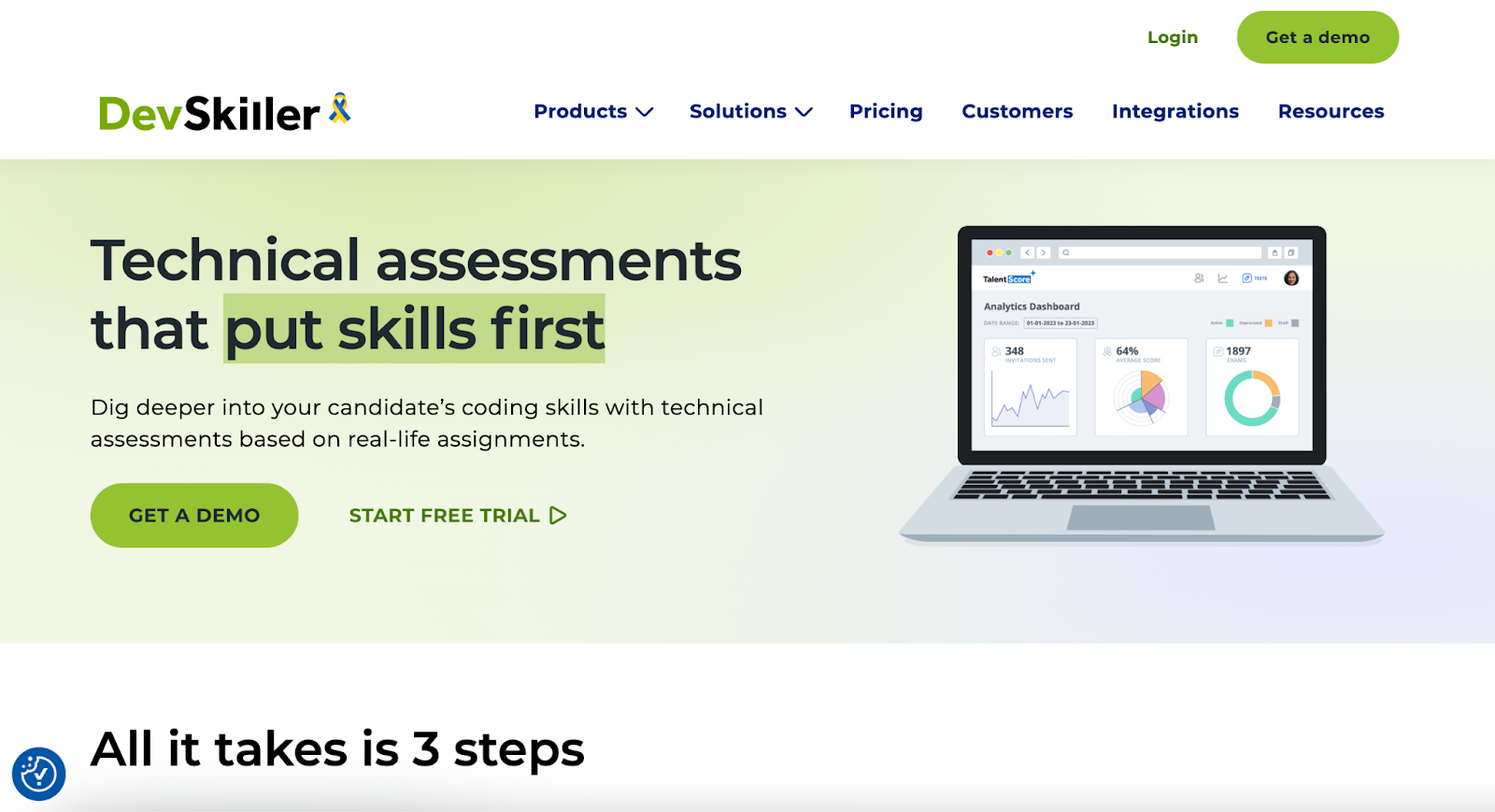
  8. Devskiller
  9. Hired
  10. Glider.ai

Read the detailed description on each of the top recruiting software platforms below:

  1. HackerEarth (Coding Assessments)

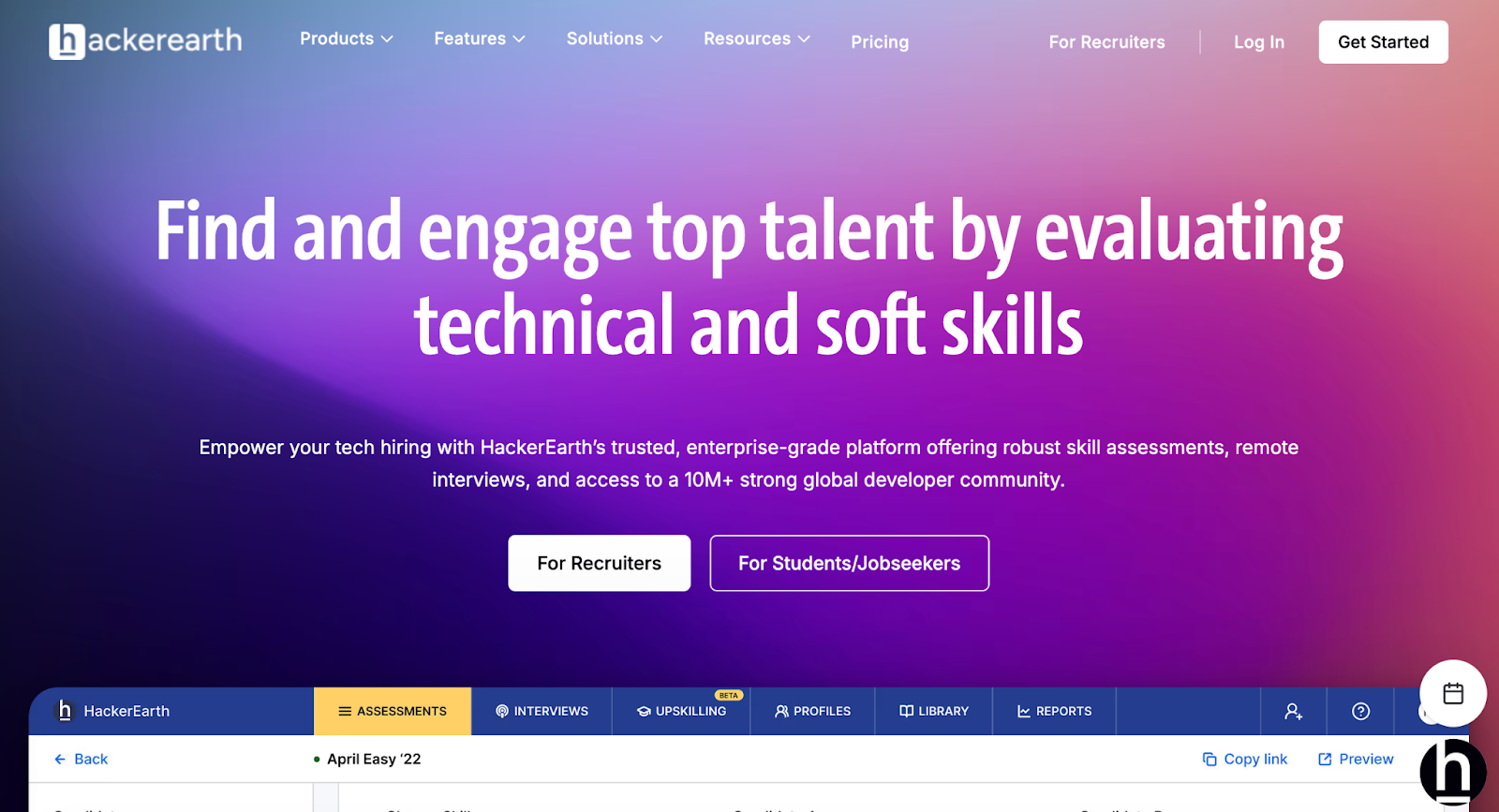
    Recruit, HackerEarth’s technical recruitment software, allows companies to use online coding tests to automate their tech screening process.

    With a library of more than 15,000 questions, technical leads and even non-tech recruiters can conduct tests on a large scale to grade developers for virtually any technical role.

    Supporting 35+, Recruit auto-assesses the submissions of each developer instantly based on defined parameters such as logical correctness, time-efficiency, memory-efficiency, and code quality.

    Tech recruiters can then analyze each applicant’s performance with the detailed reporting and analytics features within Recruit.

    With its proctoring measures and plagiarism detection techniques, recruiters can be surer about the originality of each submission.

    Looking to hire developers? Request a free demo

  2. Dice (Open Web)

    An award-winning social recruiting platform, Open Web aggregates profiles from over 180+ social sites to give you tech talent with hard-to-find skills.

    Tech recruiters can build a tech pro’s profile from digital signatures gathered from these social sites. Dice Open Web also helps them to reach out to passive candidates and get better response rates, saving time and cost.

    This recruiting platform offers predictive analytics to increase the efficiency of the hiring process.

    Talent acquisition and hiring managers can also get an overview of the candidates' technical aptitude as Open Web focuses on portals such as GitHub and Stack Overflow.

    (Also read: 5 reasons you should use Talent Assessment Software)

  3. Codility

    Codility offers an intuitive recruiting platform to increase brand visibility and help source programmers to add value to your company. Developers can be evaluated, or inspired, using customized tests/challenges and interviewed via the automated platform.

  4. HireVue

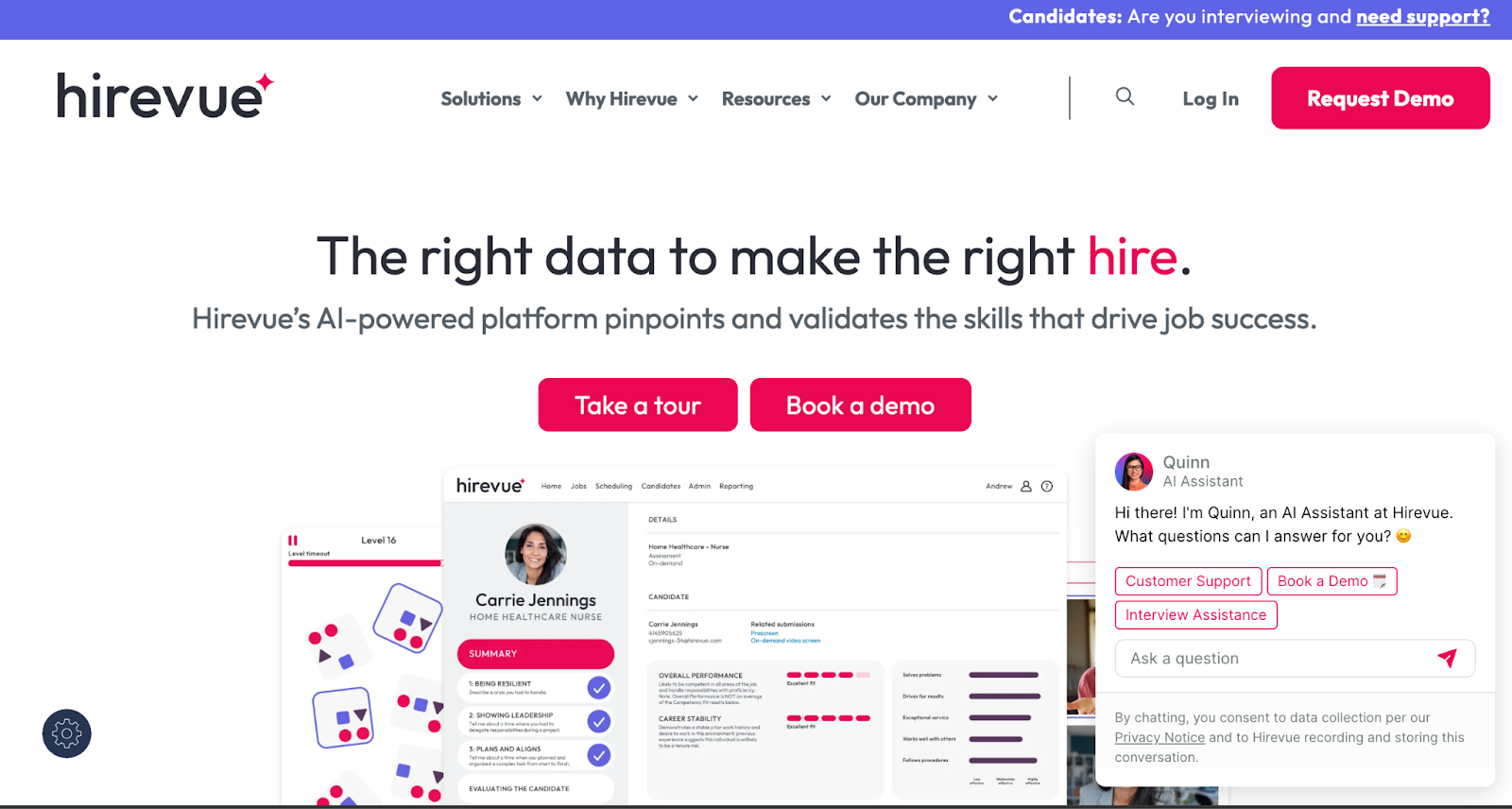
    Utah-based HireVue calls its product an “all-in-one video interview and pre-hire assessment solution.”

    The digital interview platform helps recruiters choose applicants from a sea of resumes by watching videos where they had recorded responses to interview questions.

    The company now adds artificial intelligence (voice recognition software, licensed facial recognition software, a ranking algorithm) to pick the ideal candidate.

    HireVue promises tech recruiters a modern, simple approach to hiring through insightful data.

  5. Pymetrics

    Using neuroscience games and AI, Pymetrics offers a bold recruiting platform that is bias-free.

    It helps tech recruiters build a profile of a candidate not based on resumes but on their emotional and cognitive traits.

    Pymetrics identifies what candidates are best at and matches them to the right jobs; this approach puts applicants on a more equal footing.

    “If LinkedIn and Match.com could have a child, Pymetrics would be it.” (Digital Trends)

  6. People Search (Workable)

    This search engine from Workable helps tech recruiters source candidates using “information aggregated from multiple sources in real-time,” streamline applicant tracking processes and manage interviews.

    People Search helps personalize reach and boost response rates. It allows Boolean queries as well.

  7. The Predictive Index

    This is a behavioral assessment designed to be an effective, simple, and easy evaluation of existing and future employee work skills.

    The proven methodology helps tech recruiters define the cognitive and behavior requirements for a job and assess and hire candidates accurately.

    The test uses a free-choice format and is not timed; it takes about six minutes and measures four constructs: extroversion, dominance, patience, and formality.

  8. Devskiller

    Devskiller lets companies use their own code base to test programmers online and lets developers use their own IDEs and resources.

    Tech recruiters can screen applicants with real-world sample tests to assess what really matters and interview them in real time.

    The recruiter-friendly solution automatically measures the coding skills and finds the real problem solvers. The company says it aims to imitate a “first day at work experience.”

  9. Hired

    Hired brings together tech recruiters and employees, matching the right people to the right jobs.

    The website offers “algorithmic matching, key ATS integrations, and 1:1 support” to make smart recruiting decisions for employers looking for top quality technical talent.

  10. Glider.ai

    This artificial intelligence-powered competency-based hiring platform helps recruiters build great tech teams. Glider’s approach combines the preferences and capabilities of employers (and job seekers) to ensure an efficient recruitment process without bias.

    For data-driven hiring decisions, Glider offers auto-scored coding tasks, video interviews, and real-world simulations.

(Read: How to pick the right assessment tool)

Conclusion

These are only a few of the most effective and popular recruiting platforms available in the market.

With amazing advances in artificial intelligence and machine learning, automation almost guarantees the efficiency and accuracy of the hiring process and helps create a rich workplace.

Although automation in technical recruitment is a no-brainer, organizations must remember to give enough importance to emotional intelligence and human interaction.

The recruitment landscape has changed tremendously in recent years, especially with diversity and inclusion goals and the need to become “innovative” gaining prominence.

Forward-thinking HR leaders must focus on optimizing talent along with strategic hiring and retaining engaged employees to boost overall business performance.

It pays to take all the help you can get—use talent assessment software best suited to your needs and “transform” your recruitment strategy.

Detailed feature comparison of 8 recruiting software platform for developer hiring

We decided to compare the 8 most common recruitment software platforms as per the number of users. These comparisons have been made from an external source.

All platforms have been compared based on price, number of users (admins), number of assessments and 9 other criteria.

Download full comparison by filling the form below -

Developer assessment tools

How to Conduct a Recruitment SWOT Analysis (With Template)

A SWOT analysis is one of the most practical strategic frameworks in business — and it works just as powerfully when applied to recruitment. SWOT stands for Strengths, Weaknesses, Opportunities, and Threats. By mapping these four factors against your hiring process, you gain a clear picture of what is working, what is not, and where your biggest talent acquisition risks and advantages lie.

Whether you are scaling a technical team, reducing time-to-hire, or rethinking your employer brand, a recruitment SWOT analysis gives you a structured way to evaluate internal capabilities and external conditions before making critical workforce decisions. According to SHRM's 2024 Talent Trends report, organizations that conduct regular strategic assessments of their hiring processes are 2.5x more likely to meet their workforce planning goals.

This guide walks you through the full process — from defining your recruitment goals to building a visual SWOT matrix — and includes a ready-to-use template and real-world examples you can adapt immediately.

What Is a SWOT Analysis? (Definition & Meaning)

SWOT Analysis Meaning

A SWOT analysis is a strategic planning framework that organizes information into four categories: Strengths, Weaknesses, Opportunities, and Threats. The first two — strengths and weaknesses — are internal factors that your organization controls. The second two — opportunities and threats — are external factors shaped by the market, competitors, and broader industry trends.

Here is how each component breaks down:

  • Strengths: Internal attributes that give you a competitive advantage. Examples include a strong employer brand, experienced recruiters, or advanced hiring technology.
  • Weaknesses: Internal limitations that hold your hiring process back. Examples include long time-to-fill, outdated job descriptions, or limited candidate pipelines.
  • Opportunities: External conditions you can leverage to improve outcomes. Examples include emerging sourcing channels, remote work expansion, or growing talent pools in new geographies.
  • Threats: External challenges that could negatively impact your ability to hire. Examples include competitor hiring surges, economic downturns, or tightening labor markets.

The framework was first introduced in the 1960s by Albert Humphrey at the Stanford Research Institute. It has since become one of the most widely adopted tools in business strategy, used across industries from product development to human resources.

Why SWOT Analysis Matters

The power of a SWOT analysis lies in its simplicity. It forces structured thinking about both internal realities and external forces, which is exactly what most hiring teams skip when troubleshooting recruitment problems.

In a general business context, SWOT analysis helps organizations make informed decisions about product launches, market entry, or competitive positioning. In HR and recruitment, the same logic applies. You are assessing your talent acquisition function as a system — one that has strengths to leverage, weaknesses to fix, opportunities to seize, and threats to mitigate.

Without this structured evaluation, recruitment decisions tend to be reactive. A SWOT analysis shifts your approach from putting out fires to building a proactive hiring strategy.

Why Use SWOT Analysis for Recruitment?

Recruitment is not just about posting jobs and screening resumes. It is a complex workflow involving employer branding, sourcing, assessments, interviews, offer management, and onboarding. A SWOT analysis for recruitment and selection helps you evaluate each of these components systematically.

Here is why it matters for hiring teams specifically:

  • Identifies bottlenecks before they become crises. If your average time-to-fill is 45 days but the industry benchmark is 30, a SWOT analysis surfaces this weakness alongside its root causes.
  • Reveals untapped sourcing opportunities. You might discover that competitors are not yet tapping into hackathon-based hiring or niche developer communities — an opportunity you can capitalize on.
  • Aligns recruitment with business goals. When leadership plans to expand into a new market, a SWOT analysis helps your hiring team prepare by mapping available talent pools against projected headcount needs.
  • Creates a shared language for hiring stakeholders. A visual SWOT matrix gives recruiters, hiring managers, and executives a common framework to discuss priorities and tradeoffs.

A recruitment SWOT analysis is particularly useful in these scenarios:

  • You are experiencing a hiring surge and need to scale fast without sacrificing quality.
  • Candidate drop-off rates are high and you need to diagnose why.
  • You are entering a new market or hiring for roles you have not recruited for before.
  • Leadership is asking for a strategic assessment of your talent acquisition function.
  • You are evaluating whether to invest in new assessment tools or sourcing platforms.

Step-by-Step Guide to Conducting a Recruitment SWOT Analysis

Step 1 — Define Recruitment Goals

Every SWOT analysis starts with a clear objective. Without one, you end up with a generic list of observations that do not lead anywhere actionable.

Ask yourself: What specific recruitment outcome are you trying to improve? Common goals include:

  • Reducing time-to-hire by 20% over the next two quarters
  • Improving quality of hire for engineering roles
  • Increasing offer acceptance rates from 65% to 80%
  • Expanding the candidate pipeline for underrepresented talent

Define the scope as well. Are you analyzing your entire recruitment function, a single department's hiring process, or a specific role family? The tighter your scope, the more actionable your findings will be.

Step 2 — Gather Data

A SWOT analysis based on assumptions is worse than no analysis at all. Ground every quadrant in real data.

Internal data to collect:

  • Time-to-fill and time-to-hire by role and department
  • Quality-of-hire metrics (performance ratings, retention at 6 and 12 months)
  • Source-of-hire data (which channels produce the best candidates)
  • Candidate experience survey scores
  • Offer acceptance and rejection rates
  • Recruiter workload and capacity metrics

External data to collect:

  • Industry benchmarking reports (LinkedIn Talent Insights, SHRM, Glassdoor)
  • Competitor hiring activity (job postings, Glassdoor reviews, LinkedIn growth)
  • Labor market data for target roles and geographies
  • Emerging technology and sourcing channel trends

If you use coding assessments or technical screening platforms, pull data on candidate pass rates, assessment completion rates, and score distributions. This quantitative evidence strengthens your SWOT matrix significantly.

Step 3 — Identify Strengths

List the internal factors that give your recruitment function an advantage. Be specific and evidence-based.

Examples of recruitment strengths:

  • Strong employer brand with a 4.2+ Glassdoor rating
  • Dedicated technical recruiting team with domain expertise
  • Structured interview process with validated scorecards
  • Advanced hiring technology stack (ATS, AI-powered assessments, video interviews)
  • Fast offer turnaround — average of 3 days from final interview to offer
  • Active talent community or developer engagement programs

Ask your recruiters, hiring managers, and recent hires what they think works best about your process. Their input often reveals strengths that data alone misses.

Step 4 — Identify Weaknesses

This is where honesty matters most. Weaknesses are the internal gaps and limitations that slow your hiring down or reduce its quality.

Examples of recruitment weaknesses:

  • Average time-to-fill exceeding 40 days for technical roles
  • Limited candidate pipeline — over-reliance on one or two sourcing channels
  • High candidate drop-off during assessments or interviews
  • Inconsistent interview practices across teams
  • Lack of structured onboarding reducing new hire retention
  • Manual processes that create administrative bottlenecks

Building a strong candidate pipeline is one of the most common weaknesses organizations uncover during this step. If your pipeline is shallow or stale, it directly impacts every other metric.

Step 5 — Spot Opportunities

Look outward. What external trends, technologies, or market shifts can you use to strengthen your recruiting?

Examples of recruitment opportunities:

  • Growing remote-first talent pools in lower-cost geographies
  • AI-powered sourcing and screening tools that reduce manual effort
  • Hackathons and coding competitions as employer branding and sourcing channels
  • Skills-based hiring trends that broaden candidate pools beyond traditional credentials
  • Partnerships with universities, bootcamps, or professional communities
  • New candidate sourcing strategies enabled by social media and niche platforms

The key is to identify opportunities that directly address one or more of the weaknesses you listed in Step 4. This connection becomes critical when you translate your SWOT into action.

Step 6 — Recognize Threats

Threats are external factors you cannot control but must plan for. Ignoring them is how organizations get blindsided by hiring crunches.

Examples of recruitment threats:

  • Competitors offering 15–25% higher base salaries for the same roles
  • Talent shortages in specialized fields (machine learning, cybersecurity, DevOps)
  • Economic uncertainty causing hiring freezes or budget cuts
  • Negative employer brand perception from public reviews or layoff news
  • Regulatory changes affecting hiring practices (pay transparency laws, AI audit requirements)
  • Candidate use of generative AI making resume screening less reliable

Document threats alongside their potential severity and likelihood. Not all threats deserve the same level of attention, so prioritize the ones with the highest combined impact.

Step 7 — Build & Interpret the Matrix

Organize your findings into a 2x2 SWOT matrix. This visual structure makes it easy to share with stakeholders and identify patterns.

Strengths
Internal · Positive
List your top 4–6 strengths here
Weaknesses
Internal · Negative
List your top 4–6 weaknesses here
Opportunities
External · Positive
List your top 4–6 opportunities here
Threats
External · Negative
List your top 4–6 threats here

Once the matrix is complete, look for connections:

  • Strength + Opportunity: Where can you double down? (e.g., strong tech brand + growing remote talent pool = expand global sourcing)
  • Weakness + Threat: Where are you most vulnerable? (e.g., slow hiring process + aggressive competitor recruiting = losing top candidates)
  • Strength + Threat: How can strengths buffer threats? (e.g., advanced assessments + AI-generated resumes = reliable skill verification)
  • Weakness + Opportunity: What investments would close the gap? (e.g., limited pipeline + new sourcing channels = diversify sourcing strategy)

Recruitment SWOT Analysis Template (Visual + Download)

Blank Template You Can Use

Copy the template below and fill it in with your hiring team. Each quadrant should contain 4–6 specific, evidence-based factors.

STRENGTHS
Internal · Positive
WEAKNESSES
Internal · Negative
OPPORTUNITIES
External · Positive
THREATS
External · Negative

Instructions: How to Fill Each Section

  1. Start with strengths. It is easier to begin with positives. Ask: "What do candidates and hiring managers consistently praise about our process?"
  2. Move to weaknesses. Ask: "Where do we lose candidates? What do exit interviews and hiring manager feedback tell us?"
  3. Map opportunities. Research external trends and ask: "What new channels, tools, or market shifts could we leverage?"
  4. Document threats. Analyze competitor activity and market conditions. Ask: "What external forces could make hiring harder in the next 6–12 months?"
  5. Prioritize each quadrant. Rank factors by impact. Not everything deserves equal attention.
  6. Validate with data. Every factor should be backed by a metric, survey result, or documented trend — not gut feeling.

Printable / Copyable Version

The text-based template above is designed to be copied directly into any document, spreadsheet, or presentation. For a more visual version, use a tool like Miro, Lucidchart, or Canva — each offers free SWOT analysis templates you can customize with your recruitment data.

Examples: SWOT Analysis for Recruitment & Selection

Example 1 — Tech Startup Hiring Surge

A Series B startup needs to grow its engineering team from 15 to 50 developers within six months.

Strengths
Internal · Positive
  • Exciting product and mission attract developers
  • Competitive equity packages
  • Agile, fast-moving culture
Weaknesses
Internal · Negative
  • No dedicated recruiting team — founders handle hiring
  • No structured interview process or standardized assessments
  • Employer brand unknown outside local market
Opportunities
External · Positive
Threats
External · Negative
  • FAANG companies hiring aggressively for the same skill sets
  • Burnout risk if hiring delays overload current team
  • Runway pressure — each month of delay costs $80K+ in lost productivity

Example 2 — Campus Recruitment Challenge

A mid-size enterprise wants to improve its campus hiring program to build a stronger junior developer pipeline.

Strengths
Internal · Positive
  • Established relationships with 5 target universities
  • Strong L&D program for graduates
  • Brand recognition in the region
Weaknesses
Internal · Negative
  • Campus events generate applications but few quality hires
  • Assessment process is resume-based, missing actual coding skills
  • No year-round engagement — only visits during placement season
Opportunities
External · Positive
  • Run online coding challenges to engage students year-round
  • Partner with bootcamps to diversify the talent pool
  • Use skills-based assessments to improve quality of campus hires
Threats
External · Negative
  • Competitors are running branded hackathons and online events
  • Top students accepting offers earlier in the cycle from faster-moving firms
  • Declining enrollment in CS programs at target universities

Example 3 — High-Volume Hiring Needs

A BPO firm needs to hire 500 customer support agents quarterly while maintaining quality and improving candidate experience.

Strengths
Internal · Positive
  • Efficient ATS with automated workflows
  • Large recruiter team experienced in volume hiring
  • Competitive pay for the market
Weaknesses
Internal · Negative
  • 38% candidate drop-off during application process
  • High first-year attrition (42%) suggesting poor job fit
  • Generic job descriptions attracting unqualified applicants
Opportunities
External · Positive
  • AI-powered screening to pre-qualify candidates faster
  • Employee referral program expansion
  • Video interview tools to reduce scheduling bottlenecks
Threats
External · Negative
  • Gig economy pulling potential applicants away
  • Seasonal hiring spikes from competitors in the same market
  • Minimum wage increases squeezing hiring budgets

Interpreting Your SWOT Analysis for Action

How to Convert Insights into Strategy

A SWOT matrix is only valuable if it leads to concrete action. Use the TOWS strategy matrix to translate your four quadrants into specific initiatives:

  • SO Strategies (Strengths + Opportunities): Use your advantages to seize opportunities. Example: Leverage your strong employer brand (strength) to launch a remote hiring campaign targeting new geographies (opportunity).
  • WO Strategies (Weaknesses + Opportunities): Use opportunities to address weaknesses. Example: Implement AI-powered assessments (opportunity) to replace your slow manual screening process (weakness).
  • ST Strategies (Strengths + Threats): Use strengths to defend against threats. Example: Use your advanced technical assessment platform (strength) to maintain hiring quality even as candidates use AI to inflate resumes (threat).
  • WT Strategies (Weaknesses + Threats): Minimize weaknesses to reduce exposure to threats. Example: Build a proactive talent pipeline (fix weakness) to reduce dependence on reactive hiring when competitors surge (threat).

Assign each strategy an owner, a timeline, and a measurable KPI. Without accountability, even the best SWOT analysis ends up as a forgotten whiteboard exercise.

Common Pitfalls to Avoid

  • Confirmation bias. Teams tend to overweight strengths and undercount weaknesses. Use anonymous surveys and external benchmarks to keep assessments honest.
  • Listing too many factors. A quadrant with 15 items is overwhelming and unactionable. Limit each to 4–6 prioritized factors.
  • Treating SWOT as a one-time exercise. The talent market shifts constantly. Revisit your recruitment SWOT quarterly or whenever a major business change occurs.
  • Confusing internal and external factors. A common mistake is listing "talent shortage" as a weakness. It is a threat — you cannot control it internally.
  • Skipping the action plan. The matrix itself does not create change. Strategy and execution do.

How to Integrate with Other HR Frameworks

A SWOT analysis works best when combined with other strategic tools:

  • PESTLE Analysis: Expands the "Threats" and "Opportunities" quadrants by systematically examining Political, Economic, Social, Technological, Legal, and Environmental factors affecting hiring.
  • KPI Dashboards: Use recruitment KPIs (time-to-fill, cost-per-hire, quality-of-hire) to quantify each SWOT factor. Data-backed matrices are far more persuasive than qualitative-only assessments.
  • ATS and Assessment Data: Pull reporting from your applicant tracking system and technical assessment platform to validate strengths and weaknesses with real numbers.

Tools to Help with Recruitment SWOT Analysis

HR Analytics Tools (ATS, BI Tools)

Your applicant tracking system is the richest source of internal data for a recruitment SWOT. Platforms like Greenhouse, Lever, and Workday provide dashboards showing time-to-fill, source effectiveness, and pipeline conversion rates. Pair ATS data with technical assessment platforms to add candidate quality metrics — pass rates, score distributions, and assessment completion rates — directly into your SWOT.

Business intelligence tools like Tableau, Power BI, or Looker can aggregate data across systems to give you a unified view of recruitment performance.

Collaboration Tools for Team Input

A SWOT analysis should never be a solo exercise. Use collaborative tools to gather input from recruiters, hiring managers, HR leadership, and even recent hires:

  • Miro or MURAL for real-time brainstorming sessions with sticky notes mapped to each quadrant
  • Google Forms or Typeform for anonymous input collection
  • Slack or Teams for asynchronous feedback on draft matrices
  • Notion or Confluence for documenting and sharing the final analysis with stakeholders

SWOT Diagram Creators & Template Libraries

If you need a polished visual beyond the text template provided above, these tools offer free SWOT analysis templates:

  • Canva — Drag-and-drop SWOT templates with customizable colors and branding
  • Lucidchart — Diagramming tool with collaborative SWOT matrix templates
  • Creately — Offers SWOT templates with real-time co-editing
  • Miro — Whiteboard-style SWOT templates ideal for remote team workshops
  • Google Slides / PowerPoint — Simple 2x2 grid templates for quick presentations

Conclusion

A recruitment SWOT analysis gives your hiring team a structured, evidence-based way to evaluate what is working, what needs fixing, and where the biggest risks and opportunities lie. It transforms vague concerns about "hiring problems" into a prioritized, actionable strategy.

The process does not need to be complicated. Define your goals, gather real data, fill in the four quadrants, and — most importantly — convert your findings into concrete initiatives with owners and deadlines. Revisit the analysis quarterly to keep it relevant as market conditions and business priorities evolve.

Start with the template in this guide. Gather your hiring stakeholders for a 60-minute SWOT workshop. The insights you uncover will directly shape a stronger, faster, and more competitive talent acquisition strategy.

Frequently Asked Questions

What is a recruitment SWOT analysis?

A recruitment SWOT analysis applies the classic SWOT framework — Strengths, Weaknesses, Opportunities, and Threats — specifically to an organization's hiring process. It evaluates internal factors like employer brand and interview quality alongside external factors like competitor hiring activity and talent market conditions.

Why is SWOT analysis useful in recruitment?

SWOT analysis helps hiring teams identify bottlenecks, uncover untapped sourcing channels, and prepare for competitive threats. It provides a structured way to assess your recruitment function holistically rather than reacting to individual problems as they arise.

How do you conduct a SWOT analysis step by step?

Follow seven steps: (1) Define clear recruitment goals. (2) Gather internal and external data. (3) Identify strengths. (4) Identify weaknesses. (5) Spot external opportunities. (6) Recognize external threats. (7) Build the SWOT matrix and interpret connections between quadrants.

What are some examples of recruitment SWOT analysis?

A tech startup might list "exciting product mission" as a strength and "no dedicated recruiter" as a weakness. A campus recruiter might identify "year-round coding competitions" as an opportunity and "competitors offering earlier offers" as a threat. The examples section above includes three detailed, filled-in matrices.

How does recruitment SWOT help improve hiring?

It forces data-driven evaluation of your entire hiring workflow, highlights where resources are best allocated, and creates alignment between recruiters, hiring managers, and leadership. When paired with a TOWS strategy matrix, it directly translates into prioritized action plans with measurable outcomes.

How often should you update a recruitment SWOT analysis?

Review your recruitment SWOT at least quarterly, or whenever a significant change occurs — such as a new business unit launch, a major competitor entering your talent market, or a shift in hiring volume. The talent market evolves quickly, and a stale SWOT can lead to outdated strategies.

How to Build a Recruitment Pipeline for Seasonal Hiring

Seasonal hiring can be a daunting task, whether it is peak accounting season for finance companies or the time for a product launch, recruiting talent on short notice can be complicated and economically draining. This is where predictive analytics to prepare a recruitment pipeline for seasonal hiring comes into the picture. Creating a talent pipeline for seasonal hiring not only helps companies cut down on hiring costs but also expedites the process without a lot of bottlenecks. This article aims to answer questions like How to build a productive recruitment pipeline for seasonal hiring, What seasonal hiring is, How it differs from traditional recruitment processes, etc.

What Is Seasonal Hiring? How Is It Different From Traditional Hiring?

Seasonal hiring refers to hiring processes conducted during peak business seasons in an organization. A recruitment pipeline refers to a recruitment framework specifically designed to meet the talent needs of an organization. Having a recruitment pipeline contributes to the overall hiring success of the organization. It comprises important hiring tasks that involve candidate sourcing, workforce planning, resume screening and interviewing potential candidates, designing an applicant tracking system (ATS) and finally, onboarding and training process. During a seasonal recruitment process, the interview and screening process is tailored to suit the organisation’s short-term goals during peak business season.

How To Build A Recruitment Pipeline?

Building a recruitment pipeline occurs in different stages. The entire process takes extensive planning, consideration of employer branding at every point of the recruitment system. Seasonal hiring requires hiring teams to have a clear understanding of the organization’s business goals and the pulse of the candidate pool they aim to tap into. The following tips can help build a robust recruitment pipeline for seasonal requirements.

Start Early: Planning Ahead

Seasonality is a regular event. For example, if an organization conducts heavy business during festive seasons, hiring teams must be well prepared to conduct recruitment or outsource it at least Two months prior to the beginning of the season. For example, Companies like Macy's begin their winter recruitment efforts more than six months before the holiday season. This allows them to plan for any hiring contingencies and build a robust talent pool of candidates who are interested in helping Macy’s achieve its seasonal business goals. According to a report by Reuters, the retail sector alone is expected to add 520,000 new jobs in the final quarter of 2024. Starting early can help businesses secure top talent before competitors do.

Develop a Sourcing Strategy

It is essential to conduct thorough market research and analysis to find the best sourcing strategy. Businesses should make use of multiple channels to attract quality candidates. For high-volume recruiting, reaching out to RPO firms and recruitment agencies that specialise in seasonal recruitment are good options to consider. For long-term recruitment, organizations should consider exploring the following recruitment sources.

Job boards: Post openings on popular job sites.

Social media: Leverage platforms like LinkedIn and Facebook to reach potential candidates.

Employee referrals: Encourage current employees to refer qualified candidates.

Build Talent Pools

Creating talent pools involves collecting resumes and information from potential candidates throughout the year, even when there are no immediate openings. This strategy allows businesses to maintain relationships with previous applicants and keep them engaged.

Example: A logistics company might build a talent pool by reaching out to past seasonal workers who performed well but were not hired full-time. By nurturing these relationships, they can quickly fill positions as needed.

Craft Inclusive Job Descriptions

Great job descriptions attract a diverse pool of candidates. It is important to ensure that job descriptions are crafted with language that indicates diversity and inclusion in the workplace. Although seasonal recruitment means hiring for temporary positions, good candidates often get selected for the long term. An apt job description ensures candidate engagement and pleasant candidate experience.

Utilize Technology

Today’s era demands employing recruitment technologies that ensure compliance with the latest recruitment guidelines, and offer automated resume screening services and interviewing techniques, thus improving employer branding and candidate experience. Application Tracking Systems can help manage incoming applications and track their status down the pipeline. Companies like Amazon have invested heavily in technology to streamline their seasonal hiring processes. They use data analytics to predict staffing needs based on historical trends and customer demand, allowing them to adjust their recruitment strategies accordingly.

Focus on Candidate Experience

A positive candidate experience is crucial for attracting and retaining seasonal workers. Organizations should ensure that their application process is straightforward and user-friendly. This includes:
  • Clear job descriptions
  • Timely communication
  • Efficient onboarding processes
Research shows that companies with a strong candidate experience see up to a 70% increase in acceptance rates for job offers.

Engage Candidates Throughout the Process

Candidate experience is one of the crucial cornerstones for which organisations strive to perfect the recruitment process. Establishing clear communication with applicants and informing them of their application status after the screening and interview stages is a major indicator of how much candidate experience matters to businesses. Candidate experience is a major factor affecting employer branding. Retailers like Target send personalized emails to applicants, providing updates and tips for interviews, which enhances candidate engagement and reduces drop-off rates during the hiring process.

Offer Competitive Compensation and Benefits

To attract top talent during peak seasons, businesses should consider offering competitive compensation packages. This could include higher hourly wages, signing bonuses, or flexible work arrangements. During the holiday season, many retailers offer increased pay rates or bonuses for seasonal employees as an incentive for joining their team. This strategy not only attracts more applicants but also helps retain quality workers.

Monitor and Optimize Your Pipeline

Regularly reviewing your recruitment pipeline allows you to identify areas for improvement. Analyze metrics such as time-to-fill positions, candidate quality, and turnover rates among seasonal hires. Companies that actively monitor their recruitment processes can reduce time-to-hire by up to 30%, significantly improving their ability to meet seasonal demands.

Conclusion

Building a recruitment pipeline for seasonal hiring requires strategic planning, effective sourcing methods, and a focus on candidate experience. By starting early, utilizing technology, and engaging with potential hires throughout the process, organizations can create a robust pipeline that ensures they are well-prepared for peak periods.

The benefits of an effective seasonal recruitment pipeline are clear: reduced time-to-fill positions, improved candidate quality, and enhanced operational efficiency during critical times. As demonstrated by successful companies across various industries, investing in a solid recruitment strategy pays off significantly during peak seasons—ensuring businesses can meet customer demands while maintaining high service levels.

By adopting these practices and continuously optimizing their approach, organizations can build sustainable seasonal workforces that drive success year after year.

Benefits of Recruitment Process Outsourcing (RPO)

Today’s era has seen a steep increase in the use of technology in hiring and outsourcing the hiring process. To keep up with the changing times, organisations are adopting a quality-first approach while designing hiring strategies. However, this process requires a dedicated group of people working on a single goal, thus engaging the organization’s financial and physical resources which can prove to be costly in the long run. Hence, more and more establishments are relying on recruitment process outsourcing companies to help them in reducing recruiting costs, save time, find unique talent pools that suit the company’s requirements, etc. This article does a deep dive into the benefits of outsourcing recruitment and the different factors that make it the preferred choice of recruitment for many companies.

What is Recruitment Process Outsourcing?

Outsourcing simply means seeking external help for functions that are crucial to an organization’s well-being. Talent management is one such facet that determines the rate of success of any organization, irrespective of the field. For example, recruiting quality hires is as important to a software company as it is to a law firm. Recruitment process outsourcing helps expedite several functions of an organization’s talent search process while ensuring quality and cost reduction at every stage.

How Does RPO Ensure The Quality of Hires?

Companies that offer recruitment process services have a strong network of reliable talent sources that have a detailed database of qualified candidates. This access allows organizations to tap into a wider selection pool, thus enabling them to control the quality of hire. By broadening the search, RPO improves the likelihood of not only finding highly qualified candidates but also finding those who are the right fit for your organization.

In addition to that, RPO companies are equipped with the latest technology like an ATS (Applicant Tracking System) to track a candidate’s progress down the recruitment pipeline and conduct advanced screening and assessment techniques, possess highly qualified recruitment experts who can identify the right candidates, employ money-saving strategies and focus on long-term hiring goals. The following section will elaborate on these benefits in detail.

The Benefits of Recruitment Process Outsourcing

1. Streamlined Recruitment Processes

An entire hiring cycle comprises intricate tasks that involve lots of effort. For example, the task of sourcing the right candidates who are highly qualified and a great fit for the organisation can be cumbersome if it is not streamlined. RPO companies employ proven methodologies to manage the entire hiring process in a systematic manner. This structured approach eliminates inefficiencies in the hiring process and ensures a uniform hiring experience for candidates. By leveraging this expertise, companies can develop a proactive talent pipeline.

2. Cost Reduction

Saving money is a major concern for many organizations considering recruitment process outsourcing. Traditional recruitment methods involve high expenses related to job advertisements, staffing agencies and administrative expenses. Outsourcing takes care of the extra costs involved in the recruitment process. RPO providers utilize their established networks and resources to minimize the costs, and offer more economical hiring solutions.

3. Faster Time-to-Hire

RPO companies help organizations hire faster, as they have better access to wider talent pools that can fetch the right candidates. An RPO company’s extensive network enables them to help organizations fill vacancies for top jobs quickly and efficiently.

4. Enhanced Employer Branding

Partnering with an RPO provider can strengthen a company’s employer brand. RPO firms often have established relationships with candidates and can create a positive candidate experience throughout the recruitment process. By ensuring effective communication and engagement, companies can enhance their reputation in the job market, attracting higher-quality candidates.

5. Scalability and Flexibility

RPO offers businesses the flexibility to scale recruitment efforts based on fluctuating hiring demands. Whether facing seasonal peaks or organizational changes, RPO solutions can quickly adjust to meet varying needs without compromising quality or efficiency. This adaptability is particularly beneficial for companies experiencing rapid growth or restructuring.

6. Access to Advanced Technology

Many RPO providers come equipped with state-of-the-art technology, including Applicant Tracking Systems (ATS) and Customer Relationship Management (CRM) tools. These technologies facilitate better tracking of candidate statuses, improve communication between employers and applicants, and enhance overall recruitment efficiency. By utilizing these tools, companies can focus on strategic initiatives rather than getting bogged down by administrative tasks.

7. Compliance Support

Navigating the complexities of employment laws and regulations can be daunting for many organizations. RPO providers specialize in compliance management, ensuring that all recruitment practices adhere to relevant laws and standards. This reduces legal risks associated with hiring practices while fostering a fair and transparent recruitment process.

8. Focus on Core Business Activities

By outsourcing recruitment functions, companies can redirect their internal resources towards core business activities that drive growth. This strategic focus allows organizations to enhance product offerings, improve customer service, and develop new markets without being distracted by the intricacies of talent acquisition.

9. Data-Driven Insights

RPO providers offer valuable analytics and reporting capabilities, allowing businesses to gain insights into their recruitment processes. By tracking key performance indicators (KPIs), organizations can make informed decisions about their hiring strategies and continuously improve their processes over time.

Factors to Consider While Deciding on RPO Companies

Understanding Recruitment Needs

Organizations must consider their hiring needs before deciding to outsource their hiring services to a third party company. If the company has a long-term hiring need and can make do with the internal talent acquisition team, then they should reconsider hiring an RPO company. Similarly, if there is a new product or service being introduced and there is an urgent need for new hires, outsourcing may be an organization’s best way out. It is also important to consider the following factors besides long-term and short-term hiring are volume of hiring, recruitment goals and internal capabilities.

Industry Expertise

Once the need to outsource hiring process is justified, the next step is to identify companies that have a proven track record of hiring the best candidates in the industry whose goals align with the goals of the company. An RPO partner familiar with the specific challenges and requirements of your sector can offer tailored solutions that align with your business goals.

Provider Capabilities and Services

Evaluate the capabilities and services offered by potential RPO providers, including:

Sourcing Strategies: Understand their methods for sourcing candidates, including access to talent pools and innovative recruitment techniques.

Screening Processes: Investigate how they assess candidates to ensure quality hires.

Technology Utilization: Check if they leverage advanced recruitment technologies, such as Applicant Tracking Systems (ATS) and analytics tools, to optimize the hiring process. It is also crucial to conduct an internal study of the latest recruitment technologies prevalent in the industry, before proceeding to understand the technologies being used by RPO companies.

Cost and Return on Investment (ROI)

While cost is a significant factor, it is essential to focus on the overall value and ROI that an RPO provider can deliver. Consider:

Transparent Pricing Models: Clear communication is key to ensuring there are no hidden costs related to the outsourced recruiting firm’s services. Take time to understand their pricing in detail, which further allows both parties to seamlessly communicate their monetary expectations.

Cost-effectiveness: Evaluate how their services can reduce overall recruitment expenses while maintaining quality.

Conclusion

To summarize, outsourcing hiring comes with a lot of opportunities for effective hiring. It expedites the hiring process for large organizations by improving the time-to-hire, reduces hiring efforts by employing automated screening technologies like HackerEarth in an effective way. However, it is recommended to consider factors such as an RPO company’s recruitment needs, cost and return on investment and use of technology. If you are a hiring manager or an organization looking to optimize your in-house hiring process with a powerful assessment technology in a cost-effective way, consider HackerEarth’s assessment solutions. From conducting hackathons to offering cutting-edge tech-hiring services for remote work, HackeEarth could be the answer to your hiring needs and challenges. Above all, before you make the decision to outsource the hiring process, understand the hiring needs of your organization and ensure that there are no other ways to hire efficient candidates.

How to Measure the Effectiveness of Recruitment and Selection Process

In today’s competitive job market, it’s not enough for companies to just fill open positions. To ensure long-term success, it’s crucial to measure the effectiveness of recruitment and selection processes. An efficient recruitment process not only attracts top talent but also ensures that new hires are a good fit for the company’s culture and long-term goals. Without proper measurement, companies risk hiring mismatched candidates, leading to turnover and wasted resources.

But how do you accurately assess whether your recruitment and selection process is working as intended? The key lies in using data-driven insights, evaluating key metrics, and continually optimizing the process. Let’s explore how to measure the effectiveness of recruitment and selection, and how platforms like HackerEarth can help streamline this process through skill-based evaluations.

1. Time to Hire

One of the most commonly used metrics to evaluate recruitment effectiveness is the “Time to Hire” (TTH). This metric tracks the amount of time it takes to move a candidate from application to hire. The faster you can hire, the less your business is interrupted by vacant positions.

How to measure:
Time to Hire can be calculated by tracking the number of days from when a job is posted until a candidate accepts an offer. By assessing this metric over time, you can determine whether your recruiting processes are efficient or whether there are bottlenecks.

Why it’s important:
A shorter Time to Hire generally reflects an efficient recruitment process, allowing your team to remain productive and ensuring that candidates don’t lose interest due to a lengthy hiring process.

Example:
Tech companies often face high competition for talent, which means any delays in hiring can result in candidates accepting offers elsewhere. Using a recruitment platform like HackerEarth, which allows for streamlined skill-based assessments, can reduce the time spent on manual screenings and ensure candidates with the right technical expertise are quickly identified and moved through the interview process.

2. Quality of Hire

Attracting a high volume of applicants is one thing, but attracting the right candidates is another. The “Quality of Hire” (QoH) is a metric that evaluates how well new hires are performing in their roles. It looks beyond just whether someone was hired, but whether they’re actually succeeding and adding value to the organization.

How to measure:
Quality of Hire can be measured using performance evaluations, feedback from hiring managers, and retention rates. Key performance indicators (KPIs) such as job performance, cultural fit, and alignment with company values can give a solid picture of a hire’s effectiveness.

Why it’s important:
Quality of Hire directly impacts team performance, innovation, and culture. A poor-quality hire can result in wasted training resources, low productivity, and even reduced morale among existing employees.

Example:
For tech roles, Quality of Hire can be assessed through measurable outcomes, such as project completion rates, quality of code, or innovation contributions. By using a platform like HackerEarth, companies can assess candidates’ technical skills through coding tests and hackathons, ensuring that only those with the right expertise are hired.

3. Candidate Experience

The candidate experience during the recruitment and selection process plays a huge role in determining how effective your process is. A poor candidate experience can harm your employer brand and may even cause top talent to walk away.

How to measure:
Candidate feedback surveys are an excellent way to gauge the overall experience of your candidates. Questions about the clarity of job descriptions, the efficiency of the interview process, and the communication from the hiring team can offer insights into areas of improvement.

Why it’s important:
Candidates who have a positive experience are more likely to share their experience with others, and may even be more likely to accept a job offer if extended. They’re also more likely to return in the future for other opportunities.

Example:
A candidate who applies for a developer position at a tech company may experience multiple stages of assessment, including resume screening, coding challenges, and technical interviews. By incorporating automated assessments and coding challenges using platforms like HackerEarth, companies can provide candidates with a seamless, professional experience, while also speeding up the recruitment process.

4. Cost per Hire

Cost per Hire (CPH) is an essential metric that helps recruiters assess the financial efficiency of their recruitment process. By calculating the cost involved in hiring each candidate, you can determine where you can optimize resources and reduce unnecessary expenses.

How to measure:
Cost per Hire includes all expenses associated with the hiring process: advertising costs, agency fees, recruiter salaries, software tools, and any other expenses incurred. It’s calculated by dividing total hiring costs by the number of hires in a given period.

Why it’s important:
By optimizing recruitment costs without sacrificing the quality of hires, companies can save money and improve the overall effectiveness of their recruiting strategy. Reducing Cost per Hire is crucial in scaling your recruitment efforts without exceeding your budget.

Example:
In the tech industry, using automated tools like HackerEarth’s pre-employment skill assessments can significantly reduce the time and money spent on manual resume screening and initial technical interviews. This not only improves candidate experience but also reduces the total cost of hiring by cutting down on the need for costly external recruiting services.

5. Retention Rate

A key indicator of recruitment effectiveness is how long new hires stay with your organization. High turnover rates can be a sign of poor recruitment decisions, mismatch between candidate and job expectations, or a lack of support during the onboarding process.

How to measure:
The retention rate can be calculated by dividing the number of employees remaining after a certain period (usually one year) by the total number of hires during that same period.

Why it’s important:
High turnover rates can be costly and disruptive, both for the organization and the remaining team members. By assessing retention rates, you can identify trends and make improvements to your hiring and onboarding strategies.

Example:
If a company is consistently losing developers after a few months, it may be a sign that the recruitment process isn’t effectively assessing the candidates’ long-term fit with the organization. Using skill assessments in platforms like HackerEarth helps ensure that candidates have the necessary expertise and can succeed in the role, which improves long-term retention.

The role of HackerEarth in measuring recruitment effectiveness

HackerEarth can play a pivotal role in enhancing recruitment and selection processes by providing skill-based assessments that streamline the hiring process. Instead of relying solely on resumes, which can be subjective and prone to biases, HackerEarth allows organizations to evaluate candidates’ technical abilities through objective, real-world challenges.

By integrating HackerEarth’s automated coding challenges, pre-employment skill assessments, and hackathons, companies can quickly identify top talent, improve the quality of hire, and reduce time-to-hire. This skill-first hiring philosophy ensures that candidates are not only a good cultural fit but also have the technical competencies required to succeed in the role.

Additionally, HackerEarth’s data-driven insights provide organizations with the necessary metrics to track recruitment efficiency, improve candidate experience, and ultimately make more informed hiring decisions.

Conclusion

Measuring the effectiveness of your recruitment and selection process is essential for building a high-performing team. By focusing on key metrics like Time to Hire, Quality of Hire, Candidate Experience, Cost per Hire, and Retention Rate, organizations can identify areas for improvement and implement data-driven solutions. Leveraging platforms like HackerEarth further enhances this process by offering skill-based assessments that ensure the right candidates are hired efficiently, ultimately improving recruitment outcomes and organizational success.

Top 10 SaaS Recruitment Software

The competition for good jobs is very high, and SaaS recruitment software is used in modern companies to manage the vast pool of candidates. These cloud-based software solutions allow organizations to perform repetitive tasks, improve candidate experience, and make data-driven decisions. Facilities like applicant tracking and hiring are thus achieved by recruitment platforms, making it easier for teams to identify talent and integrate them into the organization.

Below, we outline the 10 best SaaS recruitment solutions to help you transform your HR management.

What is SaaS Recruitment Software?

SaaS recruitment software is an application that offers solutions for hiring a candidate for a particular job from start to finish. Compared to conventional methods and tools, SaaS solutions are web-based and thus can be used irrespective of geographical location and working model, whether remote or hybrid. They typically include features like:

  • Applicant tracking.
  • CRM – candidate relationship management.
  • Presentation of data for hiring trends.
  • Advanced media technologies.

Why Use SaaS Recruitment Software?

There are several benefits of employing SaaS recruitment software that help in countering traditional challenges regarding the problem:

  • Scalability: Able to handle any business type, from emerging startups to incumbent large giants.
  • Cost-Effectiveness: Since it is not a complex network setup, it does not warrant huge IT or maintenance expenditures.
  • User-Friendly Interfaces: Reduces the workload of the HR departments and hiring managers when recruiting talents.

Real-Time Updates: Communicates and ensures everyone within and outside the organization is on the same page.

Explore the benefits of these platforms in Best Recruitment Software for Seamless Hiring.

Top 10 SaaS Recruitment Software

Workable

Workable is one of the all-in-one SaaS recruitment tools, and it is famous for having convenient interfaces and numerous benefits. It offers:

  • AI-driven candidate sourcing.
  • Pre-screening questionnaires.
  • Integrated video interviews.

Why Choose Workable? Its simplicity makes it convenient for firms seeking an easy-to-use but functional tool.

Lever

Lever integrates applicant tracking with CRM solutions so candidates can be contacted individually. Key features include:

  • Automated workflows.
  • High-quality data about recruitment outcomes.
  • Customizable pipelines.

Case Study: Lever proved helpful at Netflix by easing the hiring process through which the entertainment giant sources its talent.

Greenhouse

Greenhouse is one of the biggest SaaS recruitment platforms for structured hiring. Its features include:

  • Independent evaluation checklists for candidate scores.
  • Recruitment and orientation procedures for the new employees.
  • High-level data to enhance the processes of selection.

Why Choose Greenhouse: This is especially suitable for organizations that want to organize their hiring and gather quantitative data.

BambooHR

BambooHR is designed for small to mid-sized organizations that need an integrated HR system, tools, and recruitment features. Key features include:

  • Recruitment and hiring for talent.
  • E-signatures for contracts of employment.
  • Employee self-service portals, and so forth.

Learn more about tools for small businesses in Recruiting Software for Small Businesses.

JazzHR

JazzHR is one of the few affordable solutions without a focus on features. It includes:

  • Procedures for hiring in coordination with other departments.
  • Flexible templates for job listings.
  • Integrations with other HR tools and applications.

Case Study: A U.S.-based marketing agency reduced its time-to-hire by 30% using JazzHR’s candidate tracking system.

SmartRecruiters

SmartRecruiters provides features that can meet the demands of large organizations in their hiring process. Highlights include:

  • Hires AI to provide candidate suggestions.
  • Recruitment in multiple countries for the company and supporting multiple languages.
  • Employer branding tools.

Why Choose SmartRecruiters: It has several superior attributes, which makes it most preferred by large-scale international organizations.

Zoho Recruit

Zoho Recruit collaborates with other tools within the Zoho family, providing an easy transition to other business applications. For courier businesses aiming to expand, understanding how to get courier contracts is crucial to secure consistent delivery opportunities. Key features include:

  • Sourcing of candidates through job portals and social networking sites.
  • Computerization of routine or mundane tasks.
  • Customized daily, weekly, or monthly reports that can guide specific strategies and tactics.

Case Study: A European logistics company implemented Zoho Recruit to handle large volumes of recruitment during busy seasons and saw a 40% increase in the hiring process.

Recruitee

Today, Recruitee is aimed at collective hiring, and working with a team is very convenient. It offers:

  • Broaden the reach through integration with other job boards.
  • Checklists for structured interviews.
  • Dragging and dropping of pipeline options.

Why Choose Recruitee: It is especially relevant to teams that recognize the importance of working together and avoiding unnecessary steps.

iCIMS

iCIMS is a scalable talent acquisition software perfect for growing businesses. Its features include:

  • AI-enabled SaaS recruitment marketing.
  • Mobile-friendly career sites.
  • Analytical tools and measurement of performance with a wide range of KPIs.

Why Choose iCIMS: It is especially useful for organizations that want to improve their employer branding and attract more candidates.

Bullhorn

Bullhorn has been developed to accommodate many customers and is used by staffing and recruitment agencies. Features include:

  • End-to-end recruitment CRM.
  • Powerful search capabilities.
  • Instant hiring through mobile applications.

Explore more about top solutions in Top Recruiting Software: A Comprehensive Guide.

How to Choose the Right SaaS Recruitment Software

Identify Your Needs

  • Small businesses seek usability and low software costs.
  • Organizations may require additional functionalities, such as AI integration or support for multiple languages.

Evaluate Scalability

Make sure the software can expand as your organization expands, as this will help you develop the necessary heavy SaaS recruitment.

Consider Integration

Choose solutions compatible with other applications you already use, like HR management systems or payroll software.

Prioritize Candidate Experience

Always select user-friendly software for the application and one with added facilities such as mobile-friendly and real-time integration.

Case Studies: SaaS Recruitment Software in Action

Case Study 1: Spotify’s Greenhouse Integration

Spotify chose Greenhouse to utilize structured SaaS recruitment procedures at the international level. This led to a 25% reduction in hiring bias and enhanced candidate satisfaction scores.

Case Study 2: Zoho Recruit at DHL

DHL implemented Zoho Recruit to efficiently recruit temporary workers. During the festive season, for instance, DHL may require more workers to meet the increased demand.

Future Trends in SaaS Recruitment

AI-Powered Insights

AI is also expected to enhance candidate matching and even do more predictive hiring trends.

Gamification in Recruitment

More platforms will also integrate the features to make the assessments more compelling and accurate.

Hyper-Personalization

SaaS recruitment trends personalized candidate experiences include automated follow-ups and custom job recommendations.

Advanced Analytics

Recruitment platforms will give more information about candidates and hiring efficiency.

Conclusion

SaaS Recruitment software is also revolutionizing the way organizations look for, assess, and hire candidates. Thus, proper platform selection helps increase productivity, provide candidates with a better experience, and achieve the desired result in the hiring process.

Ready to streamline your recruitment process? Visit HackerEarth’s Official Website to explore cutting-edge solutions and resources for your hiring needs.

In the Spotlight

Technical Screening Guide: All You Need To Know

Read this guide and learn how you can establish a less frustrating developer hiring workflow for both hiring teams and candidates.
Read More
Top Products

Explore HackerEarth’s top products for Hiring & Innovation

Discover powerful tools designed to streamline hiring, assess talent efficiently, and run seamless hackathons. Explore HackerEarth’s top products that help businesses innovate and grow.
Frame
Hackathons
Engage global developers through innovation
Arrow
Frame 2
Assessments
AI-driven advanced coding assessments
Arrow
Frame 3
FaceCode
Real-time code editor for effective coding interviews
Arrow
Frame 4
L & D
Tailored learning paths for continuous assessments
Arrow
Authors

Meet our Authors

Get to know the experts behind our content. From industry leaders to tech enthusiasts, our authors share valuable insights, trends, and expertise to keep you informed and inspired.
Ruehie Jaiya Karri
Kumari Trishya

7 Tech Recruiting Trends To Watch Out For In 2024

The last couple of years transformed how the world works and the tech industry is no exception. Remote work, a candidate-driven market, and automation are some of the tech recruiting trends born out of the pandemic.

While accepting the new reality and adapting to it is the first step, keeping up with continuously changing hiring trends in technology is the bigger challenge right now.

What does 2024 hold for recruiters across the globe? What hiring practices would work best in this post-pandemic world? How do you stay on top of the changes in this industry?

The answers to these questions will paint a clearer picture of how to set up for success while recruiting tech talent this year.

7 tech recruiting trends for 2024

6 Tech Recruiting Trends To Watch Out For In 2022

Recruiters, we’ve got you covered. Here are the tech recruiting trends that will change the way you build tech teams in 2024.

Trend #1—Leverage data-driven recruiting

Data-driven recruiting strategies are the answer to effective talent sourcing and a streamlined hiring process.

Talent acquisition leaders need to use real-time analytics like pipeline growth metrics, offer acceptance rates, quality and cost of new hires, and candidate feedback scores to reduce manual work, improve processes, and hire the best talent.

The key to capitalizing on talent market trends in 2024 is data. It enables you to analyze what’s working and what needs refinement, leaving room for experimentation.

Trend #2—Have impactful employer branding

98% of recruiters believe promoting company culture helps sourcing efforts as seen in our 2021 State Of Developer Recruitment report.

Having a strong employer brand that supports a clear Employer Value Proposition (EVP) is crucial to influencing a candidate’s decision to work with your company. Perks like upskilling opportunities, remote work, and flexible hours are top EVPs that attract qualified candidates.

A clear EVP builds a culture of balance, mental health awareness, and flexibility—strengthening your employer brand with candidate-first policies.

Trend #3—Focus on candidate-driven market

The pandemic drastically increased the skills gap, making tech recruitment more challenging. With the severe shortage of tech talent, candidates now hold more power and can afford to be selective.

Competitive pay is no longer enough. Use data to understand what candidates want—work-life balance, remote options, learning opportunities—and adapt accordingly.

Recruiters need to think creatively to attract and retain top talent.


Recommended read: What NOT To Do When Recruiting Fresh Talent


Trend #4—Have a diversity and inclusion oriented company culture

Diversity and inclusion have become central to modern recruitment. While urgent hiring can delay D&I efforts, long-term success depends on inclusive teams. Our survey shows that 25.6% of HR professionals believe a diverse leadership team helps build stronger pipelines and reduces bias.

McKinsey’s Diversity Wins report confirms this: top-quartile gender-diverse companies see 25% higher profitability, and ethnically diverse teams show 36% higher returns.

It's refreshing to see the importance of an inclusive culture increasing across all job-seeking communities, especially in tech. This reiterates that D&I is a must-have, not just a good-to-have.

—Swetha Harikrishnan, Sr. HR Director, HackerEarth

Recommended read: Diversity And Inclusion in 2022 - 5 Essential Rules To Follow


Trend #5—Embed automation and AI into your recruitment systems

With the rise of AI tools like ChatGPT, automation is being adopted across every business function—including recruiting.

Manual communication with large candidate pools is inefficient. In 2024, recruitment automation and AI-powered platforms will automate candidate nurturing and communication, providing a more personalized experience while saving time.

Trend #6—Conduct remote interviews

With 32.5% of companies planning to stay remote, remote interviewing is here to stay.

Remote interviews expand access to global talent, reduce overhead costs, and increase flexibility—making the hiring process more efficient for both recruiters and candidates.

Trend #7—Be proactive in candidate engagement

Delayed responses or lack of updates can frustrate candidates and impact your brand. Proactive communication and engagement with both active and passive candidates are key to successful recruiting.

As recruitment evolves, proactive candidate engagement will become central to attracting and retaining talent. In 2023 and beyond, companies must engage both active and passive candidates through innovative strategies and technologies like chatbots and AI-powered systems. Building pipelines and nurturing relationships will enhance employer branding and ensure long-term hiring success.

—Narayani Gurunathan, CEO, PlaceNet Consultants

Recruiting Tech Talent Just Got Easier With HackerEarth

Recruiting qualified tech talent is tough—but we’re here to help. HackerEarth for Enterprises offers an all-in-one suite that simplifies sourcing, assessing, and interviewing developers.

Our tech recruiting platform enables you to:

  • Tap into a 6 million-strong developer community
  • Host custom hackathons to engage talent and boost your employer brand
  • Create online assessments to evaluate 80+ tech skills
  • Use dev-friendly IDEs and proctoring for reliable evaluations
  • Benchmark candidates against a global community
  • Conduct live coding interviews with FaceCode, our collaborative coding interview tool
  • Guide upskilling journeys via our Learning and Development platform
  • Integrate seamlessly with all leading ATS systems
  • Access 24/7 support with a 95% satisfaction score

Recommended read: The A-Zs Of Tech Recruiting - A Guide


Staying ahead of tech recruiting trends, improving hiring processes, and adapting to change is the way forward in 2024. Take note of the tips in this article and use them to build a future-ready hiring strategy.

Ready to streamline your tech recruiting? Try HackerEarth for Enterprises today.

(Part 2) Essential Questions To Ask When Interviewing Developers In 2021

The first part of this blog stresses the importance of asking the right technical interview questions to assess a candidate’s coding skills. But that alone is not enough. If you want to hire the crème de la crème of the developer talent out there, you have to look for a well-rounded candidate.

Honest communication, empathy, and passion for their work are equally important as a candidate’s technical knowledge. Soft skills are like the cherry on top. They set the best of the candidates apart from the rest.

Re-examine how you are vetting your candidates. Identify the gaps in your interviews. Once you start addressing these gaps, you find developers who have the potential to be great. And those are exactly the kind of people that you want to work with!

Let’s get to it, shall we?

Hire great developers

What constitutes a good interview question?

An ideal interview should reveal a candidate’s personality along with their technical knowledge. To formulate a comprehensive list of questions, keep in mind three important characteristics.

  • Questions are open-ended – questions like, “What are some of the programming languages you’re comfortable with,” instead of “Do you know this particular programming language” makes the candidate feel like they’re in control. It is also a chance to let them reply to your question in their own words.
  • They address the behavioral aspects of a candidate – ensure you have a few questions on your list that allow a candidate to describe a situation. A situation where a client was unhappy or a time when the developer learned a new technology. Such questions help you assess if the candidate is a good fit for the team.
  • There is no right or wrong answer – it is important to have a structured interview process in place. But this does not mean you have a list of standard answers in mind that you’re looking for. How candidates approach your questions shows you whether they have the makings of a successful candidate. Focus on that rather than on the actual answer itself.

Designing a conversation around these buckets of interview questions brings you to my next question, “What should you look for in each candidate to spot the best ones?”

Hire GREAT developers by asking the right questions

Before we dive deep into the interview questions, we have to think about a few things that have changed. COVID-19 has rendered working from home the new normal for the foreseeable future. As a recruiter, the onus falls upon you to understand whether the developer is comfortable working remotely and has the relevant resources to achieve maximum productivity.

#1 How do you plan your day?

Remote work gives employees the option to be flexible. You don’t have to clock in 9 hours a day as long as you get everything done on time. A developer who hasn’t always been working remotely, but has a routine in place, understands the pitfalls of working from home. It is easy to get distracted and having a schedule to fall back on ensures good productivity.

#2 Do you have experience using tools for collaboration and remote work?

Working from home reduces human interaction heavily. There is no way to just go up to your teammate’s desk and clarify issues. Virtual communication is key to getting work done. Look for what kind of remote working tools your candidate is familiar with and if they know what collaborative tools to use for different tasks.

Value-based interview questions to ask

We went around and spoke to our engineering team, and the recruiting team to see what questions they abide by; what they think makes any candidate tick.

The result? – a motley group of questions that aim to reveal the candidate’s soft skills, in addition to typical technical interview questions and test tasks.


Recommended read: How Recruiting The Right Tech Talent Can Solve Tech Debt


#3 Please describe three recent projects that you worked on. What were the most interesting and challenging parts?

This is an all-encompassing question in that it lets the candidate explain at length about their work ethic—thought process, handling QA, working with a team, and managing user feedback. This also lets you dig enough to assess whether the candidate is taking credit for someone else's work or not.

#4 You’ve worked long and hard to deliver a complex feature for a client and they say it’s not what they asked for. How would you take it?

A good developer will take it in their stride, work closely with the client to find the point of disconnect, and sort out the issue. There are so many things that could go wrong or not be to the client’s liking, and it falls on the developer to remain calm and create solutions.

#5 What new programming languages or technologies have you learned recently?

While being certified in many programming languages doesn't guarantee a great developer, it still is an important technical interview question to ask. It helps highlight a thirst for knowledge and shows that the developer is eager to learn new things.

#6 What does the perfect release look like? Who is involved and what is your role?

Have the developer take you through each phase of a recent software development lifecycle. Ask them to explain their specific role in each phase in this release. This will give you an excellent perspective into a developer’s mind. Do they talk about the before and after of the release? A skilled developer would. The chances of something going wrong in a release are very high. How would the developer react? Will they be able to handle the pressure?


SUBSCRIBE to the HackerEarth blog and enrich your monthly reading with our free e-newsletter – Fresh, insightful and awesome articles straight into your inbox from around the tech recruiting world!


#7 Tell me about a time when you had to convince your lead to try a different approach?

As an example of a behavioral interview question, this is a good one. The way a developer approaches this question speaks volumes about how confident they are expressing their views, and how succinct they are in articulating those views.

#8 What have you done with all the extra hours during the pandemic?

Did you binge-watch your way through the pandemic? I’m sure every one of us has done this. Indulge in a lighthearted conversation with your candidate. This lets them talk about something they are comfortable with. Maybe they learned a new skill or took up a hobby. Get to know a candidate’s interests and little pleasures for a more rounded evaluation.

Over to you! Now that you know what aspects of a candidate to focus on, you are well-equipped to bring out the best in each candidate in their interviews. A mix of strong technical skills and interpersonal qualities is how you spot good developers for your team.

If you have more pressing interview questions to add to this list of ours, please write to us at contact@hackerearth.com.

(Part 1) Essential Questions To Ask When Recruiting Developers In 2021

The minute a developer position opens up, recruiters feel a familiar twinge of fear run down their spines. They recall their previous interview experiences, and how there seems to be a blog post a month that goes viral about bad developer interviews.

While hiring managers, especially the picky ones, would attribute this to a shortage of talented developers, what if the time has come to rethink your interview process? What if recruiters and hiring managers put too much stock into bringing out the technical aspects of each candidate and don’t put enough emphasis on their soft skills?

A report by Robert Half shows that 86% of technology leaders say it’s challenging to find IT talent. Interviewing developers should be a rewarding experience, not a challenging one. If you don’t get caught up in asking specific questions and instead design a simple conversation to gauge a candidate’s way of thinking, it throws up a lot of good insight and makes it fun too.

Developer Hiring Statistics

Asking the right technical interview questions when recruiting developers is important but so is clear communication, good work ethic, and alignment with your organization’s goals.

Let us first see what kind of technical interview questions are well-suited to revealing the coding skills and knowledge of any developer, and then tackle the behavioral aspects of the candidate that sets them apart from the rest.

Recruit GREAT developers by asking the right questions

Here are some technical interview questions that you should ask potential software engineers when interviewing.

#1 Write an algorithm for the following

  1. Minimum Stack - Design a stack that provides 4 functions - push(item), pop, peek, and minimum, all in constant order time complexity. Then move on to coding the actual solution.
  2. Kth Largest Element in an array - This is a standard problem with multiple solutions of best time complexity orders where N log(K) is a common one and O(N) + K log(N) is a lesser-known order. Both solutions are acceptable, not directly comparable to each other, and better than N log(N), which is sorting an array and fetching the Kth element.
  3. Top View of a Binary Tree - Given a root node of the binary tree, return the set of all elements that will get wet if it rains on the tree. Nodes having any nodes directly above them will not get wet.
  4. Internal implementation of a hashtable like a map/dictionary - A candidate needs to specify how key-value pairs are stored, hashing is used and collisions are handled. A good developer not only knows how to use this concept but also how it works. If the developer also knows how the data structure scales when the number of records increases in the hashtable, that is a bonus.

Algorithms demonstrate a candidate’s ability to break down a complex problem into steps. Reasoning and pattern recognition capabilities are some more factors to look for when assessing a candidate. A good candidate can code his thought process of the algorithm finalized during the discussion.


Looking for a great place to hire developers in the US? Try Jooble!


#2 Formulate solutions for the below low-level design (LLD) questions

  • What is LLD? In your own words, specify the different aspects covered in LLD.
  • Design a movie ticket booking application like BookMyShow. Ensure that your database schema is tailored for a theatre with multiple screens and takes care of booking, seat availability, seat arrangement, and seat locking. Your solution does not have to extend to the payment option.
  • Design a basic social media application. Design database schema and APIs for a platform like Twitter with features for following a user, tweeting a post, seeing your tweet, and seeing a user's tweet.

Such questions do not have a right or wrong answer. They primarily serve to reveal a developer’s thought process and the way they approach a problem.


Recommended read: Hardest Tech Roles to Fill (+ solutions!)


#3 Some high-level design (HLD) questions

  • What do you understand by HLD? Can you specify the difference between LLD and HLD?
  • Design a social media application. In addition to designing a platform like Twitter with features for following a user, tweeting a post, seeing your tweet, and seeing a user's tweet, design a timeline. After designing a timeline where you can see your followers’ tweets, scale it for a larger audience. If you still have time, try to scale it for a celebrity use case.
  • Design for a train ticket booking application like IRCTC. Incorporate auth, features to choose start and end stations, view available trains and available seats between two stations, save reservation of seats from start to end stations, and lock them till payment confirmation.
  • How will you design a basic relational database? The database should support tables, columns, basic field types like integer and text, foreign keys, and indexes. The way a developer approaches this question is important. A good developer designs a solution around storage and memory management.
Here’s a pro-tip for you. LLD questions can be answered by both beginners and experienced developers. Mostly, senior developers can be expected to answer HLD questions. Choose your interview questions set wisely, and ask questions relevant to your candidate’s experience.

#4 Have you ever worked with SQL? Write queries for a specific use case that requires multiple joins.

Example: Create a table with separate columns for student name, subject, and marks scored. Return student names and ranks of each student. The rank of a student depends on the total of marks in all subjects.

Not all developers would have experience working with SQL but some knowledge about how data is stored/structured is useful. Developers should be familiar with simple concepts like joins, retrieval queries, and the basics of DBMS.

#5 What do you think is wrong with this code?

Instead of asking developer candidates to write code on a piece of paper (which is outdated, anyway), ask them to debug existing code. This is another way to assess their technical skills. Place surreptitious errors in the code and evaluate their attention to detail.

Now that you know exactly what technical skills to look for and when questions to ask when interviewing developers, the time has come to assess the soft skills of these candidates. Part 2 of this blog throws light on the how and why of evaluating candidates based on their communication skills, work ethic, and alignment with the company’s goals.

View all

Best Pre-Employment Assessments: Optimizing Your Hiring Process for 2024

In today's competitive talent market, attracting and retaining top performers is crucial for any organization's success. However, traditional hiring methods like relying solely on resumes and interviews may not always provide a comprehensive picture of a candidate's skills and potential. This is where pre-employment assessments come into play.

What is Pre-Employement Assessment?

Pre-employment assessments are standardized tests and evaluations administered to candidates before they are hired. These assessments can help you objectively measure a candidate's knowledge, skills, abilities, and personality traits, allowing you to make data-driven hiring decisions.

By exploring and evaluating the best pre-employment assessment tools and tests available, you can:

  • Improve the accuracy and efficiency of your hiring process.
  • Identify top talent with the right skills and cultural fit.
  • Reduce the risk of bad hires.
  • Enhance the candidate experience by providing a clear and objective evaluation process.

This guide will provide you with valuable insights into the different types of pre-employment assessments available and highlight some of the best tools, to help you optimize your hiring process for 2024.

Why pre-employment assessments are key in hiring

While resumes and interviews offer valuable insights, they can be subjective and susceptible to bias. Pre-employment assessments provide a standardized and objective way to evaluate candidates, offering several key benefits:

  • Improved decision-making:

    By measuring specific skills and knowledge, assessments help you identify candidates who possess the qualifications necessary for the job.

  • Reduced bias:

    Standardized assessments mitigate the risks of unconscious bias that can creep into traditional interview processes.

  • Increased efficiency:

    Assessments can streamline the initial screening process, allowing you to focus on the most promising candidates.

  • Enhanced candidate experience:

    When used effectively, assessments can provide candidates with a clear understanding of the required skills and a fair chance to showcase their abilities.

Types of pre-employment assessments

There are various types of pre-employment assessments available, each catering to different needs and objectives. Here's an overview of some common types:

1. Skill Assessments:

  • Technical Skills: These assessments evaluate specific technical skills and knowledge relevant to the job role, such as programming languages, software proficiency, or industry-specific expertise. HackerEarth offers a wide range of validated technical skill assessments covering various programming languages, frameworks, and technologies.
  • Soft Skills: These employment assessments measure non-technical skills like communication, problem-solving, teamwork, and critical thinking, crucial for success in any role.

2. Personality Assessments:

These employment assessments can provide insights into a candidate's personality traits, work style, and cultural fit within your organization.

3. Cognitive Ability Tests:

These tests measure a candidate's general mental abilities, such as reasoning, problem-solving, and learning potential.

4. Integrity Assessments:

These employment assessments aim to identify potential risks associated with a candidate's honesty, work ethic, and compliance with company policies.

By understanding the different types of assessments and their applications, you can choose the ones that best align with your specific hiring needs and ensure you hire the most qualified and suitable candidates for your organization.

Leading employment assessment tools and tests in 2024

Choosing the right pre-employment assessment tool depends on your specific needs and budget. Here's a curated list of some of the top pre-employment assessment tools and tests available in 2024, with brief overviews:

  • HackerEarth:

    A comprehensive platform offering a wide range of validated skill assessments in various programming languages, frameworks, and technologies. It also allows for the creation of custom assessments and integrates seamlessly with various recruitment platforms.

  • SHL:

    Provides a broad selection of assessments, including skill tests, personality assessments, and cognitive ability tests. They offer customizable solutions and cater to various industries.

  • Pymetrics:

    Utilizes gamified assessments to evaluate cognitive skills, personality traits, and cultural fit. They offer a data-driven approach and emphasize candidate experience.

  • Wonderlic:

    Offers a variety of assessments, including the Wonderlic Personnel Test, which measures general cognitive ability. They also provide aptitude and personality assessments.

  • Harver:

    An assessment platform focusing on candidate experience with video interviews, gamified assessments, and skills tests. They offer pre-built assessments and customization options.

Remember: This list is not exhaustive, and further research is crucial to identify the tool that aligns best with your specific needs and budget. Consider factors like the types of assessments offered, pricing models, integrations with your existing HR systems, and user experience when making your decision.

Choosing the right pre-employment assessment tool

Instead of full individual tool reviews, consider focusing on 2–3 key platforms. For each platform, explore:

  • Target audience: Who are their assessments best suited for (e.g., technical roles, specific industries)?
  • Types of assessments offered: Briefly list the available assessment categories (e.g., technical skills, soft skills, personality).
  • Key features: Highlight unique functionalities like gamification, custom assessment creation, or seamless integrations.
  • Effectiveness: Briefly mention the platform's approach to assessment validation and reliability.
  • User experience: Consider including user reviews or ratings where available.

Comparative analysis of assessment options

Instead of a comprehensive comparison, consider focusing on specific use cases:

  • Technical skills assessment:

    Compare HackerEarth and Wonderlic based on their technical skill assessment options, focusing on the variety of languages/technologies covered and assessment formats.

  • Soft skills and personality assessment:

    Compare SHL and Pymetrics based on their approaches to evaluating soft skills and personality traits, highlighting any unique features like gamification or data-driven insights.

  • Candidate experience:

    Compare Harver and Wonderlic based on their focus on candidate experience, mentioning features like video interviews or gamified assessments.

Additional tips:

  • Encourage readers to visit the platforms' official websites for detailed features and pricing information.
  • Include links to reputable third-party review sites where users share their experiences with various tools.

Best practices for using pre-employment assessment tools

Integrating pre-employment assessments effectively requires careful planning and execution. Here are some best practices to follow:

  • Define your assessment goals:

    Clearly identify what you aim to achieve with assessments. Are you targeting specific skills, personality traits, or cultural fit?

  • Choose the right assessments:

    Select tools that align with your defined goals and the specific requirements of the open position.

  • Set clear expectations:

    Communicate the purpose and format of the assessments to candidates in advance, ensuring transparency and building trust.

  • Integrate seamlessly:

    Ensure your chosen assessment tool integrates smoothly with your existing HR systems and recruitment workflow.

  • Train your team:

    Equip your hiring managers and HR team with the knowledge and skills to interpret assessment results effectively.

Interpreting assessment results accurately

Assessment results offer valuable data points, but interpreting them accurately is crucial for making informed hiring decisions. Here are some key considerations:

  • Use results as one data point:

    Consider assessment results alongside other information, such as resumes, interviews, and references, for a holistic view of the candidate.

  • Understand score limitations:

    Don't solely rely on raw scores. Understand the assessment's validity and reliability and the potential for cultural bias or individual test anxiety.

  • Look for patterns and trends:

    Analyze results across different assessments and identify consistent patterns that align with your desired candidate profile.

  • Focus on potential, not guarantees:

    Assessments indicate potential, not guarantees of success. Use them alongside other evaluation methods to make well-rounded hiring decisions.

Choosing the right pre-employment assessment tools

Selecting the most suitable pre-employment assessment tool requires careful consideration of your organization's specific needs. Here are some key factors to guide your decision:

  • Industry and role requirements:

    Different industries and roles demand varying skill sets and qualities. Choose assessments that target the specific skills and knowledge relevant to your open positions.

  • Company culture and values:

    Align your assessments with your company culture and values. For example, if collaboration is crucial, look for assessments that evaluate teamwork and communication skills.

  • Candidate experience:

    Prioritize tools that provide a positive and smooth experience for candidates. This can enhance your employer brand and attract top talent.

Budget and accessibility considerations

Budget and accessibility are essential factors when choosing pre-employment assessments:

  • Budget:

    Assessment tools come with varying pricing models (subscriptions, pay-per-use, etc.). Choose a tool that aligns with your budget and offers the functionalities you need.

  • Accessibility:

    Ensure the chosen assessment is accessible to all candidates, considering factors like language options, disability accommodations, and internet access requirements.

Additional Tips:

  • Free trials and demos: Utilize free trials or demos offered by assessment platforms to experience their functionalities firsthand.
  • Consult with HR professionals: Seek guidance from HR professionals or recruitment specialists with expertise in pre-employment assessments.
  • Read user reviews and comparisons: Gain insights from other employers who use various assessment tools.

By carefully considering these factors, you can select the pre-employment assessment tool that best aligns with your organizational needs, budget, and commitment to an inclusive hiring process.

Remember, pre-employment assessments are valuable tools, but they should not be the sole factor in your hiring decisions. Use them alongside other evaluation methods and prioritize building a fair and inclusive hiring process that attracts and retains top talent.

Future trends in pre-employment assessments

The pre-employment assessment landscape is constantly evolving, with innovative technologies and practices emerging. Here are some potential future trends to watch:

  • Artificial intelligence (AI):

    AI-powered assessments can analyze candidate responses, written work, and even resumes, using natural language processing to extract relevant insights and identify potential candidates.

  • Adaptive testing:

    These assessments adjust the difficulty level of questions based on the candidate's performance, providing a more efficient and personalized evaluation.

  • Micro-assessments:

    Short, focused assessments delivered through mobile devices can assess specific skills or knowledge on-the-go, streamlining the screening process.

  • Gamification:

    Engaging and interactive game-based elements can make the assessment experience more engaging and assess skills in a realistic and dynamic way.

Conclusion

Pre-employment assessments, when used thoughtfully and ethically, can be a powerful tool to optimize your hiring process, identify top talent, and build a successful workforce for your organization. By understanding the different types of assessments available, exploring top-rated tools like HackerEarth, and staying informed about emerging trends, you can make informed decisions that enhance your ability to attract, evaluate, and hire the best candidates for the future.

Tech Layoffs: What To Expect In 2024

Layoffs in the IT industry are becoming more widespread as companies fight to remain competitive in a fast-changing market; many turn to layoffs as a cost-cutting measure. Last year, 1,000 companies including big tech giants and startups, laid off over two lakhs of employees. But first, what are layoffs in the tech business, and how do they impact the industry?

Tech layoffs are the termination of employment for some employees by a technology company. It might happen for various reasons, including financial challenges, market conditions, firm reorganization, or the after-effects of a pandemic. While layoffs are not unique to the IT industry, they are becoming more common as companies look for methods to cut costs while remaining competitive.

The consequences of layoffs in technology may be catastrophic for employees who lose their jobs and the firms forced to make these difficult decisions. Layoffs can result in the loss of skill and expertise and a drop in employee morale and productivity. However, they may be required for businesses to stay afloat in a fast-changing market.

This article will examine the reasons for layoffs in the technology industry, their influence on the industry, and what may be done to reduce their negative impacts. We will also look at the various methods for tracking tech layoffs.

What are tech layoffs?

The term "tech layoff" describes the termination of employees by an organization in the technology industry. A company might do this as part of a restructuring during hard economic times.

In recent times, the tech industry has witnessed a wave of significant layoffs, affecting some of the world’s leading technology companies, including Amazon, Microsoft, Meta (formerly Facebook), Apple, Cisco, SAP, and Sony. These layoffs are a reflection of the broader economic challenges and market adjustments facing the sector, including factors like slowing revenue growth, global economic uncertainties, and the need to streamline operations for efficiency.

Each of these tech giants has announced job cuts for various reasons, though common themes include restructuring efforts to stay competitive and agile, responding to over-hiring during the pandemic when demand for tech services surged, and preparing for a potentially tough economic climate ahead. Despite their dominant positions in the market, these companies are not immune to the economic cycles and technological shifts that influence operational and strategic decisions, including workforce adjustments.

This trend of layoffs in the tech industry underscores the volatile nature of the tech sector, which is often at the mercy of rapid changes in technology, consumer preferences, and the global economy. It also highlights the importance of adaptability and resilience for companies and employees alike in navigating the uncertainties of the tech landscape.

Causes for layoffs in the tech industry

Why are tech employees suffering so much?

Yes, the market is always uncertain, but why resort to tech layoffs?

Various factors cause tech layoffs, including company strategy changes, market shifts, or financial difficulties. Companies may lay off employees if they need help to generate revenue, shift their focus to new products or services, or automate certain jobs.

In addition, some common reasons could be:

Financial struggles

Currently, the state of the global market is uncertain due to economic recession, ongoing war, and other related phenomena. If a company is experiencing financial difficulties, only sticking to pay cuts may not be helpful—it may need to reduce its workforce to cut costs.


Also, read: 6 Steps To Create A Detailed Recruiting Budget (Template Included)


Changes in demand

The tech industry is constantly evolving, and companies would have to adjust their workforce to meet changing market conditions. For instance, companies are adopting remote work culture, which surely affects on-premises activity, and companies could do away with some number of tech employees at the backend.

Restructuring

Companies may also lay off employees as part of a greater restructuring effort, such as spinning off a division or consolidating operations.

Automation

With the advancement in technology and automation, some jobs previously done by human labor may be replaced by machines, resulting in layoffs.

Mergers and acquisitions

When two companies merge, there is often overlap in their operations, leading to layoffs as the new company looks to streamline its workforce.

But it's worth noting that layoffs are not exclusive to the tech industry and can happen in any industry due to uncertainty in the market.

Will layoffs increase in 2024?

It is challenging to estimate the rise or fall of layoffs. The overall state of the economy, the health of certain industries, and the performance of individual companies will play a role in deciding the degree of layoffs in any given year.

But it is also seen that, in the first 15 days of this year, 91 organizations laid off over 24,000 tech workers, and over 1,000 corporations cut down more than 150,000 workers in 2022, according to an Economic Times article.

The COVID-19 pandemic caused a huge economic slowdown and forced several businesses to downsize their employees. However, some businesses rehired or expanded their personnel when the world began to recover.

So, given the current level of economic uncertainty, predicting how the situation will unfold is difficult.


Also, read: 4 Images That Show What Developers Think Of Layoffs In Tech


What types of companies are prone to tech layoffs?

2023 Round Up Of Layoffs In Big Tech

Tech layoffs can occur in organizations of all sizes and various areas.

Following are some examples of companies that have experienced tech layoffs in the past:

Large tech firms

Companies such as IBM, Microsoft, Twitter, Better.com, Alibaba, and HP have all experienced layoffs in recent years as part of restructuring initiatives or cost-cutting measures.

Market scenarios are still being determined after Elon Musk's decision to lay off employees. Along with tech giants, some smaller companies and startups have also been affected by layoffs.

Startups

Because they frequently work with limited resources, startups may be forced to lay off staff if they cannot get further funding or need to pivot due to market downfall.

Small and medium-sized businesses

Small and medium-sized businesses face layoffs due to high competition or if the products/services they offer are no longer in demand.

Companies in certain industries

Some sectors of the technological industry, such as the semiconductor industry or automotive industry, may be more prone to layoffs than others.

Companies that lean on government funding

Companies that rely significantly on government contracts may face layoffs if the government cuts technology spending or contracts are not renewed.

How to track tech layoffs?

You can’t stop tech company layoffs, but you should be keeping track of them. We, HR professionals and recruiters, can also lend a helping hand in these tough times by circulating “layoff lists” across social media sites like LinkedIn and Twitter to help people land jobs quicker. Firefish Software put together a master list of sources to find fresh talent during the layoff period.

Because not all layoffs are publicly disclosed, tracking tech industry layoffs can be challenging, and some may go undetected. There are several ways to keep track of tech industry layoffs:

Use tech layoffs tracker

Layoff trackers like thelayoff.com and layoffs.fyi provide up-to-date information on layoffs.

In addition, they aid in identifying trends in layoffs within the tech industry. It can reveal which industries are seeing the most layoffs and which companies are the most affected.

Companies can use layoff trackers as an early warning system and compare their performance to that of other companies in their field.

News articles

Because many news sites cover tech layoffs as they happen, keeping a watch on technology sector stories can provide insight into which organizations are laying off employees and how many individuals have been affected.

Social media

Organizations and employees frequently publish information about layoffs in tech on social media platforms; thus, monitoring companies' social media accounts or following key hashtags can provide real-time updates regarding layoffs.

Online forums and communities

There are online forums and communities dedicated to discussing tech industry news, and they can be an excellent source of layoff information.

Government reports

Government agencies such as the Bureau of Labor Statistics (BLS) publish data on layoffs and unemployment, which can provide a more comprehensive picture of the technology industry's status.

How do companies reduce tech layoffs?

Layoffs in tech are hard – for the employee who is losing their job, the recruiter or HR professional who is tasked with informing them, and the company itself. So, how can we aim to avoid layoffs? Here are some ways to minimize resorting to letting people go:

Salary reductions

Instead of laying off employees, businesses can lower the salaries or wages of all employees. It can be accomplished by instituting compensation cuts or salary freezes.

Implementing a hiring freeze

Businesses can halt employing new personnel to cut costs. It can be a short-term solution until the company's financial situation improves.


Also, read: What Recruiters Can Focus On During A Tech Hiring Freeze


Non-essential expense reduction

Businesses might search for ways to cut or remove non-essential expenses such as travel, training, and office expenses.

Reducing working hours

Companies can reduce employee working hours to save money, such as implementing a four-day workweek or a shorter workday.

These options may not always be viable and may have their problems, but before laying off, a company owes it to its people to consider every other alternative, and formulate the best solution.

Tech layoffs to bleed into this year

While we do not know whether this trend will continue or subside during 2023, we do know one thing. We have to be prepared for a wave of layoffs that is still yet to hit. As of last month, Layoffs.fyi had already tracked 170+ companies conducting 55,970 layoffs in 2023.

So recruiters, let’s join arms, distribute those layoff lists like there’s no tomorrow, and help all those in need of a job! :)

What is Headhunting In Recruitment?: Types & How Does It Work?

In today’s fast-paced world, recruiting talent has become increasingly complicated. Technological advancements, high workforce expectations and a highly competitive market have pushed recruitment agencies to adopt innovative strategies for recruiting various types of talent. This article aims to explore one such recruitment strategy – headhunting.

What is Headhunting in recruitment?

In headhunting, companies or recruitment agencies identify, engage and hire highly skilled professionals to fill top positions in the respective companies. It is different from the traditional process in which candidates looking for job opportunities approach companies or recruitment agencies. In headhunting, executive headhunters, as recruiters are referred to, approach prospective candidates with the hiring company’s requirements and wait for them to respond. Executive headhunters generally look for passive candidates, those who work at crucial positions and are not on the lookout for new work opportunities. Besides, executive headhunters focus on filling critical, senior-level positions indispensable to companies. Depending on the nature of the operation, headhunting has three types. They are described later in this article. Before we move on to understand the types of headhunting, here is how the traditional recruitment process and headhunting are different.

How do headhunting and traditional recruitment differ from each other?

Headhunting is a type of recruitment process in which top-level managers and executives in similar positions are hired. Since these professionals are not on the lookout for jobs, headhunters have to thoroughly understand the hiring companies’ requirements and study the work profiles of potential candidates before creating a list.

In the traditional approach, there is a long list of candidates applying for jobs online and offline. Candidates approach recruiters for jobs. Apart from this primary difference, there are other factors that define the difference between these two schools of recruitment.

AspectHeadhuntingTraditional RecruitmentCandidate TypePrimarily passive candidateActive job seekersApproachFocused on specific high-level rolesBroader; includes various levelsScopeproactive outreachReactive: candidates applyCostGenerally more expensive due to expertise requiredTypically lower costsControlManaged by headhuntersManaged internally by HR teams

All the above parameters will help you to understand how headhunting differs from traditional recruitment methods, better.

Types of headhunting in recruitment

Direct headhunting: In direct recruitment, hiring teams reach out to potential candidates through personal communication. Companies conduct direct headhunting in-house, without outsourcing the process to hiring recruitment agencies. Very few businesses conduct this type of recruitment for top jobs as it involves extensive screening across networks outside the company’s expanse.

Indirect headhunting: This method involves recruiters getting in touch with their prospective candidates through indirect modes of communication such as email and phone calls. Indirect headhunting is less intrusive and allows candidates to respond at their convenience.Third-party recruitment: Companies approach external recruitment agencies or executive headhunters to recruit highly skilled professionals for top positions. This method often leverages the company’s extensive contact network and expertise in niche industries.

How does headhunting work?

Finding highly skilled professionals to fill critical positions can be tricky if there is no system for it. Expert executive headhunters employ recruitment software to conduct headhunting efficiently as it facilitates a seamless recruitment process for executive headhunters. Most software is AI-powered and expedites processes like candidate sourcing, interactions with prospective professionals and upkeep of communication history. This makes the process of executive search in recruitment a little bit easier. Apart from using software to recruit executives, here are the various stages of finding high-calibre executives through headhunting.

Identifying the role

Once there is a vacancy for a top job, one of the top executives like a CEO, director or the head of the company, reach out to the concerned personnel with their requirements. Depending on how large a company is, they may choose to headhunt with the help of an external recruiting agency or conduct it in-house. Generally, the task is assigned to external recruitment agencies specializing in headhunting. Executive headhunters possess a database of highly qualified professionals who work in crucial positions in some of the best companies. This makes them the top choice of conglomerates looking to hire some of the best talents in the industry.

Defining the job

Once an executive headhunter or a recruiting agency is finalized, companies conduct meetings to discuss the nature of the role, how the company works, the management hierarchy among other important aspects of the job. Headhunters are expected to understand these points thoroughly and establish a clear understanding of their expectations and goals.

Candidate identification and sourcing

Headhunters analyse and understand the requirements of their clients and begin creating a pool of suitable candidates from their database. The professionals are shortlisted after conducting extensive research of job profiles, number of years of industry experience, professional networks and online platforms.

Approaching candidates

Once the potential candidates have been identified and shortlisted, headhunters move on to get in touch with them discreetly through various communication channels. As such candidates are already working at top level positions at other companies, executive headhunters have to be low-key while doing so.

Assessment and Evaluation

In this next step, extensive screening and evaluation of candidates is conducted to determine their suitability for the advertised position.

Interviews and negotiations

Compensation is a major topic of discussion among recruiters and prospective candidates. A lot of deliberation and negotiation goes on between the hiring organization and the selected executives which is facilitated by the headhunters.

Finalizing the hire

Things come to a close once the suitable candidates accept the job offer. On accepting the offer letter, headhunters help finalize the hiring process to ensure a smooth transition.

The steps listed above form the blueprint for a typical headhunting process. Headhunting has been crucial in helping companies hire the right people for crucial positions that come with great responsibility. However, all systems have a set of challenges no matter how perfect their working algorithm is. Here are a few challenges that talent acquisition agencies face while headhunting.

Common challenges in headhunting

Despite its advantages, headhunting also presents certain challenges:

Cost Implications: Engaging headhunters can be more expensive than traditional recruitment methods due to their specialized skills and services.

Time-Consuming Process: While headhunting can be efficient, finding the right candidate for senior positions may still take time due to thorough evaluation processes.

Market Competition: The competition for top talent is fierce; organizations must present compelling offers to attract passive candidates away from their current roles.

Although the above mentioned factors can pose challenges in the headhunting process, there are more upsides than there are downsides to it. Here is how headhunting has helped revolutionize the recruitment of high-profile candidates.

Advantages of Headhunting

Headhunting offers several advantages over traditional recruitment methods:

Access to Passive Candidates: By targeting individuals who are not actively seeking new employment, organisations can access a broader pool of highly skilled professionals.

Confidentiality: The discreet nature of headhunting protects both candidates’ current employment situations and the hiring organisation’s strategic interests.

Customized Search: Headhunters tailor their search based on the specific needs of the organization, ensuring a better fit between candidates and company culture.

Industry Expertise: Many headhunters specialise in particular sectors, providing valuable insights into market dynamics and candidate qualifications.

Conclusion

Although headhunting can be costly and time-consuming, it is one of the most effective ways of finding good candidates for top jobs. Executive headhunters face several challenges maintaining the g discreetness while getting in touch with prospective clients. As organizations navigate increasingly competitive markets, understanding the nuances of headhunting becomes vital for effective recruitment strategies. To keep up with the technological advancements, it is better to optimise your hiring process by employing online recruitment software like HackerEarth, which enables companies to conduct multiple interviews and evaluation tests online, thus improving candidate experience. By collaborating with skilled headhunters who possess industry expertise and insights into market trends, companies can enhance their chances of securing high-caliber professionals who drive success in their respective fields.

View all