12 best online interview platforms for technical hiring in 2026
Estimated read time: 8 min
Meta description: Compare 12 online interview platforms for technical hiring in 2026 — live coding, async video, and AI screening tools reviewed side by side.
Editor's note on persona: This article is written for recruiters and technical hiring managers running engineering reqs and pipelines. Vocabulary and examples are oriented to that audience throughout.
Online interview platforms for technical hiring are purpose-built software that combines video interviewing with live coding environments, technical assessments, and structured evaluation tools. For recruiters running engineering reqs, choosing the right platform shapes both pipeline quality and candidate experience — and the wrong tool quietly inflates time-to-screen, drops strong candidates, and forces engineers into evaluation sessions that feel like work-arounds.
Generic video tools were not built for this. The candidate is screen-sharing an IDE that keeps lagging, code snippets are getting pasted into a Google Doc, and at the end of the loop the hiring manager is not sure whether they can actually do the job or just talk about it convincingly. For recruiters and hiring managers running technical loops, the choice of virtual interview software directly shapes both pipeline quality and candidate experience.
This guide compares 12 online interview platforms for technical hiring — including coding interview platforms, remote technical interview tools, and developer hiring software — so recruiters can shortlist faster and skip vendor demos that don't fit their pipeline. For deeper context on building out your evaluation process, see our guide to designing technical assessments and our overview of the HackerEarth technical hiring platform.
One editorial position worth stating up front: platforms without native assessment libraries create hidden coordination costs — separate logins, manual candidate handoffs, mismatched scoring rubrics — that often offset their lower sticker price. Buyers comparing on price alone tend to underestimate this.
Quick-pick summary: online interview platforms at a glance
The labels below reflect each tool's strongest documented use case based on publicly available product information, vendor positioning, and common buyer scenarios — not a ranked verdict. Listed alphabetically.
- Strong fit for interview intelligence and note-taking: BrightHire
- Strong fit for standardized technical assessments: CodeSignal
- Strong fit for high-volume developer screening: Codility
- Strong fit for real-time pair programming: CoderPad
- Strong fit for end-to-end technical hiring: HackerEarth
- Strong fit for coding challenges plus interviews: HackerRank
- Strong fit for enterprise video interviewing: HireVue
- Strong fit for anonymous technical interviews: Interviewing.io
- Strong fit for AI-assisted async screening: myInterview
- Strong fit for budget-conscious video interviewing: Spark Hire
- Strong fit for structured multi-stage workflows: VidCruiter
- Strong fit for one-way asynchronous interviews: Willo
The 12 best online interview platforms for technical hiring in 2026
1. HackerEarth
HackerEarth is a technical hiring platform that combines live coding interviews, pre-screening assessments, sourcing challenges, and a skills library in one product suite. Its FaceCode product gives interviewers and candidates a real-time collaborative code editor supporting 40+ programming languages, with a multi-interviewer panel format so multiple evaluators can join a single session. A drawing and flowchart canvas handles system design discussions without anyone navigating away from the session.
Paired with HackerEarth Assessments — which draws on a library of 40,000+ questions across a wide range of skills — recruiters get coverage from first-round screening through final-stage live interviews in one workflow. HackerEarth also runs Hiring Challenges for sourcing developer talent at scale, and recently launched OnScreen (April 2026), its AI interview product aimed at automating structured first-round interviews. HackerEarth serves 500+ global enterprises including Google, Microsoft, Elastic, Flipkart, and Brillio; for a documented buyer outcome, see HackerEarth's published customer case studies.
Pricing: Custom pricing. Free trial status — verify with vendor.
Best for: Recruiters and engineering hiring teams who want live coding, sourcing, and assessments handled in the same platform without juggling separate logins per stage.
2. CoderPad
CoderPad is a live coding interview platform centered on a collaborative IDE for real-time pair programming. Its collaborative IDE supports a wide range of programming languages (verify current count with the vendor), the drawing board handles architecture discussions, and session playback lets interviewers revisit how a candidate thought through a problem after the call ends. Engineering teams tend to like it because it feels close to how they actually work.
Pros: Strong pair programming workflow. Easy for candidates to use with minimal setup. Good language coverage for most technical roles.
Cons: No built-in pre-screening assessment library, so a separate tool is needed for top-of-funnel screening. Limited analytics and reporting compared to full-stack platforms.
Pricing: Third-party pricing reports have placed plans starting around $150 per month, but this figure may be outdated — confirm current rates directly with CoderPad before budgeting.
Best for: Teams that want a dedicated live coding environment for final-stage interviews and handle screening elsewhere.
3. HireVue
HireVue is an enterprise video interviewing platform covering async video interviews, AI-driven assessments, and game-based evaluations. It is widely used across multiple role types, not just technical ones, and scales to high interview volumes.
Pros: Proven at enterprise scale. Broad role coverage beyond technical hiring. Deep ATS integration ecosystem.
Cons: In 2021, HireVue announced it would stop using facial analysis in candidate assessments following an independent algorithmic audit — coverage and analysis of that decision is documented in MIT Technology Review. Buyers evaluating HireVue in 2026 should verify the current status of AI scoring practices directly with the vendor. High price point puts it out of reach for smaller teams. Live coding is not a core capability.
Pricing: Custom enterprise pricing.
Best for: Large enterprises running high-volume, multi-role hiring programs where async video is the primary screening format.
4. CodeSignal
CodeSignal is a technical assessment platform best known for its Coding Score, a standardized benchmark that gives a consistent, comparable signal across candidates regardless of which company's test they took. For recruiters frustrated by the subjectivity of comparing candidates across different assessments, that standardization can be useful.
Pros: Standardized scoring helps reduce early-stage bias. Clean candidate experience. Good coverage of common programming languages.
Cons: Live interview features are weaker than dedicated tools like FaceCode or CoderPad. Less flexibility for teams that want highly customized assessments.
Pricing: Custom pricing.
Best for: Recruiters who want a standardized, comparable technical benchmark across all candidates rather than custom role-specific assessments.
5. Codility
Codility is a developer screening platform with an established reputation in high-volume and campus hiring. It offers automated top-of-funnel screening and a live technical interview product for later-stage candidates (verify current product naming with the vendor).
Pros: Large question library built up over years. Suited to processing high screening volumes. Reasonable ATS integrations.
Cons: Candidates have reported rigid test environments that feel disconnected from real development workflows. The interface feels dated next to newer platforms.
Pricing: Custom pricing.
Best for: High-volume early-career or campus hiring programs that need reliable automated screening at scale.
6. VidCruiter
VidCruiter is a structured interview platform focused on consistency and documentation across multi-stage hiring processes. If your team runs complex interview workflows across large panels and needs standardized scorecards and compliance-friendly documentation, it does that well. It does not include native live coding.
Pros: Strong structured interview workflow features. Well suited for regulated industries. Good at bringing consistency across large interview panels.
Cons: No native live coding or technical assessment capability — pair with a dedicated coding tool for engineering roles.
Pricing: Custom pricing.
Best for: HR teams in regulated industries managing structured, multi-stage interview workflows across mixed or non-technical role types.
7. Spark Hire
Spark Hire is an affordable video interviewing tool covering one-way async video and live video interviews. It is straightforward to set up and priced for smaller teams, though it is not designed for technical assessment workflows.
Pros: Affordable for small and mid-sized teams. Easy to set up with minimal onboarding. Clean async video experience for candidates.
Cons: Lacks live coding tooling and is not designed for technical interview evaluation.
Pricing: Third-party reports have listed plans starting around $149 per month, but this figure may not reflect current 2026 pricing — confirm with Spark Hire directly.
Best for: Small teams or startups needing simple, affordable async video screening for non-technical or mixed roles.
8. myInterview
myInterview is an AI-assisted async screening tool designed for high-volume top-of-funnel review. Candidates record async video responses and the AI shortlists them based on communication and fit signals. It is useful for recruiters with very large applicant volumes who need faster shortlisting, but it is not designed to evaluate technical skill.
Pros: Handles very large application volumes efficiently. AI shortlisting can reduce early-stage review time.
Cons: Not designed for technical assessment. Independent researchers and outlets such as MIT Technology Review have raised concerns about bias in AI personality scoring tools generally, which is worth factoring in before deployment.
Pricing: Custom pricing with a free trial available.
Best for: High-volume teams screening entry-level or non-technical candidates where shortlisting speed matters more than technical depth.
9. Willo
Willo is an asynchronous one-way video interview tool. Candidates record video responses on their own time without an app download, and recruiters review them on their own schedule. It is GDPR compliant and easy to use, but real-time interaction and technical evaluation are out of scope.
Pros: Simple experience for both recruiters and candidates. Strong GDPR compliance posture. No friction from app downloads.
Cons: Async-only — no real-time interview or coding capability, so it does not fit live technical loops.
Pricing: Third-party reports have listed plans starting around $83 per month, but this figure may not reflect current 2026 pricing — confirm with Willo directly.
Best for: Small and mid-sized teams that need a clean, compliant async video tool for non-technical roles on a modest budget.
10. HackerRank
HackerRank is a coding assessment platform with strong name recognition among developers, paired with a live interview product (verify current product naming with the vendor). Its certification ecosystem is something candidates use independently to validate skills, which gives it credibility in the developer community.
Pros: Large and well-known developer community. Extensive coding challenge library. Developer-recognized certifications add credibility.
Cons: UX complaints from both recruiters and candidates appear consistently in public reviews. Pricing lacks transparency compared to most competitors.
Pricing: Custom pricing.
Best for: Recruiters who want access to a large developer challenge library and community recognition.
11. Interviewing.io
Interviewing.io is a marketplace-style platform offering anonymous technical interviews with pre-vetted candidates. Rather than running your own top-of-funnel screening, recruiters tap into a pool of engineers who have already cleared anonymous interviews on the platform. For senior or specialist reqs where top-of-funnel effort is high and bias in early screening is a real concern, that model can be useful.
Pros: Anonymous interview format can reduce bias at the early evaluation stage. Pre-vetted candidate pool eliminates a significant chunk of top-of-funnel work.
Cons: Limited customization makes it difficult to fit into complex enterprise hiring workflows. Not suited for high-volume or campus-scale hiring programs.
Pricing: Per-hire pricing model.
Best for: Companies hiring senior or specialized engineers who want pre-vetted talent and a bias-reduced interview format.
12. BrightHire
BrightHire is an interview intelligence layer that sits on top of Zoom, Google Meet, or Teams, adding AI note-taking, structured highlights, and searchable recordings to existing interview workflows. If interviewers are spending too much time on documentation and not enough on evaluation, it addresses that gap directly.
Pros: Reduces the documentation burden on interviewers. Makes session recordings searchable and reviewable by the whole team.
Cons: Entirely dependent on your existing video conferencing setup. No native live coding or assessment capability.
Pricing: Custom pricing.
Best for: Teams that want to improve interview note quality and decision consistency without overhauling their existing setup.
Feature comparison: online interview platforms for technical hiring
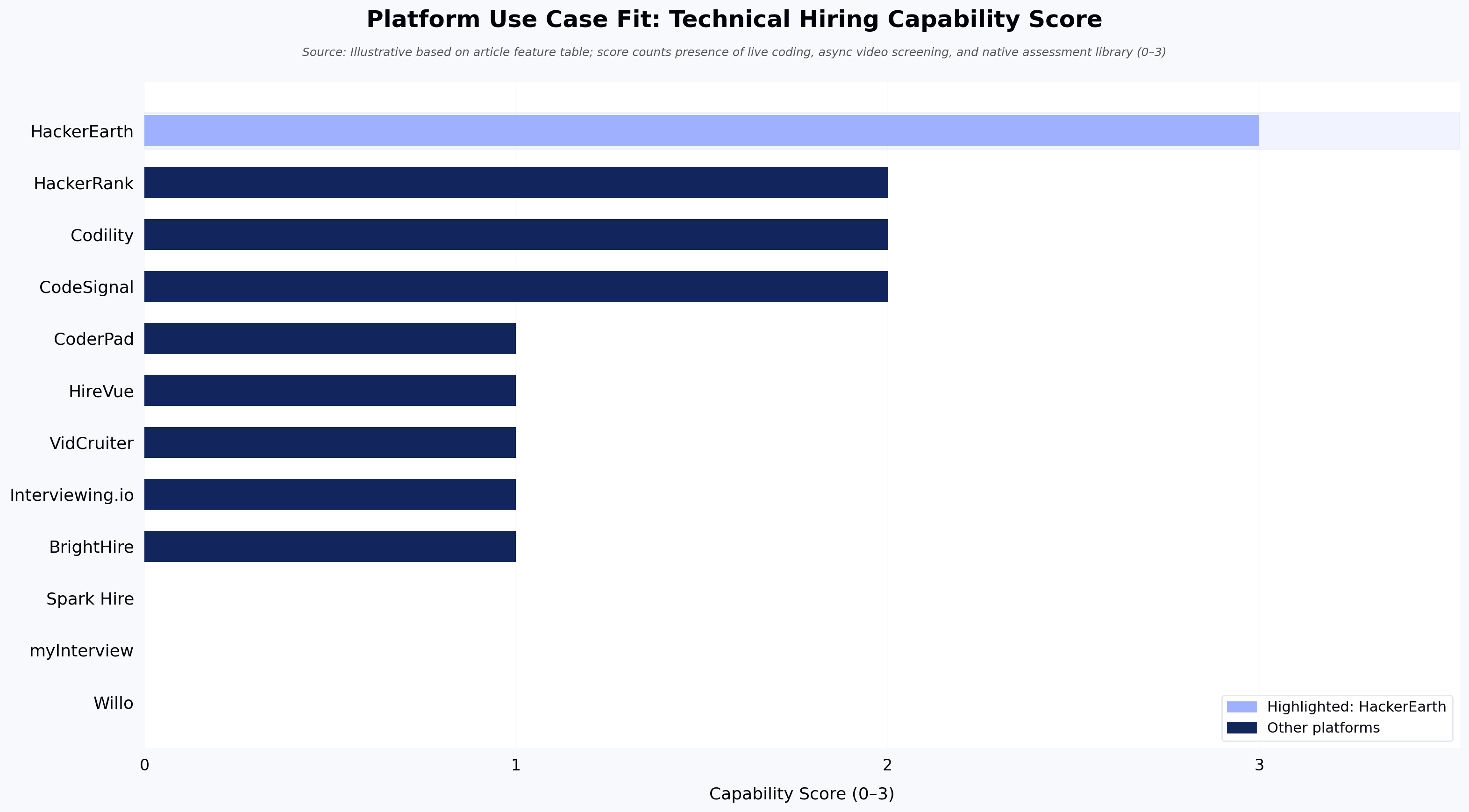
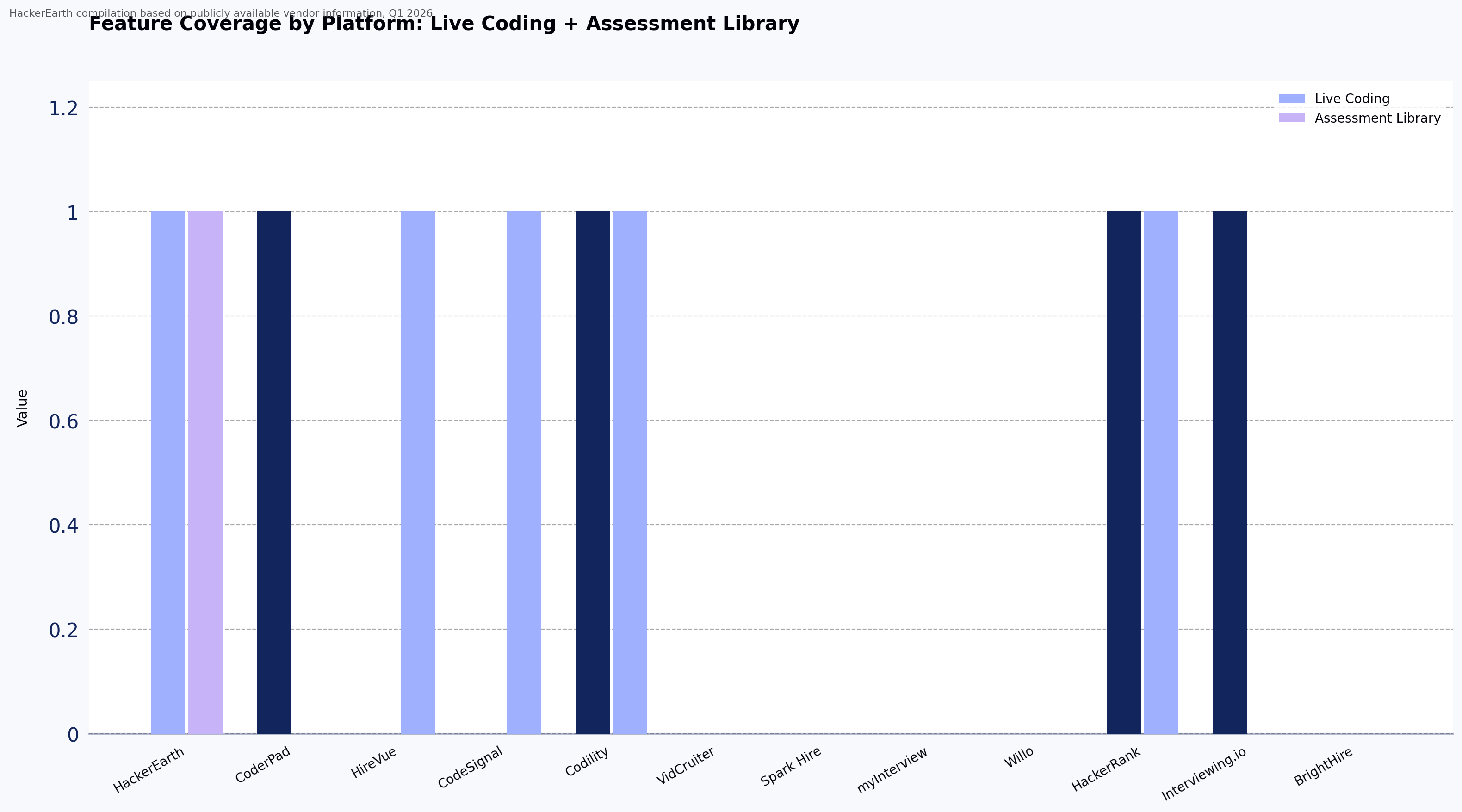
| Platform | Live coding | Async video | Assessment library | ATS integrations | Pricing model |
|---|---|---|---|---|---|
| HackerEarth | Yes (FaceCode) | Limited | Yes (40,000+ questions) | Yes | Custom |
| CoderPad | Yes | No | No | Yes | Subscription |
| HireVue | No | Yes | Yes (non-coding) | Yes | Custom enterprise |
| CodeSignal | Limited | Limited | Yes | Yes | Custom |
| Codility | Yes | No | Yes | Yes | Custom |
| VidCruiter | No | Yes | No (non-coding) | Yes | Custom |
| Spark Hire | Live video | Yes | No | Yes | Subscription |
| myInterview | No | Yes | No | Yes | Custom |
| Willo | No | Yes | No | Yes | Subscription |
| HackerRank | Yes | Limited | Yes | Yes | Custom |
| Interviewing.io | Yes | No | N/A (marketplace) | Limited | Per-hire |
| BrightHire | No | Add-on layer | No | Yes | Custom |
Source: HackerEarth compilation based on publicly available vendor information, compiled Q1 2026. Features and pricing change regularly — verify current details with each vendor before finalizing decisions.
How to choose an online interview platform for technical hiring
For recruiters evaluating coding interview platforms or remote technical interview tools, the practical question is rarely "which tool is best" — it's "which tool fits how our reqs actually move through the pipeline." A few questions worth answering before shortlisting:
- Do you need both pre-screening assessments and live coding interviews, or just one stage covered?
- How important is ATS integration, and which systems (Greenhouse, Lever, Workday) do you need to connect to?
- What does the candidate experience look like end-to-end across your screen, technical, and onsite stages — and where are the drop-off points?
- Are you hiring at volume (campus, early-career reqs) or for senior specialist roles where a marketplace model may fit better?
For a deeper look at structuring evaluations across the full funnel, see our resources on skills-based assessment design and the HackerEarth Engineering blog for ongoing technical hiring analysis.
Frequently asked questions about coding interview platforms
What is the best platform for live coding interviews? The strongest live coding interview platforms in 2026 include HackerEarth FaceCode, CoderPad, and HackerRank's live coding product (verify current product naming with the vendor). Choice depends on whether you need integrated pre-screening assessments, a dedicated standalone coding environment, or access to a large developer challenge library.
How do online technical interview platforms work? Online technical interview platforms combine video conferencing with a collaborative code editor, allowing candidates and interviewers to write, run, and discuss code in real time. Most include session recording, playback, and integrations with applicant tracking systems so interview data flows into the broader hiring workflow.
What should I look for in a coding interview tool? Key criteria include language coverage, candidate experience (no app downloads, minimal setup), collaborative editing with live execution, session recording, ATS integration, and whether the platform also supports pre-screening assessments or only live interviews.
Do online interview platforms integrate with ATS systems? Most enterprise-grade platforms offer ATS integrations with common systems such as Greenhouse, Lever, and Workday. The depth of integration varies — confirm specific connectors and data-sync behavior with each vendor before purchase.
Are AI-powered interview tools reliable? AI-powered interview tools are reliable for some tasks (note-taking, summarization, scheduling, shortlisting) but unreliable for others (personality scoring, facial analysis) where independent researchers and regulators have raised credibility and bias concerns. Recruiters should verify how AI is used, what data is collected, and whether scoring is auditable before relying on it for hiring decisions.
Conclusion
Online interview platforms for technical hiring vary widely in scope — from standalone async video tools to full technical hiring suites combining sourcing, assessments, and live coding. For recruiters and hiring managers focused on technical reqs, the platforms that consolidate live coding and pre-screening assessments in a single workflow reduce tool sprawl and give a more complete picture of candidate capability.
If hidden coordination costs across separate screening and interview tools are slowing your reqs down, a consolidated workflow — assessments, live coding, and sourcing in one platform — is the specific problem HackerEarth is built to solve.
Try it: Start a free trial of HackerEarth Assessments and FaceCode — evaluate candidates end-to-end without booking a demo.