Best AI interview agent platforms compared for technical hiring in 2026
Estimated read time: 15 minutes
Editorial disclosure: This guide is published by HackerEarth. HackerEarth's OnScreen is one of the platforms reviewed below. Competitor product descriptions and feature claims are drawn from publicly available vendor documentation and G2 reviews captured in Q1 2025; ratings and feature parity may have shifted since capture and should be re-verified against current vendor documentation before procurement decisions.
Forty-two percent of candidates who report a negative interview experience say they would reject a subsequent offer (BCG, Decoding Global Talent, 2023) — which means the AI interview agent platforms compared in this guide are not just productivity tools; they directly shape whether your top technical hires accept. AI interview agent platforms compared here are software tools that automate candidate screening, conduct adaptive technical and behavioral interviews, evaluate code quality, and generate structured scorecards that flow into your ATS. This guide helps technical recruiters and engineering managers choose the right tool for their hiring workflow by evaluating each platform on technical assessment depth, scoring transparency, compliance readiness, and integration quality.
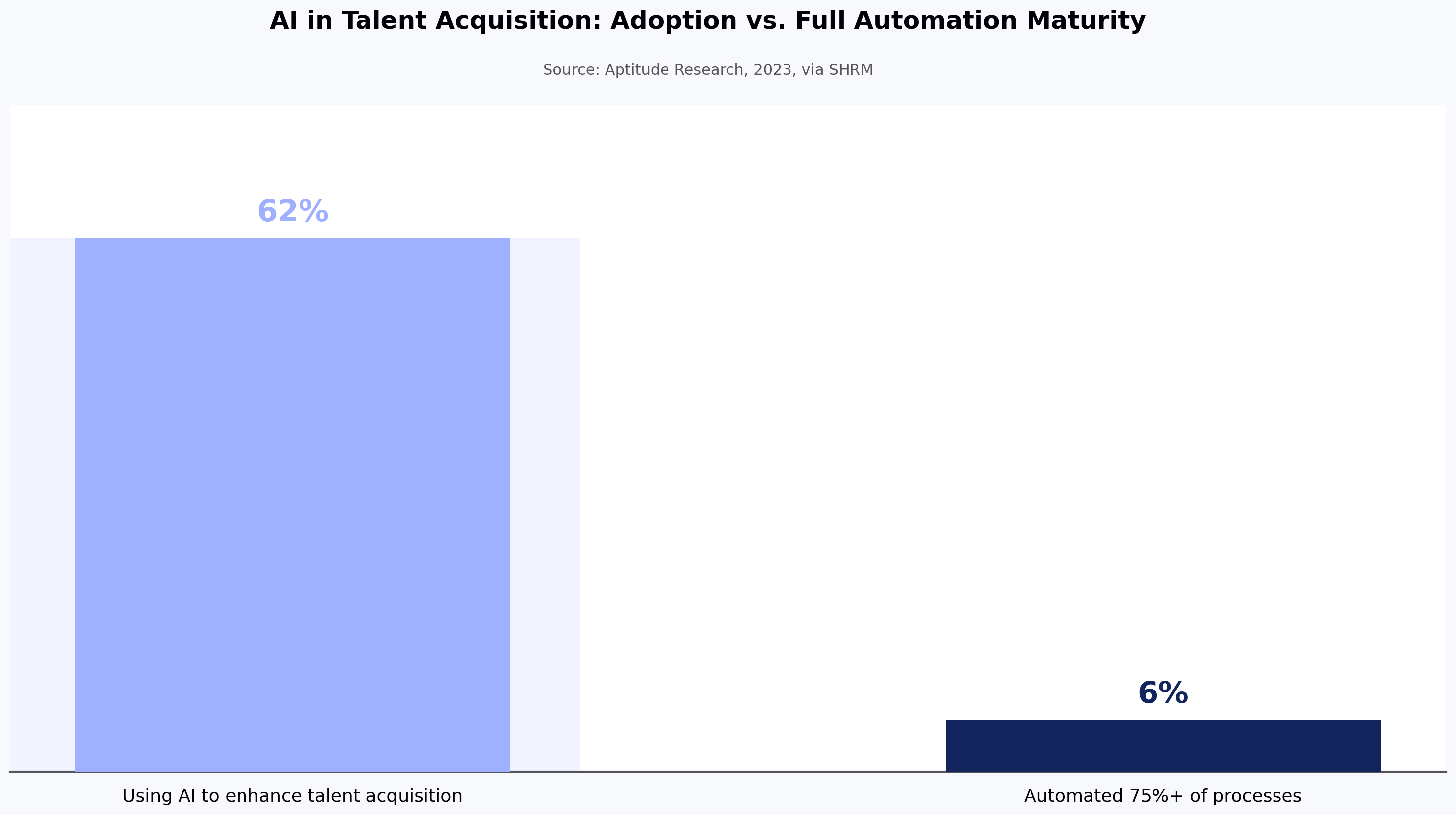
According to Aptitude Research data (2023) referenced by SHRM, 62% of HR leaders surveyed were using AI to enhance talent acquisition, but only 6% had automated 75% of their processes. The gap between adoption and automation maturity is why choosing the right platform for automated technical screening matters. Your team needs a platform that engineering managers trust and candidates complete.
In this comparison, we evaluate 10 AI interview agent platforms with technical assessment capabilities. You will see features, assessment depth, pricing, verified user reviews, and enterprise readiness compared side by side so you can choose the right structured interviewing software for your hiring team.
Note on competitor claims: All competitor product descriptions, feature lists, and pricing references in this article are drawn from publicly available vendor documentation and G2 reviews. G2 ratings cited below were captured in Q1 2025 and may not reflect current scores. Specific compliance certifications attributed to competitors (e.g., WCAG 2.2) reflect vendor-reported claims and should be independently verified before procurement.
The 10 best AI interview agent platforms compared: side-by-side reference
If you are a technical recruiter or engineering manager evaluating AI interview agent platforms compared in this guide, the table below gives you a quick reference across all 10 tools before you dive into the detailed reviews. AI in the table refers to platform-specific machine learning, NLP, and rubric-applied scoring engines whose scope is described in each platform's review.
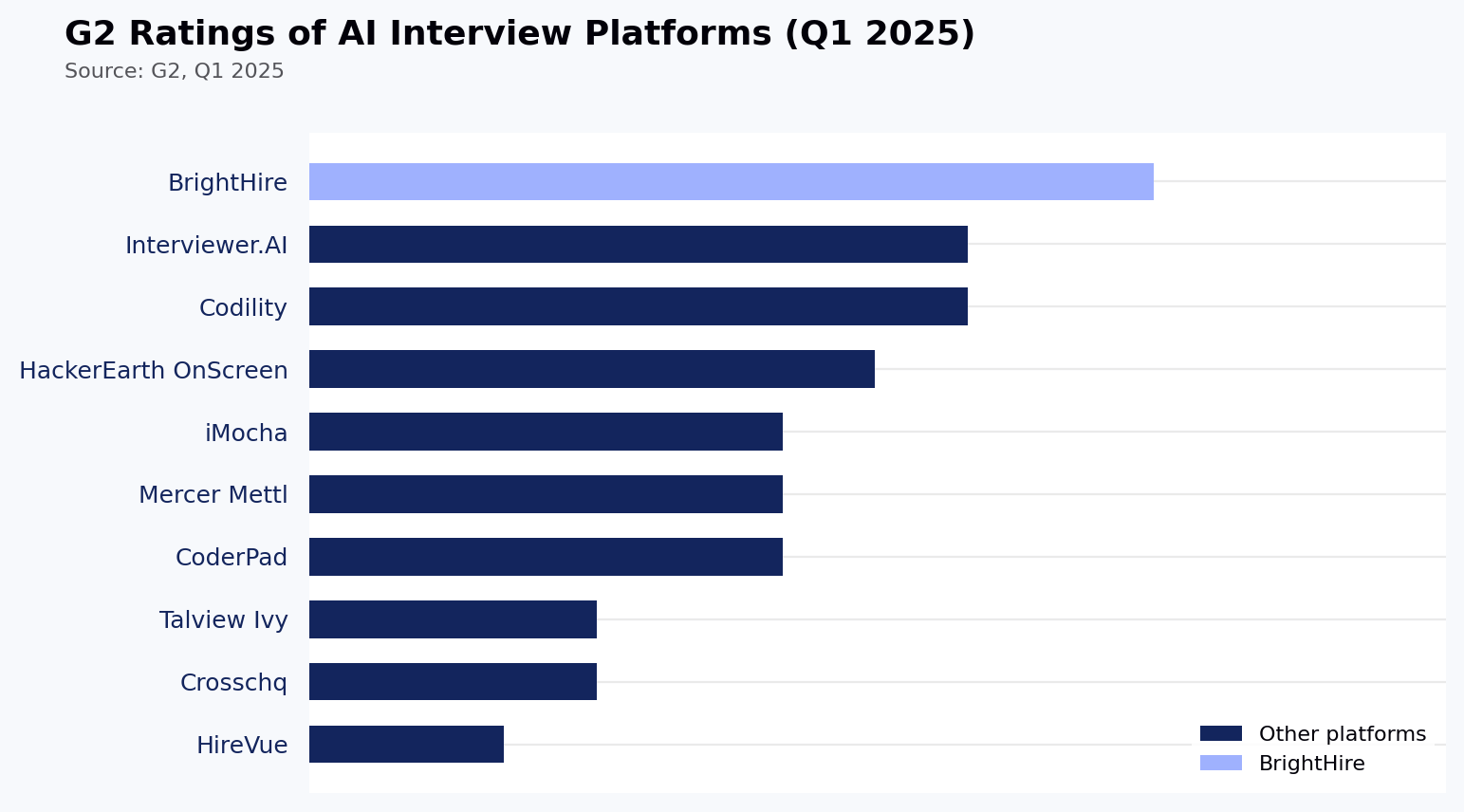
| Tool | Best for | Technical assessment depth | Compliance readiness | Key features | G2 rating (Q1 2025) |
|---|---|---|---|---|---|
| HackerEarth OnScreen | Autonomous AI interviewing with deep technical assessment | Project-type questions; integrates alongside Skill Assessments and FaceCode | Rubric-applied evaluation, KYC-grade identity verification, audit-ready scorecards | Autonomous video-avatar interviewer, enterprise-grade proctoring, ATS integrations | 4.5/5 |
| HireVue | High-volume enterprise async video interviewing | Limited; behavioral focus | Audit trails, structured evaluation records | NLP-driven interview insights, searchable transcripts, competency validation, Zoom/Teams integration | 4.1/5 |
| Codility | Live coding fidelity and accessibility-focused programs | Live IDE, pair programming, system design whiteboard | WCAG 2.2 compliant (vendor-reported); structured rubrics | Live IDE, pair programming, whiteboard, Cody assistant | 4.6/5 |
| CoderPad | Collaborative real-time pair-programming interviews | Multi-file IDE, take-home auto-grading | Integrity toolkit, keystroke playback (vendor-reported) | Multi-file IDE, project-style work, integrity toolkit, auto-grading | 4.4/5 |
| Mercer Mettl | Campus recruitment and large-scale proctored assessments | 26+ question formats; limited live coding | Live and recorded proctoring with tab-switch and webcam monitoring (vendor-reported) | Scalable online exams, proctoring, multi-language support | 4.4/5 |
| iMocha | Skills intelligence across hiring and upskilling | Multi-format questions; weaker for live coding | Candidate authentication and tab-switch detection (vendor-reported) | Tara conversational interface, role-specific tests, ATS/HR integration | 4.4/5 |
| Crosschq | ATS-native (Workday) structured interview workflows | Limited deep technical assessment | Compliance messaging, structured evaluation (vendor-reported) | Structured interviews, behavioral question scoring, Workday integration | 4.2/5 |
| Talview Ivy | Customizable AI interviewer personas for campus hiring | Limited depth for senior engineering | Structured assessment workflows (vendor-reported) | Conversational agent, real-time interaction, customizable personas | 4.2/5 |
| BrightHire | Interview intelligence and structured note-taking | Not a coding assessment tool | Interview design, note auditability (vendor-reported) | NLP-driven notes, summaries, transcripts, clip sharing | 4.8/5 |
| Interviewer.AI | Async video screening with explainable scoring | Limited for live technical evaluation | Explainable scoring, ATS integration (vendor-reported) | Async interviews, AI avatars, automated scoring, dynamic follow-ups | 4.6/5 |
How we evaluated these AI interview agent platforms
This evaluation was based on real-world performance indicators, verified user reviews, and compliance readiness. The seven criteria discussed below reflect what determines whether AI interview agent platforms compared in any rigorous review will deliver results for your hiring team. For teams ready to benchmark options, our AI interview agent product page details how these criteria map to platform capabilities.
-
Technical assessment depth: We measured the breadth and rigor of coding challenges, system design evaluation, project-based simulations, and the number of supported programming languages and skill domains each platform offers. If you want a deeper look at how AI interviewers work at the technical level, that context is useful before comparing individual tools.
-
AI scoring transparency and explainability: We assessed whether each platform provides a detailed scoring rationale for every evaluation dimension, or delivers opaque pass/fail scores that hiring managers cannot interpret or defend. Platforms that cannot produce transparent, dimension-level scoring rationale undermine the trust that makes structured interview processes effective in the first place.
-
Enterprise readiness and ATS integration: We evaluated the number and quality of native ATS integrations, API availability, SSO support, and documented integration timelines for each platform. A platform that claims fast integration but takes weeks or months longer than scoped to implement creates data integrity problems and rework costs that erase efficiency gains. Your team should verify integration timelines with vendor references before committing.
-
Candidate experience and completion rates: We measured interface clarity, developer-friendliness of coding environments, mobile accessibility, and whether each platform's design minimizes candidate drop-off. The BCG finding cited earlier — that 42% of candidates who experienced a negative interview process said they would reject a subsequent offer — makes this a measurable business metric tied directly to offer-acceptance and employer brand outcomes, not a soft one.
-
Anti-cheating and assessment integrity: We assessed proctoring capabilities including tab-switch detection, webcam monitoring, plagiarism detection, copy-paste prevention, and IP-based geofencing where vendors support them. Platforms without strong integrity measures expose your organization to evaluation fraud that undermines the screening investment. The strongest platforms in this comparison generate per-candidate integrity signals that your hiring managers can reference alongside technical performance data.
-
Regulatory compliance and bias mitigation: We evaluated whether each platform supports privacy controls, provides auditable evaluation frameworks, and addresses the requirements of NYC Local Law 144, the EU AI Act, and EEOC guidance on AI in employment selection. According to the EEOC's January 31, 2023 public meeting on AI and automated systems, EEOC guidance suggests employers may be held responsible for discriminatory outcomes from third-party AI hiring tools used in employment decisions. The practical implication is that your organization may bear compliance responsibility regardless of which platform you select. Importantly, AI systems do not eliminate bias — they exhibit different bias profiles than human screeners, which is why auditable scoring and ongoing fairness testing matter more than vendor claims of neutrality.
-
Verified user reviews and adoption evidence: We cross-referenced customer reviews from G2, Capterra, and TrustRadius, focusing on platforms with an average rating above 4.0 stars and a minimum of 50 verified reviews. Published case studies with measurable outcomes and documented client logos confirmed real-world adoption at enterprise scale.
An in-depth look at each AI interview agent platform compared
Each platform below is reviewed against the seven criteria above. The order reflects fit for autonomous technical interviewing depth specifically; each platform wins different dimensions, which we call out in the comparative judgments at the end of each review.
1. HackerEarth OnScreen: strongest fit for autonomous technical interviewing depth
HackerEarth's OnScreen runs autonomous technical and behavioral interviews with role-calibrated conversations and structured scorecards.
HackerEarth OnScreen is built for hiring teams that need to consolidate screening, autonomous interviewing, and structured scoring on a single platform. OnScreen conducts structured, role-specific technical and behavioral interviews autonomously using a video avatar. It integrates directly into HackerEarth's existing platform alongside Skill Assessments, FaceCode, and Hiring Challenges, drawing on HackerEarth's broader SkillsGraph data (150M+ assessment signals, per HackerEarth internal data) to inform question selection and scoring calibration rather than replacing rubric-based evaluation.
The platform applies a consistent rubric to each candidate. This produces rubric-applied evaluation that does not vary by interviewer mood, fatigue, or calibration drift — a bounded claim, not a claim of zero bias. AI scoring engines have their own bias profiles that require ongoing fairness testing.
OnScreen generates dimension-level scoring rationale on every interview and ships with built-in enterprise-grade proctoring that monitors for irregularities, alongside KYC-grade candidate identity verification. Specific ATS integrations, programming-language enumeration, session-recording capabilities, and EEOC/NYC Local Law 144 compliance posture should be confirmed with HackerEarth product and legal teams for your deployment.
Comparative note: OnScreen is purpose-built for autonomous interviewing depth. Codility and CoderPad outperform it on live pair-programming fidelity for senior engineering panels, while HireVue handles higher async-only video volumes for non-technical roles. OnScreen's advantage is consolidating autonomous interviewing with rubric-applied scoring inside the broader HackerEarth platform.
Best for: Technical recruiters, enterprise hiring managers, engineering managers, and campus recruitment teams at companies hiring 50+ technical roles per quarter.
Cons: Does not offer a stripped-down free tier or low-cost plan for very small teams or startups with fewer than 10 hires per year (G2 reviews). The breadth of platform capabilities can require onboarding time for teams that only need a single module.
Pricing: Contact HackerEarth for current OnScreen and Enterprise plan rates.
Case studies: See HackerEarth's published customer stories for verified outcomes and named customers.
2. HireVue: best for high-volume enterprise video interviewing at scale

HireVue combines NLP-driven interview insights with structured async video interviewing for high-volume enterprise hiring.
HireVue is best for high-volume behavioral and operational screening at enterprise scale, not for deep technical engineering roles. The platform is an established async video interviewing tool designed for enterprises managing high-volume hiring campaigns across customer service, retail, sales, and operational roles. Its Interview Insights feature uses natural language processing trained on transcribed interview responses to generate transcripts, summaries, and competency flags against structured rubrics. The NLP does not score candidates autonomously; it surfaces evidence interviewers review, and the model's signal quality varies by role type and language. The platform integrates with Zoom and Teams.
Teams hiring for senior engineering or system design roles should pair HireVue with a dedicated coding assessment tool — HireVue's behavioral focus is a poor fit for evaluating code quality or architectural reasoning.
Key features
- Interviewer benchmarking: Compares interviewer scoring patterns to surface calibration gaps — useful when your hiring panel is distributed across regions, less useful if you only have two or three regular interviewers.
- Candidate scheduling automation: Self-scheduling reduces recruiter coordination overhead for large candidate volumes; the productivity gain compounds above roughly 200 candidates per role and is marginal below it.
- Compliance documentation: Audit trails and structured evaluation records support regulatory requirements, but the records are only as defensible as the rubrics you load into them.
Comparative note: HireVue beats OnScreen and Codility on async throughput for non-technical, high-volume roles. It loses to both on technical assessment depth.
Best for: Enterprise recruiters and talent teams conducting high-volume hiring campaigns (500+ candidates per role) for customer service, retail, sales, and operational roles. Less suitable for deep technical hiring requiring code evaluation or system design assessment.
Pros: Easy to schedule and manage candidate interviews at enterprise scale. Standardized, data-driven evaluation improves fairness and consistency across distributed hiring teams.
Cons: Hybrid interview workflows can be inflexible when customization is needed (G2 review). Users report audio/video quality issues with certain setups. Recruiters report difficulty explaining AI rankings to hiring managers (G2 review, Q2 2024).
Pricing: Custom pricing only. Contact sales for plan details.
3. Codility: best for science-backed live coding assessments

Codility accelerates hiring with live coding interviews, pair programming workflows, and AI-assisted evaluation through Cody.
Codility is best for engineering teams that prioritize high-fidelity live coding interviews over async top-of-funnel screening. The platform's Interview product combines video chat, an integrated IDE, pair programming, and whiteboard functionality into a single environment where candidates demonstrate problem-solving, logic, and architectural thinking in real time. Learn more about structured technical interviewing before evaluating live-coding tools.
Codility introduced Cody, an assistant trained to observe how candidates collaborate with generative AI tools during interviews and flag patterns interviewers can review; the assistant does not score candidates and its detection signal is most useful in mid-difficulty interviews rather than senior architecture rounds. Codility is not designed for autonomous async screening at the top of the funnel.
Key features
- Structured and free-flowing interview workflows: Interviewers can run formal or open formats with consensus-based scoring — the structured mode reduces calibration drift, but only when teams actually load and enforce a shared rubric.
- Candidate-facing experience: Interactive onboarding, instant feedback, and vendor-reported WCAG 2.2 accessibility compliance reduce drop-off for candidates with accessibility needs.
- Predefined scoring rubrics: Reduce calibration drift across interviewers, but require investment to tune to your engineering levels.
Comparative note: Codility outperforms CoderPad on accessibility compliance signals and structured rubric tooling. CoderPad tends to feel more natural to engineering interviewers who want pair-programming flexibility. Codility's annual contracts can cost more per seat for organizations with seasonal hiring cycles.
Best for: Technical recruiters and engineering managers conducting specialized technical interviews where live coding fidelity, pair programming evaluation, and accessibility compliance are priorities.
Pros: High-fidelity live coding environment with an intuitive UI. Positive candidate experience with instant feedback and vendor-reported WCAG 2.2 accessibility compliance.
Cons: Pricing can be prohibitive for seasonal or internship-heavy hiring cycles (G2 review). Limited flexibility in annual plans for organizations with unpredictable hiring volumes.
Pricing: Contact Codility sales for current Starter, Scale, and Custom plan rates.
4. CoderPad: best for collaborative real-time coding interviews

CoderPad provides a collaborative pair-programming environment with multi-file IDE support and an integrity toolkit for technical interviews.
CoderPad is best for engineering managers who want to conduct live, pair-programming-style technical interviews. The platform offers a multi-file IDE, AI-integrated project work, auto-grading on take-home assignments, an integrity toolkit, and keystroke playback so interviewers can review how a candidate approached a problem after the session ends. Language coverage and specific capability claims should be confirmed via CoderPad's product documentation.
Key features
- Multi-file IDE: Supports realistic project-style coding rather than single-file snippets — closer to how engineers actually work, which produces better signal on senior candidates.
- Integrity toolkit: Flags tab switches and external paste activity during live sessions; treat the signal as a flag for follow-up, not as evidence of cheating on its own.
- Keystroke playback: Lets interviewers review the path a candidate took to a solution — particularly useful for debugging interviews where process matters more than the final answer.
Comparative note: CoderPad feels more natural than Codility to engineers running pair-programming rounds but has less mature accessibility and structured-rubric tooling. Both lose to OnScreen on autonomous interviewing depth.
Best for: Engineering managers running live pair-programming interviews who want collaborative coding fidelity over autonomous screening.
Pros: Smooth real-time collaboration; broad language support.
Cons: Basic UI; limited advanced editor and reporting features compared with dedicated assessment platforms.
Pricing: Contact CoderPad sales for current plan rates.
5. Mercer Mettl: best for campus recruitment and large-scale proctored assessments
Mercer Mettl is best for campus hiring teams that need to administer proctored, high-volume assessments across multiple geographies. The platform supports 26+ question formats, multi-language proctoring with live and recorded webcam monitoring (vendor-reported), and tab-switch detection (vendor-reported) across high-volume online exams.
Key features
- High-volume proctored exam delivery: Designed for campus and graduate-program assessment loads where parallel sessions matter more than per-interview depth.
- Multi-language and multi-geography support: Useful for global campus programs; less relevant for North America-only enterprise hiring.
- Live and recorded proctoring (vendor-reported): Webcam monitoring, tab-switch detection, and candidate identity verification across high-volume online exams.
Comparative note: Mercer Mettl beats OnScreen and Codility on raw proctored-