AI Interviews: What Is an AI Interviewer? (2026 Guide)
AI interviews are structured technical conversations conducted by an AI agent — typically a video avatar — that evaluates candidates against a fixed rubric, 24 hours a day, without a human interviewer in the loop. As of 2026, in our experience working with enterprise customers, the AI interview is no longer a novelty. It is how a growing share of enterprise technical screening actually happens, because the alternative — senior engineers running 30-minute phone screens at 9 PM on a Thursday — stopped scaling two years ago.
This guide explains what AI interviews are, where they work, where they don't, and how to decide whether your hiring process should use them. It is written for hiring managers, technical recruiters, and engineering leaders making that call in the next two quarters.
What is an AI interviewer?
An AI interviewer is software that conducts a structured interview with a candidate, asks follow-up questions based on the candidate's responses, evaluates the answers against a predefined rubric, and produces a scored report. The best implementations use a video avatar and genuine two-way conversation — not a chatbot filling out a scorecard.
Three things separate a real AI interviewer from earlier generations of automated screening:
- Conversation, not forms. The agent asks a question, listens to the answer, and follows up. It does not read from a fixed script.
- Deterministic evaluation. The same rubric applies to every candidate. The agent does not have a better or worse day.
- Identity verification in the flow. KYC-grade checks confirm the person on the call is the person who applied — a direct response to proxy candidates and AI-generated CVs.
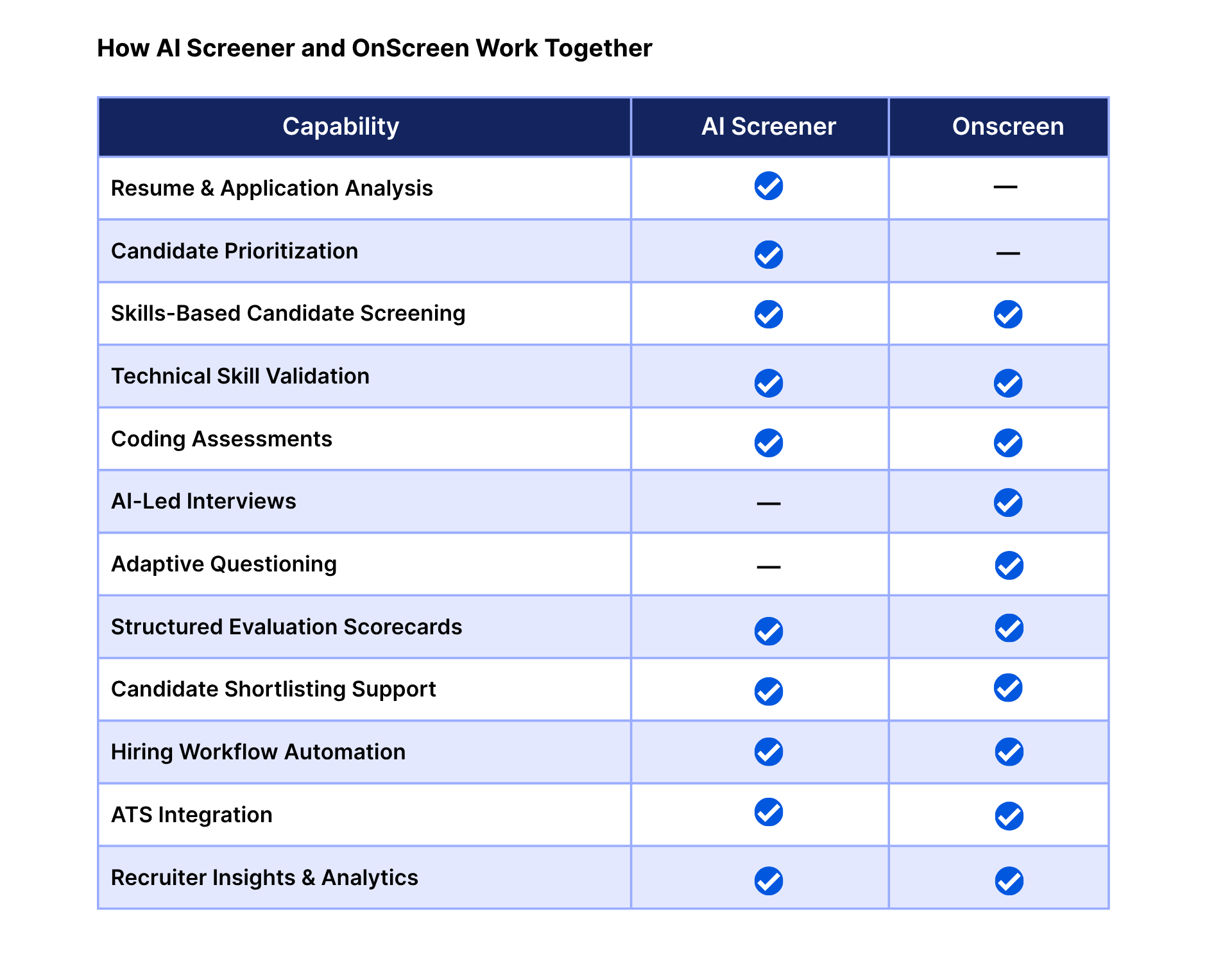
HackerEarth's OnScreen is one implementation of this pattern. Many vendors have begun shipping similar products, and the category is real — but the differences between tools matter.
Benefits of AI interviews for technical hiring
The benefits of AI interviews show up most clearly in hiring contexts where the human interview bottleneck has already broken.
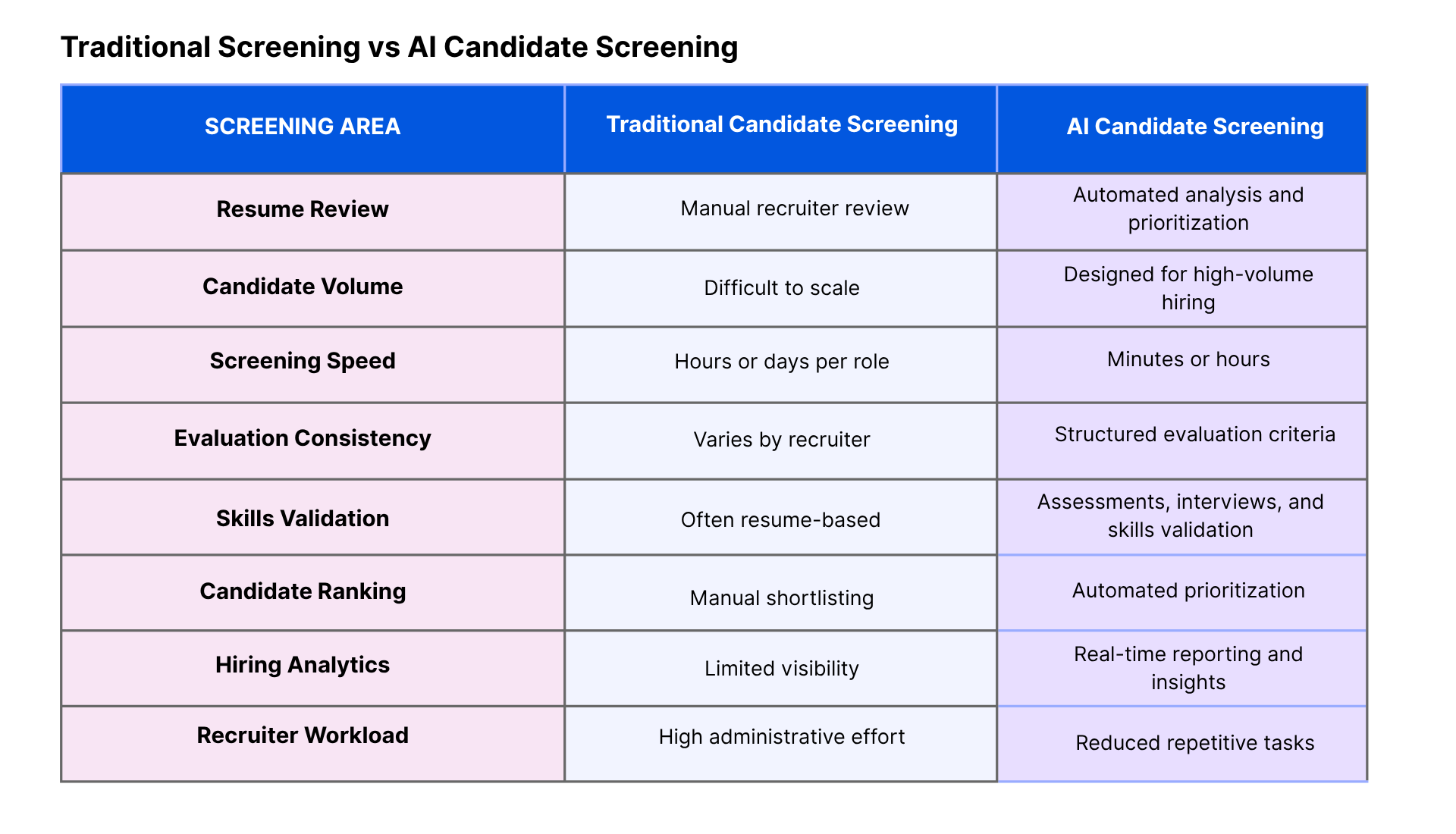
Scheduling friction disappears. A candidate who applies at 11 PM on a Sunday can complete a full technical screen before Monday morning. Before AI interviews, that candidate waited three days for a recruiter to find a slot — and often took a competing offer in the meantime.
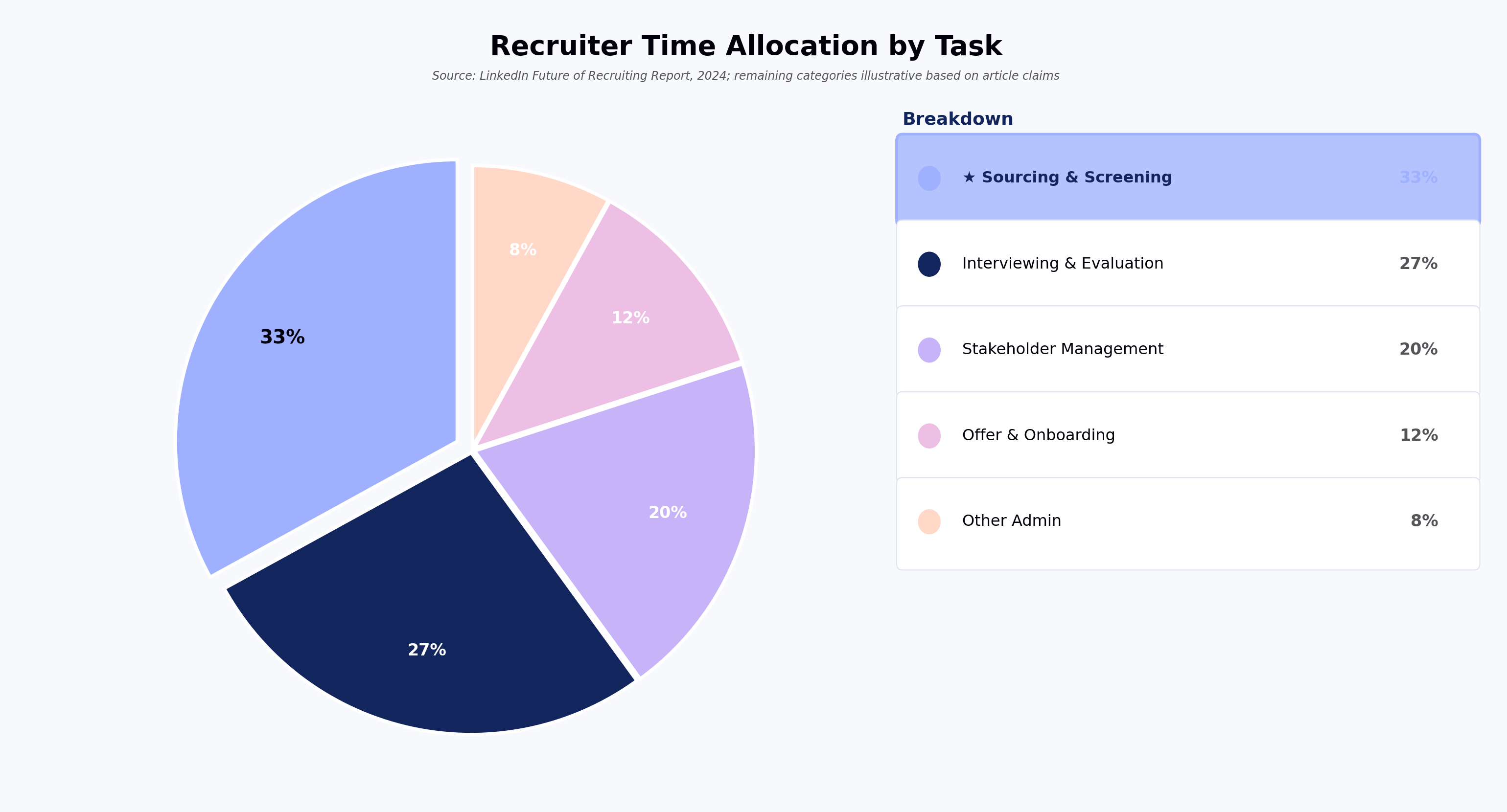
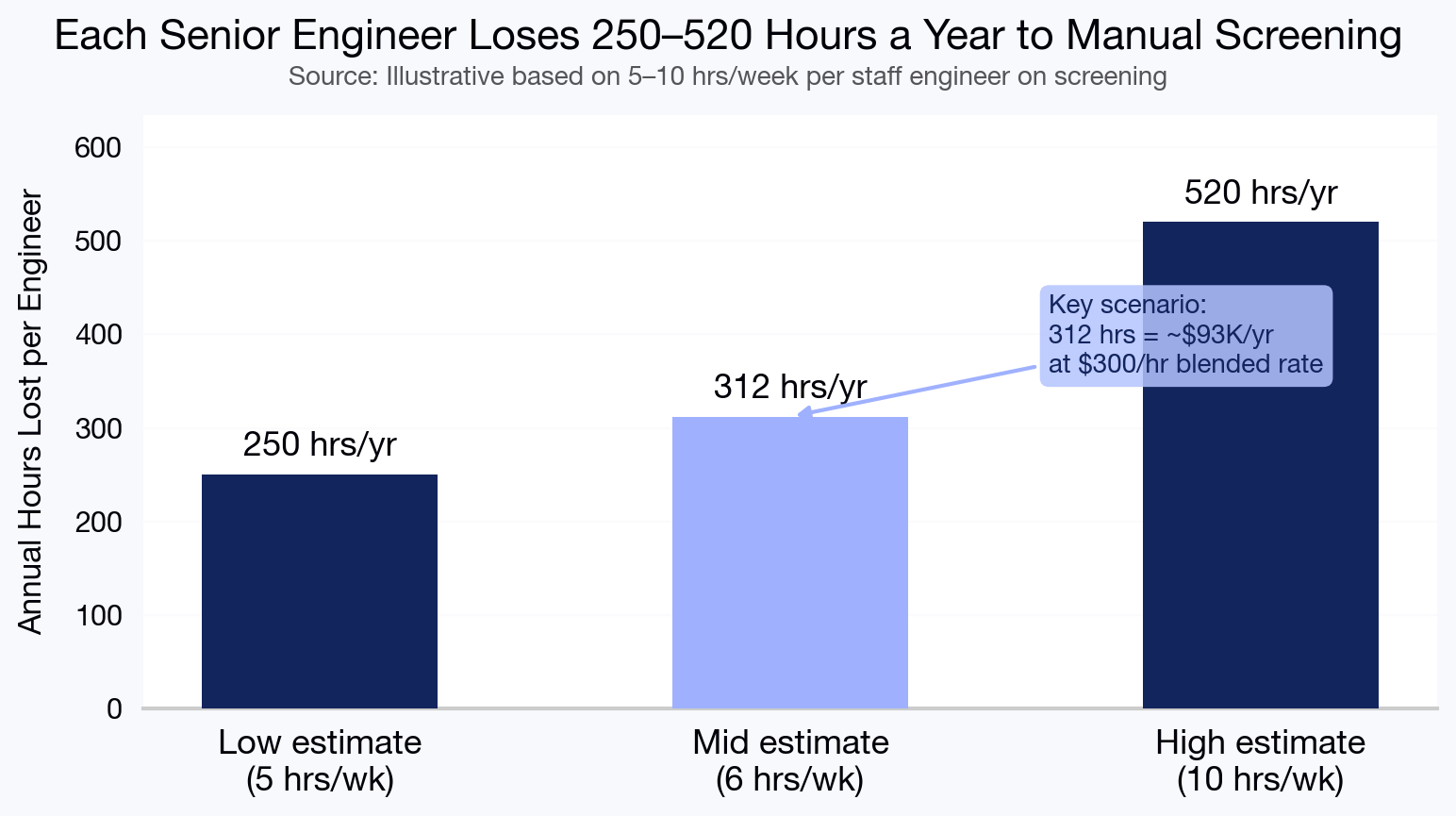
Senior engineer time gets reclaimed. In our experience across product-company customers, staff engineers often spend five to ten hours a week on screening interviews. Moving the first-round screen to an AI agent returns that time to shipping work. The human interview still happens, later in the funnel, with a pre-qualified candidate.
Evaluation stays consistent. Human panels drift. Interviewer A is tough on system design; Interviewer B is tough on coding; the candidate who gets Interviewer A on a Tuesday has a different experience than one who gets Interviewer B on a Friday. An AI agent applies the same rubric every time. That is not "zero bias" — AI systems have their own failure modes — but it is more consistent across candidates than human-led screens.
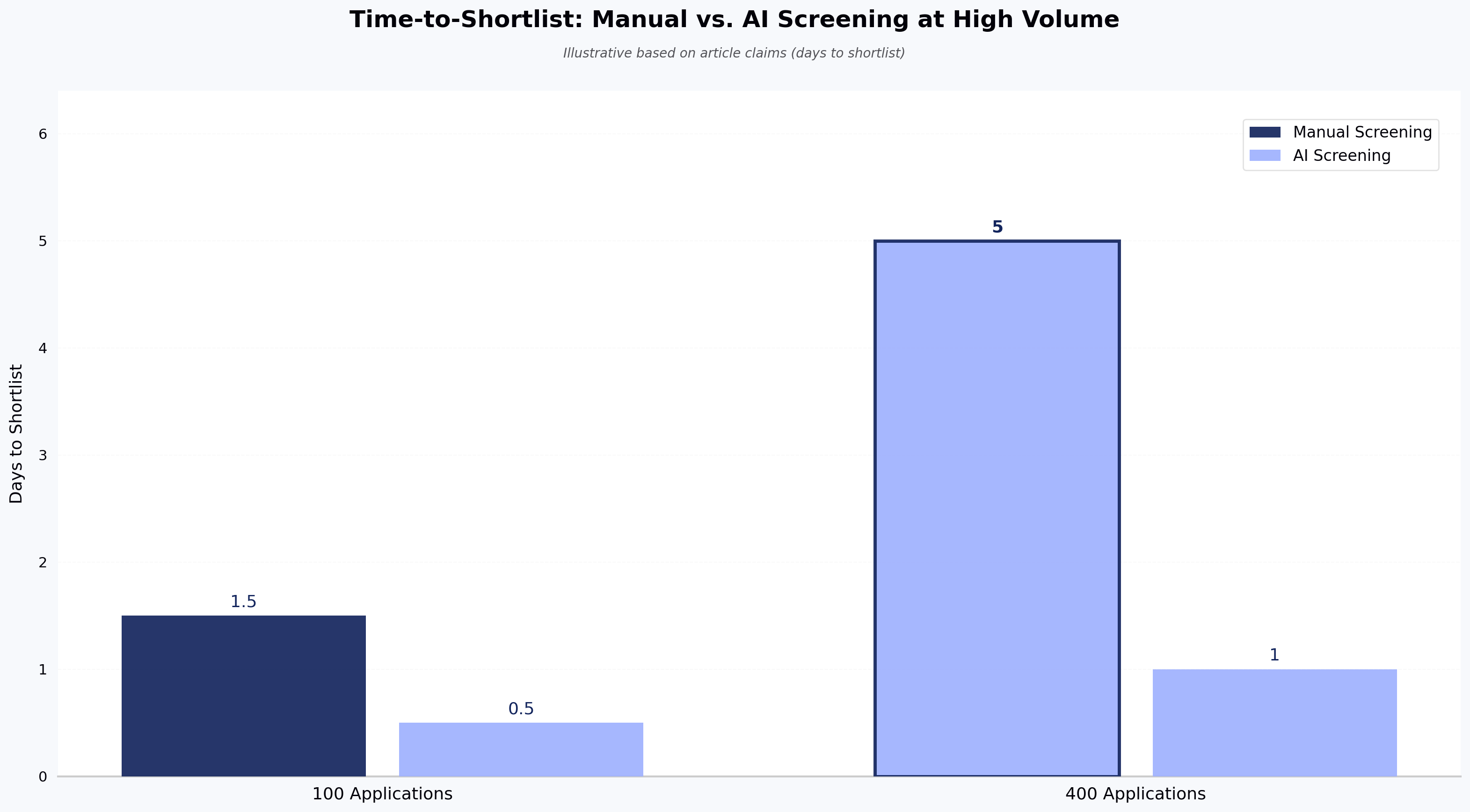
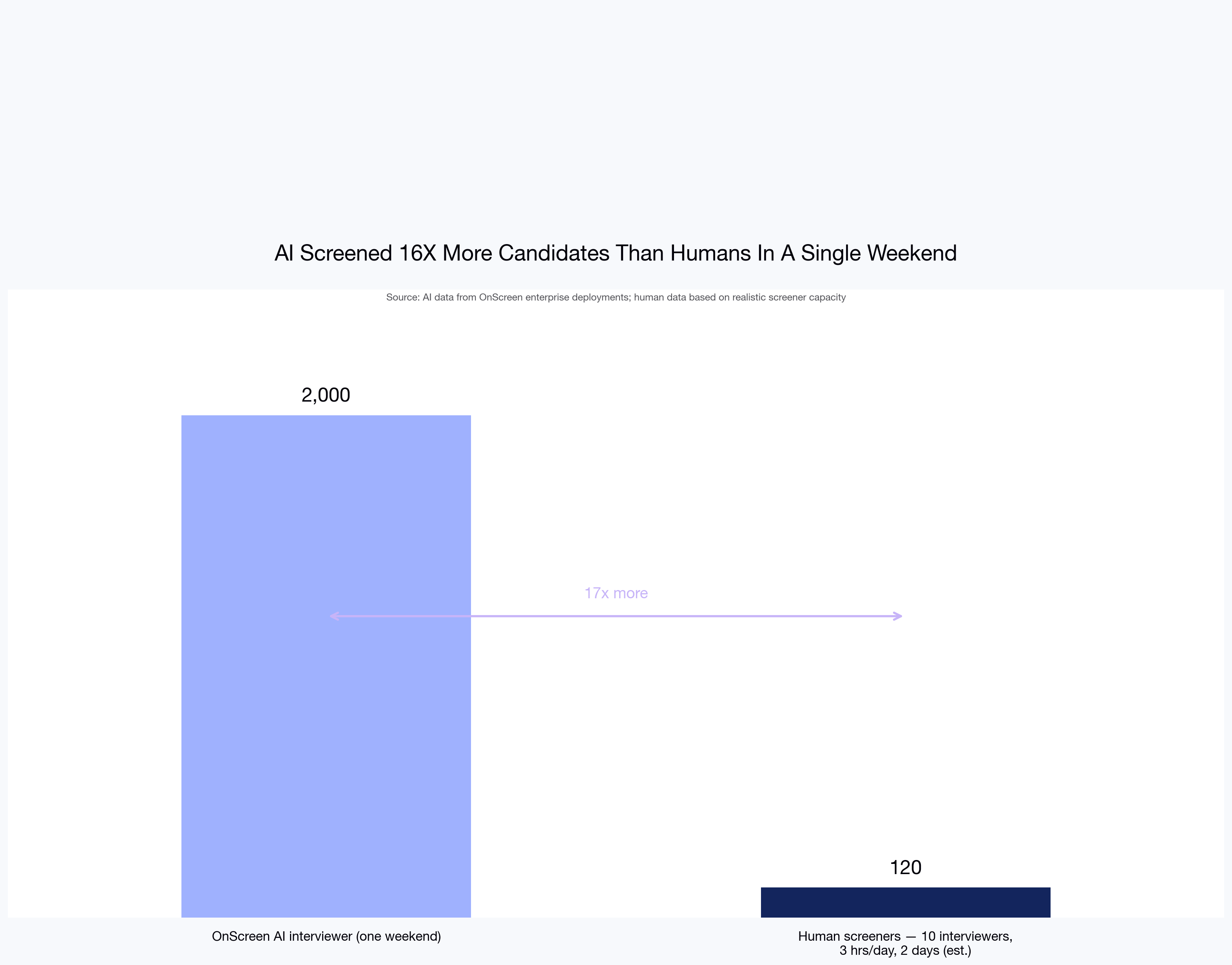
Proxy candidates and AI-generated CVs get filtered faster. Identity verification at the start of the interview makes it meaningfully harder for someone else to sit the screen. Discover Dollar Inc.'s Pawan Kuldip, Head of HR, put this plainly: "Before OnScreen, we had no reliable way to measure candidate quality, especially with the rise of AI-generated CVs... Roles that previously took much longer are now being closed within three to four weeks." At enterprise scale, OnScreen deployments have screened more than 2,000 candidates in a single weekend — volume that is simply not achievable with human interviewers alone.
How AI interviews work: technical assessment mechanics
The mechanics of an AI interview fall into four stages.
Identity and environment verification
Before the interview starts, the agent verifies the candidate's identity (government ID match, face match, sometimes liveness detection) and checks the interview environment (single person in frame, no second device visible). This is the step that blocks proxy candidates. Without it, every downstream signal is suspect.
Role-calibrated questioning
The interview itself is driven by a rubric built for the specific role — senior backend engineer, junior data scientist, SRE. The agent asks an opening technical question, listens to the response, and generates follow-ups based on what the candidate said. A candidate who mentions they used Kafka gets asked about consumer group rebalancing; a candidate who mentions Redis gets asked about cache invalidation patterns. The conversation adapts, but the rubric it is scoring against does not.
Coding evaluation (when applicable)
For roles that require code, the candidate writes code in an in-browser editor while the interview continues. The agent can ask the candidate to explain their approach, walk through edge cases, or refactor a solution. Code execution against test cases typically runs in the background as part of the broader HackerEarth platform.
Rubric-applied scoring and report generation
Every candidate response maps to specific rubric criteria — problem decomposition, technical accuracy, communication clarity, edge-case awareness. The report the hiring manager sees is not a black-box score. It shows the rubric, the candidate's response against each criterion, and the evidence (quotes, code, timestamps) supporting the score.
This matters because it is what makes AI interviews defensible under audit — a real concern for BFSI hiring processes and any regulated workforce.
Candidate experience during AI interviews
This is where the category gets scrutinized hardest.
A good AI interview experience feels like a thoughtful conversation with an interviewer who is paying attention. A bad one feels like a chatbot reading a form. The difference comes from whether the agent does genuine two-way conversation — asking follow-ups that reference what the candidate actually said — versus reading through a fixed question set.
Candidate feedback from OnScreen deployments points to a second-order benefit: serious candidates self-select. "It has also helped us identify genuinely interested candidates, since only serious applicants complete the process," Kuldip noted. In our experience, candidates who are applying casually to many roles at once tend to drop out when asked to complete a structured interview. Candidates who want the job complete it.
A few things matter for candidate experience:
- A firm time limit. Interviews should cap at 45–60 minutes. Longer correlates with drop-out, not signal.
- Clear instructions. Candidates need to know what the rubric is, approximately — not the exact questions, but the skill areas being evaluated.
- A human contact. Candidates should have a named recruiter they can reach if something goes wrong. An AI interview without a human support path is a candidate-experience failure waiting to happen.
Addressing concerns: AI interview limitations and ethics
AI interviews are not a universal replacement for human interviewers. They have real limits, and honest content about the category has to name them.
They are weaker at context-dependent judgment. An AI agent can evaluate whether a candidate's system design covers the right components. It is worse at evaluating whether the candidate would thrive in a specific team's engineering culture. Human interviews remain the right tool for that, later in the funnel.
They have their own bias profile. Any evaluation system — human or AI — has bias. AI interviews are more consistent across candidates (one rubric, applied the same way) but they inherit biases from training data and question design. The honest framing: AI interviews trade interviewer-level variance for system-level bias. Whether that is a good trade depends on your current failure mode. Teams whose human panels are wildly inconsistent gain. Teams whose panels are already well-calibrated gain less.
They don't replace the hiring manager's judgment. AI interviews produce a signal. The hiring manager still decides. Every responsible deployment of AI interviews keeps the human in the decision loop for final calls.
Regulatory scrutiny is increasing. Emerging frameworks such as the EU AI Act, New York City's AEDT law, and state-level rules under discussion in California and Illinois may have implications for automated hiring tools — though specific obligations vary by jurisdiction and are evolving. In general, an AI interview deployment should consider a bias audit, candidate disclosure, and — where required by local law — the option for a human alternative. For more on this, see the U.S. EEOC's guidance on AI in hiring.
Implementing AI interviews in your technical hiring strategy
AI interviews work best as one stage in a multi-stage funnel, not as the whole funnel. A typical deployment looks like this:
- Application and resume check — still human or rules-based, for fit and intent.
- Skills assessment — a coding or role-based assessment using structured skill assessments filters out candidates who can't meet the bar.
- AI interview — a structured technical screen that evaluates problem-solving and communication in conversation.
- Human technical interview — using a live tool like FaceCode for panel interviews, system design deep dives, or senior calibration.
- Hiring manager and team fit — always human.
The mistake teams make is inserting the AI interview without redesigning the funnel around it. If you still do a 45-minute human phone screen after the AI interview, you have added a step, not replaced one.
A few implementation rules worth naming:
- Design the rubric before picking the tool. A tool applied to a bad rubric produces bad signal at scale.
- Run parallel evaluation for the first 50 candidates. Have a human screen the same candidates the AI screens. Compare. Calibrate.
- Measure the right outcomes. Time-to-fill, offer-accept rate, and 90-day performance of hires — not just interview completion rate.
- Keep a human escalation path. Candidates who flag an issue should reach a person within 24 hours.
- What it means across roles. For engineers, it means fewer hours on screening interviews. For recruiters, pipelines move faster and unqualified candidates drop before eating senior time. For candidates, the experience is consistent and skills-first, regardless of when they apply.
Frequently asked questions about AI interviews
Are AI interviews fair?
More consistent than human interviews on rubric application; less context-aware on judgment calls. A more useful angle for evaluators: candidate-perceived fairness and outcome fairness do not always line up. Candidates often rate AI interviews as more fair than human screens because the experience is identical across applicants — but that perception does not, on its own, tell you whether the underlying rubric is producing equitable outcomes. Bias audits have to look at both dimensions, and the regulatory bar (where one exists) typically sits on outcome fairness, not candidate sentiment.
How much do AI interviews cost?
Per-interview pricing varies by vendor and volume. The savings come from senior engineer time — if your engineers don't currently do first-round screens, the ROI math looks different than if they do. As a rough illustration, assuming a staff engineer at a roughly $250,000–$330,000 total-compensation range spends six hours a week on phone screens, that blocks meaningful five-figure-per-engineer value annually in reclaimed time — but the real number depends on your comp bands and current screen volume, and should be modeled against both.
Can candidates cheat on an AI interview?
Harder than on take-homes, easier than in-person. KYC-grade identity verification blocks proxy candidates. Proctoring catches most second-device use. Candidates asking an LLM for help during the interview is the harder problem — the common mitigation is asking follow-up questions that test depth, which tends to surface gaps in LLM-coached answers.
Do AI interviews replace human interviewers?
No. They replace the first-round technical phone screen. Every responsible deployment keeps human interviews for senior calibration, team fit, and the final decision.
What roles are AI interviews best for?
Roles with clear technical rubrics — software engineering, data science, SRE, some analyst roles. They are a weaker fit for executive hires, design roles where portfolio review dominates, and customer-facing roles where the human-judgment signal is the whole point.
See it in action
If you are evaluating AI interviews for your technical hiring process, schedule a demo of HackerEarth OnScreen to see how structured AI interviews work against real roles. For teams earlier in the evaluation, our guide to designing a fair technical assessment covers the rubric work that makes any interview — AI or human — produce useful signal.