What AI is forcing HR to rethink
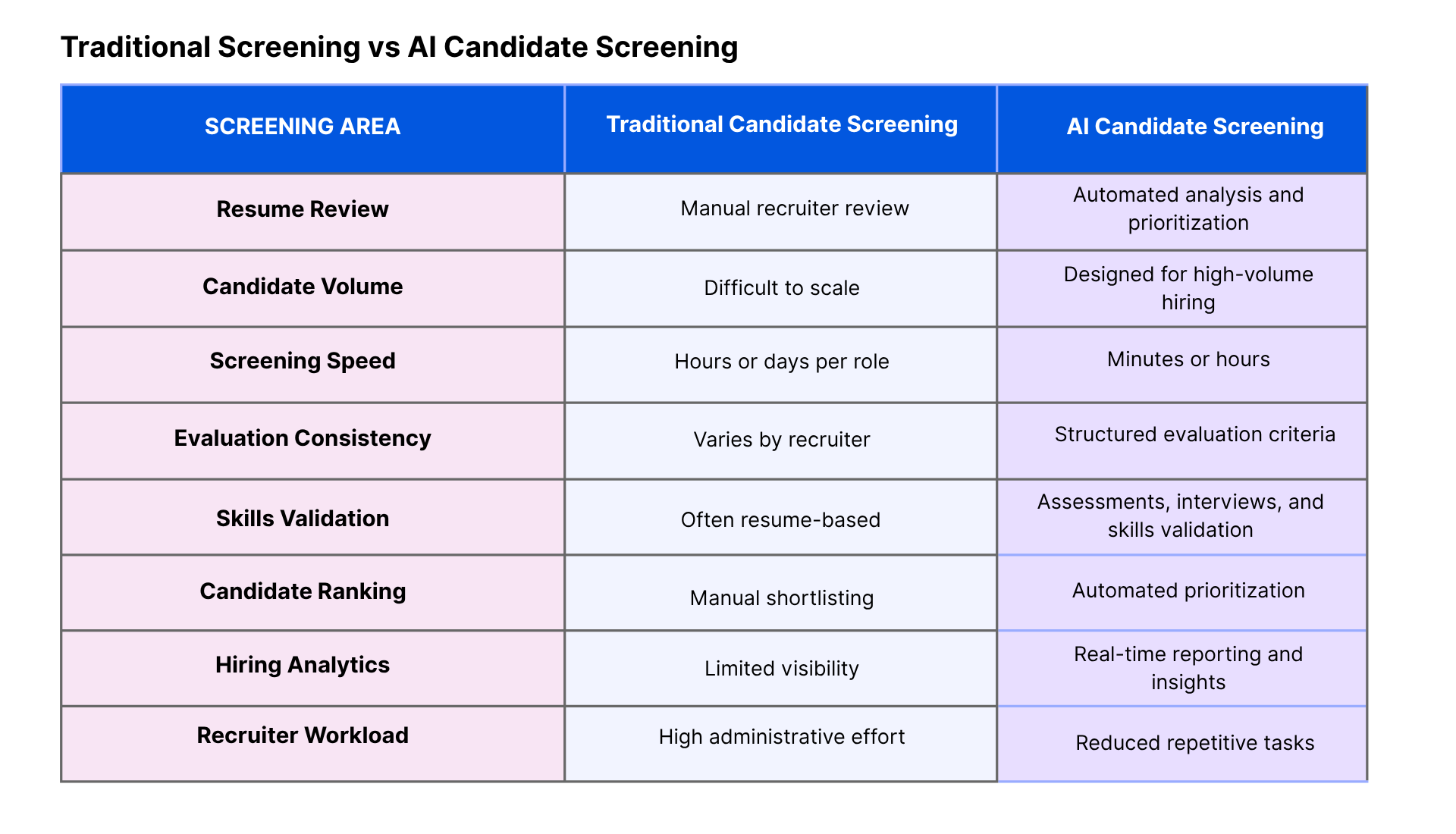
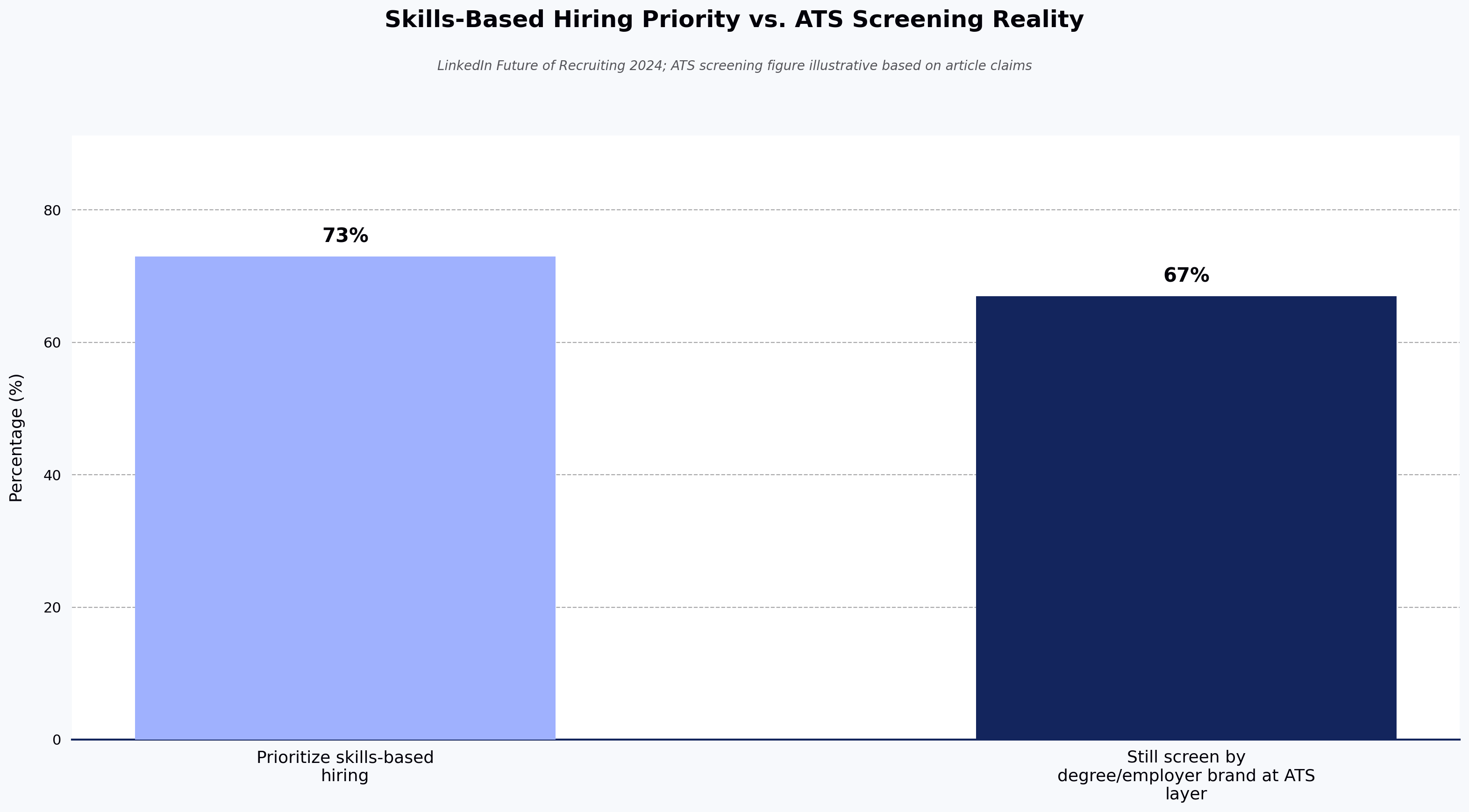
For recruiters and talent leaders, AI has made one thing clear: resumes can no longer be trusted as the primary signal of candidate capability. What AI is forcing HR to rethink is the entire screening stack — from how reqs are written, to how the ATS filters applicants, to how quality of hire (QoH) is measured against time-to-fill. According to LinkedIn's Future of Recruiting 2024 report, 73% of recruiters say skills-based hiring is a priority, yet most pipelines still screen on degree and employer brand at the ATS layer. That gap is where the rethink begins.
Why traditional resumes no longer predict strong hires
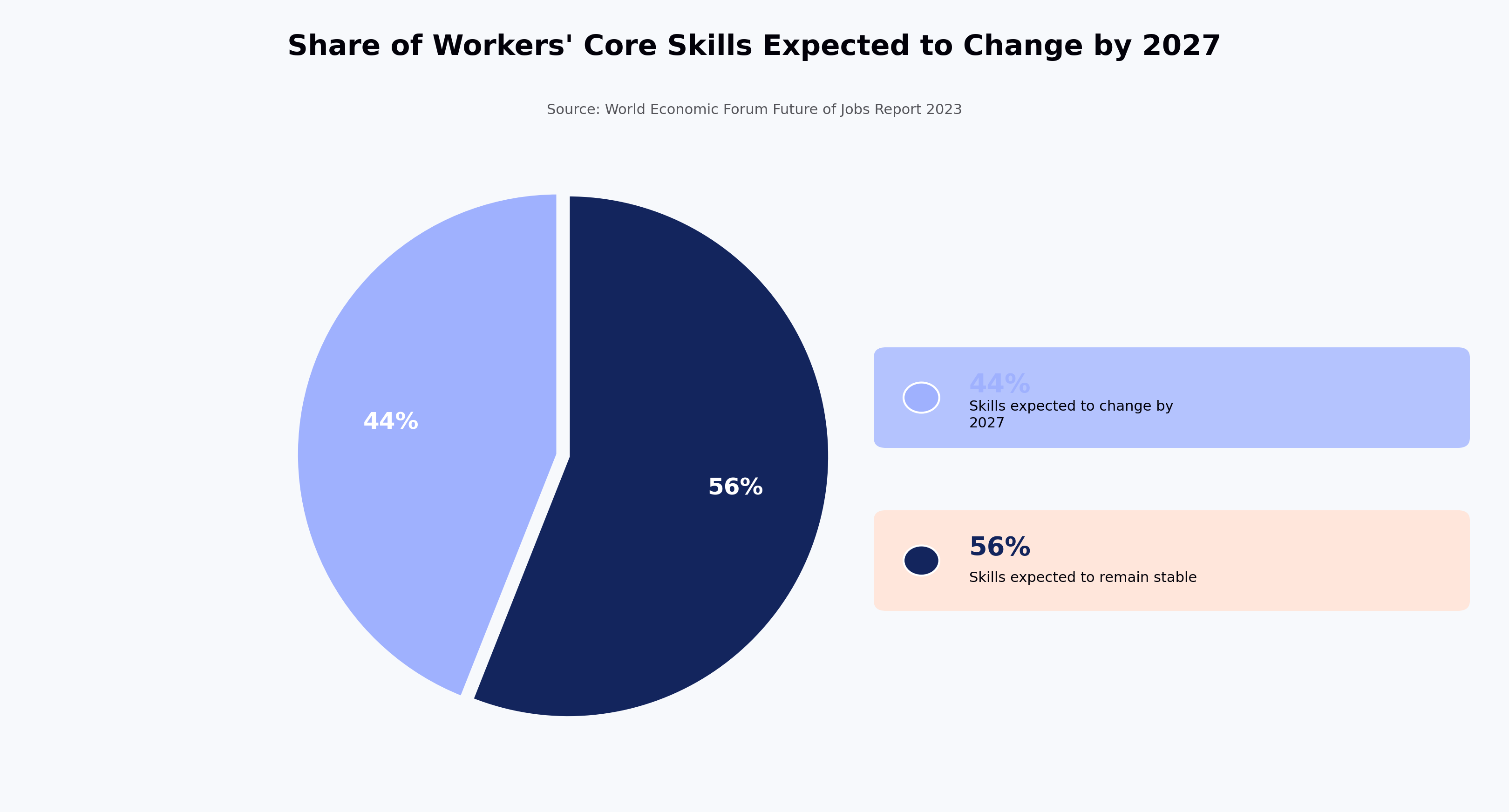
Resumes measure presentation more reliably than capability. Recruiters have long used job titles, company names, degrees, and years of experience as proxies for performance, but generative AI tools — ChatGPT, Teal, Rezi, and Kickresume among them — have collapsed the cost of producing a polished application. The World Economic Forum's Future of Jobs Report 2023 found that 44% of workers' core skills are expected to change by 2027, which means a resume snapshot ages faster than the role it describes.
For recruiters, the operational impact is direct: pipelines fill, screen rates rise, and yet QoH stays flat. As AI becomes more deeply embedded in hiring, HR leaders are being forced to rethink a single question:
What if resumes are no longer the best predictor of performance?
That question is reshaping recruitment faster than many organizations expected — though, as discussed later, the shift away from resumes carries its own trade-offs.
The resume was built for a different era
Modern work no longer fits the resume's static format. Skills evolve in months rather than years, roles overlap across functions, and professionals build expertise through online communities, freelance projects, bootcamps, and self-directed learning. According to SHRM's 2024 Talent Trends research, nearly half of HR leaders report that candidates from non-traditional backgrounds are increasingly competitive on assessments.
Resumes still reduce people to standardized timelines, and many capable candidates are filtered out by ATS rules simply because they lack the "right" employer logos. At the same time, candidates skilled in resume optimization can outperform genuinely capable professionals at the screen stage — a pattern that pre-dates AI but has been amplified by it.
It has become far easier for candidates to generate polished resumes, cover letters, and interview responses in minutes. For recruiters, the takeaway is practical: formatting and phrasing are no longer reliable proxies for capability.
AI did not break hiring — it exposed existing problems
AI did not create the resume problem; it surfaced one already present in most hiring funnels. Surveys of recruiters, including Gartner's 2024 HR research, have consistently shown three pre-AI pressures: recruiters overwhelmed by application volume, candidates optimizing resumes to pass ATS filters, and hiring managers reporting weak outcomes despite reviewing seemingly strong resumes.
AI accelerated these problems to a point where they can no longer be ignored. Many candidates can now generate a highly optimized application in seconds, and recruiters increasingly struggle to distinguish between candidates skilled at self-presentation and those who can actually do the work.
The operational shift is moving from:
"What does your resume say?"
Toward:
"Can you actually do the job?"
The rise of skills-based hiring
Skills-based hiring outperforms resume screening because it measures demonstrated capability rather than credential proximity. A growing number of organizations — including IBM, Accenture, and Delta, profiled in LinkedIn's Skills Path program — are moving toward skills-first models that prioritize practical assessments, simulations, project work, and role-specific problem-solving over employer brand or degree.
This trend is most visible in technology hiring, where coding assessments and real-world technical evaluations generally provide stronger signals than resumes alone, particularly when compared against resume-only screens for time-to-productivity. HackerEarth has run over 100 million developer assessments across enterprise hiring programs, and the consistent pattern in that dataset is that demonstrated coding performance correlates more closely with on-the-job output than degree or prior employer.
Beyond tech, a growing number of organizations are extending the model: marketing teams using campaign-brief exercises, sales teams using recorded customer-handling scenarios, and operations teams using situational judgment tests. For a deeper view of how this maps to specific roles, see our skills-based hiring guide and developer assessment platform.
Where skills-based hiring breaks down
Skills-based hiring is not without trade-offs, and recruiters evaluating it should plan for known failure modes:
- Assessment bias. Poorly designed assessments can disadvantage career returners, caregivers, and candidates with limited test-taking time as severely as resume screens disadvantage non-traditional backgrounds.
- Gaming of take-home tests. Unproctored coding or case exercises are increasingly solvable with generative AI, which means assessment design has to evolve in step with candidate tooling.
- Candidate experience at scale. Long assessment batteries lower completion rates and damage employer brand, particularly for senior candidates who have multiple offers in play.
- Legal exposure. In jurisdictions including New York City (Local Law 144) and under the EU AI Act, automated employment decision tools are subject to bias audits and disclosure requirements. Recruiters should confirm vendor compliance before deploying AI-driven scoring.
The honest read: most organizations announcing a "shift" to skills-based hiring still filter by degree at the ATS layer. The shift is real, but it is uneven.
Why HR leaders are rethinking potential
Potential is becoming more measurable in ways resumes never allowed. Traditional hiring often prioritized pedigree — familiar universities, recognizable employers, conventional career paths — but AI-powered assessment platforms (HackerEarth, HireVue, Pymetrics, Codility, and Workday Skills Cloud among them) score candidates on demonstrated performance against role-specific tasks, calibrated to a benchmark population.
These tools typically combine task-based evaluations, behavioral simulations, and structured scoring rubrics. Their limits matter too: they score what they are trained to score, they can encode bias from the training population, and they do not measure long-arc traits like cultural contribution or leadership trajectory. Recruiters should treat them as one signal in a structured interview loop, not a single decision point.
Research suggests that candidates without elite degrees frequently match or outperform credentialed peers on standardized technical assessments. In many cases, career switchers and self-taught professionals demonstrate strong adaptability and practical skill. Organizations that shift toward capability-based evaluation may gain access to broader and more diverse talent pools — though, as noted above, only if assessment design itself is audited for fairness.
The recruiter's role is changing
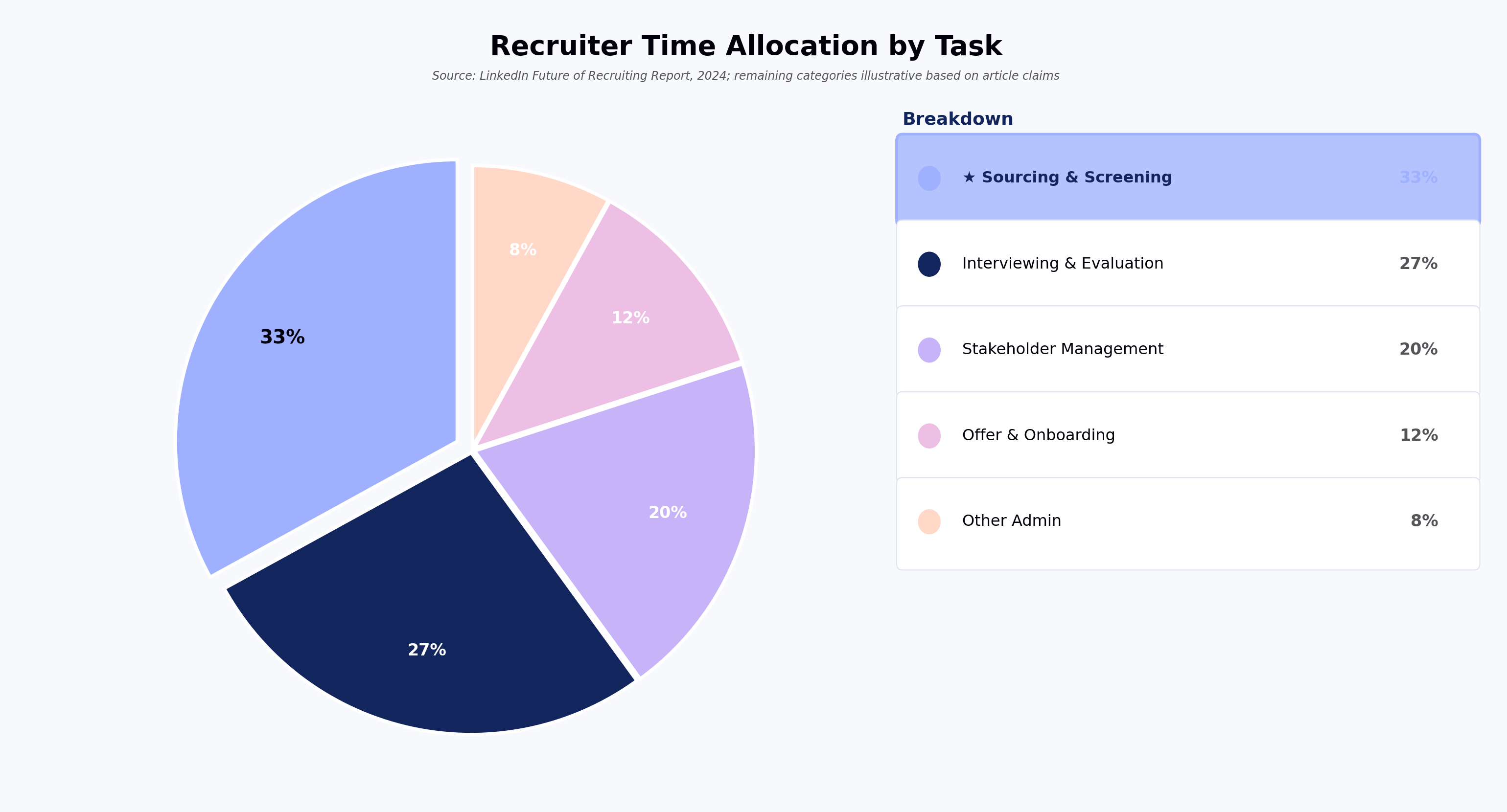
AI is not replacing recruiters; it is shifting where recruiters spend their time. Traditional recruitment rewarded screening volume and speed. Modern hiring increasingly rewards judgment, stakeholder alignment, and structured decision-making.
As automation handles sourcing, scheduling, resume parsing, and initial outreach, recruiters are spending more time on work AI cannot do well:
- Probing candidate motivation through structured behavioral interviews
- Evaluating adaptability against specific role demands using scorecards
- Building hiring-manager alignment on the req and intake brief
- Designing candidate-experience touchpoints that protect offer-accept rates
- Calibrating assessment results against on-the-job performance data
The recruiter who succeeds in an AI-heavy pipeline is the one who can interpret signal, not the one who can scan resumes faster.
Candidates are changing faster than hiring systems
Modern career paths now move faster than most ATS configurations. Today's workforce values flexibility, creativity, continuous learning, and project-based growth, and many professionals build experience through freelance work, startups, creator platforms, and side projects. Their resumes often look unconventional, but unconventional no longer equates to unqualified.
Organizations that shift toward capability-based evaluation may access talent pools that rigid resume filters would otherwise miss. For practical guidance on adjusting screening criteria, see our guide to evaluating an ATS for skills-based hiring.
The future of hiring will feel more human
There is an irony in the AI shift: as resumes become easier to automate, organizations are being pushed to evaluate creativity, adaptability, collaboration, and real-world problem-solving more directly. The likely structure of mature AI-enabled hiring is AI handling repetitive tasks — sourcing, scheduling, parsing, initial scoring — while recruiters and hiring managers focus on nuance, context, and long-term fit.
FAQ
Is skills-based hiring more effective than resume screening? Skills-based hiring tends to predict on-the-job performance more reliably than resume screening for roles where the work can be assessed directly, such as engineering, data, sales, and marketing execution. According to LinkedIn's Future of Recruiting report, 73% of recruiters now prioritize skills-based approaches. Effectiveness depends heavily on assessment design and on whether downstream ATS filters still gate candidates by degree.
What HR processes is AI changing first? AI is changing sourcing, resume parsing, candidate matching, and initial assessment scoring first, because these are high-volume, rules-based tasks. Structured interviewing, offer negotiation, and onboarding remain primarily human-led, though AI-assisted note-taking and scorecard analysis are growing.
Will AI replace recruiters? AI is unlikely to replace recruiters, but it is changing the skill profile. Recruiters who can interpret assessment data, align hiring managers, and design candidate experience will be more valuable; recruiters whose role is primarily resume scanning are most exposed.
How do I evaluate an AI hiring tool for bias? Ask the vendor for a bias audit report (required under NYC Local Law 144 for automated employment decision tools), the demographic composition of the training data, the validation methodology against job performance, and the appeal process for candidates. Avoid tools that cannot answer all four.
Is resume-based hiring going away? Resume-based hiring is under pressure but not disappearing. Most organizations are moving toward hybrid models where resumes provide context and assessments provide the capability signal. A full move away from resumes is unlikely in the next hiring cycle for most enterprises.
What is the biggest risk of switching to skills-based hiring? The biggest risk is poorly designed assessments that introduce new forms of bias or damage candidate experience. A skills-based process built on a long, unproctored, untested assessment battery will perform worse than a structured resume screen.
Next steps: See it in action
If you are a recruiter or talent leader evaluating how to move from resume-led to skills-led screening, book a demo of HackerEarth Assessments to see how role-specific evaluations, proctoring, and benchmarked scoring fit into an existing ATS pipeline. For background reading, see our developer assessment platform overview and the HackerEarth recruiter blog.
Recruiters who pair structured assessment data with strong human judgment build better pipelines than either resumes or AI alone can produce.