The 12 most effective employee selection methods for tech teams
Most tech hiring failures don't come from a shortage of candidates — they come from selection processes that over-weight resumes, unstructured interviews, and gut feel over methods that actually predict on-the-job performance. Choosing effective employee selection methods — the assessments, interviews, and evaluation processes that reliably predict job performance — is what separates hiring teams that ship strong engineers from those stuck backfilling early-tenure attrition. The 12 methods below are drawn from decades of industrial-organizational psychology research (primarily Schmidt and Hunter's 1998 meta-analysis) and reflect the methods most commonly used in technical hiring today, not a ranked "best of" list.
If you're a talent acquisition leader or recruiter running technical hiring, this guide is written for you: the vocabulary, examples, and sequencing are built around candidate screening, hiring workflow design, and defensible decision-making at scale.
What are employee selection methods?
Employee selection methods are the tools, assessments, and processes organizations use to evaluate candidates and make hiring decisions. They range from simple resume screening to complex assessment centres that simulate real job tasks.
For tech teams, the stakes are especially high. Technical roles require specific, demonstrable skills that are difficult to evaluate through conversation alone. A developer who interviews well may struggle with production-level code. A data scientist with impressive credentials may lack the practical problem-solving ability your team needs.
Effective employee selection methods close this gap by measuring what actually matters: skills, cognitive ability, working style, and the capacity to perform under real conditions.
The most widely cited framework for evaluating these methods comes from Schmidt and Hunter's 1998 meta-analysis (Psychological Bulletin, Vol. 124, No. 2, 262–274), which measured predictive validity on a scale from 0 (random chance) to 1 (perfect prediction). Understanding where each method falls on this scale helps you invest your hiring resources where they generate the strongest return.
The 12 most effective employee selection methods for tech hiring
1. Skills assessments
Skills assessments measure a candidate's proficiency in specific technical competencies required for the role. In tech hiring, this includes coding challenges, system design problems, or platform-specific tasks.
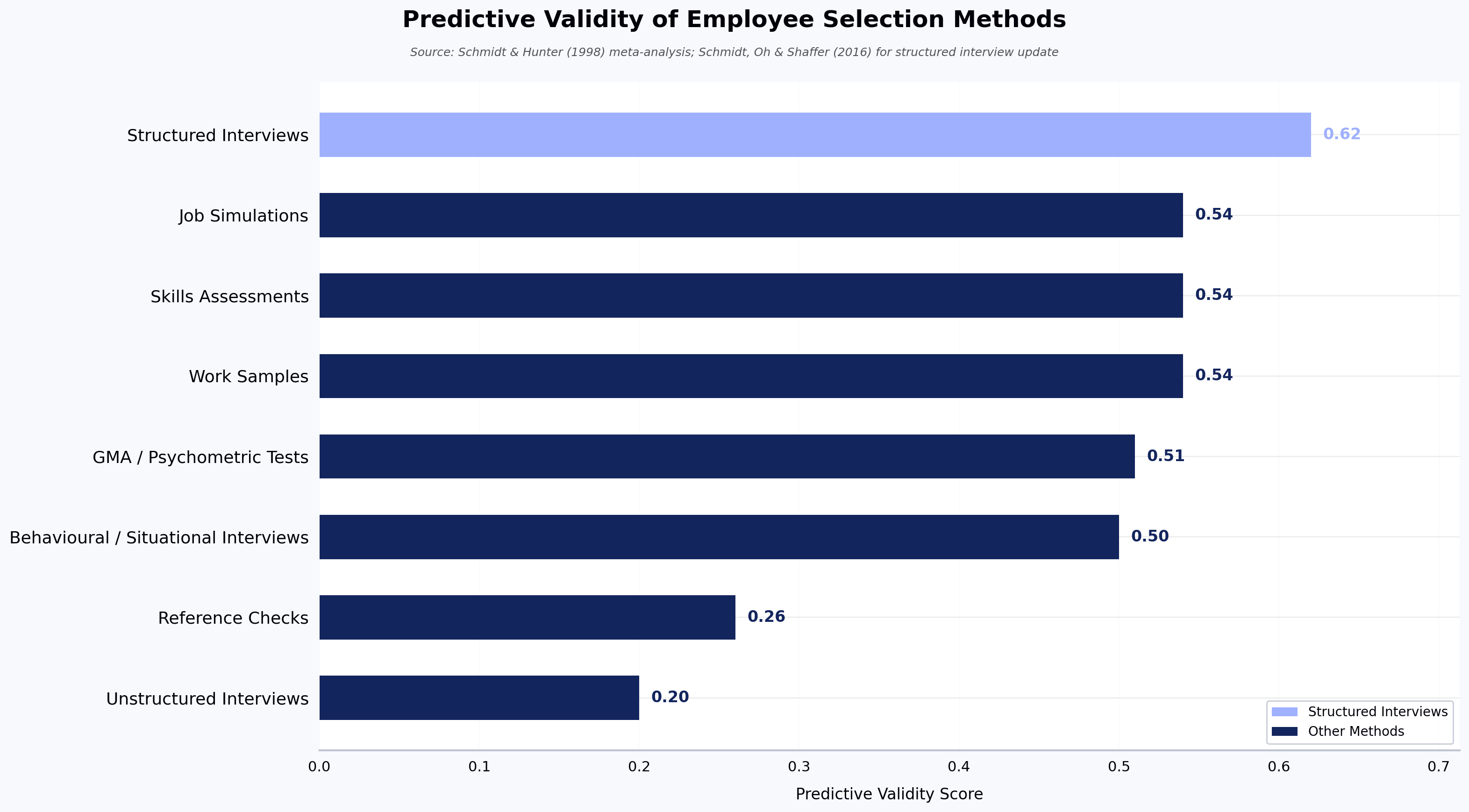
Research consistently ranks skills assessments among the strongest predictors of job performance. Work sample tests (a close cousin) achieve a predictive validity of approximately 0.54 in Schmidt and Hunter's meta-analysis, making them more reliable than unstructured interviews or resume screening.
HackerEarth's technical assessment platform supports role-specific evaluations across 40+ programming languages and 1,000+ skills, with real-time skill intelligence that surfaces candidate capability against role benchmarks — a specific capability worth calling out because it lets recruiters compare candidates on the same skill dimensions without engineering-team intervention. A full-stack developer candidate, for example, might complete assessments covering React on the front end and Node.js on the back end.
The key is relevance. Assessments should mirror actual job tasks, not abstract puzzles.
Limitations worth naming. Take-home assessments are vulnerable to candidate gaming (AI-generated code, outside help) unless proctored; proctored assessments improve integrity but add friction and can hurt candidate experience. In practice, skills assessments are among the most overused method in early-stage funnels — teams often deploy long assessments before candidates are meaningfully qualified, driving completion rates down and screening out capable applicants who won't invest hours upfront.
2. Structured interviews
Structured interviews use a standardised set of questions and a consistent scoring rubric for every candidate. Each interviewer evaluates responses against predetermined criteria rather than gut feeling.
This method achieves a predictive validity of approximately 0.58 in the original Schmidt and Hunter (1998) meta-analysis, with later updates (Schmidt, Oh, & Shaffer, 2016) placing structured interviews closer to 0.62 — making it one of the highest-performing employee selection methods available. The standardisation also reduces interviewer bias significantly compared to free-form conversations.
For a data scientist role, structured questions might include: "Walk me through how you would approach cleaning a messy dataset with 30% missing values" or "Describe how you would validate a machine learning model before deployment."
Pair structured interviews with a scoring rubric that rates responses on a 1 to 5 scale. This gives your hiring team consistent, comparable data across all candidates.
Limitations worth naming. Structured interview quality degrades over time as question sets leak into candidate-prep communities, and building an initial question bank plus training interviewers on rubric use is a non-trivial cost — often underestimated by teams adopting the method.
3. Behavioural interviews
Behavioural interviews ask candidates to describe specific past experiences to predict future performance. Questions follow the "Tell me about a time when…" format and focus on problem-solving, collaboration, and adaptability.
This method works because past behaviour is one of the strongest indicators of future behaviour. Standalone behavioural interview validity is typically lower than fully structured technical interviews — Schmidt and Hunter's data places situational/behavioural interviews in the 0.48–0.51 range, below structured technical interviews.
A strong behavioural question for a software engineer: "Describe a time you had to debug a production issue under time pressure. What was your approach, and what did you learn?"
Score responses using the STAR framework (Situation, Task, Action, Result) to maintain consistency across interviewers. For more guidance on structuring these questions, explore resources on mastering coding interview questions.
4. Work samples are the closest proxy to on-the-job performance
Work samples ask candidates to complete a task or project that closely mirrors real job responsibilities. Unlike theoretical questions, they reveal how a candidate actually performs.
For a software engineering role, this might involve building a small web application, writing an API endpoint, or refactoring legacy code. Keep the task under 2 to 4 hours to respect the candidate's time.
Work samples are highly predictive (approximately 0.54 validity per Schmidt and Hunter, 1998), but they require careful design. The task must reflect genuine job requirements, include clear evaluation criteria, and be assessed consistently across all candidates.
5. Psychometric testing measures cognitive ability and personality traits
Psychometric tests measure cognitive abilities, personality traits, and aptitude for specific types of work. General mental ability (GMA) tests achieve a predictive validity of approximately 0.51 in the Schmidt and Hunter (1998) meta-analysis.
For tech roles, cognitive assessments can measure pattern recognition, logical reasoning, and problem-solving speed. Personality assessments help identify traits linked to success in specific environments, such as conscientiousness for roles requiring meticulous attention to detail.
Use psychometric testing as a complement to skills assessments, not a replacement. Cognitive ability predicts general job performance, while technical skills assessments predict role-specific performance more precisely.
6. Peer interviews surface collaboration signal that panel interviews miss
Peer interviews involve current team members evaluating a candidate's technical ability, communication style, and collaborative approach. This gives the team a voice in hiring decisions and provides candidates with a realistic preview of their future colleagues.
A senior developer might pair-programme with a candidate for 30 minutes, assessing not just code quality but how the candidate communicates reasoning, asks questions, and responds to feedback.
Peer interviews are practitioner convention rather than an empirically validated method — Schmidt and Hunter did not report a discrete predictive validity figure for peer interviews, so treat them as a signal-gathering technique for collaboration fit rather than a primary performance predictor. Structure them with clear evaluation criteria to avoid subjective assessments that can introduce bias.
7. Hackathons and coding challenges evaluate technical ability under time pressure
Hackathons and coding challenges present candidates with problems to solve within a limited timeframe. These events test technical skill, creativity, time management, and the ability to deliver under pressure.
For high-volume tech hiring, coding challenges let you evaluate hundreds of candidates simultaneously with consistent criteria. A front-end hiring challenge might require building a specific feature in React within 3 hours.
These methods also function as employer branding tools, giving candidates a positive, engaging experience with your organisation. Automated scoring and real-time leaderboards support operational efficiency at scale, though there is no direct predictive-validity research for hackathon-format assessment — treat efficiency gains as anecdotal, not empirically validated.
8. Job simulations replicate broader working conditions
Job simulations place candidates in scenarios that replicate actual working conditions. Unlike work samples (which focus on a single task), simulations assess how candidates navigate a broader set of responsibilities.
For a DevOps role, a simulation might involve setting up a CI/CD pipeline, troubleshooting a deployment failure, and documenting the resolution. This reveals not just technical ability but workflow, prioritisation, and communication skills.
Simulations are resource-intensive to design but highly predictive. Reserve them for senior or specialised roles where the cost of a bad hire is especially high.
9. Reference checks verify claims but predict performance weakly
Reference checks involve contacting former employers, managers, or colleagues to verify a candidate's claims and gather insights about their work performance.
Reference checks have a lower predictive validity of approximately 0.26 per Schmidt and Hunter (1998), but they serve an important verification function. They confirm technical leadership experience, validate collaboration claims, and occasionally reveal red flags that other methods miss.
Ask specific, role-relevant questions: "How did this person handle code reviews?" or "Can you describe their approach to meeting tight deadlines?" Open-ended questions yield more useful information than simple confirmations. In practice, reference checks are one of the most misapplied methods — used late in the process as confirmation rather than as an independent data point, which limits their value.
10. Culture-fit assessment carries real legal risk when done poorly
Culture-fit assessments evaluate whether a candidate's values, work style, and behaviours align with the team and organisation. Used carelessly, "culture fit" becomes a vehicle for disparate impact — the EEOC has repeatedly flagged vague culture-fit criteria as a source of adverse impact claims because they allow subjective, demographically correlated preferences to drive hiring decisions.
The key is defining what you're actually measuring objectively. Instead of vague criteria, assess specific, measurable factors: comfort with ambiguity, preference for autonomous versus collaborative work, alignment with feedback norms. Some teams over-invest in culture-fit interviews as a proxy for skills evaluation — a pattern worth avoiding.
Strengthening the candidate experience during this process also reinforces your employer brand with every interaction.
11. Automated resume screening and AI interviews
Automated resume screening and AI-driven interviews use machine learning models — typically trained on historical resume, assessment, and hiring-outcome data — to evaluate applications and conduct first-round conversations. These models are trained to match candidate signals against role requirements; their limits include sensitivity to training-data bias, difficulty evaluating non-standard career paths, and reduced accuracy when applied to roles very different from the training population.
For tech hiring, some AI screening tools parse resumes for specific skills, certifications, and project experience, then rank candidates against role requirements. HackerEarth's OnScreen conducts role-calibrated conversations that adapt to candidate responses and uses a deterministic evaluation framework — meaning two candidates who give equivalent answers receive equivalent scores, regardless of interviewer availability. This reduces scheduling friction and screens every candidate who completes the assessment, rather than only those who fit into a live-interviewer calendar. AI handles first-pass screening so recruiters and hiring managers focus on later-stage judgement, not replace human interviewers.
AI screening requires careful oversight. NYC Local Law 144 now requires annual bias audits of automated employment-decision tools used on NYC-based candidates, and the EU AI Act classifies most hiring AI as high-risk, imposing documentation and transparency obligations. Audit algorithms regularly for bias, ensure training data is diverse, and always pair AI with human decision-making in later stages.
12. Panel interviews compress evaluation into a single session
Panel interviews involve multiple interviewers from different functions (a senior developer, a hiring manager, and an HR representative, for example) evaluating a candidate in a single session.
This method provides a multi-perspective assessment that reduces the total number of interview rounds, speeding up the process. Each panellist evaluates the candidate against their area of expertise: technical proficiency, project management skills, or cultural alignment.
Assign each panellist specific competencies to assess and use a shared scoring rubric. Without structure, panel interviews can devolve into unfocused conversations where the loudest voice dominates — a common failure mode when teams adopt panels to save time without investing in rubric design.
Comparing effective employee selection methods by validity and cost
Not all selection methods predict job performance equally. The table below summarises how the most common methods compare, drawing on Schmidt and Hunter (1998) and subsequent meta-analyses.
| Method | Predictive validity (approx.) | Cost to run | Scalability | Best used for |
|---|---|---|---|---|
| Structured interviews | 0.58–0.62 | Medium | Medium | Primary evaluation stage |
| Work samples | 0.54 | Medium–High | Low–Medium | Finalists, senior roles |
| Skills assessments | ~0.54 | Low–Medium | High | Early-stage screening |
| GMA / psychometric tests | 0.51 | Low | High | Complementary signal |
| Behavioural / situational interviews | 0.48–0.51 | Medium | Medium | Collaboration, soft skills |
| Job simulations | 0.54+ (context-dependent) | High | Low | Senior / specialised roles |
| AI-driven screening | Varies; validation required | Low | Very high | High-volume first pass |
| Reference checks | 0.26 | Low | Medium | Verification only |
| Unstructured interviews | 0.20 | Low | Medium | Not recommended as primary |
Validity data based on Schmidt and Hunter (1998) meta-analysis and subsequent research.
Suggested visual: a horizontal bar chart plotting predictive validity by method, sourced from Schmidt & Hunter (1998). Alt text: "Bar chart comparing predictive validity of employee selection methods, with structured interviews and work samples scoring highest and unstructured interviews scoring lowest."
The highest ROI comes from combining high-validity methods. A skills assessment followed by a structured interview creates a selection process that is both highly predictive and cost-efficient.
How to combine effective employee selection methods in sequence
Using a single selection method, no matter how strong, leaves gaps. The most effective employee selection methods work in a deliberate sequence:
- Application and automated screening: Filter the applicant pool using automated tools and resume analysis to identify candidates meeting minimum qualifications.
- Skills assessment: Test technical proficiency with role-specific coding or system design challenges. This eliminates candidates who look strong on paper but lack practical ability.
- Structured or behavioural interview: Evaluate problem-solving approach, communication skills, and deeper technical reasoning through live coding interviews.
- Work sample or simulation: For shortlisted candidates, assign a realistic task that mirrors on-the-job responsibilities.
- Peer interview or panel interview: Give the team a voice in evaluating collaboration and working style.
- Reference checks: Verify claims and gather final performance insights before extending an offer.
This sequence progressively narrows the candidate pool while increasing evaluation depth at each stage. Automated and low-cost methods handle high volumes early. Resource-intensive methods are reserved for finalists.
Reducing bias and ensuring legal compliance
Every selection method carries some risk of bias or adverse impact. Building a fair, legally defensible process requires deliberate effort at every stage.
Standardise everything. Use the same questions, scoring rubrics, and evaluation criteria for every candidate. Structured methods reduce interviewer bias significantly compared to unstructured approaches.
Monitor for adverse impact. Track selection rates across demographic groups using the four-fifths (80%) rule. If any group's selection rate falls below 80% of the highest-performing group's rate, investigate and adjust your process.
Validate your tools. Ensure assessments measure job-relevant competencies. Content validity (the assessment reflects actual job tasks) and criterion validity (scores correlate with job performance) both matter for legal defensibility.
Ensure accessibility. Provide accommodations for candidates with disabilities. Verify that remote proctoring tools work across different devices, network conditions, and accessibility needs.
Comply with automated-decision regulations. If you use AI-driven screening on candidates in New York City, NYC Local Law 144 requires an annual independent bias audit and candidate disclosure. The EU AI Act imposes additional documentation and transparency requirements for hiring AI in the EU.
Document your process. Maintain records of selection criteria, evaluation scores, and decision rationale. This protects your organisation in legal challenges and demonstrates good-faith compliance.
Choosing effective employee selection methods by role level
Not every method suits every hire. Match your approach to the role's complexity and seniority:
| Role level | Recommended stages | Emphasis |
|---|---|---|
| Junior / high-volume (e.g., Junior Developer, Support Engineer) | 2–3 stages: automated screening → skills assessment → structured interview | Efficiency, consistency, entry-level skill validation |
| Mid-level (e.g., Senior Developer, Data Scientist) | 3–4 stages: screening → skills assessment → structured interview → peer interview | Depth of technical skill, collaboration signal |
| Senior IC / Specialist (e.g., Staff Engineer, ML Lead) | 4–5 stages: screening → skills assessment → structured interview → work sample or simulation → panel | Judgment, architectural thinking, complex problem-solving |
| Leadership (e.g., Engineering Manager, VP Engineering) | 5+ stages: screening → structured interview → simulation → panel → reference checks | Strategic thinking, people leadership, referenceable track record |
Adjust the number and intensity of selection stages based on hiring volume and role criticality.
Build a stronger selection process for your tech team
A structured approach that combines multiple proven employee selection methods delivers more consistent hiring outcomes than resume review and intuition alone.
Start by identifying which methods match your roles, volume, and budget.
Then, layer them in a deliberate sequence — automated methods early, resource-intensive methods for finalists.
Standardise your evaluation criteria across every candidate and every interviewer.
Monitor selection rates for adverse impact and audit AI tools against applicable regulations.
Finally, invest in tools that assess real skills rather than polished presentations.
Why HackerEarth
HackerEarth Assessments is used by 500+ global enterprises for role-specific technical screening across 40+ programming languages, with OnScreen for AI-driven interviews and FaceCode for live coding evaluation. Schedule a demo of HackerEarth Assessments to see role-specific technical screening across 40+ languages in action.
Frequently asked questions
What are employee selection methods?
Selection and assessment are often used interchangeably, but they aren't the same: assessment is one component of selection. Selection is the end-to-end decision process — sourcing, screening, evaluating, and choosing — while assessments are the specific instruments (coding tests, structured interviews, simulations) used inside that process. Companies often over-invest in high-friction assessments while under-investing in the structured decision framework around them.
Which employee selection method has the highest predictive validity?
Structured interviews score highest in isolation (approximately 0.58 in Schmidt & Hunter 1998, closer to 0.62 in later updates), but the more useful finding from the same research is that combining methods adds more predictive power than any single method — including the highest-validity ones. A skills assessment plus a structured interview predicts performance better than either alone, and the incremental gain from adding a third well-chosen method is usually larger than switching from one high-validity method to another.
How many selection methods should a hiring process include?
Most effective hiring processes use 3 to 5 methods in sequence. Automated or low-cost methods (automated screening, skills assessments) filter candidates early, while higher-investment methods (interviews, simulations) evaluate finalists in depth.
How do you reduce bias in employee selection?
Standardise questions and scoring rubrics across all candidates. Use validated assessments, monitor selection rates across demographic groups, train interviewers on bias awareness, and combine multiple methods to reduce reliance on any single evaluator's judgment. For AI-driven tools, comply with applicable regulations such as NYC Local Law 144 and the EU AI Act.
Are AI-driven screening tools reliable for technical hiring?
AI screening improves consistency and handles high volumes efficiently, but it requires regular bias audits, diverse training data, and human oversight. Use AI for initial screening and structured evaluation, not as the sole decision-maker.
What is the difference between structured and unstructured interviews?
Structured interviews use predetermined questions and scoring criteria for every candidate, achieving a predictive validity of approximately 0.58–0.62. Unstructured interviews are free-form conversations with a validity of only 0.20, making them significantly less reliable and more prone to bias.