How technical hiring affects developer experience: a research-backed guide to getting it right
11 min read
Technical hiring — the end-to-end process of sourcing, evaluating, and selecting candidates for engineering and developer roles — has a developer experience problem. Developers consistently cite hiring friction as one of their top frustrations: ghost job postings, slow responses, and assessments with no connection to real-world skills (Stack Overflow Developer Survey, 2024). At the same time, technology companies hit only 50% of their hiring targets in 2024, down from 58% in 2023, according to reports on talent acquisition benchmarks. Those two data points are not unrelated.
Most technical hiring processes are built around evaluator convenience, not candidate experience. Assessments are inherited from three years ago without anyone reviewing whether they still reflect the job. Communication happens when someone remembers to send an email.
This guide is written primarily for recruiters and hiring managers who own the technical hiring process end-to-end, with secondary context for engineering leads who partner on calibration and interviews. It walks through six steps for closing the experience gap, with evidence for how each stage of the engineering hiring process shapes a developer's perception of your company. Whether you are revisiting skills-based hiring practices or building a process from scratch, the goal is a technical recruitment strategy that works for both sides of the table.
What is technical hiring and why developer experience matters
Defining technical hiring
Technical hiring is the end-to-end process of sourcing, evaluating, and selecting candidates for engineering and developer roles. It spans resume screening, coding assessments, technical interview rounds, system design evaluations, and offer negotiation. What distinguishes technical hiring from general hiring is its reliance on skills-based evaluation: structured challenges and role-relevant tasks that measure actual capability rather than inferred potential.
Why developer experience during hiring is a business metric
Developer experience during hiring is a business metric, not a candidate satisfaction survey. Reports suggest that 80 to 90% of candidates say a positive or negative hiring experience can change their mind about a role or company (Deloitte Global Human Capital Trends, 2024), and surveys have found that a majority say the experience signals how the company values its people. Developer communities are tight-knit. A candidate who had a poor technical interview experience in Q1 may have told six colleagues about it by Q2, and none of them sent in an application.
Step 1: Audit your current technical hiring funnel for experience gaps
You cannot fix what you have never looked at from the candidate's side. Most process documentation describes what the recruiting team does. Almost none of it describes what the developer candidate experience actually is at each step.
Map every candidate touchpoint
Walk through your hiring funnel stage by stage and ask one question at each point: what is the developer candidate experience here?
- Job posting: Does the description accurately reflect the role, or does it over-specify skills to filter volume?
- Application: How long does it take? Is it mobile-friendly?
- Screening: Does the candidate know their application was received?
- Assessment: Has the candidate been told the format, time commitment, and evaluation criteria upfront?
- Technical interview: Is the candidate's time respected? Do they know who is interviewing them and in what format?
- Decision: How long between interview and outcome? Is feedback provided?
- Offer or rejection: Is the rejection personalized, or is it a form email?
Visual asset recommendation: a hiring funnel diagram mapping candidate experience touchpoints at each stage makes this audit immediately actionable for teams.
Identify drop-off points with data
Assessment platform analytics show where candidates abandon the process, not just where you screen them out. Many drop-off points occur not during initial technical screening itself but in the days following it, when silence replaces communication. Application-to-offer conversion rates in technical roles typically hover between 0.5% and 2%, according to industry benchmarks reported by talent acquisition platforms. If that conversion rate drops sharply after assessment, that is a candidate experience signal, not a candidate quality signal. If more than 30% of invited candidates do not finish your assessment, something is failing them. Survey the people who withdrew; their answers will tell you more than funnel analytics can.
Step 2: Redesign technical assessments to respect developer time
The #1 developer complaint: assessment length and relevance
Industry surveys of developer hiring consistently find that overly long coding tests are among the top reasons developers drop out of hiring processes, with many citing length and poor relevance as their primary frustrations. From a developer's perspective, receiving a four-hour take-home with no context about what skills it tests, no deadline guidance, and no indication of how it will be evaluated sends one message before the first conversation: this company does not value their time.
Right-size your assessments
Cap take-home assessments at 60 to 90 minutes. For live coding, 45 to 60 minutes is sufficient for meaningful evaluation. Role-relevant tasks (such as debugging a representative codebase or writing tests for an existing module) produce stronger signal than abstract algorithm puzzles with no relationship to the actual job. Visual asset recommendation: a comparison table of assessment formats (take-home, live coding, AI-assisted, whiteboard) with developer experience ratings, completion times, and predictive validity benchmarks gives readers a practical decision framework.
Use structured, standardized assessments
Unstructured assessments introduce bias and make candidate comparison impossible. Schmidt and Hunter's meta-analysis (1998, Psychological Bulletin) found structured assessments predict job performance significantly more accurately than unstructured alternatives. This is the foundation of predictive assessments in technical hiring: pre-approved question libraries, consistent scoring rubrics, and role-calibrated difficulty levels that make results comparable across candidates and predictive of on-the-job performance.
HackerEarth's Skill Assessments cover 1,000+ skills across 40+ programming languages, giving every candidate for a given role the same assessment scored on correctness, efficiency, and code quality. Hiring teams compare actual performance data rather than interview impressions, which is what teams running high-volume technical hiring need to move calibration out of individual heads and into a shared rubric.
Step 3: Make technical interviews a two-way conversation
Move beyond gotcha questions
The health of your technical interview process is determined not by whether technical questions get asked but by whether those questions generate useful signal or just anxiety. "Invert a binary tree on a whiteboard" tests composure under observation as much as it tests data structure knowledge. "Walk me through how you would design the notification system for an application like ours" tests thinking, communication, and domain understanding. The only way to know which type of question you are asking is to decide in advance what a strong answer looks like and why.
Structure interviews around collaboration, not interrogation
Collaborative problem-solving formats produce better candidate data than whiteboard interrogations. Google's research on structured interviews has consistently found that rubric-based evaluation outperforms unstructured judgment for both accuracy and fairness. A useful rubric covers three things: technical depth, communication, and problem-solving approach. The rubric makes your evaluation defensible and makes the interview feel like a professional conversation rather than an audition.
HackerEarth's FaceCode runs collaborative live coding interviews in a shared environment with rubric-based scoring and auto-evaluation, so both the candidate and interviewer work on the same code in real time. This removes the observation pressure of whiteboard formats and leaves a code artifact and scored rubric the panel can review during debrief, which is what makes calibration across multiple interviewers possible at scale.
Are hiring managers technical? Why it matters
When a non-technical hiring manager leads a technical round, candidates notice and draw conclusions about your engineering culture from it. The most effective approach pairs a technical interviewer evaluating depth with a hiring manager evaluating communication, collaboration, and role fit. Neither should step outside their lane, and both roles should be explained to the candidate before the conversation begins.
Step 4: Close the communication gap at every stage
A majority of job seekers report being ghosted after an interview in recent years, according to candidate experience surveys. For developers managing multiple applications in parallel, silence reads as disrespect. It is also entirely preventable.
Set expectations before assessments
Candidates who know what to expect perform better and experience less friction. Before sending any assessment, share the format, expected time commitment, evaluation criteria, and response timeline. Candidate experience research has found that candidates who received clear process outlines rated their overall experience significantly higher. This costs the hiring team nothing except a short email.
Give timely, meaningful feedback
Developers commonly wait 10-plus days for post-interview feedback, according to hiring insights reports. The framework that works: acknowledge within 24 hours, deliver a decision within five business days, and offer brief technical feedback to candidates who completed a full assessment round. From a candidate's perspective, a single sentence noting that their solution handled the core logic well but missed edge cases is the difference between an experience they recommend and one they post about on Blind.
Step 5: Measure developer experience as a hiring KPI
Most hiring teams track time-to-fill, cost-per-hire, and offer acceptance rate but skip candidate experience in tech recruiting entirely. That measurement gap becomes a management gap fast.
Candidate Net Promoter Score (cNPS)
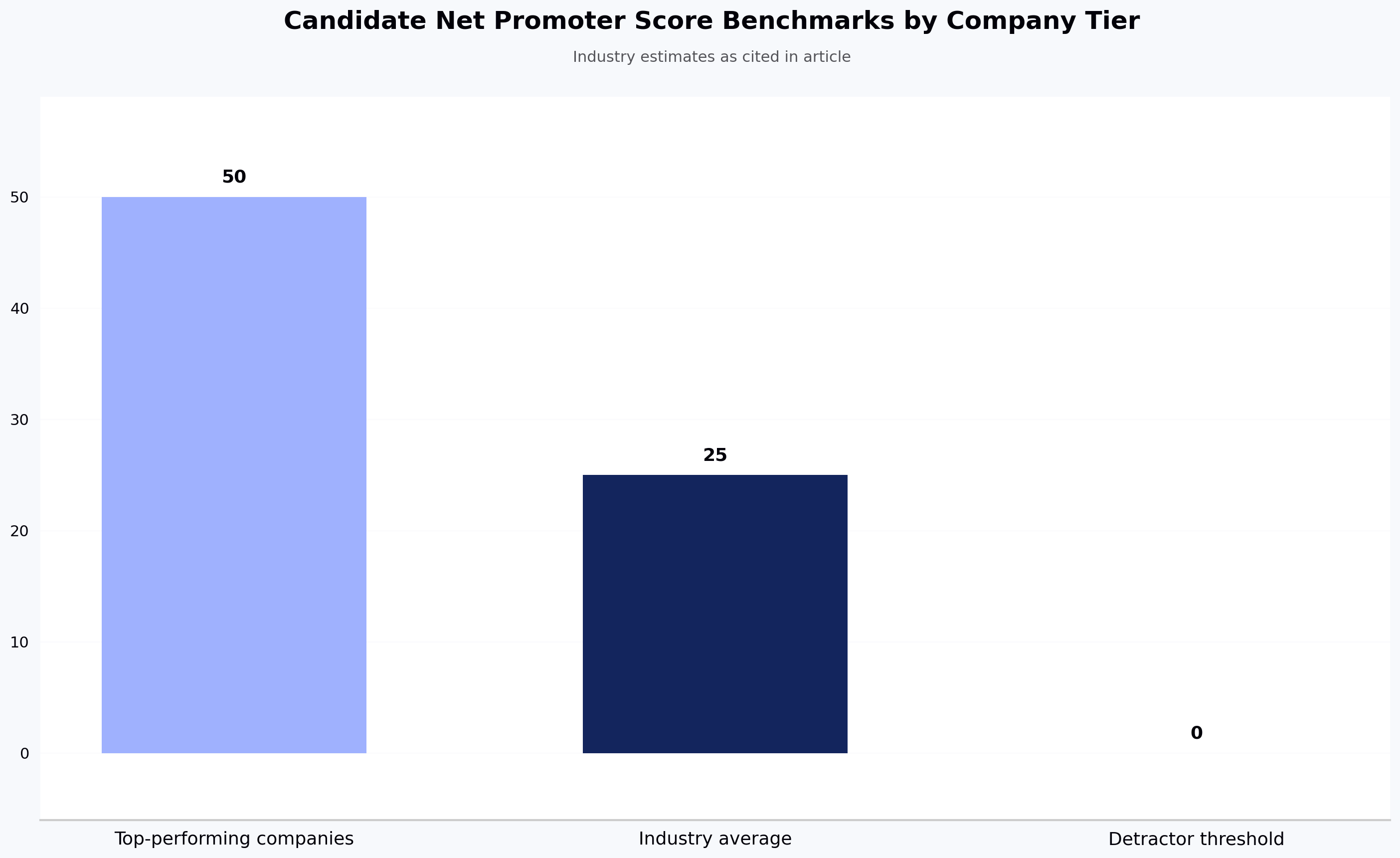
Treating cNPS like a vanity metric is the fastest way to guarantee you will not act on it. Ask candidates how likely they are to recommend applying to your company to a colleague, on a scale of 0 to 10. Send a two or three question survey within 48 hours of process completion, to both hired and rejected candidates. Industry estimates suggest top-performing companies achieve cNPS of 50 or above, while most companies land in the 20 to 30 range; a score below 0 means you are generating detractors in the developer community faster than you are generating advocates. Visual asset recommendation: a cNPS benchmark chart segmented by industry or company size gives teams immediate context for their own scores.
Track assessment completion rates
Assessment abandonment is a proxy for developer experience quality that shows up before the damage appears in offer acceptance rates. Building on the 30% threshold noted in Step 1: when abandonment crosses that line, the diagnostic questions are whether the test is too long, the instructions are unclear, or the candidate was not told what completing it would lead to.
Connect hiring experience to post-hire outcomes
IBM's Smarter Workforce Institute study (2017), conducted across more than 7,000 job applicants in 45 countries, found that candidates who rate their hiring experience positively are more likely to perform well, accept future roles, and recommend the company to peers. The hiring experience is the first chapter of employee experience, and it shapes engagement on day 90.
Step 6: Use technology to scale a developer-friendly technical hiring process
The best hiring process design fails at scale if the technology underneath it cannot hold up the load. This is where good intentions run into operational reality.
AI-assisted assessment and interview tools
AI tools, when used for tasks like scoring coding submissions against predefined rubrics, surfacing anomalies in candidate work, and ranking candidates against role criteria, can reduce candidate wait times, standardize evaluation quality, and free recruiters for the conversations that cannot be automated. Reports indicate that adoption of AI in recruiting technology grew meaningfully between 2023 and 2024, with a majority of adopters using these tools across multiple hiring stages (SHRM, industry research). The limits matter: AI scoring is only as reliable as the rubric it is trained on, and it should not make final hiring decisions or replace human judgment on offer conversations and fit.
The right question is not whether to use AI but which parts of the technical hiring process benefit from automation: assessment scoring and candidate ranking are strong fits; offer conversations and final decisions are not.
Remote proctoring done right
Remote technical hiring has introduced a candidate concern that in-person assessment never raised: surveillance. Candidates who feel they are being watched through a webcam for behavioral signals rather than evaluated on their code are having a poor experience that reflects on your company regardless of outcome. Good proctoring focuses on code similarity detection, environment consistency, and audit trails, not behavioral monitoring.
Where this framework does not apply
The six steps above assume a baseline of hiring volume, tooling, and process maturity. They will not apply cleanly in every context:
- Very early-stage companies without an ATS, structured rubrics, or repeatable hiring cadence are better served by lightweight, founder-led conversations than by formal assessment pipelines.
- Regulated industries (finance, healthcare, defense) may have compliance constraints on what kinds of skills assessments are permitted, where candidate data can be stored, and how AI scoring can be applied to selection decisions.
- Roles in jurisdictions with restrictions on unpaid work may not permit take-home assessments of meaningful length; paid take-homes or shorter in-process exercises are alternatives worth considering.
- Senior or specialist roles with small candidate pools often rely more on referrals, structured reference checks, and deep technical conversations than on standardized assessment libraries.
Treat the framework as a default for high-volume technical hiring at scaling companies, not as a universal prescription.
What happens when you get technical hiring wrong (and right)
The costs of a broken technical hiring process are quantifiable, and they compound at scale.
The cost of a bad developer hiring experience
SHRM estimates put the cost of losing a senior developer hire, including re-sourcing, re-interviewing, and lost productivity during the vacancy, at roughly $30,000 to $50,000 per incident at recent benchmarks. At any meaningful engineering hiring volume, that adds up faster than most TA leaders communicate to finance. Beyond direct cost, developers who had a poor experience with your process do not apply again, and they tell colleagues. In tight technical communities on Blind and Hacker News, a reputation for irrelevant interviews travels faster than any employer branding campaign can fix.
Companies known for strong developer hiring experiences
Companies including Stripe and Shopify have published descriptions of their hiring approaches on their engineering blogs. Stripe has described its take-home interview format as a real, self-contained task with clear scope and time estimates; Shopify engineering leaders have publicly discussed designing interviews around problems engineers actually encounter on the job. The common principle worth noting: the evaluation focuses on what a candidate can do, not whether they studied the right preparation guide.
Conclusion: technical hiring is your first product experience
For developers, your hiring process is the first product they interact with. If it is clunky, disrespectful of their time, or communicates nothing, they will assume your engineering culture works the same way.
The six steps in this guide, from auditing your funnel to measuring candidate NPS and applying technology thoughtfully, are how you close the gap between what your process is and what it signals. The companies winning the technical talent competition in 2026 are not winning on salary or brand recognition alone. They are winning because they treat hiring as a developer experience problem, not just a funnel problem.
Next steps
To see how structured assessments and collaborative live coding interviews work together in one platform, book a demo of HackerEarth or explore the Skill Assessments and FaceCode product pages.
FAQs
What is technical hiring?
Technical hiring is the specialized process of sourcing, evaluating, and selecting candidates for engineering and developer roles using skills-based methods including coding assessments, technical interview rounds, and system design problems. What changes most across contexts is depth and process weight: a Series A startup hiring its fifth engineer needs a very different process from a 5,000-person company hiring 200 engineers a quarter, and a staff-level role needs different signals than an entry-level one. Calibrating the process to seniority and company stage is what separates technical hiring from generic recruiting.
How do technical assessments improve hiring?
Structured technical assessments reduce interviewer bias, enable consistent candidate comparison, and predict job performance more accurately than resume review alone; Schmidt and Hunter's 1998 meta-analysis found structured assessment substantially outperforms unstructured alternatives in predictive validity. A well-designed assessment produces evidence of how someone actually thinks and codes. The key word is "well-designed": a four-hour abstract coding marathon predicts very little about how someone will perform in a real engineering environment.
Do hiring managers ask technical questions in interviews?
Yes, but how calibrated those questions are determines whether the interview evaluates skill or just creates anxiety. Hiring managers who are not deeply technical should focus on communication, problem-solving approach, and role fit rather than syntax questions better suited to engineering interviewers. Pairing a technical interviewer with a hiring manager, each scoped to their area, is consistently more effective than either doing the full interview alone.
How can you standardize technical hiring across teams?
Standardization requires pre-approved assessment libraries calibrated to each role, rubric-based interview evaluation, interviewer calibration training, and a centralized platform making validated content available across teams. Standardization improves both fairness and candidate experience because a coherent process signals professionalism. The trap to avoid is standardizing the wrong content: locking in an irrelevant question library consistently still produces irrelevant signals.
Why do developers drop out of hiring processes?
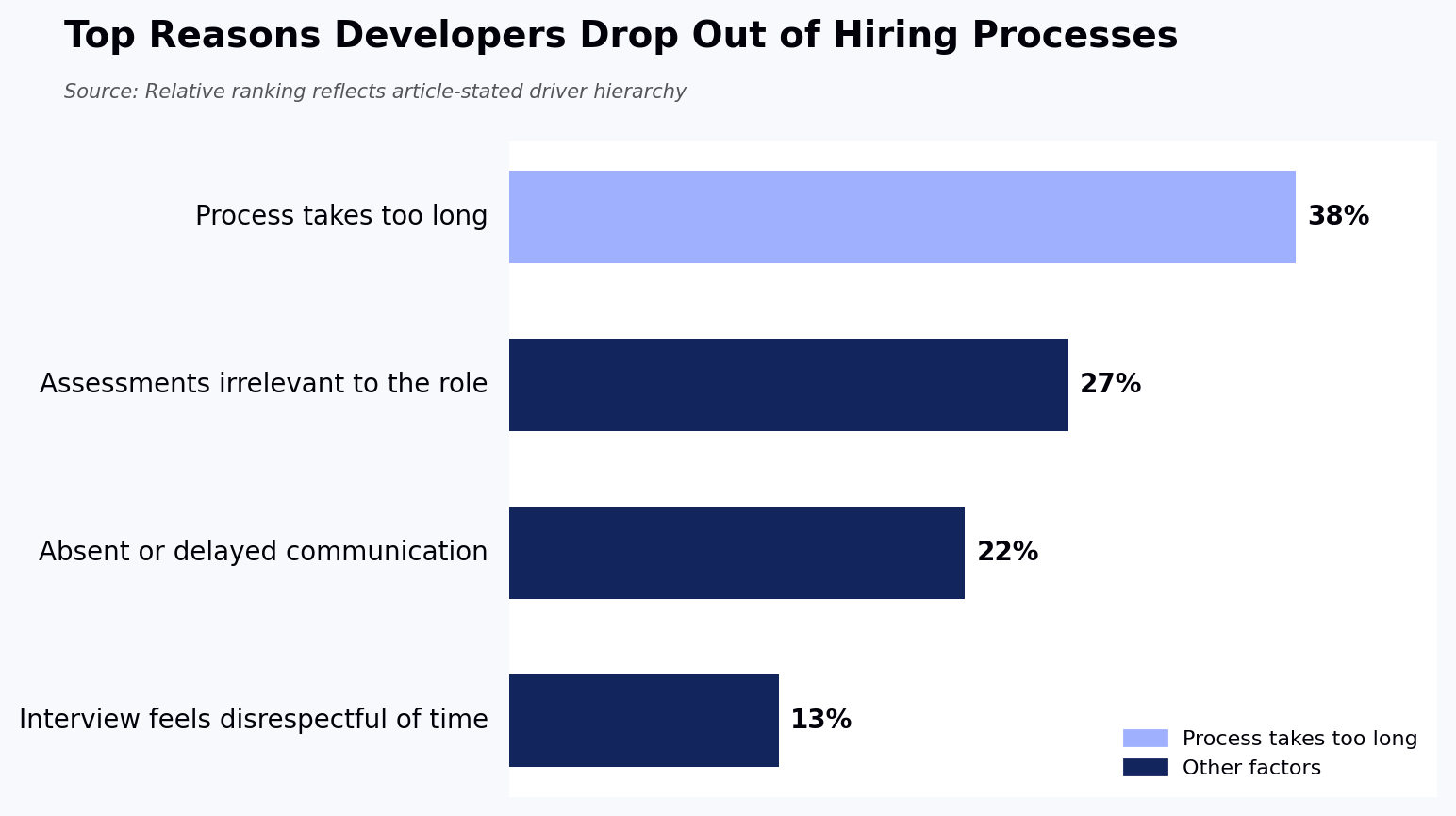
Research points to four consistent drivers: the process takes too long, assessments are irrelevant to the actual role, communication is absent or delayed, and the interview experience feels disrespectful of the candidate's time. Most of these are process changes, not budget items; they require design attention more than spend.
How does hiring experience affect employer brand?
Every candidate, hired or not, becomes a brand ambassador or detractor in the developer community. Candidate experience surveys consistently find that a majority of candidates say their hiring experience signals how the company values its people, and developer forums like Blind and Hacker News amplify both the good and the bad quickly. The employer brand your hiring process creates is not the one on your careers page; it is the one your rejected candidates describe to their colleagues.