The 15 best recruitment analytics tools for smarter hiring
By the HackerEarth Editorial Team — covering technical hiring, skills assessment, and recruitment operations
12 min read
Quick summary: Recruitment analytics tools — software that ingests, processes, and visualizes hiring data across the candidate lifecycle — turn hiring data into decisions on sourcing, screening, and quality of hire. This guide reviews 15 recruitment analytics tools by capability, breaks down approximate 2025 pricing, and shows recruiters and TA leaders how to pick the right fit.
Hiring teams hit roughly 56% of their hiring goals in 2024, according to Gartner's Reinventing Recruiting research. For a TA leader running a 40-role plan, that gap means roughly 18 seats sitting open at year-end — months of lost productivity per team and a recruiter pipeline that never catches up. Closing it requires moving from gut feel to measurable signal at every stage of the funnel.
For high-stakes roles — engineering, finance, senior individual contributors — embedded ATS analytics (Greenhouse, Ashby) tend to outperform standalone BI tools because they tie process compliance to outcome data inside the same workflow. The wrong choice in either direction costs months of integration work.
This article is written for in-house talent acquisition leaders and senior recruiters evaluating analytics platforms — not agency owners or HRIS administrators. Where workforce-planning or CHRO-level use cases come up (Visier, Eightfold), they're flagged as "for TA leaders reporting upward into the C-suite." Tools are listed alphabetically; the "best" framing reflects curation criteria (analytics depth, integration breadth, fit for declared use cases) rather than a numbered ranking. Where tactics differ by company size, that's called out in the tool reviews below — see the "How to choose" section for a full segmentation framework. Pricing figures throughout are approximate and based on publicly available data as of late 2025; several vendor figures remain unverified and should be confirmed directly with vendors before procurement.
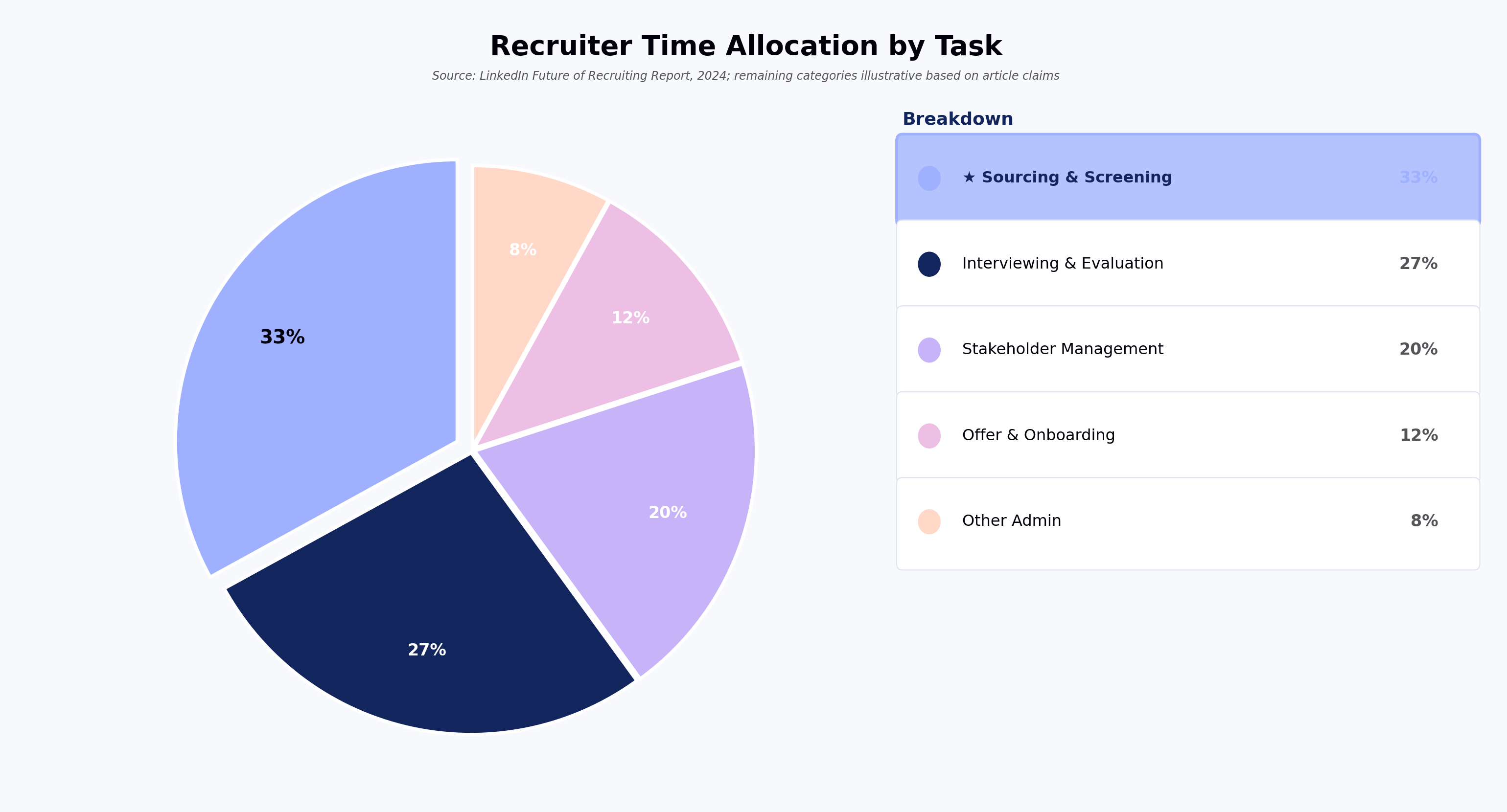
Industry reporting from SHRM and LinkedIn's Future of Recruiting points to longer time-to-hire cycles across most industries, underscoring why teams are turning to recruitment analytics tools to identify bottlenecks and prioritize the highest-converting channels.

Why recruitment analytics tools matter for hiring teams in 2025
Skills-based hiring has moved from pilot to operating model at many large employers. Reporting from SHRM and LinkedIn's Future of Recruiting documents a continued shift toward employers reducing degree requirements in favor of demonstrated skills, and McKinsey's research on skills-based organizations suggests that companies hiring on verified skills can see benefits in retention and internal mobility relative to peers relying primarily on credentials.
The link between recruitment analytics tools and business outcomes is increasingly visible in industry research. Deloitte's Global Human Capital Trends research reports that organizations with more mature talent analytics functions tend to report stronger results against workforce planning goals than less analytically mature peers. Reducing mis-hires also lowers recruiting costs — SHRM industry reporting on cost-per-hire points to bad-hire costs that can run into multiples of first-year salary when productivity loss and replacement costs are included.
For technical hiring specifically, verifying skills before interviews is where the largest funnel leakage tends to occur. HackerEarth's assessment platform pulls candidate performance data from coding tests, projects, and live interviews into a single report — giving recruiters verified skill signal they can use to prioritize the candidates most likely to convert. For more on this approach, see our guide to skills-based hiring and how it changes pipeline prioritization.

What is recruitment analytics software?
Recruitment analytics software is a category of HR technology that connects sourcing channels, applicant tracking, assessment platforms, and workforce data to surface patterns — for example, where high-quality candidates drop off, or which interview stages are most predictive of on-the-job performance.
These tools integrate with existing HR systems to pull sourcing, ATS, and assessment data into a single report, drawing from job boards, assessment platforms, and internal workforce records. By applying machine learning and predictive modeling, they help recruiting teams flag hiring slowdowns in specific regions, identify which interviewers reject candidates who succeed elsewhere, and reallocate sourcing spend toward channels that historically yield higher retention. For a deeper dive on connecting assessment outputs with ATS reporting, see our technical hiring guide.
Key features to look for in recruitment analytics tools
The right recruitment analytics tools share a few foundational capabilities. Dashboards remain central: teams need real-time visibility and customizable reports that track KPIs such as source of hire, offer acceptance rates, and candidate Net Promoter Scores. Effective dashboards go beyond raw counts to show conversion ratios at every stage of the funnel.
Predictive analytics for candidate success and diversity metrics are equally important. These tools use historical performance data to identify traits associated with retention in specific roles, while tracking representation against DEI goals. AI-assisted matching can support objective scoring when the underlying models are transparent about what data they are trained on and what their limits are — recruiters should ask vendors directly about model inputs, refresh cadence, and known failure modes. Finally, integration with the existing tech stack — ATS, job boards, and learning platforms — is essential for pulling sourcing, ATS, and assessment data into a single report.
| Feature | Description | Business impact |
|---|---|---|
| Real-time dashboards | Visibility into pipeline health and KPIs | Faster identification of bottlenecks |
| Predictive matching | Models that score candidates against role criteria | Higher quality of hire and reduced turnover |
| Skills assessments | Objective testing of technical and behavioral skills | Reduced subjectivity and better competency alignment |
| Outreach analytics | Tracking engagement on email and SMS sequences | Better sourcing spend and employer branding |
| DEI tracking | Monitoring representation throughout the funnel | Stronger compliance and inclusive culture |
The 15 best recruitment analytics tools (reviewed)
There is no single "best" recruitment analytics platform — the right fit depends on company size, industry, and hiring volume. Tools below are listed alphabetically. Pricing figures are approximate 2025 list prices gathered from vendor websites and public listings; confirm current pricing with vendors directly before procurement.
Ashby
Ashby has gained traction among tech-centric startups and mid-market teams for its all-in-one approach with native analytics.
- Overview: A platform combining ATS, CRM, scheduling, and BI-level analytics.
- Pros: BI-quality native reports, fast scheduling UI, and customizable pipelines.
- Cons: Steep learning curve and a higher entry price point for smaller teams.
- Best for: Data-driven startups and mid-market tech companies.
- Pricing: Contact vendor for current pricing.
- Why it made the list: Built-in analytics remove the need for a separate BI layer for most reporting needs.
Bullhorn Analytics
Bullhorn is widely used by staffing and recruitment firms, with a focus on consultant productivity and agency revenue tracking.
- Overview: Analytics suite for agencies tracking placements, billings, and pipeline efficiency.
- Pros: Tight integration with Bullhorn ATS, recruiter-performance dashboards, and agency-specific KPIs.
- Cons: Not designed for in-house corporate recruiting teams.
- Best for: Mid-to-large staffing agencies and executive search firms that need P&L-level reporting tied to an enterprise ATS.
- Pricing: Custom based on agency size.
- Why it made the list: Built around agency P&L — revenue per recruiter, gross margin per placement — rather than corporate hiring KPIs. Choose Bullhorn over Recruit CRM when the agency runs on an established Bullhorn ATS and needs deep financial reporting; choose Recruit CRM for smaller, sourcing-led agencies prioritizing recruiter productivity over financial depth.
Eightfold AI
Eightfold AI is a talent intelligence platform that uses deep learning to match candidates to roles based on transferable skills. It is particularly effective for reskilling and internal mobility programs.
- Overview: A predictive platform that evaluates candidates based on a broader skills profile.
- Pros: Tools designed to reduce certain forms of bias, skills-matching across roles, and a consolidated view of the talent lifecycle.
- Cons: Model outputs can be hard to explain to non-technical stakeholders.
- Best for: Enterprises undergoing transformation or with significant internal mobility programs (typically a CHRO-level decision).
- Pricing: Custom enterprise quotes — contact vendor.
- Why it made the list: Direct support for skills-based hiring at enterprise scale.
Gem
Gem is a recruitment CRM focused on passive candidate outreach and pipeline analytics, layered on top of an existing ATS.
- Overview: A sourcing-first platform tracking conversion rates for email sequences and pre-hire funnel drop-offs.
- Pros: Detailed outreach analytics, support for diverse candidate sourcing, and talent pooling.
- Cons: Higher cost and potential redundancy for teams relying solely on inbound applicants.
- Best for: Sourcing-heavy teams and companies recruiting passive talent.
- Pricing: Contact vendor for current pricing.
- Why it made the list: Granular outreach ROI data linking message and channel performance to actual hires.
Greenhouse Recruiting Analytics
Greenhouse promotes structured hiring — a methodology using data to keep interviews consistent and objective. Its analytics suite is embedded in its ATS, providing granular visibility into interviewer performance and funnel drop-offs.
- Overview: An ATS-first platform with built-in analytics focused on process optimization and DEI.
- Pros: Interview scorecards, diversity reporting, and a large marketplace of integrated tools.
- Cons: Pricing can be high for smaller teams, and the mobile app is limited for end-to-end setup.
- Best for: Mid-market to enterprise teams that value process consistency.
- Pricing: Custom pricing, typically mid-to-enterprise tier.
- Why it made the list: Standardized interview kits and scorecards tied directly to analytics — useful for teams trying to reduce inter-interviewer variance.
HackerEarth
HackerEarth is a technical hiring platform that combines skill assessments, live coding interviews, and skills intelligence. Its analytics layer is designed for organizations that need to verify technical capability at scale rather than rely on resumes alone, and is built for roles with five or more candidates per opening rather than low-volume one-off hires.
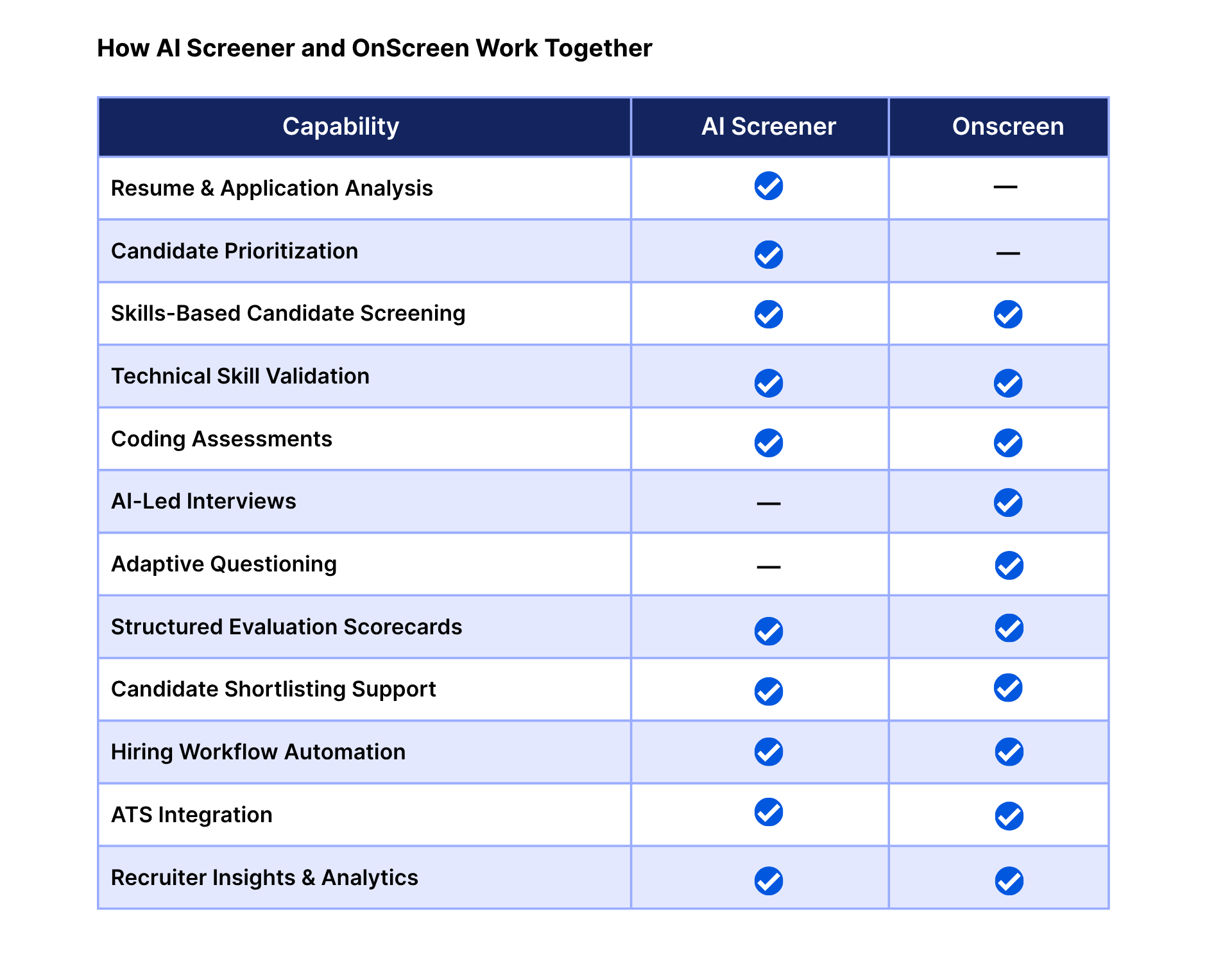
- Overview: A technical screening and engagement suite that uses assessment data to identify capable candidates across technical and non-technical roles. HackerEarth Skill Assessments handles the core evaluation flow, while HackerEarth OnScreen provides proctored live coding interviews.
- Pros: Detailed reporting on test and question effectiveness, with question-level analytics that flag items where strong hires and rejected candidates score similarly (a signal the question isn't differentiating). Proctoring is available specifically through OnScreen for live interview scenarios.
- Cons: Strongest fit for technical and engineering roles; not designed for low-volume hiring contexts.
- Best for: Tech-led organizations and enterprises scaling their engineering teams with five or more candidates per role.
- Pricing: Skill Assessments offers published Growth ($99/month) and Scale ($399/month) tiers, with enterprise pricing available on request — contact sales for current pricing.
- Why it made the list: Detailed reporting on test and question effectiveness gives interviewers structured signal that resumes and one-shot coding tests do not provide.
iCIMS Talent Cloud
iCIMS is a global enterprise platform handling high hiring volumes with AI-assisted screening and reporting.
- Overview: A talent cloud managing end-to-end recruitment for global organizations.
- Pros: Large integration marketplace, compliance features, and high configurability.
- Cons: Interface can feel dated and overwhelming without training.
- Best for: Global enterprises and high-volume hiring environments.
- Pricing: Enterprise custom pricing — contact vendor for current quotes.
- Why it made the list: Strong fit for organizations needing an audit-ready global talent system.
IBM watsonx Orchestrate for HR
IBM offers HR-focused AI capabilities within its broader watsonx product family; confirm current product naming and scope directly with IBM, since the lineup has shifted in recent years. The offering uses AI to help recruiters prioritize candidates by predicting performance and fit signals.
- Overview: An AI platform analyzing candidate and workforce trends. Buyers should ask for documentation on training data sources, refresh frequency, and known limitations.
- Pros: Predictive matching, automated scoring, and market intelligence analysis.
- Cons: Most effective inside the broader IBM ecosystem.
- Best for: Enterprises looking for AI assistance in high-volume screening.
- Pricing: Custom enterprise pricing.
- Why it made the list: Adverse impact analysis tooling for identifying and mitigating certain forms of bias in recruitment.
Jobvite Analytics
Jobvite is a talent acquisition suite known for its employer-brand-to-onboarding focus and referral management analytics.
- Overview: A suite providing intelligence across the recruitment lifecycle.
- Pros: Employee referral tracking, career site analytics, and hiring manager dashboards.
- Cons: The breadth of the platform can lead to a steep learning curve.
- Best for: Mid-to-large enterprises focused on talent communities and referrals.
- Pricing: Enterprise custom pricing.
- Why it made the list: Strong referral analytics — useful for teams where referrals drive a meaningful share of hires.
Manatal
Manatal is a cloud-based platform popular with recruitment agencies and SMBs for its affordability and ease of use. It offers a unified ATS and CRM with candidate enrichment from public profiles.
- Overview: A cost-effective recruiting solution with automated candidate scoring and social profile enrichment.
- Pros: Fast setup, AI-assisted interview features (vendor should be asked about model inputs and limits), and integration with a large catalog of job boards.
- Cons: Customization and reporting depth are lighter than enterprise tools like Visier.
- Best for: Small to mid-sized recruitment agencies and growing startups.
- Pricing: Contact vendor for current pricing.
- Why it made the list: Candidate enrichment and automated formatting at a price point accessible to small teams.
MokaHR
MokaHR is a data-driven recruitment platform used by global brands to support automated screening and analytics.
- Overview: An enterprise platform combining automation with end-to-end recruitment analytics.
- Pros: Full-funnel visibility, automated screening, and match scoring (vendor should be asked about model inputs and accuracy methodology).
- Cons: Best suited for high-volume enterprise environments; may be complex for small teams.
- Best for: Multinational corporations and rapidly scaling enterprise teams.
- Pricing: Custom enterprise pricing.
- Why it made the list: Designed for high-volume global hiring where automated screening throughput is a primary constraint.
Recruit CRM
Recruit CRM targets headhunters and executive search firms with a fast interface and automation for outreach.
- Overview: An ATS and CRM focused on recruiter productivity.
- Pros: Chrome sourcing extension, radius and Boolean search, and automated email sequences.
- Cons: Some analytics features and LinkedIn integrations require paid add-ons.
- Best for: Smaller and mid-sized staffing agencies and independent executive recruiters who prioritize sourcing speed and recruiter UX over deep financial reporting.
- Pricing: Contact vendor for current pricing.
- Why it made the list: Consistently high ratings for ease of setup and customer support in the agency segment. Choose Recruit CRM over Bullhorn for leaner agencies that value setup speed and per-user pricing predictability; choose Bullhorn for larger agencies needing enterprise financial reporting.
Tableau for HR
Tableau is a data visualization tool used by HR teams to build bespoke dashboards by blending data from multiple recruitment sources.
- Overview: A BI platform used by data-mature organizations to create interactive recruiting reports.
- Pros: Flexible dashboard design, ability to connect to any data source (ATS, HRIS, spreadsheets), and strong visualization.
- Cons: Requires data or analytics skills to build and maintain.
- Best for: Large organizations with dedicated people analytics teams.
- Pricing: Tiered by role — Creator, Explorer, and Viewer tiers published on Tableau's pricing page.
- Why it made the list: Best fit for teams that have outgrown native ATS reporting and need custom data modeling.
TalentLyft
TalentLyft is a recruiting platform that specializes in recruitment marketing and sourcing analytics.
- Overview: An ATS, CRM, and recruitment marketing suite.
- Pros: Job board performance tracking, branded career pages, and engagement metrics.
- Cons: Lacks the post-hire performance analytics found in Visier.
- Best for: Mid-sized companies focused on employer brand and sourcing efficiency.
- Pricing: Custom quotes, generally mid-market accessible.
- Why it made the list: Recruitment marketing reporting designed for non-technical recruiters.
Visier
Visier is a people analytics platform that connects recruiting data with employee performance and retention outcomes. It is designed to answer pre-built business questions using existing HR data.
- Overview: A people analytics solution focused on predictive forecasting and industry benchmarking.
- Pros: Analytical depth, business-user-friendly dashboards, and predictive capabilities for turnover and skill gaps.
- Cons: High total cost of ownership and lengthy implementation cycles for large enterprises.
- Best for: Large, data-mature enterprises with complex global reporting needs (typically a CHRO-level decision).
- Pricing: Custom enterprise pricing.
- Why it made the list: Strong capability for connecting pre-hire analytics with longer-term workforce planning across large organizations.
How to choose the right recruitment analytics tool for your team
Selecting the right recruitment analytics tool is an alignment exercise between the tool's capabilities and your team's operational maturity.
- Small businesses and startups often benefit from all-in-one platforms like Manatal or Ashby that provide core analytics without requiring a dedicated data analyst. Prioritize speed of setup and time-to-value.
- Mid-market companies typically have more structured processes and a greater need for funnel optimization. Greenhouse or Gem provide the depth to identify bottlenecks and track diverse candidate flow.
- Enterprise organizations require a talent intelligence layer that integrates with complex HR tech stacks; Visier, Eightfold AI, or iCIMS are better matched at that scale, offering predictive modeling and cross-functional reporting.
Before implementation, talent leaders should ask three questions:
- What data needs to be integrated? Confirm the tool can ingest data from your current job boards, ATS (such as Workday or Greenhouse), and sourcing platforms like LinkedIn Recruiter.
- How fast can we get results? Look for tools with pre-built dashboards for immediate visibility.
- Does it support our specific hiring goals? For example, technical hiring teams that need to verify skills rather than just resumes may want to evaluate a dedicated assessment platform alongside their general analytics tool. Our guide to evaluating technical assessment platforms covers the criteria in more detail.
When evaluating any tool on this list, ask vendors for case studies that name the customer, the role family being hired, and a specific metric moved (time-to-hire reduced from X to Y, offer acceptance improved by Z percentage points). Vendors who can't produce that detail should be treated with skepticism.
When recruitment analytics tools may not be the right fit
Not every organization benefits from a dedicated recruitment analytics platform on day one. Companies hiring fewer than 10 people per year often lack the data volume needed to produce statistically meaningful insights — a spreadsheet and a structured interview rubric will go further. Organizations without a baseline ATS or with inconsistent record-keeping should fix data hygiene before layering analytics on top, since predictive models trained on dirty data produce misleading outputs. Teams without an analyst or recruiter willing to interpret dashboards will also see limited return.
Pricing for recruitment analytics tools: what to budget
Recruitment software pricing in 2025 generally falls into three models: subscription-based, per-user/seat-based, or volume-based. Subscription models dominate, with costs scaling based on active job slots or company headcount. Pricing figures here are approximate and based on publicly available data as of late 2025; vendors regularly update list prices, so confirm directly before procurement.
| Tier | Monthly cost (est.) | Target company size | Example tools | Common pricing model |
|---|---|---|---|---|
| Foundational | $15–$100 | SMBs and solo recruiters | Manatal, HackerEarth Skill Assessments (Growth) | Per user/month or published tier |
| Growth/mid-market | $ |