title: "Why AI Interviews Are Becoming Standard Practice in Technical Hiring" meta_description: "AI interviews are becoming default in technical hiring. Learn how recruiters can deploy structured AI evaluation without sacrificing candidate quality." read_time: "8 min read" primary_persona: "Recruiter / TA Leader"
Why AI interviews are becoming standard practice in technical hiring
AI interviews — automated technical screening conversations conducted by conversational AI rather than a human recruiter — are increasingly becoming a default layer in technical hiring pipelines. They handle first-round evaluation at a scale and consistency that human-led screening cannot match. If you're a recruiter or talent acquisition leader running high-volume technical funnels, the question is no longer whether to use structured AI evaluation, but how to deploy it without sacrificing candidate quality or experience. The framing below draws on conversations with our enterprise customers through 2025.
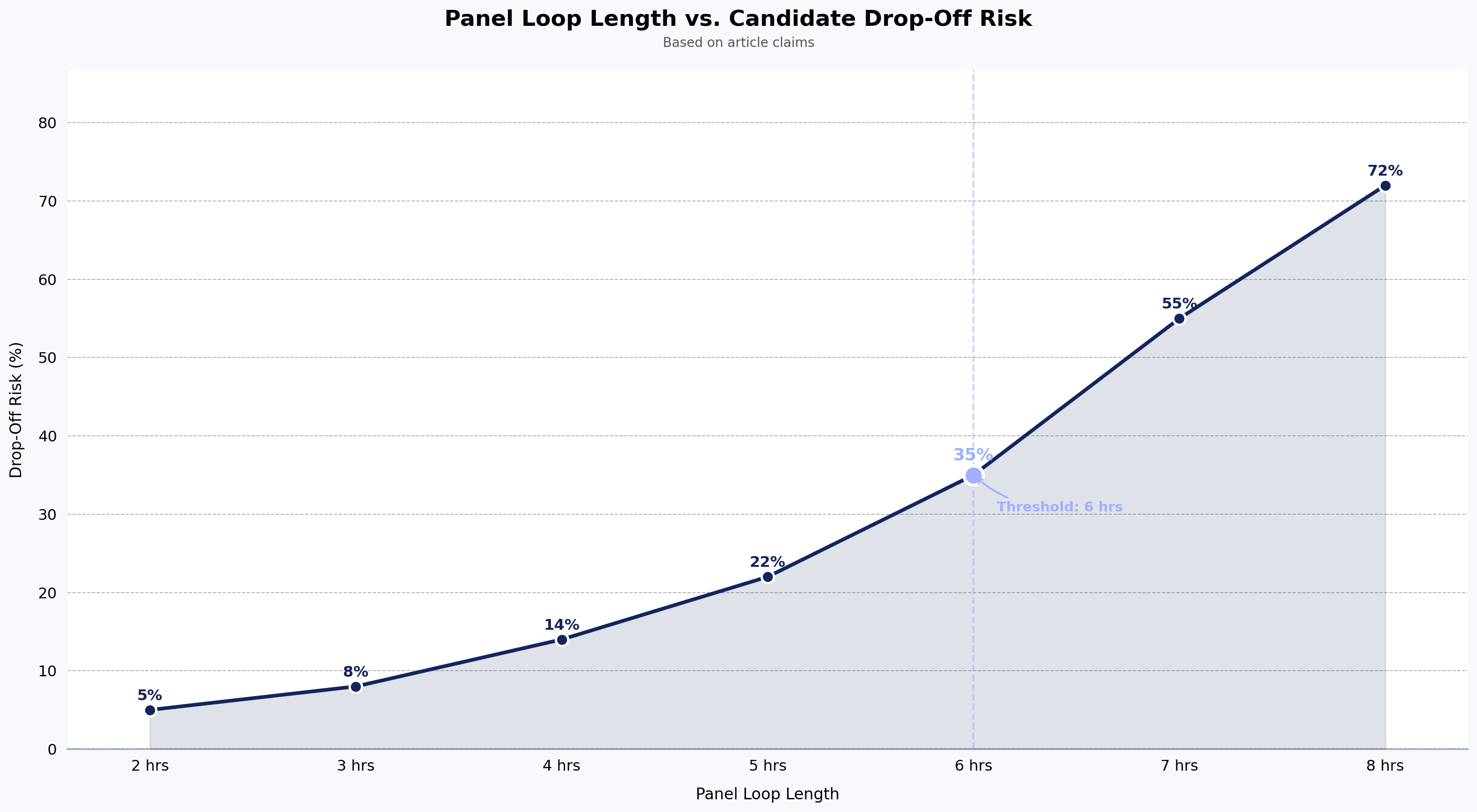
Technical hiring has a throughput problem. Recruiters managing engineering reqs juggle inconsistent evaluation standards across interviewers, scheduling bottlenecks across time zones, and drop-off rates that climb every time a candidate waits too long to hear back. In customer conversations, we hear that senior engineers can spend 5+ hours a week on screening interviews — time pulled directly from product work. AI interviews — asynchronous video interviews and live technical screens conducted by software trained on role-specific rubrics and question banks — have emerged as a direct response. The AI here is doing three specific things: parsing candidate responses with natural language processing trained on role-relevant question-answer pairs, scoring code submissions against pre-defined rubrics, and flagging integrity signals through proctoring models. Its limits are real: it does not assess judgment in ambiguous situations, it inherits patterns from the data it was trained on, and it should not make final hiring decisions.
How AI interviews remove the limits of human screening
The most immediate value of automated technical screening is capacity. A single AI interviewer can screen thousands of candidates simultaneously, across time zones, without scheduling conflicts, and with consistent rubric application. For recruiters running high-volume technical hiring or expanding globally, this removes the constraints imposed by available recruiter capacity.
Consistency is another advantage. Human screening can vary across interviewers, days, and even times of day. AI interviews apply the same rubric to every candidate — more consistent across candidates than human-led screens, and producing cleaner data for hiring decisions downstream. HackerEarth's technical assessments apply a fixed, role-mapped rubric to every candidate response and produce a structured scorecard per dimension, so the same input from two candidates produces the same evaluation regardless of when or where the screen runs. For a deeper view of how rubric design shapes signal quality, see our guide to designing technical assessments that predict on-the-job performance.
Automating repetitive screening can reduce recruiter time spent on first-round calls, though the magnitude depends heavily on funnel volume and current process maturity. The clearer benefit is reallocation: senior engineering and recruitment teams stop running first-round screens and focus on final technical rounds, culture fit, and candidate closing.
What the data actually tells us about AI interviews
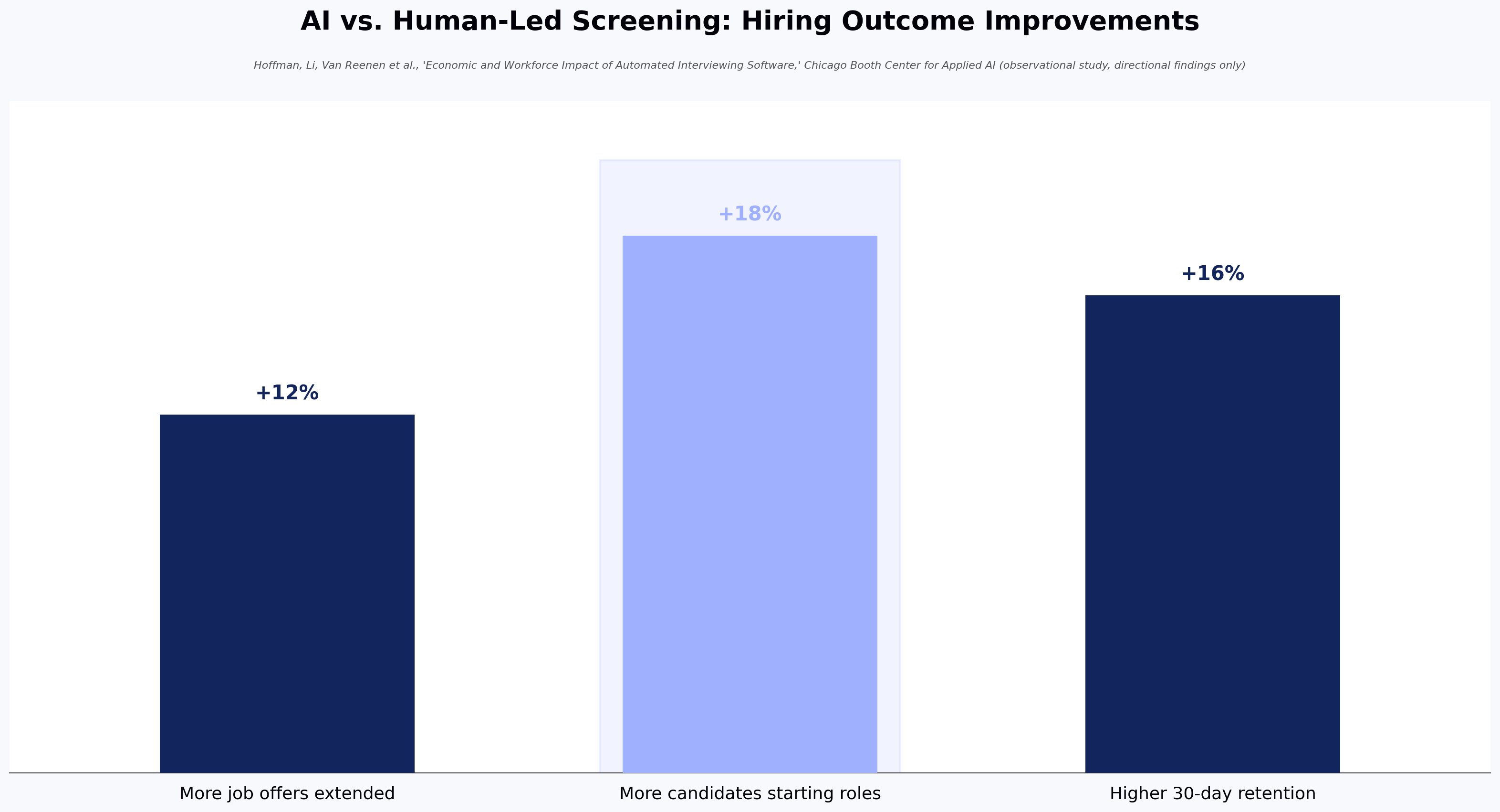
A large-scale observational field study by researchers at the University of Chicago Booth School of Business analyzed roughly 70,000 applicants screened using AI-led interviews and compared outcomes against human-led screens at the same employers. The working paper (Hoffman, Li, Van Reenen, and colleagues, "Economic and Workforce Impact of Automated Interviewing Software," circulated through Chicago Booth's Center for Applied Artificial Intelligence) reports directional findings that may challenge assumptions about automation compromising hiring quality: approximately 12% more job offers extended, 18% more candidates starting their roles, and 16% higher 30-day retention at organizations using AI interviews versus those relying on human-led screens. Because the study is observational rather than a randomized controlled trial, the magnitudes should be read as directional rather than causal.
The directional signal across published candidate-experience surveys we have reviewed is also consistent: transparent AI interview processes do not appear to damage candidate experience the way many recruiters assume they will, with candidates anecdotally citing fairness, scheduling flexibility, and consistency.
There is a contrarian read worth stating plainly: if candidates report comparable or better experience with AI interviewers than with recruiter phone screens, that is at least partly a verdict on the quality of recruiter phone screens, not just a vote for automation. The implication is uncomfortable — the top-of-funnel recruiter screen, as practiced in most organizations, may be the weakest link in the process, and structured AI evaluation can meaningfully strengthen it when paired with human judgment in later rounds.
What really happens in an AI interview
In an AI interview, candidates interact with software that combines NLP response parsing, live coding evaluation, and video avatar technology in a single session. Each layer does specific work that recruiters should understand before buying.
Natural language processing parses responses contextually, not just by keyword. When a candidate mentions a specific framework or design choice, the system can probe deeper with follow-up questions, producing an adaptive interview rather than a static questionnaire.
For technical roles, conversational AI assessments include live coding environments that evaluate code quality, problem-solving approach, runtime efficiency, and framework familiarity — not just whether a test case passes. HackerEarth's broader assessment platform supports 1,000+ skills and 40+ programming languages across its coding environments, which feed into the question pool available to interview workflows.
Video avatar technology is where platform differentiation shows up. HackerEarth's OnScreen, for example, uses lifelike AI video avatars designed to deliver genuine two-way conversation rather than chatbot-style scripted exchange — a capability worth verifying live in any demo. For more on how interview tooling fits into broader hiring infrastructure, see our overview of ATS integration in technical hiring.
On bias: AI systems do not eliminate bias, and any vendor claiming "zero bias" should be treated with suspicion. What well-built systems do is apply evaluation more consistently across candidates than human-led screens, and they can be audited for disparate impact in ways human interviewers cannot. The honest framing is that AI shifts the bias profile — it does not zero it out. For a longer treatment, see our piece on bias in hiring algorithms.
Where AI interviews fall short and human judgment is essential
AI interviews are strongest at structured, high-volume, skills-based screening. They are weakest in several specific scenarios recruiters should plan around:
- Senior and executive roles, where the signal lives in judgment, ambiguity tolerance, and cross-functional navigation rather than demonstrable skills.
- Highly open-ended problem solving, particularly system design discussions where the value is in the back-and-forth and the candidate's questions, not the answer.
- Roles where interpersonal nuance is the job — engineering management, customer-facing technical roles, founding engineers — where culture and communication outweigh codable skill.
- Final-round decisions and offer conversations, which remain human work.
The practical rule: use AI interviews to widen the top and middle of the funnel, and protect human time for the decisions that actually require it.

What to evaluate when selecting an AI interview platform
Most vendor checklists read the same. The criteria that actually differentiate platforms are quantitative and integration-specific, not feature names.
Question library
Look for a question library that is role-mapped and version-controlled rather than a raw question count — the relevant question is whether the library covers your specific roles with current questions.
Adaptive questioning
Adaptive follow-up questioning is worth verifying live in a demo. Many platforms market it but deliver scripted branching.
Proctoring
Ask vendors for their false-positive rates on integrity flags and how candidates can appeal — a platform that flags 10% of honest candidates is worse than one that flags 2%.
ATS integration
ATS integration should be native to your specific ATS (Greenhouse, Lever, Workday, SmartRecruiters) with documented field mappings, not "via Zapier."
Candidate experience
Request completion-rate benchmarks and average time-to-complete.
Security
Ask for SOC 2 Type II reports, GDPR and regional data residency commitments, and specifics on encryption in transit and at rest — not vague reassurance words.
Customer references
Ask for named enterprise customers in your industry, not logo walls.
HackerEarth OnScreen note: OnScreen combines in-depth technical interviewing, live proctoring, and KYC-grade identity verification in a single workflow. For a walkthrough of how proctoring fits into a defensible hiring process, see HackerEarth's Smart Browser proctoring overview.
Getting AI interview implementation right
Successful deployment of AI interviews is a process design problem, not a software problem.
- Define scope clearly. AI interviews work best after initial application review and before final human-led rounds. Trying to use them for final decisions is where adoption fails.
- Be transparent with candidates. Tell applicants they are interviewing with an AI, explain what is evaluated, and offer a clear path to human review. Trust scores improve when candidates are not surprised.
- Correlate scores with downstream outcomes. Track performance reviews, ramp time, and 6- and 12-month retention against AI interview scores. If the correlation is weak, your rubric is wrong, not the technology.
- Retrain recruiters. The job shifts from running screens to interpreting AI output, calibrating rubrics, and spending recovered time on candidate relationships and offer closing.
Note on regulatory requirements: disclosure rules including New York City's Local Law 144 and the EU AI Act are jurisdiction-specific and evolving. Consult legal counsel for the requirements that apply to your hiring locations.
An illustrative scenario
The numbers below are illustrative, not benchmark data; the calibration step is the work most teams skip and then blame the tool for.
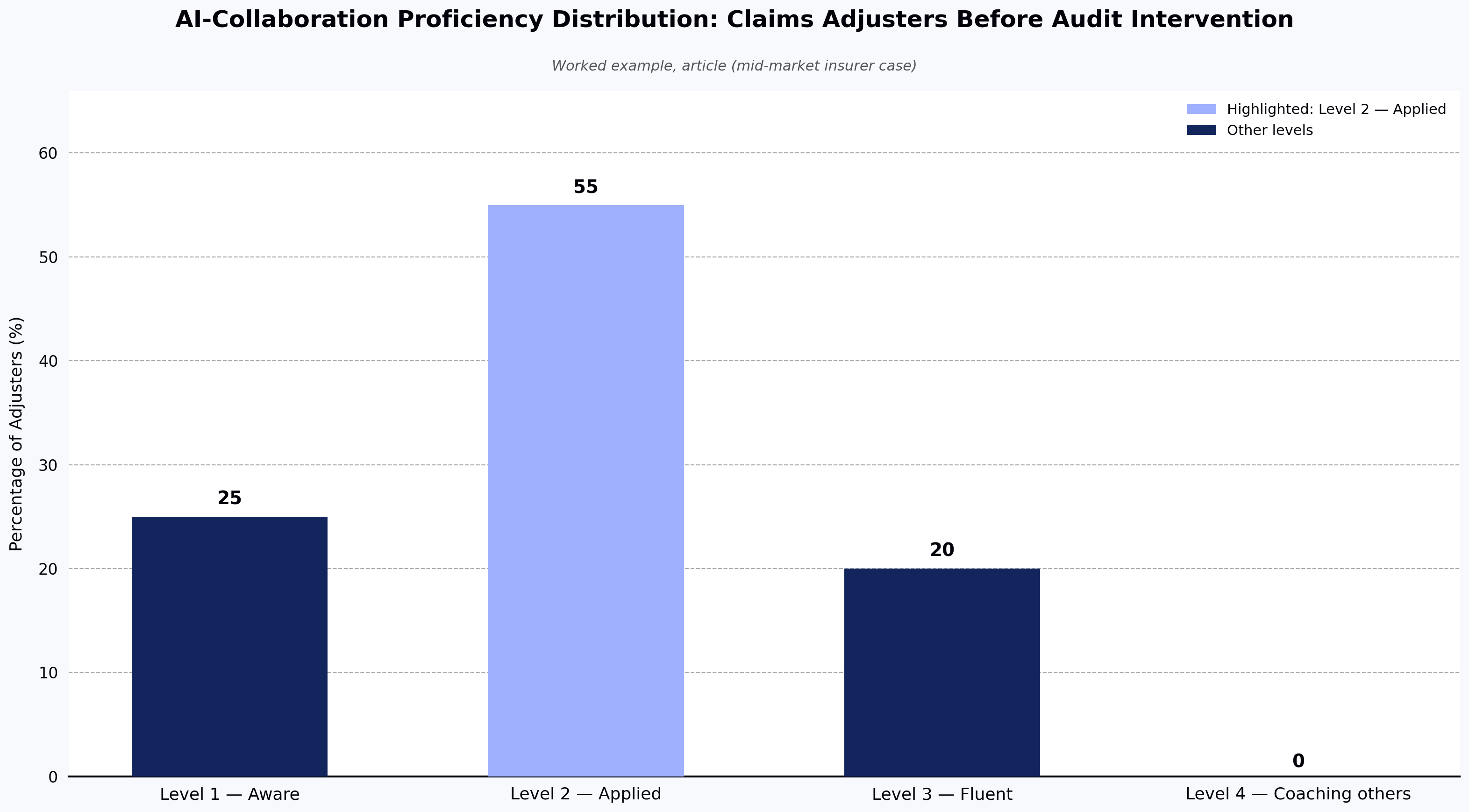
Consider, hypothetically, a recruiter at a mid-sized fintech hiring 40 backend engineers in two quarters. Pre-AI, a team of this profile might run on the order of several hundred recruiter phone screens and a couple hundred engineer-led technical screens to fill the roles, consuming hundreds of engineering hours. Routing the top-of-funnel through structured AI evaluation with a calibrated rubric could plausibly reduce engineer-led screens to the most promising candidates and recover a substantial share of those engineering hours — provided the rubric was calibrated against prior successful hires before launch.
Frequently asked questions
Are AI interviews fair? AI interviews are more consistent across candidates than human-led screens because every applicant is evaluated against the same rubric. They are not bias-free — any system trained on historical data inherits patterns from that data. The right standard is auditable consistency and documented bias testing, not the impossible bar of zero bias.
How do AI interviews work for coding roles? As a general industry pattern, well-built platforms preserve a candidate's code submission when it does not compile and evaluate approach, partial logic, and debugging behavior rather than awarding zero. Partial credit is typically applied at the rubric dimension level (e.g., correctness, efficiency, code structure) rather than as a single composite score, so a candidate who designs a sound solution but fails an edge case is not graded identically to one who never structured the problem.
Can AI interviews replace technical phone screens? For most volume technical roles, structured AI evaluation can produce more consistent signal than a 20-minute recruiter phone screen, and can free recruiter time for relationship-building and closing. For senior, executive, and management roles, AI interviews are worth using to supplement rather than replace human screening.
What is an AI interview agent? An AI interview agent is software that conducts a structured candidate interview end-to-end — asking questions, evaluating responses, and producing a scorecard. The tension worth surfacing: an "agent" is often described as a single system, but in practice it is a stack of models (NLP, code evaluation, proctoring, sometimes avatar generation) that may come from different vendors under one interface. When evaluating an agent, ask which components are built in-house versus licensed, where evaluation data is stored, and which model produces the final candidate score — the answers expose how defensible the platform's evaluation actually is.
How long does it take to deploy AI interviews? Deployment time varies widely depending on ATS integration complexity and how much rubric calibration is needed. Anecdotally, organizations with well-documented role scorecards deploy faster than those building rubrics from scratch during rollout. Ask vendors for deployment timelines tied to your specific ATS and rubric maturity rather than a generic range.
Do candidates know they are being interviewed by AI? They should. Transparent disclosure improves completion rates and trust, and is a regulatory requirement in several jurisdictions, including New York City's Local Law 144 and emerging rules in the EU under the AI Act. Specific obligations vary by location — consult legal counsel for your hiring jurisdictions.
Next steps
If you are evaluating AI interviews for technical hiring, the fastest way to assess fit is on your own roles and rubrics, not a generic demo. HackerEarth's OnScreen combines AI-led technical interviewing, live proctoring, and KYC-grade identity verification in one workflow, drawing on HackerEarth's broader platform-wide assessment library, which covers 1,000+ skills and 40+ programming languages.
Schedule a demo of HackerEarth OnScreen to see it run against a role you are actively hiring for, with your rubric and your candidate profile.