Recruitment CRM software is a system that helps talent teams build and maintain relationships with candidates — including passive prospects and past applicants — before, during, and after an active job opening. Unlike an applicant tracking system, which manages people who have already applied, a recruitment CRM focuses on long-term engagement, segmented outreach, and pipeline development. For recruiters competing for skilled candidates, CRM software is increasingly the layer that keeps pipelines warm between requisitions.
Industry analysts project the global recruiting candidate relationship management software market will approach $24 billion by 2032, according to one market forecast, as companies invest in tools to build relationships with candidates. Adoption of AI features inside CRM software is also rising, though precise enterprise-adoption figures vary by source and methodology. These trends suggest that talent acquisition leaders are leaning on CRM platforms to maintain pipelines, accelerate hiring, and improve candidate experiences.
If you are planning to upgrade your hiring tech, here's what to look for next:
- Platforms that centralize candidate data and automate personalized follow-ups across channels
- Communication tools that nurture passive candidates until they are ready to engage
- Analytics dashboards that show clear insights into talent pipeline health and recruiter performance
- Smart automation and AI features that match candidates accurately and strengthen long-term relationships
Each of the platforms ahead helps you connect with top talent, simplify recruiting tasks, and create candidate experiences that turn engagement into quality hires.
Editorial disclosure: HackerEarth, which publishes this article, is included in the list below. HackerEarth's core category is technical skills assessment and AI interviewing rather than full-suite recruitment CRM; we've included it because many tech hiring teams use it alongside a CRM or ATS. Tools are presented in no particular ranked order, and each entry notes where the tool is and is not a strong fit.
What recruitment CRM software is (and where it falls short)
Recruitment CRM software refers to systems that help recruiting teams build meaningful, ongoing relationships with potential candidates and manage their communication consistently as part of a long-term recruiting strategy.
A recruitment CRM works earliest in the journey — nurturing passive candidates, former applicants, and silver medalists who may become strong hires later. This approach allows recruiters to automate workflows such as follow-up emails, event invitations, and talent pool updates while maintaining a consistent, personalized candidate experience.
Where recruitment CRM software is not the right tool. A dedicated CRM is overkill for teams hiring fewer than ~10 roles a year, for single-role or one-off hires, and for organizations whose entire candidate flow comes from inbound applications to an existing ATS. CRM rollouts also tend to stall when no one owns nurture content, when recruiter incentives are tied only to fills (not pipeline health), or when data hygiene from the ATS side is poor — in those cases, the CRM becomes another empty inbox. For teams in those situations, a well-configured ATS plus a disciplined sourcing process often outperforms a new CRM purchase.
Key benefits of recruitment CRM software
Recruiters can gain measurable advantages from a recruitment CRM, including faster cycles, better candidate experience, and stronger team collaboration:
- Faster hiring cycles: Recruiting technology adoption is associated with shorter time-to-hire, though the size of the effect depends on team maturity and existing workflows. One vendor-published benchmark report claims companies using advanced recruiting technology hire roughly 26% faster, which is worth treating as directional rather than definitive until corroborated by independent research.
- Improved candidate experience: Candidate experience remains a critical differentiator during hiring. According to HRLineup's recruitment statistics roundup, a majority of candidates say their hiring experience reflects how a company treats employees, and poor experiences lead many to abandon applications. Personalized, automated CRM communication can reduce drop-off and improve perceptions of the employer brand.
- Proactive engagement and pipeline development: Industry surveys suggest CRM-enabled automation improves candidate engagement for many hiring teams (see, for example, this Global Growth Insights market report; methodology and sample size are not disclosed in detail). Segmented outreach keeps talent pipelines active rather than reactive.
- Team collaboration and visibility: Recruitment CRM systems centralize candidate engagement histories, notes, and scheduled interactions so hiring teams can coordinate more effectively. Shared visibility reduces duplication of effort and maintains consistent communication across stakeholders.
- Reduced repetitive work through automation: Automating follow-ups, reminder messages, and segmentation frees recruiters to focus on strategic activities. Vendor-published estimates put weekly time spent on low-value administrative work at roughly 13 hours per recruiter (see this RecruitBPM analysis — note this is a CRM vendor's blog, not independent research).
📌 Interested read: How to do tech recruitment marketing efficiently

How we picked the best CRM software for recruiting (methodology)
We selected the top recruitment CRM software based on five criteria that determine a platform's effectiveness for modern recruiting workflows:
- Usability: We prioritized platforms with intuitive interfaces that allow recruiters to navigate workflows, track candidates, and manage communication without extensive training.
- AI-driven features: Platforms that use AI to recommend candidates and automate follow-up sequences. AI can reduce repetitive tasks and accelerate targeting of top candidates.
- Automation: We focused on automated communication, pipeline management, and candidate nurturing.
- Integrations: We evaluated CRM connections with job boards, ATS, calendars, and analytics.
- Pricing: We assessed cost-effectiveness relative to features offered.
Side-by-side comparison: top 10 CRM software for recruiting (2026)
The table below compares 10 recruitment CRM software platforms in 2026. Tools are listed alphabetically; ranking-style ordering would not be meaningful given that each platform serves different team sizes and use cases.
| Tool | Ideal for | Key features | Pros | Cons | G2 rating |
| Bullhorn | Large staffing agencies and enterprise recruiting | Unified CRM and operations, candidate and client management, reporting, workflow automation | Mature platform centralizing candidate and client workflows; scalable for large volumes | UI feels dated; steeper learning curve | 4.2 |
| Gem | Candidate engagement and sourcing teams | CRM with AI engagement sequences, multi-stage outreach, talent pool nurturing | High user satisfaction; excellent engagement tools; deep integrations | Relies on external ATS for full applicant tracking; pricing not transparent | 4.8 |
| Greenhouse | Structured hiring for mid-to-large teams | Pipeline automation, interview scorecards, analytics, collaborative hiring workflows | Excellent collaboration; data-driven recruiting | Requires training to unlock full value; higher enterprise pricing | 4.4 |
| HackerEarth | Technical skills assessment and AI interviewing alongside an existing CRM/ATS | Automated skill assessments, AI interview automation, rubric-applied evaluation that reduces interviewer mood variance, pipeline management, recruiter workflow automation | Strong AI-assisted screening workflows; deep technical evaluations; integrates with major ATS systems | Not a full-suite CRM on its own; limited deep customization at entry tier | 4.5 |
| JobAdder | Agencies needing simple recruiting plus CRM | Candidate pipelines, job posting automation, workflow tracking, reporting | Easy setup; automates job board posting and candidate workflows | Analytics and advanced CRM features are less robust | 4.4 |
| Manatal | SMB recruiting teams needing a simple CRM | Pipeline management, automated job posting, social sourcing, drag-and-drop pipelines | Affordable and easy to use; strong sourcing and collaboration tools | Less advanced analytics compared to enterprise tools | 4.8 |
| Recruit CRM | Agencies and teams needing a combined CRM and ATS | Candidate and client pipelines, automated outreach, analytics, customizable workflows | Easy onboarding; CRM + ATS hybrid; strong automation and customizability | Some performance and reporting gaps at scale | 4.8 |
| Recruiterflow | Small to mid-sized agencies needing CRM + ATS | Automated scheduling, email automation, customizable pipelines | Strong email automation and follow-ups; responsive support | Some performance issues (loading, mobile analytics) | 4.6 |
| SmartRecruiters | Mid-to-large enterprise talent acquisition | CRM + ATS, AI matching and automation, career site publishing, interview scheduling | Highly scalable; robust integrations; automates large hiring operations | Can be expensive for smaller companies; complex setup | 4.3 |
| Zoho Recruit | Recruiting teams within the Zoho ecosystem | Candidate tracking, offer workflows, customizable dashboards, multi-channel sourcing | Strong integration with CRM/HR tools; cost-effective for SMEs | Steeper learning curve for advanced custom setups | 4.4 |
Top 10 CRM software for recruiting compared
Below, each tool is reviewed individually. Each entry opens with a one-sentence summary of where the tool fits best.
1. Bullhorn
Bullhorn is best for large staffing agencies needing unified ATS and CRM at scale.
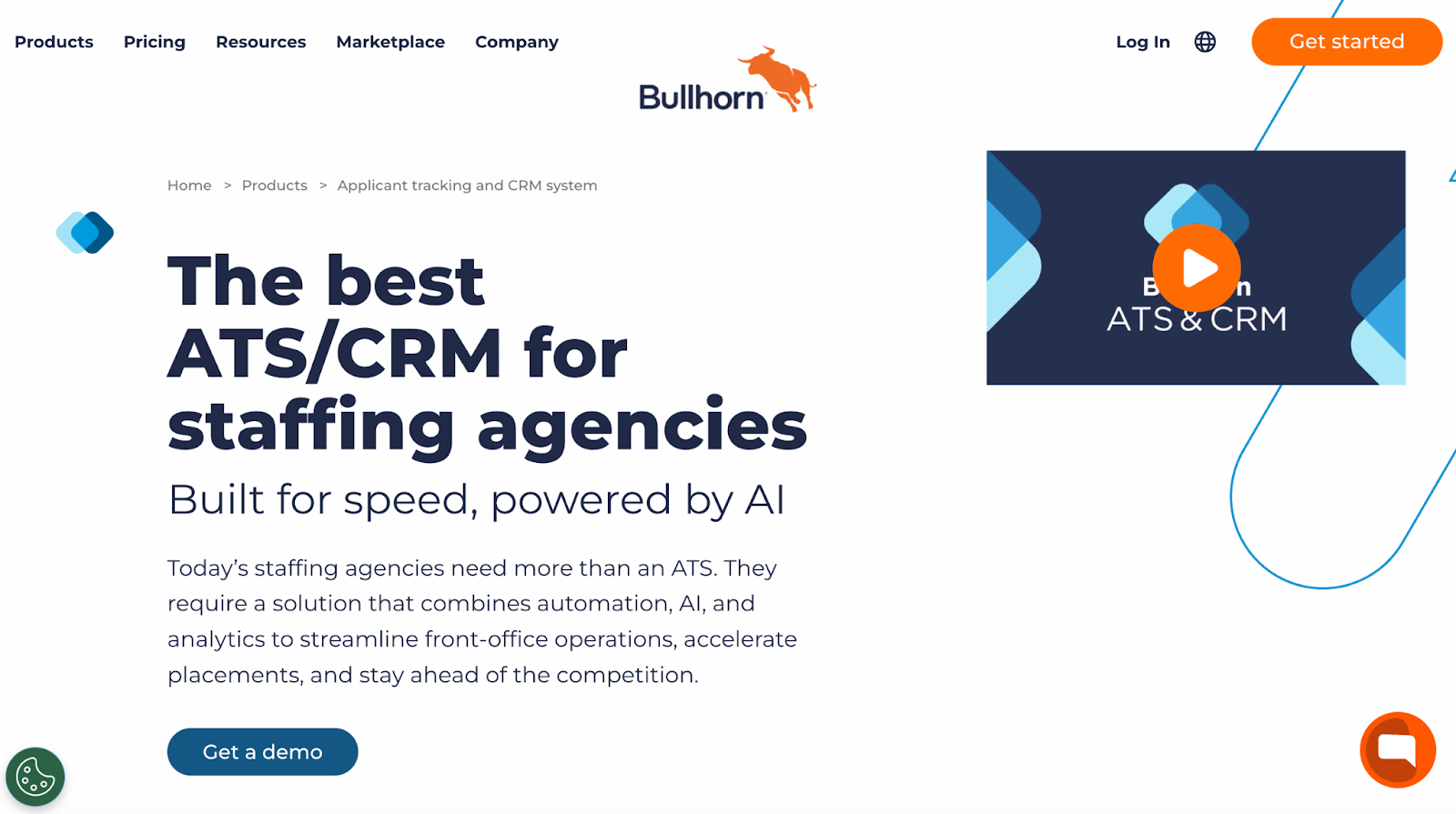
Grow your agency with this AI-assisted recruiting CRM
Bullhorn is an ATS and CRM used by more than 10,000 staffing and recruitment agencies. Bullhorn reports that agencies using its full suite see 36% more placements, 51% more submissions, and a 22% higher fill rate (source: Bullhorn — these are vendor self-reported figures and have not been independently verified).
The platform combines candidate tracking, client relationship management, resume parsing, interview scheduling, and analytics on one cloud-based platform. Recruiters also rely on its AI recruiting assistants and automation features to handle routine tasks while they focus on higher-value engagements with candidates and clients.
Key features
- Track candidates through every hiring stage with CRM and ATS
- AI recruiting assistants for outreach and sourcing
- Manage client and candidate relationships in one system
Pros
- Schedule interviews and collect feedback with ease
- Build reports that reflect recruiter and placement performance
Cons
- Performance can slow during heavy data usage
- Higher cost with limited customer support responsiveness reported by some users
Pricing
- Available in Bullhorn ATS & CRM, Front Office, Workforce Edition & Bullhorn 360: Custom pricing
2. Gem
Gem is best for sourcing-led teams that already have an ATS and want a deep candidate-engagement layer on top.
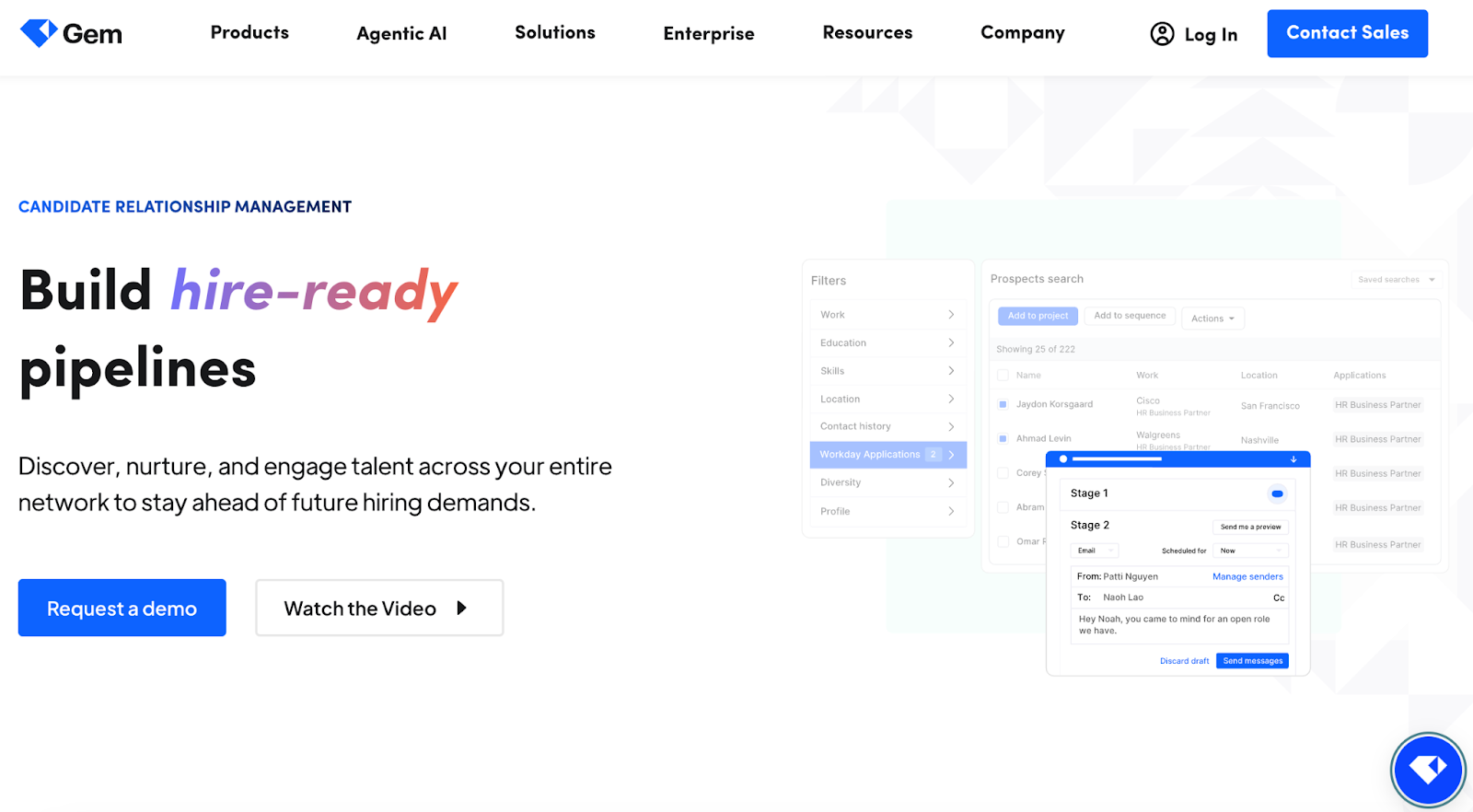
Secure top talent using Gem's candidate CRM platform
Gem automatically adds and enriches candidate profiles, runs outreach via email, SMS, phone, and InMail, and pulls from a database of more than 800 million profiles.
It also offers integrations across plans rather than restricting them to premium tiers. The company continues to expand its product through focused acquisitions such as InterviewPlanner.
Key features
- Auto-add and enrich profiles from sourcing platforms
- Run outreach across email, SMS, phone, and InMail
- Rediscover past candidates using AI search tools
Pros
- Sourcing across 800 million profiles
- Connects with 50+ ATS integrations
Cons
- Long setup timelines for data migration
- Lacks built-in client management for staffing agencies
Pricing
- Custom pricing
3. Greenhouse
Greenhouse is best for mid-to-large in-house teams that want structured, scorecard-driven hiring with strong collaboration features.
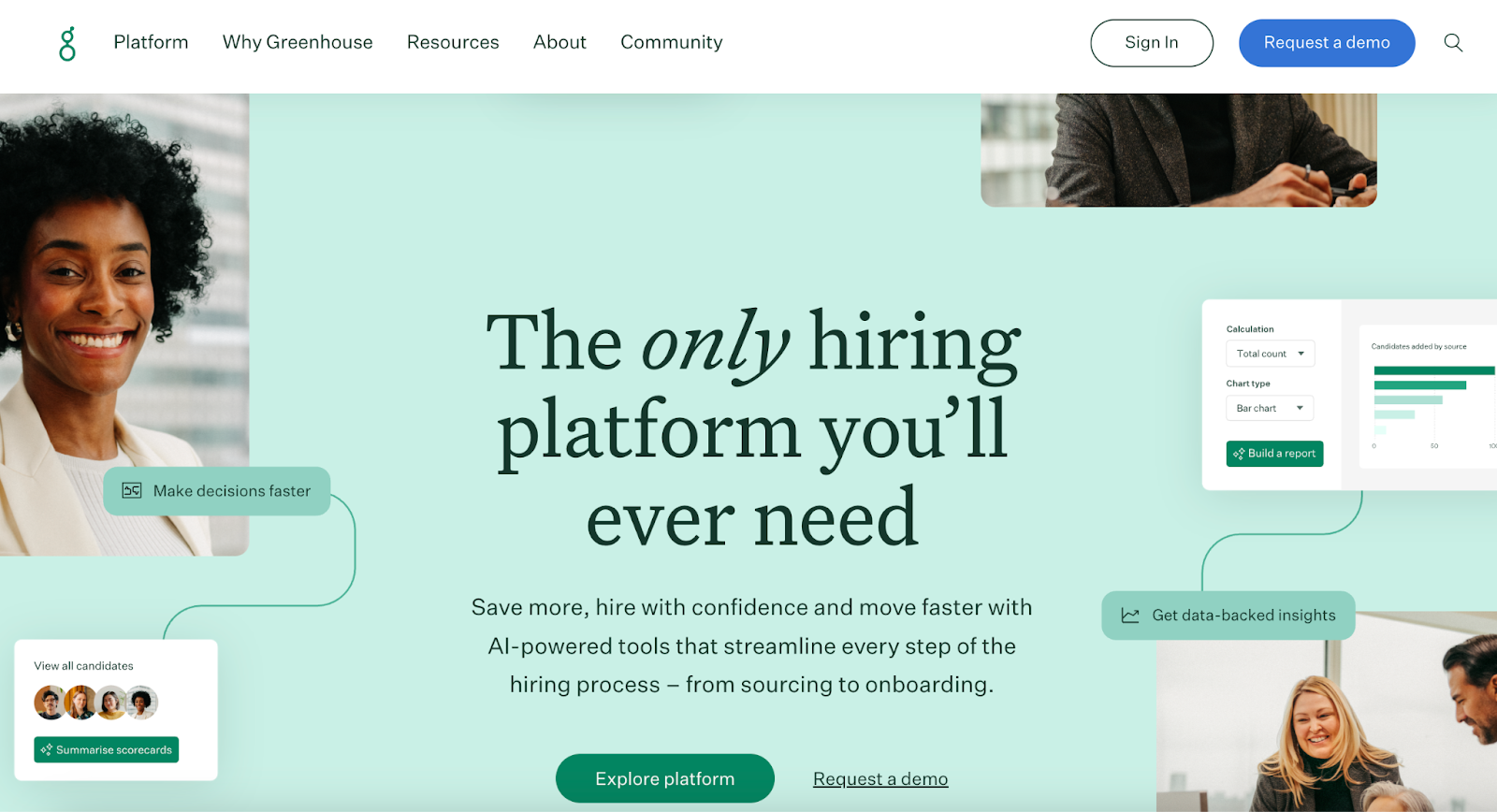
Greenhouse streamlines hiring with CRM tools from sourcing to onboarding
Greenhouse integrates sourcing, interviewing, and offer management into a single platform. It provides standardized interview kits and shared scorecards to help teams compare candidates more consistently and reduce subjective impressions. Automated reminders and messaging allow recruiters to follow up with candidates throughout the pipeline.
Its reporting tools and dashboards help track candidate progress and identify issues in the process. Mobile recruiting tools allow teams to review candidate information and submit feedback from anywhere. Integrations with platforms like LinkedIn, Slack, BambooHR, and DocuSign make it easier to manage candidates and related tasks.
Key features
- Provide interviewers with standardized questions and evaluation criteria
- Capture consistent feedback to support collaborative decision-making
- Show where candidates progress or stall for pipeline reporting
Pros
- Reduces candidate communication gaps with automated follow-ups
- Keeps teams coordinated with clear task assignments during hiring
Cons
- Lacks a built-in sourcing marketplace compared to some other CRM tools
- Reporting customization requires in-depth configuration knowledge
Pricing
- Custom pricing
4. HackerEarth
HackerEarth is best for tech hiring teams that need rigorous coding assessments and AI-assisted interviews to plug into an existing CRM or ATS — it is not a full-suite recruitment CRM on its own.
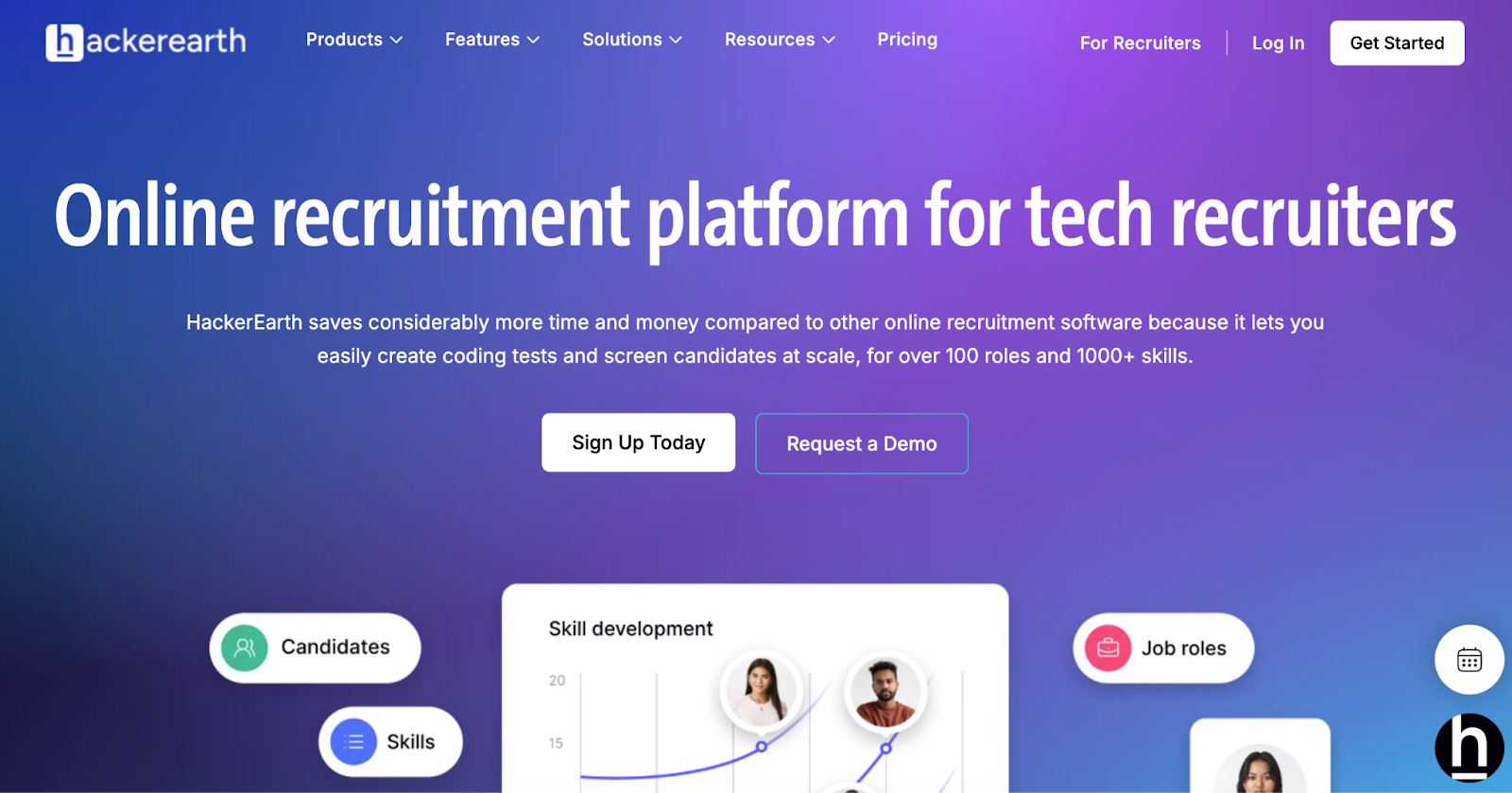
Use HackerEarth to recruit and assess top candidates
HackerEarth is an online recruitment platform focused on technical skills assessment and AI interviewing. Recruiters use it to build coding assessments that evaluate more than 1,000 technical skills, with rubric-applied scoring intended to be more consistent across candidates than unstructured human screens. The HackerEarth profile functions as a digital portfolio for developers — showcasing technical ability, work experience, and participation in coding contests — and integrates with major ATS and CRM systems so assessment data flows into the recruiter's existing pipeline.
The platform's AI Interview Agent and AI Screening Agent help recruiters automate first-pass screening and structured interviews; specific performance metrics depend on role mix and configuration. SmartBrowser technology and advanced proctoring with tab-switch detection support test integrity. HackerEarth supports 40+ programming languages, and its hiring challenges can draw on a developer community of 10M+ developers globally.
Key features
- Library of coding questions across 1,000+ technical skills, including AI, machine learning, and data science
- Customizable coding tests using pre-built templates or your own problem statements
- Project-based assessments that simulate real job challenges with custom datasets
- Proctoring tools including SmartBrowser, tab-switch detection, webcam monitoring, and customizable invigilation
Pros
- Hiring challenges that tap into HackerEarth's 10M+ developer community
- AI Screening Agent to assist with resume screening and shortlisting
- Reach into a global developer audience
Cons
- Not a full recruitment CRM — works best alongside one
- Fewer customization options at entry-level pricing
Pricing
- Pricing tiers are currently being finalized; please refer to the HackerEarth pricing page or contact sales for current plan and trial details.
📌 Suggested read: The 12 most effective employee selection methods for tech teams
5. JobAdder
JobAdder is best for agencies that want straightforward candidate tracking with CRM functionality and minimal configuration.
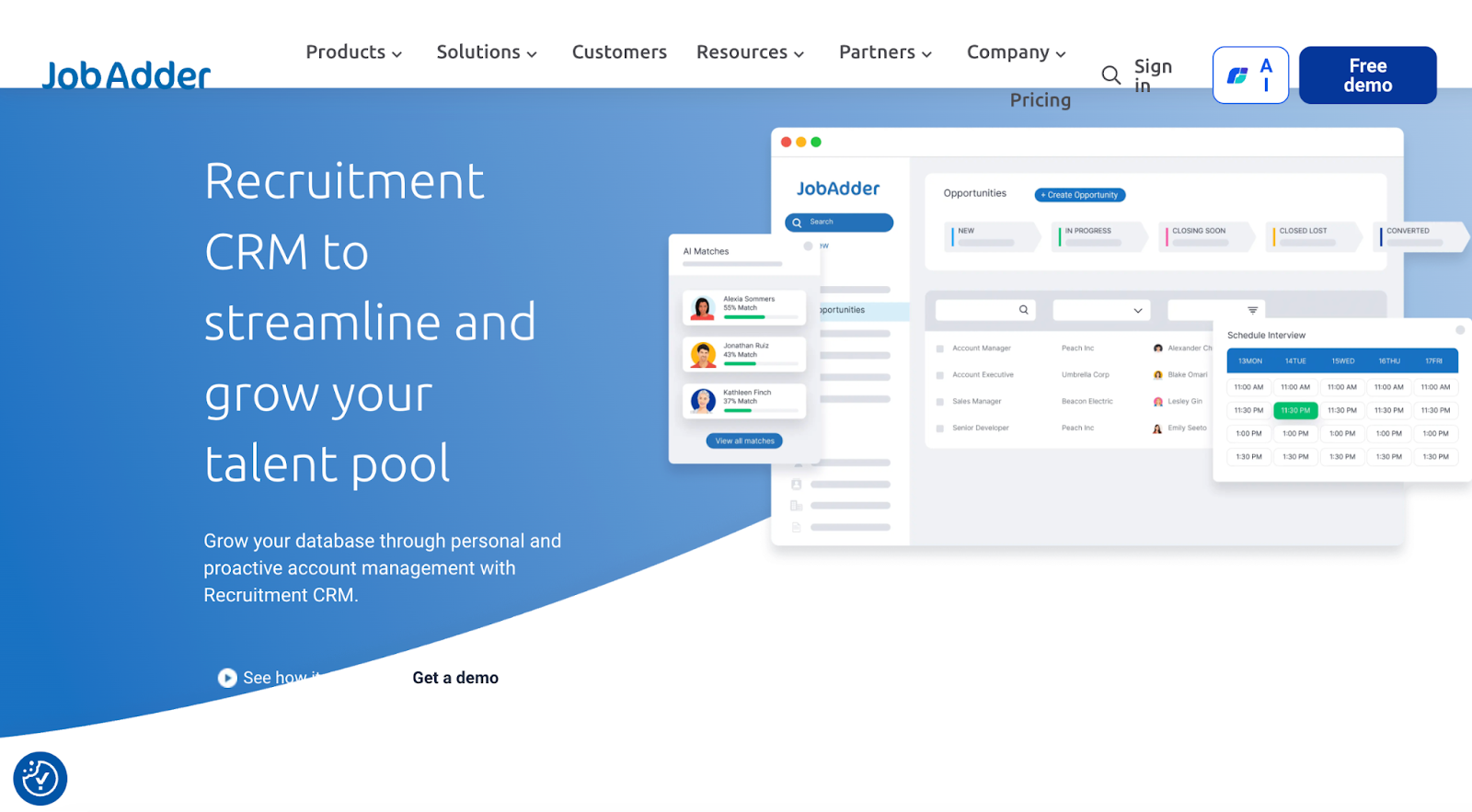
Refine your sourcing with an AI-assisted recruitment CRM
With JobAdder, users can manage opportunity records, track candidates, and update job information quickly using quick-view popups. It helps recruiters capture leads, assign tasks, and automatically convert closed deals into job records. The platform supports communication with clients and candidates through SMS, email, and WhatsApp using custom templates.
Recruiters can tag skills, manage talent pools, and subscribe to records for timely updates. JobAdder integrates with LinkedIn, SourceBreaker, DaXtra, and Sourcr for a connected recruiting experience. Predictive search, candidate matching, and automated messaging help reduce manual work. Dashboards and filters provide fast access to job, candidate, and deal information.
Key features
- View and update candidate information using quick-view popups
- Automate task assignments and track opportunity records
- Convert closed deals into job records for matching candidates
Pros
- Bulk messages via email, SMS, or WhatsApp templates
- Tag candidates and manage talent pools based on skills and ratings
Cons
- Slower customer support that often refers users to self-help
- User interface can feel clunky or outdated at times
Pricing
- Available in Recruiter Lite, Recruiter Essential, Recruiter Pro & Recruiter Business: Custom pricing
6. Manatal
Manatal is best for SMB recruiting teams that need an affordable CRM with strong sourcing automation.
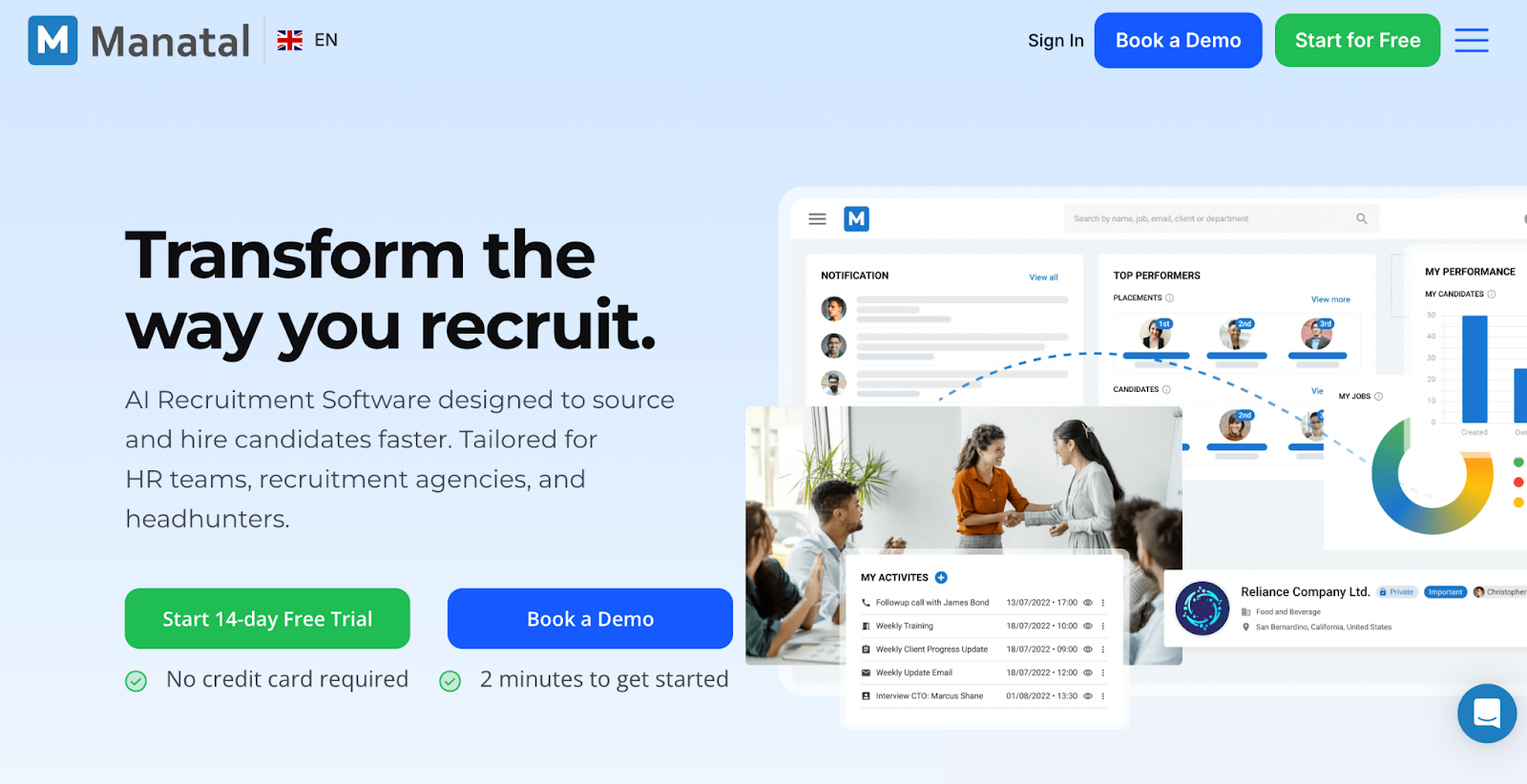
Manatal's recruitment CRM is geared to small and mid-sized teams
Manatal supports HR teams and agencies with a CRM built around sourcing automation and candidate data. Recruiters use drag-and-drop pipelines and Kanban boards to track progress across every active role.
The platform also supports job distribution across 2,500+ global and local job boards. Built-in AI suggests candidates and enriches profiles using data from 20+ public and social platforms. Mobile access lets recruiters manage activity and updates from any device.
Key features
- Customize hiring pipelines using drag-and-drop stages
- Post jobs across 2,500+ global job boards
- Enrich candidate profiles using social and public data
Pros
- Simple interface without long training requirements
- Mobile recruiting features across devices
Cons
- Lacks detailed recruiter performance reports
- Limits with AI accuracy and pipeline visibility
Pricing
- Professional: $19/month per user
- Enterprise: $39/month per user
- Enterprise Plus: $59/month per user
- Custom: Contact for pricing
📌 Related read: How talent assessment tests improve hiring accuracy and reduce employee turnover
7. Recruit CRM
Recruit CRM is best for staffing agencies that want a single tool covering both candidate and client pipelines.
Use Recruit CRM as your all-in-one ATS and CRM
Recruit CRM gives recruitment agencies a single system to manage jobs, candidates, clients, and revenue without switching tools during daily work. The platform combines ATS and CRM capabilities so teams can post roles, source candidates, manage outreach, and track workflows from one dashboard. Recruit CRM also supports employer branding by helping teams maintain consistent communication with candidates throughout long hiring cycles.
Agencies across 100+ countries use Recruit CRM to manage relationships and scale operations with a unified recruiting system. Teams benefit from shared visibility across candidates, clients, and jobs.
Key features
- Automate resume parsing, job posting, and candidate tracking
- Source leads and maintain candidate engagement and client relationships
- Chrome extension Boolean search and 5,000+ integrations
Pros
- One system for ATS, CRM, and engagement
- Integrations, workflow automation, and analytics
Cons
- Performance slowdowns with very large datasets
- Extra cost for advanced modules and add-ons
Pricing
- Pro: $100/month per user
- Business: $150/month per user
- Enterprise: $165/month per user
8. Recruiterflow
Recruiterflow is best for small-to-mid agencies that want CRM, ATS, and email automation in one platform.
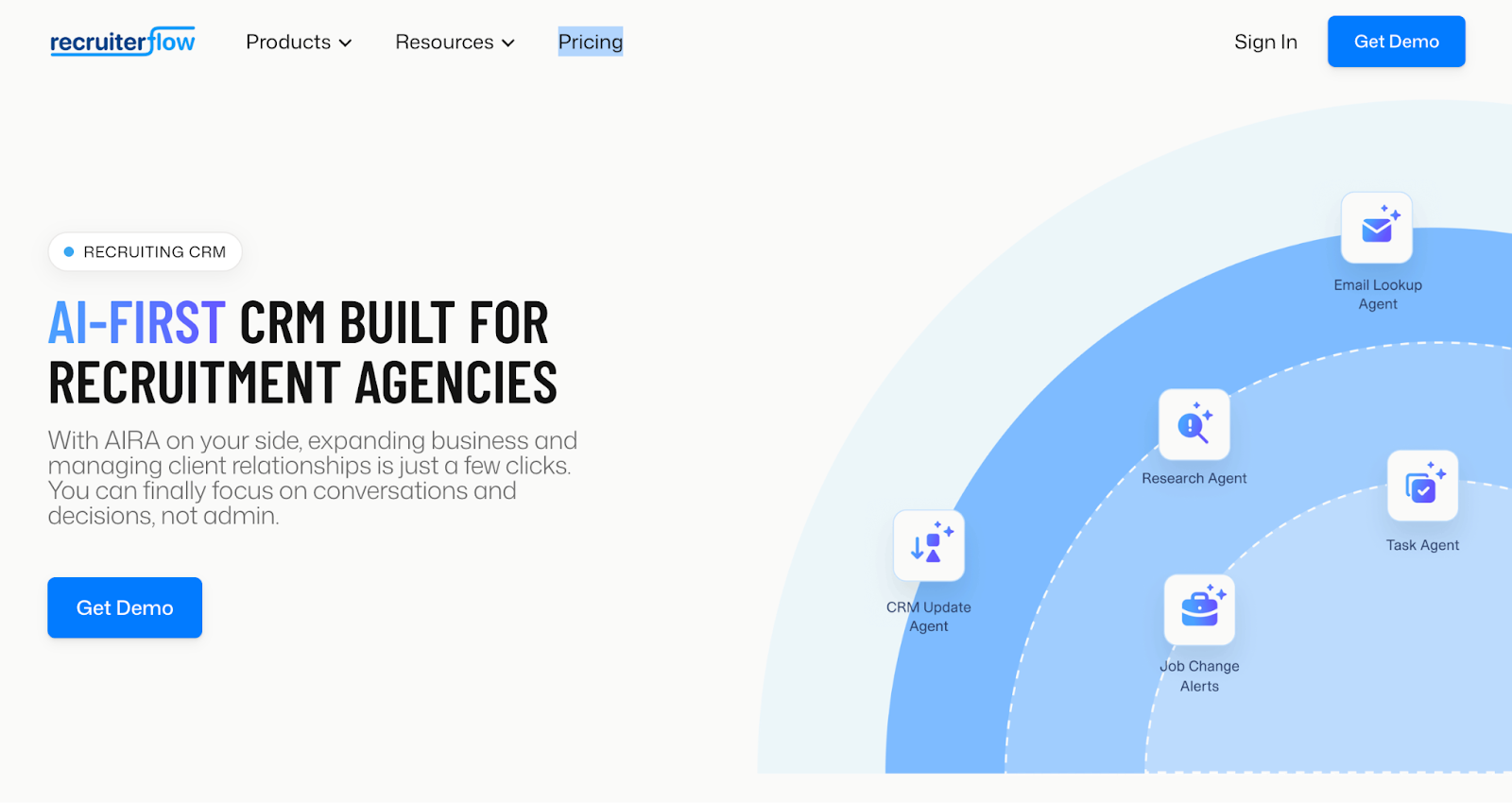
Recruiterflow combines CRM workflows with AI-assisted automation
Recruiterflow's AI agent, AIRA, tracks interactions across calls, emails, SMS, and notes to manage administrative tasks. The platform includes tools for job-change alerts, predictive candidate matching, and automated outreach campaigns across multiple channels.
It centralizes client management, deal