Home
/
Blog
/
Hiring Tools
/
Technical Skills Test for Hiring: How to Evaluate Developers Accurately

Technical Skills Test for Hiring: How to Evaluate Developers Accurately

Author
Shruti Sarkar
Calendar Icon
April 22, 2026
Timer Icon
3 min read
Share

Explore this post with:

Technical Skills Test for Hiring: How to Evaluate Developers Accurately

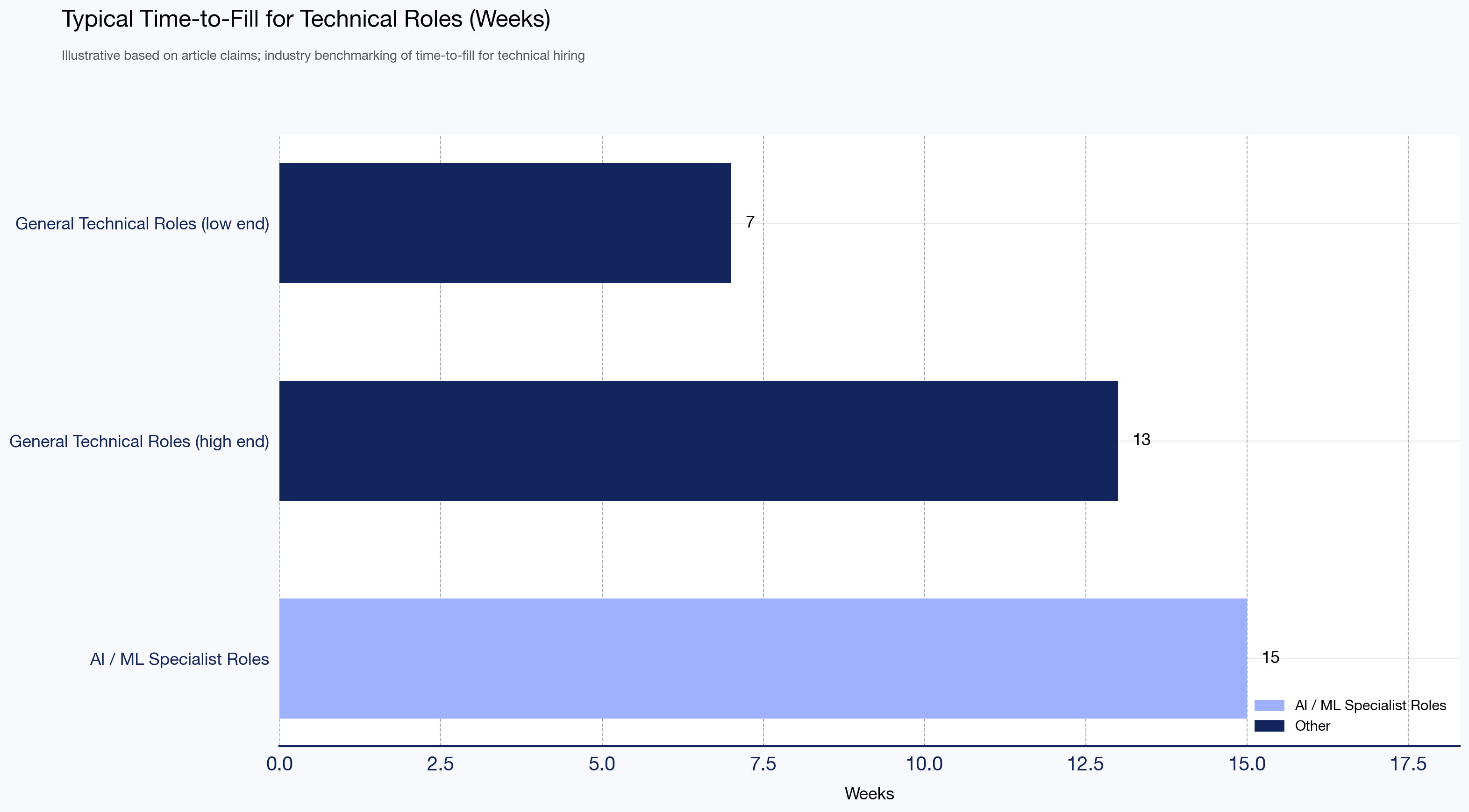
A technical skills test for hiring is the most direct way to separate developers who can do the job from those who interviewed well for it. Right now that distinction matters more than ever. The U.S. Bureau of Labor Statistics projects software developer employment will grow 15% from 2024 to 2034, while 76% of companies already report facing a direct tech talent shortage. AI/ML roles average 89 days to fill. Technical positions in general take about 66 days, roughly 50% longer than non-technical roles.

The pressure to make accurate assessments fast is measurable and real. A technical assessment for hiring replaces resume-and-gut-feel screening with objective, role-relevant evidence that hiring teams at every technical depth can act on confidently.
What Is a Technical Skills Test for Hiring?

Definition and Purpose

Think of a technical skills test the way you would a work sample rather than an audition. It is a structured evaluation designed to measure whether a candidate can actually perform the technical work a role requires, under conditions that resemble real job tasks. McKinsey research confirms that hiring for skills is five times more predictive of job performance than hiring based on education and more than twice as effective as hiring based on work experience alone. A well-designed developer skills assessment converts that predictive advantage into a shortlist hiring managers can trust.

Why Traditional Screening Falls Short

Resume screening feels like a quality gate but functions more like a noise filter, and the problem is getting worse. With AI-generated resumes now flooding pipelines, surface polish has decoupled from underlying capability. Nearly 60% of bad hires occur because the employee could not produce the level of work the employer required. An IT skills assessment or programming test for hiring, positioned at the top of the funnel, is the most direct way to close that gap before it costs anything.

Types of Technical Assessments for Hiring

The format you choose determines what you actually learn about a candidate, and picking the wrong one at the wrong stage wastes everyone's time.

Coding Challenges (Algorithmic and Data Structures)

Algorithmic tests are the workhorse of early-stage technical screening because they scale to hundreds of candidates simultaneously with automated grading. The criticism is fair though: pure algorithmic challenges measure a narrower skill set than most real roles require, so use them as a first filter, not a final verdict.

Project-Based / Take-Home Assignments

Take-home projects surface the qualities that truly separate strong engineers from average ones: code organization, documentation habits, and edge case handling. Keep them under four hours, because anything longer starts selecting for availability rather than ability.

Multiple-Choice and Conceptual Knowledge Tests

For IT skills assessment in cloud, networking, or database roles, multiple-choice tests efficiently verify domain knowledge before investing in a live conversation. They should never be the primary evaluation tool for software engineering roles.

Pair Programming and Live Coding Sessions

A live coding session tells you more in 60 minutes than a stack of submitted exercises will, because you watch a candidate's thinking process in real time, not just the output. The cost is interviewer time, which is why this belongs at the final stage, not the first.

Full-Stack or Role-Specific Simulations

Role-specific simulations, such as debugging an actual API or extending a real component, are the gold standard for senior positions where a mis-hire is expensive. HackerEarth's real-world project simulations test code quality, logic, and technical depth against actual role demands rather than generic computer science theory.

How to Build an Effective Technical Screening Test - Step by Step

Step 1 - Define the Role's Core Technical Competencies

Before picking a format, list the five to eight technical competencies the role genuinely requires in the first ninety days, not the full laundry list from the job description. Everything downstream, including format, difficulty, and rubric, flows from this list.

Step 2 - Choose the Right Test Format (or Combine Formats)

Multi-measure testing consistently outperforms single-format assessments, because no one format catches everything. HackerEarth supports combining coding challenges, MCQs, and project-based tasks in a single candidate workflow, which means you can layer signal at each funnel stage without asking candidates to use three separate platforms.

Step 3 - Set Difficulty Level and Time Limits

A tech hiring assessment that is too easy produces a flat score distribution where everyone looks similar. Calibrate time limits to how long a proficient developer takes to complete the task comfortably, not how long an expert finishes it, because expert-speed limits create pressure that penalizes methodical thinkers over fast ones.

Step 4 - Use Anti-Cheating and Proctoring Measures

Assessment fraud doubled in 2025 and is not a hypothetical concern anymore. According to CodeSignal's 2026 research, cheating and fraud attempt rates for proctored assessments rose from 16% in 2024 to 35% in 2025, driven by unauthorized AI use, proxy test-taking, and plagiarism. HackerEarth's AI proctoring uses face detection, live monitoring, plagiarism checks, and keystroke pattern analysis to maintain integrity at scale, while also creating a behavioral record of how each candidate engaged with the problem, which itself becomes an evaluation signal.

Step 5 - Establish Scoring Rubrics and Benchmarks Before Reviewing

Rubrics finalized before any submissions are reviewed remove the bias that creeps in when scoring criteria shift based on what the first few candidates produced. A useful rubric for a programming test for hiring covers four dimensions: functional correctness, efficiency, code quality and readability, and edge case handling. HackerEarth's automated scoring covers all four with per-submission reports that include percentile benchmarks against the broader candidate population.

Step 6 - Pilot the Test Internally

Have two or three engineers on the relevant team complete the technical evaluation test under real conditions before it goes live. This catches time limit problems and ambiguous instructions before they affect actual candidates, and it creates reference submissions hiring managers can use when interpreting later scores.

What to Measure in a Developer Skills Assessment

Code Correctness and Efficiency

Correctness is the baseline, but efficiency is where the differentiation lives. A solution that works in O(n squared) time when O(n log n) is available tells you something meaningful about how a developer thinks at scale.

Code Quality and Readability

Code that works but that no teammate can read or extend without spending an afternoon deciphering it is not production-ready. Quality signals, including naming conventions, function decomposition, and absence of anti-patterns, matter especially for roles involving existing codebases.

Problem-Solving Approach

In live coding formats, the approach often tells you more than the solution. A candidate who clarifies requirements before writing, tests incrementally, and communicates their reasoning clearly is showing you how they will actually behave on the job.

Domain-Specific Knowledge

A software engineering test that ignores the tech stack the role uses is measuring general aptitude rather than job readiness. An IT skills assessment for a cloud infrastructure role should include provider-specific knowledge, not just generic systems concepts.

Speed vs. Depth Trade-Off

Speed is a weak proxy for competence in software development. The best technical interview tests give proficient developers enough time to complete the work carefully, then differentiate on quality and sophistication rather than who finished fastest.

How Non-Technical Recruiters Can Confidently Use Technical Assessments

Non-technical HR generalists should not have to interpret code to run an effective screening process, and with the right platform they do not have to.

Leveraging Auto-Scored Reports and Percentile Benchmarks

A platform worth using hands you a structured report with scores across each competency, a percentile rank against comparable candidates, and a pass or fail recommendation against the threshold your team set in advance. HackerEarth's candidate reports are built specifically for non-technical reviewers, which means a recruiter can make confident shortlist decisions without a senior engineer looking over their shoulder at every submission.

Collaborating with Hiring Managers on Interpretation

A clean working protocol eliminates most of the friction: recruiters advance candidates who meet or exceed the threshold automatically, flag the narrow band just below it for engineering manager review, and reject clearly below-floor candidates without escalating. This removes the calibration meetings that slow offers down.

Avoiding Common Misinterpretations

The two errors that come up most often are treating a strong score on a general coding challenge as sufficient evidence for a specialized role, and treating a low score as disqualifying when the test itself was poorly designed. Both are fixed at the design stage, not during review.

Technical Skills Test Best Practices for 2025

Prioritize Candidate Experience

A strong developer who is currently employed and fielding three other offers will not complete a two-hour assessment with unclear instructions. If your test would fail that basic gut check, it needs to be shorter, clearer, or more obviously connected to the actual job.

Ensure Fairness and Reduce Bias

Research by SHL in 2025 found that ML-based grading for technical tests increased the number of women who cleared coding simulations by 27.75% compared to traditional cut-off methods. Objective scoring, when properly designed, produces fairer outcomes as a side effect of removing evaluator subjectivity.

Keep Tests Job-Relevant

A technical screening test that measures skills the role does not require produces misleading data and wastes candidate goodwill. Relevance is what gives a score meaning, and removing off-topic questions is the single most reliable improvement most teams can make.

Iterate Based on Data

Every assessment deployment generates completion rates, score distributions, and eventually post-hire performance correlations. Teams that review this data quarterly and adjust their tests accordingly consistently produce better hiring outcomes than teams that treat assessment design as a one-time decision.

Combine Assessments with Structured Interviews

A technical skills test measures output. A structured interview measures thinking, communication, and judgment in a collaborative context. The most predictive hiring processes use assessment results to inform interview questions rather than treating them as separate events.

Comparing Top Technical Assessment Platforms

Every platform in this space has genuine strengths, and the right choice depends on your hiring volume, role mix, and how much your non-technical recruiters need to operate independently.
HackerEarth's practical advantage is that it covers the full workflow in one place. Where HackerRank is strong on algorithms and enterprise scale, HackerEarth adds live coding interviews through FaceCode, hackathon-based sourcing, and analytics without requiring a separate tool for each. For teams that want to stop stitching together point solutions, that consolidation is worth more than any individual feature comparison.

Conclusion

The technical skills test for hiring is not an optional layer on top of interviews. It is the mechanism that determines whether hiring decisions are based on evidence or on impressions. Resumes tell you what someone claims. Assessments tell you what they can do.

HackerEarth is built for the full scope of that problem: assessment library, live interviewing, AI proctoring, hackathon-based sourcing, and ATS integrations in one platform that non-technical HR generalists can operate without constant engineering manager support.

The most useful next step is running a technical assessment on your next open developer role and comparing the shortlist it produces to what resume screening alone would have given you.

See HackerEarth Assessments in action for your specific technical roles. Request a free demo and walk through the full candidate evaluation workflow with the HackerEarth team.

Try HackerEarth's assessment library for free with a 14-day trial, no credit card required. Access 17,000+ questions across 900+ skills.

Talk to the HackerEarth team about building a custom assessment for your next developer hire. Get role-specific test recommendations within 48 hours.

Subscribe to The HackerEarth Blog

Get expert tips, hacks, and how-tos from the world of tech recruiting to stay on top of your hiring!

Author
Shruti Sarkar
Calendar Icon
April 22, 2026
Timer Icon
3 min read
Share

Hire top tech talent with our recruitment platform

Access Free Demo
Related reads

Discover more articles

Gain insights to optimize your developer recruitment process.

Automated Interview Tools: How They're Reshaping First-Round Technical Screening

Automated Interview Tools: How They're Reshaping First-Round Technical Screening

The average recruiter spends 23 hours screening candidates for a single hire (Testlify, 2025). For technical roles, where 70 to 80% of applicants lack the baseline skills required, that investment produces inconsistent results anyway. First-round technical screens are the biggest bottleneck in engineering hiring pipelines - not because hiring teams are slow, but because the manual process was never built to handle modern application volume.

Automated interview tools now handle first-round technical screening with consistency, speed, and measurable accuracy. Technical interview automation has moved from experimental to operational at thousands of companies - and the category of automated hiring tools now spans everything from async coding tests to AI agents that conduct live adaptive interviews. This article covers what these tools are, how they work, what benefits and risks to expect, and how to evaluate the right platform for your team.

What Are Automated Interview Tools?

Automated interview tools are software platforms that screen job candidates without requiring a live interviewer in the first round. They use coding assessments, AI-scored video interviews, or conversational AI agents to evaluate candidates at scale - replacing the repetitive first-round screen so hiring teams can focus on deeper evaluation with candidates who have already proved baseline competency.

Three categories exist, and they are not interchangeable:

  • Automated coding assessments: Asynchronous code challenges scored automatically by AI, evaluating correctness, efficiency, and code quality.
  • AI-powered video interviews: Recorded responses evaluated by NLP and ML models for technical accuracy or role-specific competencies. Video interview automation is the fastest-growing category by adoption volume.
  • AI interview agents: Conversational AI that conducts live, adaptive technical interviews in real time - probing weak areas with follow-up questions and generating structured evaluation reports.

The first two are pre-screening interview tools that filter the funnel before any human time is spent. The third is closer to a first-round technical interview conducted by software.

How They Differ From Traditional Screening

Dimension Manual Phone Screen Automated Tool
Time per candidate 30–60 minutes active recruiter time Minutes of setup; zero marginal time per candidate
Consistency Varies by interviewer, day, and mood Identical criteria applied to every candidate
Scalability Limited by recruiter bandwidth Screens hundreds simultaneously
Bias risk High (unconscious, interpersonal) Lower – but dependent on assessment and model quality
Data captured Notes, impressions Time-per-question, code metrics, structured scores

Why First-Round Technical Screening Needs Automation

The Volume Problem

The math stopped working for manual screening before most teams admitted it. Companies receive an average of 250 applications per open role (Glassdoor); for enterprise technical positions that routinely reaches several thousand. Ashby's analysis of 31 million applications found job application volume grew 2.6 to 3x in early 2024 alone. Automated candidate screening exists because manual screening at that volume is not a slower version of the same process - it is a different process entirely.

Inconsistency in Evaluation

Two recruiters conducting unstructured phone screens will rank the same candidate pool differently - because unstructured interviews have a criterion-related validity of just 0.38, meaning they predict job performance barely better than chance (Schmidt and Hunter meta-analysis). Structured interviews with standardized questions reach a validity of 0.51. Automated tools enforce identical evaluation criteria for every candidate, removing the interviewer variance that makes unstructured screens an unreliable filter.

Time-to-Hire Pressure

Engineering roles take an average of 44 days to fill (LinkedIn/High5Test, 2024-2025), and 60% of companies saw that number increase in 2024 - only 6% managed to reduce it (GoodTime, 2025). Automated first-round screening compresses the stage with the most headroom: 87% of companies using AI in recruitment report average time-to-hire reductions of 50% (DemandSage, 2024).

How Automated Interview Tools Work in Practice

Step 1 - Assessment Design

The hiring team selects or builds the evaluation - a timed coding challenge in the team's actual stack, multiple-choice questions, system design prompts, debugging exercises, or a combination. HackerEarth's technical assessment platform offers 16,000-plus questions across 40-plus programming languages, with role-specific templates deployable in minutes or customizable to the specific problems your engineering team works on. An assessment built for a backend engineer working with distributed systems will produce a meaningfully different shortlist than a generic "software engineer" test.

Step 2 - Candidate Completion

Candidates receive an invitation link and complete the assessment on their own schedule within a deadline. Most platforms include remote proctoring features - browser lockdown, webcam monitoring, copy-paste detection, tab-switch alerts - that maintain integrity without a human proctor. Removing scheduling friction from this stage alone reduces candidate drop-off from processes qualified people find inconvenient.

Step 3 - AI-Powered Evaluation

Basic implementations check for correctness. Advanced platforms deliver genuine AI candidate evaluation - assessing code quality, time and space complexity, edge-case handling, and problem-solving approach, not just whether the answer is compiled. HackerEarth's AI Interview Agent conducts adaptive conversational technical interviews, probing weak areas with follow-up questions and generating reports covering both technical depth and communication patterns.

Step 4 - Shortlist Generation

The platform generates a ranked shortlist with per-question performance data, time spent, code quality metrics, and aggregate scores. Recruiters move to live interviews with full context on each candidate's specific strengths and gaps - rather than starting from scratch in a 45-minute phone call.

From 500 applicants to 15 qualified candidates in 48 hours, not 2 weeks.

Key Benefits of Automated Interview Tools for Technical Hiring

Faster Screening at Scale

Manual screening is not a slower version of automated screening - it is a categorically different process that does not scale. 80% of companies with high-volume hiring needs report that automated interview tools have significantly reduced initial screening time (wecreateproblems.com, 2026), and teams using automation fill 64% more jobs per recruiter than non-adopters (Indeed/Bluehorn, 2024).

Consistent, Objective Evaluation

The structured data automated tools produce - identical questions, identical scoring criteria, identical constraints - removes the interviewer variance that makes unstructured screens unreliable. 72% of companies now use structured assessments for standardized candidate evaluation (SSR Recruiting Statistics, 2026), nearly double the figure from 2023.

Better Candidate Experience

Most candidates prefer completing an assessment on their own time over coordinating a 15-minute phone screen that takes three days to schedule. 67% of candidates are comfortable with AI screening as long as a human makes the final decision (Glassdoor, 2024), and 72% say the smoothness of the interview process affects whether they accept a job offer (Withe). The candidate experience benefit is a conversion rate metric, not just goodwill. See more on improving the candidate experience at each stage of technical hiring.

Richer Hiring Data

A phone screen produces notes. An automated tool produces time-per-question, code efficiency scores, debugging approach, and problem-solving patterns - structured data that improves shortlisting accuracy now and creates a feedback loop for future hiring cycles.

Freed-Up Recruiter Bandwidth

When the first-round screen is handled automatically, recruiters stop reviewing coding submissions and start doing the work that actually requires human judgment: selling candidates on the role, managing offers, and building pipeline. 58% of recruiters say AI reduces busywork and lets them focus on candidate relationships (Greenhouse, 2024).

Limitations and Risks to Watch For

Over-Reliance on Automation

Automated tools should filter, not decide. A ranked shortlist is input to a human evaluation, not a substitute for one - final decisions require judgment about cultural fit and communication depth that no automated assessment captures. The 93% of hiring managers who emphasize human involvement (Insight Global, 2025) are reflecting a practical reality, not nostalgia.

Candidate Perception

Experienced engineers have strong opinions about timed coding tests, and many of those opinions are not positive. A 45-minute algorithm challenge under proctoring conditions does not replicate how anyone actually works. The mitigation is transparency: explain what the assessment evaluates and what comes next, and pair it with prompt, personal follow-up.

Assessment Quality Matters

A badly designed automated assessment is worse than no assessment - it creates false confidence in a signal that measures nothing useful. The platform provides the delivery infrastructure; the question quality determines what you are actually evaluating. Validated, role-specific question libraries are categorically different from generic question banks, and this distinction is the one most evaluations underweight.

Bias in AI Models

AI scoring models inherit the biases of their training data. A model trained primarily on candidates from a particular educational background or geography will favor profiles that resemble that set. 56% of firms worry that AI may inadvertently screen out qualified applicants (NYSSCPA research). Require fairness audit documentation from any platform you evaluate - vendor marketing is not a substitute for published audit results.

What to Look For When Evaluating Automated Interview Tools

The market for interview automation software and automated assessment platforms has expanded fast enough that "AI-powered" now describes tools with very different underlying capabilities. Evaluate on specifics, not marketing claims.

  • Question library depth and customization: Can it be configured for your actual stack? HackerEarth's 16,000-plus questions across 40-plus languages cover the specificity most engineering teams need.
  • AI evaluation transparency: Does the platform explain how scores are generated, or does it produce a number without explanation?
  • Proctoring and integrity features: Browser lockdown, webcam monitoring, plagiarism detection, and anomaly flagging are now table stakes.
  • ATS integration: Native integrations with Greenhouse, Lever, and Workday keep candidate data synchronized without manual work.
  • Candidate experience design: Branded interface, mobile-friendly completion, and automated status communications.
  • Reporting and analytics: Exportable scorecards, cohort benchmarking, and pipeline conversion data by assessment type.
  • Support for multiple formats: Coding challenges, system design, MCQs, debugging, and AI-led interviews are different tools for different evaluation needs.

HackerEarth covers all of these criteria and is trusted by 4,000-plus companies globally. Explore HackerEarth's technical assessment platform to see the full capability set.

How Companies Are Using Automated Tools to Transform Technical Hiring

The results from real deployments are more dramatic than the category marketing suggests. Unilever revamped early-career hiring using AI video analysis and gamified assessments, reducing time-to-hire by 90%, filtering 80% of candidates through AI-analyzed interviews, and saving an estimated 50,000 hours of recruiter time annually - with reported annual cost savings exceeding $1.3 million (BestPractice.ai). Their previous timeline of four months to screen thousands of applicants compressed to a few weeks.

At smaller scale, fast-growing technical teams use automated coding assessments to run campus screening across thousands of applicants in a weekend - a timeline that would take dozens of recruiters to replicate manually. Distributed teams replace timezone-dependent phone screens with async AI interviews that produce better structured data and remove the scheduling delays that cause qualified candidates to accept other offers first. HackerEarth customers run automated hackathons and assessment-based screening for high-volume technical pipelines, generating pre-qualified shortlists before any recruiter reviews a single resume.

The Role of AI Interview Agents in First-Round Screening

Static coding assessments have been the standard for automated technical screening for years, but they have a ceiling: they evaluate what a candidate produces in isolation, not how they think through an unfamiliar problem. AI interview agents remove that ceiling by conducting live, conversational technical interviews that adapt in real time - probing gaps when a candidate's answer reveals one, exploring unexpected depth when it appears, and generating structured reports covering technical knowledge, problem-solving approach, and communication patterns.

HackerEarth's AI Interview Agent is built for this use case. It scales across large candidate pools without timezone constraints or interviewer scheduling requirements, and candidates who reach the live technical panel have already demonstrated both the skills and the communication clarity to make that panel worthwhile. For teams evaluating the best AI interview assistants available, this is the distinction between automating a test and automating an interview.

Frequently Asked Questions

What are automated interview tools?

Automated interview tools are software platforms that screen candidates without a live interviewer, using coding assessments, AI-scored video interviews, or conversational AI agents to evaluate candidates at scale. Modern platforms evaluate code quality, problem-solving approach, and adaptive follow-up responses - not just keyword presence. The category has matured significantly; the difference between platforms is now question library quality and scoring transparency, not whether AI is involved.

Can automated interview tools replace human interviewers?

No - they handle first-round filtering, not final decisions, and 93% of hiring managers say human involvement remains essential in the process (Insight Global, 2025). The honest framing is that these tools eliminate the part of hiring that consumes the most recruiter time and produces the least reliable signal.

How do automated screening tools reduce hiring bias?

Identical questions and scoring criteria for every candidate remove the variability caused by different interviewers and the interpersonal dynamics that distort unstructured screens (Schmidt and Hunter). The important caveat: AI scoring models trained on historically skewed data replicate that skew, so published fairness audits are a non-negotiable vendor requirement, not a nice-to-have.

What types of roles benefit most from automated interview tools?

Software engineering, data science, DevOps, and QA benefit most because coding, debugging, and system design can be objectively evaluated at scale. The scalability advantage is most pronounced in high-volume scenarios - campus recruiting, distributed hiring across time zones, and large intake drives where manual screening would require a much bigger team.

How long does it take to set up an automated interview tool?

Pre-built templates deploy in minutes; custom assessments for a specific stack take a few hours; ATS integration typically takes one to two days. The setup cost is front-loaded and small relative to the screening time it replaces from the first cohort onward.

What should I look for in an automated interview platform?

Question library depth and validation, AI scoring transparency, remote proctoring features, native ATS integrations, candidate experience design, exportable analytics, and support for multiple formats including coding, system design, MCQs, and AI-led interviews. Question library quality is the highest-leverage criterion and the one that gets underweighted most often when teams focus on platform interface instead.

Conclusion

Automated interview tools are not replacing technical interviewers. They are removing the 23-hour bottleneck that stops hiring teams from reaching the best candidates fast enough - a manual process that consumes recruiter time, produces inconsistent results, and filters out candidates based on who happened to conduct the screen rather than what the candidate can actually do.

The teams building faster, fairer technical hiring pipelines are the ones that have automated the repetitive first-round screen and redirected human judgment to where it matters: evaluating depth, assessing fit, and convincing qualified candidates that your company is worth joining.

Start with HackerEarth's assessment platform - a free trial gets your first automated technical screening assessment live within minutes, with a question library built for the roles your team actually hires.

AI in the Hiring Process: Benefits, Risks & Step-by-Step Implementation Guide (2026)

AI in the Hiring Process: Benefits, Risks & Step-by-Step Implementation Guide (2026)

43% of organizations used AI for HR tasks in 2026, up from 26% in 2024 (SHRM). 64% of companies using HR AI apply it specifically to recruiting - making talent acquisition the primary entry point for enterprise AI adoption. The pitch is compelling: faster screening, better matching, lower cost-per-hire. The reality is more complicated.

AI in the hiring process delivers real efficiency gains, but it also introduces bias risks, legal obligations, and candidate trust problems that most implementation guides gloss over. This article covers how ai in hiring and recruiting actually works across the funnel, what the measurable benefits and risks look like, what compliance requirements apply in 2025, and a six-step framework for implementing it responsibly. Platforms like HackerEarth apply AI specifically to skills-based technical assessments - one of the highest-signal, lowest-risk applications covered here.

What Is AI in Hiring - and Why Does It Matter Now?

Defining AI in the Hiring Context

"AI in hiring" covers a wider spectrum than most vendors admit, and conflating the categories leads to buying the wrong tools. At one end is rule-based automation - fixed logic like auto-rejecting applications missing a required field. In the middle is machine learning, which improves from data patterns to score resumes or predict fit. At the far end is generative AI - large language models that draft job descriptions, generate outreach, or summarize interview notes. Most platforms market themselves as "AI-powered" while running rule-based logic; when evaluating any tool, ask which layer it operates at, what data trained it, and how it explains its outputs.

Key Market Drivers in 2025

Three pressures are making adoption urgent rather than optional. AI screening reduces time-to-shortlist by up to 40% and automation adopters fill 64% more jobs per recruiter (Eightfold AI and Indeed/Bluehorn, 2024-2025). AI reduces cost-per-hire by up to 30% at scale (DemandSage, 2025). And 65% of hiring managers have now caught candidates using AI deceptively in applications (High5Test, 2026) - making resume credentials even less reliable and skills-based assessment more necessary.

(Visual callout: "AI Hiring at a Glance" - 43% of orgs use AI for HR; 64% apply it to recruiting; 40% faster time-to-shortlist; 30% cost-per-hire reduction.)

How Is AI Used in the Hiring Process?

How is ai used in hiring in practice? AI in hiring and recruiting now touches every funnel stage:

  • Job description optimization: NLP tools remove biased language and improve keyword targeting
  • Candidate sourcing and outreach: AI searches databases and drafts personalized messages
  • Resume screening and shortlisting: ML-based parsing ranks applicants against role criteria
  • Skills assessments and coding tests: AI administers, grades, and proctors technical evaluations
  • Interview scheduling and chatbots: Conversational AI handles calendar coordination and candidate Q&A

AI for Job Description Optimization

This is one of the lowest-risk, highest-ROI places to start - the tool never touches a candidate, just the text that attracts them. AI-generated job descriptions reduce time-to-publish by approximately 40% and decrease biased language by 25 to 50% (LinkedIn Talent Solutions, 2025), with measurable downstream impact on applicant diversity for technical roles.

AI for Candidate Sourcing and Outreach

AI sourcing cuts time on top-of-funnel prospecting by approximately 50% (Fetcher, 2024-2025) and AI-personalized outreach increases positive response rates by 5 to 12% (LinkedIn Talent Solutions, 2025). The limitation worth stating plainly: these tools surface candidates who look like your past hires, which reinforces existing team homogeneity unless you actively counterbalance it.

AI for Resume Screening and Shortlisting

This is simultaneously the most widely used and most legitimately criticized AI hiring application. 56% of companies use AI for screening (DemandSage), but keyword-matching logic rejects qualified candidates who describe skills differently - a senior engineer who writes "built distributed systems" may score below someone who wrote the phrase verbatim. The communities calling it "keyword matching on steroids" are not entirely wrong about the weaker implementations.

AI for Skills-Based Assessments and Coding Tests

This is where AI produces its clearest signal in technical hiring, because it tests what candidates can actually do instead of predicting it from resume proxies. HackerEarth administers AI-proctored coding assessments across 40-plus programming languages and 1,000-plus skills, with automated scoring that removes both human inconsistency and keyword-matching limitations. A candidate either solves the problem or does not - that output is objective and defensible in a way that resume ranking scores simply are not.

See how HackerEarth's AI-powered coding assessments help you evaluate developer skills objectively - [Request a Free Demo]

AI for Interview Scheduling and Chatbots

Conversational AI reduces candidate response times from 7 days to under 24 hours (Paradox/Olivia, 2025), and 40% of firms used AI chatbots with candidates in 2024 (NYSSCPA). This is where the ATS black hole gets solved: automated communication ensures no application disappears without acknowledgment.

AI for Video Interview Analysis

AI sentiment and facial expression analysis in video interviews is technically possible and legally hazardous - several active discrimination lawsuits name these tools specifically. Treat this application as requiring legal review before deployment, not a standard hiring workflow.

(Visual callout: Comparison table - "AI vs. Manual Processes Across the Hiring Funnel" covering time saved, accuracy, and risk level per stage.)

Benefits of AI in Hiring and Recruiting

Speed and Efficiency Gains

Automation adopters fill 64% more jobs and submit 33% more candidates per recruiter than non-adopters (Indeed/Bluehorn, 2024). The practical outcome is that hiring managers review fewer applications, but better ones.

Cost Reduction

Companies using AI in recruitment reduce cost-per-hire by up to 30% (DemandSage, 2025), driven by reduced agency dependency, lower job board spend, and fewer unqualified interviews consuming hiring manager time.

Improved Quality of Hire

Candidates selected through AI processes are 14% more likely to receive an offer than those selected by manual screening (Forbes/Carv). For technical roles, skills-based assessments produce the strongest quality signal because they evaluate demonstrated ability rather than claimed credentials.

Enhanced Candidate Experience

79% of candidates want transparency when AI is used in their evaluation (HireVue, 2024-2025). Faster responses and automated status updates improve satisfaction - but only when the AI is disclosed, which most candidates currently do not realize has happened.

Scalability for High-Volume Hiring

Campus drives and hackathon-based recruiting that require evaluating thousands of candidates become operationally feasible with automated grading and proctoring. HackerEarth's hackathon platform sources and evaluates passive technical talent at scale, turning a months-long manual sourcing exercise into a structured, measurable pipeline event.

(Visual callout: Risk-benefit matrix - 2x2 grid showing benefit magnitude vs. implementation complexity for each AI use case.)

AI Bias in Hiring: Risks and Ethical Concerns

Bias is the section most AI vendor content buries - which is exactly why it belongs near the front of any honest implementation guide.

How AI Bias Enters the Hiring Pipeline

AI systems learn from historical data, so if your past hiring decisions favored certain backgrounds or demographic profiles, the AI replicates those preferences at scale. Amazon's internal resume screener - trained on a decade of male-dominated applications - learned to penalize references to women's colleges; Amazon abandoned it. A Stanford study from October 2025 found AI screening tools still rated older male candidates higher than female candidates with identical qualifications. The bias does not cut one direction; it reflects whatever patterns existed in the training data.

Transparency, Explainability, and Privacy

Black-box AI hiring tools cannot explain why a specific applicant ranked where they did - and humans reviewing AI recommendations accept them without challenge approximately 90% of the time (NYC compliance research). This is both a governance failure and a legal exposure: the EU AI Act and NYC Local Law 144 both require explainable outputs and audit trails. Separately, video interview tools, behavioral assessments, and keystroke monitoring collect biometric data subject to GDPR and CCPA - before deploying any tool capturing video or audio, document what is collected, how long it is retained, and how candidates are notified.

The Risk of Over-Automation

The r/humanresources communities raise this correctly: fully automated screening produces fully automated errors at scale. AI-assisted, human-decided is the only configuration that lets you catch the tool's mistakes before they compound into discriminatory patterns.

AI Hiring Laws and Compliance: What HR Teams Must Know in 2025

The legal landscape is specific, enforceable, and expanding faster than most HR teams realize.

NYC Local Law 144 (Automated Employment Decision Tools)

In effect since January 2023 and enforced since July 2023, NYC LL 144 requires annual bias audits by independent third-party auditors, public posting of audit results, and candidate notification at least 10 business days before an AEDT is used - for any role performed in New York City, including remote roles associated with an NYC location. Penalties reach $1,500 per day per violation. A December 2025 audit by the NY State Comptroller found enforcement weak due to self-reporting challenges, but that does not reduce employer legal exposure.

EU AI Act - High-Risk Classification for Hiring AI

The EU AI Act classifies AI used in employment decisions as high-risk, triggering obligations for technical documentation, decision logging, human oversight by at least two qualified individuals, and conformity assessments before deployment. Partial effect began February 2025; full effect is August 2026. It applies to any company using these tools to evaluate EU-based candidates, regardless of where the employer is headquartered.

EEOC Guidance and Federal Landscape

The EEOC's 2023 guidance confirmed that Title VII anti-discrimination law applies to AI hiring tools, and a 2025 federal case (Mobley v. Workday) ruled that AI tools can be treated as "agents" of the employer - raising the stakes for vendor due diligence. State-level laws are accelerating: Illinois AI Video Interview Act requires candidate consent for AI video analysis; Colorado AI Act takes effect June 2026; California regulations effective October 2025 require four-year retention of AI decision records.

Building a Compliance Checklist

  1. Inventory every AI tool in your hiring workflow and determine whether it qualifies as an AEDT under applicable law.
  2. Engage an independent third-party auditor for annual bias audits; do not rely on vendor-provided reports.
  3. Implement candidate disclosure notices covering what tool is used, what data it collects, and how it affects evaluation.
  4. For video or behavioral tools, obtain explicit opt-in consent and document retention and deletion policies.
  5. Ensure all AI tools produce explainable outputs - if you cannot justify a ranking to a regulator, the tool is a liability.
  6. Establish a quarterly internal review cadence; annual audits are the legal minimum, not the operational standard.
  7. Brief your legal team on state-specific obligations if you hire in NY, IL, CO, or CA.

(Visual callout: Downloadable compliance checklist graphic.)

How to Implement AI in Your Hiring Process - A Step-by-Step Framework

Most content on how to use ai in hiring stops at benefits and risks. This section is the roadmap.

Step 1 - Audit Your Current Hiring Workflow

Map your current process stage by stage and identify where candidates drop off, where recruiter time disappears, and where decision quality varies most. AI applied to the wrong bottleneck produces efficiency in the wrong place.

Step 2 - Define Clear Objectives and KPIs

Name the specific outcome you are improving before selecting a tool - reduce time-to-shortlist by 30%, increase diversity of technical shortlists by 20%, decrease unqualified first-round interviews by 40%. Without a defined KPI, you cannot tell whether the AI is working or quietly causing harm.

Step 3 - Select the Right AI Tools for Each Stage

Match tool category to the bottleneck: NLP writing tools for job descriptions, AI talent search for passive sourcing, ML-based ATS with explainable scoring for resume screening, HackerEarth for technical evaluation, conversational AI for scheduling. The platforms best at one stage are rarely best at all of them.

Step 4 - Run a Controlled Pilot

Start with one role family or one hiring stage, tracking KPIs against a control group. A pilot of 30 to 50 candidates produces enough data to evaluate signal quality and test candidate notification workflows before they apply at full volume.

Step 5 - Train Your Hiring Team

Without training, hiring managers rubber-stamp AI recommendations - which is exactly how bias amplification becomes a legal problem. Recruiters need to know how to read AI outputs, flag anomalies, and document the cases where they override the tool.

Step 6 - Monitor, Audit, and Iterate

Set a quarterly review cadence to examine pass rates by demographic group and candidate experience scores. HackerEarth's built-in analytics surface assessment performance by candidate cohort, giving HR generalists visibility into whether the evaluation process is producing equitable outcomes before the annual audit requires them to prove it.

The Future of AI in Hiring: Trends to Watch

Understanding the future of ai in hiring matters now because the tools and regulations shaping the next two years are already in early deployment.

Generative AI for Hyper-Personalized Candidate Journeys

Generative AI is moving from drafting job descriptions to contextual personalization across the full candidate journey - career site content, chatbot responses, and offer communications that adapt to individual profiles. This will become standard practice for competitive employers within 12 to 18 months.

Agentic AI and Autonomous Recruiting Workflows

Agentic AI systems that orchestrate multi-step hiring tasks end-to-end are moving from experimental to early adoption. LinkedIn's first true AI recruiter agent, launched in 2024, drafts job descriptions, sources candidates, and initiates outreach as a sequential workflow - what used to take a sourcer a full day now runs in the background.

Skills Ontologies and Dynamic Job Matching

AI is increasingly able to map transferable skills across roles, identifying that a candidate's experience in one domain covers requirements in another they would never have thought to apply for. This directly supports the skills-first movement by reducing dependence on job title matching and credential proxies.

Regulatory Evolution and Responsible AI as a Competitive Advantage

The EU AI Act, California, Colorado, and Illinois have all established enforceable AI hiring obligations in the last 18 months. Companies that invest in transparent, auditable AI practices now will face lower legal exposure and stronger candidate trust than those treating compliance as a future problem.

Frequently Asked Questions

How is AI used in the hiring process?

AI in hiring spans five stages: job description optimization, candidate sourcing, resume screening, skills-based assessments, and interview scheduling - with 64% of organizations that use HR AI applying it specifically to recruiting (SHRM, 2025). Skills assessments carry the strongest signal quality and lowest bias risk; fully automated resume rejection carries the highest.

How does AI reduce bias in the hiring process?

Properly designed AI reduces bias by applying consistent evaluation criteria to every candidate and enabling blind assessment formats that remove identity signals - HackerEarth's coding assessments evaluate code quality alone. The caveat that never appears in vendor marketing: AI trained on historically biased data replicates those biases at scale, so bias reduction requires ongoing audit, not just initial design.

What are the legal risks of using AI in hiring?

NYC Local Law 144 requires annual independent bias audits and candidate notification with penalties reaching $1,500 per day; the EU AI Act classifies hiring AI as high-risk effective August 2026; California, Colorado, and Illinois each have separate, enforceable requirements. The legal landscape is expanding state by state faster than most HR teams are tracking it.

How are companies using AI in the hiring process in 2025?

43% of organizations used AI for HR tasks in 2025 (SHRM), up from 26% the prior year. Unilever used AI video analysis and gamified assessments to screen 250,000 applicants per year, cutting time-to-hire by 75%; HackerEarth customers run AI-proctored assessments and hackathons that cut cost-per-hire for technical roles by more than 75%. The consistent pattern in successful deployments is AI for volume and initial filtering, humans for relationships and final decisions.

Will AI replace human recruiters?

No - 74% of candidates still prefer human interaction for final hiring decisions even as they accept AI assistance in earlier stages (Insight Global, 2025). The stages where AI adds the most value are exactly the stages where recruiters least want to spend time; the stages where human judgment is irreplaceable - offer negotiation, cultural fit, hiring manager alignment - are where recruiters add the most value.

Conclusion

The efficiency case for AI in hiring is real: faster screening, lower cost-per-hire, and better quality signals for technical roles. So is the risk: bias amplified at algorithmic speed, legal exposure growing as regulation matures, and the genuine harm of automated rejection for candidates who deserved a human look.

The companies that get this right treat AI as the narrowing layer and humans as the deciding layer - and invest specifically in tools, like HackerEarth's skills-based assessments, where the AI evaluates demonstrated ability rather than predicting it from proxies that have always been unreliable.

Ready to remove guesswork from technical hiring? Start your free trial of HackerEarth's assessment platform and experience AI-driven candidate evaluation firsthand.

Top 12 AI Hiring Tools to Use in 2026 (Features, Pricing and Honest Pros/Cons)

Top 12 AI Hiring Tools to Use in 2026 (Features, Pricing and Honest Pros/Cons)

The market for AI hiring tools has never been larger or more confusing. According to SHRM's 2025 Talent Trends research, 43% of organizations now leverage AI in HR tasks, up from 26% in 2024. The real problem is that "AI-powered" appears in the marketing copy of almost every tool in the HR tech stack, whether the underlying capability is genuinely intelligent or simply a scheduled email sequence with better branding.

This guide covers 12 tools across the full hiring funnel with honest coverage of what each does well, where it falls short, and what you should expect to pay. It also addresses the two topics most listicles skip entirely: ai hiring tools bias and the tightening legal compliance landscape for 2025 and 2026. We cover sourcing through onboarding, with a comparison table for quick scanning.

What Are AI Hiring Tools and How Do They Actually Work?

Core AI Technologies Behind Modern Hiring Tools

Five distinct technologies sit under the "AI hiring" label, and they are not interchangeable. NLP handles resume parsing and chatbot conversations. ML powers candidate scoring by learning patterns from historical hiring data. Computer vision analyzes video interviews for behavioral signals, though emotion recognition is now banned under the EU AI Act as of February 2025, which matters if you use ai based hiring tools with video analysis features. Generative AI writes job descriptions and outreach at scale. Predictive analytics forecasts quality-of-hire from early assessment signals. Most top ai hiring tools combine two or three of these; very few do all five well.

Where AI Fits in the Hiring Funnel (Stage-by-Stage)

Sourcing tools (SeekOut, Fetcher) find passive candidates. Screening tools (Paradox, Humanly) triage inbound applications. Assessment tools (HackerEarth) evaluate job-relevant skills objectively. Interview tools (HireVue, FaceCode) structure and analyze conversations. Decision and onboarding tools (Eightfold, Phenom) consolidate insights and automate post-offer workflows. Knowing which stage is your actual bottleneck before you buy anything is the most underrated step in this entire process.

How We Evaluated These AI Hiring Tools

We assessed each tool on seven criteria: depth of genuine AI capability versus rule-based automation, ease of use for non-technical HR generalists, bias mitigation features and audit transparency, integration with major ATS and HRIS platforms, pricing transparency, candidate experience quality, and regulatory compliance readiness under NYC Local Law 144, the EU AI Act, Illinois AIPA, and Colorado SB 24-205.

The 12 Best AI Hiring Tools for 2026

1. HackerEarth - Best for AI-Powered Technical Assessments and Developer Hiring

Every other tool on this list has the same blind spot: none of them can tell you whether a software engineer can actually write production-quality code. HackerEarth solves that. Its assessment library covers 17,000+ questions across 900+ skills and 40+ programming languages, with automated grading that scores code on correctness, efficiency, and quality using SonarQube-based analysis. The AI Screener handles early-stage technical and behavioral interviews, generating structured scorecards that HR generalists can act on without a coding background. FaceCode supports live pair programming interviews with AI-assisted evaluation and panels for up to five interviewers. The hackathon platform sources developer talent proactively, building employer brand with exactly the audience that ignores job boards.

Pros: Deep technical evaluation rather than a proxy for it, strong anti-cheating AI, 15+ ATS integrations, full workflow from sourcing through live interview in one platform.

Cons: Purpose-built for technical roles. Non-technical hiring teams will find the specialization overkill.

Pricing: Contact for pricing. 14-day free trial, no credit card required.

Start a free trial of HackerEarth Assessments - see how AI-powered coding evaluations cut your technical screening time by 60%.

2. HireVue - Best for AI Video Interviewing at Scale

HireVue is the incumbent for enterprise video interviewing, having processed nearly 20 million assessments in Q1 2024 alone. Candidates record asynchronous video responses; the AI ranks them and generates shortlists. Text-based interviewing is available for candidates who prefer not to be on camera, which matters for both accessibility and completion rates.

Pros: Battle-tested at enterprise scale, structured interview design reduces evaluator inconsistency, strong ATS integrations.

Cons: $35,000+ per year pricing is prohibitive for most mid-market teams. Emotion recognition features have attracted bias criticism and are now restricted under the EU AI Act.

Pricing: Custom enterprise, typically $35,000+/year.

3. Eightfold AI - Best for Talent Intelligence and Internal Mobility

Eightfold is less a hiring tool and more a strategic talent operating system, which is why it belongs on a shortlist for large enterprises but rarely for anyone else. Its deep-learning model builds skills-based profiles for every candidate and employee in your system, enabling both external matching and internal mobility recommendations. Internal talent marketplace platforms with AI skills graphs have increased internal fill rates by 15 to 25% according to Gartner and Eightfold data from 2024 to 2025.

Pros: Unmatched talent intelligence depth, strong DE&I analytics, internal mobility features most platforms do not attempt.

Cons: At $7 to $10 per employee per month, a 10,000-person company is looking at up to $1.2 million annually. Implementation typically requires dedicated internal resources and weeks to months of onboarding.

Pricing: Enterprise custom. Reports indicate $7-10/employee/month for large deployments.

4. Fetcher - Best for Automated AI Sourcing

Fetcher does one thing and does it well: it puts qualified passive candidates in your pipeline without requiring a sourcing team to run Boolean searches. You set criteria, the AI surfaces profiles and personalizes outreach sequences, and candidates land in your ATS. Automated sourcing tools like Fetcher have been shown to reduce top-of-funnel prospecting time by approximately 50%, and AI-driven diversity sourcing has improved underrepresented group representation in shortlists by 8 to 14%.

Pros: Minimal setup, diversity filters, integrates with most ATS platforms.

Cons: Sourcing only. Once a candidate enters your funnel, Fetcher's job is done.

Pricing: Custom. Free pilot available.

5. Paradox (Olivia) - Best for Conversational AI and High-Volume Hiring

Olivia is the AI assistant that handles the parts of high-volume recruiting that burn out human recruiters fastest: answering the same FAQ for the 400th time, sending scheduling links, following up on no-shows. McDonald's used Paradox to process over 2 million applications globally in 2024. One documented case study showed candidate response times dropping from seven days to under 24 hours after deployment.

Pros: Multilingual (100+ languages), strong scheduling automation, built for hourly and frontline hiring at scale.

Cons: The conversational AI works well for structured, high-volume intake but struggles with nuanced professional-level candidate conversations.

Pricing: Custom, starting approximately $1,000/month.

6. Humanly - Best for AI-Assisted Screening and Interview Notes

Humanly automates text-based candidate screening conversations and generates structured interview summaries for hiring managers. Its bias-reduction nudges flag language in recruiter communications that may disadvantage candidates from certain groups. It is a practical mid-market option for teams that need screening automation without a six-figure procurement process.

Pros: Simpler and cheaper than Paradox or HireVue, bias-nudge feature is genuinely useful.

Cons: Narrower feature set than enterprise alternatives. Not suited for technical role depth.

Pricing: Contact for pricing. Demo available.

7. Textio - Best for AI-Optimized Job Descriptions and Employer Branding

Job postings that mention specific skills see a 19% higher view-to-apply rate on LinkedIn than those that do not, and AI-generated descriptions reduce time-to-publish by approximately 40% while decreasing biased language by 25 to 50% according to Textio benchmark data. If your pipeline problem starts at the top because your postings attract the wrong people or too few of them, this is where to start.

Pros: Measurable funnel impact, easy to adopt, no ATS integration required to deliver value.

Cons: Addresses one stage only. Not a sourcing, screening, or assessment tool.

Pricing: Contact for pricing. Free trial available.

8. Pymetrics (by Harver) - Best for Neuroscience-Based Candidate Matching

Pymetrics uses behavioral science games to measure cognitive and emotional attributes, then matches candidates to roles based on trait profiles derived from top performers. The approach bypasses resume screening entirely, which is genuinely useful for roles where traditional credentials predict little about actual performance.

Pros: Bias-audited model design, surfaces non-traditional candidates, useful for volume hiring.

Cons: Some candidates find game-based assessments off-putting, which affects completion rates. No public free tier.

Pricing: Approximately $10,000+/year.

9. SeekOut - Best for AI Talent Search and Diversity Sourcing

SeekOut searches across 750 million+ public profiles and goes deeper than LinkedIn, pulling from GitHub, academic publications, patents, and security clearance data. For engineering teams, defense contractors, or any organization sourcing in a genuinely thin talent market, it consistently finds candidates that standard searches miss.

Pros: Exceptional for niche and technical talent, strong diversity filtering.

Cons: Premium pricing and sourcing-only focus mean it requires complementary tools downstream.

Pricing: Custom enterprise. Annual contracts typically start at $15,000-40,000+ for smaller teams.

10. Manatal - Best for Budget-Friendly AI Recruitment for SMBs

Manatal is the honest answer for teams who need real AI functionality without enterprise pricing. At $15 per user per month, it combines candidate scoring, resume parsing, social media enrichment, and pipeline management in an ATS that small businesses and staffing agencies can configure in hours rather than months.

Pros: Most accessible price point on this list, genuine AI functionality, 14-day free trial.

Cons: AI depth does not match enterprise platforms. Not built for technical role evaluation.

Pricing: $15/user/month. 14-day free trial available.

11. Phenom - Best for Enterprise AI Talent Experience Platforms

Phenom covers the talent experience from career site to internal mobility in one platform: AI-personalized career site, recruiting CRM, candidate chatbot, and internal role recommendations. For large organizations that want fewer vendor relationships rather than more, it reduces the point-solution sprawl that quietly makes most recruiting stacks expensive and inconsistent.

Pros: End-to-end coverage, strong employer brand and candidate experience features.

Cons: Enterprise pricing and implementation complexity are a real commitment. Rarely the deepest tool at any single stage.

Pricing: Custom enterprise. Demo available.

12. Workable - Best for All-in-One AI Recruiting for Mid-Market Teams

Workable is the practical choice for mid-market teams that want AI sourcing, ATS, auto-screening, and built-in video interviews without managing four separate vendor relationships. Its AI sourcing suggests candidates from a database of 400 million profiles based on the job description. At $169 per month with a 15-day free trial, the barrier to testing it is low.

Pros: Strong value, 200+ integrations, fast to implement.

Cons: AI sourcing and screening depth does not match dedicated tools like SeekOut or HackerEarth for specialized technical hiring.

Pricing: From $169/month. 15-day free trial.

AI Hiring Tools Comparison Table

Use this table to match the best ai hiring tools 2026 has to offer against your hiring stage and budget. Enterprise pricing requires a vendor conversation in most cases.

How AI Hiring Tools Can Be Biased - And How to Protect Your Organization

Most listicles skip this section. It is the one most likely to save you from a discrimination lawsuit.

Common Sources of Bias in AI Recruitment Algorithms

AI models learn from historical data, which means they inherit whatever patterns that data contains. Amazon scrapped its AI resume tool in 2018 after discovering it systematically downgraded women because the training data was a decade of predominantly male resumes. The tool was not programmed to discriminate; it learned to. More recent evidence shows the problem persists: a 2024 University of Washington study found AI screening tools preferred white-associated names 85.1% of the time across 3 million comparisons. The Workday class action lawsuit, conditionally certified in June 2025 for age discrimination claims potentially covering millions of applicants over 40, established that AI vendors, not just employers, can now be held liable for discriminatory outcomes.

How to Audit and Mitigate Bias in Your AI Hiring Stack

Demand demographic pass-through rates at each funnel stage from every vendor, ask for documentation of third-party bias audits (not vendor self-assessments), and maintain human decision points that can override AI outputs. HackerEarth's skills-based assessment approach is a practical example of reducing resume-level bias by design: when the first quality signal is a candidate's performance on a coding problem rather than their employment history, credential-based proxy bias has no entry point. Under NYC Local Law 144, independent audits are already legally required for tools used in New York City hiring. Treat that as a baseline for any tool you deploy.

Legal and Compliance Landscape for AI in Hiring (2025-2026)

The compliance environment for top ai tools for hiring has changed materially and fast. In 2024 alone, AI-powered hiring tools processed over 30 million applications while triggering hundreds of discrimination complaints.

NYC Local Law 144 and What It Means for Your AI Tools

Enforcement began July 2023. The law applies to any employer using an automated employment decision tool to screen candidates for jobs in New York City, regardless of company location. Requirements: annual independent bias audits, public disclosure of results, and at least 10 business days advance notice to candidates. Penalties run from $500 to $1,500 per violation per day.

EU AI Act Implications for Recruitment Technology

AI hiring tools are classified as high-risk under the EU AI Act. Emotion recognition in video interviews became illegal on February 2, 2025. Core high-risk obligations, including documentation, human oversight mandates, and bias assessment, become enforceable on August 2, 2026. If your organization hires in EU countries, that deadline should already be on your compliance calendar.

Emerging U.S. State Regulations to Watch

Illinois amendments to the AI Video Interview Act (effective January 2026) allow discrimination victims to sue privately and ban ZIP codes as proxy variables. Colorado's SB 24-205 takes effect June 30, 2026, requiring reasonable care to prevent algorithmic discrimination. California's Civil Rights Council Regulations, effective October 1, 2025, are among the most detailed in the country, holding vendors liable alongside employers and requiring four years of record keeping.

How to Choose the Right AI Hiring Tool for Your Team

Map Tools to Your Biggest Hiring Bottleneck

The most expensive mistake teams make when evaluating ai based hiring tools is buying to solve every stage simultaneously. Identify your actual bottleneck first. Sourcing problem? Look at SeekOut, Fetcher, or Workable. Screening volume problem? Paradox, Humanly, or Workable's auto-screening. Assessment quality problem for technical roles? HackerEarth specifically. Interview scheduling friction? Any AI scheduling integration solves that in a week. Buying an enterprise suite before you have identified your constraint is like buying a truck when you needed a filing cabinet.

Questions to Ask Vendors Before You Buy

What data trains your model, and how recent is it? Can you share your most recent independent bias audit? What does implementation look like for a team of our size? What is the candidate-facing experience? How do you handle data deletion requests under GDPR or CCPA? What is your process when a customer identifies a discriminatory output? That last question tells you everything about the vendor's governance maturity and honesty.

Start with One Use Case, Then Expand

The teams that get the most value from ai hiring tools validate ROI at a single workflow before expanding. If technical hiring is your highest-volume pain point, start with HackerEarth's AI-powered assessments to cut screening time and establish a quality baseline. Once you have evidence (fewer mis-hires, faster time-to-hire, better hiring manager satisfaction), you have a business case for the next layer.

Start a free trial of HackerEarth Assessments - see how AI-powered coding evaluations cut your technical screening time by 60%.

Frequently Asked Questions About AI Hiring Tools

How do AI hiring tools work?

They ingest candidate data, apply ML and NLP models to produce scored recommendations or automated actions, and hand structured output to recruiters for final decisions. The quality of every output depends entirely on the quality and fairness of the training data, which is why vendor transparency on model training matters more than feature lists.

How do AI tools speed up the hiring process?

AI compresses the highest-volume stages: resume screening that took hours is reduced to minutes, scheduling back-and-forth is automated, and coding assessment grading via tools like HackerEarth is instant. Across the full funnel, AI tools reduce time-to-hire by an average of 50%, with 75% of recruiters reporting that AI speeds up resume screening specifically. The time savings at assessment and screening stages are where most teams see the fastest, most measurable returns.

How can AI hiring tools be biased - and how do you prevent it?

AI inherits bias from training data: if historical hiring over-represented certain demographics, the model learns to prefer those patterns. Prevention requires independent third-party bias audits, adverse-impact analysis at each funnel stage, and human oversight with authority to override outputs. Skills-first tools like HackerEarth remove credential-based proxy bias by evaluating demonstrated ability rather than background.

Are AI hiring tools compliant with laws like NYC Local Law 144 and the EU AI Act?

Compliance depends on both the vendor and the buyer, because the employer remains responsible for candidate notification, documentation, and human oversight regardless of what the vendor provides. Ask every vendor for their independent bias audit documentation and their candidate notification templates before signing, and involve legal or compliance teams in selection.

How should HR teams evaluate AI hiring tools for DEI performance?

Request demographic pass-through rates at each funnel stage, ask whether adverse-impact ratios have been independently validated, and check whether bias audits cover intersectional categories rather than single-demographic breakdowns. Tools that assess skills over credentials are structurally better for DEI outcomes, because credential screening tends to replicate historical access inequalities rather than measure actual capability.

Conclusion

The best ai tools for hiring in 2026 cover every stage from sourcing to onboarding, but the right tool depends entirely on where your process breaks down. A 50,000-person enterprise has different needs from a mid-market tech company hiring 30 engineers per quarter, and the category is crowded enough that general-purpose recommendations are mostly useless.

What applies universally is bias diligence and compliance readiness. The legal environment has hardened across NYC, California, Illinois, Colorado, and the EU, and litigation targeting AI vendors directly is now established risk, not hypothetical. Before signing with any vendor, run through the questions in this guide and involve your legal team in the conversation.

The most practical starting point for most technical hiring teams is a focused pilot on a single workflow. HackerEarth's 14-day free trial covers assessments across 900+ skills and 40+ programming languages, live coding via FaceCode, and AI proctoring with no credit card required.

Ready to see how AI-powered assessments can transform your technical hiring? Start your free HackerEarth trial today.

Book a personalized demo to see HackerEarth in action for your hiring workflow.

Top Products

Explore HackerEarth’s top products for Hiring & Innovation

Discover powerful tools designed to streamline hiring, assess talent efficiently, and run seamless hackathons. Explore HackerEarth’s top products that help businesses innovate and grow.
Frame
Hackathons
Engage global developers through innovation
Arrow
Frame 2
Assessments
AI-driven advanced coding assessments
Arrow
Frame 3
FaceCode
Real-time code editor for effective coding interviews
Arrow
Frame 4
L & D
Tailored learning paths for continuous assessments
Arrow
Get A Free Demo