Top 12 AI hiring tools to use in 2026 (features, pricing and honest pros/cons)
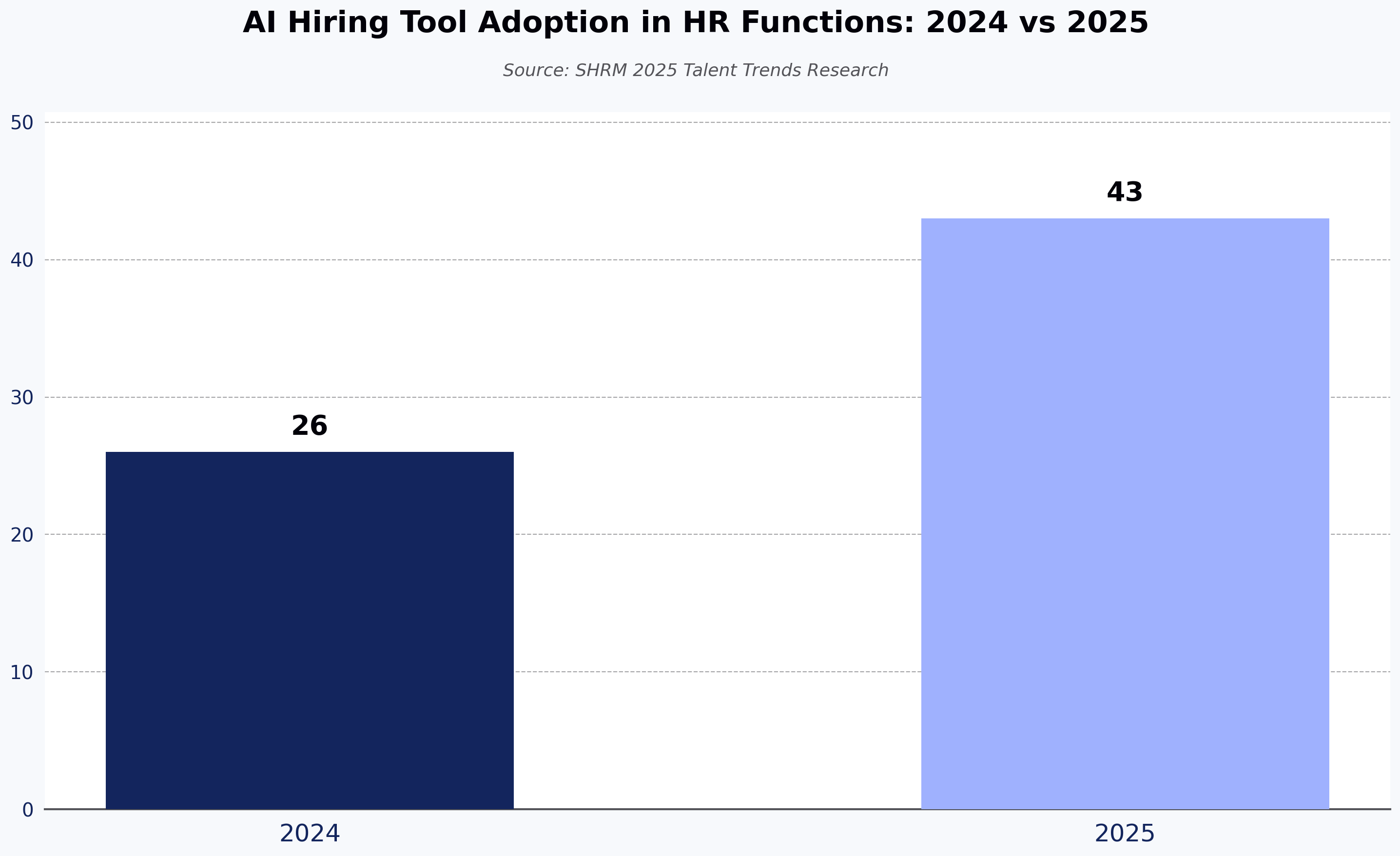
AI hiring tools — software that uses machine learning, NLP, and predictive analytics to screen, assess, match, or schedule candidates — now sit inside 43% of HR functions, according to SHRM's 2025 Talent Trends research, up from 26% in 2024. The category is crowded and the label is loose: "AI-powered" appears on the marketing copy of nearly every tool in the HR tech stack, whether the underlying capability is meaningfully intelligent or a scheduled email sequence with better branding.
This guide covers 12 tools across the full hiring funnel with honest coverage of what each does well, where it falls short, and what you should expect to pay. It also addresses the two topics most listicles skip entirely: bias in AI-driven hiring and the tightening legal compliance landscape for 2025 and 2026. We cover sourcing through onboarding, with a comparison table for quick scanning.
Methodology and authorship: This guide was produced by the HackerEarth editorial team. Tools were evaluated based on publicly available product documentation, vendor briefings, published pricing (where disclosed), independent third-party research, and regulatory guidance current as of publication. HackerEarth is included in this list as the publisher's own product; readers should weigh that context accordingly.
What are AI hiring tools and how do they actually work?
Core AI technologies behind modern hiring tools
Five distinct technologies sit under the "AI hiring" label, and they are not interchangeable. NLP handles resume parsing and chatbot conversations. ML powers candidate scoring by learning patterns from historical hiring data. Computer vision analyzes video interviews for behavioral signals, though emotion recognition is now banned under the EU AI Act as of February 2025, which matters if you use video-based tools. Generative AI writes job descriptions and outreach at scale. Predictive analytics forecasts quality-of-hire from early assessment signals. Most tools combine two or three of these; very few do all five well.
Where AI fits in the hiring funnel (stage-by-stage)
Sourcing tools (SeekOut, Fetcher) find passive candidates. Screening tools (Paradox, Humanly) triage inbound applications. Assessment tools (HackerEarth) evaluate job-relevant skills objectively. Interview tools (HireVue, FaceCode) structure and analyze conversations. Decision and onboarding tools (Eightfold, Phenom) consolidate insights and automate post-offer workflows. Identifying your actual bottleneck before you buy anything is a commonly overlooked step in this entire process.
How we evaluated these tools
We assessed each tool on seven criteria: depth of genuine AI capability versus rule-based automation, ease of use for non-technical HR generalists, bias mitigation features and audit transparency, integration with major ATS and HRIS platforms, pricing transparency, candidate experience quality, and regulatory compliance readiness under NYC Local Law 144, the EU AI Act, Illinois AIPA, and Colorado SB 24-205. Ratings are based on documentation review, vendor demos where offered, and cross-referenced third-party analyst coverage.
The 12 best AI hiring tools for 2026
| # | Tool | Best for | Pricing (public) |
|---|---|---|---|
| 1 | HackerEarth | Technical assessments & developer hiring | Contact for pricing; free trial |
| 2 | HireVue | Video interviewing at scale | ~$35,000+/yr (reported) |
| 3 | Eightfold AI | Talent intelligence & internal mobility | Enterprise custom |
| 4 | Fetcher | Automated sourcing | Custom |
| 5 | Paradox (Olivia) | Conversational AI & high-volume hiring | Custom |
| 6 | Humanly | Mid-market screening & interview notes | Contact for pricing |
| 7 | Textio | Job descriptions & employer branding | Contact for pricing |
| 8 | Pymetrics (Harver) | Neuroscience-based matching | Custom |
| 9 | SeekOut | Talent search & diversity sourcing | Custom enterprise |
| 10 | Manatal | Budget-friendly SMB recruiting | $15/user/month |
| 11 | Phenom | Enterprise talent experience | Custom enterprise |
| 12 | Workable | All-in-one mid-market | From $169/month |
1. HackerEarth — best for technical assessments and developer hiring
HackerEarth focuses on a gap most general-purpose hiring tools do not address: evaluating whether a software engineer can actually write production-quality code. Its assessment library spans 1,000+ skills and 40+ programming languages, with automated grading that scores code on correctness, efficiency, and quality. OnScreen supports early-stage technical and behavioral interviews, generating structured scorecards that HR generalists can act on without a coding background. FaceCode supports live pair programming interviews with AI-assisted evaluation and a multi-interviewer panel format. The hackathon platform sources developer talent proactively, building employer brand with an audience that often ignores job boards.
Pros: - Delivers deep technical evaluation rather than a resume proxy - Includes AI-based anti-cheating and proctoring - Integrates with major ATS platforms - Covers sourcing through live interview in one workflow
Cons: - Purpose-built for technical roles - Overkill for non-technical hiring teams - Public pricing not disclosed
Pricing: Contact for pricing. Free trial available.
2. HireVue — best for video interviewing at scale
HireVue is the incumbent for enterprise video interviewing. The company has reported processing large volumes of assessments in recent quarters, though independent verification of specific figures is limited. Candidates record asynchronous video responses; the AI ranks them and generates shortlists. Text-based interviewing is available for candidates who prefer not to be on camera, which matters for both accessibility and completion rates.
Pros: - Proven at enterprise scale - Structured interview design reduces evaluator inconsistency - Integrates with major ATS platforms
Cons: - Enterprise pricing is prohibitive for most mid-market teams - Emotion recognition features have attracted bias criticism - Restricted under the EU AI Act as of February 2025
Pricing: Custom enterprise, reportedly ~$35,000+/year.
3. Eightfold AI — best for talent intelligence and internal mobility
Eightfold is less a hiring tool and more a strategic talent operating system, which is why it belongs on a shortlist for large enterprises but rarely for anyone else. Its deep-learning model builds skills-based profiles for candidates and employees, enabling both external matching and internal mobility recommendations. Industry analysts including Gartner have noted that AI-based internal talent marketplaces can lift internal fill rates meaningfully, though specific percentage gains vary by organization and are typically vendor-reported.
Pros: - Strong talent intelligence depth - Robust DE&I analytics - Includes internal mobility features many platforms lack
Cons: - Enterprise pricing scales quickly with headcount - Reported rates of $7–$10 per employee per month would put a 10,000-person deployment in the seven-figure range annually (derived math; not vendor-confirmed) - Implementation typically requires dedicated internal resources and weeks to months of onboarding
Pricing: Enterprise custom. Reports indicate $7–10/employee/month for large deployments.
4. Fetcher — best for automated sourcing
Fetcher does one thing and does it well: it puts qualified passive candidates in your pipeline without requiring a sourcing team to run Boolean searches. You set criteria, the AI surfaces profiles and personalizes outreach sequences, and candidates land in your ATS. Vendors in this category, including Fetcher, report that automated sourcing can meaningfully reduce top-of-funnel prospecting time and improve representation of underrepresented groups in shortlists, though independent, peer-reviewed figures remain limited.
Pros: - Requires minimal setup - Supports diversity filters - Integrates with most ATS platforms
Cons: - Sourcing only - No downstream screening or assessment - Impact figures largely vendor-reported
Pricing: Custom. Free pilot available.
5. Paradox (Olivia) — best for conversational AI and high-volume hiring
Olivia is the AI assistant that handles the parts of high-volume recruiting that burn out human recruiters fastest: answering the same FAQ for the 400th time, sending scheduling links, following up on no-shows. Paradox has publicly disclosed large-scale deployments with employers including McDonald's; specific application volumes are vendor-reported. Case studies published by Paradox describe significant reductions in candidate response times after deployment.
Pros: - Multilingual (100+ languages) - Strong scheduling automation - Built for hourly and frontline hiring at scale
Cons: - Works well for structured, high-volume intake - Struggles with nuanced professional-level candidate conversations - Pricing is not publicly listed
Pricing: Custom. Per publicly available information, deployments reportedly start around $1,000/month.
6. Humanly — best for mid-market screening and interview notes
Humanly automates text-based candidate screening conversations and generates structured interview summaries for hiring managers. Its bias-reduction nudges flag language in recruiter communications that may disadvantage candidates from certain groups. It is a practical mid-market option for teams that need screening automation without a six-figure procurement process.
Pros: - Simpler and cheaper than Paradox or HireVue - Bias-nudge feature is useful in practice - Reasonable implementation timeline
Cons: - Narrower feature set than enterprise alternatives - Not suited for technical role depth - Pricing is not publicly listed
Pricing: Contact for pricing. Demo available.
7. Textio — best for AI-optimized job descriptions and employer branding
If your pipeline problem starts at the top because your postings attract the wrong people or too few of them, Textio is where to start. Per Textio's own benchmarks, AI-assisted job descriptions can reduce time-to-publish and decrease biased language relative to unedited postings; independent replication of the specific percentage gains is limited, so treat vendor figures as directional.
Pros: - Measurable funnel impact - Easy to adopt - Does not require ATS integration to deliver value
Cons: - Addresses one stage only - Not a sourcing, screening, or assessment tool - Benefit figures are largely vendor-reported
Pricing: Contact for pricing. Free trial available.
8. Pymetrics (by Harver) — best for neuroscience-based candidate matching
Pymetrics uses behavioral science games to measure cognitive and emotional attributes, then matches candidates to roles based on trait profiles derived from top performers. The approach bypasses resume screening entirely, which can help for roles where traditional credentials predict little about actual performance.
Pros: - Bias-audited model design - Surfaces non-traditional candidates - Useful for volume hiring
Cons: - Some candidates find game-based assessments off-putting - Completion rates can vary - No public free tier
Pricing: Reportedly ~$10,000+/year (vendor-dependent; not publicly listed).
9. SeekOut — best for talent search and diversity sourcing
SeekOut searches across a large index of public profiles and goes deeper than LinkedIn, pulling from GitHub, academic publications, patents, and security clearance data. For engineering teams, defense contractors, or any organization sourcing in a thin talent market, it consistently finds candidates that standard searches miss. Profile coverage figures (often cited at 750 million+) are vendor-reported.
Pros: - Strong for niche and technical talent - Robust diversity filtering - Broad public data coverage
Cons: - Premium pricing - Sourcing-only focus requires complementary tools downstream - Pricing is not publicly listed
Pricing: Custom enterprise. Annual contracts are reportedly in the mid five-figure range and up, though vendor-specific pricing is not publicly listed.
10. Manatal — best for budget-friendly SMB recruiting
Manatal is a reasonable answer for teams that need real AI functionality without enterprise pricing. At $15 per user per month, it combines candidate scoring, resume parsing, social media enrichment, and pipeline management in an ATS that small businesses and staffing agencies can configure in hours rather than months.
Pros: - Accessible price point - Genuine AI functionality - 14-day free trial
Cons: - AI depth does not match enterprise platforms - Not built for technical role evaluation - Limited advanced analytics
Pricing: $15/user/month. 14-day free trial available.
11. Phenom — best for enterprise talent experience platforms
Phenom covers the talent experience from career site to internal mobility in one platform: AI-personalized career site, recruiting CRM, candidate chatbot, and internal role recommendations. For large organizations that want fewer vendor relationships, it reduces the point-solution sprawl that quietly makes most recruiting stacks expensive and inconsistent.
Pros: - End-to-end coverage - Strong employer brand features - Solid candidate experience tools
Cons: - Enterprise pricing - Implementation complexity is a real commitment - Rarely the deepest tool at any single stage
Pricing: Custom enterprise. Demo available.
12. Workable — best for all-in-one mid-market recruiting
Workable is a practical choice for mid-market teams that want AI sourcing, ATS, auto-screening, and built-in video interviews without managing four separate vendor relationships. Its AI sourcing suggests candidates from a large public-profile database (vendor-reported at 400 million+). At $169 per month with a 15-day free trial, the barrier to testing it is low.
Pros: - Strong value - 200+ integrations - Fast to implement
Cons: - Sourcing depth does not match dedicated tools like SeekOut - Assessment depth does not match dedicated tools like HackerEarth - Advanced AI features tied to higher tiers
Pricing: From $169/month. 15-day free trial.
Comparison table
Use this table to match tools against your hiring stage and budget. Enterprise pricing requires a vendor conversation in most cases.
| Tool | Primary stage | Best for | Public pricing | Notable compliance signal |
|---|---|---|---|---|
| HackerEarth | Assessment / Interview | Technical hiring | Contact | Skills-based; reduces credential proxy bias |
| HireVue | Interview | Enterprise video | ~$35k+/yr | Emotion features restricted under EU AI Act |
| Eightfold | Full funnel | Talent intelligence | Enterprise | Bias audit documentation available |
| Fetcher | Sourcing | Passive candidates | Custom | Diversity filters |
| Paradox | Screening | High-volume hourly | From ~$1k/mo | Structured intake |
| Humanly | Screening | Mid-market | Contact | Bias-nudge feature |
| Textio | JD authoring | Employer brand | Contact | Bias-language reduction |
| Pymetrics | Assessment | Trait matching | ~$10k+/yr | Bias-audited model design |
| SeekOut | Sourcing | Technical / cleared talent | Custom | Diversity search |
| Manatal | ATS + AI | SMBs | $15/user/mo | Standard vendor controls |
| Phenom | Full funnel | Enterprise TX | Custom | Career-site personalization |
| Workable | Full funnel | Mid-market | From $169/mo | Broad integrations |
How AI hiring tools can be biased — and how to protect your organization
Most listicles skip this section. It is the one most likely to save you from a discrimination lawsuit.
Common sources of bias in AI recruitment algorithms
AI models learn from historical data, which means they inherit whatever patterns that data contains. Amazon scrapped its AI resume tool in 2018 after reports that it systematically downgraded women because the training data was a decade of predominantly male resumes. The tool was not programmed to discriminate; it learned to.
More recent evidence shows the problem persists. A 2024 University of Washington study found that AI screening tools preferred white-associated names in a substantial majority of comparisons across roughly 3 million resume pairings.
The Workday class action lawsuit was conditionally certified in mid-2025 for age discrimination claims. It could cover a large group of applicants over 40. The certification established that AI vendors, not just employers, may be held liable for discriminatory outcomes.
How to audit and mitigate bias in your AI hiring stack
Demand demographic pass-through rates at each funnel stage from every vendor, ask for documentation of third-party bias audits (not vendor self-assessments), and maintain human decision points that can override AI outputs. Skills-based assessment approaches are one practical way to reduce resume-level bias by design: when the first quality signal is a candidate's performance on a job-relevant task rather than employment history, credential-based proxy bias has less entry point. HackerEarth's technical assessments are built on this pattern — grading is anchored to demonstrated code output rather than resume signals. Under NYC Local Law 144, independent audits are already legally required for tools used in New York City hiring. Treat that as a baseline for any tool you deploy.
Legal and compliance landscape for AI in hiring (2025–2026)
The compliance environment has changed materially and fast. Reports from civil rights and labor advocacy groups indicate that tens of millions of applications now pass through AI-based hiring tools each year, and complaints alleging discriminatory outcomes have risen alongside adoption.
NYC Local Law 144 and what it means for your AI tools
Enforcement of NYC Local Law 144 began in July 2023. The law applies to any employer using an automated employment decision tool to screen candidates for jobs in New York City, regardless of company location. Requirements: annual independent bias audits, public disclosure of results, and at least 10 business days advance notice to candidates. Penalties are reportedly in the $500 to $1,500 per-violation range under the law's civil penalty framework; consult counsel for current enforcement guidance.
EU AI Act implications for recruitment technology
AI hiring tools are classified as high-risk under the EU AI Act. Emotion recognition in workplace and education contexts became prohibited on February 2, 2025. Core high-risk obligations, including documentation, human oversight mandates, and bias assessment, become enforceable on August 2, 2026. If your organization hires in EU countries, that deadline should already be on your compliance calendar.
Emerging U.S. state regulations to watch
Illinois amendments to the AI Video Interview Act (reported effective January 2026) allow discrimination victims to sue privately and address the use of proxy variables such as ZIP codes; consult primary statute text for exact language. Colorado's SB 24-205 takes effect in 2026 (state guidance currently references February 1, 2026 following legislative amendment; verify with counsel), requiring reasonable care to prevent algorithmic discrimination. California's Civil Rights Council has adopted regulations on automated-decision systems in employment; as currently proposed, they include record-keeping obligations and hold vendors accountable alongside employers. Consult the California Civil Rights Department for current effective dates and regulation numbers.
How to choose the right AI hiring tool for your team
Map tools to your biggest hiring bottleneck
The most expensive mistake teams make when evaluating these tools is buying to solve every stage at once. Identify your actual bottleneck first. Sourcing problem? Look at SeekOut, Fetcher, or Workable. Screening volume problem? Paradox, Humanly, or Workable's auto-screening. Assessment quality problem for technical roles? HackerEarth specifically. Interview scheduling friction? Any AI scheduling integration can resolve that quickly. Buying an enterprise suite before you have identified your constraint is like buying a truck when you needed a filing cabinet.
Questions to ask vendors before you buy
What data trains your model, and how recent is it? Can you share your most recent independent bias audit? What does implementation look like for a team of our size? What is the candidate-facing experience? How do you handle data deletion requests under GDPR or CCPA? What is your process when a customer identifies a discriminatory output? That last question reveals the vendor's governance maturity.
Start with one use case, then expand
The teams that get the most value from these tools validate ROI at a single workflow before expanding. If technical hiring is your highest-volume pain point, HackerEarth's technical assessments are a defensible starting point: they establish a skills baseline before any resume review, and results feed directly into hiring-manager scorecards. Once you have evidence (fewer mis-hires, faster time-to-hire, better hiring manager satisfaction), you have a business case for the next layer.
Frequently asked questions
How do AI hiring tools work?
AI hiring tools use machine learning and NLP to automate candidate screening, scoring, and matching decisions. Under the hood, they ingest candidate data (resumes, application answers, assessment results, video responses), apply trained models to produce scored recommendations or automated actions, and hand structured output to recruiters for final decisions. Output quality depends on the quality and fairness of the training data — which is why vendor transparency on how models are trained matters more than feature lists.
How do AI tools speed up the hiring process?
AI compresses the highest-volume stages: resume screening that took hours is reduced to minutes, scheduling back-and-forth is automated, and coding assessment grading via tools like HackerEarth is instant. Industry surveys of recruiters (including SHRM and vendor-commissioned research) consistently report meaningful reductions in time-