Shruti Sarkar

Author
Shruti Sarkar

Blogs
Shruti writes at the crossroads of AI, ethics, and the future of hiring. With a background in both engineering and philosophy, they challenge assumptions in how we assess and select talent.
author’s Articles

Insights & Stories by Shruti Sarkar

Read Shruti Sarkar for deeply reflective takes on automation, AI interviews, and what fair, inclusive hiring could look like in tomorrow’s workplace.
Clear all
Thank you! Your submission has been received!
Oops! Something went wrong while submitting the form.
Filter
Filter

10 Best AI Interview Agent Platforms for Hiring QA Engineers in 2026

QA engineers are the hardest technical hires to screen. 70% of managers trust AI in hiring, yet the same report showed only 27% of the employees express high confidence in AI's ability to evaluate candidate quality. (Checkr)

The divide between adoption and confidence widens further when your team is hiring QA engineers. Screening for this role requires evaluating automation frameworks like Selenium and Cypress, testing strategy thinking, debugging methodology, and CI/CD integration knowledge. This is where an AI interview agent platform built for technical depth becomes essential.

An AI interview agent automates candidate screening, conducts structured interviews, evaluates technical competency, and delivers scored reports. QA roles specifically require platforms that can assess test automation scripting, API testing proficiency, CI/CD pipeline familiarity, edge-case identification, and debugging approach. 

In this article, we compare the 10 best AI interview agent platforms for hiring QA engineers in 2026, evaluating their features, pros, cons, and pricing to help you choose the right solution.

The 10 Best AI Interview Agent Platforms: Side-by-Side Comparison

This table gives you a scannable overview of each tool's positioning, strengths, limitations, and verified G2 rating. Use it to identify which platforms warrant a deeper look based on your team's specific QA hiring requirements.

Tool Name Best For Key Features Pros Cons G2 Rating
HackerEarth AI Interview Agent Full-lifecycle QA technical hiring with AI-driven assessment and live coding AI Interviewer with adaptive follow-ups, 25,000+ questions, QA-specific assessments, FaceCode live coding, Smart Browser proctoring Scales QA screening with deep technical assessment; bias-resistant evaluation; 15+ ATS integrations No low-cost or stripped-down plans 4.5/5
Crosschq Structured behavioral interviews with authenticity signals AI-led interviews, structured planning, fraud detection, ATS integration, compliance reporting Structured evaluation framework; Workday-native integration ATS sync requires extensive configuration; scoring lacks transparency for technical roles 4.2/5
Talview Ivy High-volume behavioral screening with human-like AI avatar Customizable AI personas, multi-language support (20+ languages), structured evaluation, real-time interaction Multi-language support; scalable for high-volume non-technical roles Candidates report impersonal experience; cannot probe technical depth for QA roles 4.2/5
HireVue Enterprise video interviewing at scale AI summaries, searchable transcripts, competency validation, Zoom/Teams integration Easy scheduling; standardized data-driven evaluations Hybrid workflows inflexible; audio/video issues reported 4.1/5
CoderPad Collaborative live coding interviews for developers Multi-file IDE, AI-integrated projects, integrity toolkit, auto-grading, keystroke playback Smooth real-time collaboration; supports 30+ languages Limited advanced reporting; basic UI for non-coding assessment 4.4/5
Codility Enterprise-grade technical assessment science Live coding IDE, pair programming, whiteboard, structured workflows, instant feedback High-fidelity coding environment; WCAG 2.2 accessibility Pricing high for seasonal hiring; limited annual plan flexibility 4.6/5
BrightHire Interview intelligence and AI note-taking AI notes, transcripts, summaries, interview design, clip sharing, ATS sync Automates note-taking; strong adoption and ease of use Initial setup and scorecard automation learning curve 4.8/5
Mercer Mettl Campus recruitment and large-scale assessment Online exams, AI proctoring, 26+ question formats, multi-language registration Complete assessment platform with robust proctoring; multi-language support Pricing high for small teams; advanced analytics limited 4.4/5
iMocha Skills intelligence beyond basic hiring Tara Conversational AI, multi-format questions, role-specific assessments, ATS/HR integration Actionable analytics; customizable assessments Learning curve; test setup not intuitive 4.4/5
Interviewer.AI Async video screening with AI scoring Async interviews, AI avatars, automated scoring, ATS integration Structured evaluations; ATS and admissions integration Limited broader analytics; nuanced reviews may need manual checks 4.6/5

How We Evaluated These AI Interview Agent Platforms

Our evaluation was based on hands-on analysis, verified user reviews from G2 and Capterra (2024 to 2026), and hiring criteria specific to QA engineering roles. In 2026, these are the eight criteria that matter most.

  • QA-Specific Assessment Depth: We measured whether each platform can evaluate QA automation frameworks (Selenium, Cypress, Playwright), API testing tools (Postman, REST Assured), CI/CD integration knowledge, and test strategy design thinking.

In QA hiring, a platform that only assesses Python syntax without evaluating test design, edge-case identification, debugging methodology, and framework architecture is functionally incomplete. 

  • AI Interview Adaptiveness: We evaluated how intelligently each platform adapts follow-up questions based on candidate responses, probes for depth on QA-specific topics, and distinguishes memorized answers from genuine domain expertise. 

Platforms that deliver static question sets regardless of candidate performance miss the signal that separates a junior QA tester from a senior QA engineer. Learn more about why this matters in our guide on how to create a structured interview process.

  • Technical Interview Capability: We assessed whether each platform offers live coding, pair programming, code replay, and real-time evaluation for QA scripting tasks, or only behavioral video interviews. 

Reddit communities including r/ExperiencedDevs and r/cscareerquestions consistently report in 2024 threads that behavioral AI cannot differentiate a junior QA tester giving polished answers from a senior QA engineer giving terse but technically precise ones. 

  • Proctoring and Assessment Integrity: We examined the depth of anti-cheating measures: tab-switching detection, webcam monitoring via computer vision, AI-based plagiarism detection, copy-paste prevention, and browser lockdown capability.

The EEOC's May 2023 guidance on AI selection tools makes clear that employers bear legal responsibility for the validity and fairness of automated assessments. 

  • Enterprise Readiness and ATS Integration: We evaluated whether each platform integrates natively with major ATS systems (Greenhouse, SAP, Workable, iCIMS, Lever), supports SSO, offers API access, and maintains ISO-level security certifications. 

G2 and Capterra reviews from 2023 to 2024 consistently flag integration friction as a hidden cost that delays ROI by weeks or months. For teams exploring automation in talent acquisition, a platform that creates a new data silo defeats the purpose of adopting AI in the first place.

  • Candidate Experience Quality: We looked at how the interview process feels from the candidate's side: interface clarity, mobile accessibility, scheduling flexibility, and whether the experience reflects positively on the employer brand. 
  • Pricing Transparency and ROI: We analyzed whether pricing is publicly available, what billing frequency is offered, and whether the platform delivers measurable improvements in time-to-hire and recruiter efficiency. 
  • Verified User Reviews: We verified customer reviews from G2, Capterra, and TrustRadius, focusing on platforms with an average rating above 4.0 stars and a minimum of 50 verified reviews. Review recency was restricted to 2024 through 2026 to ensure relevance to current product capabilities.

Platforms with fewer verified reviews or ratings below 4.0 stars were excluded from this comparison.

📌 Suggested read: AI Interviewer: How AI Is Changing Technical Interviews in 2026

The 10 Best AI Interview Agent Platforms: An In-Depth Comparison

Let's start with the platform that combines AI interviewing with deep technical assessment capability and take a closer look at each.

1. HackerEarth AI Interview Agent: Best Overall for QA Technical Hiring

HackerEarth's AI Interview Agent delivers adaptive, bias-resistant technical interviews.

HackerEarth is an AI-native technical talent intelligence platform built on over a decade of developer evaluation data, encompassing hundreds of millions of code evaluation signals. The platform's library contains 25,000+ curated questions across 1,000+ skills and 40+ programming languages, serving enterprises including Amazon, Siemens, Barclays, and GlobalLogic. 

QA hiring managers and TA leaders running 50+ concurrent open technical roles use HackerEarth to screen QA engineers on real testing competency. The AI Interview Agent is the platform’s autonomous interviewing product, designed to run deep technical and behavioral interviews through a lifelike video avatar that adapts follow-up questions in real time based on each candidate’s responses.

When hiring QA engineers specifically, the agent evaluates test automation scripting across Selenium, Cypress, and Playwright, along with API testing methodology using Postman and REST Assured, CI/CD pipeline integration knowledge, and testing strategy thinking.

It goes beyond "can you write code" to "can you design a test framework, identify edge cases, and debug a failing test suite." The agent automates 5+ hours of engineer evaluation per hire and saves engineering teams 15+ hours weekly.

The platform integrates natively with 15+ ATS systems including Greenhouse, SAP SuccessFactors, Workable, iCIMS, Lever, LinkedIn Talent Hub, Jobvite, Zoho Recruit, JazzHR, and Oracle Taleo, plus a Recruit API for custom integrations. Your team also gets 24/7 global support, dedicated account managers, and SLA-backed guarantees. You can learn more about how HackerEarth fits into the broader landscape of top online technical interview platforms.

See how HackerEarth evaluates QA engineers on automation scripting, API testing, debugging methodology, and CI/CD pipeline configuration. Book a demo to experience QA-specific adaptive interviewing firsthand.

Key Features of HackerEarth AI Interview Agent

  • Adaptive QA-Specific Questioning: The AI Interview Agent dynamically adjusts follow-up questions based on candidate responses, probing deeper into test automation architecture, edge-case identification, debugging methodology, and framework design patterns when a candidate demonstrates surface-level versus expert-level QA knowledge.
  • Comprehensive Evaluation Matrix: Every interview generates a structured scorecard with dimension-level scoring and written rationale, covering technical competency, QA domain knowledge, problem-solving approach, communication clarity, and collaboration style, making every score explainable to hiring managers.
  • Lifelike Video Avatar with Zero Bias: The AI conducts interviews through a natural video avatar interface, masking PII including gender, accent, appearance, and ethnicity to eliminate unconscious bias from the evaluation process entirely.
  • Real-Time Code Evaluation for QA Scripts: Candidates write and execute test automation scripts, API test cases, and debugging solutions in a sandboxed environment with real-time code quality analysis covering correctness, maintainability, efficiency, and security.
  • FaceCode Live Coding Integration: After AI screening, shortlisted candidates move seamlessly into FaceCode live coding interviews with QA leads, with code replay, AI-generated summaries, private interviewer chat rooms, and PII masking built in, requiring no platform switch.
  • Enterprise-Grade Proctoring: Smart Browser technology with tab-switching detection, AI-powered webcam monitoring, audio analysis, extension detection, and copy-paste prevention generates an Assessment Integrity Score for every candidate, protecting assessment validity for high-stakes QA hiring.
  • 15+ Native ATS Integrations: Assessment results, interview recordings, scorecards, and candidate rankings flow bidirectionally into Greenhouse, SAP, Workable, iCIMS, Lever, and 10+ additional ATS platforms, eliminating dual data entry and keeping the TA team's system of record current in real time.

Who HackerEarth AI Interview Agent Is Best For

If you are a technical recruiter, QA hiring manager, or engineering leader running 50+ concurrent open QA and developer roles, HackerEarth is built for your workflow. It is particularly strong if you are hiring QA automation engineers, SDET roles, or QA leads where testing framework expertise must be validated before the live interview stage.

Campus recruitment teams screening CS graduates for QA aptitude across 10+ universities simultaneously will find the scalable assessment infrastructure especially valuable. If your organization requires ISO-certified, bias-resistant evaluation infrastructure that satisfies EEOC and OFCCP compliance requirements, you can rely on HackerEarth's certification portfolio.

HackerEarth AI Interview Agent's Pros

  • Automates first-level QA screening with structured, rubric-based evaluation that QA leads trust enough to skip manual phone screens
  • Deep technical assessment library covering QA-specific skills (Selenium, Cypress, API testing, CI/CD) that generic AI interview tools in this comparison do not evaluate
  • Enterprise-grade proctoring and ISO certifications satisfy procurement and compliance requirements at Fortune 500 organizations

HackerEarth AI Interview Agent's Cons

  • Does not offer low-cost or stripped-down plans for small teams or seasonal hiring
  • The depth of configuration options (custom rubrics, question sets, integration settings) can require onboarding support for first-time administrators

HackerEarth AI Interview Agent's Pricing

  • Growth Plan: $99/month (or $990/year). Includes 10 interview credits per month (120/year), AI-powered technical interviews, real-time code evaluation, automated candidate screening, custom interview templates, multi-language support, detailed performance analytics, interview recording and playback, and ATS integrations.
  • Enterprise: Custom pricing. Adds SSO, customized user roles, access to professional services, and premium support for large-scale hiring volumes.
  • Yearly billing saves two months compared to monthly billing. Credits are consumed per attempted interview, not per invite sent.

Case Studies:

  • Amazon: Amazon used HackerEarth to assess 1,000+ candidates simultaneously using automated skill evaluation, accurately assessing over 60,000 developers. Amazon's Talent Acquisition Leader described the platform as having optimized their recruitment process, enabling the team to assess 60,000+ developers through automated skill evaluation.
  • Trimble: Before HackerEarth, Trimble's recruiters manually assessed close to 30 candidates per position. After implementing HackerEarth assessments, the candidate pool dropped from 30 to 10 per position, a 66% reduction, while eliminating paper tests and improving shortlist quality.

📌 Related read: How to Create a Structured Interview Process: A Step-by-Step Guide for Hiring Managers

2. Crosschq: Best for Structured Behavioral Screening with Reference Intelligence

Crosschq positions its AI interview agent around structured behavioral interviews and reference intelligence.

Crosschq is an AI interview agent platform rooted in reference intelligence and structured behavioral interviewing. The platform conducts AI-led interviews with structured planning, fraud detection through behavioral authenticity signals, compliance reporting, and reference intelligence integration. Its heritage in reference checking gives it credibility in the "quality of hire" conversation, and its Workday Marketplace presence means organizations already running Workday can discover and evaluate it within their existing ecosystem.

However, Crosschq focuses entirely on behavioral interviews and reference verification. It does not evaluate QA automation scripting, testing framework knowledge, API testing methodology, or any form of coding ability.

Key Features of Crosschq

  • Compliance and Reporting: Built-in compliance reporting supports audit trails and regulatory requirements for organizations with strict hiring governance mandates.
  • ATS Integration with Workday Focus: Native Workday Marketplace presence and integrations with other ATS platforms allow interview data to flow into existing recruitment workflows.
  • Structured Interview Planning Tools: Hiring managers can build interview plans with predetermined questions, scoring rubrics, and evaluation criteria before the first candidate is screened.

Who Crosschq Is Best For

If you are a TA leader or HR director at a mid-to-large enterprise focused on behavioral screening and reference verification for non-technical or hybrid roles, Crosschq fits your workflow. 

Crosschq's Pros

  • Structured behavioral evaluation framework ensures every candidate is assessed against the same criteria consistently
  • Reference intelligence adds a data layer that most AI interview platforms do not provide
  • Workday-native integration reduces configuration friction for organizations already in that ecosystem

Crosschq's Cons

  • ATS sync with Greenhouse required weeks of configuration and multiple support calls, with data mapping that was not plug-and-play
  • AI scoring lacks transparency for technical roles, making it difficult to explain why one candidate scored higher than another

Crosschq's Pricing

Custom pricing. Contact Crosschq's sales team for a quote. Pricing conversations typically cover interview volume, ATS integration requirements, and reference intelligence module access.

3. Talview Ivy: Best for High-Volume Multilingual Behavioral Screening
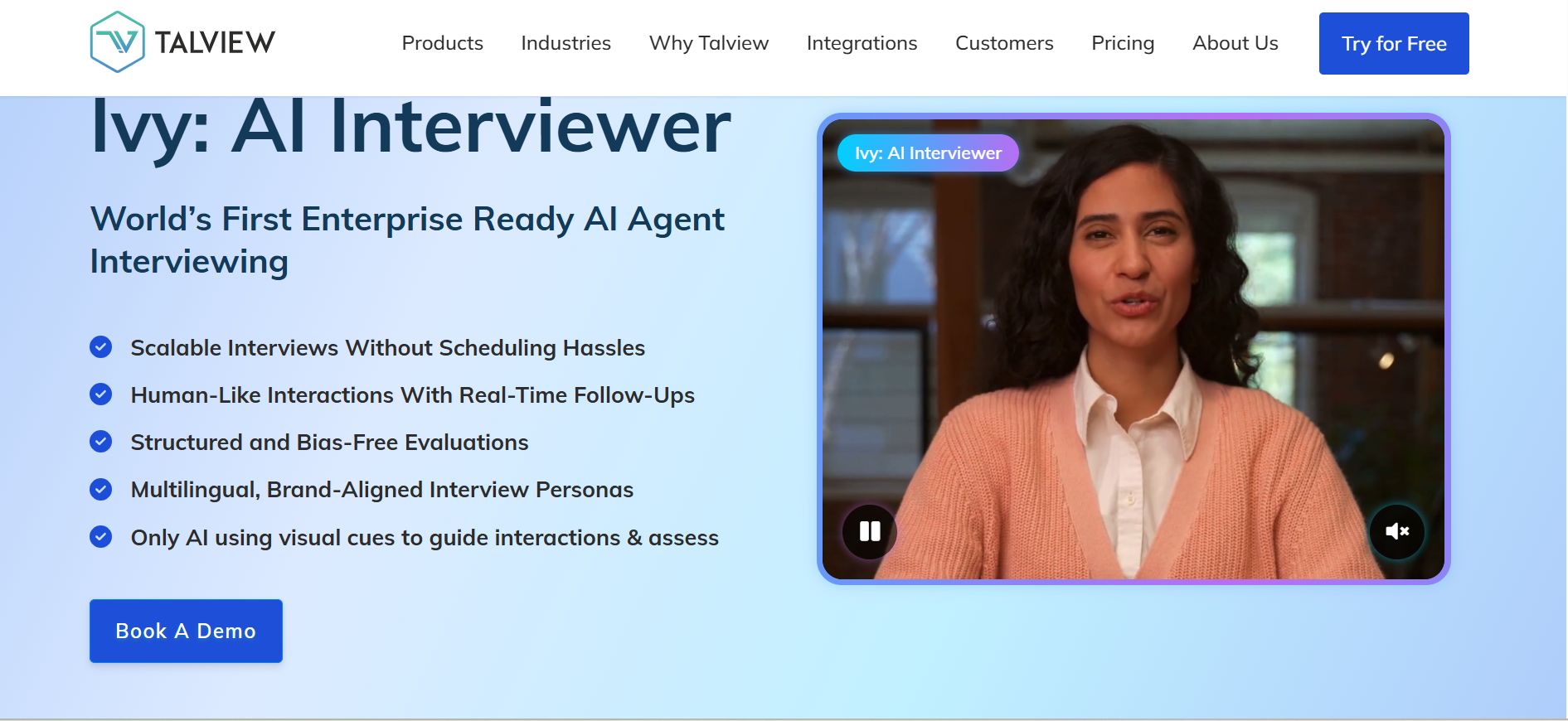
Talview positions Ivy as the "first human-like AI interview agent," with customizable personas.

Talview Ivy is an AI interview agent that positions itself as the first human-like AI interviewer, conducting real-time conversational interviews with customizable personas across 20+ languages. The platform is designed for high-volume behavioral screening, particularly in industries like banking, IT services, and business process outsourcing where organizations need to screen thousands of candidates in multiple languages simultaneously.

For QA hiring specifically, Talview Ivy's limitations are significant. The platform cannot probe QA technical depth. It does not evaluate Selenium scripting, Cypress test architecture, API testing methodology, CI/CD integration knowledge, or any form of coding competency.

Key Features of Talview Ivy

  • Real-Time Conversational Interaction: The AI engages candidates in dynamic, back-and-forth conversation rather than static one-way video recording, creating a more natural interview experience.
  • Structured Evaluation with Scoring Rubrics: Every interview produces a scored evaluation against predefined behavioral criteria, enabling consistent comparison across candidates.
  • Fraud Detection Signals: The platform includes behavioral signals to flag potential interview fraud or coached responses during the screening process.

Who Talview Ivy Is Best For

Talview Ivy fits your workflow if you are in banking, insurance, IT services, or BPO and hiring customer-facing or operations roles across multiple countries and languages.

Talview Ivy's Pros

  • Multi-language support across 20+ languages enables truly global behavioral screening at scale
  • Human-like conversational interface creates a more engaging candidate experience than one-way video tools
  • Structured scoring rubrics deliver consistent behavioral evaluations across thousands of candidates

Talview Ivy's Cons

  • AI could not probe deeply enough for system design or domain-specific technical knowledge
  • Workday integration required extensive manual configuration and some data did not flow back cleanly
  • Candidate drop-off reported among engineering applicants, with one reviewer noting their team stopped using it for engineering roles due to employer brand concerns

Talview Ivy's Pricing

Custom pricing. Contact Talview's sales team for a quote based on interview volume, language requirements, and integration scope.

4. HireVue: Best for Enterprise Video Interviewing at Scale
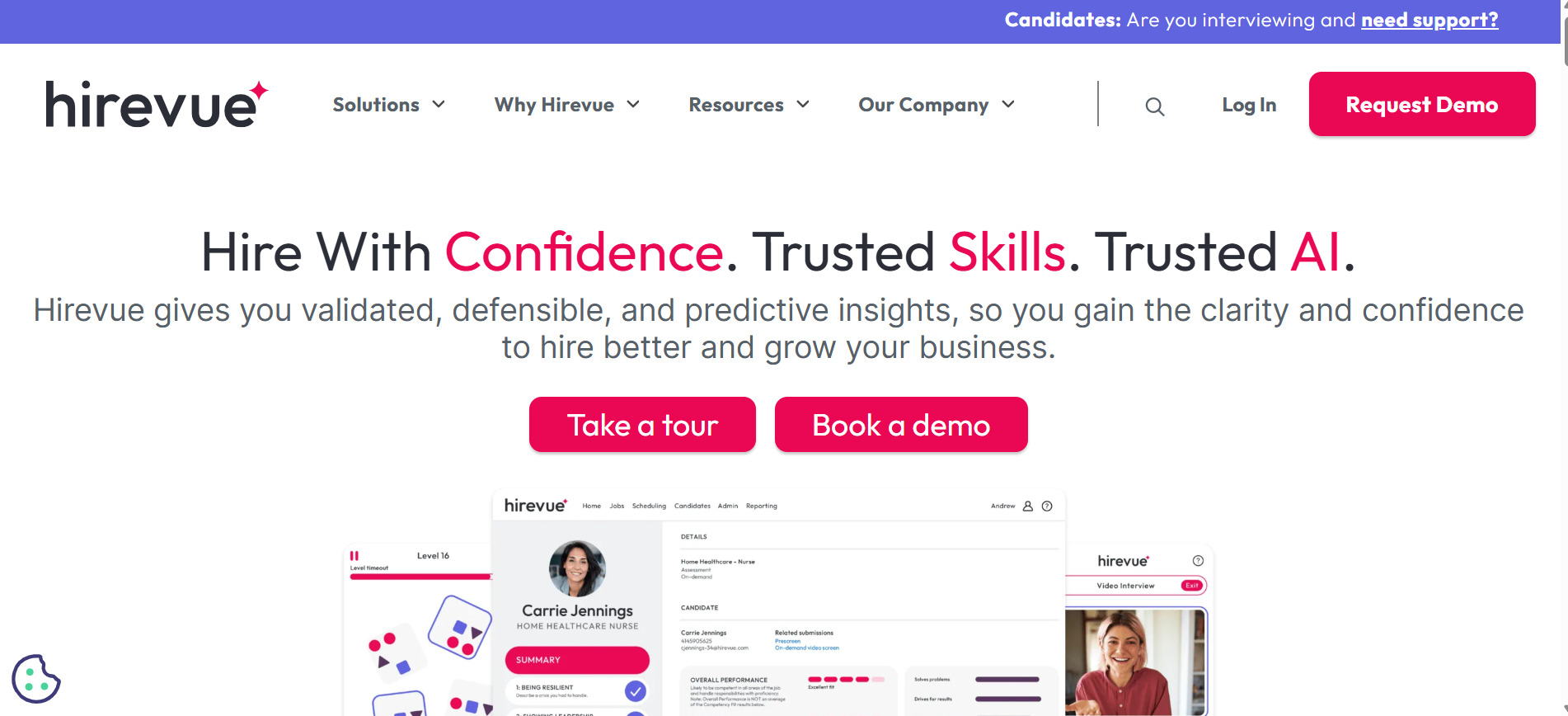
HireVue combines AI-powered video interviewing with competency validation and searchable transcripts.

HireVue is one of the most established names in enterprise AI video interviewing. The platform's Interview Insights feature combines structured, science-backed interview content with AI assistance to generate summaries, searchable transcripts, and interviewer benchmarks from every conversation. 

The platform standardizes evaluation at scale, which is valuable for organizations where interview quality varies widely across interviewers and locations. But, HireVue is a behavioral video interview platform. It does not offer a coding environment, live coding capability, or technical assessment engine. It cannot evaluate whether a QA candidate can write a Playwright test, design an API testing strategy using REST Assured, or configure a CI/CD pipeline's testing stage. 

Key Features of HireVue

  • Competency Validation Framework: HireVue maps interview responses to predefined competency models, providing structured validation against role requirements.
  • Zoom and Teams Integration: Native integration with existing video conferencing tools means hiring teams do not need to onboard candidates onto a new platform.
  • Interviewer Benchmarking: The platform tracks interviewer performance and consistency over time, helping TA leaders identify calibration gaps across their interview panel.

Who HireVue Is Best For

HireVue fits your workflow if you already use Zoom or Microsoft Teams and want to add structured AI evaluation without changing your video infrastructure.

HireVue's Pros

  • Scheduling and managing candidate interviews is straightforward, reducing administrative overhead for recruiters
  • AI-assisted summaries and searchable transcripts reduce manual review time per candidate
  • Standardized, data-driven evaluation improves fairness and consistency across large interview panels

HireVue's Cons

  • Hybrid interview workflows can be inflexible when teams need to customize evaluation stages
  • Users report audio and video quality issues with certain device and network setups
  • Archiving candidates per role is limited, creating friction for teams managing multiple open positions simultaneously

HireVue's Pricing

Custom pricing. Contact HireVue's sales team for a quote based on interview volume, feature requirements, and enterprise integration scope.

5. CoderPad: Best for Collaborative Live Coding Interviews
CoderPad provides a multi-file IDE with AI-integrated projects and integrity tooling.

CoderPad is a live coding interview platform built for collaborative, real-time technical evaluation. The platform provides a multi-file IDE where candidates complete AI-integrated projects, and interviewers observe the process through keystroke playback, auto-grading, and optional video/audio explanations. 

For QA engineer hiring, CoderPad offers partial relevance. Your team can use the live coding environment to assess whether a candidate can write Selenium scripts, build API test cases, or debug a failing test in real time. However, CoderPad does not include QA-specific question libraries, pre-built test automation assessments, or structured evaluation rubrics tailored to testing frameworks.

Key Features of CoderPad

  • Keystroke Playback and Auto-Grading: Interviewers can replay the candidate's entire coding session step by step, with automated grading providing an initial evaluation layer.
  • Integrity Toolkit: Code similarity checks, IDE exit tracking, randomized question ordering, and AI-assisted webcam proctoring protect assessment validity during remote sessions.
  • Video and Audio Explanations: Candidates can record verbal explanations of their code, giving interviewers insight into reasoning and communication alongside the technical output.

Who CoderPad Is Best For

CoderPad is a strong fit if you already have QA-specific questions prepared and want a reliable IDE platform to administer them in real time.

CoderPad's Pros

  • Smooth real-time collaboration and live coding experience with minimal latency across geographies
  • Supports 30+ programming languages with realistic multi-file project environments
  • Auto-grading and keystroke playback reduce manual evaluation time and provide reviewable evidence

CoderPad's Cons

  • Some advanced language-specific features and template customizations are limited
  • Basic UI and limited advanced editor features compared to full-featured IDEs
  • Minimal analytics and post-interview reporting for tracking trends across multiple candidates

CoderPad's Pricing

Custom pricing. Contact CoderPad's sales team for a quote based on team size, interview volume, and feature requirements.

6. Codility: Best for Enterprise-Grade Technical Assessment Science
Codility combines a high-fidelity live coding IDE with pair programming and structured workflows.

Codility is a technical assessment platform built for enterprise organizations that prioritize scientific rigor in their evaluation process. The platform offers a live coding IDE, pair programming capability, whiteboard functionality for system design discussions, and structured interview workflows with instant candidate feedback. 

For QA engineer hiring, Codility provides a strong coding evaluation environment. Your team can assess whether a candidate writes clean, efficient test scripts and solves debugging challenges under realistic conditions. However, Codility does not offer pre-built assessments for Selenium test suite architecture, API testing strategy using Postman or REST Assured, CI/CD pipeline testing configuration, or QA-specific edge-case identification scenarios.

Key Features of Codility

  • Structured Interview Workflows: Hiring teams configure evaluation workflows with predefined stages, scoring criteria, and question sequences to maintain consistency across all interviewers.
  • Cody AI Assistant Integration: The platform evaluates how candidates prompt, use, and validate outputs from an integrated AI coding assistant, measuring collaboration with generative AI tools.
  • Instant Candidate Feedback: Candidates receive immediate feedback after completing assessments, improving the candidate experience and reducing anxiety about opaque evaluation processes.

Who Codility Is Best For

Codility is particularly relevant if you need accessibility-compliant evaluation environments and want to measure candidate collaboration with AI coding tools.

Codility's Pros

  • High-fidelity live coding environment with an intuitive interface that candidates and interviewers consistently rate positively
  • Structured workflows allow interviewers to maintain evaluation consistency while retaining flexibility to probe specific areas
  • WCAG 2.2 accessibility compliance ensures inclusive assessments that meet enterprise DEI and procurement standards

Codility's Cons

  • Pricing can be prohibitive for seasonal hiring or internship programs with fluctuating assessment volumes
  • Annual plan structure offers limited flexibility for teams whose hiring volume varies significantly quarter to quarter

Codility's Pricing

  • Starter: $1,200/user annually.
  • Scale: $6,000 per 3 users annually.
  • Custom: Contact Codility for pricing based on team size, assessment volume, and enterprise integration requirements.

All prices are billed annually.

7. BrightHire: Best for Interview Intelligence and AI Note-Taking

BrightHire captures transcripts, AI-generated notes, and structured summaries from every interview.

BrightHire is an interview intelligence platform that automates the capture and analysis of interview conversations. The platform generates AI-powered notes, full transcripts, structured summaries, and shareable interview clips, enabling hiring teams to make evidence-based decisions without relying on memory or manual note-taking.

When your QA lead conducts a live technical interview, BrightHire captures every detail of the conversation, generates a structured summary highlighting key technical responses, and syncs that data directly into your ATS. The limitation for QA engineer hiring is that BrightHire does not conduct interviews autonomously and does not assess coding ability. 

Key Features of BrightHire

  • Interview Clip Sharing: Specific candidate responses can be clipped and shared with hiring committee members, enabling collaborative decision-making without requiring everyone to attend the live session.
  • ATS Sync for Scores and Summaries: Transcripts, scores, and AI-generated summaries flow directly into your ATS, keeping candidate records complete without manual data entry.
  • Async and Live Interview Support: BrightHire supports both asynchronous first-round interviews and live interview intelligence capture, providing flexibility across different stages of the hiring funnel.

Who BrightHire Is Best For

BrightHire fits your workflow, if multiple stakeholders participate in your hiring decisions and need access to structured interview data without attending every session.

BrightHire's Pros

  • Automates note-taking and captures key moments with AI, freeing interviewers to focus entirely on the candidate conversation
  • Streamlines collaborative decision-making through transcripts, summaries, and shareable interview clips
  • High adoption rates among users due to ease of use and the immediate time savings it delivers

BrightHire's Cons

  • Initial setup and scorecard automation can feel unintuitive, requiring trial and error to configure correctly
  • New users face a learning curve without guided tutorials or structured onboarding walkthroughs

BrightHire's Pricing

  • BrightHire Screen: Contact for pricing.
  • Interview Intelligence Platform: Available in Recruiters, Teams, and Enterprises tiers. Contact BrightHire for pricing based on team size and feature requirements.

8. Mercer Mettl: Best for Campus QA Recruitment and Large-Scale Assessment

Mercer Mettl combines scalable online exam management with AI-assisted proctoring for campus assessments.

Mercer Mettl is an AI-driven assessment and proctoring platform designed for organizations that need to screen large candidate volumes in campus recruitment and enterprise hiring drives. For QA engineer hiring at the campus level, Mercer Mettl offers partial coverage. 

The platform's multiple question formats allow your team to build assessments that include coding challenges, multiple-choice questions on testing concepts, and scenario-based questions on QA methodology. AI-enabled proctoring with secure browser, live proctoring, automated monitoring, and "proctor the proctor" features protect assessment integrity during remote campus drives.

Key Features of Mercer Mettl

  • 26+ Question Formats: Hiring teams can build assessments using coding challenges, MCQs, case studies, simulations, and subjective response formats tailored to the role.
  • Exam Evaluation Dashboards: Digital answer sheet assignment, evaluation, and re-evaluation tools with progress tracking dashboards streamline the grading process for large candidate pools.
  • ERP and ATS Integration: Assessment results and candidate data flow into existing enterprise systems, supporting seamless workflows for organizations with complex recruitment infrastructure.

Who Mercer Mettl Is Best For

Mercer Mettl is relevant if you screen across multiple campuses and need multi-language support, scalable exam infrastructure, and integration with existing ERP systems.

Mercer Mettl's Pros

  • Complete assessment platform with AI-enabled proctoring that handles thousands of simultaneous test-takers reliably
  • Flexible question formats and multi-language support make it adaptable for diverse campus hiring requirements
  • Scalable infrastructure supports large-scale assessment drives without performance degradation

Mercer Mettl's Cons

  • Pricing can be high for smaller teams or organizations conducting frequent assessments outside of campus season
  • Advanced analytics and custom report flexibility are limited, requiring workarounds for teams that need deep performance insights
  • Some advanced features require dedicated onboarding and training before teams can use them effectively

Mercer Mettl's Pricing

Custom pricing. Contact Mercer Mettl's sales team for a quote based on assessment volume, proctoring requirements, and integration scope.

9. iMocha: Best for QA Skills Intelligence Beyond Basic Hiring
iMocha combines its Tara Conversational AI agent with multi-format assessments and role-specific analytics.

iMocha is a skills intelligence platform that extends beyond traditional hiring assessments into workforce analytics, upskilling, and talent development. The platform's Tara Conversational AI agent conducts human-like interviews with adaptive questioning, supporting both technical and behavioral evaluation across multiple assessment formats. 

iMocha offers role-specific assessments, multi-format question support (MCQs, coding challenges, simulations, case studies), and integration with ATS and HR systems for seamless data flow. For QA engineer hiring, iMocha provides more QA-relevant coverage than most behavioral AI interview platforms in this comparison. The platform offers QA-specific skill assessment categories including manual testing, automation testing, API testing, and performance testing. 

Key Features of iMocha

  • Actionable Analytics and Skill Gap Insights: Real-time dashboards provide detailed skill gap analysis, candidate benchmarking, and hiring intelligence that support data-driven QA hiring decisions.
  • ATS and HR System Integration: Assessment results and candidate profiles integrate with major ATS and HR platforms, keeping recruitment workflows unified.
  • Role-Specific Assessment Templates: Pre-built assessment templates for common technical roles accelerate test creation, reducing the time your team spends building assessments from scratch.

Who iMocha Is Best For

If you are on an enterprise TA team, at a recruitment agency, or an L&D leader who needs a skills intelligence platform that serves both hiring and workforce development, iMocha fits your workflow.

iMocha's Pros

  • Actionable analytics provide clear skill gap insights that help QA hiring managers make evidence-based shortlisting decisions
  • Customizable assessments allow teams to build QA-specific evaluations tailored to their exact framework and methodology requirements
  • AI-driven proctoring verifies exam integrity across remote assessment sessions

iMocha's Cons

  • Initial learning curve for new users, particularly when configuring advanced assessment workflows
  • Test setup process is not always intuitive, requiring additional time to build and validate custom QA assessments
  • Some advanced reporting features require additional configuration before delivering the full depth of available insights

iMocha's Pricing

  • 14-day free trial available.
  • Basic: Contact for pricing.
  • Pro: Contact for pricing.
  • Enterprise: Contact for pricing.

10. Interviewer.AI: Best for Async QA Candidate Screening with AI Scoring

Interviewer.AI combines asynchronous video interviews with AI-powered avatars and automated scoring.

Interviewer.AI is an asynchronous video interview platform that uses AI-driven scoring and conversational AI avatars to screen candidates at scale. Candidates complete interviews on their own schedule, with AI-powered avatars simulating live interview dynamics through adaptive follow-up questions. 

The platform generates automated scoring, structured summaries, and candidate comparisons, reducing manual screening effort by up to 80% according to Interviewer.AI's published product documentation. 

Key Features of Interviewer.AI

  • Automated Scoring and Candidate Summaries: AI-driven scoring generates structured evaluations and candidate comparisons, providing an initial ranking layer before human review.
  • ATS and Admissions Integration: Interview results and candidate data flow into existing ATS and admissions platforms, supporting unified workflows for both corporate hiring and university recruitment.
  • Multi-Geography and Multi-Language Support: The platform supports screening across geographies and languages, making it relevant for organizations with distributed hiring needs.

Who Interviewer.AI Is Best For

Interviewer.AI is relevant as a behavioral pre-screen layer for QA hiring funnels where technical assessment happens in a subsequent stage using a dedicated coding evaluation platform.

Interviewer.AI's Pros

  • Structured, explainable evaluations with AI-generated insights give hiring managers transparency into how candidates were scored
  • ATS and admissions integration supports unified workflows for both corporate and university recruitment pipelines
  • Asynchronous format improves candidate convenience and reduces scheduling coordination for distributed hiring teams

Interviewer.AI's Cons

  • Limited analytics for overall career page or specific job page engagement, making it difficult to track top-of-funnel performance
  • Nuanced candidate evaluation may require additional manual review beyond AI-generated scores, particularly for senior or specialized roles

Interviewer.AI's Pricing

  • Essential: $636/year (15 seats, up to 3 job postings).
  • Professional: $804/year (25 seats, up to 5 job postings).
  • Enterprise: Contact for pricing.

All prices are billed annually.

The Right AI Interview Agent Makes QA Hiring Measurably Faster

When you are selecting an AI interview agent for QA engineer hiring, technical assessment depth is the single factor that separates platforms that accelerate your process from platforms that add another step to it. 

A tool that automates behavioral screening but forces your QA lead to re-interview every candidate on Selenium scripting, API testing methodology, CI/CD pipeline configuration, and edge-case identification has not replaced a step. It has created a new one. Evaluate platforms on whether they produce QA-specific competency scores your engineering team trusts enough to act on without conducting their own phone screen.

HackerEarth's AI Interview Agent supports the full QA technical hiring lifecycle. It screens candidates with adaptive questioning on test automation frameworks and evaluates real-time code quality for QA scripts in a sandboxed environment. Shortlisted candidates move into FaceCode live coding interviews with diagram boards for test architecture discussions, and results flow into 15+ ATS platforms bidirectionally. 

The teams that will hire QA engineers fastest in 2026 and beyond are the ones combining intelligent automation with validated technical assessment at every stage of the funnel. Book a demo today to see how HackerEarth's AI Interview Agent evaluates QA engineers on the skills that predict on-the-job performance, or try HackerEarth out now to experience the platform firsthand.

FAQs

1. Can an AI interview agent assess QA automation skills like Selenium and Cypress?

Most AI interview agents focus on behavioral screening and cannot evaluate QA automation frameworks. Platforms with technical assessment engines, like HackerEarth, offer QA-specific coding challenges that test Selenium, Cypress, Playwright, API testing, and CI/CD integration in sandboxed environments with real-time code evaluation.

2. How do AI interview agents prevent candidates from cheating during remote assessments?

Leading platforms use multi-layer proctoring including tab-switching detection, webcam monitoring, AI-based plagiarism detection, browser lockdown, and copy-paste prevention. These integrity measures generate a per-candidate assessment score that flags suspicious behavior without creating a hostile testing experience.

3. Do AI interview agents work for hiring senior QA leads and SDETs?

Platforms with adaptive questioning and architecture evaluation capabilities can assess senior QA professionals on test strategy design, framework architecture, and system-level debugging. Generic behavioral AI tools are typically limited to entry-level and mid-level screening only.

4. How do AI interview agents handle candidates who have accessibility needs?

Leading platforms support screen readers, keyboard navigation, extended time accommodations, and WCAG-compliant interfaces. Check whether your shortlisted platform documents specific accessibility features and meets current web accessibility standards before purchasing.

5. What is the difference between an AI interview agent and a technical assessment platform?

An AI interview agent conducts conversational interviews autonomously, while a technical assessment platform evaluates coding and domain skills through structured challenges. The strongest platforms for QA hiring combine both capabilities in a single workflow.
10 Best AI Interview Tools for Your Next Best Hire in 2026

In 2026, the majority of HR leaders believe organizations that do not adopt AI solutions within 12 to 24 months will fall behind in organizational success. A 2026 Gartner HR survey found that 45% of employers using AI in recruitment report measurable time savings and efficiency gains. 

LinkedIn's 2025 Future of Recruiting report revealed that 73% of recruiting professionals expect AI to fundamentally change how companies find and evaluate talent, with structured interviewing and AI-driven assessment cited as the top two areas of transformation. 

The pressure on your hiring team is not abstract. Recruiters lose hours to resume screening, engineers burn productive time on unqualified candidates, evaluation standards vary from one interviewer to the next, and hiring decisions stall while stakeholders wait for interview feedback. An AI interview agent solves this bottleneck by bringing consistency, speed, structured data, and objectivity to every stage of the funnel.

An AI interview tool for hiring teams automates candidate screening, conducts structured technical and behavioral assessments, delivers real-time evaluation insights, and integrates with your ATS. 

In this article, we compare 10 AI interview tools across features, pros, cons, pricing, and verified user ratings to help you choose the right platform for your hiring team.

The 10 Best AI Interview Tools: Side-by-Side Comparison

If you are a technical recruiter or hiring manager evaluating AI interview tools for your team, this table gives you a scannable comparison of all 10 platforms across the dimensions that matter most.

Tool Name Best For Key Features Pros Cons G2 Rating
HackerEarth AI Interview Agent Enterprise technical hiring; full-lifecycle interviewing and assessments AI Interviewer with adaptive questioning, AI Screener, 25,000+ questions, FaceCode live coding, advanced proctoring, 15+ ATS integrations Scales technical hiring end-to-end; deep skill assessments across 1,000+ skills; bias-resistant evaluation with PII masking No low-cost or stripped-down plans for small teams 4.5/5
HireVue High-volume enterprise video interviewing Interview Insights with AI summaries, searchable transcripts, competency validation, Zoom/Teams integration Easy scheduling; standardized, data-driven evaluations at scale Hybrid workflows can be inflexible; audio/video quality issues reported 4.1/5
CoderPad Collaborative live coding interviews AI-integrated projects, real multi-file IDE, integrity toolkit, auto-grading, keystroke playback Smooth real-time collaboration; supports 30+ languages Basic UI; limited advanced editor features; minimal post-interview reporting 4.4/5
Codility Enterprise-grade technical assessment science Live coding IDE, pair programming, whiteboard, structured workflows, WCAG 2.2 accessibility, instant feedback High-fidelity interview environment; intuitive candidate experience Pricing high for seasonal hiring; limited annual plan flexibility 4.6/5
BrightHire Interview intelligence and AI note-taking AI-powered notes, summaries, transcripts, interview design, clip sharing, ATS integration Automates note-taking; strong adoption and ease of use Setup and scorecard automation learning curve 4.8/5
Metaview AI-powered recruiting analytics AI summaries, transcripts, pattern insights, interview recall, question queries Saves recruiter time; structured insights; seamless integrations Transcript accuracy varies for non-native speakers 4.8/5
Interviewer.AI Async video screening with AI scoring Asynchronous interviews, AI avatars, automated scoring, dynamic follow-up questions Structured, explainable evaluations; ATS and admissions integration Limited broader analytics; nuanced reviews may require manual checks 4.6/5
Mercer Mettl Campus recruitment and large-scale assessment Scalable online exams, AI proctoring, 26+ question formats, evaluation dashboards End-to-end assessments; robust proctoring; multi-language support Pricing high for small teams; advanced analytics limited 4.4/5
iMocha Skills intelligence beyond basic hiring Tara Conversational AI, multi-format questions, role-specific assessments, ATS/HR integration Actionable analytics; customizable assessments Learning curve; test setup not intuitive 4.4/5
Radancy Culture fit and soft skills evaluation Video assessments, Smart Shortlisting, customizable branding, ATS integration Excellent support; clear candidate insights; scalable Dashboard UX outdated; beginner learning curve 4.7/5

How We Evaluated These AI Interview Tools

Every tool in our list was evaluated against seven criteria that reflect what technical recruiters, engineering managers, and campus hiring leads actually need from an AI interview tool in 2026.

  • AI Capabilities: We assessed how intelligently each platform interprets candidate responses, whether it supports adaptive follow-up questioning, and whether it delivers actionable insights beyond surface-level scoring. Tools with genuine AI-powered technical assessment depth reduce reliance on subjective judgment and make evaluations more objective across your entire hiring team.
  • Technical Assessment Depth: We measured question library size, skill coverage breadth, including niche areas like GenAI, DevOps, and ML, support for real-world project simulations, and code quality evaluation beyond pass/fail. 
  • Enterprise Readiness: We evaluated scalability to 1,000+ concurrent candidates, ATS integration depth, security certifications (e.g., ISO 27001 and SOC 2), SSO support, and role-based access controls. Your hiring infrastructure needs to perform under the same volume pressures as your production systems do.
  • Candidate Experience: We examined interface clarity, developer-friendly coding environments, mobile accessibility, assessment completion rates, and the tool's impact on the employer brand. 
  • Anti-Cheating and Assessment Integrity: We measured proctoring sophistication, including tab-switch detection, webcam monitoring, AI-based plagiarism detection, and IP geofencing, as well as impersonation prevention and Assessment Integrity Score generation. Platforms with advanced proctoring for technical assessments protect your hiring decisions from fraudulent candidate behavior at every stage.
  • Pricing Transparency and ROI: We analyzed publicly available pricing, billing flexibility covering monthly and annual options, credit-based versus per-user models, and whether the platform delivers measurable improvements in time-to-hire and recruiter efficiency. 
  • Verified User Reviews: We checked ratings and review themes from G2, Capterra, and TrustRadius, focusing on platforms with an average rating above 4.0 stars and a minimum of 50 verified reviews. 

📌 Suggested read: AI in Technical Hiring: What Recruiters Need to Know in 2026

The 10 Best AI Interview Tools: An In-Depth Comparison

Here is a closer look at each platform, starting with the tool that scored highest across our evaluation criteria.

1. HackerEarth AI Interview Agent: Best Overall for Technical Hiring

HackerEarth's AI Interview Agent conducts adaptive technical and behavioral interviews with a lifelike video avatar.

HackerEarth is an AI-native technical talent intelligence platform built for enterprise companies that hire technical talent at scale. The platform's assessment engine draws from a library of 25,000+ questions across 1,000+ skills and 40+ programming languages, covering everything from Python, Java, JavaScript, and Go to niche competencies in GenAI, DevOps, ML, and embedded systems. 

With 4,000+ enterprise clients, a 10M+ developer community, and named customers including Amazon, Siemens, Barclays, and GlobalLogic, HackerEarth serves organizations where technical hiring is a continuous, operationally critical function.

The AI Interview Agent conducts end-to-end technical and behavioral interviews using a lifelike video avatar with adaptive follow-up questioning. Your engineering team recovers 5+ hours of evaluation time per hire and 15+ hours per week that would otherwise go to first-level interviews. 

Every candidate receives an Assessment Integrity Score, giving your hiring managers confidence that results reflect genuine ability. HackerEarth holds ISO 27001, 27017, 27018, and 27701 certifications, uses AES-256 encryption, and runs on AWS multi-AZ infrastructure for high availability.

Enterprise support includes 24/7 global availability, dedicated account managers, SLA-backed guarantees, and professional services for custom question development. This makes HackerEarth reliable for organizations managing high-volume lateral hiring, multi-university campus drives, and specialized technical roles where evaluation accuracy directly impacts the quality of their engineering teams.

Key Features of HackerEarth AI Interview Agent

  • AI-Powered Candidate Screening: Replaces manual resume reviews and phone screens with structured, bias-resistant first-level evaluation. Analyzes candidate experience against role requirements and delivers ranked shortlists directly to your TA team.
  • Advanced Proctoring and Integrity: Smart Browser technology prevents tab switching, copy-pasting, screen sharing, and impersonation through AI-based webcam monitoring. Generates an Assessment Integrity Score for every candidate, giving your hiring managers confidence in the authenticity of the result.
  • FaceCode Live Coding Platform: Real-time collaborative coding environment with HD video, diagram board for system design, AI-generated interview summaries, full session recording, and PII masking. Supports panels of up to 5 interviewers with a private chat room for interviewer-only communication.
  • Comprehensive Evaluation Matrix: Every interview generates a structured scorecard that covers technical dimensions, with a detailed scoring rationale. Code quality is evaluated using SonarQube-based scoring for correctness, maintainability, security, and readability.
  • Enterprise-Grade ATS Integration: Native integrations with 15+ major ATS platforms, including Greenhouse, SAP SuccessFactors, iCIMS, Lever, Workable, and LinkedIn Talent Hub. Recruit API available for custom integration with proprietary systems.
  • Bias-Resistant Evaluation: PII masking removes gender, accent, appearance, and other bias-triggering personal information from the screening and interview stages. Supports EEOC and OFCCP compliance requirements.

Who HackerEarth AI Interview Agent Is Best For

Technical recruiters, enterprise hiring managers, engineering managers, and campus recruitment teams at companies running 50+ concurrent technical roles. Particularly strong for organizations hiring across niche skills such as ML, GenAI, DevOps, and full-stack, managing multi-university campus drives, or seeking to reduce engineering interview hours without sacrificing evaluation quality. 

HackerEarth AI Interview Agent's Pros

  • Scales technical hiring end-to-end from AI screening through live coding interviews, eliminating the need to stitch together multiple point solutions
  • Deep skill assessment across 1,000+ technical competencies with code replay, AI-generated summaries, and global candidate benchmarking
  • Enterprise-grade security (ISO 27001/27017/27018/27701) with advanced proctoring that hiring managers trust for high-stakes assessments
  • Integrates natively with 15+ ATS platforms, including Greenhouse, SAP SuccessFactors, and iCIMS, with a Recruit API for custom integrations

HackerEarth AI Interview Agent's Cons

  • Does not offer a low-cost or stripped-down plan for teams with minimal hiring volume (G2 review)
  • Non-technical recruiters may need initial onboarding guidance to navigate the full question library and configure custom assessments (G2 review)

HackerEarth AI Interview Agent's Pricing

  • Growth Plan: $99/month (or $990/year). Includes 10 interview credits per month, AI-powered technical interviews, real-time code evaluation, custom interview templates, multi-language support, detailed performance analytics, interview recording and playback, and ATS integrations.
  • Enterprise Plan: Custom pricing. Adds SSO, customized user roles, professional services, premium support, and custom credit allocation for large-scale hiring volumes.
  • Yearly billing saves two months compared to monthly. Credits are consumed per attempted interview, not per invite sent.

Case Studies

  • Amazon: Assessed 60,000+ developers and ran 1,000+ simultaneous candidate evaluations using automated skill assessment, with zero additional recruiter headcount required.
  • Trimble: Reduced the candidate pool per hire from 30 to 10 (66% reduction), eliminating manual first-level assessments and freeing recruiter bandwidth for high-value engagement.
  • GlobalLogic: Screened candidates from 25 universities in a single year, with evaluation time dropping to 20 minutes per candidate and assessment creation taking approximately 30 minutes.

📌 Related read: How to Create a Structured Interview Process: A Step-by-Step Guide for Hiring Managers

Try HackerEarth Now

2. HireVue: Best for High-Volume Enterprise Video Interviewing

HireVue's AI-powered hiring platform for enterprise video interviews.

HireVue is an AI interview tool designed for enterprises that need to accelerate hiring through intelligent video interviews at scale. HireVue's core capability is Interview Insights. It combines structured, science-backed interview content with AI assistance, turning every conversation into an actionable, data-driven evaluation.

The platform's interview frameworks are grounded in I/O psychology research, ensuring that questions and evaluation criteria are validated for predictive accuracy rather than assembled ad hoc by individual interviewers.

Key Features of HireVue

  • Competency Validation: Standardizes evaluation against predefined competencies, reducing subjective judgment and ensuring consistent scoring across interviewers.
  • Interviewer Benchmarking: Tracks interviewer performance patterns to identify calibration gaps and improve evaluation consistency across the hiring team.
  • Video Platform Integration: Seamless integration with Zoom and Microsoft Teams, enabling teams to conduct AI-enhanced interviews without switching platforms.
  • Enterprise Scheduling: Automated scheduling workflows that reduce coordination overhead for high-volume hiring programs.

Who is HireVue best for

Enterprise recruiters, talent teams, and hiring managers are conducting high-volume or remote interviews where standardized evaluation and scheduling efficiency are the primary requirements. Particularly relevant for organizations with 100+ open roles and distributed hiring teams that need consistent evaluation across geographies.

HireVue's Pros

  • Easy to schedule and manage candidate interviews at enterprise scale
  • AI-assisted summaries reduce manual review time and standardize evaluations
  • Consistent, data-driven evaluation improves fairness across interviewers and locations

HireVue's Cons

  • Hybrid interview workflows combining async video and live stages can be inflexible (G2 review)
  • Users report audio/video quality issues with certain candidate setups and lower-bandwidth connections (G2 review)
  • Archiving candidates per role is limited, creating friction in multi-role hiring programs (G2 review)

HireVue's Pricing

  • Custom pricing. Contact sales for enterprise plans. Pricing discussions typically cover user seats, interview volume, integration requirements, and support tier.

3. CoderPad: Best for Collaborative Live Coding Interviews

CoderPad's AI-aware assessment platform for realistic technical interviews.

CoderPad is an AI coding interview platform with multi-file projects, prompt crafting, tool selection, and output verification within real-world development workflows. The platform goes beyond isolated coding challenges by simulating real-world development environments where candidates work with files, dependencies, and AI tools as they would on the job.

The platform supports unified workflows from asynchronous projects to live interviews. According to CoderPad, the platform reduces engineering interview time by approximately 33%.

Key Features of CoderPad

  • Realistic Multi-File Environments: Simulate actual development workflows with auto-grading, keystroke playback, and optional video/audio explanations for deeper evaluation.
  • Integrity Toolkit: Code similarity checks, IDE exit tracking, randomized questions, and AI-assisted webcam proctoring maintain assessment authenticity.
  • Gamified Testing: Engaging, interactive test formats that improve candidate completion rates and provide richer evaluation signals.

Who CoderPad Is Best For

Technical interviewers, engineering managers, and distributed teams who need collaborative, high-fidelity coding assessments. Best suited for organizations where live-coding evaluation is the primary interview format and assessing AI-collaboration skills is a priority.

CoderPad's Pros

  • Smooth real-time collaboration and live coding experience across distributed teams
  • Supports 30+ languages and real-world coding environments with auto-grading
  • Keystroke playback and AI-assisted insights reduce manual evaluation time
  • A purpose-built coding environment that goes beyond generic video conferencing tools for technical interviews

CoderPad's Cons

  • Some advanced language-specific features and template customizations are limited (G2 review)
  • Basic UI and limited advanced editor features compared to local IDE environments (G2 review)
  • Minimal analytics and post-interview reporting for aggregate candidate insights (G2 review)

CoderPad's Pricing

  • Custom pricing. Contact sales. Plans are typically scoped based on team size, interview volume, and integration requirements.

4. Codility: Best for Enterprise-Grade Technical Assessment Science

Codility's Screen and AI Interview tools for technical hiring.

Codility is an AI interview tool built for high-fidelity, collaborative technical assessments that evaluate both coding skills and AI-enabled collaboration. The platform's Interview product combines video chat, IDE, pair programming, and whiteboard functionality in a single environment.

Interviewers can standardize workflows while remaining flexible to adapt to candidate responses and role requirements. Interactive onboarding, instant feedback, and WCAG 2.2 accessibility compliance ensure that the assessment process is inclusive and reflects positively on your employer brand. 

Key Features of Codility

  • Empowered Interviewers: Tools for structured and free-flowing workflows, real-time discussion, and consensus building across interviewer panels.
  • AI Assistant (Cody): Measures candidate collaboration with generative AI tools, evaluating how effectively they use AI in their problem-solving process.
  • System Design Evaluation: Whiteboard functionality enables architecture and system design discussions alongside live coding assessment.

Who Codility Is Best For

Technical recruiters, engineering managers, and enterprise teams who conduct high-volume or specialized technical interviews where assessment fidelity, candidate experience, and accessibility compliance are priorities. 

Codility's Pros

  • High-fidelity live coding environment with intuitive, developer-friendly UI
  • Supports structured workflows while allowing interviewer flexibility for adaptive evaluation
  • Positive candidate experience with instant feedback and WCAG 2.2 accessibility compliance

Codility's Cons

  • Pricing can be high for seasonal or internship-heavy hiring at $1,200/user (Starter) (G2 review)
  • Limited flexibility in annual plans for teams with fluctuating test volumes (Capterra review)

Codility's Pricing

  • Starter: $1,200/user (annual)
  • Scale: $6,000 per 3 users (annual)
  • Custom: Contact for pricing
  • All prices listed annually.

5. BrightHire: Best for Interview Intelligence and AI Note-Taking

BrightHire's interview intelligence platform with AI-powered summaries and notes.

BrightHire is an AI interview tool that extends your recruiting team by automating structured first-round interviews and delivering real-time interview intelligence. The platform captures complete candidate context through transcripts, summaries, AI-generated notes, and shareable interview clips, allowing your recruiters to surface top talent earlier and make data-driven decisions without spending hours on manual documentation.

BrightHire integrates seamlessly with your ATS workflows, ensuring that results, transcripts, scores, and evaluation highlights flow directly into existing systems without manual data transfer. 

Key Features of BrightHire

  • Clip Sharing: Share specific interview moments with hiring managers and stakeholders, enabling collaborative decision-making without requiring everyone to attend every interview.
  • Async Interview Support: Candidates complete structured interviews on their own schedule, providing flexibility while maintaining evaluation consistency.
  • ATS-Native Integration: Results, transcripts, scores, and evaluation highlights flow directly into existing ATS workflows without manual data transfer.

Who BrightHire Is Best For

Recruiters, talent teams, and hiring managers who want to scale candidate screening while improving fairness, consistency, and insight quality. Particularly strong for teams that conduct high volumes of first-round interviews and need to reduce administrative overhead without sacrificing evaluation rigor.

BrightHire's Pros

  • Streamlines decision-making through transcripts, summaries, and shareable interview clips
  • Strong team adoption due to ease of use and comprehensive insight delivery
  • Supports both async and live interview formats for scheduling flexibility across time zones

BrightHire's Cons

  • Initial setup and scorecard automation can feel unintuitive for new administrators (G2 review)
  • Requires some trial and error to configure interview templates correctly (G2 review)
  • Learning curve for new users without guided onboarding tutorials (G2 review)

BrightHire's Pricing

  • BrightHire Screen: Contact for pricing
  • Interview Intelligence Platform: Available in Recruiter, Teams, and Enterprise tiers. Contact for pricing.

6. Metaview: Best for AI-Powered Recruiting Analytics

Metaview's AI-powered interview summaries and recruiting analytics.

Manual note-taking during interviews splits your recruiters' attention between listening and documenting, and Metaview eliminates that trade-off entirely. The platform automatically captures, summarizes, and analyzes candidate conversations, freeing your recruiters to focus on candidate engagement during live interviews. 

The platform is built with GDPR, CCPA, and SOC II compliance, addressing the data privacy requirements that enterprise hiring teams face when processing candidate conversations at scale.

Key Features of Metaview

  • Transcripts and Analytics: Provides searchable transcripts and identifies patterns across candidate responses for data-driven evaluation.
  • Interview Recall: Ask the AI questions about past interviews and receive instant, contextual answers from the full conversation history.
  • Pattern Insights: Identifies recurring themes, strengths, and concerns across multiple candidate interviews for aggregate hiring intelligence.
  • Seamless Integrations: Connects with existing ATS, CRM, and video platforms without disrupting established recruiting workflows.

Who Metaview Is Best For

Recruiters, TA leads, and hiring managers who want to reduce administrative work, improve interview consistency, and generate actionable insights. Strongest for teams conducting 50+ interviews per month, where manual note-taking is a measurable productivity drain.

Metaview's Pros

  • Eliminates manual note-taking and recovers hours per week for active recruiters
  • Provides structured, actionable insights and summaries that improve decision quality
  • Pattern recognition across multiple interviews helps calibrate interviewer standards

Metaview's Cons

  • Transcript accuracy can vary, especially for non-native or accented speech, requiring manual edits (G2 review)
  • Some users report occasional technical issues with integration stability (G2 review)

Metaview's Pricing

  • Free AI Notetaker: $0
  • Pro AI Notetaker: $60/month per user
  • Enterprise AI Notetaker: Custom pricing
  • AI Recruiting Platform: Custom pricing

7. Interviewer.AI: Best for Async Video Screening with AI Scoring

Interviewer.AI's end-to-end AI video interview platform for high-volume screening.

Interviewer.AI combines asynchronous video interviews with AI-driven scoring to streamline high-volume candidate screening. Candidates complete structured interviews on their own schedule, removing the coordination overhead that slows down first-round evaluation for distributed hiring teams. According to Interviewer.AI, the platform reduces manual screening effort by up to 80%. 

AI-powered avatars simulate live interview dynamics by presenting conversational, adaptive follow-up questions based on each candidate's responses, so your team gets a richer signal without being in the room. 

Key Features of Interviewer.AI

  • Automated Scoring and Summaries: AI-driven insights and candidate comparisons support objective evaluation at scale.
  • Multi-Language Support: Conducts interviews across multiple languages, supporting global hiring programs.
  • ATS and Admissions Integration: Seamless integration with hiring and admissions workflows for both corporate and academic use cases.
  • Explainable Evaluations: AI scoring includes rationale and supporting evidence, enabling hiring teams to understand and trust the evaluation output.

Who Interviewer.AI Is Best For

Hiring teams, universities, and growing businesses globally that need to screen large candidate volumes fairly and efficiently. Particularly relevant for organizations with distributed candidate pools, high first-round screening volumes, and a need to evaluate communication and readiness across multiple languages and regions.

Interviewer.AI's Pros

  • Provides structured, explainable evaluations with AI-generated insights and rationale
  • Supports asynchronous interviews, improving candidate convenience and reducing scheduling overhead
  • Multi-language support extends applicability to global hiring programs across regions

Interviewer.AI's Cons

  • Limited analytics for overall career page or specific job page engagement (G2 review)
  • May require additional manual review for nuanced candidate evaluation (G2 review)
  • Navigation is sometimes not intuitive for first-time users (G2 review)

Interviewer.AI's Pricing

  • Essential: $636/year (15 seats, up to 3 job postings)
  • Professional: $804/year (25 seats, up to 5 job postings)
  • Enterprise: Contact for pricing
  • All prices listed annually.

8. Mercer Mettl: Best for Campus Recruitment and Large-Scale Assessment

Mercer Mettl's virtual talent assessment tools for large-scale hiring.

Mercer Mettl is an AI-driven assessment and proctoring solution designed to simplify large-scale hiring and campus recruitment. It combines online exam management, AI-assisted proctoring, and advanced evaluation tools to enable organizations to conduct secure, fair, and scalable assessments across multiple campuses, geographies, and role types simultaneously.

The platform supports 26+ question formats, a built-in equation editor, and automated scheduling, making it adaptable to assessment programs that span technical coding challenges, cognitive aptitude tests, domain knowledge evaluations, and behavioral assessments.

Key Features of Mercer Mettl

  • AI-Assisted Proctoring: 3-point authentication, secure browser, live and automated proctoring, and "proctor the proctor" features for multi-layer integrity assurance.
  • Multi-Language Support: Registration and assessment delivery in multiple languages, supporting campus hiring across diverse geographies.
  • ERP/ATS Integration: Connects with enterprise resource planning and applicant tracking systems for seamless data flow.
  • Real-Time Analytics: Live dashboards providing actionable insights during and after assessment events for immediate decision-making.

Who Mercer Mettl Is Best For

Universities, large enterprises, and organizations managing high-volume campus recruitment or role-based assessments. Strongest for companies running annual campus hiring drives across 10+ universities simultaneously, where assessment integrity, multi-language support, and scalable exam administration are non-negotiable requirements.

Mercer Mettl's Pros

  • End-to-end assessment platform with AI-enabled, multi-layer proctoring
  • Flexible, scalable, and user-friendly for high-volume exam administration
  • "Proctor the proctor" feature adds a quality assurance layer for consistent proctoring standards

Mercer Mettl's Cons

  • Pricing can be high for smaller teams or organizations with infrequent assessment needs (G2 review)
  • Some advanced features require dedicated onboarding and training investment (G2 review)
  • Custom report flexibility and deep analytics are limited at higher granularity levels (Capterra review)

Mercer Mettl's Pricing

  • Custom pricing. Contact sales. Plans are scoped based on assessment volume, user count, proctoring requirements, and integration needs.

9. iMocha: Best for Skills Intelligence Beyond Hiring

iMocha's conversational AI agent Tara for intelligent, human-like interviews.

iMocha is an AI interview tool that supports pre-employment screening, upskilling, and campus recruitment through its Tara Conversational AI agent. Tara conducts intelligent, human-like interviews by adapting questioning based on candidate responses, covering technical, cognitive, and behavioral domains within a single assessment session. 

The platform supports multi-format questions, including multiple-choice, coding challenges, simulations, case studies, and custom scenarios. Role-specific assessments can be pre-built or customized to match your organization's exact requirements, skill levels, and competency frameworks.

Key Features of iMocha

  • Advanced Analytics and Reporting: Real-time dashboards, detailed skill gap insights, and actionable hiring intelligence for data-driven decisions.
  • Role-Specific Assessments: Pre-built and customizable assessments tailored to specific roles, skill levels, and organizational requirements.
  • ATS/HR Integration: Seamless connection with applicant tracking and HR systems for unified candidate data management.
  • Skills Intelligence Platform: Extends beyond hiring to support workforce upskilling, internal mobility, and organizational skill gap analysis.

Who iMocha Is Best For

Enterprises, recruitment agencies, and educational institutions that require scalable, secure, and data-driven assessments. Particularly relevant for organizations that want a single platform for both external hiring assessment and internal workforce skill intelligence.

iMocha's Pros

  • AI-driven proctoring verifies exam integrity across all assessment formats
  • Customizable tests and role-specific assessments adapt to diverse hiring requirements
  • The skills intelligence layer provides visibility into internal mobility and organizational skill gaps

iMocha's Cons

  • Initial learning curve for new users navigating the platform (G2 review)
  • The test setup process is not always intuitive, requiring trial and error (G2 review)
  • Some advanced reporting features require additional configuration and support (Capterra review)

iMocha's Pricing

  • 14-day free trial available
  • Basic: Contact for pricing
  • Pro: Contact for pricing
  • Enterprise: Contact for pricing

10. Radancy: Best for Culture Fit and Soft Skills Evaluation

Radancy's AI screening and video interview platform for culture fit evaluation.

Radancy is a platform trusted for 7,000,000+ interviews globally, enabling businesses to connect with candidates through video-based assessments focused on communication, personality, cultural alignment, and interpersonal readiness. The platform captures soft skills signals that traditional resume screening and coding assessments miss entirely, giving your hiring team a structured view of how candidates present themselves and articulate ideas.

Quick setup helps your team begin interviewing within minutes, requiring minimal technical configuration. Radancy scales consistently for teams of all sizes, from SMBs running a handful of open roles to enterprise organizations managing hundreds of positions. 

Key Features of Radancy

  • Smart Shortlisting: Automatically ranks and filters candidates based on predefined criteria, reducing manual review time.
  • Customizable Branding: Maintains company identity across the entire interview experience for a consistent employer brand presentation.
  • ATS Integration: Connects to existing applicant tracking systems to ensure seamless candidate data flow and workflow continuity.

Who Radancy Is Best For

Small businesses, large enterprises, and recruitment teams who are looking to assess soft skills, communication, and cultural fit efficiently. Best suited for roles where interpersonal skills, presentation ability, and cultural alignment are as important as technical competency.

Radancy’sPros

  • Excellent customer support that is responsive and helpful throughout onboarding and ongoing use
  • Clear insights into candidates' communication skills and cultural fit through structured video assessment
  • Scalable solution that works consistently for teams of all sizes and hiring volumes

Radancy’s Cons

  • Dashboard overview page could benefit from a UX update for improved navigation (G2 review)
  • Involves a learning curve for beginners unfamiliar with video interview platforms (G2 review)

Radancy’s Pricing

  • Custom pricing. Contact sales for plan details based on team size and interview volume.

The Right AI Interview Tool Makes All the Difference

When choosing an AI interview tool in 2026, the decision comes down to how deeply the platform evaluates technical skills, how well it integrates with your existing ATS, how robust its proctoring and integrity measures are, and whether it delivers measurable ROI in time-to-hire reduction and recruiter efficiency. The tools that score highest across all four dimensions are platforms that connect screening, assessment, and live interviewing into a unified data model rather than solving one stage in isolation.

HackerEarth AI Interview Agent supports the entire technical hiring lifecycle, from autonomous AI screening to structured live-coding interviews on FaceCode. With advanced proctoring that detects AI tool misuse, 15+ ATS integrations, and enterprise-grade security certifications, the platform delivers the depth, scale, and reliability that hiring teams at leading enterprises depend on. 

As AI-generated code and AI-assisted candidates become the norm in 2026, the teams that hire best will be those with platforms that can verify genuine skill, detect AI misuse, and connect every evaluation data point from screening to live interview in a single decision framework. 

If your team is ready to connect AI screening, technical assessment, and live coding interviews in a single platform, book a demo today to see HackerEarth's AI Interview Agent in action.

FAQs

Q1: How long does it take to set up an AI interview tool? 

Most platforms can be configured within a few hours to a few days, depending on ATS integration complexity, question library customization, and the number of roles you need to launch simultaneously.

Q2: Can AI interview tools handle non-technical roles? 

Yes, many platforms support behavioral, cognitive, and soft skills assessments alongside technical evaluations, making them useful for customer-facing, managerial, and hybrid roles that require structured candidate screening.

Q3: What is the typical ROI timeline for implementing an AI interview tool? 

Most organizations see measurable improvements in time-to-hire and recruiter efficiency within the first 60 to 90 days, with full ROI realization depending on hiring volume, ATS integration depth, and how many manual screening steps the platform replaces.

Q4: Do candidates need special software to use AI interview tools? 

Most platforms run entirely in a web browser with no downloads required, though some use a secure browser for proctored assessments that prevents tab switching, screen sharing, and unauthorized tool access.

Q5: Can AI interview tools replace human interviewers entirely, or are they best used alongside human evaluation? 

AI interview tools are most effective when they handle structured screening, scoring, and first-round evaluation at scale, while human interviewers focus on nuanced judgment calls, culture fit conversations, and final-round decision-making that benefits from interpersonal context.

How an AI Interview Agent Evaluates Selenium and QA Automation Skills

Most QA automation interviews test the wrong things. On one hand, candidates are increasingly using AI to shape their applications. iHire’s 2024 survey found 17.3% of job seekers used AI to write a resume or cover letter, up from 2.8% in 2023. 

On the other hand, employers are evaluating AI-assisted candidates with generic screens, while candidates can easily use generative AI to answer standard Selenium questions. The result is resume keyword inflation, where every applicant lists Selenium, TestNG, Cucumber, and Jenkins, but recruiters still cannot tell who has built a production-grade automation framework versus who only completed a tutorial.

That is why a purpose-built AI interview agent matters. It shifts screening from keyword matching to live evaluation of real automation skills. This guide shows how HackerEarth’s AI Interview Agent applies structured rubrics, adaptive follow-ups, real-time code evaluation, and proctoring to screen QA automation candidates more accurately.

Why QA Automation Hiring Is Broken (And Why Generic AI Tools Don't Fix It)

Open any QA automation job listing, and you will receive hundreds of applications that look functionally identical. Every candidate claims expertise in Selenium WebDriver, proficiency with TestNG or JUnit, familiarity with Cucumber BDD, and hands-on experience with Jenkins pipelines. 

Your recruiters cannot distinguish between a candidate who designed and maintained a scalable Page Object Model framework in production and one who followed a YouTube tutorial series last month. Without a structured, domain-specific evaluation layer, these resume keywords become noise that drains your team's screening hours without producing a reliable signal.

Where Do Most AI Tools Go Wrong?

Many AI interview platforms available today do not address this disconnect. They focus on behavioral interview questions or general algorithmic coding challenges, the kind of problems you'd find on competitive programming sites. These tools can verify whether a candidate writes syntactically correct Python.

They cannot evaluate whether that same candidate understands how to architect a test framework, can diagnose a StaleElementReferenceException in a CI pipeline, or knows the practical difference between a fluent wait and an explicit wait. 

For QA automation hiring specifically, the gap between what generic tools assess and what the job actually requires makes AI-assisted screening feel no more useful than random filtering.

The situation worsens when you factor in candidate-side AI use. QA automation engineers are technically proficient enough to paste a Selenium scripting prompt into ChatGPT and receive a working, well-commented answer within seconds.

If your AI interview tool relies on static question banks with predictable coding exercises, you are measuring the quality of the candidate's AI assistant. This dynamic turns every static coding assessment into a test of prompt engineering.

How does a domain-specific AI interview agent help?

A domain-specific AI interview agent takes a fundamentally different approach. It decomposes QA automation evaluation into discrete skill dimensions, deploys adaptive follow-up questions that require genuine real-time technical reasoning, and simultaneously evaluates code quality across correctness, maintainability, and readability.

Building a structured interview process around these capabilities replaces keyword-based guesswork with competency-based evidence. The question is: what exactly does the AI evaluate, and how deep does it go?

The Seven QA Automation Skill Dimensions an AI Interview Agent Evaluates

A well-designed AI interview agent does not treat QA automation as a single, monolithic skill to be scored as a single number. Instead, it decomposes the role into discrete, measurable competency dimensions that map directly to what your QA engineers do every day on the job. 

HackerEarth's AI Interview Agent evaluates candidates across these seven dimensions, drawing from a technical assessment library of 25,000+ curated questions spanning 1,000+ skills to generate a structured, dimension-by-dimension scorecard with scoring rationale for every assessment point.

1. Selenium WebDriver Core Competency

This dimension covers the fundamentals every QA automation engineer must demonstrate: locator strategies (CSS selectors, XPath, relative locators, and chained locators), browser interaction patterns, dynamic element handling, and WebDriver architecture. The AI starts with practical scenarios. A candidate who mentions XPath will face follow-up questions about when XPath is the wrong choice, what alternatives offer better performance, and how they handle locator stability in rapidly changing UIs.

2. Test Framework Architecture and Design Patterns

Framework design is what separates production-ready QA engineers from tutorial followers. The AI evaluates understanding of Page Object Model implementation, factory patterns, test data management strategies, and the ability to architect a framework that scales to hundreds of test cases without becoming brittle. Scenario-based questions probe why the candidate chose specific design patterns for specific situations.

3. Synchronization and Wait Strategies

Timing issues cause more flaky tests than any other single factor in Selenium automation. This dimension assesses whether candidates understand the practical differences between implicit, explicit, fluent, and custom waits. It also evaluates their ability to handle AJAX-heavy applications and dynamic content loading. The AI presents debugging scenarios containing code snippets with timing-related failures and evaluates the candidate's diagnostic approach step by step.

4. CI/CD Pipeline Integration

The AI also evaluates candidates on Jenkins and GitHub Actions configuration for test execution, parallel test execution strategies, containerized browser environments using Docker, and how to design a test suite that provides fast feedback loops without becoming a pipeline bottleneck. Candidates who claim CI/CD experience are asked how they triage a test that passes locally but fails consistently in the pipeline.

5. Cross-Browser and Cross-Platform Testing Strategy

This dimension goes beyond knowing that Selenium Grid exists. The AI assesses understanding of Grid architecture and hub-node configuration, cloud testing platform integration with services such as BrowserStack or Sauce Labs, mobile web testing considerations, and handling browser-specific rendering differences in test assertions.

Candidates with real cross-platform experience can articulate the tradeoffs between running a self-hosted Grid and using a cloud provider at scale.

6. Debugging and Failure Analysis

When a test fails at 2 AM in the CI pipeline, your QA engineer needs to diagnose it quickly. The AI evaluates exception-handling strategies, implementation of screenshot and log capture, root-cause analysis methodology, and how candidates communicate findings to the development team. It presents real-world failure scenarios with stack traces and assesses whether the candidate can trace the failure back to a code change, an environment issue, or a genuine product defect.

7. Test Data Management and API-Layer Testing

Senior QA engineers understand the test pyramid and know that not every validation belongs in the UI layer. This dimension evaluates how candidates manage test data across environments, integrate API testing into their automation strategy, decide when to push validation from the UI layer down to the API or unit layer, and balance test coverage against execution speed. 

A candidate who defaults to UI-level testing for everything reveals weak strategic thinking that no amount of Selenium syntax knowledge can compensate for. 

How the AI Interview Agent's Adaptive Questioning Works

The seven skill dimensions define what gets evaluated. But the real differentiator is not the dimensions themselves. It is how the AI adapts its questioning in real time based on each candidate's responses. The adaptive questioning model determines whether that evaluation captures genuine expertise or rehearsed answers.

Evolving Line of Questioning

Traditional AI interview platforms pull questions from a fixed pool in a predetermined order. HackerEarth's AI Interview Agent takes a fundamentally different approach, evolving its line of questioning based on each candidate's responses in real time. 

If a candidate demonstrates strong knowledge of explicit waits, the AI escalates to custom wait conditions and AJAX polling strategies. If a candidate struggles with basic locator strategies, the agent adjusts the difficulty downward to map their proficiency floor accurately.

This branching dialogue means no two QA automation interviews follow the same path, making it structurally impossible for candidates to prepare by memorizing a question bank.

Live Environment Tests

Candidates also write actual Selenium code in a live environment. The AI evaluates submissions across correctness, maintainability, security, and readability simultaneously. 

QA automation roles require evaluating whether a candidate’s Page Object Model implementation follows clean abstraction principles or creates tightly coupled dependencies that will break at scale. 

Multi-Dimensional Scorecard

After every interview, the AI generates a dimension-by-dimension scorecard that goes beyond a single numeric score. Each of the seven skill dimensions receives its own assessment, along with a written rationale explaining what the candidate demonstrated and where weaknesses appeared.

Your hiring manager sees exactly why a candidate scored at the 85th percentile in debugging but at the 50th percentile in CI/CD integration, rather than receiving a single opaque number that tells them nothing actionable.

Adaptive Follow-up Questioning 

Smart Browser technology, tab-switch detection, audio monitoring, and extension detection form the proctoring layer. But adaptive follow-up questioning is the strongest anti-gaming mechanism. When a candidate provides a polished answer about Selenium Grid architecture, the AI immediately probes with a contextual follow-up: "Your Grid configuration uses four nodes.

How would you handle a scenario where one node consistently produces different test results than the others?" That kind of real-time, context-dependent dialogue requires genuine technical thinking that cannot be outsourced to ChatGPT mid-conversation.

Where AI Evaluation Excels and Where Human Judgment Is Still Essential

An AI interview agent delivers its strongest value where consistency, scale, and objectivity matter most. It evaluates foundational QA automation competency with zero variation between candidates, applies identical scoring rubrics at 2 PM and 2 AM, provides structured, comparable scorecards across all time zones, and saves your engineering team 15+ hours per week that would otherwise be spent on first-round interviews. 

For filtering candidates who lack core Selenium knowledge, understanding of synchronization, awareness of framework design, or CI/CD competency, AI outperforms human interviewers in speed, consistency, cost, and objectivity.

But an honest evaluation of any AI interview tool requires acknowledging where it falls short today. Architectural judgment calls remain difficult for AI to assess reliably. Deciding when to invest in UI automation versus API testing for a specific product, designing a test data strategy for a microservices migration, evaluating whether a legacy test suite should be refactored or replaced, or balancing test coverage against pipeline speed in a resource-constrained sprint: these decisions depend on accumulated context that no question bank can fully replicate. As one senior QA lead noted on Reddit's r/ExperiencedDevs: "The AI was great for eliminating obviously unqualified candidates. It was terrible at distinguishing between the top 30%."

The optimal workflow uses both layers in sequence. 

  • Deploy the AI Interview Agent for the first 80% of your evaluation, establishing a reliable technical competency baseline across all seven QA automation dimensions. 
  • Then reserve FaceCode live coding interviews for the final 20%, where a senior QA engineer on your team evaluates architectural thinking, system design decisions, test strategy tradeoffs, and team collaboration dynamics in real time. 

This combination gives you the AI's strengths in structured, scalable first-pass filtering while preserving human judgment where it genuinely adds irreplaceable value.

Implementing AI-Driven QA Automation Interviews in Your Hiring Workflow

Moving from manual QA screening to AI-driven evaluation does not require a multi-month implementation project. Here is a practical five-step workflow for getting started.

Step 1: Define Role Requirements

Identify which of the seven QA automation skill dimensions matter most for your open role. A mid-level Selenium engineer may need deep evaluation across WebDriver competency, synchronization, framework architecture, and cross-browser testing. A senior QA lead role likely requires heavier weighting on CI/CD integration, test data strategy, debugging methodology, and API-layer testing. HackerEarth's JD-to-test generation feature lets you upload a job description and auto-generate a role-specific assessment in minutes.

Step 2: Configure for Your Tech Stack

Your team may work with Selenium, Playwright, Cypress, and Appium, or a mix of multiple frameworks. Configure the AI evaluation to match the specific frameworks, languages, tools, and environments your role requires. HackerEarth supports 40+ programming languages and 1,000+ skills, so the assessment reflects your actual engineering environment.

Step 3: Integrate with Your ATS

Connect the AI Interview Agent to your existing applicant tracking system. HackerEarth integrates natively with Greenhouse, Lever, SAP SuccessFactors, iCIMS, Workable, and 10+ other platforms. A Recruit API is available for custom integrations. Scorecards and candidate reports flow directly into your system of record without creating a new data silo.

Step 4: Run and Review

The AI conducts evaluations autonomously. Candidates complete their interview on their own schedule, and your hiring manager receives a structured scorecard with dimension-level scoring and written rationale before they ever speak to the candidate. No engineering hours are consumed until a candidate has cleared the AI competency baseline.

Step 5: Measure and Optimize

Track four key metrics after implementation: time-to-hire reduction, interview-to-offer ratio, engineering hours saved per hire, and post-hire performance correlation with AI scores. These data points indicate whether the AI is filtering effectively and where you may need to adjust dimension weights or difficulty thresholds for specific roles.

Once your workflow is live, one question remains: what does this evaluation process look like from the candidate's perspective, and how can QA automation engineers prepare for it?

What QA Automation Candidates Should Know About AI Interviews

If you are sharing this guide with QA automation candidates (or if you are a QA engineer reading this yourself), here is what the evaluation actually looks like from the other side of the screen.

The AI interview agent evaluates your skills across the seven dimensions covered earlier in this guide: WebDriver core competency, framework architecture, synchronization strategies, CI/CD integration, cross-browser testing, debugging methodology, and test data management.

 It is not a trivia quiz. 

You will not be asked to recite the difference between findElement and findElements from memory. Instead, you will work through real-world scenarios that mirror the problems you solve on the job, write actual code in a live environment, and explain your reasoning as you go. The AI adapts its follow-up questions based on your responses, so the interview naturally finds your proficiency level.

Preparation matters, but the right kind of preparation matters more. 

Focus on articulating why you make specific technical decisions, not just what those decisions are. Practice explaining your framework design choices, walking through your debugging methodology step by step, and describing how your test automation strategy fits into a CI/CD pipeline. HackerEarth's AI Practice Agent (Helix) lets you practice mock interviews with instant AI feedback, so you can calibrate your responses and identify blind spots before the real evaluation.

When the interview starts, you will interact with a lifelike video avatar in a conversational format. The evaluation scores you on genuine skill across multiple competency dimensions, not on keyword density, verbal polish, or how confidently you present rehearsed answers. Candidates with real production experience consistently perform well because the adaptive questioning rewards depth of understanding over surface-level familiarity.

The Regulatory Context: Why Explainable AI Evaluation Matters

Your legal and compliance teams will eventually ask a pointed question about any AI interview tool you adopt: Can you explain and defend every hiring decision the AI influenced?

Regulatory requirements are making this question unavoidable. New York City's Local Law 144, effective since July 2023, requires independent bias audits of automated employment decision tools and mandates that employers notify candidates when AI is used in their evaluation. The EU AI Act, which took effect in August 2024, classifies AI used in hiring as "high-risk," requiring conformity assessments, human oversight mechanisms, and transparency documentation. These are current obligations for companies hiring in those jurisdictions.

HackerEarth supports compliance through structural design. Structured scorecards with dimension-by-dimension rationale create an audit trail that documents exactly what the AI evaluated, how it scored each competency, and why it reached its conclusions. PII masking removes bias-triggering personal information entirely from the evaluation process. ISO 27001, 27017, 27018, and 27701 certifications, combined with participation in the EU-US Data Privacy Framework, meet the security and data governance standards that enterprise procurement teams require before approving any AI tool that handles candidate data.

Conclusion

When evaluating an AI interview tool for QA automation roles, prioritize four capabilities: domain-specific question depth, adaptive follow-up questioning, structured scorecards, and regulatory-compliance infrastructure that meets your legal and procurement teams' requirements. 

The right tool should reduce your engineering team's interview burden without sacrificing the evaluation rigor that distinguishes a production-ready QA engineer from a tutorial follower. If the AI cannot clearly explain why it scored a candidate the way it did, it will not survive your first compliance audit or your first skeptical engineering manager.

HackerEarth's AI Interview Agent evaluates QA automation candidates across all seven competency dimensions covered in this guide, drawing from 25,000+ curated questions and insights from 100M+ assessment signals to generate dimension-level scorecards with written rationale for every evaluation point. 

The distance between what generic AI tools evaluate and what QA automation roles actually demand will only widen as test frameworks, CI/CD pipelines, and browser environments grow more complex.

Organizations that invest in domain-specific AI evaluation now will build a compounding advantage in hiring speed, evaluation consistency, and engineering team productivity. See how HackerEarth's AI Interview Agent evaluates QA automation skills in your specific hiring context. Try HackerEarth out now.

FAQs

1. Can an AI interview tool replace human recruiters entirely?

No. AI interview tools automate structured first-pass technical screening and scoring, but human recruiters remain essential for candidate relationship building, offer negotiation, and evaluating cultural alignment within your hiring teams.

2. Do AI interview tools introduce bias into the hiring process?

Well-designed platforms reduce bias by applying identical evaluation criteria to every candidate, masking personally identifiable information, and generating structured scorecards that remove subjective judgment from the initial screening stage.

3. How much does a typical AI interview tool cost for employers?

Pricing varies widely, from $99 per month for entry-level plans with limited interview credits to custom enterprise agreements based on hiring volume, integration requirements, and dedicated support needs.

4. Can AI interview tools handle assessments in multiple programming languages?

Leading platforms support 30 to 40 or more programming languages, allowing candidates to complete coding evaluations in the language most relevant to their role and your engineering team's technology stack.

5. What is the difference between an AI interview tool and a standard video interview platform?

AI interview tools actively evaluate candidate responses, generate structured scores, and adapt questions in real time, whereas standard video platforms simply record conversations without providing automated technical assessment.

AI Interview Agent vs One-Way Video Interview: Which Is Better for Technical Hiring?

AI is interviewing your candidates. But which AI? A 2024 Resume Builder survey found that 24% of companies were using AI to conduct the entire interview process. However, 88% of HR leaders acknowledge their AI hiring tools have rejected qualified candidates (Harvard Business School's Hidden Workers report).

The term AI interview spans very different tools, from autonomous agents that run adaptive technical conversations to one-way video recordings scored by sentiment models. For teams hiring developers, treating these systems as interchangeable creates problems. Each one measures different capabilities, shapes the candidate experience in different ways, introduces distinct compliance considerations, and offers varying levels of predictive value for hiring decisions.

In this guide, we compare the two main categories of AI interviews through the lens of technical recruiting. You’ll learn how each model works, what users on G2 and Reddit say about them, where current research points, and which option best fits your engineering hiring pipeline based on reliability, fairness, auditability, and hiring accuracy.

What Are AI Interview Agents and One-Way Video Interviews?

The term AI interview has become an umbrella label for fundamentally different technologies. Before comparing them, you need to understand how each category works and what it actually measures.

AI Interview Agents: How They Work

AI Interview Agents are autonomous AI systems that conduct real-time, interactive interviews with candidates. They ask questions, evaluate responses, adapt follow-up questions based on answers, and generate structured scorecards without human involvement.

The technology uses a curated question library, adaptive branching logic, evaluation matrices, and historical assessment data to simulate a structured technical conversation. For engineering roles, this includes live code evaluation, architecture discussion, system design probing, and debugging walkthroughs. 

Candidates experience a two-way interaction in which their answers directly shape the interview's direction, producing structured outputs such as scorecards, transcripts, code replays, and question-by-question breakdowns.

G2 reviewers and Reddit users consistently describe AI Interview Agents as more engaging than static recording tools because their adaptive conversations mirror real interview dynamics.

One-Way Video Interviews: How They Work

One-way video interviews are asynchronous recording platforms in which candidates receive preset questions, prepare during a brief window, record their responses within a time limit, and submit their recordings for AI or human review.

The typical flow works like this: a candidate sees a question on screen, gets 30 to 60 seconds of preparation time, then records a 1- to 3-minute response. Some platforms analyze facial expressions, vocal tone, word choice, and response structure using AI. 

Others simply store recordings for human reviewers to watch later. One-way video tools are one-directional with no follow-up questions, asynchronous with no real-time interaction, focused on delivery style rather than technical content, and limited in their code-evaluation capabilities. Platforms in this category include HireVue, Spark Hire, myInterview, and Interviewer.AI.

G2 reviewers of platforms in this category note that AI competency scores tend to be "directional but not granular enough" for technical roles. TrustRadius reviewers have found that AI scoring from one-way video tools didn't correlate strongly with on-the-job performance for engineering positions, raising important questions about predictive validity when your team is evaluating developers. 

For a deeper look at how AI interviewers are evolving across both categories, see the AI Interviewer Guide 2026.

Side-by-Side Comparison: AI Interview Agent vs One-Way Video Interview

This table provides technical recruiters and engineering managers with a quick reference for how these two approaches differ across the dimensions that matter most in developer hiring.

Criterion AI Interview Agent One-Way Video Interview
Interaction Model Two-way, adaptive, conversational One-directional, pre-recorded, static
Technical Evaluation Depth Code execution, system design, architecture probing, adaptive follow-ups Behavioral and situational responses; limited or no code evaluation
Candidate Experience Conversational and dynamic; closer to a real interview Frequently described as "talking to a wall" on Reddit and G2
Bias Risk Profile Evaluates code output and reasoning; PII masking available Often analyzes facial expressions, tone, and accent, with documented bias concerns
Cheating Resistance Proctored code execution, tab-switch detection, AI tool detection Limited; candidates can prepare and rehearse recordings
Predictive Validity for Technical Roles High. Skills-based assessment is 29% more predictive of job performance (Sackett et al., 2023) Lower. Evaluates interview performance, not job performance
Scalability Unlimited concurrent interviews, 24/7 availability High. Asynchronous by nature
Regulatory Compliance Skills-based evaluation is less exposed to facial analysis bias audit requirements NYC Local Law 144 and similar regulations specifically target automated tools using biometric analysis
Integration with Hiring Workflow Generates structured scorecards, code replays, and transcripts for downstream rounds Generates video recordings and AI scores; limited integration with technical evaluation workflows

AI Interview Agents evaluate technical ability directly. They execute candidate code, probe system design decisions, and adapt questions based on the depth of each response. The output is a structured assessment of a candidate's ability to build, debug, and reason about software in real time.

One-way video interviews evaluate how candidates present their answers. Facial expression analysis, vocal tone scoring, and keyword detection are the most common evaluation mechanisms. For communication-heavy roles, those signals carry genuine weight. For engineering roles that involve writing code and designing systems, those signals measure something fundamentally different from day-to-day job performance.

How We Evaluated These Two Approaches

We did not evaluate these categories based on vendor feature checklists or marketing claims. Instead, we applied six criteria designed specifically for technical hiring outcomes, informed by I/O psychology research, real user reviews from G2 and Capterra, and community feedback from Reddit and developer forums.

These six criteria frame every argument in the sections that follow: 

1. Technical Assessment Depth

Can the tool evaluate code quality, algorithmic thinking, system design, and debugging, or does it only assess verbal communication and behavioral responses? For developer roles, the ability to execute and score candidate code is the minimum bar for a meaningful technical evaluation.

2. Predictive Validity

Does the evaluation method correlate with actual on-the-job performance? We used Sackett et al.'s 2023 meta-analysis as the benchmark for comparing skills-based assessment approaches against behavioral interview scoring methods.

3. Candidate Experience and Completion Rates

What do candidates actually report about the experience? We analyzed G2 reviews from 2024 to 2026, Capterra reviews, and Reddit threads across r/recruitinghell, r/cscareerquestions, r/ExperiencedDevs, and r/recruiting to identify sentiment patterns for both categories.

4. Bias Resistance and Compliance

Does the evaluation method rely on facial analysis, vocal tone, or accent scoring? All of these carry documented bias risks and growing regulatory exposure. We factored in NYC Local Law 144 requirements and the broader trend toward mandatory bias audits for automated hiring tools.

5. Cheating and Integrity Resistance

With candidates increasingly using AI copilots during interviews, how well does each approach resist gaming? AI-Powered Interviews that include proctored environments, such as HackerEarth's Smart Browser technology, detect tab switching, screen capture, AI tool usage, extension activity (including ChatGPT), and copy-paste attempts. One-way video platforms offer minimal resistance to rehearsed or AI-generated responses.

6. Enterprise Workflow Integration

Does the tool produce outputs useful for downstream interview rounds and final hiring decisions? Structured scorecards, code replays, transcripts, and ATS-compatible reports create an evidence trail your engineering managers can act on. A video recording paired with a single AI-generated score does not serve the same purpose. For more on how these workflows are evolving across technical hiring, see our guide on AI for Recruiting.

The Case for AI Interview Agents in Technical Hiring

Technical hiring breaks down when the evaluation method measures the wrong signal. AI Interview Agents address this problem by anchoring every assessment to what candidates can actually build, debug, and reason through. 

The following sections examine why this category consistently outperforms static alternatives across four dimensions your engineering pipeline depends on: 

They Evaluate What Candidates Can Build, Not How They Sound

The core distinction between AI Interview Agents and other AI interview approaches lies in what is measured. AI Interview Agents that include live code evaluation, project simulations, and adaptive technical questioning assess the skill that actually predicts whether someone will succeed in an engineering role. Structured skills-based assessments have decades of I/O psychology research confirming their superiority over presentation-focused evaluation methods when predicting on-the-job engineering performance.

Adaptive Follow-Ups Expose Depth That Static Questions Cannot

The most revealing moment in a technical interview is the follow-up question. When a candidate explains a design decision, a skilled interviewer probes the trade-offs. When a solution has an edge case, a strong interviewer asks about it. One-way video interviews, by their very structure, cannot do this. Every candidate receives the same static questions regardless of how they respond.

They Resist the "AI vs. AI" Problem

Employers now face an arms race where candidates use AI copilots and preparation tools to generate polished, template-perfect responses. The question becomes unavoidable: is your AI interview tool evaluating the candidate's ability, or the AI assistant's output? AI Interview Agents that evaluate code execution in proctored environments measure genuine ability rather than AI-assisted performance. 

Structured Scorecards Create an Evidence Trail Engineering Managers Trust

Engineering managers need more than a pass/fail score or an opaque AI rating. They need code replays, question-by-question breakdowns, and structured reasoning assessments to make confident hiring decisions, calibrate their interview panels, and diagnose evaluation errors when a hire doesn't work out.

The Case Against One-Way Video Interviews for Technical Hiring

One-way video interviews screen at scale, with no scheduling overhead. That efficiency advantage is genuine. But for technical hiring specifically, the evidence from review platforms, developer communities, regulatory bodies, and I/O psychology research shows that the trade-offs outweigh the convenience. 

Here is where one-way video falls short across four critical areas:

They Measure Interview Performance, Not Job Performance

One-way video tools analyze how a candidate delivers their answer using vocal confidence, eye contact, keyword usage, and response structure. For roles where communication style is the primary job requirement, these signals carry weight.

For engineering roles, the daily work involves writing code, debugging systems, and designing architecture. Scoring a developer on vocal tone and facial expressions measures something disconnected from what they will actually do on the job.

Employers using one-way video AI scoring for technical roles consistently report a weaker correlation between assessment scores and post-hire performance than those using skills-based evaluation methods. The predictive validity gap is the difference between hiring developers who interview well and those who build well.

Candidate Experience Is Actively Harmful to Employer Brand

Multiple G2 reviewers describe one-way video interview experiences as "dehumanizing" and "robotic." Reddit r/recruitinghell threads describe the process as "talking to the void." This sentiment is consistent across platforms, years, and geographies.

For your team, the candidate experience problem creates a selection problem. Top developers with multiple competing offers are the most likely to abandon an application that feels impersonal or disrespectful of their time. 

Candidates who undergo a dehumanizing process tend to be those with fewer options. Adverse selection degrades the quality of your shortlist before a human interviewer ever sees it, meaning your engineering managers are reviewing a pool that has already lost its strongest candidates.

Bias Risk Is Structurally Higher When AI Analyses Faces and Voices

Regulatory scrutiny is intensifying around AI tools that use biometric analysis in hiring decisions. Reddit r/jobs includes accounts from candidates with accents, speech impediments, and autism spectrum traits who report being systematically screened out by tools that score vocal tone and facial expressions. These are not hypothetical risks. They are documented patterns with real legal exposure.

AI Interview Agents that evaluate code output, technical reasoning, and problem-solving approach are structurally less exposed to this category of bias. When the evaluation input is code that either works or doesn't, and system design reasoning that holds up or doesn't, the surface area for discrimination based on appearance, accent, or neurotype shrinks dramatically.

They Are Easy to Game and Impossible to Probe

The combination of pre-set questions, preparation windows, and no follow-up mechanism makes one-way video interviews vulnerable to AI-assisted gaming. Reddit r/cscareerquestions users describe how AI prep tools generate "perfect-sounding but shallow answers" that score well on delivery metrics but collapse when anyone asks a probing follow-up question.

A one-way video interview cannot ask that follow-up. It structurally cannot distinguish between a candidate who deeply understands a topic and one who recited an AI-generated summary 30 seconds before pressing record.

For your engineering hiring, this means the tool designed to save time may actually increase downstream interview load by passing through candidates who cannot survive a live technical conversation.

The Contrarian Take: The Real Problem Is Not Bias or Candidate Experience, It Is Measuring the Wrong Thing

Most debates about AI interviews center on bias, candidate experience, and efficiency. Those concerns are real. But the most consequential failure of many AI interview tools is more fundamental: they optimize for interview performance instead of job performance.

85% of employers using structured, skills-based assessments report improved quality of hire compared with those relying on unstructured or presentation-focused evaluation methods (ResearchGate). 

Reddit r/recruiting users describe an "AI vs. AI" absurdity where candidates use generative AI to produce polished video responses, AI tools score those responses highly based on delivery metrics, and nobody involved in the process can answer the most basic question: "What is actually being measured?"

The reframe is straightforward. The first question you should ask about any AI interview tool is not "Is it fast?" or "Is it fair?" It is: "Does this tool measure the thing that predicts whether this person will succeed in the role?" 

If the answer involves facial expressions, vocal confidence, or eye contact for a software engineering position, you are measuring the wrong thing entirely. Speed and fairness matter, but only after you have confirmed that the underlying measurement is connected to job performance.

When One-Way Video Interviews Still Make Sense

One-way video interviews are not inherently broken. They solve real problems in specific contexts:

  • Non-technical, high-volume roles where communication style, customer-facing presence, and verbal clarity are genuinely job-relevant evaluation criteria.
  • Initial culture and communication screening after candidates have already passed a skills-based technical assessment, functioning as a supplementary layer rather than a primary filter.
  • Resource-constrained teams with no technical assessment infrastructure in place, where one-way video serves as a temporary screening mechanism while the team builds a more skills-focused pipeline.
  • Customer-facing engineering roles where presentation ability is a meaningful component of day-to-day responsibilities, alongside technical competency.

How HackerEarth's AI Interview Agent Bridges the Gap

The gap between what most AI interview tools measure and what actually predicts engineering success is the problem HackerEarth's AI Interview Agent was built to close. 

The platform addresses every evaluation criterion discussed earlier in this article. Here is what that looks like in practice.

Autonomous Technical Interviews at Scale

The AI Interview Agent conducts structured, role-specific technical and behavioral interviews without human intervention. Trained on 25,000+ questions and insights from 100M+ assessments, it uses a lifelike AI video avatar for natural candidate engagement and covers 30+ programming languages, including Python, Java, JavaScript, Go, Rust, and C++. 

Adaptive follow-up questioning ensures every interview reflects the candidate's actual depth rather than following a scripted, one-size-fits-all path.

Bias-Resistant, Compliance-Ready Evaluation

The platform evaluates code output, technical reasoning, and problem-solving, and not just facial expressions or vocal tone. PII masking removes gender, accent, and appearance from the evaluation process. HackerEarth holds ISO 27001, 27017, 27018, and 27701 certifications and maintains EEOC and OFCCP compliance. 

Every evaluation generates a comprehensive scoring matrix with auditable rationale, giving your compliance team the documentation trail they require.

Enterprise-Grade Proctoring and Integrity

Smart Browser technology detects tab switching, AI tool usage, copy-pasting, and impersonation. Every evaluation receives an Assessment Integrity Score, giving your team confidence that results reflect genuine candidate ability rather than AI-assisted performance.

Seamless Workflow Integration

Results integrate with 15+ ATS platforms, including Greenhouse, SAP SuccessFactors, iCIMS, Lever, and Workable. Structured scorecards, code replays, transcripts, and PDF reports flow directly into your hiring workflow without requiring manual data entry or platform switching.

Results at Scale

The platform has delivered measurable outcomes across enterprise deployments. Amazon assessed 1,000+ candidates simultaneously and evaluated 60,000+ developers total. Trimble achieved a 66% reduction in candidate pool per hire, from 30 to 10 candidates per position. GlobalLogic screened candidates from 25 universities in a single year with a 20-minute evaluation time per candidate. Engineering teams using the platform save 15+ hours weekly on interview-related work.

📌 Related read: Automation in Talent Acquisition: A Comprehensive Guide

Explore HackerEarth's AI Interview Agent to see how it fits your technical hiring pipeline.

How to Choose the Right AI Interview Approach for Your Technical Hiring

Here’s a step-by-step process you can follow to choose the right AI interview approach for your hiring process: 

Step 1: Start with the Role Requirements

If the role involves writing code, designing systems, debugging production issues, or reasoning about architecture, your evaluation tool must assess those skills directly. Communication-focused evaluation tools measure something adjacent to the job, not the job itself. Match the evaluation mechanism to the daily work the role demands.

Step 2: Assess Your Compliance Exposure

If your current AI interview tool analyzes facial expressions, vocal tone, or accent as part of its scoring, check whether your organization is subject to regulations such as NYC Local Law 144 or similar emerging frameworks. Skills-based evaluation tools that score code output and technical reasoning face significantly less regulatory scrutiny than tools that rely on biometric analysis.

Step 3: Measure Candidate Completion Rates, Not Just Efficiency

A screening tool that processes 1,000 candidates per day delivers zero value if your best candidates abandon the process halfway through. Track completion rates, candidate sentiment, and application withdrawal patterns alongside throughput metrics. Ask whether the experience would make a top-tier developer want to join your team or walk away. 

Step 4: Demand Predictive Validity Data

Ask every AI interview vendor one direct question: "Can you show me data proving that candidates who score highly on your tool perform better on the job?" If the answer is vague or deflects to efficiency metrics, the tool is optimizing for speed without evidence that it improves hiring outcomes. 

Skills-based, structured assessments have decades of I/O psychology research supporting their predictive validity. Any vendor tool your team evaluates.

The Method of AI Evaluation Matters More Than Whether You Use AI at All

The question facing your technical hiring team is no longer whether to use AI in your interview process. It is whether the AI you choose measures the skill that actually predicts engineering success.

The evidence from I/O psychology research, G2 and Reddit user feedback, and the regulatory landscape all converge on the same conclusion: for developer roles, tools that evaluate code execution, system design reasoning, and adaptive problem-solving outperform tools that score vocal tone, eye contact, and presentation confidence.

Your evaluation method shapes the quality of every shortlist your engineering managers see, so aligning that method with what the job actually demands is the highest-leverage decision you can make.

HackerEarth's AI Interview Agent was built around this principle. It evaluates candidates across 30+ programming languages using adaptive follow-up questioning, real-time code evaluation, PII masking, and enterprise-grade proctoring, then delivers structured scorecards that integrate with 15+ ATS platforms. 

The AI interview landscape will continue to evolve as regulations tighten around biometric analysis, candidate use of AI expands, and employers demand stronger connections between assessment scores and on-the-job outcomes. Teams that anchor their evaluation infrastructure to skills-based, structured assessment now will be best positioned as those pressures compound.

Book a demo today to see how HackerEarth's AI Interview Agent evaluates technical candidates for your engineering pipeline.

FAQs

Q1: How should candidates prepare for an AI-powered interview?

Candidates should practice coding in a timed environment, review system design fundamentals, and articulate their reasoning process clearly. Familiarity with live coding tools and structured problem-solving approaches helps build confidence and improve performance.

Q2: Do AI interview tools fully replace human interviewers?

No. AI interview tools handle first-level screening and structured evaluation at scale, but human interviewers remain essential for final-round assessments, culture fit conversations, and nuanced judgment calls that require contextual understanding.

Q3: How long does it take to implement an AI interview platform?

Most AI interview platforms can be configured and running within two to four weeks, depending on ATS integration complexity, question library customization, and internal stakeholder alignment on evaluation rubrics and scoring criteria.

Q4: Can candidates tell when a company uses AI to evaluate their interview?

Many companies now disclose AI usage in their hiring process, and some regulations require it. Candidates can often identify AI interviews by the structured format, timed responses, and automated follow-up patterns during the session.

Q5: What is the typical cost of AI interview software for employers?

Pricing varies widely. Entry-level plans for AI interview platforms typically start around $99 per month, while enterprise solutions with custom integrations, advanced proctoring, and dedicated support involve custom pricing based on hiring volume.

How to Use an AI Interview Agent to Screen Automation Testing Candidates

Half the candidates who list Selenium on their resume cannot write a working test script. TThat has less to do with dishonesty than with how dramatically the barrier to looking qualified has dropped. According to Capterra, 58% of candidates used AI tools to complete job assessments or applications in 2024, and the Identity Theft Resource Center found that resume and application fraud surged by over 118% in the same period. TWhen AI can generate a polished application in minutes, credentials and self-reported experience simply stop functioning as reliable filters. 

For automation testing roles, this signal collapse is especially damaging. Recruiters are not technical enough to assess framework proficiency, and engineering managers do not have time to screen every applicant. An AI interview agent solves this by replacing manual resume reviews and phone screens with structured, skill-specific technical evaluations that identify genuine automation testing expertise.

This guide gives you a step-by-step implementation path for using an AI interview agent to screen automation testing candidates. You will learn how to design a skill rubric, configure question types, set up integrity safeguards, and integrate the agent into your existing ATS workflow. The guide draws on data from 100M+ assessments and real enterprise case studies.

Why Automation Testing Roles Are Uniquely Hard to Screen

Automation testing resumes are keyword-dense by nature. A candidate who completed a weekend course may list Selenium, Cypress, TestNG, Jenkins, and Docker on their resume. Another candidate with five years of Page Object Model design and CI/CD pipeline integration experience may list many of the same terms. Keywords tell you little about proficiency level, and resumes are often where the signal ends.

1. Recruiters Cannot Reliably Validate Technical Depth

Your recruiters compound the problem through no fault of their own. Most technical recruiters can confirm that a candidate has used Selenium. They cannot confidently assess whether that candidate understands dynamic wait strategies, data-driven testing patterns, element locator design, or cross-browser test orchestration.

This is not a recruiter skills gap. It is a structural mismatch between recruiter expertise and what automation testing roles actually demand.

2. Traditional Screening Methods Are Losing Effectiveness

Take-home assignments once helped bridge this gap, but they are weakening under two pressures. Completion rates drop sharply when candidates face lengthy exercises. AI-generated submissions are also becoming harder to distinguish from genuine work without live verification.

Companies that rely on phone screens face a similar issue. A 30-minute call can gauge communication and enthusiasm, but it cannot reveal whether someone can debug a flaky test suite or architect a maintainable automation framework.

3. AI Has Flattened Candidate Differentiation

There is also a convergence problem. AI-prepped candidates now deliver polished, STAR-formatted answers to behavioral questions about automation testing experience. When every candidate sounds rehearsed and uses similar structure, polish stops being a useful signal.

Your evaluation process must shift from what candidates say to what they can demonstrably build and explain in real time.

4. Structured Interviews Create Better Hiring Signals

Companies using structured interviews see 2x higher predictive validity for job performance compared to unstructured interviews, according to SHRM. An AI interview agent brings that structure to the screening stage, where it has historically been absent.

What an AI Interview Agent Actually Does (and Doesn't Do)

Before you configure anything, you need a clear picture of what an AI interview agent handles and where its limits are.

What It Does What It Does Not Do
Runs structured first-round interviews Replace final-round human interviews
Tests role-specific automation skills Guarantee a perfect hire
Evaluates live coding performance Work well with generic setup
Generates scored reports Replace manager judgment
Screens at scale across time zones Measure presentation over substance
Reduce PII-based bias signals Eliminate all hiring risk

An AI interview agent is an autonomous system that conducts structured technical and behavioral interviews without human involvement. It evaluates candidate responses against predefined rubrics, generates scored, evidence-based reports, and delivers the results to your hiring team. 

Think of it as a consistent, always-available first-round interviewer that applies the same standard to every candidate regardless of time zone, hiring volume, or interviewer availability.

For automation testing screening, a well-configured agent handles several critical functions. 

  • It conducts adaptive, role-specific questioning, asking Selenium, Cypress, or API testing questions and probing deeper based on each candidate's responses. 
  • It evaluates code in real time as candidates write actual automation test scripts in a sandboxed environment, assessing logic, efficiency, and adherence to best practices. 
  • It generates structured scorecards with scoring rationale for every evaluation dimension, giving your engineering manager reviewable evidence instead of a vague thumbs-up. 
  • And it does all of this at scale, running hundreds of simultaneous interviews while masking PII like gender, accent, and appearance to eliminate unconscious bias.

Equally important is what the agent does not do. 

  • It does not replace final-round human interviews for senior roles where architecture discussions and team-fit evaluation require human judgment. 
  • It does not guarantee a perfect hire; it improves signal quality at the screening stage, not at the offer stage. 
  • It does not produce useful results without proper configuration, because a generic rubric produces generic evaluations. 
  • And it does not measure presentation over substance. Some AI video interview tools assess surface-level proxies like eye contact and speech cadence. 

The best agents evaluate output, not optics. If your candidate writes a working Selenium script that handles dynamic waits correctly, that matters far more than their webcam posture.

One concern deserves honest acknowledgment. A Tidio study in 2024 found that 68% of job seekers reported negative perceptions of AI-driven video interviews lacking human interaction. However, the right response is not to avoid AI screening but to position it as the layer that makes human interaction more valuable. When the agent handles first-round verification, your engineering manager spends their limited interview time on system design philosophy and problem-solving approach instead of retesting Selenium basics.

HackerEarth's AI Interview Agent puts this approach into practice. Built on a decade of developer evaluation data and trained on 25,000+ deep technical questions, it uses a lifelike video avatar and adaptive follow-up questioning to conduct structured AI interviews across 30+ programming languages. For a broader look at how AI interviewers fit into modern recruiting workflows, see this Complete Guide for Recruiters.

Step-by-Step: Configuring an AI Interview Agent for Automation Testing Roles

Configuring an AI interview agent for automation testing roles requires deliberate choices at four stages: rubric design, question selection, integrity safeguards, and workflow integration. Shortcut any of these, and the agent will underperform.

Step 1: Define the Automation Testing Skill Rubric

Your job description says "3+ years Selenium experience." Your rubric needs to define what that means in evaluative terms. Map the dimensions your AI interview agent will assess. For a mid-level automation testing role, these typically include:

  • Core framework proficiency: Selenium WebDriver, Cypress, Playwright, or Appium, depending on the tech stack
  • Test architecture: Page Object Model, Screenplay Pattern, data-driven testing, and keyword-driven frameworks
  • Programming language depth: Java, Python, JavaScript, or TypeScript as applied specifically to test automation
  • CI/CD integration: Jenkins, GitHub Actions, GitLab CI, or CircleCI pipeline configuration and test execution
  • API testing: REST Assured, Postman/Newman, or framework-native API testing capabilities
  • Debugging and maintenance: Flaky test handling, dynamic waits, element locator strategies, and test data management

Pro tip: Weigh these dimensions according to the role's actual priorities. For a mid-level position, framework proficiency and test architecture might carry 40% of the total score, CI/CD integration 20%, and communication skills 10%.

Avoid the common mistake of using a generic QA assessment that evaluates manual testing concepts, such as the defect lifecycle, rather than automation-specific skills. The wrong rubric will screen for the wrong profile, no matter how capable the AI agent is

HackerEarth's Technical Assessments let you upload a job description and auto-generate a role-specific assessment, then customize it from a library of 25,000+ questions covering 1,000+ skills across 40+ programming languages. The Enterprise plan includes custom question creation and professional question development services for highly specialized roles.

Step 2: Select and Configure the Right Question Types

The rubric tells the agent what to evaluate. Question types determine how.

Coding challenges place the candidate in a sandboxed IDE to write real automation test code. Example: "Write a Selenium WebDriver script that navigates to a login page, enters credentials from a data file, and verifies the dashboard loads within 3 seconds." The AI evaluates code quality, logic, efficiency, and adherence to automation best practices.

Architecture questions test structural thinking. Ask the candidate to design a test automation framework for a microservices application with 15 services and independent deployment pipelines. The agent evaluates depth of reasoning, not keyword density.

Debugging scenarios present broken test scripts with common automation issues: stale element references, incorrect locator strategies, misused implicit waits, and hardcoded test data. The candidate identifies and fixes each problem, while the agent tracks the candidate's diagnostic approach.

Behavioral questions surface real-world experience. "Describe a time you maintained a large test suite that became unreliable" reveals communication clarity and problem-solving methodology beyond what any resume conveys.

The critical differentiator across all question types is adaptive follow-up questioning. When a candidate mentions Page Object Model, the agent probes further: "What are its limitations, and when would you choose an alternative pattern?" This is precisely where memorized definitions fail. 

Candidates who prepped with ChatGPT can recite textbook answers, but they cannot navigate unpredictable follow-up depth. Recruiters worry that AI screening tools miss qualified candidates due to rigid filtering. Adaptive follow-ups address this concern directly by finding each candidate's actual proficiency boundary rather than applying a binary pass/fail on a single answer.

Step 3: Set Up Integrity and Proctoring Safeguards

This step is non-negotiable. What the community calls "the AI cheating arms race" is real: candidates can paste a prompt into ChatGPT and receive working Selenium code in seconds. Without proctoring, your assessment measures prompt-engineering ability rather than just automation-testing competency.

Layer your defenses:

  • Tab-switching detection flags when candidates navigate away from the assessment environment
  • Webcam monitoring and screen capture verify identity and detect suspicious behavior
  • AI-based plagiarism detection compares submitted code against known AI-generated patterns and other submissions
  • Copy-paste prevention blocks externally generated code from entering the IDE
  • Extension detection identifies browser tools providing real-time AI assistance

Balance firmness with candidate experience. Proctoring that feels like interrogation drives top candidates out of your pipeline. 

Prioritize code replay capability. After the assessment, your team watches a keystroke-by-keystroke playback of how the candidate built their solution. Fluent, iterative typing signals genuine knowledge. Large pasted code blocks or sudden jumps in complexity signal external help. This evidence trail gives engineering managers confidence before they invest their own time in a live interview.

HackerEarth's Smart Browser proctoring covers all five layers listed above and generates an Assessment Integrity Score for each candidate. The code replay feature provides the keystroke-level evidence your team needs to trust the screening results.

Step 4: Integrate the AI Agent into Your Existing Hiring Workflow

Results that live in a separate platform will not be used. The AI agent's output must flow directly into the systems your team already works in.

ATS integration

Native connections to your applicant tracking system ensure candidate scores, code replays, and AI-generated summaries appear inside your recruiter's existing workflow without manual data transfer or platform switching.

Workflow placement

The AI interview agent replaces the manual phone screen, not the final-round interview. Your funnel becomes: Application → AI Interview Agent screening → Recruiter reviews shortlisted candidates → Live technical interview with engineering → Offer. This preserves the human touchpoints candidates value while removing the bottleneck that slows your pipeline.

Asynchronous scheduling

This eliminates timezone coordination entirely. Candidates receive a link, complete the interview on their own schedule, and results appear in your dashboard within minutes. For global automation testing hiring, this alone can shave days off the screening cycle.

Stakeholder visibility

Give engineering managers read access to scorecards and code replays before the live interview. With that context, the live conversation focuses on architecture decisions and cross-team collaboration style rather than retesting framework fundamentals.

HackerEarth integrates natively with Greenhouse, SAP SuccessFactors, Workable, LinkedIn Talent Hub, iCIMS, Jobvite, Zoho Recruit, JazzHR, Oracle Taleo, Lever, and IBM Kenexa. For proprietary systems, the Recruit API (available with the Scale plan) enables custom integration, ensuring every screening data point reaches the tools your team already relies on.

Screening Automation Testers with Confidence Starts with the Right Setup

The gap between an automation testing job posting and a qualified hire is a screening problem. Resumes overstate proficiency, take-home assignments invite AI-generated submissions, and phone screens filter for confidence rather than competency. Every day your team spends on manual screening is a day the role stays open, and release cycles slow down.

An AI interview agent closes that gap when you configure it with intention. Define a rubric that maps to real automation testing work. It shouldn’t just include resume keywords. Select question types that force candidates to write, debug, and explain code under observed conditions. Layer proctoring safeguards that verify authenticity without alienating strong candidates. Then integrate the agent directly into the ATS your recruiters already use so that results reach the right stakeholders without extra steps.

HackerEarth's AI Interview Agent supports every stage of this workflow. It covers 25,000+ technical questions, real-time code evaluation, adaptive follow-ups, Smart Browser proctoring, and native ATS integrations, all built on insights from 100M+ assessments. Your engineering managers receive scored, evidence-backed candidate profiles before the live interview even begins.

The teams that hire automation testers faster in 2026 will not be the ones with bigger recruiter headcounts. They will be the ones with better screening infrastructure. Book a demo to see how it works for your open roles.

FAQs

1. How long does it take to configure an AI interview agent for an automation testing role?

Most teams can go from job description to live assessment in under an hour. Platforms like HackerEarth let you upload a JD, auto-generate a role-specific test, and customize questions from a pre-built library. The rubric weighting and proctoring settings add minimal additional setup time.

2. Can an AI interview agent evaluate both junior and senior automation testers?

Yes, if you configure separate rubrics for each level. A junior rubric might focus on core Selenium scripting and basic locator strategies, while a senior rubric emphasizes framework architecture, CI/CD pipeline design, cross-browser orchestration, and mentoring approach. Adaptive follow-up questioning automatically adjusts depth based on candidate responses.

3. Do candidates receive feedback after completing an AI interview?

This depends on the platform and your team's policy. Some AI interview agents generate candidate-facing summaries highlighting performance areas. Even when automated feedback is not shared, the structured scorecards give your recruiters specific talking points to deliver personalized updates, which improves candidate experience and protects your employer brand.

4. How do you measure the ROI of AI interview screening for automation testing hires?

Track four metrics before and after implementation: time from application to shortlist, engineering hours spent on screening interviews, interview-to-offer ratio, and 90-day performance scores for new hires. Trimble reduced the number of candidates recruiters had to evaluate per hire from 30 to 10 after adopting structured screening, a 66% efficiency gain that directly translates to recovered recruiter bandwidth.

5. Can an AI interview agent screen for niche frameworks like Appium or Playwright?

Absolutely. The key is rubric specificity. If you are hiring for mobile automation, your rubric should include Appium-specific dimensions like device farm configuration, gesture handling, and hybrid app testing. Platforms with deep question libraries, such as HackerEarth's 25,000+ question bank covering 1,000+ skills, support these niche configurations out of the box.

Automated Interview Tools: How They're Reshaping First-Round Technical Screening

Automated Interview Tools: How They're Reshaping First-Round Technical Screening

The average recruiter spends 23 hours screening candidates for a single hire (Testlify, 2025). For technical roles, where 70 to 80% of applicants lack the baseline skills required, that investment produces inconsistent results anyway. First-round technical screens are the biggest bottleneck in engineering hiring pipelines - not because hiring teams are slow, but because the manual process was never built to handle modern application volume.

Automated interview tools now handle first-round technical screening with consistency, speed, and measurable accuracy. Technical interview automation has moved from experimental to operational at thousands of companies - and the category of automated hiring tools now spans everything from async coding tests to AI agents that conduct live adaptive interviews. This article covers what these tools are, how they work, what benefits and risks to expect, and how to evaluate the right platform for your team.

What Are Automated Interview Tools?

Automated interview tools are software platforms that screen job candidates without requiring a live interviewer in the first round. They use coding assessments, AI-scored video interviews, or conversational AI agents to evaluate candidates at scale - replacing the repetitive first-round screen so hiring teams can focus on deeper evaluation with candidates who have already proved baseline competency.

Three categories exist, and they are not interchangeable:

  • Automated coding assessments: Asynchronous code challenges scored automatically by AI, evaluating correctness, efficiency, and code quality.
  • AI-powered video interviews: Recorded responses evaluated by NLP and ML models for technical accuracy or role-specific competencies. Video interview automation is the fastest-growing category by adoption volume.
  • AI interview agents: Conversational AI that conducts live, adaptive technical interviews in real time - probing weak areas with follow-up questions and generating structured evaluation reports.

The first two are pre-screening interview tools that filter the funnel before any human time is spent. The third is closer to a first-round technical interview conducted by software.

How They Differ From Traditional Screening

Dimension Manual Phone Screen Automated Tool
Time per candidate 30–60 minutes active recruiter time Minutes of setup; zero marginal time per candidate
Consistency Varies by interviewer, day, and mood Identical criteria applied to every candidate
Scalability Limited by recruiter bandwidth Screens hundreds simultaneously
Bias risk High (unconscious, interpersonal) Lower – but dependent on assessment and model quality
Data captured Notes, impressions Time-per-question, code metrics, structured scores

Why First-Round Technical Screening Needs Automation

The Volume Problem

The math stopped working for manual screening before most teams admitted it. Companies receive an average of 250 applications per open role (Glassdoor); for enterprise technical positions that routinely reaches several thousand. Ashby's analysis of 31 million applications found job application volume grew 2.6 to 3x in early 2024 alone. Automated candidate screening exists because manual screening at that volume is not a slower version of the same process - it is a different process entirely.

Inconsistency in Evaluation

Two recruiters conducting unstructured phone screens will rank the same candidate pool differently - because unstructured interviews have a criterion-related validity of just 0.38, meaning they predict job performance barely better than chance (Schmidt and Hunter meta-analysis). Structured interviews with standardized questions reach a validity of 0.51. Automated tools enforce identical evaluation criteria for every candidate, removing the interviewer variance that makes unstructured screens an unreliable filter.

Time-to-Hire Pressure

Engineering roles take an average of 44 days to fill (LinkedIn/High5Test, 2024-2025), and 60% of companies saw that number increase in 2024 - only 6% managed to reduce it (GoodTime, 2025). Automated first-round screening compresses the stage with the most headroom: 87% of companies using AI in recruitment report average time-to-hire reductions of 50% (DemandSage, 2024).

How Automated Interview Tools Work in Practice

Step 1 - Assessment Design

The hiring team selects or builds the evaluation - a timed coding challenge in the team's actual stack, multiple-choice questions, system design prompts, debugging exercises, or a combination. HackerEarth's technical assessment platform offers 16,000-plus questions across 40-plus programming languages, with role-specific templates deployable in minutes or customizable to the specific problems your engineering team works on. An assessment built for a backend engineer working with distributed systems will produce a meaningfully different shortlist than a generic "software engineer" test.

Step 2 - Candidate Completion

Candidates receive an invitation link and complete the assessment on their own schedule within a deadline. Most platforms include remote proctoring features - browser lockdown, webcam monitoring, copy-paste detection, tab-switch alerts - that maintain integrity without a human proctor. Removing scheduling friction from this stage alone reduces candidate drop-off from processes qualified people find inconvenient.

Step 3 - AI-Powered Evaluation

Basic implementations check for correctness. Advanced platforms deliver genuine AI candidate evaluation - assessing code quality, time and space complexity, edge-case handling, and problem-solving approach, not just whether the answer is compiled. HackerEarth's AI Interview Agent conducts adaptive conversational technical interviews, probing weak areas with follow-up questions and generating reports covering both technical depth and communication patterns.

Step 4 - Shortlist Generation

The platform generates a ranked shortlist with per-question performance data, time spent, code quality metrics, and aggregate scores. Recruiters move to live interviews with full context on each candidate's specific strengths and gaps - rather than starting from scratch in a 45-minute phone call.

From 500 applicants to 15 qualified candidates in 48 hours, not 2 weeks.

Key Benefits of Automated Interview Tools for Technical Hiring

Faster Screening at Scale

Manual screening is not a slower version of automated screening - it is a categorically different process that does not scale. 80% of companies with high-volume hiring needs report that automated interview tools have significantly reduced initial screening time (wecreateproblems.com, 2026), and teams using automation fill 64% more jobs per recruiter than non-adopters (Indeed/Bluehorn, 2024).

Consistent, Objective Evaluation

The structured data automated tools produce - identical questions, identical scoring criteria, identical constraints - removes the interviewer variance that makes unstructured screens unreliable. 72% of companies now use structured assessments for standardized candidate evaluation (SSR Recruiting Statistics, 2026), nearly double the figure from 2023.

Better Candidate Experience

Most candidates prefer completing an assessment on their own time over coordinating a 15-minute phone screen that takes three days to schedule. 67% of candidates are comfortable with AI screening as long as a human makes the final decision (Glassdoor, 2024), and 72% say the smoothness of the interview process affects whether they accept a job offer (Withe). The candidate experience benefit is a conversion rate metric, not just goodwill. See more on improving the candidate experience at each stage of technical hiring.

Richer Hiring Data

A phone screen produces notes. An automated tool produces time-per-question, code efficiency scores, debugging approach, and problem-solving patterns - structured data that improves shortlisting accuracy now and creates a feedback loop for future hiring cycles.

Freed-Up Recruiter Bandwidth

When the first-round screen is handled automatically, recruiters stop reviewing coding submissions and start doing the work that actually requires human judgment: selling candidates on the role, managing offers, and building pipeline. 58% of recruiters say AI reduces busywork and lets them focus on candidate relationships (Greenhouse, 2024).

Limitations and Risks to Watch For

Over-Reliance on Automation

Automated tools should filter, not decide. A ranked shortlist is input to a human evaluation, not a substitute for one - final decisions require judgment about cultural fit and communication depth that no automated assessment captures. The 93% of hiring managers who emphasize human involvement (Insight Global, 2025) are reflecting a practical reality, not nostalgia.

Candidate Perception

Experienced engineers have strong opinions about timed coding tests, and many of those opinions are not positive. A 45-minute algorithm challenge under proctoring conditions does not replicate how anyone actually works. The mitigation is transparency: explain what the assessment evaluates and what comes next, and pair it with prompt, personal follow-up.

Assessment Quality Matters

A badly designed automated assessment is worse than no assessment - it creates false confidence in a signal that measures nothing useful. The platform provides the delivery infrastructure; the question quality determines what you are actually evaluating. Validated, role-specific question libraries are categorically different from generic question banks, and this distinction is the one most evaluations underweight.

Bias in AI Models

AI scoring models inherit the biases of their training data. A model trained primarily on candidates from a particular educational background or geography will favor profiles that resemble that set. 56% of firms worry that AI may inadvertently screen out qualified applicants (NYSSCPA research). Require fairness audit documentation from any platform you evaluate - vendor marketing is not a substitute for published audit results.

What to Look For When Evaluating Automated Interview Tools

The market for interview automation software and automated assessment platforms has expanded fast enough that "AI-powered" now describes tools with very different underlying capabilities. Evaluate on specifics, not marketing claims.

  • Question library depth and customization: Can it be configured for your actual stack? HackerEarth's 16,000-plus questions across 40-plus languages cover the specificity most engineering teams need.
  • AI evaluation transparency: Does the platform explain how scores are generated, or does it produce a number without explanation?
  • Proctoring and integrity features: Browser lockdown, webcam monitoring, plagiarism detection, and anomaly flagging are now table stakes.
  • ATS integration: Native integrations with Greenhouse, Lever, and Workday keep candidate data synchronized without manual work.
  • Candidate experience design: Branded interface, mobile-friendly completion, and automated status communications.
  • Reporting and analytics: Exportable scorecards, cohort benchmarking, and pipeline conversion data by assessment type.
  • Support for multiple formats: Coding challenges, system design, MCQs, debugging, and AI-led interviews are different tools for different evaluation needs.

HackerEarth covers all of these criteria and is trusted by 4,000-plus companies globally. Explore HackerEarth's technical assessment platform to see the full capability set.

How Companies Are Using Automated Tools to Transform Technical Hiring

The results from real deployments are more dramatic than the category marketing suggests. Unilever revamped early-career hiring using AI video analysis and gamified assessments, reducing time-to-hire by 90%, filtering 80% of candidates through AI-analyzed interviews, and saving an estimated 50,000 hours of recruiter time annually - with reported annual cost savings exceeding $1.3 million (BestPractice.ai). Their previous timeline of four months to screen thousands of applicants compressed to a few weeks.

At smaller scale, fast-growing technical teams use automated coding assessments to run campus screening across thousands of applicants in a weekend - a timeline that would take dozens of recruiters to replicate manually. Distributed teams replace timezone-dependent phone screens with async AI interviews that produce better structured data and remove the scheduling delays that cause qualified candidates to accept other offers first. HackerEarth customers run automated hackathons and assessment-based screening for high-volume technical pipelines, generating pre-qualified shortlists before any recruiter reviews a single resume.

The Role of AI Interview Agents in First-Round Screening

Static coding assessments have been the standard for automated technical screening for years, but they have a ceiling: they evaluate what a candidate produces in isolation, not how they think through an unfamiliar problem. AI interview agents remove that ceiling by conducting live, conversational technical interviews that adapt in real time - probing gaps when a candidate's answer reveals one, exploring unexpected depth when it appears, and generating structured reports covering technical knowledge, problem-solving approach, and communication patterns.

HackerEarth's AI Interview Agent is built for this use case. It scales across large candidate pools without timezone constraints or interviewer scheduling requirements, and candidates who reach the live technical panel have already demonstrated both the skills and the communication clarity to make that panel worthwhile. For teams evaluating the best AI interview assistants available, this is the distinction between automating a test and automating an interview.

Frequently Asked Questions

What are automated interview tools?

Automated interview tools are software platforms that screen candidates without a live interviewer, using coding assessments, AI-scored video interviews, or conversational AI agents to evaluate candidates at scale. Modern platforms evaluate code quality, problem-solving approach, and adaptive follow-up responses - not just keyword presence. The category has matured significantly; the difference between platforms is now question library quality and scoring transparency, not whether AI is involved.

Can automated interview tools replace human interviewers?

No - they handle first-round filtering, not final decisions, and 93% of hiring managers say human involvement remains essential in the process (Insight Global, 2025). The honest framing is that these tools eliminate the part of hiring that consumes the most recruiter time and produces the least reliable signal.

How do automated screening tools reduce hiring bias?

Identical questions and scoring criteria for every candidate remove the variability caused by different interviewers and the interpersonal dynamics that distort unstructured screens (Schmidt and Hunter). The important caveat: AI scoring models trained on historically skewed data replicate that skew, so published fairness audits are a non-negotiable vendor requirement, not a nice-to-have.

What types of roles benefit most from automated interview tools?

Software engineering, data science, DevOps, and QA benefit most because coding, debugging, and system design can be objectively evaluated at scale. The scalability advantage is most pronounced in high-volume scenarios - campus recruiting, distributed hiring across time zones, and large intake drives where manual screening would require a much bigger team.

How long does it take to set up an automated interview tool?

Pre-built templates deploy in minutes; custom assessments for a specific stack take a few hours; ATS integration typically takes one to two days. The setup cost is front-loaded and small relative to the screening time it replaces from the first cohort onward.

What should I look for in an automated interview platform?

Question library depth and validation, AI scoring transparency, remote proctoring features, native ATS integrations, candidate experience design, exportable analytics, and support for multiple formats including coding, system design, MCQs, and AI-led interviews. Question library quality is the highest-leverage criterion and the one that gets underweighted most often when teams focus on platform interface instead.

Conclusion

Automated interview tools are not replacing technical interviewers. They are removing the 23-hour bottleneck that stops hiring teams from reaching the best candidates fast enough - a manual process that consumes recruiter time, produces inconsistent results, and filters out candidates based on who happened to conduct the screen rather than what the candidate can actually do.

The teams building faster, fairer technical hiring pipelines are the ones that have automated the repetitive first-round screen and redirected human judgment to where it matters: evaluating depth, assessing fit, and convincing qualified candidates that your company is worth joining.

Start with HackerEarth's assessment platform - a free trial gets your first automated technical screening assessment live within minutes, with a question library built for the roles your team actually hires.