Read time: 12 min read
Best AI interview tools in 2026: 10 platforms compared
An AI interview tool — software that conducts structured candidate interviews (technical, behavioral, or both) without a human interviewer on the other side of the call — is increasingly central to how enterprise teams screen at scale. The strongest platforms in this category do three things well: they run a consistent evaluation rubric across every candidate, they verify the person on the other end is who they claim to be, and they produce evaluation data your ATS can actually use. The weaker ones are chatbots wearing a scorecard.
This article compares 10 AI interview tools that hiring teams are actively evaluating in 2026. We look at what each platform is good at, where it breaks down, what it costs when pricing is public, and what verified users on G2 and Capterra say about the day-to-day experience. If you are a technical recruiter, TA lead, or engineering hiring manager choosing between AI interview tools this quarter, this is the comparison we would want if we were sitting in your seat.
A note on category boundaries: "AI interview tools" overlaps with AI screening platforms, technical assessment tools, and interview intelligence software. The strongest options combine several of these — a live coding IDE without adaptive questioning is an assessment tool, not an interview tool; a transcription assistant without evaluation logic is a note-taker. We flag which category each platform actually belongs in below.
Disclosure: This article is published on hackerearth.com and HackerEarth is included among the tools reviewed. See the "How we evaluated" section for our conflict-of-interest note. Pricing, product details, and third-party review scores (G2, Capterra, TrustRadius) for third-party tools are based on publicly available information as of November 2025 and should be verified directly with each vendor before purchase. Crowdsourced ratings change continuously.
The 10 AI interview tools compared: side-by-side table
If you are evaluating AI interview tools for your team this quarter, this table is the scannable version. The in-depth reviews follow.
| Tool | Best for | Key features | Pros | Cons | G2 rating (as of Nov 2025) |
|---|---|---|---|---|---|
| HackerEarth (OnScreen) | Enterprise technical hiring with identity verification | OnScreen AI interview agent, 24/7 video-avatar interviewers, KYC-grade identity verification, 1,000+ skills, FaceCode live coding, proctoring, ATS integrations | Combines in-depth interview + proctoring + KYC in one product; consistent rubric across candidates | Pricing available on request; enterprise-oriented | 4.5/5 |
| HireVue | High-volume enterprise video interviewing | Interview Insights AI summaries, competency validation, Zoom/Teams integration | Standardized evaluations at enterprise scale | Hybrid workflows can be inflexible; variable A/V quality | 4.1/5 |
| CoderPad | Collaborative live coding interviews | Multi-file IDE, integrity toolkit, auto-grading, keystroke playback | Realistic dev environment; 30+ languages (per CoderPad) | Basic UI; limited post-interview analytics | 4.4/5 |
| Codility | Assessment science with accessibility compliance | Live IDE, pair programming, whiteboard, WCAG 2.2, structured workflows | High-fidelity interview environment | Per-user pricing awkward for seasonal hiring | 4.6/5 |
| BrightHire | Interview intelligence and note-taking | AI notes, summaries, transcripts, clip sharing | Replaces manual note review with structured summaries | Not an interviewer — a note-taker for humans | 4.8/5 |
| Metaview | Recruiting analytics on top of interviews | AI summaries, transcripts, question queries, ATS sync | Saves recruiter time; strong integrations | Transcript accuracy varies for non-native speakers | 4.8/5 |
| Interviewer.AI | Async video screening with AI scoring | Async interviews, AI avatars, automated scoring, dynamic follow-ups | Structured, explainable async evaluations | Limited depth for technical roles | 4.6/5 |
| Mercer Mettl | Campus recruitment at large scale | Online exams, AI proctoring, 26+ question formats (per Mercer Mettl) | Proven at very high volume; multi-language | Pricing high for small teams; interview depth limited | 4.4/5 |
| iMocha | Skills intelligence beyond hiring | Tara conversational AI, role-specific assessments, skills analytics | Actionable skill-gap analytics | Test setup has a learning curve | 4.4/5 |
| Radancy | Culture-fit and soft-skills evaluation | Video assessments, Smart Shortlisting, employer branding | Clear candidate insights; scalable | Dashboard UX dated | 4.7/5 |
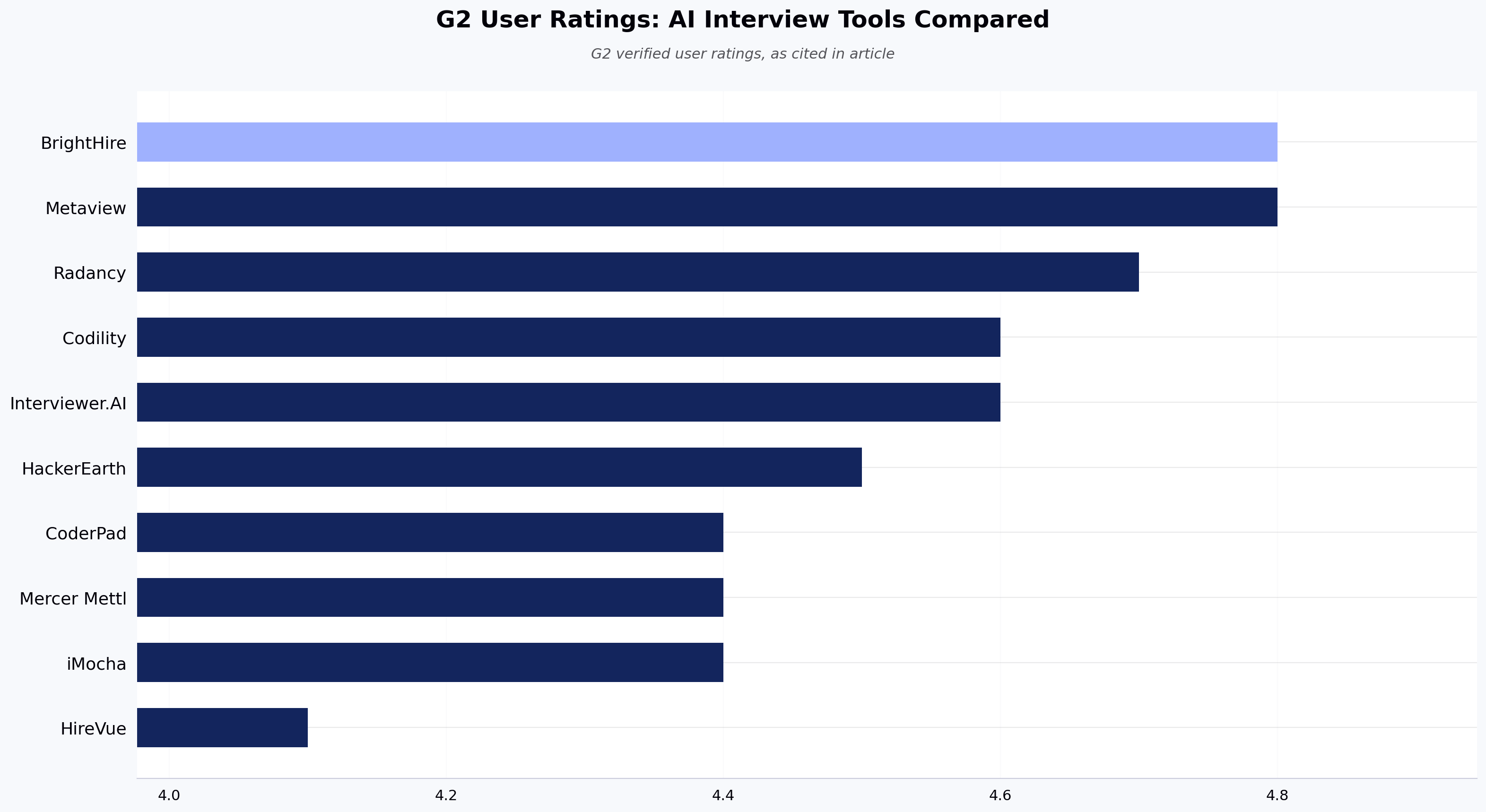
Source: G2 verified user ratings as of November 2025. Ratings change continuously; re-verify before purchase.
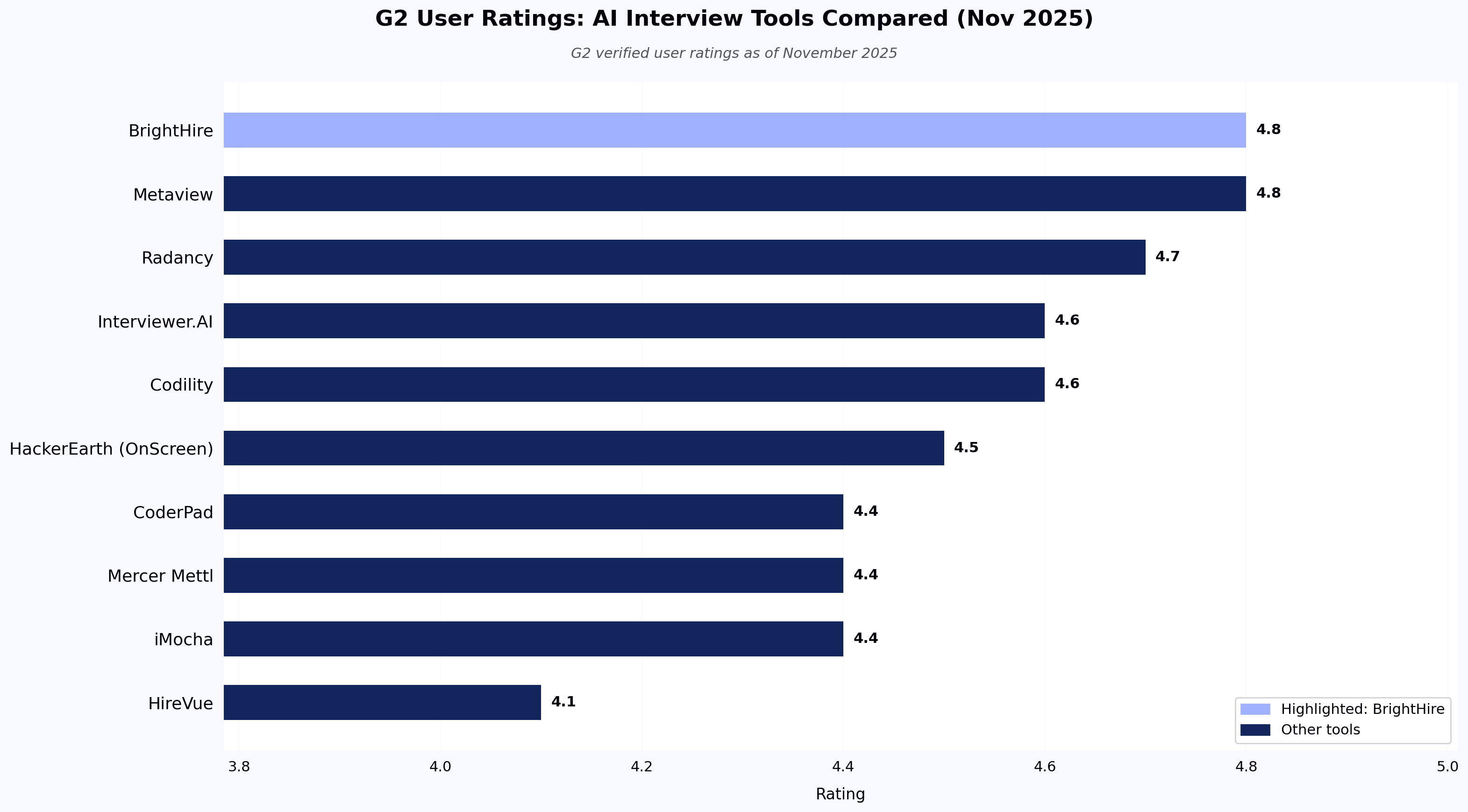
How we evaluated these AI interview tools
Every tool was evaluated against seven criteria that reflect what technical recruiters, engineering managers, and campus hiring leads actually need in 2026. We weighted these criteria so that no single platform — including HackerEarth — wins every dimension. BrightHire and Metaview lead on interview intelligence. Codility leads on accessibility compliance. Radancy leads on soft-skills evaluation. HackerEarth's OnScreen leads on the specific combination of in-depth technical interview plus KYC-grade identity verification plus proctoring in one workflow.
Conflict-of-interest disclosure: HackerEarth publishes this article and is included among the tools reviewed. To manage the conflict, we applied the same criteria to HackerEarth as to every other vendor, sourced HackerEarth claims from publicly documented product capabilities, and hedged any claim not yet third-party verified. Readers should weight our HackerEarth section accordingly.
The seven criteria:
- Interview depth and adaptivity. Does the platform actually conduct an interview — reading responses, asking follow-ups, probing on weak answers — or is it a scripted questionnaire with a transcript? For every "AI-powered" claim, we asked what the model does, what it is trained on, and where its limits sit.
- Technical assessment coverage. Question library size, skill coverage breadth, support for real-world project simulations, and code evaluation beyond pass/fail.
- Enterprise readiness. Scalability to high concurrent volumes, ATS integration depth, security certifications (ISO 27001, SOC 2), SSO, role-based access.
- Candidate experience. Interface clarity, developer-friendly coding environments, mobile access, completion rates, and impact on employer brand.
- Interview integrity. Proctoring sophistication, tab-switch detection, webcam monitoring, plagiarism detection, and — critically in 2026 — impersonation prevention through identity verification.
- Pricing transparency. Publicly available pricing, billing flexibility, per-user versus credit models. Where vendors do not publish pricing, we say so; the comparison is incomplete on that dimension.
- Verified user reviews. Ratings and review themes from G2, Capterra, and TrustRadius, captured as of November 2025, with a preference for AI interview tools above 4.0 stars and 50+ verified reviews. Crowdsourced scores change continuously; re-verify before purchase.
Industry context: According to Gartner's 2024 HR technology survey (Gartner press release, August 2024), most HR leaders plan to increase HR technology investment in 2025. LinkedIn's 2025 Future of Recruiting report reports that many recruiting professionals expect AI to change how companies find and evaluate talent (see report for the specific figure).
A note on compliance and where these tools don't fit. AI interview tools are not appropriate everywhere. Roles requiring active security clearance, hiring conducted in New York City under Local Law 144, and high-risk hiring covered by the EU AI Act (EUR-Lex: Regulation (EU) 2024/1689) all carry audit, disclosure, or candidate-notice obligations. Under the EU AI Act, AI systems used for recruitment are classified as high-risk under Annex III, triggering transparency, human oversight, conformity assessment, and post-market monitoring obligations. Most high-risk obligations are scheduled to apply from August 2026 per the phased implementation timeline; verify current status against the official EUR-Lex text before relying on this date. Small teams hiring fewer than ~10 people per year will often find the configuration overhead exceeds the time saved — you are the target for structured interview guides, not AI interviewers. Treat the tools below as accelerators for structured hiring at scale, not as a replacement for legal review.
For teams designing a structured process before layering in AI, our guide on how to create a structured interview process is a useful starting point.
📌 Suggested reads: - How to create a structured interview process: a step-by-step guide for hiring managers - AI assistant for interviews: how it works and when to use one - HackerEarth AI screening agent
The 10 best AI interview tools in 2026: in-depth comparison
A closer look at each of the AI interview tools above, what it does well, and where it breaks.
1. HackerEarth (OnScreen): technical interviews with built-in identity verification

HackerEarth's OnScreen AI interview agent conducts role-calibrated technical interviews with a video-avatar interviewer.
OnScreen is HackerEarth's AI interview product. It conducts structured technical interviews around the clock using a video-avatar interviewer that presents questions and captures responses on camera, with candidate identity verification and proctoring built into the same session. The evaluation framework is deterministic: every candidate is scored against the same rubric, so results are comparable across interviews without depending on which recruiter or engineer sat in the room. OnScreen holds role-calibrated conversations that adapt to candidate responses — the model is grounded in HackerEarth's assessment library of 1,000+ skills, and its scope is bounded to the rubric configured for each role rather than open-ended dialogue.
The product sits alongside HackerEarth Assessments, FaceCode (live coding interviews with human interviewers), and Hiring Challenges in a single platform, so the interview stage feeds forward into the next round without candidate data getting stranded between tools.
Pawan Kuldip, Head of Human Resources, Discover Dollar Inc., described the shift this way: "Before OnScreen, we had no reliable way to measure candidate quality, especially with the rise of AI-generated CVs. Roles that previously took much longer are now being closed within three to four weeks." In one enterprise deployment described by HackerEarth, a customer used OnScreen to screen more than 2,000 candidates in a single weekend, applying the same rubric to each conversation — an illustration of the deterministic evaluation model at high concurrent volume.
Where OnScreen fits in the workflow: it is designed for technical recruiters and engineering hiring managers running multiple concurrent roles where proxy candidates and AI-generated CVs have started to reach later rounds. The KYC-grade identity verification confirms the person being evaluated is who they claim to be — the specific defense against proxy candidates that a transcript-and-summary product cannot offer — and the proctoring layer runs alongside the interview without adding friction for legitimate candidates. When you want humans in the room for system design panels or staff-level onsites, FaceCode handles that with a shared IDE and integrated question library.
Best for: technical recruiters and engineering hiring managers at organizations running multiple concurrent technical roles, especially where proxy candidates and AI-generated CVs have started to reach later rounds. Also relevant for BFSI and IT services buyers who need defensibility and identity verification in the same workflow.
Where it doesn't fit: senior leadership hires where culture and judgment dominate, or teams hiring fewer than five candidates per role where the setup overhead outweighs the time saved.
Pricing: available on request. Enterprise contract.
G2 rating (as of Nov 2025): 4.5/5
2. HireVue: enterprise video interviewing at high volume
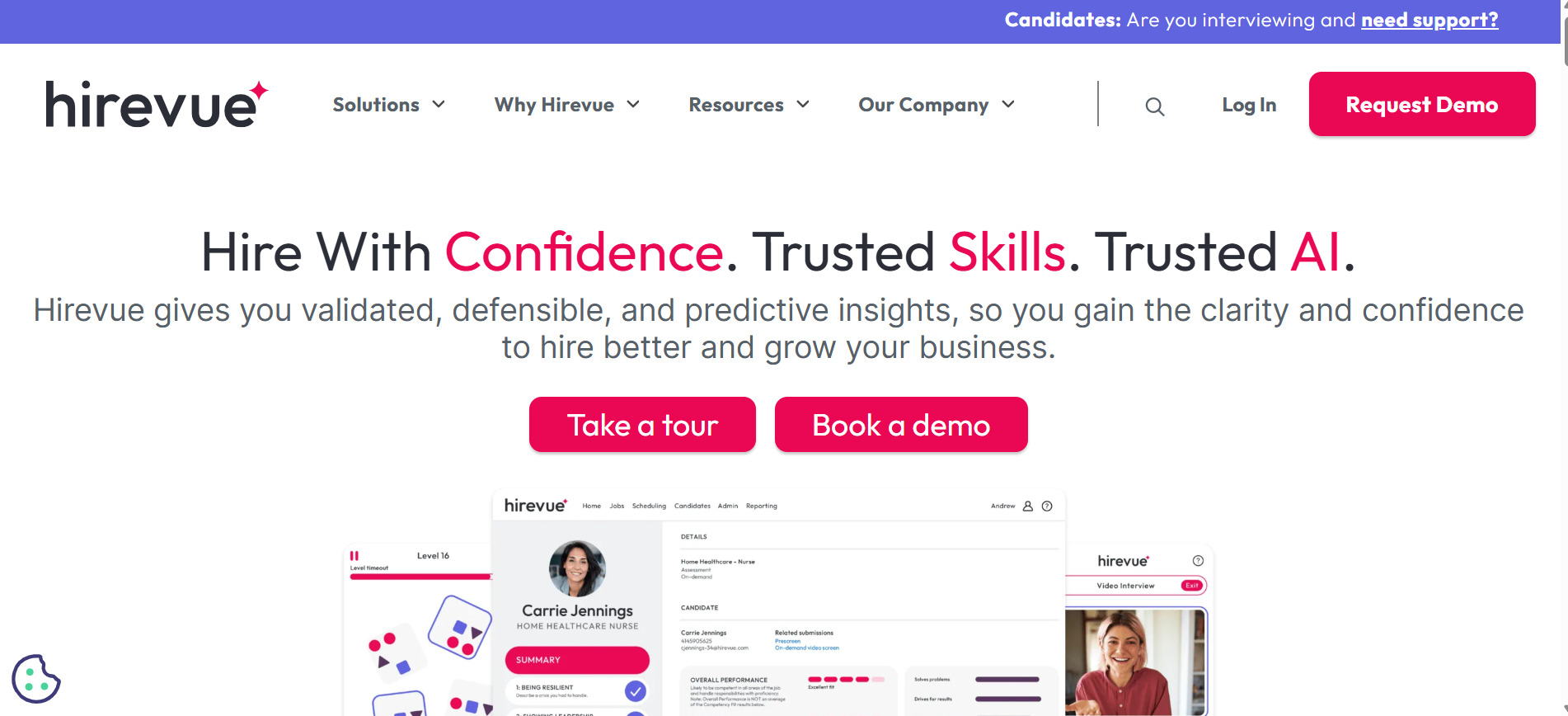
HireVue's enterprise video interview platform. Interview Insights uses AI to generate post-interview summaries and surface evaluation themes from transcripts.
HireVue is the incumbent in high-volume video interviewing. Its Interview Insights feature combines structured interview content with AI that produces summaries and surfaces evaluation themes from transcripts. According to HireVue's product documentation, its interview frameworks draw on industrial-organizational psychology research; verify the specific validation claims against HireVue's current science documentation before referencing them in your own procurement materials.
Key features
- Competency validation against predefined frameworks.
- Interviewer benchmarking to track calibration gaps across teams.
- Native integration with Zoom and Microsoft Teams.
- Enterprise scheduling automation for high-volume programs.
Best for: enterprise talent teams running 100+ open roles across distributed geographies where standardized evaluation and scheduling efficiency are the primary requirements.
Pros: standardized evaluations at scale; AI summaries reduce manual review time; strong scheduling.
Cons: hybrid workflows combining async and live stages can be inflexible (G2 review); users report A/V quality issues on lower-bandwidth setups; archiving candidates per role creates friction in multi-role programs.
Pricing: custom; contact sales.
G2 rating (as of Nov 2025): 4.1/5
3. CoderPad: realistic live coding, not interview automation
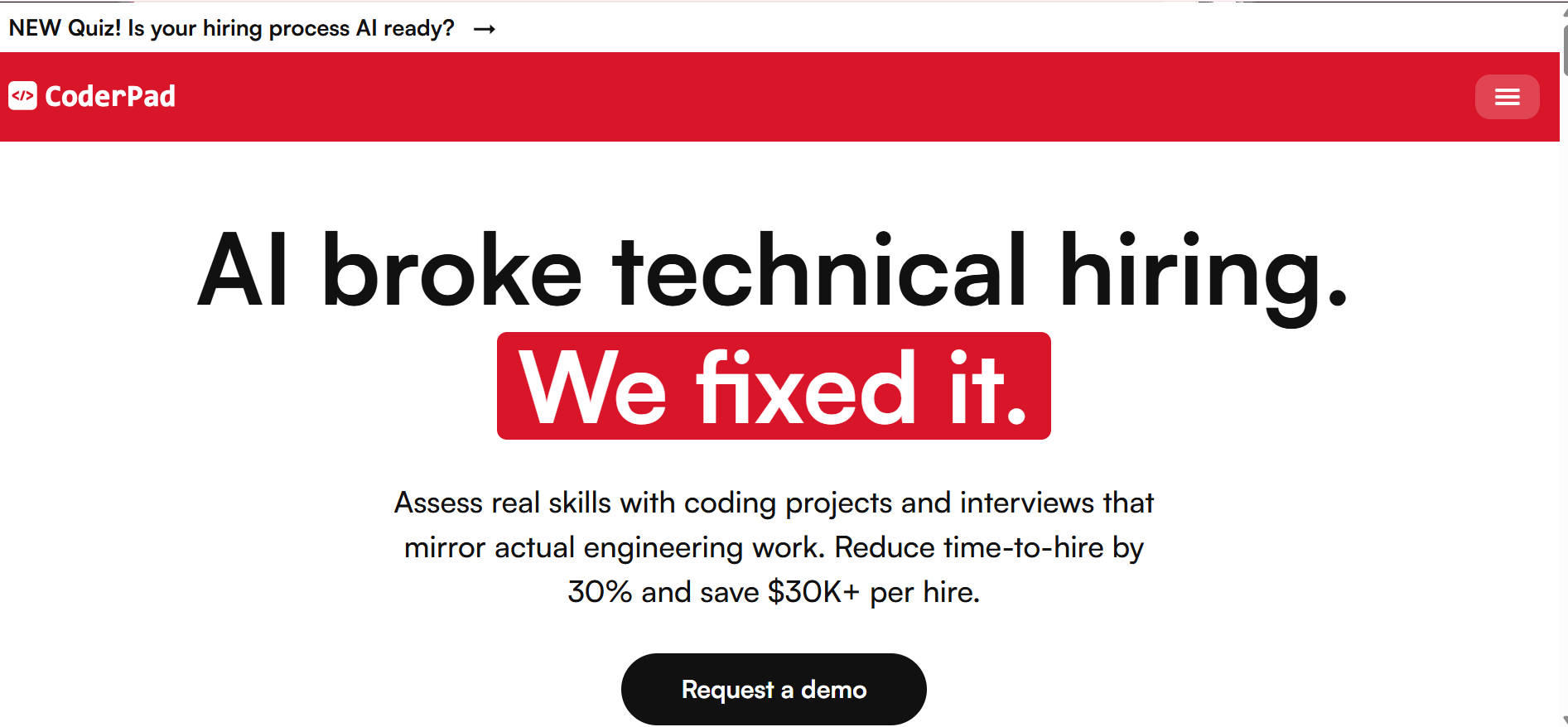
CoderPad's AI-aware assessment platform for realistic technical interviews.
CoderPad is a live coding interview environment, not an AI interviewer. Worth being clear on that: CoderPad gives your engineers a realistic multi-file IDE to run the interview in, complete with dependencies and AI tools candidates can use. It does not replace the interviewer.
Key features
- Multi-file IDE with auto-grading, keystroke playback, and optional video/audio explanations.
- Integrity toolkit: code similarity checks, IDE exit tracking, randomized questions, webcam proctoring.
- 30+ languages supported per CoderPad's product documentation.
- Unified workflow from async projects to live interviews.
Best for: engineering teams where live coding by human interviewers is the primary format and you want a purpose-built IDE instead of a shared screen.
Pros: smooth real-time collaboration; realistic dev environment; keystroke playback reduces manual replay.
Cons: some language-specific features limited (G2 review); basic UI compared with a local IDE; minimal post-interview analytics.
Pricing: custom; scoped by team size and volume.
G2 rating (as of Nov 2025): 4.4/5
4. Codility: assessment fidelity with accessibility built in
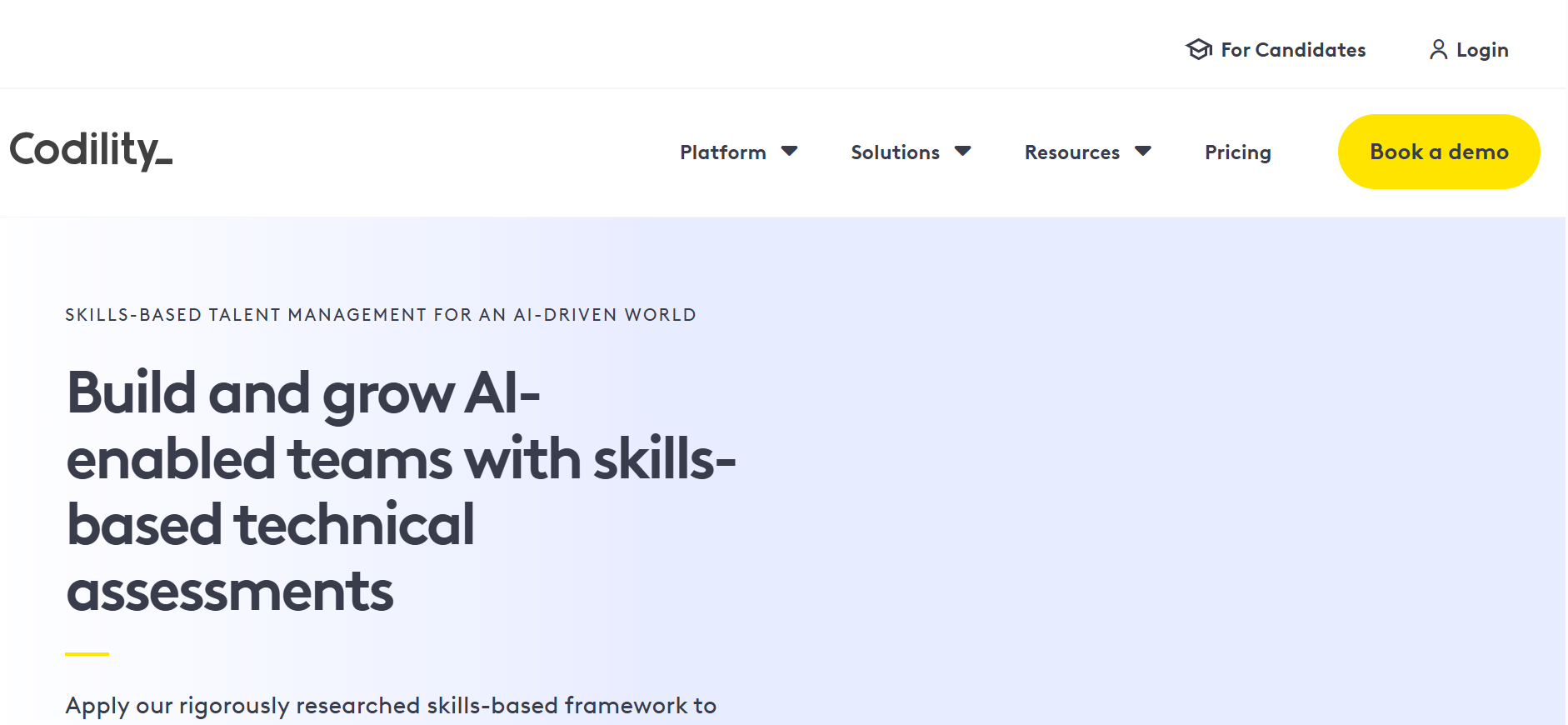
Codility's Screen and AI Interview tools for technical hiring.
Codility's Interview product combines video, IDE, pair programming, and whiteboard in a single environment. Where it differentiates is on assessment science and accessibility — WCAG 2.2 compliance is not table stakes in this category, and Codility leads on it.
Its AI assistant, Cody, observes how candidates apply generative AI to problem-solving rather than trying to score them outright. That is a more honest framing than most vendors are offering right now.
Key features
- Structured and free-flowing interviewer workflows.
- Cody AI assistant for observing candidate-AI collaboration.
- Whiteboard for system design alongside live coding.
- WCAG 2.2 accessibility compliance.
Best for: teams that conduct high-volume or specialized technical interviews where fidelity, candidate experience, and accessibility compliance matter. If your primary bottleneck is live technical interviewing for a small, steady team under 20 concurrent roles, the Starter plan is often more predictable than an enterprise contract.
Pros: high-fidelity live coding environment; developer-friendly UI; strong candidate experience.
Cons: per-user pricing on Starter can be expensive for seasonal or internship-heavy hiring (G2 review); annual plans inflexible for fluctuating volumes (Capterra review).
Pricing (as listed on Codility's published pricing page as of November 2025; not verified by HackerEarth and subject to change): - Starter: $1,200/user/year - Scale: $6,000 per 3 users/year - Custom: contact sales
Re-verify pricing directly with Codility before purchase.
G2 rating (as of Nov 2025): 4.6/5
5. BrightHire: interview intelligence for humans running the interview

BrightHire's interview intelligence platform.
BrightHire is a note-taker and interview intelligence layer for humans running the interview, not an AI that runs the interview itself. Worth being direct about the category: if you want the AI to conduct the interview, this is not that tool. If you want to eliminate manual note review and calibrate human interviewers, BrightHire is one of the stronger options.
Key features
- AI-generated notes, summaries, and transcripts from every interview.
- Shareable clips for hiring debriefs.
- Interview design templates and scorecard configuration.
- ATS integration for pushing structured evaluation data downstream.
Best for: TA leaders and hiring managers who want to standardize how humans conduct interviews without adding proctoring or identity verification overhead.
Pros: replaces manual note review; strong debrief workflow; ATS-native.
Cons: scorecard configuration has a learning curve; does not evaluate candidates itself.
Pricing: custom; contact sales.
G2 rating (as of Nov 2025): 4.8/5
6. Metaview: recruiting analytics layered on interview data
Metaview sits in similar territory to BrightHire. It produces AI summaries, transcripts, and searchable interview data across your pipeline, then answers structured questions across that data ("show me candidates who mentioned Kubernetes and passed technical screens"). Per Metaview's product documentation, the platform integrates with major ATS and video platforms. The analytics layer is what differentiates it from a pure note-taker: recruiting leaders can query patterns across hundreds of interviews rather than reviewing individual transcripts, which is useful for identifying interviewer calibration gaps, common candidate objections, or skill signals that correlate with downstream success. Metaview does not conduct interviews or verify candidate identity; it observes and analyzes interviews conducted by humans.
Best for: recruiting teams that want pattern insights across hundreds of interviews, not just individual note-taking.
Pros: saves recruiter time; strong ATS/video integrations; useful analytics layer for cross-interview queries.
Cons: transcript accuracy varies for non-native speakers; not a replacement for interviewer evaluation.
Pricing: custom.
G2 rating (as of Nov 2025): 4.8/5
7. Interviewer.AI: async video screening with AI scoring
Interviewer.AI runs asynchronous video interviews with AI avatars, automated scoring, and dynamic follow-up questions per candidate response (product documentation). The strongest use case is initial screening for roles where async video is accept