15 types of employee engagement surveys you need to know about
An employee engagement survey is a structured questionnaire that measures how committed, motivated, and satisfied employees feel about their work, manager, and organization. For HR leaders and people teams, these surveys are one of the few direct instruments available to detect retention risk, diagnose culture issues, and gather evidence before making workforce decisions.
Research from Gallup suggests that highly engaged business units tend to see higher productivity and lower turnover than disengaged ones, though the size of the effect varies by industry and methodology. This article walks through 15 survey types worth knowing, where each one fits in the employee lifecycle, and the trade-offs that often go undiscussed.
Why employee engagement surveys matter
Engagement surveys help HR teams move from anecdote to evidence. Used well, they can:
- Surface motivation and morale signals before they show up in attrition data.
- Identify which teams, managers, or locations carry the highest retention risk.
- Reveal gaps between stated values and day-to-day employee experience.
- Inform career progression and internal mobility decisions with structured data.
For a broader definition of the underlying concept, see What is employee engagement?
A point of view: not all surveys deserve equal weight
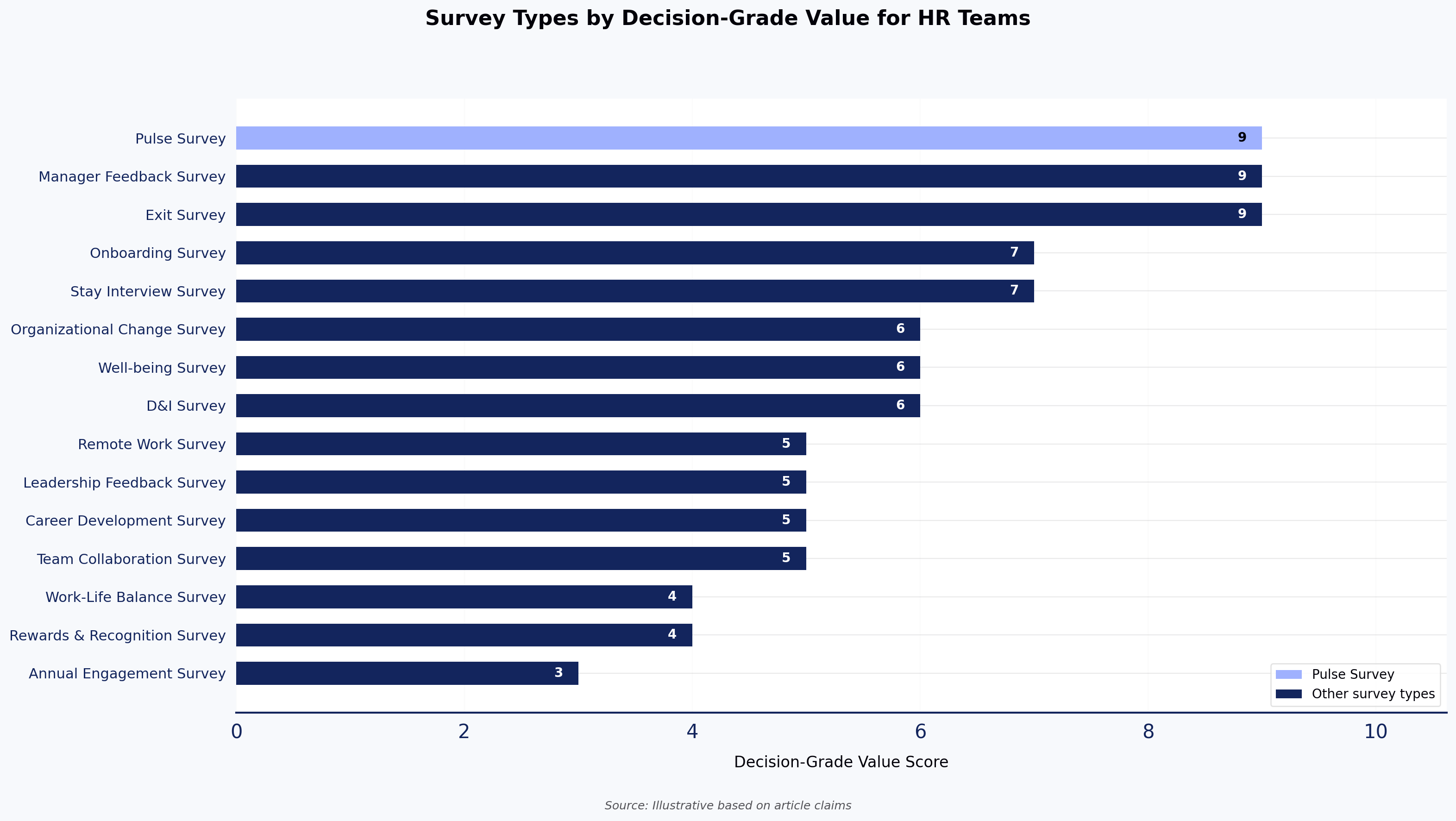
Most articles on this topic treat all 15 survey types as equally valuable. They aren't. In our view, three categories produce the most decision-grade data for HR teams: pulse surveys (because they capture change over time), manager feedback surveys (because manager quality is the single strongest predictor of team engagement, per Gallup's State of the Global Workplace), and exit surveys (because departing employees tend to be more candid than current ones).
Annual engagement surveys, by contrast, are often over-weighted relative to what they reveal. By the time results land, the conditions that produced them have usually shifted.
15 types of employee engagement surveys
1. Onboarding survey
An onboarding survey measures whether new hires feel supported, informed, and set up to succeed in their first 30 to 90 days. Typical questions cover clarity of job expectations, quality of orientation, and access to tools and people.
- Ideal frequency: Day 7, day 30, day 90.
- Owner: People operations or hiring manager.
- Sample question: "On a scale of 1–5, how clear are your responsibilities for the next 30 days?"
2. Pulse survey
A pulse survey is a short, recurring poll (usually 3–10 questions) that captures employee sentiment in near real time. It is the best instrument for detecting change between annual cycles.
- Ideal frequency: Weekly to monthly.
- Owner: HR business partners.
- Trade-off: Run too often and response rates collapse from fatigue.
3. Annual engagement survey
An annual engagement survey is a comprehensive instrument covering leadership, communication, work-life balance, growth, and overall satisfaction. It gives a wide-angle view but a stale one.
- Ideal frequency: Once a year.
- Owner: CHRO or head of people.
- Sample question: "Would you recommend this organization as a place to work?"
4. Manager feedback survey
A manager feedback survey assesses the quality of the employee–manager relationship, which research consistently identifies as one of the strongest predictors of engagement and retention.
- Ideal frequency: Twice a year.
- Owner: L&D or people operations.
5. Remote work engagement survey
A remote work engagement survey measures how connected, equipped, and productive distributed employees feel. Questions cover access to tools, virtual collaboration quality, and isolation risk.
- Ideal frequency: Quarterly.
- Owner: HR business partners.
For more on distributed teams, see Building a remote work culture.
6. Diversity and inclusion survey
A D&I survey measures whether employees experience the workplace as fair, equitable, and inclusive across identity groups. Results often need to be segmented carefully to protect anonymity.
- Ideal frequency: Annually.
- Owner: DEI lead or CHRO.
7. Well-being survey
A well-being survey measures physical, mental, and emotional health signals, including stress, workload, and the perceived usefulness of wellness benefits.
- Ideal frequency: Twice a year.
- Owner: HR or benefits team.
8. Career development survey
A career development survey assesses whether employees see a path forward and feel the organization is investing in their growth. Common areas include training access, internal mobility, and growth conversations.
- Ideal frequency: Annually.
- Owner: L&D head.
9. Work-life balance survey
A work-life balance survey identifies where workload, scheduling, or flexibility policies are creating friction. It is most useful when paired with operational data such as hours worked or PTO usage, rather than read in isolation.
- Ideal frequency: Twice a year.
- Owner: HR business partners.
10. Exit survey
An exit survey is a retrospective diagnostic tool that collects feedback from employees who have already decided to leave. Its purpose is to identify patterns in departures, not to retain the individual respondent.
- Ideal frequency: At every voluntary exit.
- Owner: People operations.
11. Stay interview survey
A stay interview survey asks current employees what is keeping them in their role and what could prompt them to leave. Unlike exit surveys, stay interviews are a retention instrument.
- Ideal frequency: Annually, with high performers.
- Owner: Direct manager, supported by HR.
12. Leadership feedback survey
A leadership feedback survey measures how senior leaders are perceived in terms of vision, communication, and trustworthiness. Anonymity matters more here than almost anywhere else.
- Ideal frequency: Annually.
- Owner: CHRO.
13. Team collaboration survey
A team collaboration survey assesses how effectively teams coordinate, share information, and resolve conflict. It often surfaces process gaps that engagement scores alone miss.
- Ideal frequency: Twice a year.
- Owner: Team lead or HRBP.
14. Rewards and recognition survey
A rewards and recognition survey measures whether employees feel their contributions are noticed and fairly rewarded, covering both monetary and non-monetary recognition.
- Ideal frequency: Annually.
- Owner: Total rewards or HR.
15. Organizational change survey
An organizational change survey captures employee sentiment during restructures, mergers, leadership transitions, or major policy shifts. Running one before and after a change reveals the actual impact on engagement.
- Ideal frequency: Pre- and post-change.
- Owner: Change management lead or CHRO.
The limitations of engagement surveys
Engagement surveys are useful, but they are not neutral instruments. A few trade-offs worth naming:
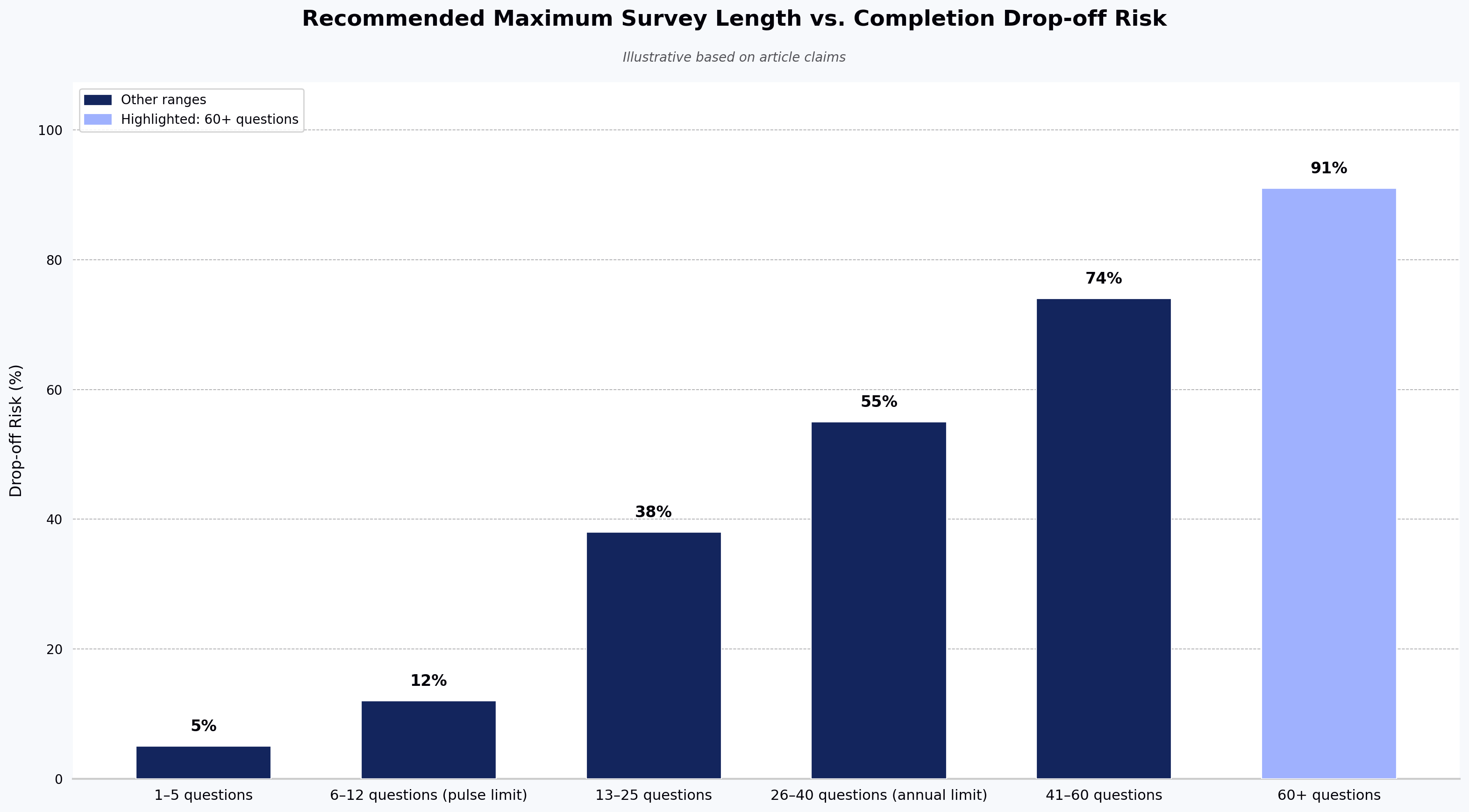
- Survey fatigue. Response rates tend to fall sharply when employees are asked too often or see no action taken on prior results. According to SHRM, shorter and less frequent surveys often produce higher-quality data than long, frequent ones.
- Anonymity limits. Small teams, demographic segmentation, and free-text responses can make "anonymous" surveys identifiable in practice. Employees often sense this and self-censor.
- Recency bias. Responses tend to reflect the last two weeks, not the last year — a recent project deadline or team conflict can dominate scores.
- Causation is hard. A higher engagement score after an intervention does not prove the intervention caused the change. Confounding variables (compensation cycles, leadership changes, market conditions) often explain more than HR initiatives do.
- Context where surveys fail. In environments with active layoffs, weak psychological safety, or no follow-through on prior surveys, results may reflect what employees think is safe to say, not what they believe.
How to design engagement surveys that produce useful data
The standard advice — keep it simple, ensure anonymity, act on feedback — is true but generic. A few more operationally specific recommendations:
- Cap the survey at 12 questions for pulses, 40 for annuals. Longer surveys produce diminishing returns and rising drop-off.
- Pre-commit to publishing results. Decide before launching what you will share, with whom, and on what timeline. If you cannot pre-commit to sharing, the survey will erode trust the second time you run it.
- Use the same 3–5 anchor questions every cycle. Without a stable backbone, you cannot track change over time, only sentiment in the moment.
- Segment cautiously. Reporting cuts smaller than ~7 respondents per segment usually compromise anonymity and should be aggregated up.
- Build a closing-the-loop ritual. For every survey, publish a one-page summary of what changed and what didn't, within 30 days. This single practice does more for response rates than any incentive.
Connecting engagement data to hiring decisions
Some organizations are starting to use engagement data to inform hiring — for example, by analyzing the traits and behaviors of highly engaged top performers and looking for similar signals in candidates. This is sometimes referred to as predictive hiring.
The connection is real but should not be overstated. Engagement data reflects post-hire experience; hiring decisions are made pre-hire. The most defensible use is identifying which roles, teams, and managers retain people well, then routing candidates accordingly. Structured skill assessments and interview data remain the more direct inputs to hiring decisions. HackerEarth's skill assessments and skills intelligence capabilities are designed for that pre-hire layer, and pair naturally with engagement data on the post-hire side.
Case studies: engagement surveys in practice
The cases below are illustrative of how large organizations have publicly discussed using engagement and inclusion surveys. Specific outcome numbers vary across sources and reporting years.
Case study 1: Microsoft and remote work pulse surveys
During the pandemic, Microsoft publicly discussed using internal pulse surveys and analysis of work patterns to understand the experience of remote employees. The company's Work Trend Index reports describe how employee feedback informed investments in collaboration tools and well-being resources. Direct causal claims linking specific product changes to specific engagement score improvements are difficult to verify externally and should be treated as correlated rather than proven.
Case study 2: Unilever and gender representation
Unilever has publicly reported reaching gender balance in management, with the company announcing in 2020 that it had achieved 50% women in management globally. This outcome reflects a multi-year effort that included recruitment targets, leadership development, and policy changes, not a single diversity and inclusion survey. Surveys were one input among many.
The future of engagement surveys
Forward-looking observations, hedged appropriately:
- AI-assisted analysis. Vendors are increasingly applying natural language processing to free-text survey responses to surface themes faster than manual coding allows. The quality depends heavily on the training data and the language model used, and outputs should be reviewed by humans before acting on them.
- Personalization by role and lifecycle stage. Organizations are likely to move toward survey content tailored to role, tenure, and location, rather than one-size-fits-all instruments.
- Gamified and conversational formats. Some vendors are experimenting with chat-based or short-form formats designed to improve completion rates, though evidence on data quality is still emerging.
- Tighter links to workforce planning. Engagement data may be combined more often with skills and performance data to inform retention forecasts and internal mobility, rather than sitting in a standalone HR dashboard.
FAQs
How often should you run employee engagement surveys? A common pattern is one annual deep-dive survey paired with monthly or quarterly pulse surveys. Running pulses more often than monthly tends to reduce response quality without adding signal.
What questions should you ask in a pulse survey? Keep pulses to 3–10 questions, anchored by 3–5 questions you repeat every cycle. Useful anchors include a likelihood-to-recommend question, a manager support question, and a workload or well-being question.
Are anonymous employee surveys really anonymous? In theory yes, but in practice anonymity weakens with small team sizes, demographic filters, and free-text responses. Aggregate small segments and tell employees clearly what is and is not protected.
What's the difference between an exit survey and a stay interview? Exit surveys collect feedback from employees who are leaving and are used to identify patterns in attrition. Stay interviews are conducted with current employees to understand what keeps them in their role.
How do engagement surveys connect to hiring? The most defensible connection is using engagement data to identify high-retention teams and managers, then directing hiring effort and onboarding investment there. Treat engagement signals as informative of post-hire experience, not as direct predictors of candidate fit.
What's the biggest mistake organizations make with engagement surveys? Running them without committing to share results and act. The second cycle of an unactioned survey usually sees a sharp drop in response rates and a hit to trust.
Takeaway
If you only do three things with engagement surveys, make them these: run pulses to detect change, run manager feedback surveys to find your strongest and weakest people leaders, and run exit surveys to learn what your current employees won't tell you. Pair that data with structured pre-hire signals from HackerEarth's skill assessments to connect who you hire with how engaged they later become.