Meta title: Workforce Skills Audit for AI Transformation: A Practical Guide Meta description: Learn how to conduct a workforce skills audit before an AI transformation program — with steps, metrics, and pitfalls to avoid. Read the guide.
How to Conduct a Workforce Skills Audit Before an AI Transformation Program
11 min read
The gap between AI license spend and AI-driven productivity is now wide enough that boards are asking CHROs to explain it — and the honest answer usually starts with the fact that no one measured workforce readiness before signing the contract. A workforce skills audit before an AI transformation program is the diagnostic step that separates companies making informed capability investments from companies buying enterprise licenses that gather dust. The audit's most underrated output is not the skills map itself but the employee trust and change-management foundation it builds — a differentiator this guide surfaces up front rather than as an afterthought.
Done well, a workforce skills audit before an AI transformation program produces a clear map of who can already work with AI tools, who needs targeted upskilling, and which roles will change shape entirely. This guide walks through the steps, the metrics that matter, and the trade-offs most rollouts ignore. It is written for CHROs, Heads of People Analytics, and Heads of L&D who have been asked, usually by the board, how AI-ready their workforce is and don't yet have a clear answer.
The competitive angle most audits miss: employee trust and change management
Before the first assessment goes out, consider the employee experience. Skills audits can trigger surveillance anxiety, especially when framed poorly or when results are perceived as inputs to workforce reduction. Most published guides treat this as a footnote; in practice, it is the variable that most consistently predicts whether an audit produces usable data or shelf-ware. A few considerations worth building into the program design:
- Communicate purpose up front. Employees are more likely to engage honestly with assessments when the audit is framed as an input to development and mobility, not evaluation for cuts.
- Data protection and legal scope. In GDPR jurisdictions and where works councils or unions are active, assessment data is subject to consultation requirements and clear retention rules. Loop in legal and employee relations before, not after.
- Anonymised aggregate reporting. Individual-level results should stay with the employee and their manager; leadership and board reporting should be at the cohort level.
- Right to challenge results. Any validated assessment can misfire. Employees should have a clear route to contest or retake, particularly where results feed into role changes.
Published enterprise AI adoption post-mortems consistently note that audits without a communications plan produce lower participation and lower trust in the resulting training programs.
Why a workforce skills audit matters before AI transformation
An AI transformation program without a skills audit is a procurement exercise. You buy Copilot seats, roll out a GenAI policy, and hope adoption follows. It rarely does. A 2024 BCG study of workers across multiple countries reportedly found that regular use of GenAI among frontline employees has grown sharply year over year, while only a minority had received formal training on the tools. BCG has also reported that untrained users are less likely to trust or effectively use AI. Readers should consult the report directly for the exact percentages, as figures have been revised across BCG's series.
The audit isn't about counting who has "AI skills." It's about answering three questions with evidence:
- Where in the workflow does AI actually change the work?
- Which people can already do that work, and which cannot?
- What is the shortest path from the current state to an AI-fluent workforce?
Skip this and you get a pattern documented in MIT Sloan's coverage of enterprise AI adoption: enterprises investing in AI without precise insight into current workforce skills end up with adoption concentrated among the already-fluent and abandoned by everyone else. Closing skills gaps requires precise measurement first, not blanket training programs.
What a workforce skills audit for AI transformation actually measures
A traditional skills audit inventories capabilities against role descriptions. A workforce skills audit for AI transformation adds three layers that a traditional audit misses.
Task-level exposure to AI. The question is not "does this person know Python." It is how much of this person's weekly work is automatable, augmentable, or unchanged by current generative AI tools. The OECD Employment Outlook 2023 discusses AI's impact at the level of tasks within occupations rather than occupations as a whole. A task-level view is the one that most directly drives training decisions.
AI-collaboration skill, not AI-tool literacy. Knowing how to open ChatGPT is not a skill. Being able to write a prompt that produces production-ready output, evaluate the output for hallucination or bias, and integrate it into a defensible workflow — that is a skill, and it varies wildly across the workforce.
Judgment and domain depth. The counterintuitive finding across most enterprise AI rollouts: the people who benefit most from AI tools are often the domain experts who can spot when the output is wrong. The audit needs to capture domain depth, not just tool familiarity.
The five steps to conduct a workforce skills audit before an AI transformation program
The steps below assume you have a workforce of at least 1,000 employees. At smaller scale, most of the same principles apply but you can compress the process into weeks rather than months.
Step 1: Translate the AI transformation strategy into audit objectives
Before measuring anything, name the business outcomes the AI program is meant to deliver. "Improve productivity" is not an objective. "Reduce time-to-resolution in customer support by 30% using AI-assisted response drafting" is. Every skill you audit should map back to at least one named outcome.
This step also functions as an intake exercise for the audit itself. Before you commission any assessment, work through a short intake questionnaire with the executive sponsor. A condensed example:
- Role and function in scope. Which functions are we auditing, and why these first?
- Industry and regulatory context. Are there compliance constraints (financial services, healthcare, EU AI Act exposure) that shape what "AI-ready" means here?
- Success definition. What does high performance look like in each in-scope role 12 months after the AI rollout — in observable terms?
- Existing data. What performance, LMS, or assessment data already exists that we should reuse rather than re-collect?
- Constraints. Works council, union, or GDPR consultation requirements? Budget envelope? Timeline pressure from the board?
This step usually reveals that the AI program itself is under-specified. That is useful information — better to surface it now than after 18 months of training spend.
Step 2: Build the task-and-skill inventory
For the roles in scope, decompose the work into tasks and map each task to the underlying skills. Two shortcuts save weeks of effort:
- Use an existing skills taxonomy as a starting point (SFIA for technical roles, WEF Future of Jobs taxonomies for cross-functional). Do not build one from scratch unless you have a reason.
- Anchor the inventory in what people actually do, not in job descriptions. Job descriptions in most enterprises are 3–5 years out of date.
For each task, tag it with the AI-exposure layer: automatable today, augmentable today, augmentable within 12–24 months, or unchanged. This tag is what turns a skills inventory into an AI-readiness inventory.
Step 3: Measure current skills against the inventory
This is where most audits break down. Manager-reported and self-reported skills data is unreliable. Research from the World Economic Forum's Future of Jobs Report 2025 and academic work on skill self-assessment consistently show meaningful divergence between perceived proficiency and validated results. Treat the direction of that finding as a planning assumption rather than a single fixed benchmark.
Three measurement approaches work in combination:
- Validated assessments for skills where objective evaluation is possible — coding, data analysis, prompt engineering, structured problem-solving. Platforms like HackerEarth Assessments produce rubric-scored signal at scale for these skills, and their real-time skill intelligence output is what turns raw scores into a coverage map decision-makers can act on. For enterprises building internal AI-fluency programs, HackerEarth's VibeCode Arena adds a targeted evaluation of AI-collaboration behaviour — how a candidate or employee frames a prompt, iterates with an AI assistant, and validates the output — as a complement, not a replacement, to a broader assessment layer.
- Work-sample review for skills that don't compress into a test — writing, design judgment, client conversation. Look at recent artifacts, not hypothetical performance.
- Manager and self-assessment as triangulation, not ground truth. Where these three diverge sharply, that is a data point worth investigating.
Cover the workforce in tiers. Full assessment for the 15–25% of roles most exposed to AI change; sampled assessment for the middle tier; lightweight self-report with spot-check for the least exposed.
Sample rubric: a lightweight AI-collaboration self-assessment
Use this as a starting point for the self-report layer or as a manager conversation guide. It is not a replacement for validated assessment, but it surfaces the right conversation before you invest in one.
| Dimension | Level 1 — Aware | Level 2 — Applied | Level 3 — Fluent | Level 4 — Coaching others |
|---|---|---|---|---|
| Prompt design | Can use pre-written prompts | Adapts prompts for own tasks | Designs multi-step prompts with context | Trains team on prompt patterns |
| Output evaluation | Accepts output as-is | Spots obvious errors | Detects hallucination and bias reliably | Sets team review standards |
| Workflow integration | One-off use | Uses AI in a recurring task | Redesigns a workflow around AI | Redesigns team workflows |
| Domain judgment | Defers to AI output | Cross-checks against domain knowledge | Consistently improves AI output with domain expertise | Mentors others on when to override |
A completed row per employee, aggregated by team, produces a first-pass heat map before any formal assessment runs.
Step 4: Map gaps to actions with the Build / Buy / Borrow / Bridge framework
For each skill gap, decide which of four actions applies:
- Build: targeted upskilling with a defined outcome and measurement. Not "complete a course" — demonstrate the skill.
- Buy: hire for the gap. Often the right answer for scarce senior AI-native roles.
- Borrow: contract or partner for time-limited need. Useful for capabilities you don't want to maintain internally.
- Bridge: internal mobility. Move people from adjacent roles where their existing skills plus targeted training makes them AI-fluent faster than hiring externally.
Most enterprises over-index on Build and under-invest in Bridge. Bridge is where internal talent marketplaces produce the clearest ROI, and where a skills-based mobility approach shows results earliest.
Example: workforce skills audit at a mid-market insurer
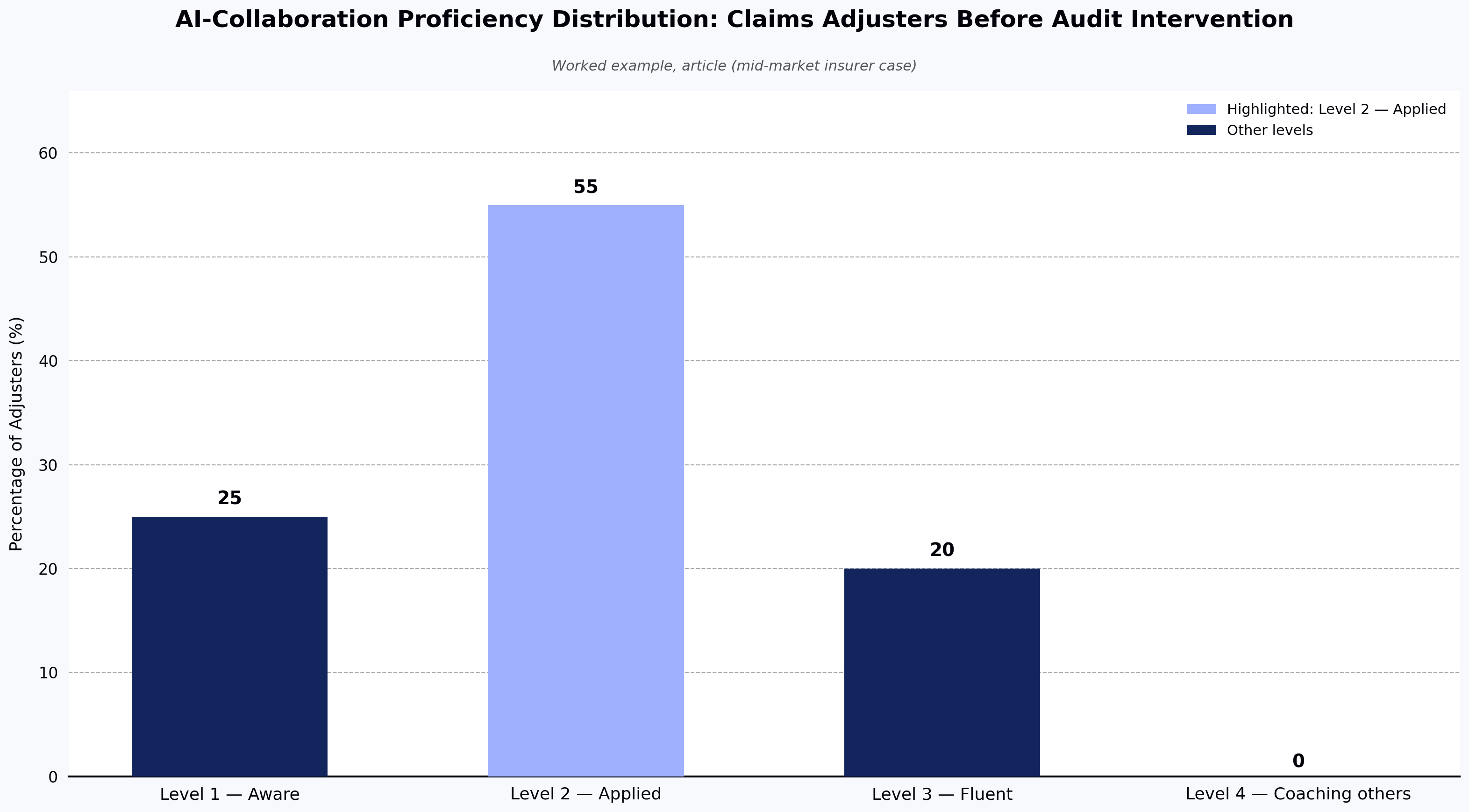
A mid-market insurer with 4,000 employees audits its claims operations function. Task-level tagging identifies that 35% of adjuster tasks are augmentable with current GenAI tools. Validated assessment shows 20% of adjusters already operate at Level 3 on the rubric above, 55% at Level 2, and 25% at Level 1. The gap plan looks like this:
- Build: structured upskilling for the 55% at Level 2, targeting Level 3 within 6 months on prompt design and output evaluation.
- Buy: two senior AI-literate claims leads to seed the team.
- Borrow: a 6-month vendor engagement to stand up prompt libraries and evaluation standards.
- Bridge: move 15 high-performing customer service reps into adjuster tracks, where their existing domain exposure plus AI-collaboration training closes the gap faster than external hiring.
That single page — with skill levels, headcount, and named actions — is the audit output the board actually needs.
Step 5: Baseline metrics and set the re-audit cadence
The audit is not a one-time event. In HackerEarth's enterprise program experience, AI model capabilities in enterprise-relevant workflows appear to shift on a roughly 6–12 month cycle, based on observed vendor release patterns and customer adoption reporting. A skills baseline established today is partially stale within a year. Establish:
- The metrics you will re-measure (skill coverage rate, AI-collaboration proficiency distribution, gap-to-target ratio by function)
- The cadence — annually at minimum, semi-annually for roles at the frontier of AI exposure
- The threshold that triggers action between audits (e.g., a new model capability that changes the exposure tag on a major task cluster)
Manager and employee interview guide
Assessment data alone does not tell you why a gap exists. A short structured interview — 20–30 minutes per participant on a sampled basis — turns rubric scores into a diagnosis. Use variants of the following prompts:
For managers:
- Walk me through a recent task on your team where an AI tool was used well. What made it work?
- Walk me through one where the output was wrong or unusable. How did you catch it?
- Which two or three people on your team would you trust to redesign a workflow around AI, and why?
- Where would you invest one week of training time for the whole team if that was all you got?
For employees:
- Which parts of your weekly work do you already do faster or better with AI assistance?
- Where have you tried AI and gone back to doing it the old way? Why?
- What would need to change — tools, permissions, training, examples — for you to use AI on more of your work?
- What is the one thing you would not want AI to do in your role, and why?
The pattern that emerges from these interviews, when triangulated with assessment data and manager rating, is usually a more accurate picture than any single measurement stream.
Using AI to conduct the skills audit itself
Published research from MIT Sloan and other enterprise AI adoption post-mortems covers how AI tools themselves can accelerate the audit. It is worth spelling out where AI helps and where it does not.
Where AI helps:
- Role and task parsing. Feed job descriptions and JIRA/ticket histories into an LLM to extract task inventories at scale. This turns weeks of interview work into days of review work.
- Skill clustering. Use embeddings to group related skills across taxonomies and reconcile inconsistent naming across functions.
- Outlier detection. AI is good at flagging assessment results that diverge sharply from manager rating, tenure, or peer distribution — useful for prioritising manual review.
- Draft development plans. Generate first-pass upskilling plans per employee that a manager then edits, rather than writing from scratch.
Where AI does not help (yet):
- Primary evaluation of individual skill. LLM-based skill inference from resumes or activity logs produces high false-positive rates. Use it to prioritise, not to score.
- Judgment-heavy skills. AI cannot yet reliably distinguish good domain judgment from confident-sounding output. Human review remains the anchor.
- Bias-sensitive decisions. Anything that feeds into promotion, pay, or reduction decisions needs human-in-the-loop and auditable rubrics.
The practical pattern: use AI to accelerate the audit's process, use validated assessment for the evaluation itself, and use human review at every decision point that affects a person's role.
Common failure modes when conducting a workforce skills audit before AI transformation
Four patterns commonly documented in enterprise AI rollout post-mortems explain most failed audits.
Auditing tools instead of skills. "How many people have used ChatGPT this month" is a usage metric, not a skills metric. Usage without proficiency is noise.
Ignoring the domain-expert paradox. Senior domain experts often score low on AI-tool proficiency and high on AI-augmented output quality. If your audit metric is tool proficiency alone, you will misdirect training budget toward people who don't need it.
Building the taxonomy in a vacuum. HR-built skills taxonomies that never touch the actual workflow produce inventories that managers refuse to use. Every skill definition should be reviewed by someone who does the work.
Treating the audit as a compliance exercise. If the audit output is a slide deck for the board and nothing else, the money was wasted. The output is a training plan, a hiring plan, and a mobility plan with named individuals and measurable outcomes.
What good looks like: planning benchmarks
The figures below are HackerEarth's internal planning estimates from enterprise program experience, not audited public benchmarks. Treat them as directional inputs to your own budget and timeline conversations, and pressure-test them against your own vendor quotes and historical data.
- Coverage. A well-run audit at enterprise scale typically covers 60–80% of in-scope roles with validated assessment within 90–120 days of kickoff.
- Assessment layer cost. A rough working range of $40–120 per employee is a reasonable planning figure, with the higher end applying when custom role-based content is required.
Two outcome metrics matter more than the rest: the percentage of the workforce that moves at least one proficiency level on priority skills within 12 months of the audit, and the percentage of in-scope roles that hit their AI-augmented productivity target. If both are trending up, the audit did its job.
Frequently asked questions
Where do most audits break down in practice — and how do you catch it early? The single most common failure point is not the five-step process itself but the sequencing of stakeholder buy-in. Audits that start with HR building a taxonomy and only involve line managers at the assessment stage tend to produce inventories managers reject. The counterintuitive fix: involve two or three sceptical line managers in Step 2 (task inventory) before HR has committed to a taxonomy. If they cannot recognise the tasks their own team performs in the draft, restart Step 2 before spending on assessment.
What skills are required for AI transformation? At the workforce level, four skill clusters matter: AI-collaboration skills (prompt design, output evaluation, workflow integration), data literacy, domain judgment, and change adaptability. Technical AI skills (ML engineering, model fine-tuning) matter for a small specialist cohort. The distribution across these clusters varies by role — a customer support agent needs different AI skills than a data analyst.
How long does a workforce skills audit for AI transformation take? For a 1,000–10,000-person workforce, plan for 90–120 days from kickoff to actionable output, assuming an existing skills taxonomy is used as the starting point. Building a taxonomy from scratch adds 60–90 days. Larger enterprises typically phase by function rather than attempting a single-wave audit.
Should we use AI to conduct the skills audit itself? Partially. See the "Using AI to conduct the skills audit itself" section above for a detailed breakdown of where LLMs and embeddings accelerate the process and where they should not be the primary signal.
What is the hardest audit trade-off no one talks about? The tension between assessment depth and employee trust. The more rigorous the validated assessment, the more it feels like surveillance to employees — and the more likely participation drops or is gamed. The organisations that resolve this well tend to invest disproportionately in the communications wrapper (purpose, data handling, right to challenge, individual data ownership) before the assessment goes out, not after. If your program plan spends more on the assessment vendor than on the change and communications workstream, that is usually a warning sign.
Can smaller companies conduct a meaningful skills audit before AI transformation? Yes, at compressed scope. Under 500 employees, focus on the 10–20 roles most exposed to AI change, use lightweight validated assessment for those roles, and rely on manager conversation for the rest. The five-step structure still applies; the timeline compresses to 4–6 weeks.
Key takeaways
- Conduct the audit before buying AI tools at scale — procurement without capability data produces low adoption and stranded license spend.
- Measure task-level AI exposure and AI-collaboration skill, not tool usage or self-reported familiarity.
- Combine validated assessment, work-sample review, and self-report as triangulation — never rely on self-report alone.
- Map every gap to Build, Buy, Borrow, or Bridge; most enterprises under-invest in Bridge and over-invest in Build.
- Treat the audit as a recurring baseline on a 6–12 month cadence, not a one-time deliverable.
- Design the audit with employee trust and data protection in mind from day one, not as an afterthought.
Next steps
To see how validated skill assessment fits into an AI-readiness audit at enterprise scale, request a walkthrough of HackerEarth Assessments. To go deeper on the mobility side of the Build/Buy/Borrow/Bridge framework, read how skills-based hiring rollouts succeed and fail, or explore HackerEarth's technical hiring blog for related program design guides.