Building Predictive Coding Assessments: How to Design Tests That Actually Predict Job Performance
Building predictive coding assessments is the process of designing structured, work-sample-based technical tests that measure a candidate's ability to do the actual job, rather than their ability to solve abstract puzzles. For technical recruiters and talent acquisition leads, the operational problem is clear: resume volume is up, AI-generated applications are harder to filter, and senior engineers are being pulled into interview loops that could have been avoided with better upstream screening.
A well-designed coding assessment addresses this directly. But most coding tests in circulation today are poorly calibrated — they lean on algorithmic riddles that rarely reflect production work, or they run so long that strong candidates abandon them mid-way. Building predictive coding assessments requires three specific inputs: a clear competency model for the role, work-sample questions calibrated to that model, and a scoring rubric that reduces evaluator bias. For a broader view of how skills-based hiring fits into modern recruiting, see our guide to technical hiring and our overview of skills-based assessments.
What is a coding assessment?
A coding assessment test is a technical evaluation used to measure a candidate's programming ability. It acts as a digital "audition" for a developer role. Instead of just talking about how they solve problems, candidates have to actually write, debug, or review code in a controlled environment.
Coding assessment vs. coding challenge vs. technical interview
It is easy to mix these up, but they serve different roles:
- Coding assessment: A standardized, often automated test given early in the hiring process to filter candidates.
- Coding challenge: Usually a more competitive task, often used in hackathons or for brand building.
- Technical interview: A live session where an engineer watches a candidate solve a problem in real-time.
The goal of the assessment is to ensure that only the most capable candidates make it to the expensive, time-consuming technical interview phase.
Why building predictive coding assessments matters in modern tech hiring
Skills-based hiring has become a dominant approach in technical recruiting, and research increasingly suggests that degrees and job titles are weaker signals of on-the-job performance than direct evidence of skill. The relevant question for hiring teams is no longer "where did they work?" but "can this person build the feature we need?"
What does the research suggest?
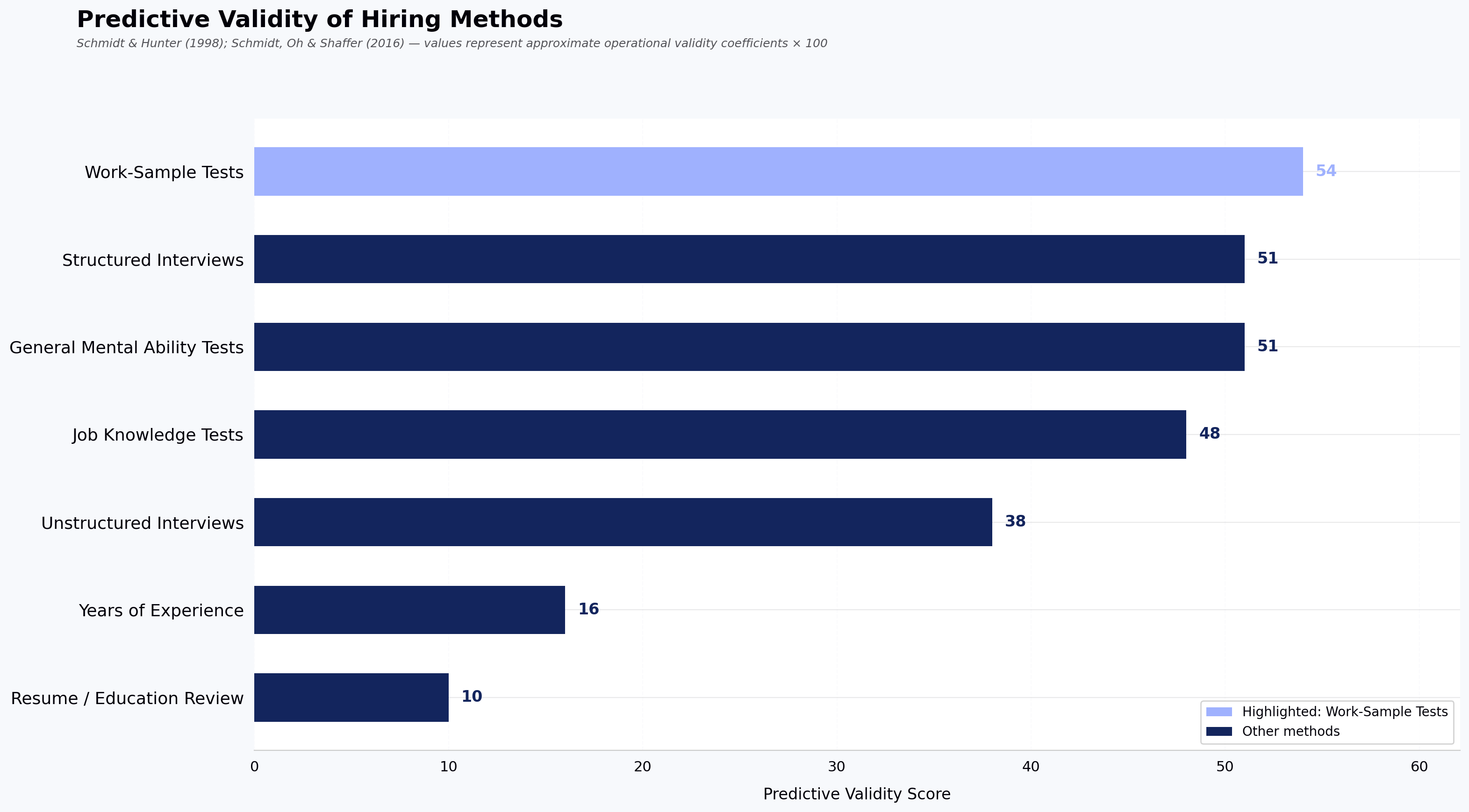
Research on structured hiring methods has long indicated that work-sample tests are among the most predictive selection tools available. A widely cited meta-analysis by Schmidt and Hunter (1998), and its 2016 update by Schmidt, Oh, and Shaffer, found that work-sample tests and structured assessments predict job performance substantially better than unstructured resume review. Organizations that adopt structured skill evaluation in place of resume screening also commonly report shorter time-to-hire, though the magnitude depends heavily on role and process design.
Business impact
A poor hire in engineering carries costs beyond salary — onboarding time, opportunity cost on delayed projects, and the review overhead created by lower-quality code. The U.S. Department of Labor has estimated that the cost of a bad hire can reach roughly 30% of that employee's first-year earnings, and industry surveys often place the figure higher for technical roles. A structured coding test acts as an early filter against these downstream costs.
7 Types of coding assessment tests
Not every developer role is the same, so your developer coding test shouldn't be either.
- Algorithmic problem-solving tests: These test logic and data structures. Best for entry-level roles or computer science-heavy positions.
- Real-world project-based assessments: Candidates build a small feature or a mini-app. Among the most predictive formats for day-to-day performance.
- Debugging & code review challenges: Instead of writing code, the candidate finds errors in existing code. This tests their attention to detail.
- System design assessments: Best for senior roles. It tests how they architect large-scale applications.
- Multiple-choice tests: Good for a quick "sanity check" on language-specific knowledge (like Java or React basics).
- Pair programming simulations (industry practice): The candidate collaborates with a human interviewer or, in some emerging formats, an AI-based assistant. Where AI is involved, buyers should ask vendors specifically what the model does (e.g., prompts the candidate, scores responses, or simulates a teammate), what data it was trained on, and its known limitations — including risk of inconsistent scoring and bias in generated prompts. This format is not a current HackerEarth capability.
- Take-home assignments: A longer project done on the candidate's own time. Useful for deeper evaluation, but with a notable caveat — take-homes can disadvantage candidates with caregiving responsibilities, second jobs, or limited unpaid hours, and completion rates tend to drop as length increases.
Which assessment type for which role?
| Role level | Best assessment type | Why? |
|---|---|---|
| Junior / Intern | Algorithmic & Basics | Tests foundational logic and learning potential. |
| Mid-Level | Real-World Project | Tests if they can handle daily tickets independently. |
| Senior / Lead | System Design & Code Review | Tests high-level thinking and mentorship skills. |
How to build predictive coding assessments step by step
Building predictive coding assessments is a strategic exercise, not a matter of pulling random questions from a library. The steps below outline a repeatable process.
Step 1 — Define the role's core competencies
Don't test a front-end developer on heavy database optimization if they will never touch the backend. List the top three skills they need on day one.
Step 2 — Choose the right question types
Combine one algorithmic question for logic with one work-sample question that mirrors a real task from your codebase.
Step 3 — Set time limits that respect candidates
Industry practice suggests that an initial programming skills assessment of 60 to 90 minutes balances signal quality against candidate drop-off. Longer tests tend to depress completion rates without materially improving predictive value.
Step 4 — Build a structured scoring rubric
Don't just look at "Does the code run?" Look at code quality, efficiency, and how they handled edge cases. A clear rubric reduces evaluator variance — though it does not eliminate the risk of adverse impact. Algorithmic auto-scoring can systematically disadvantage candidates whose problem-solving style differs from the rubric's assumptions, so rubrics should be reviewed periodically against outcome data by demographic group where legally permitted.
Step 5 — Incorporate anti-cheating measures
With generative AI tools now widely available, plagiarism detection alone is insufficient. Platforms typically combine copy-paste restrictions, tab-switch detection, similarity checks against known solutions, and webcam-based proctoring. A caveat: webcam proctoring raises privacy and legal considerations in jurisdictions such as the EU (GDPR) and Illinois (BIPA), and some candidates decline to participate on those grounds. HackerEarth's assessment platform includes a Smart Browser feature designed to restrict candidate activity during a test; buyers should confirm the specific capabilities and jurisdictional fit with the vendor.
Step 6 — Pilot, measure, and iterate
Have your current developers take the test. If your top senior dev can't pass it, the test is probably flawed. Use their feedback to refine the difficulty.
A contestable claim: when algorithmic tests hurt hire quality
One observation that runs against the grain of common practice: for mid-level and senior roles focused on maintenance, integration, and production reliability, heavy reliance on algorithmic timed tests can reduce hire quality. Candidates who excel at competitive-programming-style problems under time pressure are not the same population as candidates who excel at reading unfamiliar code, negotiating trade-offs with product managers, and shipping without breaking production. Teams that select primarily on algorithmic scores for these roles frequently report a mismatch between assessment performance and on-the-job outcomes within the first six months. For most non-entry-level engineering roles, work-sample and code-review formats appear to correlate more closely with performance than algorithmic drills.
How to choose a coding assessment platform
When evaluating a coding assessment platform, look for the following, and probe each with a specific vendor question:
- A large, refreshed question library — ask how often questions are rotated and how leaked-question detection works.
- Support for the languages your team actually uses — including any legacy stacks.
- Direct ATS integration — ask which ATS systems have native connectors, what data syncs both ways, and whether integration requires custom engineering effort.
- Analytics that support calibration — including score distributions, question difficulty data, and adverse-impact reporting.
Buyers should benchmark two or three platforms against a shortlist of their own hiring criteria rather than relying on vendor demos alone.
Key takeaways
- Work-sample and structured assessments predict job performance substantially better than resume review (Schmidt & Hunter, 1998; Schmidt, Oh & Shaffer, 2016).
- Initial screening assessments in the 60–90 minute range generally balance signal against candidate drop-off.
- Algorithmic tests can underperform work-sample tests for mid-level and senior maintenance-focused roles.
- Webcam proctoring raises privacy and legal issues in some jurisdictions (e.g., GDPR, BIPA) and should be adopted with counsel review.
- AI-based assessment features should be evaluated against specific vendor disclosures about model behavior, training data, and known limits.
Next steps: see how structured assessments fit your hiring process
If you want to evaluate how a structured coding assessment would perform against your current screening funnel, request a demo of HackerEarth Assessments or explore the HackerEarth developer assessment platform to review question library coverage, ATS integrations, and reporting for your role types.
FAQs
What is a coding assessment test?
A coding assessment test is a standardized technical evaluation, typically delivered online, in which candidates write, debug, or review code within a fixed time window. Beyond the basic definition, three design choices determine whether an assessment predicts on-the-job performance: whether questions are work-sample or abstract, whether the rubric evaluates code quality alongside correctness, and whether the format matches the seniority of the role.
How long should a coding assessment test take?
For an initial screen, 60 to 90 minutes is a common target. For deeper, project-based assessments later in the process, roughly 3 to 4 hours is often cited as a practical upper bound before drop-off and fatigue meaningfully degrade the signal.
Can a coding assessment test replace a technical interview?
No. An assessment filters for technical ability under controlled conditions, but a technical interview is where you evaluate signals a test can't capture: how a candidate communicates trade-offs, how they respond to changing requirements mid-problem, how they ask clarifying questions, and how they collaborate with an interviewer under ambiguity. These judgment and communication signals are directly relevant to daily engineering work and are difficult to score in an asynchronous test.
How do you prevent cheating on online coding tests?
Modern platforms use several methods: plagiarism detection, disabling copy-paste, webcam proctoring, tab-switch detection, and question randomization. No single method is complete; combining behavioral signals with post-test verification (such as a short live follow-up) is typically more reliable than any one control alone.
What makes a coding assessment test predictive of job performance?
A test is predictive when it mirrors the actual work. Testing for work samples — such as fixing a bug in a representative codebase — tends to correlate with performance more closely than abstract algorithmic puzzles, particularly for mid-level and senior roles.