Home
/
Blog
/
Candidate Experience
/
6 Must-Track Candidate Experience Metrics To Hire Better

6 Must-Track Candidate Experience Metrics To Hire Better

Author
Ruehie Jaiya Karri
Calendar Icon
March 24, 2023
Timer Icon
3 min read
Share

Explore this post with:

Imagine this: You went to a restaurant for lunch.

There is a 30 min wait period and you decide to wait since you heard great things about their food.

After 45 minutes, you get a table but there is no waiter in sight to request a menu card.

A waiter finally comes up to you, looks disinterested in taking your order, and doesn’t even get you a water bottle.

You wait 20 more minutes after placing your order and decide you had enough. You get up and leave—without even tasting the food.

Now, the figurative restaurant is your job application process. If the process is slow, lengthy, and complicated, candidates will not have the patience to see it through.

If you as recruiters do not show an interest in them, keep them in the loop proactively, and nurture them, your candidates will go elsewhere for a job.

Moreover, even if your organization has a reputation as a great place to work, candidates will never find out because getting in itself is so problematic.

Good employer branding and robust corporate culture mean nothing if the candidate experience you provide is not up to the mark. It is a large part of your business and even if you are doing all the right things, there will always be improvements to be made.

By improving candidate experience, you can increase conversion rates and reduce cost per hire. The best way to do so is to collect and use candidate experience metrics and insights.

Use the data you gather to see how candidates interact with job postings, h ow they click through the application form, and what their profile looks like at different stages of the application process.

Shift your focus to improving your candidate experience! Let’s start with the basics and discuss how hiring metrics and insights can help create an awesome candidate experience.

Candidate experience metrics: Which are the most relevant?

Keep Your Eye On These 6 Candidate Experience Metrics:

#1 Time-to-hire

Time-to-hire is the length of time it takes to fill a vacancy. This is one of the most important candidate experience metrics because if you’re unable to fill positions quickly, you may be losing valuable resources in terms of productivity, morale, and revenue.

Time-to-hire is a metric that measures the average length of time it takes to fill an open position. You can measure this in days, weeks, or months, depending on your industry and how quickly you need to fill the vacancy.

For example, if you run a fast food restaurant with long lines of hungry customers waiting for their lunch orders and only one person is working the register while another employee is off sick with the flu, it would be important to find someone new as soon as possible.

If you can improve or make your time-to-hire metric quicker, you’ll be able to hire new employees faster. This will allow you to fill positions more quickly, increasing productivity and revenue.

Also read: Data-Driven Recruiting – All You Need To Know

#2 Interview-to-offer ratio

The next metric to track is the number of interviews it takes before you make an offer to a new employee. This is the number of interviews you conduct divided by the number of offers you make.

For example, if you conduct 10 interviews and hire only one new employee, your ratio is 10/1. This will help you determine whether your interview process is thorough enough or needs more work.

For example, if it takes, on average, three interviews for every hire in your company and there are only two people interviewing candidates at any given time, then you’re not going to be able to fill positions as fast as possible.

You can improve this by adding more interviewers or by training existing employees to conduct interviews. Once this metric is enhanced, your candidate experience will also improve because you can fill positions faster and more efficiently.

The speed at which you can fill a position is an important metric because it has a direct impact on your company’s bottom line. If you have to fill 10 positions and each position takes three months to fill, then that’s 30 months of lost productivity.

#3 Interview experience

This is a measure of how well you’ve trained your interviewers. You want to make sure that your interviewers are aware of their biases and that they work hard to eliminate them from the interview process. If an interviewer is biased against women, for example, this will show up in their interviews with female candidates. This is also an important candidate experience metrics.

Automated tools are a great way to reduce bias in the interview process. By using these tools, you can ensure that your interviews are more consistent and fair. Automated tools also help with candidate screening by allowing recruiters to quickly identify candidates who don’t meet the company’s requirements.

If you don’t have a structured interview process, it can be easy for bias to creep in. The best way to prevent this from happening is by hiring a professional recruiter who knows how to create a structured interview process that will help you identify the most qualified candidates.

Also read: 5 Steps To Create A Remote-First Candidate Experience In Recruitment

#4 Net promoter score (NPS)

NPS is another metric that can help enhance the candidate experience. It’s a simple question that you can ask at the end of an interview: “On a scale of 1-10, how likely is it that you would recommend us to a friend or colleague?”

The answer will give you insights into how your company is viewed by candidates. If your score is low, then there are areas where you must improve. You may need more training for interviewers or offer more information about what life at your company looks like.

On the other hand, a high NPS score doesn’t mean there’s no need for you to improve your candidate experience. It’s a good indicator that there are ways that you can make the process more seamless, and it will help you identify them. A LinkedIn study found that 78% of candidates say that their entire candidate experience is a clear indication of how a business values its employees.

For example, if many candidates say that they didn’t have all of their questions answered during the interview, then consider creating an FAQ page or providing more information about what life at your company looks like.

#5 Offer acceptance rate

A good offer acceptance rate is a strong indicator that candidates are satisfied with your interview process. If you have a low acceptance rate, then it’s likely that there are ways you could improve candidate experience.

For example, if many candidates didn’t feel like they had enough time to prepare for their interviews or weren’t sure what kind of questions they’d be asked, consider creating an FAQ page or providing more information about what life at your company looks like.

This metric is especially important to large companies that receive a lot of applications. It’s easy to ignore the candidates who aren’t right for your company, but if you want to improve the candidate experience, it’s important to find ways of making the process more personal.

For example, consider inviting applicants who were rejected back into the process as mentors or interviewers. You could also send them thank you notes and other forms of recognition for their efforts even though they weren’t selected. Remember, a study found that 73% of candidates say the job search is very stressful, so give it your best to make your candidate experience stress-free.

Also read: Joel Soucy’s Roadmap To Creating A Seamless Employee Experience

#6 Candidate drop-off

A bad candidate experience directly contributes to a high candidate drop-off rate. The candidate drop-off rate is the percentage of applicants who visited your career site but didn’t apply or those who abandoned filling out an application midway.

You’ll want to track this metric over time to see if it’s decreasing or increasing. If it’s going up, consider what you can do to keep candidates engaged and interested in applying for jobs with your company.

Make sure that your job listings are relevant and current, or create new ones based on feedback from applicants.

If your candidate drop-off rate is declining, you can celebrate this by highlighting the decrease in your recruiting efforts.

How FaceCode Can Help Improve Your Candidate Experience | FREE EBOOK

Expert tips for a memorable candidate experience

  • Consider how the hire will fit in the company

When you begin efforts to improve your candidate experience, you must consider not only what the person will contribute to your organization but also how they will get along with existing employees.

Will this person be performing a specific function? If so, are there any metrics you can use to measure their performance? What is the salary range for this position? How important is it that we fill this vacancy quickly? Can we afford to take our time and find the perfect candidate?

Answer all these questions before you begin the search for your ideal hire.

Also read: Optimize Your Hiring Process With Recruitment Analytics

  • Keep candidates well-informed

Make sure that your candidates know how their applications are doing. From the initial contact, until the current status of their application, your candidates should know where they are in the process. Use candidate relationship management software to keep your candidates well-informed.

Send a detailed offer letter that includes all pertinent information about the position to candidates. This can include salary, benefits, and other relevant details.

Give candidates a timeline of when they should expect to hear from the company. This will help them plan their lives around this new job opportunity, which is important to both parties involved.

If you need more time to make a decision about your candidates, be honest about it. This will help them move on with their lives as well as keep your company’s reputation intact.

  • Adapt schedules to candidates’ needs

Schedule interviews and assessments so they match your candidates’ needs. For example, if you need to set up an interview with someone who works nights and weekends, do it during their off hours.

This will help keep everyone happy. Sometimes, the candidate can’t make it on time because of a sick child or some other emergency. Let them know that you understand and will reschedule for another day (or week). This can be advantageous to both parties. Because it shows that you care about their needs as well as the company’s needs.

You can effectively address these scheduling requirements by leveraging the efficiencies that HR technology tools offer. To ensure you get to use only the top platforms, ensure to check out the best HR software lists available in reputable review platforms.

  • Ensure new hires’ eagerness to onboard

When it’s time for onboarding, make sure your new hire feels welcome and happy about joining the team. You can do this by creating an employee onboarding kit and sending a welcome email that includes the necessary information they need to get started. This could be the company’s mission statement, a list of benefits and perks, or even an overview of their role in the company.

This is the time to educate them on the company’s culture and values, as well as their role within it. It’s also an opportunity to show them what they can expect from you and your team. If they’re new to customer support, example scripts will help them get started quickly.

Be sure to go the extra mile to keep their enthusiasm high. Right from the time they learn they have been hired until they start their onboarding. If you can sustain this, your new hires will likely perform well in their work from day one onward.

  • Job simulation

This is a great way to get your new hires ready for their first day of work. Job simulation helps them learn about their job and the tools they’ll use on it, as well as how it fits into the company’s operations. You can also use it to test how well they grasp procedures and policies.

Job simulations are a growing trend among employers, who view them as the most effective way to assess candidates’ abilities. With job simulations, you can replicate the conditions of real-world jobs. They can be used in a variety of roles, from help desk agents to marketers to technicians.

A job simulation can be as simple as walking them through their day with you. Or it could involve a more elaborate simulation that includes training materials and other tools.

Why candidate experience matters

Candidate experience is not just a part of the recruitment process; it’s a critical element that can significantly impact an organization’s ability to attract top talent. The way candidates perceive and interact with a company’s recruitment process can have far-reaching consequences.

The recruitment process is often the first interaction a candidate has with a company. A positive experience can enhance the company’s brand, while a negative one can tarnish it. In the age of social media and online reviews, candidates are quick to share their experiences, and these shared experiences can influence a company’s reputation.

A smooth and engaging candidate experience attracts top-quality candidates. Talented individuals have multiple options, and they tend to gravitate towards organizations that value and respect their time and efforts during the recruitment process.

Candidates who have a positive experience are more likely to accept job offers and remain with the company longer. A negative experience, on the other hand, can lead to declined offers and a higher turnover rate, which is costly for any organization.

The candidate experience is a reflection of a company’s culture and values. A respectful, transparent, and engaging process suggests a positive work environment, whereas a disorganized and impersonal process may indicate systemic issues within the organization.

In industries where competition for talent is fierce, the candidate experience can be a significant differentiator. Companies that invest in creating a positive candidate experience stand out and are more likely to attract the best talent.

Feedback from candidates can be invaluable in refining recruitment processes. Understanding where candidates face challenges or discomfort can help companies make necessary adjustments to improve efficiency and effectiveness.

Use candidate experience metrics to leave lasting impressions

Impress your candidates by using candidate experience metrics

There you have it! The key candidate experience metrics and insights that you must consider to help improve candidate experience.

You only get one chance to make a first impression. Working on enhancing the candidate experience is one way to do it.

It won’t be an overnight change, but if you stay consistent in your efforts, it will pay off.

Subscribe to The HackerEarth Blog

Get expert tips, hacks, and how-tos from the world of tech recruiting to stay on top of your hiring!

Author
Ruehie Jaiya Karri
Calendar Icon
March 24, 2023
Timer Icon
3 min read
Share

Hire top tech talent with our recruitment platform

Access Free Demo
Related reads

Discover more articles

Gain insights to optimize your developer recruitment process.

What AI Is Forcing HR to Rethink About Hiring

What AI is forcing HR to rethink

For recruiters and talent leaders, AI has made one thing clear: resumes can no longer be trusted as the primary signal of candidate capability. What AI is forcing HR to rethink is the entire screening stack — from how reqs are written, to how the ATS filters applicants, to how quality of hire (QoH) is measured against time-to-fill. According to LinkedIn's Future of Recruiting 2024 report, 73% of recruiters say skills-based hiring is a priority, yet most pipelines still screen on degree and employer brand at the ATS layer. That gap is where the rethink begins.

Why traditional resumes no longer predict strong hires

Resumes measure presentation more reliably than capability. Recruiters have long used job titles, company names, degrees, and years of experience as proxies for performance, but generative AI tools — ChatGPT, Teal, Rezi, and Kickresume among them — have collapsed the cost of producing a polished application. The World Economic Forum's Future of Jobs Report 2023 found that 44% of workers' core skills are expected to change by 2027, which means a resume snapshot ages faster than the role it describes.

For recruiters, the operational impact is direct: pipelines fill, screen rates rise, and yet QoH stays flat. As AI becomes more deeply embedded in hiring, HR leaders are being forced to rethink a single question:

What if resumes are no longer the best predictor of performance?

That question is reshaping recruitment faster than many organizations expected — though, as discussed later, the shift away from resumes carries its own trade-offs.

Share of Workers' Core Skills Expected to Change by 2027
Source: World Economic Forum Future of Jobs Report 2023

The resume was built for a different era

Modern work no longer fits the resume's static format. Skills evolve in months rather than years, roles overlap across functions, and professionals build expertise through online communities, freelance projects, bootcamps, and self-directed learning. According to SHRM's 2024 Talent Trends research, nearly half of HR leaders report that candidates from non-traditional backgrounds are increasingly competitive on assessments.

Resumes still reduce people to standardized timelines, and many capable candidates are filtered out by ATS rules simply because they lack the "right" employer logos. At the same time, candidates skilled in resume optimization can outperform genuinely capable professionals at the screen stage — a pattern that pre-dates AI but has been amplified by it.

It has become far easier for candidates to generate polished resumes, cover letters, and interview responses in minutes. For recruiters, the takeaway is practical: formatting and phrasing are no longer reliable proxies for capability.

AI did not break hiring — it exposed existing problems

AI did not create the resume problem; it surfaced one already present in most hiring funnels. Surveys of recruiters, including Gartner's 2024 HR research, have consistently shown three pre-AI pressures: recruiters overwhelmed by application volume, candidates optimizing resumes to pass ATS filters, and hiring managers reporting weak outcomes despite reviewing seemingly strong resumes.

AI accelerated these problems to a point where they can no longer be ignored. Many candidates can now generate a highly optimized application in seconds, and recruiters increasingly struggle to distinguish between candidates skilled at self-presentation and those who can actually do the work.

The operational shift is moving from:

"What does your resume say?"

Toward:

"Can you actually do the job?"

The rise of skills-based hiring

Skills-based hiring outperforms resume screening because it measures demonstrated capability rather than credential proximity. A growing number of organizations — including IBM, Accenture, and Delta, profiled in LinkedIn's Skills Path program — are moving toward skills-first models that prioritize practical assessments, simulations, project work, and role-specific problem-solving over employer brand or degree.

This trend is most visible in technology hiring, where coding assessments and real-world technical evaluations generally provide stronger signals than resumes alone, particularly when compared against resume-only screens for time-to-productivity. HackerEarth has run over 100 million developer assessments across enterprise hiring programs, and the consistent pattern in that dataset is that demonstrated coding performance correlates more closely with on-the-job output than degree or prior employer.

Beyond tech, a growing number of organizations are extending the model: marketing teams using campaign-brief exercises, sales teams using recorded customer-handling scenarios, and operations teams using situational judgment tests. For a deeper view of how this maps to specific roles, see our skills-based hiring guide and developer assessment platform.

Where skills-based hiring breaks down

Skills-based hiring is not without trade-offs, and recruiters evaluating it should plan for known failure modes:

  • Assessment bias. Poorly designed assessments can disadvantage career returners, caregivers, and candidates with limited test-taking time as severely as resume screens disadvantage non-traditional backgrounds.
  • Gaming of take-home tests. Unproctored coding or case exercises are increasingly solvable with generative AI, which means assessment design has to evolve in step with candidate tooling.
  • Candidate experience at scale. Long assessment batteries lower completion rates and damage employer brand, particularly for senior candidates who have multiple offers in play.
  • Legal exposure. In jurisdictions including New York City (Local Law 144) and under the EU AI Act, automated employment decision tools are subject to bias audits and disclosure requirements. Recruiters should confirm vendor compliance before deploying AI-driven scoring.

The honest read: most organizations announcing a "shift" to skills-based hiring still filter by degree at the ATS layer. The shift is real, but it is uneven.

Skills-Based Hiring Priority vs. ATS Screening Reality
Source: LinkedIn Future of Recruiting 2024; ATS screening figure illustrative based on article claims

Why HR leaders are rethinking potential

Potential is becoming more measurable in ways resumes never allowed. Traditional hiring often prioritized pedigree — familiar universities, recognizable employers, conventional career paths — but AI-powered assessment platforms (HackerEarth, HireVue, Pymetrics, Codility, and Workday Skills Cloud among them) score candidates on demonstrated performance against role-specific tasks, calibrated to a benchmark population.

These tools typically combine task-based evaluations, behavioral simulations, and structured scoring rubrics. Their limits matter too: they score what they are trained to score, they can encode bias from the training population, and they do not measure long-arc traits like cultural contribution or leadership trajectory. Recruiters should treat them as one signal in a structured interview loop, not a single decision point.

Research suggests that candidates without elite degrees frequently match or outperform credentialed peers on standardized technical assessments. In many cases, career switchers and self-taught professionals demonstrate strong adaptability and practical skill. Organizations that shift toward capability-based evaluation may gain access to broader and more diverse talent pools — though, as noted above, only if assessment design itself is audited for fairness.

The recruiter's role is changing

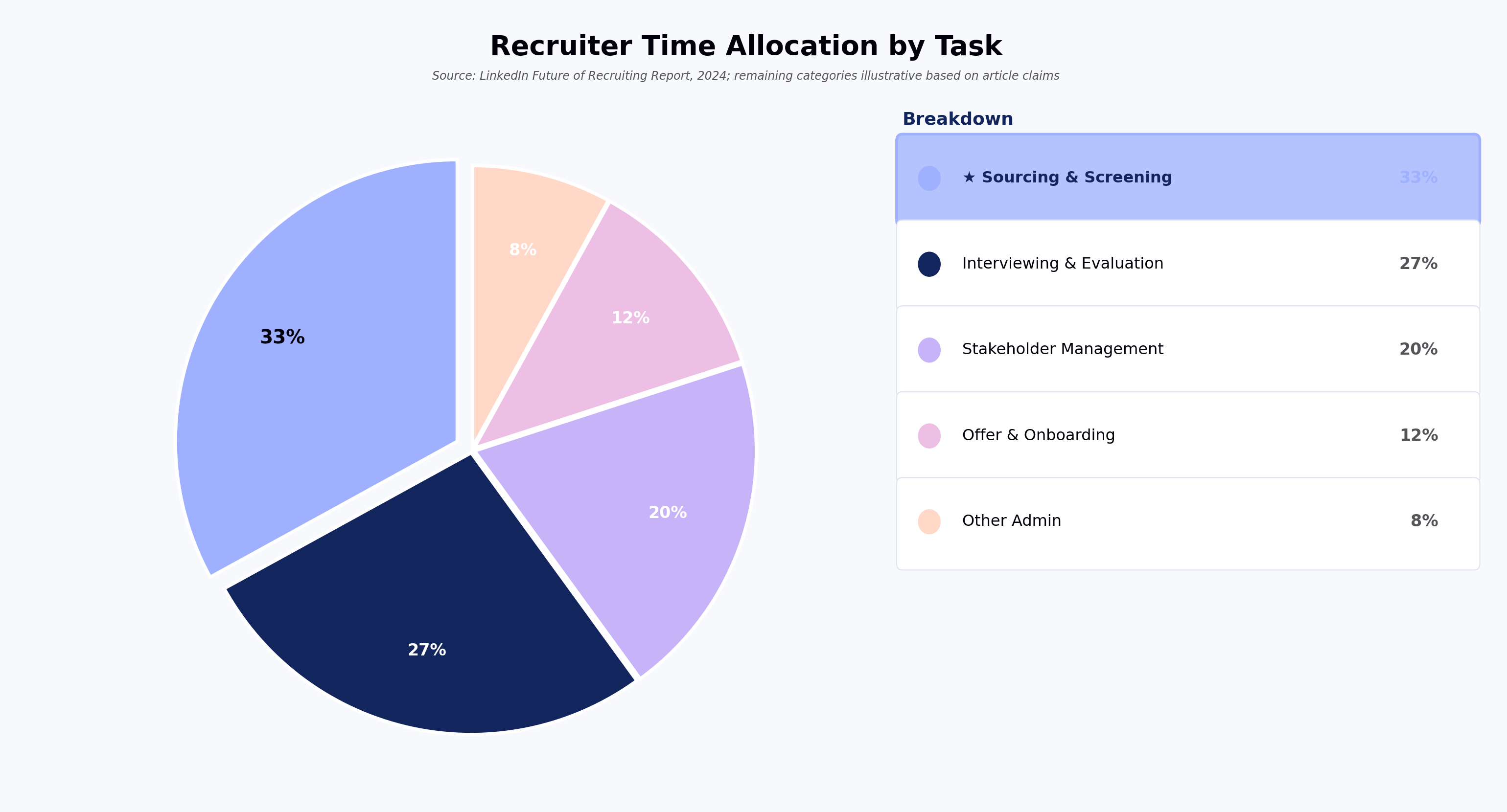
AI is not replacing recruiters; it is shifting where recruiters spend their time. Traditional recruitment rewarded screening volume and speed. Modern hiring increasingly rewards judgment, stakeholder alignment, and structured decision-making.

As automation handles sourcing, scheduling, resume parsing, and initial outreach, recruiters are spending more time on work AI cannot do well:

  • Probing candidate motivation through structured behavioral interviews
  • Evaluating adaptability against specific role demands using scorecards
  • Building hiring-manager alignment on the req and intake brief
  • Designing candidate-experience touchpoints that protect offer-accept rates
  • Calibrating assessment results against on-the-job performance data

The recruiter who succeeds in an AI-heavy pipeline is the one who can interpret signal, not the one who can scan resumes faster.

Candidates are changing faster than hiring systems

Modern career paths now move faster than most ATS configurations. Today's workforce values flexibility, creativity, continuous learning, and project-based growth, and many professionals build experience through freelance work, startups, creator platforms, and side projects. Their resumes often look unconventional, but unconventional no longer equates to unqualified.

Organizations that shift toward capability-based evaluation may access talent pools that rigid resume filters would otherwise miss. For practical guidance on adjusting screening criteria, see our guide to evaluating an ATS for skills-based hiring.

The future of hiring will feel more human

There is an irony in the AI shift: as resumes become easier to automate, organizations are being pushed to evaluate creativity, adaptability, collaboration, and real-world problem-solving more directly. The likely structure of mature AI-enabled hiring is AI handling repetitive tasks — sourcing, scheduling, parsing, initial scoring — while recruiters and hiring managers focus on nuance, context, and long-term fit.

FAQ

Is skills-based hiring more effective than resume screening? Skills-based hiring tends to predict on-the-job performance more reliably than resume screening for roles where the work can be assessed directly, such as engineering, data, sales, and marketing execution. According to LinkedIn's Future of Recruiting report, 73% of recruiters now prioritize skills-based approaches. Effectiveness depends heavily on assessment design and on whether downstream ATS filters still gate candidates by degree.

What HR processes is AI changing first? AI is changing sourcing, resume parsing, candidate matching, and initial assessment scoring first, because these are high-volume, rules-based tasks. Structured interviewing, offer negotiation, and onboarding remain primarily human-led, though AI-assisted note-taking and scorecard analysis are growing.

Will AI replace recruiters? AI is unlikely to replace recruiters, but it is changing the skill profile. Recruiters who can interpret assessment data, align hiring managers, and design candidate experience will be more valuable; recruiters whose role is primarily resume scanning are most exposed.

How do I evaluate an AI hiring tool for bias? Ask the vendor for a bias audit report (required under NYC Local Law 144 for automated employment decision tools), the demographic composition of the training data, the validation methodology against job performance, and the appeal process for candidates. Avoid tools that cannot answer all four.

Is resume-based hiring going away? Resume-based hiring is under pressure but not disappearing. Most organizations are moving toward hybrid models where resumes provide context and assessments provide the capability signal. A full move away from resumes is unlikely in the next hiring cycle for most enterprises.

What is the biggest risk of switching to skills-based hiring? The biggest risk is poorly designed assessments that introduce new forms of bias or damage candidate experience. A skills-based process built on a long, unproctored, untested assessment battery will perform worse than a structured resume screen.

Next steps: See it in action

If you are a recruiter or talent leader evaluating how to move from resume-led to skills-led screening, book a demo of HackerEarth Assessments to see how role-specific evaluations, proctoring, and benchmarked scoring fit into an existing ATS pipeline. For background reading, see our developer assessment platform overview and the HackerEarth recruiter blog.

Recruiters who pair structured assessment data with strong human judgment build better pipelines than either resumes or AI alone can produce.

Must-Know Recruitment Questions for HR and Talent Acquisition Teams (2026)

Recruitment questions every HR professional should know in 2025

Estimated read time: 7 minutes

Most "tell me about yourself" answers are now written by ChatGPT the night before the interview. That single shift — candidates arriving with rehearsed, AI-polished narratives — has broken the standard interview script and forced recruiters to redesign their question sets from the ground up. This guide outlines the categories of recruitment questions every HR professional should know in 2025, why each matters, and example questions you can adapt to your hiring rubric or scorecard today.

LinkedIn's 2024 Global Talent Trends report notes that skills-based hiring and behavioral assessment have moved from optional to expected in most talent acquisition workflows. Yet many hiring conversations still rely on outdated prompts that produce polished answers and unclear signals. The recruiter persona — the one running req intake, pipeline reviews, and screen calls — needs a tighter toolkit.

Who this is for: This article is written for recruiters and talent acquisition partners running structured interviews. Hiring managers building a scorecard alongside the recruiter will also find the question categories useful.

Adoption of Structured Hiring Practices Among HR Teams (2020–2025)
Source: LinkedIn Global Talent Trends claims cited in article

Why modern recruitment questions fail when they stay outdated

Industry observers at SHRM have noted that candidates are better prepared, interviews are more structured, and expectations on both sides have risen (SHRM research). With generative AI tools widely available, many candidates now enter screens with refined, rehearsed narratives.

The result is predictable — polished answers, unclear signals, and decisions made on incomplete understanding. The quality of the recruitment questions you bring into the room directly defines the quality of the signal you capture on the scorecard.

A contestable position worth stating plainly: behavioral interview frameworks like STAR are now overused to the point where candidates have memorized the structure, which reduces signal quality unless interviewers probe past the rehearsed answer with follow-ups.

What this article won't claim

Structured behavioral interviewing is not a silver bullet. Over-indexing on adaptability can screen out deep specialists whose value is stability and depth. Ownership-mindset framing, if applied rigidly, can disadvantage neurodivergent candidates or those from cultures where collective credit is the norm. Use the questions below as part of a balanced rubric — not as a single filter.

From "tell me about yourself" to understanding real intent

Traditional opening questions rarely reveal a candidate's intent or direction. A stronger opening probes why a candidate is moving at this specific point and what kind of work keeps them engaged beyond compensation.

Evidence from Gallup's 2023 State of the Global Workplace report suggests today's workforce is increasingly motivated by alignment, learning, and perceived growth — not stability alone. If this layer is missed early in the interview, the rest of the evaluation becomes less reliable.

Example intent and motivation questions

  • "Walk me through the last time you decided to leave a role. What specifically triggered the decision?"
  • "What kind of work has made you lose track of time in the last 12 months?"
  • "If this role didn't exist, what would your second-choice next move be — and why?"
  • "What would need to be true 18 months from now for you to consider this move a success?"

What to listen for

  • Specific triggers and trade-offs, not generic phrases like "growth" or "new challenges."
  • Consistency between the stated motivation and the candidate's actual career pattern.

Red flags

  • Answers that match the job description back to you almost verbatim.
  • Vague language about "culture" or "growth" with no concrete example.

Behavioral and competency-based recruitment questions: getting past scripted answers

One of the biggest challenges recruiters face today is not lack of talent, but over-prepared talent. Hiring practitioners increasingly find that well-structured, confident answers do not always reflect real capability, especially when responses are influenced by preparation tools or rehearsed narratives.

This is why competency-based questions — which explore decision-making logic, trade-offs, and real-time reasoning — produce higher signal than story-based prompts alone. For technical roles, pairing these with a practical assessment helps confirm what the interview surfaces. HackerEarth's skill assessments use role-specific question libraries and rubric-based scoring so the recruiter can compare candidate outputs against a defined standard, rather than relying on the candidate's own narrative of their capability.

Example behavioral and competency-based questions

  1. "Tell me about a decision you made in the last six months that you would make differently today. What changed your thinking?"
  2. "Describe a time you disagreed with your manager on a priority. How did you handle it?"
  3. "Walk me through a project where the scope changed mid-execution. What did you cut, and why?"
  4. "Give me an example of feedback you initially rejected but later acted on."

How to probe past the rehearsed answer

If a candidate delivers a clean STAR-format response, follow up with: "What's one detail you usually leave out of that story?" or "Who would tell that story differently?" These prompts disrupt the rehearsed structure and surface the actual reasoning.

Situational judgment and adaptability questions

Workplaces are shaped by continuous change — shifting priorities, evolving tools, and hybrid collaboration. Many hiring teams now treat adaptability as a core hiring parameter rather than a soft skill, particularly for roles where ambiguity is the default state.

Situational judgment questions present a realistic scenario and ask the candidate how they would navigate it. They are harder to rehearse than story-based prompts because the scenario is novel.

Example situational judgment questions

  • "You join the team and discover the project you were hired to lead has already slipped two months. What are your first three actions in week one?"
  • "Two stakeholders give you conflicting priorities on the same Friday. Both are senior to you. How do you handle it?"
  • "A teammate is consistently delivering work that is technically correct but late. You are not their manager. What do you do?"
  • "You realize halfway through a quarter that the metric you committed to is no longer the right one. How do you raise it?"
  • "Your top-performing team member tells you in a 1:1 they're considering leaving. They haven't told their manager. What do you do in the next 24 hours?"
  • "A vendor misses a critical deadline that puts your launch at risk. Walk me through how you decide whether to escalate, switch vendors, or absorb the delay."

What to listen for

  • Sequencing — do they ask clarifying questions before acting?
  • Trade-off awareness — do they acknowledge what they would not do?
  • Stakeholder reasoning — who do they involve, and when?

Culture and values-alignment questions

Cultural fit is often misunderstood as shared interests or personality alignment. A more useful frame is behavioral consistency with the team's working norms.

A second contestable position: generic "culture fit" questions should be retired in favor of values-alignment scenarios that name a specific behavior the company expects. "Culture fit" as a phrase invites bias; a scenario tied to a stated company value forces a more concrete answer.

Example values-alignment questions

  • "Our team gives feedback in writing before live discussion. Describe the last time you gave hard feedback. What did you write down first?"
  • "We prioritize shipping over perfection. Tell me about a time you shipped something you weren't fully proud of. What happened next?"
  • "Describe the last time you changed your mind because of data, not opinion."

For a deeper look at how culture signals show up in technical interviews, see our guide on how to design a structured technical interview.

Identifying ownership mindset over task execution

Task completion alone is no longer a strong hiring indicator for most knowledge roles. What recruiters and hiring managers increasingly screen for is the ownership mindset — how a candidate behaves when outcomes are unclear, accountability is shared, or success metrics evolve mid-execution.

A concrete scenario

Consider a Series B SaaS company hiring its first sales operations manager. The pipeline is messy, the CRM is half-implemented, and the founder is the de-facto rev-ops owner. Standard task-execution questions ("walk me through how you'd clean a pipeline") produce textbook answers. Ownership-mindset questions — "What would you stop doing in your first 30 days, and how would you tell the founder?" — surface whether the candidate can hold the seat. A strong answer names a specific thing they'd stop (e.g., "weekly pipeline reviews in their current form"), the trade-off they're willing to accept, and how they'd frame the conversation with the founder. A weak answer lists everything they'd add — new dashboards, new processes, new tooling — without naming a single thing they'd remove or a single conversation they'd own.

Example ownership questions

  • "Tell me about something you fixed that wasn't your job to fix."
  • "Describe a time the goalposts moved on you. What did you do in the first 48 hours?"
  • "What's a process you killed, and what replaced it?"

Red flags

  • Answers that always credit "the team" with no individual decision named.
  • Stories where the candidate is consistently the rescuer or always the victim.

Questions to avoid: legal and compliance boundaries

A structured question set is only as strong as its weakest prompt. In most jurisdictions, certain questions are either illegal or carry significant legal risk because they touch protected characteristics or regulated information.

Common categories to avoid in initial screens:

  • Age, date of birth, or graduation year as a proxy for age.
  • Marital status, family planning, or childcare arrangements ("Do you plan to have kids?" "Who watches your children?").
  • Citizenship or national origin beyond the legally permitted "Are you authorized to work in [country]?"
  • Religion, religious holidays, or observance schedules.
  • Disability or medical history, including questions about prior workers' compensation claims.
  • Salary history — now restricted or banned in many US states and several other jurisdictions. Ask about salary expectations instead.

For a deeper treatment of pre-employment screening practices and compliance, see our overview of pre-employment assessment design. Always confirm specifics with your legal or HR compliance partner — local law varies.

Rethinking what "good answers" actually mean

In traditional interviews, clarity and confidence were often equated with strong performance. Modern hiring increasingly challenges this assumption.

The signal you want is depth, consistency, and reasoning quality — even when responses are less polished. A candidate who says "I don't know, but here's how I'd find out" is often a stronger hire than one who delivers a fluent answer with no underlying logic.

To codify this on the scorecard, score reasoning and presentation as separate rubric lines. A candidate can score 4/5 on reasoning and 2/5 on presentation and still be a strong hire — but you will only see that if the rubric separates them.

FAQ: structured hiring questions

Which recruitment question category is most often skipped — and why does it matter?

In practice, ownership-mindset questions are the category recruiters most often skip, because they're the hardest to score consistently and the answers don't fit neatly into STAR. The cost of skipping them is high: ownership signal is what separates strong individual contributors from people who execute well only when the path is clear. If you only have time to add one new category to your interview guide, this is the one with the largest marginal lift.

What is the STAR method, and is it still useful?

STAR stands for Situation, Task, Action, Result. It is a candidate-response framework that helps structure answers to behavioral questions. It remains useful as a default structure, but because most candidates now prepare STAR-formatted stories, interviewers should probe past the rehearsed answer with follow-up questions about trade-offs, omitted details, and alternative perspectives.

How many interview question frameworks should a structured interview include?

Practitioners commonly recommend 5–8 core questions per 45-minute round, with planned follow-up probes. This is a rule of thumb rather than a sourced standard. Fewer questions with deeper probes typically produce more signal than many surface-level questions.

What is the difference between behavioral and situational judgment questions?

Behavioral questions ask about past actions ("Tell me about a time you…"). Situational judgment questions ask about hypothetical scenarios ("What would you do if…"). Behavioral questions test verified history; situational questions test reasoning on novel problems. Strong interview loops use both.

How do you reduce bias in recruitment questions?

Use a structured interview where every candidate is asked the same core questions, score answers on a defined rubric, and have at least two interviewers calibrate independently before discussing. Avoid "culture fit" as a freeform judgment; replace it with values-alignment scenarios tied to documented company behaviors.

Can skill assessments replace interview questions?

No. Assessments and interview questions answer different things. Assessments produce structured skill evaluation against a defined rubric; interview questions surface reasoning, motivation, and judgment. The strongest hiring loops pair both — skill assessments for verified capability, structured behavioral interviews for everything assessments can't measure.

Final thoughts and next steps

The recruitment questions every HR professional should know in 2025 are not a fixed list — they are a working toolkit you adapt to the role, the level, and the rubric. The categories above (intent, behavioral, situational, values-alignment, ownership) give you a structure; the example questions give you a starting point.

Next steps

  • Audit your current interview guide. Map every question to one of the five categories above. If a category is empty, add two questions.
  • Separate reasoning from presentation on your scorecard. Score them as distinct rubric lines.
  • Pair interviews with skill verification. Schedule a demo of HackerEarth Assessments to see how rubric-based skill scores integrate with your interview scorecard, so your hiring decision isn't relying on candidate self-report alone.

Sources referenced: LinkedIn Global Talent Trends, SHRM Research, Gallup State of the Global Workplace.

Why Empathy Could Be Your Biggest Hiring Advantage

Why Empathy Could Be Your Biggest Hiring Advantage

Why Human-Centered Hiring Matters More Than Ever

Hiring has never been more optimized than it is today.

From AI-powered recruitment tools to automated screening systems and structured interview workflows, HR and talent acquisition teams now have more ways than ever to improve hiring speed, consistency, and scalability.

But in the middle of this efficiency-driven approach, one critical element is slowly disappearing: employee empathy.

Empathy in hiring is not about slowing down recruitment or making decisions less objective. It is about ensuring candidates are treated like people navigating important career decisions, not just profiles moving through a hiring pipeline.

As recruitment becomes increasingly system-driven, preserving the human side of hiring is becoming both more difficult and more important.

For HR leaders and talent acquisition professionals, this is no longer just a workplace culture discussion. It directly impacts candidate experience, employer branding, hiring quality, and long-term employee retention.

When Hiring Feels Like a Process Instead of an Experience

Most modern recruitment systems are designed around efficiency.

Applications are filtered automatically, interviews are scheduled faster, and candidates move through hiring stages with minimal manual effort. Operationally, this creates speed and structure.

But from a candidate’s perspective, the experience can often feel distant and impersonal.

Many candidates go through multiple interview rounds without clear communication, feedback, or transparency about timelines and expectations. Even when the hiring process is fair, it may still feel mechanical.

This creates a growing challenge for HR and TA teams:

How do you maintain hiring efficiency without removing the human connection from recruitment?

That is where empathy becomes essential.

The Hidden Cost of Low-Empathy Hiring

The impact of low-empathy hiring is not always immediate, but it compounds over time.

Candidates remember how organizations made them feel during the recruitment process, especially during rejection or delayed communication. Those experiences shape employer perception long before someone becomes an employee.

Over time, this directly affects employer brand and candidate trust.

There is also another hidden cost.

When hiring becomes too rigid or overly process-driven, recruiters may overlook candidates with strong long-term potential simply because they do not perfectly match predefined criteria.

Without empathy, context disappears.

And when context disappears, opportunities are often missed.

For HR leaders, empathy is no longer just a soft skill. It is becoming a competitive hiring advantage.

Why Empathy Is Becoming a Competitive Hiring Skill

Today’s workforce is far more dynamic than it was a decade ago.

Professionals switch industries, build careers through unconventional paths, and learn skills outside traditional education systems. As a result, resumes and structured evaluations only tell part of the story.

Empathy helps recruiters understand what exists beyond the surface.

It allows hiring teams to better understand:

  • Career transitions
  • Employment gaps
  • Nontraditional experience
  • Personal growth journeys

This shift changes the entire hiring mindset.

Instead of asking:

“Does this candidate perfectly match the role?”

Recruiters are increasingly asking:

“What could this candidate become in the right environment?”

That perspective creates stronger and more future-focused hiring decisions.

Where Empathy Fits in Modern Recruitment

Empathy does not replace structured hiring systems.

In fact, it becomes most effective when built into them.

Simple improvements in communication can significantly improve candidate experience. Clear updates, transparent timelines, respectful rejection emails, and honest feedback all contribute to a more human-centered recruitment process.

These small changes often have a lasting impact on how candidates perceive an organization.

For HR teams, the goal is not to remove structure from hiring.

The goal is to ensure structure does not remove humanity.

Better Hiring Decisions Start With Better Human Understanding

Empathy also improves the quality of hiring decisions themselves.

When recruiters take time to understand a candidate’s context, they often uncover strengths that are not immediately visible on resumes or scorecards.

A candidate who appears average on paper may demonstrate exceptional adaptability, resilience, or problem-solving ability in real-world situations.

Without empathy, those signals are easy to miss.

For talent acquisition leaders, this means recognizing that hiring is not just about selecting the strongest profile.

It is about identifying the strongest long-term fit within a real human context.

Final Thoughts

As recruitment continues evolving through automation, AI hiring tools, and structured decision-making, the biggest risk is not losing efficiency.

It is losing humanity.

Employee empathy ensures hiring remains people-focused, even as processes become more technology-driven.

It does not slow recruitment down. Instead, it helps organizations create better candidate experiences, stronger employer brands, and more thoughtful hiring decisions.

Because candidates may forget interview questions or assessment scores.

But they will always remember how they were treated during the hiring process.

And in today’s competitive talent market, that experience often determines whether top talent chooses to join or walk away.

Top Products

Explore HackerEarth’s top products for Hiring & Innovation

Discover powerful tools designed to streamline hiring, assess talent efficiently, and run seamless hackathons. Explore HackerEarth’s top products that help businesses innovate and grow.
Frame
Hackathons
Engage global developers through innovation
Arrow
Frame 2
Assessments
AI-driven advanced coding assessments
Arrow
Frame 3
FaceCode
Real-time code editor for effective coding interviews
Arrow
Frame 4
L & D
Tailored learning paths for continuous assessments
Arrow
Get A Free Demo