Guide to reduce hiring costs in 2026
By the HackerEarth Talent Research Team — drawing on operational data from technical hiring programs across 500+ global enterprises.
Estimated read time: 7 minutes
Reducing hiring costs means lowering the total spend to source, assess, and onboard each new employee — without extending time-to-fill or degrading quality-of-hire. For recruiters and talent acquisition leads benchmarking cost-per-hire in 2026, the quickest wins come from consolidating sourcing channels, shortening interview loops with structured assessments, and expanding internal mobility before opening external reqs.
According to SHRM's 2022 Human Capital Benchmarking Report (the most recent published SHRM benchmarking figure at the time of writing; more recent SHRM data should be substituted when available), the average cost-per-hire in the United States is approximately $4,700, though many employers report figures two to three times higher for specialized technical roles. For recruiters and heads of talent acquisition, the practical question is where in the funnel to cut spend without lengthening pipeline or losing quality candidates.
This guide covers what hiring costs include, how to calculate cost-per-hire, and specific strategies — with trade-offs named — to reduce hiring costs across your requisitions.
Understanding hiring costs and where they accumulate
Hiring costs are the total direct and indirect expenses a company incurs to fill a single requisition, from sourcing through onboarding. These costs vary by role seniority, industry, and hiring model (in-house vs. agency).
Some employers spend heavily on external agencies, while others invest in internal sourcing teams and assessment technology. Either approach touches multiple stages of the funnel: sourcing, screening, interviewing, offer, and onboarding. Small inefficiencies at each stage compound into a higher cost-per-hire.
Components of hiring costs
Hiring costs comprise several line items that accumulate across the recruitment funnel. The main components include:
- Sourcing and advertising — job board fees, sponsored posts, and paid social campaigns. Posting to every available board rarely improves quality; concentrating spend on two or three channels that historically produce hires is usually more efficient.
- Recruitment agency fees — commonly reported in the 15–25% of first-year salary range, though the exact figure varies by market and specialty. Agencies can accelerate senior or niche hires but are rarely justified for roles below roughly $80,000 base salary (a commonly cited internal-sourcing break-even that varies by employer), where the fee often exceeds internal sourcing costs by a wide margin.
- Employee referral programs — referral bonuses (commonly ranging from $1,000–$5,000, though this varies widely by company and role level) and internal admin. Referrals often reduce cost-per-hire compared with agency channels, though they carry a known trade-off: referral-heavy pipelines can shrink demographic diversity if the existing workforce lacks it.
- Interviewing and assessment — hiring manager and panel time, scheduling coordination, assessment platform licenses, and occasional travel.
- Onboarding and training — equipment, software licenses, ramp-time productivity loss, and structured training programs. These are frequently under-counted in cost-per-hire calculations.
- Recruitment technology — applicant tracking systems (ATS), assessment platforms, sourcing tools, and analytics. These carry fixed costs but can lower marginal cost-per-hire when utilization is high.
How to calculate hiring costs accurately
Cost-per-hire is calculated by summing all internal and external recruiting costs and dividing by the number of hires in a period. SHRM and ANSI define a standardized formula, but a simplified working model looks like this:
Cost-per-hire (illustrative) = (advertising + agency fees + technology + recruiter salaries [allocated] + onboarding costs) ÷ number of hires
This is a simplified model — production benchmarks from SHRM include additional internal and external cost categories.
A worked example
Consider an anonymized scenario from a mid-size fintech (~800 employees) hiring a mid-level backend engineer in-house:
- Job board and sponsored posts: $1,200
- Agency fee (skipped — sourced in-house): $0
- Assessment platform (allocated per hire): $300
- Recruiter time (20 hours at $50/hour loaded): $1,000
- Hiring manager and panel time (15 hours at $90/hour loaded): $1,350
- Onboarding (equipment, software, training): $2,500
Total cost-per-hire: ~$6,350
Compare that to the same hire made through a contingency agency at a 20% fee on a $110,000 salary. The agency fee alone is $22,000 — before internal interview and onboarding costs are counted. In this fintech's case, moving three of four backend hires from agency to in-house sourcing reduced blended cost-per-hire by roughly 60% over two quarters. Tracking cost scenario-by-scenario reveals where reallocating spend produces the biggest reduction.
Key metrics to measure hiring costs
Three metrics govern hiring-cost visibility. Each should be tracked per requisition and per channel:
- Cost-per-hire — total recruiting spend divided by number of hires. A falling cost-per-hire generally indicates funnel efficiency, though it should be read alongside quality signals.
- Time-to-fill — calendar days from req open to accepted offer. Longer cycles inflate cost because open reqs drain hiring manager time and delay revenue-generating work.
- Quality-of-hire — post-hire performance and retention at 6 and 12 months. A cheap, fast hire that leaves in six months is more expensive than a slower, more selective process.
For deeper benchmarking guidance, see our guide to time-to-fill benchmarks and structured interview design.
Strategies to reduce hiring costs
Lowering cost-per-hire usually requires changes across sourcing, assessment, employer brand, and internal mobility. Each strategy below carries a trade-off worth naming.
Optimize sourcing channels
Concentrate spend on the two or three channels that produced the majority of your last 20 hires. For engineering roles, that typically means LinkedIn, GitHub, and one specialist community (e.g., Stack Overflow Jobs' successor networks). For non-technical roles, referral programs and LinkedIn generally outperform general job boards.
Referral programs are often more cost-effective than agency sourcing, but they can narrow the demographic profile of your pipeline. Pair referrals with a separate diversity sourcing channel to offset that risk.
Shorten and standardize the interview loop
Long, unstructured interview loops are a primary driver of time-to-fill inflation. Structured interviews with a fixed rubric and a shared question bank reduce panel time and improve inter-rater reliability. Asynchronous video interviews can compress scheduling for early-stage screens, though candidates in senior roles sometimes perceive them as impersonal — reserve them for the first evaluation stage.
Standardized skills assessments delivered before the panel round filter out mismatched candidates earlier in the funnel. HackerEarth Assessments are coding and role-based assessments that evaluate technical and non-technical talent against a structured rubric, replacing resume screening with skills-first signal. Recruiters use them to shortlist candidates before hiring-manager time is spent, and HackerEarth's assessment data — drawn from technical hiring programs across 500+ global enterprises — consistently shows that funnels applying pre-panel skills filters see meaningful reductions in hiring-manager screening hours per hire.
Build employer brand deliberately
LinkedIn's Future of Recruiting report suggests companies with strong employer brands often report lower cost-per-hire and higher inbound applicant volume. Content — engineering blog posts, employee stories, conference talks — builds inbound pipeline over 12–18 months. This is a slower lever than paid sourcing and works best as a compounding investment, not a quarterly fix.
Invest in recruitment technology with a utilization test
An ATS reduces coordination overhead. Skills assessment platforms reduce hiring-manager screening time. AI resume screeners can rank applicants against job criteria, but they carry documented bias risks — see EEOC technical guidance on the use of AI in employment decisions — so audit outputs against protected-class outcomes and keep a human reviewer in the loop.
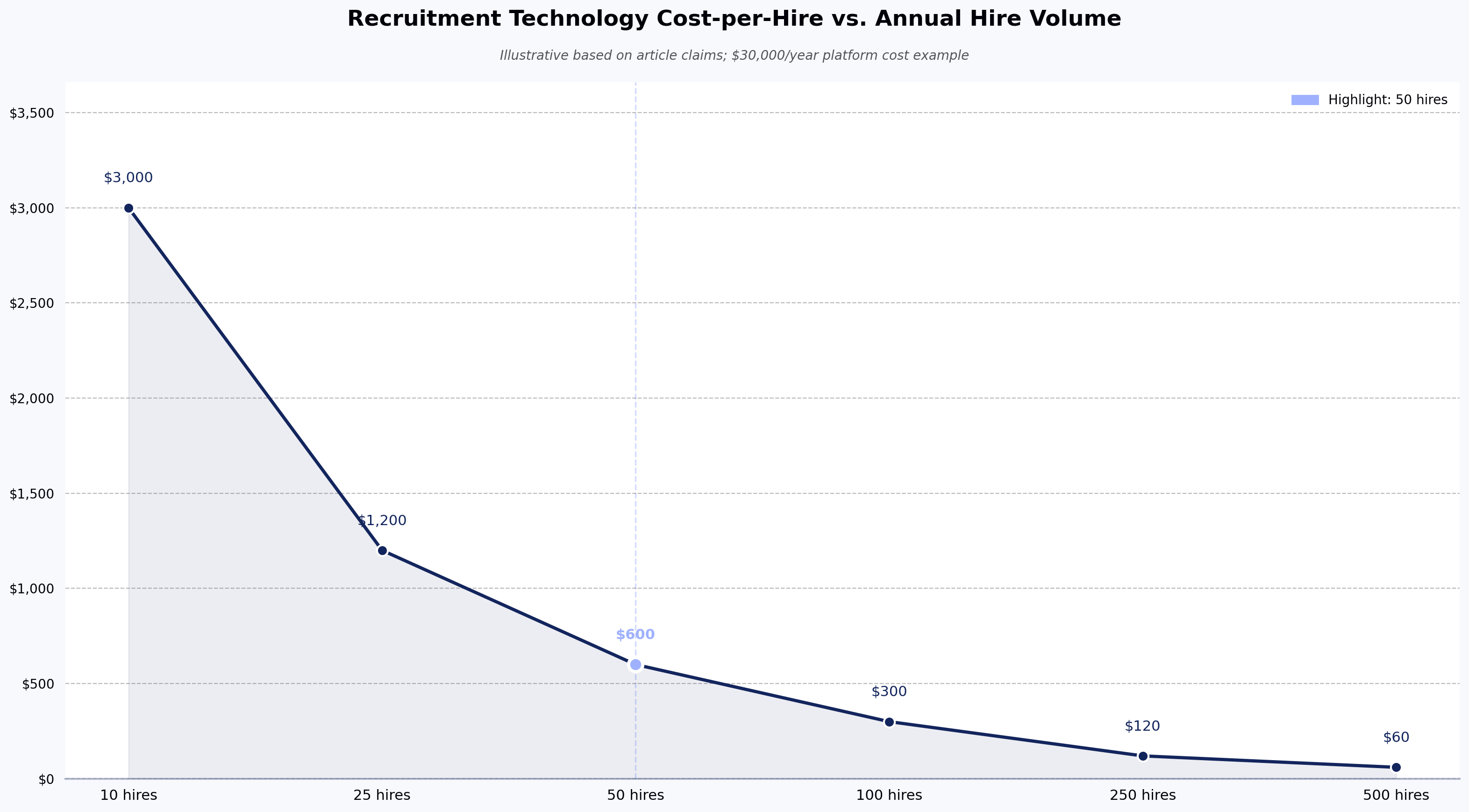
Before adding a tool, calculate its cost per hire at expected volume. A $30,000/year platform used on 50 hires costs $600 per hire; on 500 hires it costs $60.
Expand internal mobility — where the skills exist
Filling roles internally typically avoids external sourcing and agency spend, and internal hires ramp faster because they know the company. The limit is real: internal mobility works only when the required skills exist inside the organization. For net-new capabilities (e.g., a first ML engineer), internal mobility is not an option and forcing it delays the hire.
Skills-mapping tools help identify internal candidates before opening an external req by giving L&D and TA leaders a shared view of workforce capability. HackerEarth's SkillsGraph supports workforce-level skill mapping and internal L&D analytics, helping organizations understand where capability gaps sit before committing external sourcing budget.
Measuring and monitoring hiring costs on an ongoing basis
Tracking cost metrics once per quarter is not enough to catch drift. Build a shared dashboard reviewed monthly with cost-per-hire, time-to-fill, and quality-of-hire broken down by channel, role family, and requisition owner. Standard tooling for this includes your ATS reporting layer, a BI tool (Looker, Tableau, or Power BI), or a lightweight spreadsheet if volume is under ~100 hires per year.
Set anomaly thresholds so the dashboard flags variance rather than requiring manual inspection. A useful rule of thumb: any role family running 25% above rolling 12-month cost-per-hire, or 20% above time-to-fill, warrants a same-week root-cause review. Common causes are agency reliance creeping back in, panel scheduling delays, and assessment stages being skipped for "known" candidates.
Benchmark against SHRM and industry-reported figures for your role level. If your cost-per-hire is 30% above benchmark for a given role family, the diagnosis is usually in one or two line items (agency reliance, unfilled req time, or long interview loops), not across the entire funnel.
Hiring cost benchmarks by role family
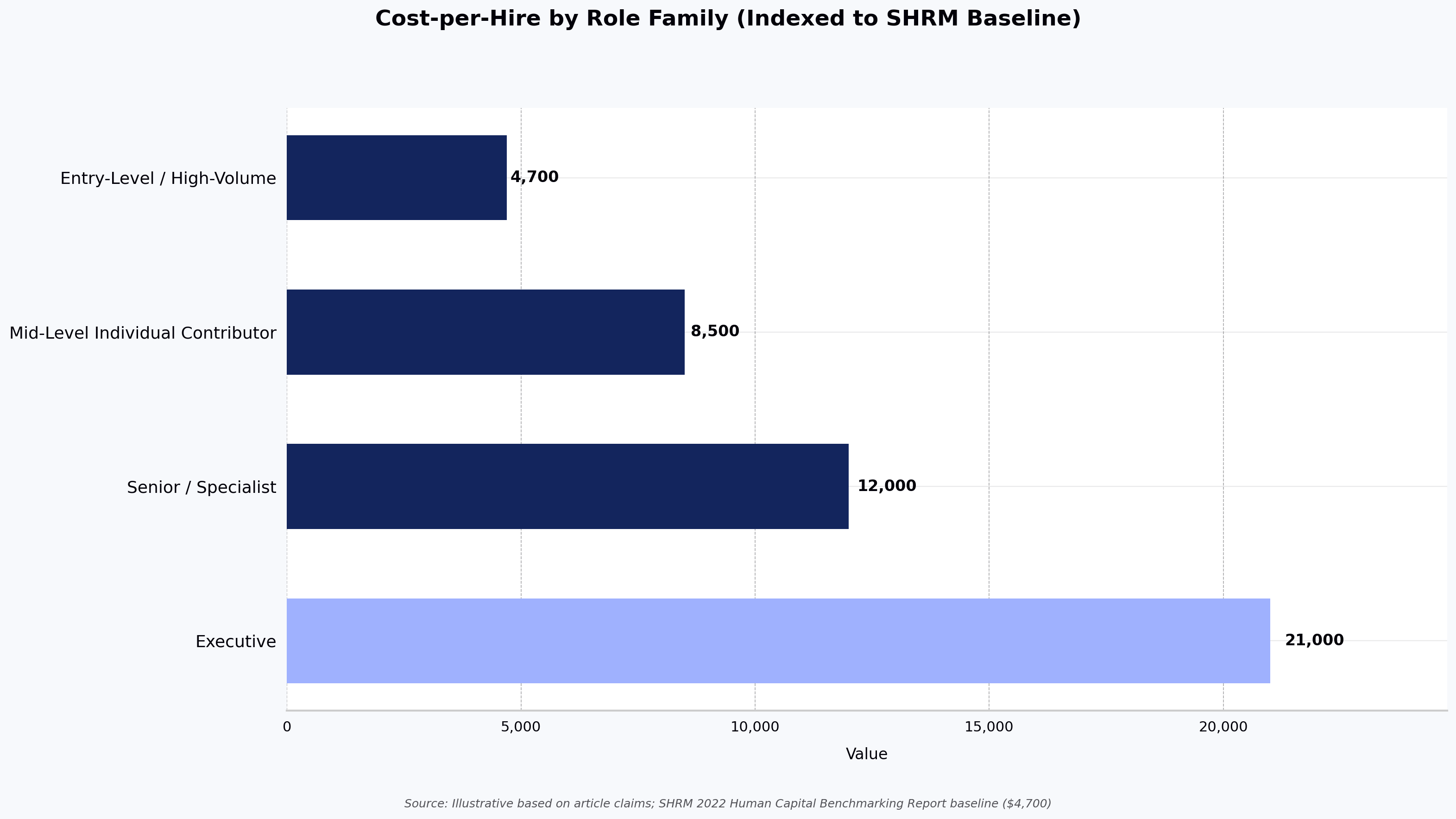
Cost-per-hire varies sharply by role family, and averaging across all reqs obscures where the money actually goes. A rough working framework:
- Entry-level and high-volume roles (support, sales development, junior operations): typically at or below the SHRM $4,700 average. Cost is dominated by job board spend and recruiter time; onboarding is relatively light.
- Mid-level individual contributors (software engineers, product managers, data analysts): commonly 1.5–2x the average. Assessment platform costs and panel interview hours drive most of the variance.
- Senior and specialist roles (staff engineers, ML specialists, security leads): 2–3x the average or higher, especially where agency or executive search is involved. Time-to-fill often exceeds 60 days, and every additional week of open-req cost compounds.
- Executive hires: often 3–5x the average once retained search fees are counted, though these are rarely benchmarked in the same dataset as bulk hires.
Track each role family separately. A blended cost-per-hire figure that mixes support hires with staff engineers hides both wins and losses.
When reducing cost-per-hire is the wrong goal
Cost-per-hire is a useful metric, but optimizing it in isolation can quietly damage the business. Cases where a higher cost-per-hire is the correct outcome:
- Critical role, small candidate pool. For a first ML engineer or a compliance lead in a regulated industry, the cost of a bad hire — or an unfilled req — is far higher than agency spend. Pay the fee, close the role.
- Employer brand investments with 12–18 month payback. Content, community, and events raise short-term cost-per-hire but reduce it later. Kill the investment prematurely and the compounding benefit disappears.
- Quality-of-hire is trending down. Falling cost-per-hire paired with falling 12-month retention is a signal that screening rigor was cut too far. The right response is to reintroduce assessment or interview stages, not to cut further.
The strategic framing: open-req cost — hiring manager time, delayed roadmap, lost revenue — is often larger than sourcing cost. When those two pull in opposite directions, prioritize closing the req.
Frequently asked questions
What is the average cost-per-hire in 2026? The most recent widely cited SHRM benchmark puts U.S. cost-per-hire at roughly $4,700, though that figure predates recent wage inflation and tighter technical talent markets — many practitioners now treat it as a floor rather than a midpoint. Geographic variance is significant: cost-per-hire in major U.S. metros typically runs 20–40% above the national figure, while remote-first roles skew lower on sourcing but higher on assessment tooling.
How do employee referral programs reduce recruiting costs? Referrals typically reduce sourcing spend by displacing job board and agency channels, and referred candidates often have shorter time-to-fill and higher retention. The trade-off is that referral pipelines can reinforce existing demographic patterns in the workforce.
Are recruitment agencies worth the fee? Agency fees in the 15–25% of first-year salary range are rarely justified for roles below roughly $80,000 base salary, where internal sourcing costs are typically lower. Agencies remain useful for confidential searches, hard-to-find specialists, and executive roles.
Does AI screening actually cut costs? AI resume screeners can reduce recruiter time in high-volume funnels, but they carry bias risks documented by researchers and regulators, including EEOC guidance on algorithmic decision-making in employment. Cost savings should be weighed against audit and compliance requirements.
How much can employer branding lower cost-per-hire? Industry research points to lower cost-per-hire at companies with sustained employer-brand investment, driven by higher inbound application rates. Gains typically show up 12–18 months into a sustained content and engagement investment.
What's the single quickest way to reduce hiring costs? For most teams, the largest early gain comes from cutting time-to-fill by shortening and standardizing the interview loop. Every week a req stays open adds internal cost — often more than the sourcing spend itself.