Technical hiring has changed dramatically over the last few years. Recruiters face more applicants per role, developers expect faster feedback, and teams need tools that do more than just run coding tests. As a result, large companies are rethinking how they assess engineers.
Modern talent‑acquisition platforms that combine live interviewing, structured scoring, and detailed analytics are helping organizations make better decisions faster. In fact, nearly 60% of HR leaders say AI‑powered tools have improved talent acquisition by reducing bias and accelerating hiring, highlighting how technology is reshaping recruiting workflows and outcomes.
In this article, we'll do a HackerRank vs HackerEarth comparison and see how these online coding interview platforms perform against key criteria like interview workflows, integrations, analytics, and candidate experience to help you make the right choice.
What are Coding Interview Platforms?
A coding interview platform is software that helps companies evaluate candidates' technical skills during the hiring process. These tools provide coding tests, live interview environments, scoring tools, candidate dashboards, and integrations with HR systems.
Additionally, they help recruiters and engineering managers assess candidates fairly, consistently, and with objective data.
What is HackerRank?
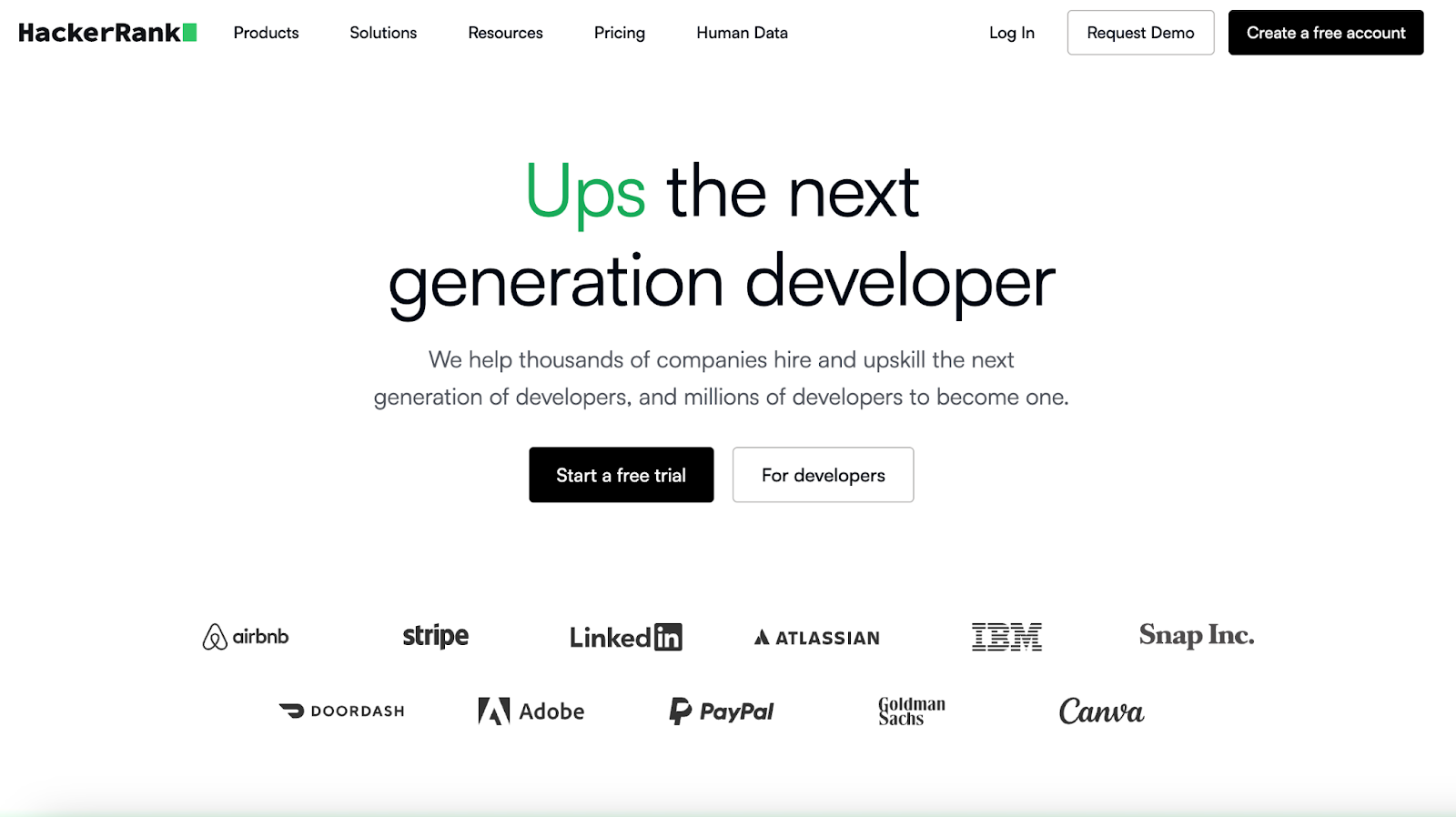
HackerRank delivers a full suite of coding assessments, live interviews, and workflow tools for recruiters and engineering teams. It handles large volumes of technical tests daily and supports 55+ programming languages, making it a reliable option for enterprises facing heavy hiring needs.
The platform extends beyond simple coding tests. It includes advanced proctoring, adaptive AI interview tools, and the ability to simulate real-world tasks that reflect on-the-job coding challenges. Its question library spans thousands of challenges, enabling recruiters to build customized assessments for screening, take-home projects, and live interviews.
Recruiters use HackerRank for:
- High-volume screening campaigns, such as campus hiring or global rollouts
- Structured technical assessments that filter candidates before human interviews
- Supporting engineering managers in live pair-programming interviews
The platform’s scoring features allow weighted grading and custom test creation. It integrates with major ATS systems, enabling automated workflows that seamlessly move candidates from online tests to interview stages.
That said, HackerRank's depth of features can come with a steeper onboarding curve, and some smaller teams have noted that the platform's workflows feel designed more for high-volume hiring than lightweight interview schedules.
What is HackerEarth?
Known as one of the best HackerRank alternatives, HackerEarth is an all-in-one coding interview platform that combines technical assessments with recruiting workflows. It combines coding tests with virtual interviewing via FaceCode, reporting dashboards, and structured analytics.
It brings screening and interview tools together, allowing hiring teams to move candidates smoothly from initial assessments to live technical interviews and final review stages. HackerEarth also emphasizes ease of use for recruiters and candidates. It has built-in ATS connectors and reporting that help teams track candidate pipelines and recruiter performance across interviews.
Some of its core capabilities include:
- FaceCode interviews: Browser-based coding challenges with live audio/video
- ATS integration: Seamless connections with applicant tracking for smoother recruiter workflows
- Analytics dashboards: Structured insights into test performance and interview outcomes
- Custom question library: Recruiters can build tests tailored to specific roles and skills
The platform suits small to mid-sized companies and teams that want a balanced mix of screening and interviewing tools with intuitive workflows. It works well for companies that need clear candidate pipelines with structured steps from test invitation to interview completion. That said, HackerEarth is primarily developer-focused and may not be the best fit for teams that need broad psychometric, behavioral, or cognitive assessments alongside technical screening.
Feature Comparison: HackerRank vs HackerEarth
To help you decide which platform fits your hiring needs, we’ll dive into a HackerEarth vs HackerRank coding interview tool comparison. We’ll compare both tools side by side on the basis of workflows, integrations, analytics, and the candidate experience.
Side‑by‑Side Feature Deep Dive: HackerRank vs HackerEarth
Now that we understand what each platform offers, it’s time to dive deeper into a technical interview software comparison to see how they perform in real-world hiring scenarios.
Live coding & collaboration
Ever wondered how a developer really thinks under pressure? Real-time coding reveals problem-solving instincts, collaboration style, and adaptability in ways a resume can’t.
Here’s how HackerRank and HackerEarth tackle this critical part of technical hiring:
HackerRank
HackerRank lets you run live coding interviews in a shared, real-time environment that mirrors how developers work daily. You can review code, debug issues, or build features alongside candidates. Pair programming gives a clear sense of how well you might collaborate with someone on your team.
The platform also includes code repository questions, realistic coding challenges, and built-in AI assistants that let you see how candidates interact with modern developer tools. Security features track tab switches, multiple monitors, and outside help, helping maintain trust in the interview results.
HackerEarth
HackerEarth’s FaceCode offers a collaborative real-time editor that supports over 40 programming languages. You can run live-coding interviews with panels of up to 5 interviewers and integrate diagram boards for systems design. Its Coding Assessment Test and library of 40,000+ pre-built questions let you tailor interviews to your job requirements while evaluating candidates objectively.
FaceCode also uses AI to generate detailed session summaries that cover technical skills, problem-solving approach, and collaboration style. The platform records interviews for later review, masks candidate information to support unbiased evaluations, and securely handles high-volume hiring, all while keeping the candidate experience smooth and professional.
🏆Winner: HackerEarth
While HackerRank provides a realistic coding workflow, HackerEarth gives teams more tools to evaluate, record, and analyze performance across multiple dimensions, making it the stronger choice for structured and scalable hiring.
Structured evaluation & scoring
Live coding is one thing, but structured evaluation turns raw performance into hiring decisions you can trust.
This section looks at how HackerRank and HackerEarth measure, score, and analyze candidate results:
HackerRank
HackerRank automatically scores coding tests against predefined unit tests and lets you build flexible scorecards with custom criteria you define. You can benchmark candidate results against a global developer pool and see weighted scoring rather than just pass/fail outputs.
Meanwhile, advanced evaluation features show code quality, efficiency, and AI fluency, giving you a richer view of how a candidate approaches problems from multiple angles. Reports capture detailed analytics and highlight performance across coding, logic, and higher‑order skills.
HackerEarth
HackerEarth auto‑evaluates coding assessments using test cases and supports partial scoring, so candidates earn points for solving components of a problem. The platform generates leaderboards and analytics that show metrics such as accuracy, speed, and problem‑solving trends.
Its assessment dashboard makes it easy to compare candidates at a glance, spot performance patterns, and refine future tests based on real data. Teams can also tap into AI‑generated summaries and performance trends to help make decisions faster.
🏆Winner: HackerEarth
HackerEarth’s scoring and analytics feel more complete for structured evaluation because they combine large‑scale automated scoring, partial credit, and ready dashboards that hiring teams actually use to compare and iterate.
Candidate experience
How your candidates feel during and after an interview matters as much as how well they perform in it.
Research shows that around 77 % of candidates who have a negative experience will share it with their networks, potentially harming your employer brand and future recruiting efforts. In contrast, about 65% of candidates who have a positive experience are likely to engage with that company again, whether as future applicants or even as customers.
Let’s look at how HackerRank and HackerEarth shape the candidate experience:
HackerRank
HackerRank gives candidates a familiar coding environment with a fully featured IDE based on the Monaco Editor, the same editor that powers Visual Studio Code, offering things like autocomplete, real‑time linting, and IntelliSense across many languages. This lets candidates code in a workspace that mirrors professional tools rather than a barebones test box.
The platform also includes preparation resources and compatibility checks to help candidates familiarize themselves with it before their interview or test. It supports real‑time communication with interviewers during live sessions and collects feedback on performance, helping both sides communicate clearly throughout the process.
HackerEarth
HackerEarth focuses on a smooth and intuitive coding experience with an IDE designed for clarity and usability. Candidates see inline error messages and detailed feedback as they code, can choose from more than 40 programming languages, and access practice tests and assessments that help them get comfortable before the real interview.
The platform also lets candidates take tests in multiple regional languages and invites them to provide feedback after assessments to help recruiters improve future experiences. These elements work together to reduce friction and make the overall process feel respectful and engaging.
🏆Winner: HackerRank
HackerRank edges ahead here with its Monaco Editor-based IDE, which gives candidates the same autocomplete, linting, and IntelliSense experience they use in professional development environments like VS Code. This familiarity reduces friction and lets candidates focus on problem-solving rather than adjusting to an unfamiliar interface. HackerEarth offers strong candidate-centric features like multi-language support and practice tests, but HackerRank's IDE experience is hard to beat for developer comfort during high-pressure interviews.
Integrations & hiring workflows
Integrating assessments with applicant tracking systems and workflow tools keeps recruiters focused on hiring rather than hopping between apps.
HackerRank
HackerRank connects directly with a broad ecosystem of ATS, scheduling, and productivity tools. It supports 40+ ATS integrations, including Greenhouse, Ashby, BreezyHR, Darwinbox, Freshteam, and more, allowing recruiters to send coding tests, schedule live interviews, and view results all from within their existing systems. Recruiters can use a REST API to build custom workflows and push assessment invites, test results, and interview links into internal HR systems.
These integrations also help keep scorecards, interview notes, and candidate records synchronized without manual data entry. HackerRank includes scheduling tool integrations and single sign-on options to help teams manage user access and streamline authentication.
HackerEarth
HackerEarth also fits into your existing hiring stack and helps recruiters automate assessment tasks across systems. It provides direct ATS integrations with popular platforms, including Greenhouse, LinkedIn Talent Hub, Lever, iCIMS, Workable, JazzHR, SmartRecruiters, Zoho Recruit, and Recruiterbox.
These connections let teams create assessments, invite candidates, and view detailed reports without switching apps. In addition to pre‑built ATS connectors, HackerEarth offers a Recruit API so teams can manage tests, invites, and results from custom internal systems. This API supports webhook‑style event flows that help embed coding assessments and live interviews into your broader HRIS workflows.
🏆Winner: Tie
Both HackerRank and HackerEarth connect with major ATS platforms, support APIs for custom workflow automation, and offer secure single sign-on. HackerEarth adds extensive webhook support, while HackerRank has a broad ecosystem of integrations, including scheduling tools. Either platform can integrate smoothly into modern hiring stacks, making them equally strong choices for managing recruitment workflows.
Analytics & reporting
Hiring decisions should rest on solid data. Analytics help you understand what worked, what didn’t, and why across your assessments and interviews:
HackerRank
HackerRank offers a range of analytics tools that help you measure candidate performance and hiring funnel metrics. Recruiters can access dashboards showing test usage, interview usage, and question‑level insights, and they can create custom reports combining selected data points from tests, candidate attempts, and invites. These reports give you the flexibility to export and analyze data in formats like Excel to support deeper evaluation and external sharing.
It also provides structured interview scorecards that map performance to predefined skills, allowing you to compare evaluator feedback consistently across interviews. Recruiters can view detailed candidate reports that include problem‑solving scores, code-quality indicators, session-integrity markers, and more, helping teams make informed decisions based on both quantitative and qualitative signals.
HackerEarth
HackerEarth delivers in‑depth, data‑driven analytics to identify top performers and assess test effectiveness. The platform’s Codeplayer records every keystroke and replays sessions, helping you see how candidates approached a problem, shifting analysis from scores to reasoning patterns.
Alongside this, HackerEarth offers question‑based analytics and a health score for each question based on difficulty, language choice, and historical data, helping teams build better assessments over time. Test analytics include metrics on score distributions, test completion times, and candidate funnel performance, giving recruiters a clear picture of how assessments perform and where adjustments make the most impact.
🏆Winner: HackerEarth
HackerRank provides robust dashboards and custom reports, but HackerEarth’s combination of detailed session replay, question analytics, and test effectiveness metrics gives hiring teams richer insight into both candidate behavior and assessment quality.
Pricing & Packaging Signals
Hiring teams vary widely in size, technical needs, and hiring volume, so choosing the right plan comes down to which features and flexibility matter most. Pricing transparency and scalability also shape the overall value a platform delivers.
HackerRank
Here’s a quick look at how HackerRank structures its plans for teams of all sizes:
- Starter: $199/month
- 1 user
- 2000+ questions
- Access to Screen + Interview
- Advanced plagiarism detection
- Leaked question protection
- Multi-file project questions
- 10 assessment attempts per month ($20/additional attempt)
- Pro: $449/month
- Unlimited users
- 4000+ questions
- Three-star AI features
- AI-assisted IDE
- AI proctoring & identity verification
- Advanced evaluation & scorecard assist
- Integrations: ATS (Greenhouse, Lever, Ashby), Calendar (Google & Outlook)
- 25 assessment attempts per month ($20/additional attempt)
- Enterprise: Custom Pricing
- Full library of 7500+ questions
- 40+ integrations (including Workday, Oracle, Eightfold)
- Test up to 100k candidates at once
- Advanced user roles and permissions
- Designated account manager and professional services
- SSO/SCIM support and premium support
HackerEarth
HackerEarth offers clear, tiered pricing that scales from small teams to large enterprises:
A] Skill Assessments
- Growth ($99/month)
- Basic assessment credits
- Coding questions
- Plagiarism detection
- Scale ($399/month)
- 20,000+ question library
- Advanced analytics
- Video response support
- Calendar and ATS integrations
- Enterprise (Custom Pricing)
- Full access to 40,000+ question library
- API & SSO support
- Professional services and global benchmarking
- Premium support
B] AI Interviewer
- Growth ($99/month)
- AI-driven interviews
- Real-time code evaluation
- Screening templates and analytics
- Enterprise (Custom Pricing)
- Enterprise-grade SSO
- Custom roles & permissions
- Professional services
C] Talent Engagement & Hackathons: Custom Pricing
- Hackathons, community challenges, and brand engagement
D] Learning & Development: Business Tier (~$15/month per user)
- Developer upskilling
- Competency mapping
- Insights and analytics
- Free developer practice content available
Here’s a side-by-side summary for quick comparison:
Which One Should You Choose?
After exploring features, workflows, pricing, and candidate experience, it’s clear that both HackerRank and HackerEarth offer powerful solutions. However, your final decision comes down to your team’s priorities, hiring volume, and workflow needs.
Here's when to choose HackerRank:
- You want a professional-grade IDE experience that mirrors tools like VS Code, helping candidates perform at their best during live coding sessions.
- Your team runs high-volume screening campaigns such as campus hiring or global rollouts and needs a platform built to handle scale efficiently.
- You prefer structured technical assessments with global benchmarking, weighted scoring, and AI-assisted evaluation to compare candidates objectively.
- You already use an ATS or scheduling tool that HackerRank integrates with, and you want a straightforward plug-and-play setup..
Here's when to choose HackerEarth:
- You need structured interviews at scale, with access to 40,000+ questions and customizable Coding Assessment Tests tailored to specific roles.
- Your hiring process requires enterprise-grade workflow automation, API support, and detailed analytics for data-driven decisions.
- You want candidate-centric experiences that include multi-language assessments, practice tests, and AI-generated session summaries.
- Your team values modular product offerings that cover AI Interviewer, Talent Engagement, and Learning & Development in addition to assessments.
Ultimately, your choice depends on your team’s priorities, whether you value real-time coding simplicity, structured assessment depth, or enterprise-scale workflows.
HackerEarth is one of the most comprehensive coding interview platforms available, helping teams hire faster, evaluate candidates more thoroughly, and deliver a better candidate experience. Get started with a demo today and see how it fits your hiring needs.
FAQs
Is HackerRank better than HackerEarth?
It depends on your priorities. HackerRank works well for teams that want simple, real-time coding interviews, a strong IDE, and structured assessments. HackerEarth wins for teams that need large-scale structured evaluations, extensive question libraries, modular features, and advanced analytics.
Which has better interview analytics?
HackerEarth provides more detailed, actionable analytics, including Codeplayer session replays, question health scores, and candidate funnel metrics. HackerRank offers dashboards, custom reports, and skill-based benchmarking, but HackerEarth’s approach gives deeper insight into both candidate behavior and assessment quality.
Can HackerEarth replace HackerRank?
For most technical hiring needs, yes. HackerEarth covers coding assessments, live interviews, and candidate analytics with comparable depth. It also adds features like multi-language assessments, AI interview summaries, and modular tools for engagement and upskilling. However, teams that heavily depend on HackerRank's Monaco Editor IDE or its specific global benchmarking data may want to evaluate both before switching.
Which platform is more scalable?
HackerEarth scales better for high-volume hiring, enterprise workflows, and large question libraries (40,000+ questions). HackerRank can also support enterprise needs, but HackerEarth’s modular offerings, APIs, and automation give it a slight edge for large organizations.
Do both support remote hiring?
Yes. Both platforms fully support remote coding interviews with live collaboration, real-time IDEs, AI-assisted evaluation, and proctoring features. HackerEarth emphasizes candidate experience and session recordings, while HackerRank focuses on real-time coding and structured evaluation.