Structured interview process: Step-by-step guide
What is a structured interview process?
A structured interview process is a hiring method where every candidate is asked the same predetermined, job-relevant questions in the same order and scored against a standardized rubric. This article walks hiring managers through how to build one — from job analysis to scoring calibration — so your team can compare candidates on evidence rather than impressions.
If you're a hiring manager, you've likely seen interviews go sideways: one interviewer digs into technical details, another chats about career goals, and a third assesses "culture fit" on instinct. You end up with inconsistent notes, gut-feel opinions, and a decision that's more art than science. Meanwhile, engineers lose time to repetitive screens, and the process drags on for weeks.
Even at large tech companies, interview outcomes often hinge on which interviewer is in the room or what questions get asked. The result is inconsistent hiring, unconscious bias, and a process that consumes resources with little accountability.
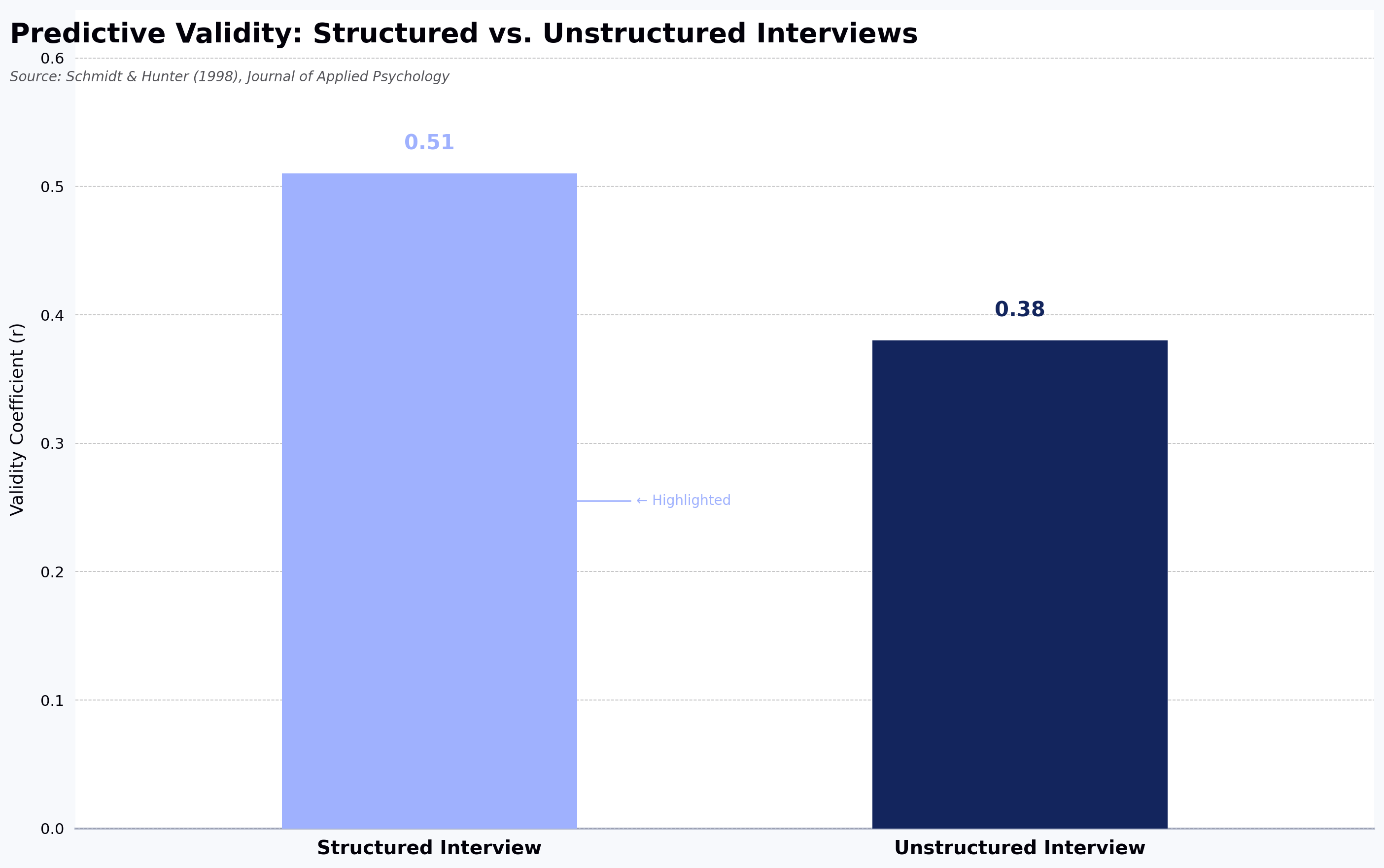
Research on interview validity — most notably the Schmidt and Hunter (1998) meta-analysis in the Journal of Applied Psychology — has consistently found that structured interviews predict on-the-job performance better than unstructured ones. This article gives you a practical strategy to standardize your interviews and make each hire more defensible.
What is a structured interview?
A structured interview is a hiring method built on three core pillars, not just a list of prepared questions:
- Predetermined, job-relevant questions: Every question is crafted to assess a specific competency required for the role.
- Consistent process for all candidates: Every candidate is asked the same questions, in the same order, by every interviewer.
- Standardized evaluation criteria: Every answer is scored against a clear, pre-defined rubric, reducing gut-feel decisions.
What sets structured interviewing apart is the discipline: every candidate, every time, measured by the same yardstick. This enables apples-to-apples comparison and exposes true differences in candidate ability, not just who "clicked" with which interviewer.
Structured vs. semi-structured vs. unstructured interviews
Structured, semi-structured, and unstructured interviews sit on a spectrum of standardization — and the difference between them predicts how much bias creeps into your hiring decisions. Many hiring managers assume they're "structured" because they have some questions prepared, but the reality is more nuanced.
Unstructured interviews:
- Ad-hoc, resume-driven.
- Each interviewer goes their own way, following threads that feel interesting.
- Evaluation is based on overall impressions or "gut feel."
- Feels natural, but leads to bias, inconsistency, and poor predictive power.
Semi-structured interviews:
- Some questions are prepared, but interviewers deviate with follow-ups.
- Evaluation criteria are vague or flexible.
- Better than nothing, but bias creeps back in through unplanned questions and subjective scoring.
Structured interviews:
- All questions and follow-ups are predetermined.
- Scoring is based on anchored rubrics, not impressions.
- Consistency is enforced across all interviewers and candidates.
- More upfront work, but measurable improvements in consistency and predictive validity.
Most organizations get stuck in the semi-structured middle ground. The bigger gains come from going the last mile — fully standardizing both questions and scoring.
Why structured interviewing works: The science behind it
Structured interviews outperform unstructured ones on three measurable dimensions: bias reduction, predictive validity, and legal defensibility.
Cognitive bias reduction. Unstructured interviews create room for confirmation bias ("they went to my college, must be good"), halo effect ("they're confident, so they must be smart"), and similarity bias ("they're just like me!").
Structured interviews force interviewers to focus on evidence rather than impressions, which mitigates these biases at each stage.
Predictive validity. Structured interviews correlate more strongly with on-the-job performance than unstructured ones.
The Schmidt and Hunter (1998) meta-analysis reported a validity coefficient of roughly 0.51 for structured interviews compared with 0.38 for unstructured interviews, and more recent SHRM guidance on structured interviewing echoes this finding.
Legal defensibility. Standardization means every candidate is evaluated on the same criteria, which supports compliance with anti-discrimination laws.
The EEOC's Uniform Guidelines on Employee Selection Procedures treat job-relatedness and consistent application as core to defensible selection practices.
Candidate experience. Candidates generally appreciate a fair, transparent process, contrary to the assumption that structure feels robotic.
When rejected candidates see that everyone was held to the same standard, they're more likely to trust the decision.
Step-by-step guide to building a structured interview process
Step 1: Conduct a job analysis and define success criteria
Structure starts before the interview. The foundation of a good structured interview isn't a question bank — it's a clear understanding of what success in the role actually looks like.
How to identify key competencies:
- Interview your top performers. What do they do differently?
- Analyze actual job tasks. What skills and behaviors are required daily?
- Consult hiring managers. What distinguishes high performers from average ones?
- Distinguish must-haves from nice-to-haves. Focus on what's truly essential.
Define success across time:
- What should a new hire accomplish in the first 30, 90, and 180 days?
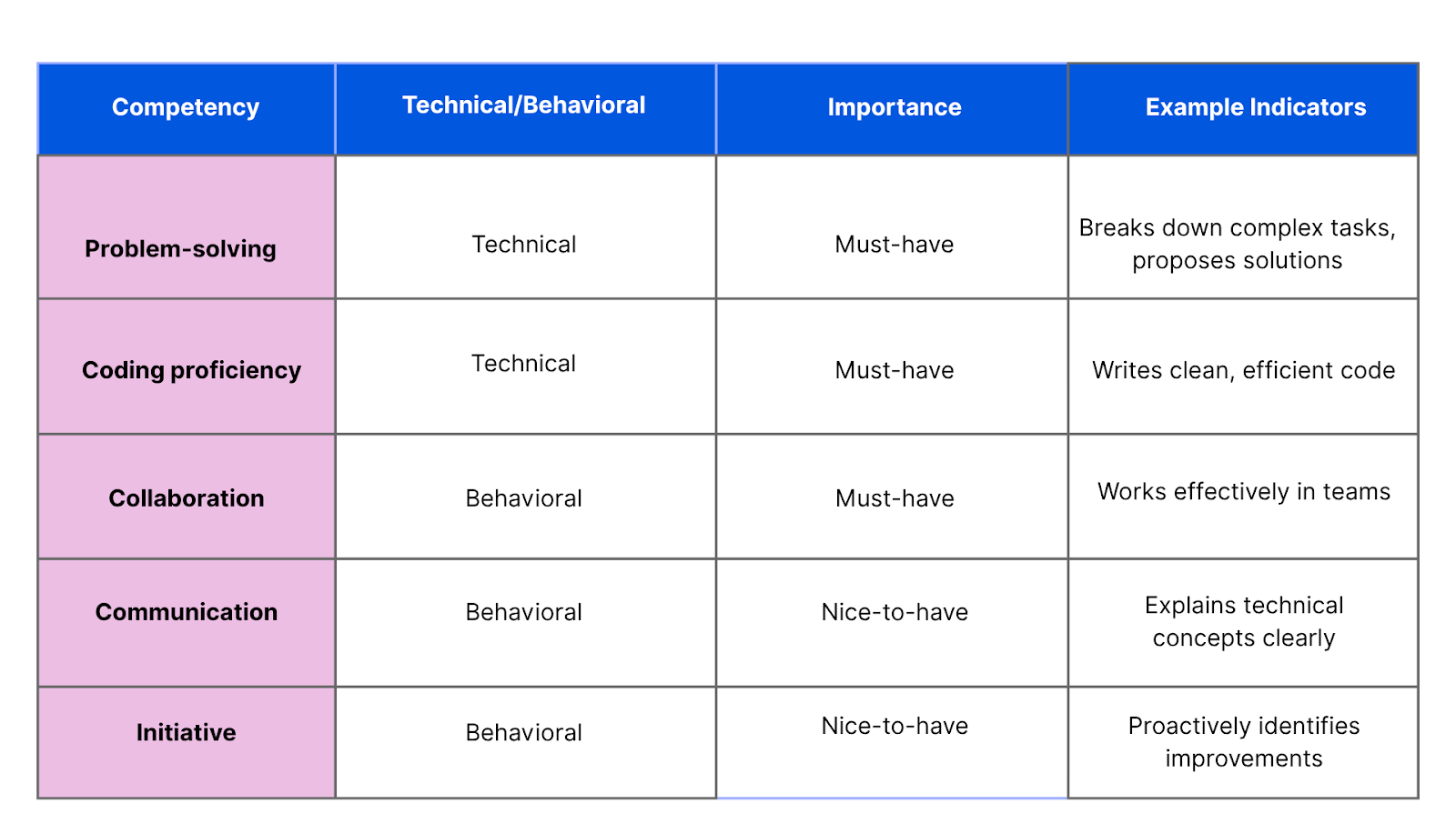
Every question, rubric, and evaluation should map back to these competencies. Get this step wrong, and everything that follows is compromised. For technical roles, tools like HackerEarth's skill assessments can help translate competency lists into role-mapped question banks.
Step 2: Design job-relevant interview questions
Every question must tie directly to a competency. If you can't explain what skill a question evaluates, cut it.
Types of questions:
- Behavioral: "Tell me about a time you debugged a complex system." Assesses past performance and approach to problems.
- Situational: "What would you do if your code review revealed a major bug right before release?" Assesses judgment and decision-making.
- Technical/job knowledge: "How does garbage collection work in Java?" Assesses expertise.
- Problem-solving: "Here's a code sample with a hidden bug. Can you find and fix it?" Assesses analytical approach.
What makes a question effective?
- Specific: Elicits detailed, job-relevant responses.
- Open-ended: Allows for different valid approaches.
- Consistent: Can be asked verbatim to every candidate.
Follow-up questions: Predetermine your follow-ups. Unplanned probing ("Can you elaborate?") reintroduces bias. Prepare 1–2 clarifying prompts per question.
Legal considerations: Avoid questions about age, marital status, family plans, or anything not directly job-relevant.
It's not the questions themselves that drive value — it's that every candidate gets exactly the same questions, enabling true comparison.
Step 3: Create a standardized scoring rubric
Most teams with "standard questions" still get inconsistent results because they lack a rubric.
Anchored rating scales: Ditch vague rubrics ("1 = poor, 5 = excellent"). Instead, define what each score actually means for each question.
How to build behavioral anchors:
- Strong answer (5): Candidate describes a complex bug, details their systematic approach, explains trade-offs, and shares results.
- Average answer (3): Candidate gives a general description, some steps, but lacks depth or specifics.
- Weak answer (1): Candidate struggles to recall an example, focuses on blame, or skips steps.
Weighting competencies: Not all competencies matter equally. For a software engineer, "coding proficiency" might be weighted twice as heavily as "initiative."
Red flags and knockouts: Define criteria that indicate an automatic concern (e.g., "refused to seek help when stuck," "breached security protocols").
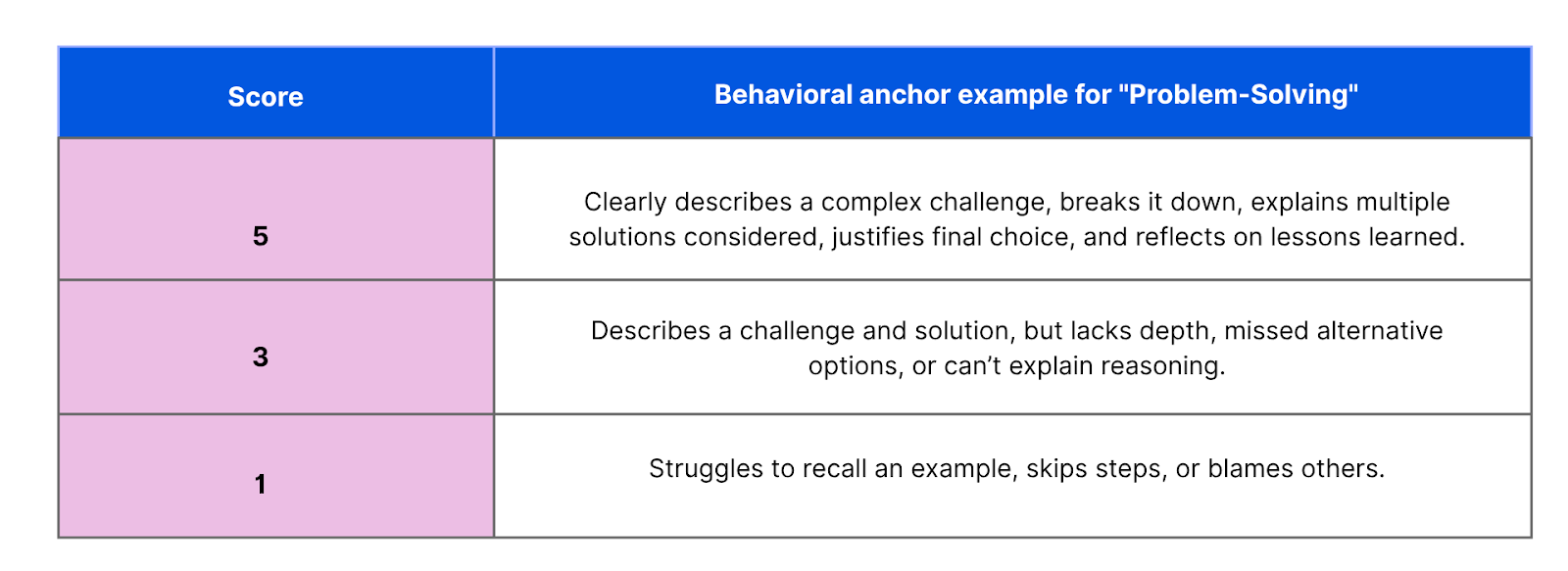
A good rubric makes scoring obvious. If interviewers are debating what score to give, your rubric isn't specific enough.
Step 4: Train your interviewers
Even a well-designed process fails if interviewers aren't trained to use it. Many experienced interviewers feel structure constrains them or implies a lack of trust. In practice, structure is about consistency, not micromanagement.
What training should cover:
- Consistent delivery: Ask questions verbatim, no leading or significant rephrasing.
- Scoring rubric: How to use anchors, not impressions.
- Evidence-based notes: Document what was said, not how you "felt."
- Bias recognition: Train interviewers to spot and mitigate their own biases.
- Legal boundaries: What's off-limits in questioning.
- Calibration exercises: Regular practice sessions to align scoring standards.
Ongoing vs. one-time training: Calibration isn't a "set and forget" task. Run sessions regularly, especially when adding new questions or interviewers. Structured processes free up time for interviewers to focus on evaluation rather than improvisation.
Step 5: Standardize the interview day experience
Consistent format: Same interview duration, structure, and number of interviewers for every candidate in the same role.
Interview flow:
- Rapport building (5 min): Brief introduction, outline the process.
- Core questions (30–40 min): Ask predetermined questions in order.
- Candidate questions (10–15 min): Allow the candidate to ask about the role, team, or company.
- Close (5 min): Explain next steps and timeline.
Handling candidate Q&A: While not scripted, interviewers should prep standard answers to common questions for consistency.
Panel interviews: Assign questions in advance to avoid overlap. Ensure smooth handoffs and avoid cross-talk.
Sample interview flow
| Segment | Time allocation |
|---|---|
| Welcome & rapport | 5 min |
| Core questions | 35 min |
| Candidate questions | 10 min |
| Close & next steps | 5 min |
A consistent, well-organized interview experience can also improve how candidates perceive your process — which is worth noting when survey feedback and offer-acceptance rates are on the line.
Step 6: Evaluate candidates using evidence, not gut feeling
Each interviewer completes their scorecard independently, before any group discussion. This prevents groupthink and anchoring.
Running effective debriefs:
- Each interviewer shares scores and evidence.
- Discussion focuses on what was observed, not impressions.
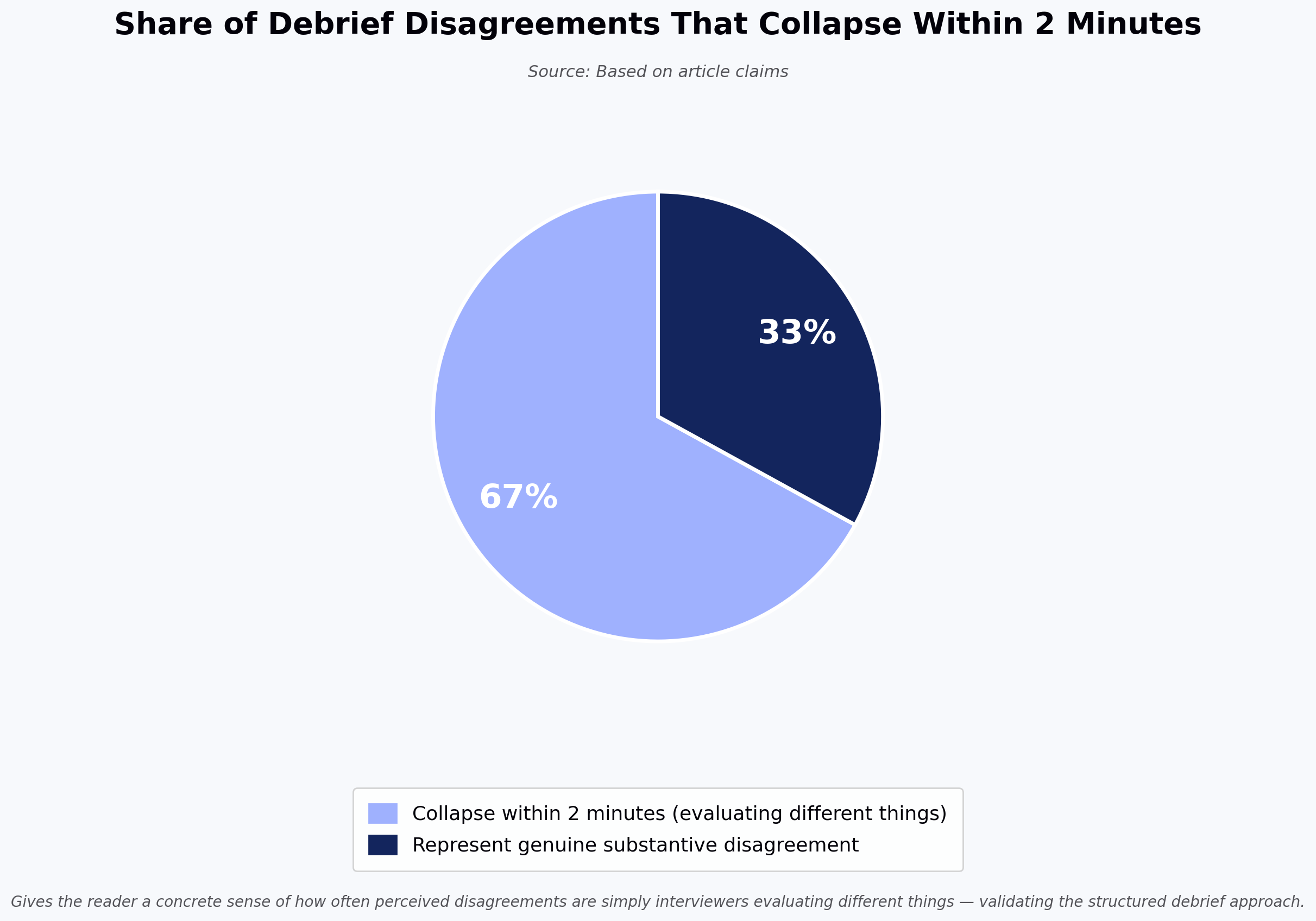
- Discrepancies are discussed in terms of evidence ("What led you to rate that answer as a 5?"), not opinions.
Common pitfalls to avoid:
- Vague language ("great culture fit") without behavioral examples.
- Letting one strong opinion dominate.
- Comparing candidates to each other rather than to the rubric.
- Failing to document the rationale for the final decision.
Documentation: Capture key evidence and the reasoning behind each decision. This matters for legal defensibility and for improving the process over time.
Even with strong questions and rubrics, if the final decision is based on "vibes," you're back where you started.
Common mistakes to avoid in structured interviewing
Even teams that have invested in a structured interview process often see it erode over time. These are the most common patterns that quietly undermine it:
- Going off-script with follow-ups: Unplanned probing reintroduces bias. Prepare follow-ups in advance.
- Skipping training (or retraining): Without reinforcement, interviewers revert to old habits.
- Using generic questions: Role-specific questions are a must. Generic banks defeat the purpose.
- Never refreshing questions: Candidates share questions online. Rotate regularly to maintain effectiveness — question leakage can render even a well-designed rubric less useful over time.
- Discussing candidates before scoring: Even a casual pre-scoring chat can anchor opinions.
- Treating structure as a one-time setup: Ongoing calibration, updates, and audits are essential.
Where structured interviews underperform
Structured interviews aren't the right fit for every hiring situation. It's worth naming the cases where the trade-offs work against you:
- Very senior or executive roles (VP/C-suite): For leadership hires where situational judgment, executive presence, and strategic fit matter more than measurable task competencies, a rigid rubric can miss what you're actually assessing.
- Highly creative or improvisational roles: Roles where the work itself is exploratory may be poorly served by a fixed question set that can't probe on unexpected threads.
- Low-volume hiring (under ~5 candidates for a role): The upfront cost of building rubrics, training interviewers, and calibrating scores can exceed the benefit when you're only interviewing a handful of people.
- Stale question banks: When questions leak or aren't refreshed, rubrics lose validity because candidates prepare rehearsed answers rather than demonstrating actual competency.
For most technical and operational roles at scale, though, the consistency benefits outweigh these limits.
How to measure structured interview effectiveness
Structured interviews generate consistent, comparable data. But implementation is just the start. How do you know it's actually working?
Key metrics to track:
- Time-to-hire: Structure may feel slower at first, but decisions come faster once implemented.
- Quality of hire: Are structured hires performing better than previous cohorts? Track interview scores against performance reviews.
- Interviewer consistency: Compare scoring patterns across interviewers. Wide discrepancies signal calibration gaps.
- Candidate experience: Survey both successful and rejected candidates. Are they reporting a fair, positive process?
- Offer acceptance rates: Structured, transparent interviews can improve candidate trust and acceptance.
- Pipeline representation: Are you seeing consistent scoring across candidate groups at each hiring stage?
Automate structured interviewing with HackerEarth
Vendor callout — HackerEarth products
HackerEarth is a technical hiring platform used by 500+ global enterprises, with a 10M+ developer community and 150M+ assessment signals across 1,000+ skills. The tools below are how HackerEarth supports structured interviewing specifically; treat this as vendor content rather than editorial recommendation.
OnScreen — HackerEarth's AI interview tool that conducts structured technical interviews 24/7 using video-avatar interviewers and built-in identity verification for candidates.
- Runs structured, role-specific interviews on a consistent question set and deterministic evaluation framework
- Reduces evaluator exposure to identifying information, producing evaluations that are more consistent across candidates than human-led screens
- Applies a rubric that doesn't vary by interviewer mood or fatigue
- Includes KYC-grade identity verification and proctoring built in
- Best used when senior engineers are spending 5+ hours a week on repetitive screening interviews
Supporting products:
- FaceCode: Live coding interviews with real-time evaluation
- Skill Assessments: Pre-built and custom skills tests covering 40+ programming languages and 1,000+ skills
- Soft skills assessments: Evaluate behavioral competencies alongside technical ones
Next steps
If you're a hiring manager trying to reduce inconsistency in your technical interviews, the fastest path is usually to pilot a structured process on one high-volume role, measure interviewer scoring consistency, then expand.
Schedule a demo of HackerEarth's assessment and interview platform to see how structured question banks, anchored rubrics, and AI-driven interviews fit into your existing hiring workflow.
FAQs
How long does it take to implement a structured interview process? Implementation can take as little as a few weeks for a single role, but expect a few months for full rollout and calibration, especially in larger organizations.
Can structured interviews be used for all roles? Mostly, but with limits. The framework applies well to technical, behavioral, and mid-level leadership positions. Structured interviews are less suited to VP/C-suite hires and to roles with fewer than about five candidates, where the setup cost typically exceeds the benefit.
Do candidates dislike structured interviews? No — candidate feedback generally trends positive. Transparency about the process and consistency in scoring tend to increase trust, especially among rejected candidates.
How do structured interviews reduce bias specifically? By fixing three variables that unstructured interviews leave open: the questions asked, the order they're asked in, and the rubric used to score them. Removing that variability closes the most common openings for confirmation bias, halo effect, and similarity bias.
What's the difference between a structured interview and a behavioral interview? A behavioral interview is a type of question ("Tell me about a time…"). A structured interview is a process: every candidate gets the same questions (behavioral, technical, etc.) and is scored by the same rubric.
How often should we update our interview questions? Refresh questions at least once a year, or whenever there's evidence that candidates are sharing them widely. Regular audits help maintain effectiveness and fairness.
Estimated read time: ~10 minutes (approx. 2,400 words at 250 wpm). Suggested meta title: "Structured interview process: Step-by-step guide" (49 characters).