Top hackathon ideas for 2026: 15 projects worth building
A top hackathon idea is a project scoped tightly enough to ship in 24–48 hours, technically interesting enough to signal skill, and demo-ready enough to hold a judge's attention in the first 60 seconds. Everything else — the framework, the tech stack, the pitch — flows from that definition. This guide covers 15 top hackathon ideas organized by domain and skill level, each with a recommended stack, build timeline, and honest notes on where the concept can fall short.
For hiring teams, L&D leaders, and innovation managers running internal or sponsored hackathons, the same criteria apply in reverse: the strongest top hackathon ideas are the ones that produce measurable signal on candidate capability, not just flashy demos. Companies using hackathons as part of talent evaluation can pair these prompts with structured assessments to build a candidate pipeline grounded in real problem-solving.
Below, you will find a framework for selecting the right idea, 15 concrete concepts across six categories, and execution notes that separate winning teams from the rest.
Note on tech stacks: APIs, SDKs, and library versions referenced below (Climatiq, Plaid, Dialogflow, MediaPipe, WebAuthn, and others) change frequently. Validate current documentation, pricing, and availability before committing a project to any specific vendor.
What makes a top hackathon idea stand out?
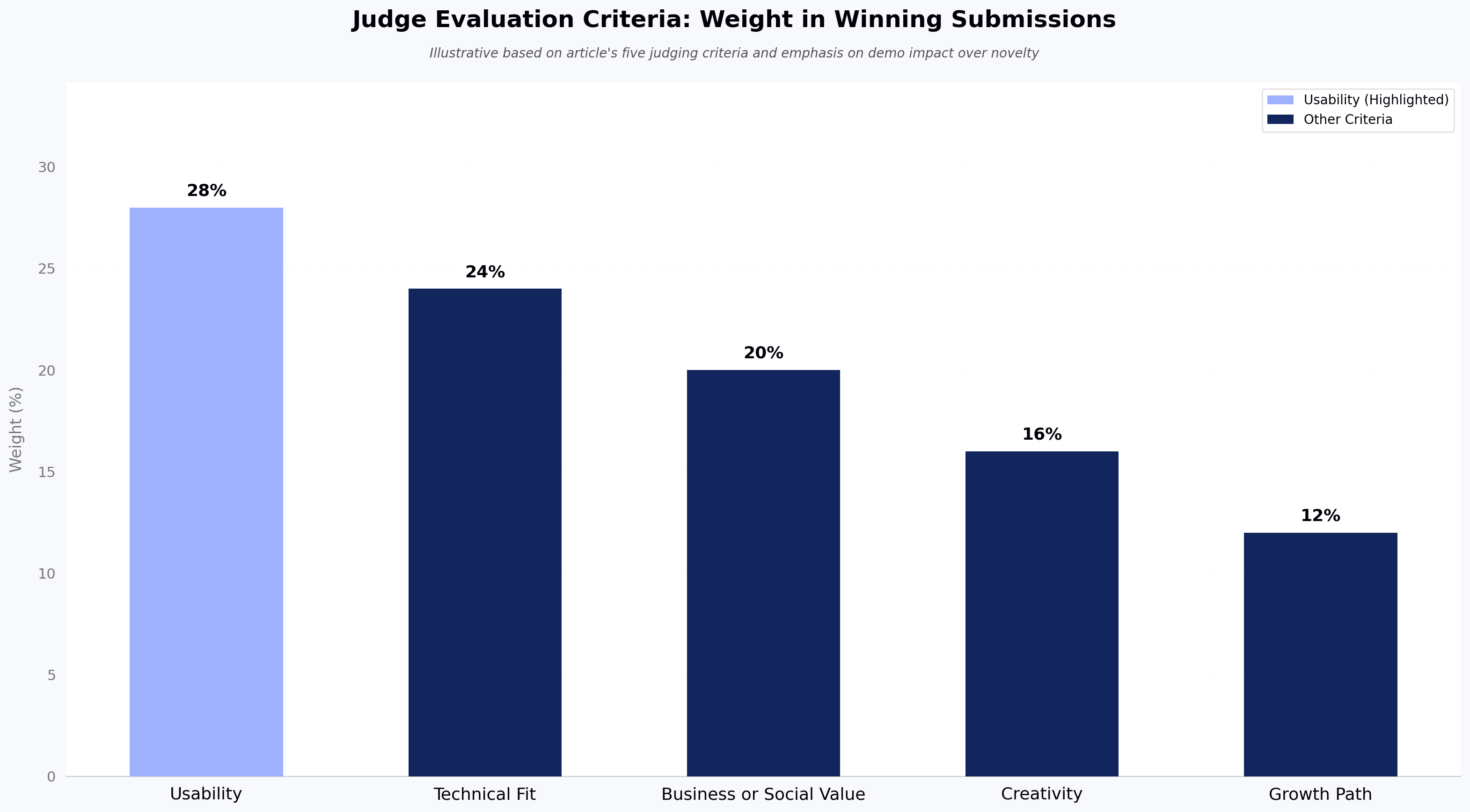
Judges at competitive hackathons tend to evaluate projects against a consistent set of criteria. Understanding these before selecting your idea gives you a structural advantage.
- Creativity — a fresh angle on a known problem tends to score higher than an incremental improvement.
- Usability — a working prototype with a clear user flow usually beats a polished slide deck.
- Technical fit — using the right tools for the problem matters more than stacking technologies for show.
- Growth path — architecture that could realistically support 10x more users or data signals engineering maturity.
- Business or social value — projects that solve problems worth solving, whether commercial or social, elevate any pitch.
The strongest hackathon ideas score well on at least three of these five dimensions. Keep them in mind as you explore the categories below.
Top hackathon ideas for AI and machine learning
AI projects are among the most popular hackathon categories heading into 2026, according to Devpost's annual hackathon trends and category breakdowns on Major League Hacking. The strongest AI hackathon ideas pair a generative or predictive model with a live, interactive demo — not a static output on a slide.
Trade-off to note: AI projects that rely on large commercial APIs (OpenAI, Anthropic, Google) can hit rate limits or cost caps during the demo window. Have a fallback prompt or cached response ready.
1. AI-powered resume screener
An AI-powered resume screener parses resumes with an NLP pipeline (typically spaCy or a transformer model fine-tuned on job descriptions), extracts skills and experience, and ranks candidates against a target role. The AI is doing entity extraction and semantic similarity scoring — not judgment — and its limits are well documented: it inherits bias from training data and struggles with non-standard resume formats.
- Tech stack: Python, spaCy or Hugging Face Transformers, Streamlit, PostgreSQL
- Skill level: Intermediate
- Build time: 24 to 36 hours
2. Real-time deepfake detector
Create a browser extension that analyzes video feeds for deepfake artifacts using convolutional neural networks. The project is timely, technically impressive, and addresses a growing security concern. Limitation: detector accuracy drops sharply on newer generative models, so frame the demo around a specific attack class rather than claiming general detection.
- Tech stack: Python, TensorFlow or PyTorch, OpenCV, Flask
- Skill level: Advanced
- Build time: 36 to 48 hours
3. Gesture-controlled music creator
Use a webcam and machine learning to let users create music through hand and body movements — no instrument required. Gesture-based music interfaces have appeared as finalists in university hackathons in recent years and consistently deliver a memorable demo, though verifying specific awards requires checking each event's public results page.
- Tech stack: MediaPipe, TensorFlow.js, Tone.js, JavaScript
- Skill level: Intermediate
- Build time: 24 to 36 hours
Hackathon ideas for healthcare and social impact
Healthcare projects tend to attract strong interest from judges and sponsors because the problems are tangible and the stakes are high. These hackathon ideas combine technical skill with meaningful outcomes.
4. Mental health check-in bot
Build a conversational agent that conducts brief daily mental health assessments and tracks mood patterns over time. Include crisis resource routing for high-risk responses to add real social impact. Ethical caveat: any project touching mental health should include clear disclaimers that it is not a substitute for care, or judges (correctly) will push back.
- Tech stack: Dialogflow or Rasa, Node.js, MongoDB, Twilio for SMS
- Skill level: Intermediate
- Build time: 24 to 36 hours
5. Accessible text reader for the visually impaired
Create a mobile app that uses the device camera to capture printed text and reads it aloud. Adding multilingual support broadens impact and demonstrates a clear growth path.
- Tech stack: Google Cloud Vision API, Text-to-Speech API, Flutter or React Native
- Skill level: Beginner to intermediate
- Build time: 12 to 24 hours
6. Community crisis response dashboard
Build a real-time dashboard that aggregates emergency reports, maps incidents, and coordinates volunteer response during natural disasters or local emergencies.
- Tech stack: React, Leaflet.js or Mapbox, Socket.io, Node.js, PostgreSQL
- Skill level: Intermediate to advanced
- Build time: 36 to 48 hours
Sustainability and clean tech hackathon ideas
Sustainability-themed hackathons appear to be growing, driven by corporate ESG commitments and increased developer interest in climate topics — a pattern reflected in category listings across Devpost and MLH. These project ideas balance technical depth with environmental relevance.
7. Personal carbon footprint tracker
Build a tracker that logs daily activities (commute, diet, energy use) and visualizes environmental impact with actionable reduction suggestions. Simple to build, easy to demo, and highly relevant.
- Tech stack: React, Chart.js, Node.js, MongoDB, Climatiq API (verify current API terms)
- Skill level: Beginner
- Build time: 12 to 24 hours
8. Smart water quality monitor
Create an IoT system that monitors pH, turbidity, and contaminant levels in real time. Display readings on a web dashboard with configurable alert thresholds. Trade-off: IoT projects require hardware procurement, calibration time, and sensor debugging — not ideal for a first hackathon or a fully remote team. Plan the hardware order at least two weeks in advance.
- Tech stack: Arduino or Raspberry Pi, MQTT, Node.js, InfluxDB, Grafana
- Skill level: Intermediate to advanced
- Build time: 36 to 48 hours
Top hackathon ideas for fintech and blockchain
Fintech hackathon ideas that simplify complex financial processes or introduce transparency through blockchain tend to score well with technical judges, though their reception with business-focused judges varies with the panel's familiarity with crypto tooling. Trade-off: blockchain projects require crypto wallet setup, testnet funding, and often gas-fee troubleshooting during the demo — factor this into scope.
9. Peer-to-peer micro-lending platform
Build a decentralized lending platform where users lend and borrow small amounts governed by smart contract terms. This project demonstrates advanced technical skill and addresses financial inclusion.
- Tech stack: Solidity, Hardhat, Ethers.js, React, MetaMask
- Skill level: Advanced
- Build time: 36 to 48 hours
10. Transparent charity donation tracker
Use blockchain to create a public ledger that tracks donations from contributor to end recipient, ensuring full transparency and accountability. Reference implementations and audit patterns are documented by the Ethereum Foundation.
- Tech stack: Ethereum or Polygon, IPFS, React, Solidity
- Skill level: Intermediate to advanced
- Build time: 24 to 36 hours
Cybersecurity and privacy hackathon ideas
Cybersecurity projects typically stand out at hackathons because they address urgent, real-world threats — a pattern reinforced by the growth of security-track sponsorships from major cloud vendors. Choosing a cybersecurity hackathon idea signals both technical maturity and awareness of industry trends.
11. Phishing email detector
Train a machine learning model to classify emails as legitimate or phishing attempts. Package it as a browser extension or email plugin for immediate practical use.
- Tech stack: Python, scikit-learn, Flask, Chrome Extension API
- Skill level: Intermediate
- Build time: 24 to 36 hours
12. Passwordless authentication system
Build a sign-on solution using cryptographic keys stored on mobile devices, removing the need for passwords entirely. WebAuthn and FIDO2 are supported by all major browsers; specification and testing resources are maintained by the FIDO Alliance.
- Tech stack: WebAuthn, Node.js, React, FIDO2 libraries
- Skill level: Advanced
- Build time: 36 to 48 hours
Beginner-friendly hackathon ideas
These project ideas are scoped for 8 to 24 hours and use widely documented tools with strong community support. Each produces a visual, demoable output that judges can engage with immediately.
13. Portfolio website generator
Build a tool that pulls data from a developer's GitHub profile and auto-generates a personal portfolio site with project descriptions, tech stacks, and contact details.
- Tech stack: GitHub API, HTML/CSS, JavaScript, Netlify
- Skill level: Beginner
- Build time: 8 to 12 hours
14. Expense splitting app
Create a mobile-first app that tracks group expenses, splits costs based on custom rules, and syncs updates across all participants in real time.
- Tech stack: Flutter, Firebase Realtime Database, Plaid API (optional; verify current terms)
- Skill level: Beginner to intermediate
- Build time: 12 to 24 hours
15. AI-powered task prioritizer
An AI-powered task prioritizer uses a lightweight ML model — typically a regression or ranking model trained on deadline, estimated effort, and past completion history — to suggest which task to work on next. The AI is scoring, not deciding, and its limits are important to state in the demo: cold-start users have no history, so the model defaults to deadline-based ranking until it learns individual patterns.
- Tech stack: React, OpenAI API, Firebase
- Skill level: Beginner
- Build time: 8 to 12 hours
The counterintuitive part: why "build the demo first" backfires for some teams
Most hackathon guides — including this one, further down — repeat the "build the demo first" mantra. It is broadly good advice, but it fails in two specific cases worth naming.
First, for infrastructure-heavy projects (blockchain, IoT, distributed systems), the demo is a thin veneer over deep plumbing. Building a mock UI first often means throwing away integration work when the real backend lands. Second, for teams with only one frontend-capable developer, front-loading the demo starves the backend of hours it cannot recover.
The better heuristic: build the demo first when the demo is the product (consumer apps, dashboards, generative tools). Build the integration first when the demo depends on load-bearing infrastructure. Most listicles skip this distinction because it complicates a clean rule.
How to choose the right hackathon idea
With dozens of potential directions, picking the right hackathon idea requires a structured approach. These five filters help narrow the options quickly.
1. Match the idea to your team's skills. If nobody on the team has worked with blockchain, a DeFi project under a 24-hour deadline creates unnecessary risk. Play to your strengths and stretch slightly beyond them.
2. Check theme alignment. Most hackathons have specific themes or challenge tracks. An idea that directly addresses the theme scores higher than a generic project, even if the generic one is technically stronger.
3. Prioritize demo impact. Judges evaluate what they can see. Choose ideas that produce visible, interactive output. A real-time dashboard running on live data tells a better story than a backend API with Postman screenshots.
4. Validate feasibility against the timeline. If the hackathon runs for 24 hours, scope your MVP to 12. The remaining time goes to debugging, polishing, and preparing your demo. Overscoped projects are the most common reason teams fail to submit.
5. Differentiate from common submissions. Weather apps, basic chatbots, and generic to-do lists flood every hackathon. Add a unique angle — accessibility, gamification, real-time data — to separate your project from the crowd.
For organizations running hackathons as part of a hiring program, these same filters apply to how ideas are selected for challenge tracks. Programs that use hackathons in their candidate sourcing strategy get sharper signal when the prompts force trade-offs on scope, feasibility, and demo impact — the same qualities that separate strong engineers on the job.

Tips to execute your hackathon idea and win
Picking the right hackathon idea is half the battle. Execution determines whether you finish with a working demo or an incomplete prototype.
1. Scope ruthlessly. Define three core features for your MVP and cut everything else. You can mention future features during the demo. Building less usually means shipping more.
2. Assign clear roles early. Divide responsibilities from the start: frontend, backend, data or ML, and demo preparation. Overlap slows teams down; parallel work accelerates them.
3. Sequence the demo strategically. For consumer-facing top hackathon ideas, build the user-facing experience first. For infrastructure-heavy projects, get the integration path working end-to-end before polishing the UI. Match the sequence to the shape of the project.
4. Test on the target device. If you are demoing on a projector, test on a projector. If your project is a mobile app, demo on an actual phone. Environment mismatches during presentations create avoidable failures.
5. Tell a story, not a feature list. Open with the problem. Show how a specific user experiences it. Walk judges through your solution step by step. Narrative structure makes technical projects memorable.
Frequently asked questions
Are hackathon-style challenges actually useful for evaluating engineering candidates?
Only under specific conditions. Hackathons produce strong signal on scoping, execution under pressure, and communication — but weak signal on code quality, testing discipline, and long-cycle collaboration. Teams that treat hackathon output as a proxy for full engineering capability tend to over-index on charisma and demo polish. Pairing hackathon performance with a structured technical assessment closes that gap.
Why do popular AI hackathon ideas often underperform against simpler projects?
Because judges see the same five generative AI wrappers every event. Novelty decays fast in crowded categories. A well-executed accessibility tool or a clean fintech dashboard often beats the tenth ChatGPT plugin of the day, even when the AI project is more technically ambitious. Popularity is not the same as competitive edge.
Can a solo participant win a hackathon?
Yes, but with real constraints. Solo entries typically cap out around 12–15 hours of buildable scope over a 24-hour event, which rules out most IoT, blockchain, and multi-service architectures. Solo participants tend to do best in beginner-friendly and single-model AI categories, where a focused demo can outshine a broader but shakier team project.
How important is the demo compared to the actual code?
Highly important, though not uniformly. Judges spend a few minutes evaluating each project. A polished, well-narrated demo with a clear problem statement and live functionality usually creates a stronger impression than clean code that stays hidden. For sponsor-track prizes with technical review, code quality matters more.
Next steps: run better hackathons and hiring programs
If you are running a hackathon as part of a hiring, L&D, or innovation program, the ideas above are only useful when paired with a framework for evaluating what participants actually built. Explore HackerEarth's hackathon and assessment platform to see how structured challenges, real-time scoring, and skills intelligence turn hackathon participation into hiring signal.