Closing the AI skills gap in HR: 2026 skills guide
Read time: 8 min
[Featured image placeholder — required before publish: comparison visual, "HR AI skill levels: automation vs. augmentation vs. intelligence"]
As a talent acquisition leader responsible for engineering hiring, the AI skills gap in HR — the mismatch between the AI tools your team has deployed and its ability to use those tools to make better hiring decisions — is likely the single biggest constraint on your hiring quality heading into 2026. Most recruiting functions have bought the software. Few can operate it well enough to change hiring outcomes. That distinction, not access to AI, is what separates recruiting teams that consistently hit quality-of-hire targets from those that don't.
For recruiters running engineering pipelines, this matters directly at the req level: the same automation stack that speeds up screening can quietly degrade quality of hire when the team behind it lacks the AI skills to interrogate its outputs.
HR is scaling AI but not capability
AI is now embedded across recruitment, hiring pipelines, sourcing analytics, and HR automation. The bottleneck is not tooling. It is the AI skills gap in HR — the data literacy, model interrogation, and assessment design capabilities recruiters need to actually operationalize these systems in a live pipeline.
According to the AIHR 2024 HR Trends report, a significant share of HR professionals report they lack the AI skills required to deliver measurable business impact through AI adoption. Recruiting is becoming AI-enabled, but not AI-capable.
For technical recruiters — where developer assessment, skills validation, and coding evaluation carry real cost-per-hire and quality-of-hire consequences — this gap is not theoretical. It shapes which engineers get through to a hiring manager and which get filtered out at the ATS before a human reviews their work.
From talent acquisition to skills-based hiring
Recruiting in 2026 is shifting from process efficiency to signal quality. Traditional recruiting focused on hiring speed, ATS throughput, and pipeline volume. The next layer — skills-based hiring — asks recruiters to predict candidate success at the req level, map skills to role requirements, and shortlist based on demonstrated ability rather than resume keywords.
Most recruiting teams are still stuck one layer below that, using AI in platforms like Workday, Greenhouse, and Eightfold to automate resume screening and shortlisting rather than to generate defensible skill signals. AI is used to simplify sourcing throughput, not to raise the accuracy of the resulting shortlists.
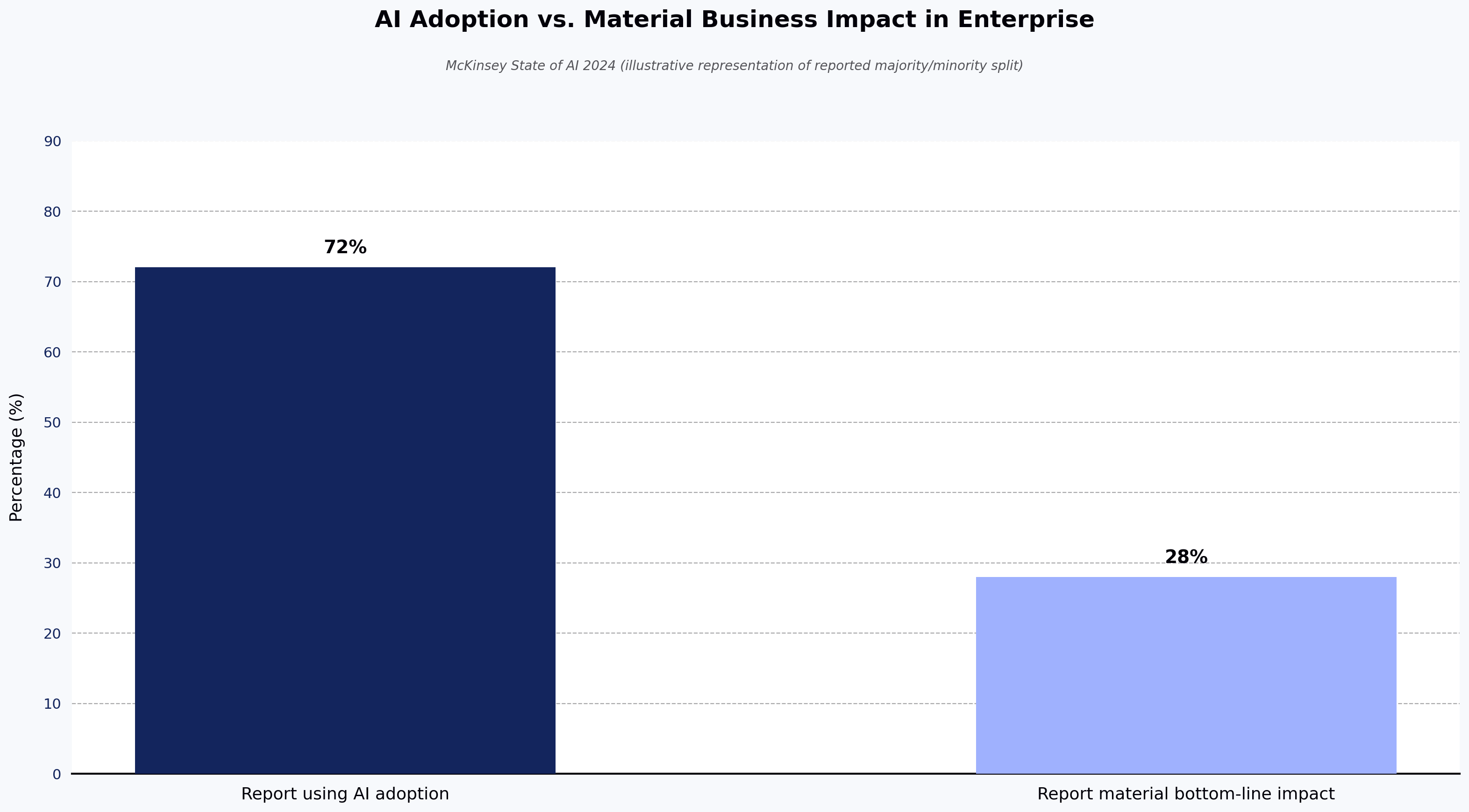
The McKinsey State of AI 2024 report found that while enterprise AI adoption has continued to rise, a majority of respondents report no material bottom-line impact from their AI use, suggesting that adoption alone does not translate into outcomes — a pattern that mirrors what recruiting teams are seeing on quality of hire.
The real AI skills gap in HR and why it matters for tech recruiting
The AI skills gap in HR is not about coding or machine learning proficiency. It is a practical disconnect between the AI tools recruiters have deployed and the ability to translate their outputs into better shortlists.
AIHR describes this gap as the inability of HR professionals to confidently, responsibly, and effectively integrate AI recruitment tools into core hiring workflows — limiting the impact of these tools on shortlist quality, req-level accuracy, and cost per hire.
For technical recruiting, poorly applied AI can:
- Generate false positives in candidate screening
- Rank candidates incorrectly due to keyword-based filtering and ATS limitations
- Miss high-potential engineers whose problem-solving depth is not visible in keyword-optimized resumes
Without structured skill validation and coding assessments, the result is a systematic skill mismatch between hired engineers and actual role requirements — a mismatch a recruiter usually only sees after the hiring manager flags underperformance at 60 or 90 days. HackerEarth's skills-based hiring approach is designed to catch that mismatch earlier, at the assessment stage, before it becomes an attrition or performance issue.
The World Economic Forum's Future of Jobs Report 2023 reports that employers expect AI and information-processing technologies to augment or transform roles at approximately 5.7 times the rate they expect these technologies to displace roles — reinforcing that the point of AI in hiring is smarter human decisions, not automated ones.
The 2026 reality: three critical gaps in AI skills recruiters must solve
Recruiting teams have adopted AI widely; the gap now is between recruitment automation and shortlist quality. Despite rising AI investments, most teams still struggle to translate these tools into better hires, particularly in engineering roles where signal quality matters most.
1. The capability gap
AI tools are available but poorly applied. In practice, this means that most AI in recruiting is limited to surface-level use cases like resume screening and ATS filtering, without deeper skill assessment or coding evaluation layered on top. In a typical funnel, this shows up as a recruiter accepting the ATS's top 25 ranked resumes without a screening call on candidates ranked 26–100, and passing that shortlist to the hiring manager who then rejects most of it as off-target.
The result: shortlists built on incomplete candidate data and weak skill signals, and a growing gap between what candidates appear to know and what they can actually do on the job. See our guide to skills-based hiring for how to close this layer of the funnel.
2. The confidence vs. competence gap
Many recruiters feel confident using ATS dashboards and AI hiring tools, but far fewer can push back on their outputs in a hiring huddle. In practice, this means a recruiter accepting an AI-ranked shortlist without asking why the model down-ranked a specific candidate, or without knowing whether the model was ever validated against actual hire outcomes for that role.
In technical recruiting, this shows up as:
- Over-reliance on AI-generated candidate rankings
- Insufficient scrutiny of algorithmic bias and data gaps
- Weak validation of applied technical skills and coding ability
3. The strategy gap
AI is often used to speed up hiring rather than improve it. Instead of functioning as a signal-quality layer, AI is reduced to an efficiency tool — so a recruiter's weekly metrics still center on time-to-fill and pipeline volume rather than 90-day performance of hires. This limits AI's impact on:
- Predictive shortlisting and candidate success
- Quality-of-hire outcomes
- Skills-based req planning
The AI skills recruiters need in 2026
1. Skills-based hiring expertise
LinkedIn's 2024 Future of Recruiting research indicates that skills-based hiring is one of the most prioritized shifts among recruiting leaders, with a growing share of recruiters reporting that they use skills data — rather than degrees or prior titles — as a primary shortlisting signal. Recruiters need to design skills-first hiring frameworks that reflect real job requirements, and they need to interpret technical assessments that measure applied competency rather than credentialed knowledge.
HackerEarth's AI-powered assessments run role-specific coding tasks against a fixed rubric, giving recruiters a defensible skill signal to bring into hiring manager reviews.
2. AI-augmented decision making
AI in 2026 is an augmentation layer, not a replacement for recruiter judgment. Recruiters need to:
- Interpret AI-generated candidate rankings and pipeline analytics
- Validate them using structured assessments
- Combine them with contextual judgment from screening calls
The Stanford AI Index 2024 reports that enterprise adoption of generative AI in HR functions is concentrated in productivity and augmentation use cases (drafting, summarization, ranking assistance) rather than full-decision automation — a pattern consistent with recruiting deployments where AI supports the recruiter rather than replaces the hiring decision.
3. Data literacy for pipeline decisions
Recruiters need to move beyond passive dashboard consumption to active data-driven decisions on the req. That means reading a shortlist's ranking distribution and knowing when the signal is thin, connecting assessment data to hiring manager feedback, and identifying pipeline patterns that predict fall-off or offer decline. Data literacy is a working recruiter capability, not an analyst-only one.
4. Structured assessment design
Shortlist quality in 2026 depends heavily on assessment design. Effective programs move toward simulation-based assessments, real-world coding challenges, structured technical interviews, and scenario-driven evaluation. Without this layer, AI-driven hiring collapses into keyword matching. HackerEarth's FaceCode — a live coding interview environment with a shared editor and question library — applies the same rubric across every candidate rather than varying with interviewer mood or fatigue.
5. AI ethics and bias detection
As AI is embedded further into recruiting workflows, recruiters need to actively test for fairness, transparency, and compliance on their reqs. This includes reviewing algorithmic outputs, documenting model behavior for the record, and building screening practices that hold up under audit. Ethical review is increasingly a baseline expectation, not an optional one.
6. Human-centric screening in an AI-driven pipeline
Even with rapid AI adoption, recruiter judgment on the screening call remains a critical differentiator. Recruiters need to evaluate behavioral traits, motivation, and role fit beyond what resumes and algorithms surface. The strongest hires typically combine validated technical skill with organizational alignment — and it is usually the recruiter, not the model, who catches the latter.
The hidden risk: AI-driven mis-hiring at the req level
The flip side of faster screening is a specific and under-discussed failure mode: AI-driven mis-hiring at scale, driven by over-reliance on recruitment automation.
AI improves hiring speed, but it can also optimize for candidates who perform well in algorithmic evaluations and ATS systems rather than those with real-world capability. That creates a bias toward resume-optimized, keyword-heavy, model-friendly profiles — instead of depth of skill and problem-solving ability. Recruiters may hit time-to-fill targets while hiring managers quietly report that new engineers are underperforming at 60 and 90 days.
For example, one anonymized mid-market SaaS employer we worked with saw a 22% drop in time-to-fill after deploying automated resume ranking, but hiring manager satisfaction with shortlists fell in the same quarter and the team reverted to combining AI ranking with a structured coding assessment before shortlist handoff.
Where AI hiring tools underperform
AI hiring tools do not improve outcomes in every scenario, and skills-based hiring frameworks are not a universal fix. There are specific req-level conditions under which they degrade quality:
- High-volume top-of-funnel screening for senior engineering roles. When AI is used to auto-reject at the top of a senior funnel, false negatives on non-traditional but strong candidates rise sharply. Structured interviews with a small manually-sourced shortlist tend to outperform aggressive AI screening for staff-level and above hires.
- Roles where the skill is judgment, not execution. Skills-based frameworks work well for roles with observable, testable outputs — coding, SQL, design tasks. They perform less well for roles where the core skill is ambiguous judgment (early-stage product leadership, security architecture in novel domains), where structured behavioral interviews often produce better signal than task-based assessments alone.
- Small candidate pools. AI ranking depends on distributional signal. In our experience working with technical recruiting teams, below roughly 40–50 candidates per role, ranking outputs are noisy enough that human review of every applicant is usually the higher-quality path — this is a practitioner heuristic, not a published threshold.
- Regulated hiring contexts. In jurisdictions with active AI hiring regulation, automated ranking without documented bias audits can create compliance exposure. New York City's Local Law 144 has been enforceable since July 5, 2023 and requires an annual independent bias audit of automated employment decision tools plus candidate notice before use. The EU AI Act classifies AI systems used for recruitment and candidate evaluation as high-risk, with obligations for high-risk systems beginning to apply from August 2, 2026. Recruiters should confirm specific requirements with their legal or compliance team before deploying automated ranking in either jurisdiction.
The point is not that AI hiring tools fail — it is that they need to be deployed against the right reqs, and skills-based frameworks need a matching assessment design behind them.
Deploying AI in recruiting more precisely
In technical recruiting, the returns come from using AI more precisely, not more broadly. Hiring decisions for engineering roles are more defensible when they are grounded in observed coding behavior, not resume signal — which is why platforms like HackerEarth Assessments and FaceCode sit alongside AI screening rather than replacing it. Assessments provide a role-specific rubric-scored coding evaluation; FaceCode provides a live interview environment with a shared editor and integrated question library so every candidate is evaluated against the same rubric. At a broader level, workforce skills mapping tools such as HackerEarth SkillsGraph aggregate skill coverage across a workforce or candidate pool to support req planning and skills-gap analysis, without predicting individual candidate performance.
These are decision inputs, not decisions. They are useful to the extent that the recruiter behind them can interpret rubric-scored outputs, spot where the signal is thin, and combine assessment data with structured screening judgment.
The future of recruiting: intelligent recruiting, not just AI-enabled recruiting
Evidence to date indicates that AI will not replace recruiters — it will reshape the role by exposing gaps in how teams evaluate skills and interpret hiring technology. The risk is not automation itself but the inability to use it well.
In our experience working with technical recruiting teams, those that rely on AI without developing deeper capability in skill evaluation, hiring analytics, and contextual decision-making tend to underperform on quality of hire, even as their time-to-fill drops. The recruiters who will outperform in 2026 are the ones who can think critically about AI outputs, validate candidates rigorously against a rubric, and use AI hiring tools as one input among several.
FAQ
What is the AI skills gap in HR? The AI skills gap in HR is the gap between the AI tools recruiting teams have deployed (screening software, ranking engines, analytics dashboards) and the AI skills — data literacy, model interrogation, structured assessment design, ethical review — required to translate those tools into better shortlists. AIHR defines it as the inability to confidently and responsibly integrate AI into HR workflows.
What AI skills do recruiters need in 2026? Six capabilities: skills-based hiring expertise, AI-augmented decision making, data literacy for pipeline decisions, structured assessment design, AI ethics and bias detection, and human-centric evaluation of behavioral and cultural signals. Each maps to a specific failure mode in AI-driven hiring.
How can recruiters close the AI skills gap — and what is the counterintuitive move most teams miss? The counterintuitive move is to stop training recruiters on the AI tool itself and instead train them to challenge the tool's outputs. Most AI-in-HR training programs focus on how to use a screening or ranking product. The higher-leverage skill is knowing when to override it — reading a ranking distribution to spot when the signal is thin, asking whether the model was validated against actual hire outcomes for that role, and being willing to pull a candidate the model down-ranked. Teams that treat AI literacy as a critical-review skill rather than a tool-training skill tend to close the gap faster.
Where does AI in recruiting underperform? AI hiring tools underperform in senior engineering funnels, roles where the core skill is judgment rather than executable output, small candidate pools where ranking signal is noisy, and regulated jurisdictions where automated ranking creates compliance exposure. In these cases, structured human review often produces better outcomes.
Are skills-based hiring frameworks always better than traditional hiring? No. Skills-based hiring works well for roles with observable, testable outputs. For ambiguous roles — early product leadership, novel security architecture — structured behavioral interviews often outperform task-based skill assessments alone. The framework should match the role.
How is skills-based hiring different from traditional talent acquisition? Traditional talent acquisition optimizes for filling reqs efficiently. Skills-based hiring optimizes for shortlist accuracy and 90-day performance by evaluating candidates against role-specific competencies. Most recruiting teams currently operate on the efficiency layer while being asked to deliver skill-signal results.
Next steps
If you are evaluating how to close the AI skills gap in your own hiring workflow, the fastest signal is usually at the assessment layer. Book a walkthrough of HackerEarth's Assessments and FaceCode to see how rubric-based skill evaluation fits alongside your existing ATS and AI screening stack.