AI Recruiting

Thank you! Your submission has been received!
Oops! Something went wrong while submitting the form.

How to Conduct a Technical Interview: 7-Step Guide

How to Conduct a Technical Interview: 7-Step Guide

If you're a recruiter trying to figure out how to conduct a technical interview that produces comparable, defensible candidate data, the bottleneck is rarely the questions — it's the inconsistency between interviewers. Your engineering team just rejected three candidates in a row, and none of the interviewers can agree on why. One wanted stronger system design instincts. Another marked down a candidate for nerves during a whiteboard exercise. A third made an offer to someone the others found underwhelming. The evaluations were inconsistent because the technical interview process was inconsistent.

Research suggests structured technical interviews predict on-the-job performance at nearly twice the rate of unstructured ones: structured formats are reported at a predictive validity coefficient of around .51 compared to .38 for ad-hoc approaches (Schmidt & Hunter, 1998, Psychological Bulletin; the .51/.38 ordering has been revisited in more recent meta-analytic work, including Sackett et al., 2022, Journal of Applied Psychology). Yet most technical interview processes remain a patchwork of interviewer preferences, inherited question banks, and gut-feel scoring.

This guide gives recruiters a direct answer to how to conduct a technical interview: a seven-step framework for conducting technical interviews that generate comparable, defensible candidate data every time. It covers where AI interview agents — software that runs a structured first-round technical interview without a human interviewer, asking adaptive questions and scoring responses against a fixed rubric — fit into the technical hiring process and where they can measurably improve it. It is written primarily for recruiters and talent acquisition leads, with shared vocabulary for the hiring managers and engineering leads they partner with.
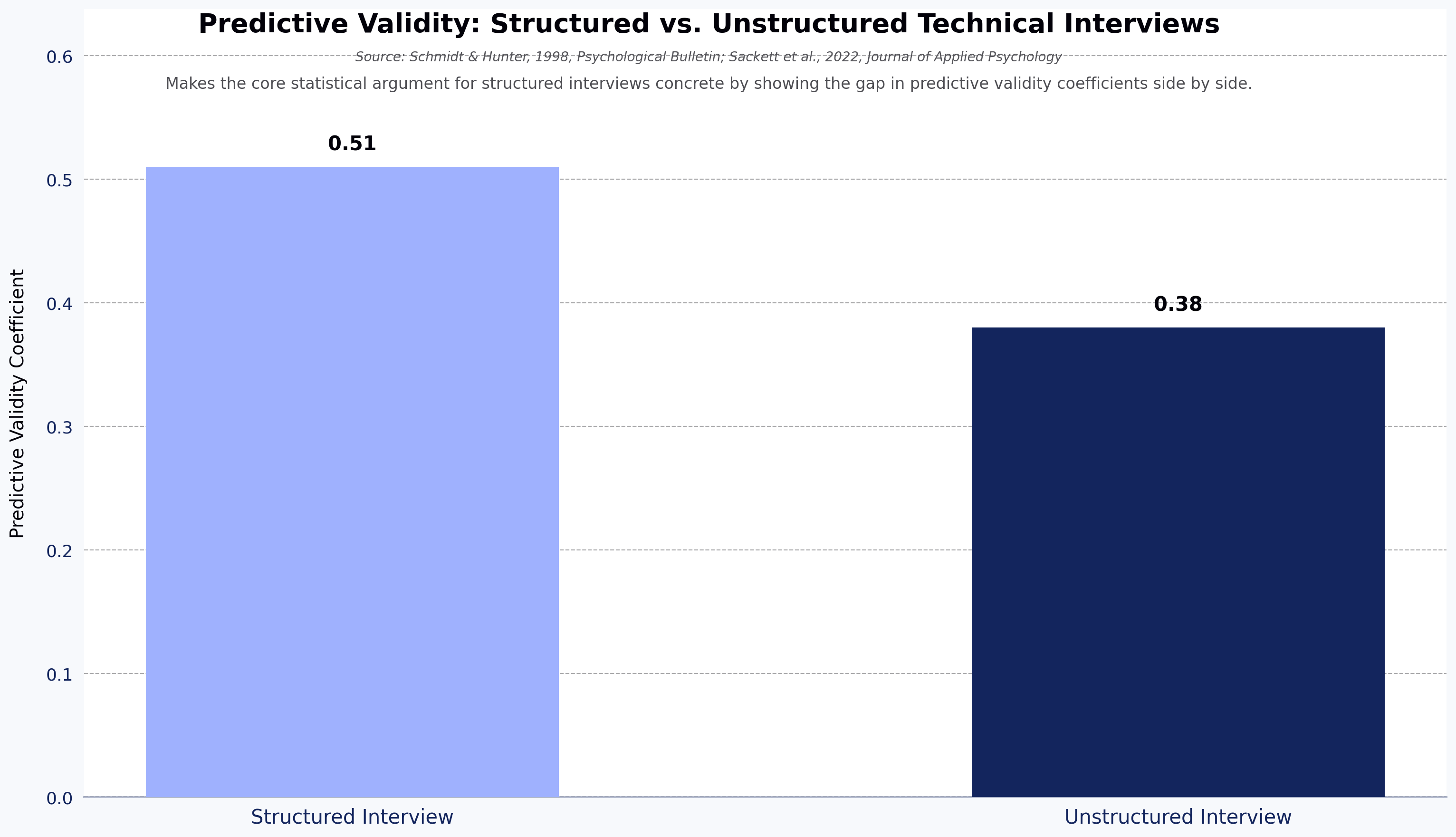
Predictive Validity: Structured vs. Unstructured Technical Interviews
Source: Schmidt & Hunter, 1998, Psychological Bulletin; Sackett et al., 2022, Journal of Applied Psychology

What Is a Technical Interview (and Why Your Process Needs a Rethink)?

A technical interview is a structured candidate evaluation that assesses engineering skills through role-relevant challenges, including live coding, system design problems, debugging exercises, pair programming, and technical phone screens. Unlike a general interview, its goal is to surface evidence of actual technical capability rather than self-reported experience.

The main formats generate different signal types. Live coding tests algorithmic thinking under pressure. System design evaluates architecture instincts at scale. Pair programming reveals how someone works alongside teammates. Take-home assignments show production-quality code without time pressure. Technical phone screens handle high-volume screening early in the pipeline.

The cost of getting the evaluation wrong is not abstract. A commonly cited industry estimate, frequently attributed to the U.S. Department of Labor, puts the cost of a bad hire at roughly 30% of the employee's first-year salary; the original source is disputed, so treat the figure as directional rather than precise. As an illustration: if a mid-level engineer earns around $140,000, that 30% rule-of-thumb would imply roughly $42,000 in recruiting, onboarding, and lost productivity before you start over. The cause is usually not that the wrong person got through; it is that the process never collected enough consistent signal to tell candidates apart.

Step 1 — Define the Role Requirements and Technical Competencies for the Interview

Building interview questions before defining what you are evaluating is the technical hiring equivalent of writing test cases for a feature that has not been specified. Partner with the engineering lead to document must-have versus nice-to-have skills before writing a single question. The output is a competency matrix that anchors every evaluation decision from screening through the final panel.

How to Build a Technical Competency Matrix

Work through three steps: list the role's core daily tasks, map each task to a measurable skill, and assign a minimum proficiency level on a beginner, intermediate, or expert scale.

Sample matrix for a mid-level backend engineer:

Core Task Required Skill Minimum Level Interview Signal
Design RESTful APIs API design patterns Intermediate System design round
Write production Python/Go Language proficiency Intermediate Live coding round
Debug production incidents Debugging and logging Intermediate Code review exercise
Review pull requests Code quality standards Intermediate Pair programming
Work with databases SQL and data modeling Intermediate Domain-specific questions
Understand system trade-offs Distributed systems basics Beginner System design round

If an interviewer cannot tie their evaluation to a row in this matrix, their feedback belongs in notes, not in the scoring rubric.

Step 2 — Choose a Structured Technical Interview Format

Not every format generates the same signal for every role. Choosing formats before the pipeline opens ensures every candidate gets the same evaluation, which is the precondition for fair comparison.

Matching Interview Formats to Role Type

  • Live coding: best for algorithmic and data structure roles, junior to mid-level engineers, and positions requiring frequent problem decomposition
  • System design: best for senior and staff engineers; evaluates architecture thinking, trade-off reasoning, and communication under ambiguity
  • Pair programming: best for teams where collaboration style strongly predicts success; reveals how someone works with a partner under real conditions. For live whiteboarding or extended pair-programming with the hiring team, a dedicated live-coding interview tool such as HackerEarth's FaceCode gives both sides a shared editor and standardized rubric to work from.
  • Take-home assignment: best when production-quality code matters more than in-the-moment speed; works well for senior and specialist roles
  • Technical phone screen: best for high-volume first-round filtering; a short, scripted, repeatable format enables fair comparison at scale

A common pipeline combination is automated technical screening, followed by an AI interview agent for first-round evaluation, followed by a live human panel. Each stage adds a different data type: objective code scores, adaptive conversational signal, and interpersonal judgment.

Step 3 — Prepare Technical Interview Questions and Scoring Rubrics

The ability to conduct coding interviews effectively depends less on the questions you choose than on the system you build around them. When technical interview questions are prepared without a shared rubric, post-interview calibration becomes an argument about preferences rather than an analysis of evidence.

Types of Technical Interview Questions

Five categories map directly to the competency matrix from Step 1:

  • Algorithmic and coding: problem decomposition, time and space complexity, implementation correctness
  • System design: scalability, fault tolerance, component trade-offs, technology selection rationale
  • Debugging and code review: identifying defects in provided code, explaining root causes, proposing fixes
  • Domain-specific: cloud architecture, ML pipelines, database optimization, security considerations
  • Behavioral-technical hybrids: past incidents, technical decisions under constraints, disagreements with technical approaches

Avoid trick questions. A question a candidate could never encounter on the job produces data about their interview preparation, not their engineering ability. For role-aligned question sets, see HackerEarth's library of coding assessment questions.

Building a Scoring Rubric That Removes Guesswork

A scoring rubric converts a conversation into data by anchoring every rating to observable evidence, so post-interview debate is about scores rather than competing impressions.

Sample rubric for a live coding round:

Criterion 1 (Does Not Meet) 3 (Meets Expectations) 5 (Exceeds)
Problem-solving approach No clear method; jumps to code immediately Clarifies requirements, outlines approach before coding Asks probing questions, considers edge cases upfront
Code correctness Solution does not pass core test cases Solution handles core cases; minor gaps in edge cases All test cases pass; candidate identifies potential issues
Code quality Unreadable or unstructured code Readable, functional, lacks optimization Clean, efficient, with clear naming and structure
Communication Silent throughout; cannot explain reasoning Narrates approach but struggles with questions Explains every decision; adapts well to follow-up questions
Speed and accuracy Did not complete the task Completed with time to spare; small errors Efficient solution delivered early; error-free

Each interviewer completes the rubric immediately after the interview, before any group discussion. This protects individual judgment from social pressure and makes calibration faster because everyone compares scores, not competing narratives.

Step 4 — Set Up the Interview Environment and Tools

A candidate who spends the first ten minutes troubleshooting a broken code editor is not demonstrating their engineering ability; they are demonstrating patience. Remove environment friction before the interview starts.

For in-person: confirm IDE or whiteboard setup, test the development environment with the actual question the day before, and ensure the candidate knows which language the company expects.

For remote technical interviews, the most common failure points are environmental: use a shared coding environment rather than a screen share, test video and audio at least 15 minutes before the session, and send any installation instructions 48 hours in advance. For live coding and system design rounds run by the hiring team, HackerEarth's FaceCode provides a shared editor, structured question flow, and rubric-aligned scoring inside one tool.

Step 5 — Use AI Interview Agents to Standardize the First-Round Technical Interview

AI interview agents are reshaping how teams run first-round technical screens because they remove the engineer's calendar from the critical path. These tools present candidates with a question set, adapt follow-up questions based on candidate responses in real time, evaluate code as it is written, and flag integrity anomalies, so every candidate gets an identical evaluation environment.

HackerEarth's AI interview tool for this stage is OnScreen — HackerEarth's AI interview tool that conducts structured technical interviews 24/7 using video-avatar interviewers and built-in identity verification. OnScreen pairs lifelike AI video-avatar interviewers with KYC-grade identity verification and enterprise-grade proctoring, then produces a structured evaluation report covering code correctness, approach quality, communication, and time usage. The AI here is doing three specific things: matching candidate answers to a fixed competency rubric, generating adaptive follow-ups from a curated question bank, and scoring code against test cases written by the hiring team. Its limits are equally specific — it does not assess team-fit, long-horizon design judgment, or anything outside the question set the hiring team configures.

As a directional guideline, AI-led first-round screens often run in the 30–45 minute range, though the right length depends on role seniority and question set rather than the tool.

See it in action: Book a demo of OnScreen to walk through how a structured first-round technical interview runs end to end.

Step 6 — Conduct the Interview With Consistency and Fairness

Consistency in a technical interview does not mean reading questions off a script; it means every candidate is evaluated on the same criteria so comparison is meaningful rather than a negotiation between interviewer preferences.

For human-led interviews: introduce yourself and your role, explain the format and time allocation at the start, follow the rubric question sequence, take timestamped notes referencing specific candidate statements, and reserve five minutes at the end for candidate questions. SHRM has reported that a substantial share of HR managers acknowledge bias influences their evaluations; specific figures vary by study, but the practical implication is the same — a rubric reduces that surface area by requiring evidence-based ratings rather than holistic impressions.

How AI Interview Agents Support Consistent Evaluations

Tools like OnScreen are designed to reduce variability at the stage where it does the most damage: first-round screening. Every candidate receives the same questions in the same sequence, scored against the same model, and evaluation does not vary by interviewer mood or fatigue. Adaptive agents go further by generating follow-up questions based on what the candidate just said or coded, so the interview adjusts to actual performance while still applying the same rubric to everyone.

Research from Glassdoor's Worklife Trends 2024 report found a majority of candidates are comfortable with AI screening provided a human makes the final decision — a useful signal that candidates respond to AI screens better when the human role in the funnel is communicated up front.

Candidate Comfort With AI Screening by Condition
Source: Illustrative based on Glassdoor Worklife Trends 2024 report (majority comfortable with AI screening when human makes final decision)
Candidate Comfort With AI Screening by Condition
Source: Glassdoor Worklife Trends 2024 report (majority comfortable with AI screening when human makes final decision)

Step 7 — Evaluate Candidates Using Data, Not Gut Feel

A frequent failure point in technical hiring is not the interview itself; it is the evaluation afterward. Teams that struggle with how to evaluate developers in interviews consistently identify the same root cause: no shared criteria going into calibration.

From Scorecards to Side-by-Side Candidate Comparison

A clean coding interview evaluation follows three steps: individual scorecard completion before any group discussion, a structured calibration meeting using rubric scores as input, and a documented hiring recommendation that maps back to the competency matrix.

AI-generated transcripts and code playback change what is possible at calibration. A hiring manager who was not in the screening round can review the transcript, see exactly how a candidate handled a specific question, and form an independent view before the panel discussion, rather than hearing a secondhand summary shaped by whoever spoke first.

For teams running assessments alongside interviews, combining assessment scores with interview rubric data gives a multi-signal picture more predictive than any single format alone. HackerEarth's assessment platform pulls both data sets into a single candidate profile, including code quality, plagiarism flags, and rubric-aligned interview scores.

Limitations of AI Interview Agents Worth Naming

AI interview agents are not a universal fit. Worth being honest about the failure modes:

  • Training-data bias. Scoring models inherit the biases of the data they were tuned on; rubric design and ongoing audits matter more than vendor marketing suggests.
  • Role mismatch. AI agents tend to perform best on well-bounded technical screens (coding, debugging, scoped system design) and less well on highly senior, ambiguous, or culture-heavy rounds.
  • Candidate experience variability. Some candidates report discomfort with avatar-led or recorded formats; making the AI step explicit and optional-to-discuss with a human reduces drop-off.
  • Identity and integrity edge cases. Even with proctoring and identity verification, no tool is bias-free or cheat-proof; treat AI signal as one input alongside human panels rather than a verdict.

Naming these openly is part of the case for using AI agents only where they add signal — typically the first round — rather than across the entire funnel.

Deliver Feedback and Improve the Candidate Experience

Feedback to rejected candidates feels like optional extra work until you realize every candidate who walks away without it is a potential detractor in a tight engineering community.

Close the loop with every candidate within five business days. For candidates who completed a full technical assessment and interview, provide rubric-referenced feedback: not "you were not quite what we were looking for" but "your solution was correct and your communication was strong; the panel needed more depth on distributed systems trade-offs for this role." That single sentence converts a rejection into information rather than judgment.

AI interview reports make this fast. A hiring manager pulls the evaluation summary, adds one sentence of human context, and delivers actionable feedback in under five minutes instead of synthesizing notes from three different interviewers.

Where AI Interview Agents Fit in the Full Hiring Funnel

Treating AI interview agents as a replacement for the full technical interview process is a common adoption mistake. They are a stage in a multi-signal pipeline, most useful when positioned at the right point in the sequence.

Screening Stage

AI agents handle high-volume first-round screens autonomously. A candidate who applies on Monday can complete a structured technical interview by Tuesday morning, without waiting for a recruiter to find a calendar slot. Time-to-hire gains are largest at this stage because the main bottleneck — scheduling and running screening calls — disappears.

Assessment Stage

Pair AI agents with structured coding assessments for a two-signal evaluation. The assessment provides objective code quality metrics; the AI interview adds conversational signals: how a candidate explains their thinking, handles ambiguity, and responds to follow-up. Together they produce more useful data than either format alone.

Final Interview Stage

Human interviewers use AI-generated transcripts and code playback to run more targeted final-round conversations. Instead of re-covering ground the AI already assessed, the final round focuses on role-specific depth, culture and collaboration signals, and questions only a human conversation can answer.

7 Common Mistakes to Avoid When Conducting Technical Interviews

Gaps between best practice and how technical interviews actually run tend to look similar regardless of company size. Each mistake below is a place where unstructured processes substitute habit for signal.

  1. Skipping the competency matrix. Questions drift toward what interviewers find interesting, not what the role requires, and post-interview calibration has no anchor.
  2. Using the same question bank for junior and senior roles. Difficulty should track seniority; using the same questions at every level tests the wrong things at both ends.
  3. Letting each interviewer freelance their own format. When every interviewer runs a different process, you cannot compare candidates; you are comparing interviewers.
  4. Prioritizing trick questions over real-world problem-solving. Trick questions test whether the candidate has seen the puzzle before, not whether they can do the job.
  5. Ignoring communication and collaboration signals. A candidate who writes correct code but cannot explain their reasoning will struggle in code reviews and incident response; communication belongs in the rubric, not as an afterthought.
  6. Waiting too long to deliver feedback. Candidates who wait two or more weeks will either accept another offer or describe the experience publicly; feedback within five business days is a competitive differentiator.
  7. Not using AI tools to scale and standardize. Running every first-round screen manually trades hiring capacity for process inertia — a structured AI-led first round frees recruiter and engineer hours for the rounds where human judgment actually matters.

Next steps

A technical interview process that produces consistent, defensible hiring decisions is built from seven repeatable moves: define role competencies with a matrix, choose structured formats matched to role type, prepare rubric-scored questions before interview day, set up a frictionless environment, standardize the first round with an AI interview agent like OnScreen, conduct every interview against the same criteria, and close the loop with specific feedback within five business days.

The recruiters who get the most out of this approach tend to share one habit: they treat the rubric and the AI report as the canonical record of the interview, not the conversation people remember afterward. That single shift — from impressions to evidence — is what makes the process more consistent across candidates than human-led screens alone.

Next step: Book a demo of OnScreen to see how a structured, rubric-applied first-round technical interview runs at scale.

FAQs

How long should a technical interview last?

Coding rounds typically need around 45 minutes; system design rounds benefit from a full 60; AI-led first-round screens often run in the 30–45 minute range because adaptive questioning removes some of the conversational drift in human-led screens. Format determines the right length more than convention does.

If interviews routinely run long, the more likely problem is an underspecified question, not an under-allocated time slot.

Can AI conduct a technical interview?

AI interview agents can run full first-round technical interviews, including adaptive questioning, real-time code evaluation, and structured report generation. They tend to work best at the screening stage where consistency and speed matter most. Human interviewers remain the stronger option for final rounds, where nuanced judgment, culture signals, and relationship-building cannot be automated.

The harder question for most teams is operational: will the panel trust the AI report enough to make calibration decisions from it, instead of re-running its work in person?

What questions should I ask in a technical interview?

Questions should map to the role's competency matrix and cover algorithmic challenges, system design prompts for senior roles, debugging exercises, and domain-specific questions relevant to the team's stack. Avoid anything that rewards memorization over applied thinking.

The most predictive questions are usually the ones that look closest to the actual job — not the cleverest puzzle in the question bank.

How do you evaluate a candidate in a technical interview?

Use a pre-built scoring rubric covering problem-solving approach, code correctness, code quality, communication, and time management, rated on a 1 to 5 scale with behavioral anchors, and complete it individually before any group discussion. Combine human rubric scores with AI-generated evaluation data for a fuller picture.

Rubrics feel like bureaucracy until the first calibration meeting where someone changes their recommendation after hearing the room — at which point you wish every score had been locked in before the discussion started.

How do you reduce bias in technical interviews?

Structure is the most consistent lever available: standardized questions, rubrics with behavioral anchors, and diverse panels reduce the conditions under which bias operates. AI-powered interviews — where the AI applies a fixed rubric and question set to every candidate, trained on the hiring team's own evaluation criteria, with limits around team-fit and senior judgment calls — can add rubric-applied evaluation that doesn't vary by interviewer mood or fatigue. According to Glassdoor's Worklife Trends 2024 research, a majority of candidates are comfortable with AI screening as long as a human makes the final decision.

Bias does not disappear with a rubric; it just has less room to operate without becoming visible in the scores.
AI Recruitment Vendor Evaluation: Buyer's Checklist 2026

How to evaluate AI recruitment vendors: the buyer's checklist for 2026

Estimated read time: 12 minutes

Meta title: AI recruitment vendor evaluation: buyer's checklist 2026 (56 characters)

Meta description: How to evaluate AI recruitment vendors in 2026: a 10-step buyer's checklist covering bias audits, EU AI Act compliance, ATS fit, and pilots. (143 characters)

Primary audience: Head of Talent Acquisition (primary); Engineering Managers and CHROs (secondary).

To evaluate AI recruitment vendors in 2026, treat procurement as a compliance, integration, and candidate-experience exercise — not a software demo. The single biggest mistake teams make is scoring vendors on feature lists before defining their own hiring bottleneck, and the second is signing without a structured pilot. This guide walks through a ten-step framework you can run with TA, engineering, IT, legal, and finance in the room.

AI systems carry regulatory, ethical, and candidate-experience implications that standard SaaS procurement was never designed to evaluate. Learning how to evaluate AI recruitment vendors with that lens is now table stakes, because the regulatory clock is running. Under the EU AI Act, full enforcement for high-risk AI systems — which explicitly includes employment AI — takes effect August 2, 2026. NYC Local Law 144 has been in force since July 5, 2023; per the NYC DCWP, civil penalties begin at $500 for a first violation and can reach $1,500 for subsequent violations, with each day of non-compliance treated as a separate violation — buyers should confirm current penalty figures with counsel before relying on them in procurement. If your evaluation process does not include compliance gatekeeping, you are collecting demos, not evaluating vendors.

This buyer's guide gives procurement teams, TA leaders, and engineering managers a shared AI recruitment vendor checklist they can work through together.

Step 1 — Define your hiring pain points before you shop

Defining your own bottleneck before vendor conversations is the single most important step in any AI recruitment vendor evaluation. Skipping it is how teams buy tools that solve the vendor's problem, not theirs. A sound recruitment technology evaluation starts with your own hiring data, not a vendor's feature list.

Map your current workflow gaps

Fill in this table before your first vendor call. The gaps you identify should drive every scoring decision that follows:

Funnel Stage Current Tool or Process Observed Gap or Delay Impact
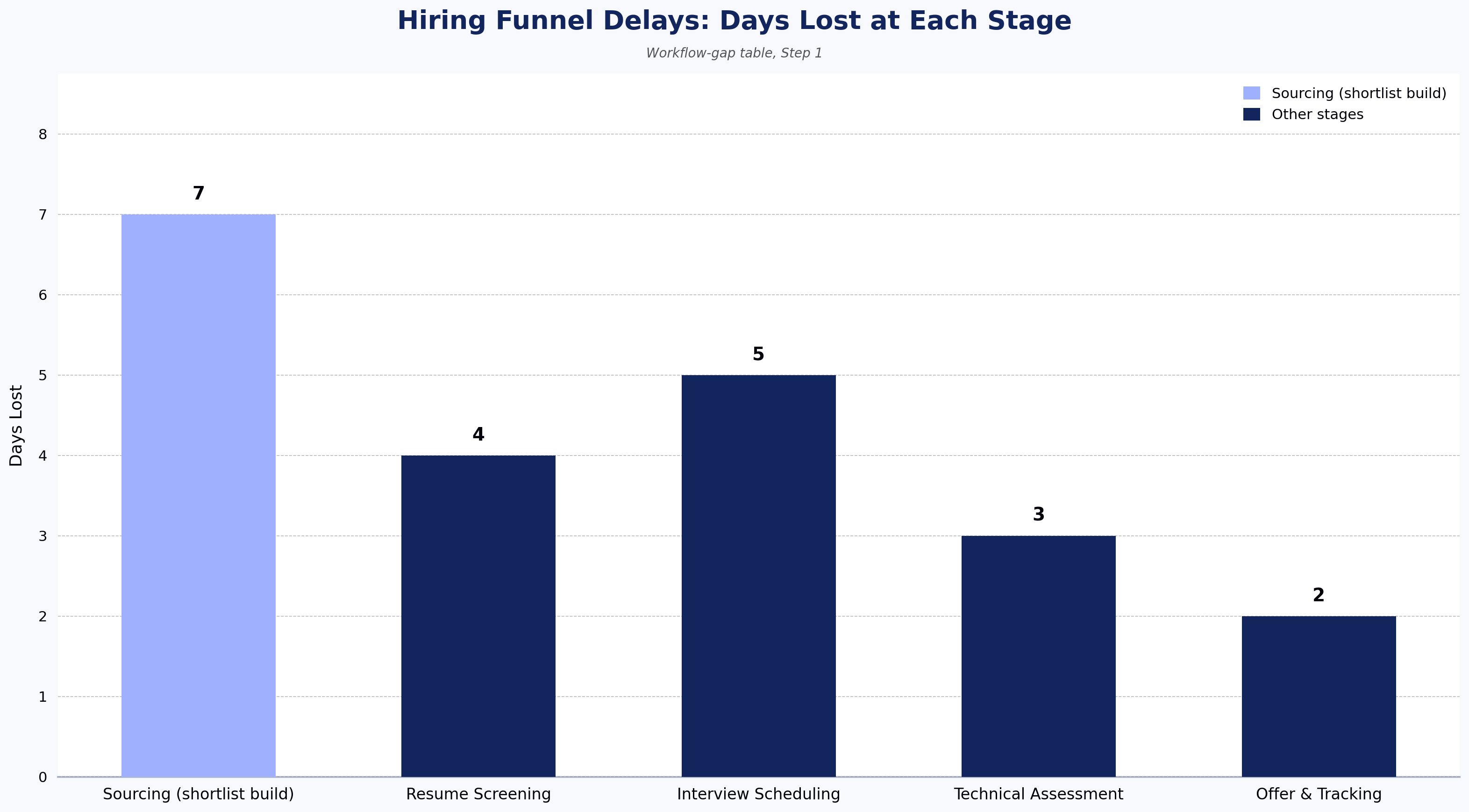
Sourcing LinkedIn Recruiter, job boards 7+ days to build shortlists for technical roles Slow top-of-funnel; passive candidates missed
AI candidate screening Manual resume review 3–5 days; inconsistent criteria across recruiters Quality varies; bias risk unquantified
Technical assessment Ad hoc whiteboard or take-home No standardized scoring; senior engineer time consumed Inconsistent data; interviewer time wasted
Interview scheduling Email coordination 4–6 days of back-and-forth per candidate Time lost; candidates drop off during wait
Offer Manual tracking Slow turnaround; no pipeline visibility Competitive candidates accept elsewhere
Hiring Funnel Delays: Days Lost at Each Stage
Source: Workflow-gap table, Step 1

Set measurable goals for AI recruitment

Goals set before vendor conversations make hiring vendor selection defensible to finance and give you a real basis for pilot evaluation. Agree on these across HR, engineering, and finance before any demo is scheduled:

  • Reduce time-to-hire for software engineering roles from 45 days to 30 days within two quarters
  • Increase technical assessment completion rate from 62% to 85% within 90 days
  • Cut cost-per-qualified-candidate by 40% for roles requiring coding evaluation
  • Achieve SOC 2 Type II compliance for all candidate data processed by the new vendor within 60 days of contract signing

Step 2 — Understand the AI recruitment vendor landscape

The AI recruitment vendor landscape splits into five distinct categories, and scoring across categories without acknowledging that is how procurement teams end up comparing tools that don't do the same job. Running an effective AI recruitment software comparison requires knowing which category each vendor belongs to before you score them — comparing a sourcing tool against an assessment platform is like scoring a plumber and an electrician on the same rubric.

Categories of AI recruitment tools

The vendor landscape breaks into five segments. Most AI recruiting tools occupy one or two of these; very few cover all of them at depth:

  • AI sourcing tools: Find and surface passive candidates from databases and code repositories.
  • AI screening and assessment platforms: Evaluate candidate qualifications through resume scoring, skills tests, or cognitive assessments.
  • AI interview platforms: Conduct, record, transcribe, or score interviews.
  • AI scheduling and workflow automation (also called recruitment automation platforms): Handle calendar coordination and candidate communications.
  • Full-stack AI recruitment suites: Attempt to cover multiple stages.

When you evaluate recruitment technology, your pain points from Step 1 should map to one or two of these segments, not all five.

Full-stack platforms vs. point solutions

The full-stack vs. point-solution decision is the one most procurement teams get wrong — usually by defaulting to a suite when a focused tool would outperform it at the specific stage that actually needs fixing:

Factor Full-Stack Platform Point Solution
AI depth per function Often broad but shallow Deep in one area
Integration overhead Lower (single vendor) Higher (multiple vendors to connect)
Data continuity Unified pipeline data Fragmented across tools
Vendor dependency risk High (single point of failure) Distributed
Time to value Longer (more to configure) Faster for targeted problem
Cost at scale Higher license cost Can be modular and lower entry

Step 3 — Evaluate core AI capabilities

The technical interrogation of an AI recruitment vendor — training data, update cadence, documented error rates — is what separates a real evaluation from a demo review. Skip it and teams discover post-contract that AI recruitment platform features that looked impressive in a demo do not hold up under real conditions. Knowing how to evaluate AI recruitment vendors at this layer means pressing on each of those dimensions explicitly.

Assessment and screening accuracy

"AI-powered" on a vendor's website means nothing without validation data behind it. Ask directly: what is the model trained on, when was it last updated, and what is the documented false-positive rate? Request specific benchmark data from each vendor in writing — the best AI recruitment platforms 2026 can produce these benchmarks on request; those that cannot should not advance past the RFP stage. HackerEarth's Skill Assessments use rubric-based scoring with role-based assessment design, which is the difference between an assessment that predicts job performance and one that measures interview prep.

AI interview and coding evaluation

When evaluating AI interview platforms, require candidates to demo the actual coding environment on real data, not a recorded walkthrough. Questions that separate real capability from polished demo:

  • Does the platform execute code in a real runtime environment, or does it only analyze syntax?
  • How many programming languages does it support natively versus through workarounds?
  • Does AI scoring operate autonomously, or does it assist a human reviewer?
  • Are transcripts and scoring rationale exportable for compliance audit?
  • Can the interview AI adapt to candidate responses, or does it follow a fixed script?

Fixed-sequence interview AI can function like a test with a publicly available answer key. For a broader comparison of interviewing tools and approaches, see HackerEarth's overview of FaceCode, the interviewer-led technical interview platform.

Candidate matching and ranking algorithms

Black-box ranking is a compliance liability, not just a technical shortcoming. Any AI talent acquisition vendor that cannot explain why their algorithm ranked one candidate above another — in terms a hiring manager can read and defend — is handing you a legal risk alongside their platform license. Require end-to-end documentation of matching logic before any contract advances.

Step 4 — Audit for bias, fairness, and compliance

Any AI hiring platform that cannot produce independent bias audit documentation in 2026 should be eliminated before the scorecard is built. This step is the regulatory gate that everything else depends on.

Bias testing and audit documentation

Require vendors to produce their bias audit methodology, not just a claim that testing was done. The documentation must include adverse impact ratios for Title VII-protected groups, the auditor's name and independence from the vendor, and the dataset used. NYC Local Law 144 sets the operational benchmark: annual independent bias audits, public results, and 10-business-day advance notice to candidates. Penalty figures previously cited in this article — first-violation and subsequent-violation amounts under the law — should be confirmed against current NYC DCWP guidance before relying on them in procurement. Enterprise buyers increasingly expect bias audit documentation as part of procurement diligence.

AI Act compliance for recruitment

The EU AI Act classifies employment AI as a high-risk system, which creates specific documentation, transparency, and human-oversight obligations for any vendor whose tool touches EU candidates. Buyers should require evidence that the vendor has mapped their product to the Act's high-risk requirements ahead of the August 2, 2026 enforcement date — including risk management documentation, data governance records, and post-market monitoring plans. US-headquartered companies using AI tools to assess candidates physically located in the EU are generally in scope; confirm specific applicability with counsel.

Bias audit documentation requirements

A defensible bias audit produces, at minimum: the auditor's identity and independence statement, the dataset and time window audited, adverse impact ratios broken out by protected category, and the remediation actions taken since the prior audit. Vendors who provide only a summary score — or who treat the audit as proprietary — are not meeting the documentation bar that current and proposed regulations expect. Request the full report under NDA if needed, not just an executive summary.

Regulatory compliance checklist

The following items form the core AI recruitment RFP criteria. Vendors who cannot confirm all applicable items in writing should not advance to demo:

  • GDPR: Data processing agreement provided; data subject rights confirmed
  • EEOC: Adverse impact compliance documentation; awareness of current EEOC technical assistance on AI and Title VII
  • NYC Local Law 144: Audit capability and candidate notification support confirmed
  • Illinois AIVIA: Consent mechanism and AI disclosure for video interview tools — verify current obligations with counsel
  • Colorado AI Act (SB 24-205): Risk assessment documented for high-risk AI systems — verify applicability and current enforcement timeline with counsel
  • SOC 2 Type II: Current certification available on request
  • Data residency: Storage location confirmed; regional options available
  • Penetration testing: Most recent test date and scope documented

Step 5 — Assess integration and technical compatibility

Integration architecture, not feature depth, is the single biggest predictor of whether an AI hiring platform actually works inside your stack. The most technically impressive tool becomes a liability if it cannot sync with the systems your team already uses — and most post-implementation complaints trace back to integration decisions made too late in procurement.

ATS and HRIS integration

For each ATS on your list — Greenhouse, Lever, Workday, iCIMS, SAP SuccessFactors — require the vendor to demonstrate bi-directional data sync, not describe it. A one-way CSV export is not an integration; it is a workaround that creates reconciliation work every time it runs. Four questions to confirm before any contract is signed:

  • How long does implementation take for each ATS you are connecting?
  • What data syncs in each direction?
  • What happens to in-flight candidates if the integration fails?
  • Is the integration native or middleware-dependent?

API flexibility and data portability

Treat API documentation quality as a proxy for vendor maturity — if it is not publicly available before the demo, that tells you something. More critically: confirm you can export all assessment data and candidate records in a structured, machine-readable format if you decide to leave. If you cannot, the vendor owns your data, not you. Build export rights and format specifications into the contract before signing.

Step 6 — Evaluate the candidate experience

Candidate experience is the side of an AI recruitment platform that procurement teams most often miss — which is how they end up buying tools their candidates abandon.

Interface usability for candidates

Run the candidate-side demo on a mobile device. Practitioner observation suggests a meaningful share of early-stage assessment completions happen on mobile, so a platform that is not genuinely mobile-responsive will show up in your completion rates — verify against your own data before relying on any external figure. Long assessments also contribute to drop-off in many teams' experience, so evaluate time-to-complete explicitly and keep assessments as short as the role allows. WCAG 2.1 AA is the minimum accessibility standard to require. For guidance on building a stronger candidate process alongside the tool, see HackerEarth's guide to improving the candidate experience.

Communication and feedback loops

Ghosting a candidate after a 45-minute AI assessment is a recruiting brand problem, not a feature gap. Evaluate what automated communications the platform sends post-completion, whether recruiters can personalize them, and whether candidates can receive any performance feedback. Sharing summary results with candidates is sometimes associated with stronger reapplication rates and employer-brand outcomes in practitioner reports, but this is a hypothesis to test, not an established finding — request vendor-specific data before assuming it applies to your pipeline.

Step 7 — Analyze pricing models and total cost of ownership

The license fee is almost never the largest cost of an AI recruitment platform — which is why buyers who model only the headline price end up explaining surprises to finance 12 months later.

Common pricing structures

Pricing Model How It Works Best Fit Watch For
Per assessment Fixed fee per candidate (market ranges vary widely) Variable or seasonal hiring volume Costs scale unpredictably at high volume
Per seat / per user Monthly or annual fee per recruiter Stable team size, high assessment volume Unused seats; overage charges
Platform license Annual flat fee within defined limits Large-volume, enterprise programs Scope limits; steep renewal increases
Per hire Fee per successful placement Early-stage teams paying on outcomes Incentive misalignment with vendor

For teams hiring at higher volumes, per-assessment pricing can become more expensive than a platform license over time — model both against your projected annual volume before deciding.

Hidden costs to watch for

Build this calculation before comparing vendors: (Annual license fee + implementation cost + integration development + training and onboarding + premium support tier + bias audit fees + overage charges) divided by expected hires per year = platform cost per hire. ATS integration scoping can vary widely depending on complexity and the ATS involved — request written scoping estimates from each vendor. Always negotiate auto-renewal clauses out of the initial contract, or require at minimum 90-day written notice before any renewal.

Step 8 — Run a structured pilot or proof of concept

A structured pilot is the only reliable way to predict how an AI recruitment platform will behave on your real data — demo environments are always clean, and yours is not.

Design a pilot framework

Run the pilot alongside your current process, not in place of it, so you have a real baseline to measure against. Practitioners commonly recommend these parameters as a rough guide:

  • Duration: 30 to 60 days minimum
  • Volume: 50 to 100 completed assessments as a rough guide for meaningful signal
  • Role type: One role type you hire frequently, run concurrently with your existing process
  • Ownership: A named recruiter on your team and a named technical contact at the vendor available within 24 hours

Metrics to track during the pilot

Establish baselines for these metrics before the pilot starts, not during:

  • Assessment completion rate (in our experience, some practitioner teams target 80% or higher; calibrate to your own historical baseline)
  • Candidate satisfaction score via post-assessment survey
  • Time-to-shortlist from role opening to a ranked candidate list
  • Hiring manager satisfaction with candidate quality
  • False-positive rate from assessment to next human review stage
  • Integration reliability: sync failures between the platform and your ATS
  • Technical support responsiveness against the vendor's stated SLA

Build a shared tracking dashboard — even a simple spreadsheet — visible to both your team and the vendor. Resistance to transparent pilot metrics is useful information about what post-contract accountability will look like.

Step 9 — Verify vendor support, security, and scalability

Support quality, security certification, and scalability are the procurement criteria most often deferred and most often regretted — the day after contract signing is when these gaps become real.

Onboarding and ongoing support

The gap between a strong demo and a successful implementation is almost always a support problem, not a product problem. Confirm whether the vendor provides a dedicated customer success manager or pool-based ticket support, whether the SLA is in the contract or verbal, and what implementation milestones the vendor is contractually accountable for. Find current customers through LinkedIn or G2 — not vendor-provided references — and ask specifically about support quality six months post-implementation.

Data security and certification

Required baseline for any enterprise AI hiring tool that processes candidate PII:

  • SOC 2 Type II: Current certification; report available on request. SOC 2 Type I is generally insufficient for enterprise procurement, though some vendors in active certification may be considered case-by-case.
  • Encryption at rest and in transit: AES-256 or equivalent
  • Data residency: EU data residency option for European candidates
  • Penetration testing: Annual third-party test; most recent report available under NDA
  • Incident response plan: Breach notification process documented within GDPR's 72-hour requirement

HackerEarth's remote proctoring for online assessments generates plagiarism detection logs, behavioral monitoring records, and tab-switch audit trails — which serve double duty as compliance documentation.

Scalability for enterprise growth

Ask vendors for uptime SLAs and peak-load benchmark data from their largest customers. Some enterprise buyers target 99.9% uptime as a baseline and treat anything below 99.5% as a negotiation point, in line with widely used hyperscaler SLA benchmarks (e.g., AWS and Azure service-level commitments) — calibrate to your own risk tolerance. Confirm whether pricing changes materially at 10x your current volume before the contract is signed, not after.

Step 10 — Build your final vendor scorecard and get buy-in

A weighted scorecard is the discipline that prevents a vendor evaluation from defaulting to whichever demo felt most polished.

Weighted scoring criteria

Apply weights that reflect your organization's priorities from Step 1. These are suggested defaults, not fixed values:

Evaluation Category Suggested Weight Rating Scale
AI accuracy and capability depth 25% 1 = no validation data; 5 = third-party validated benchmarks
Bias and compliance documentation 20% 1 = no documentation; 5 = independent audit with demographics
ATS and HRIS integration 15% 1 = CSV only; 5 = native bi-directional sync
Candidate experience quality 15% 1 = poor mobile/accessibility; 5 = full WCAG 2.1 AA, mobile-first
Pricing transparency and TCO 10% 1 = opaque custom-only; 5 = clear published model, no hidden fees
Support quality and SLAs 10% 1 = ticket-only; 5 = dedicated CSM, SLA in contract
Scalability and security 5% 1 = no SOC 2; 5 = SOC 2 Type II, documented pen testing

Any vendor below 65 requires specific risk acknowledgment before advancing. Any vendor that cannot produce bias and compliance documentation is eliminated regardless of score elsewhere.

Vendor Management Framework
Source: Article scorecard, Step 10

Stakeholder alignment and sign-off

The RACI structure below distributes accountability so every critical risk has a named owner before the purchase. R = Responsible, A = Accountable, C = Consulted, I = Informed:

Evaluation Activity TA Leadership Engineering / Hiring Managers IT and Security Procurement and Legal Finance
Define hiring pain points and goals A C I I C
Evaluate AI capability and accuracy A R I I I
Review bias audits and compliance docs A I R R I
Assess ATS integration architecture C I A I I
Run candidate-side demo review A R I I I
Review pricing model and TCO R C C R A
Conduct pilot and measure results A R C I C
Contract review and final sign-off R I C A R

The goal is not consensus — it is ensuring every critical risk has a named owner before the purchase.

Where HackerEarth fits in your AI recruitment evaluation

HackerEarth is a technical hiring platform, not a full-stack recruitment suite — and that focused scope is exactly what makes it worth putting on your shortlist if technical assessment and interviewing quality is where your process breaks down.

Against the criteria in this guide, HackerEarth's Skill Assessments provide role-based assessments and rubric-based scoring across 1,000+ skills and 40+ programming languages, with custom assessment content creation available to cover non-technical roles such as sales, customer support, and finance. HackerEarth offers two distinct interview products that buyers should evaluate separately: FaceCode, the interviewer-led platform, gives interviewers direct in-session access to HackerEarth's question library during live interviews. OnScreen, HackerEarth's AI-led interviewing product (

5 Habits That Help Technical Candidates Stand Out

5 Habits That Help Technical Candidates Stand Out at Work

Read time: 7 minutes (1,750 words ÷ 250 wpm)

Editorial methodology: This article is written by the HackerEarth Editorial Team and draws on patterns observed across technical interviews and assessments run on HackerEarth's platform, combined with named research where cited. Internal observations are flagged as editorial review, not controlled study.

Publisher notes (metadata to lock before publish): - Recommended meta title: 5 Habits That Help Technical Candidates Stand Out at Work (58 chars) - Recommended meta description: The candidates who grow into senior contributors share five observable habits. Here's how hiring teams can screen for them in a structured rubric. (148 chars) - Verify before publish: all internal HackerEarth links; McKinsey 2021 URL/year; Minto edition year; Voss 2016 publication year.

Summary: For recruiters and engineering managers, the candidates who grow into senior contributors share a small set of observable habits — how they pause, ask questions, and structure communication under pressure. This article unpacks five habits that help technical candidates stand out at work and shows how hiring teams can screen for them inside a structured interview rubric.

The most reliable way for a technical candidate to stand out at work is not technical depth — it is a set of five observable behavioral habits that show up before the first line of code is written. These habits surface in interview transcripts, in calibration sessions, and in how candidates handle ambiguity inside a structured rubric. For recruiters, hiring managers, CHROs, and engineering managers building out a pipeline, knowing which habits to screen for is the most reliable screening variable.

Daniel Goleman's foundational Harvard Business Review article on emotional intelligence argues that EI competencies are differentiators in leadership performance — a finding hiring teams can apply directly when deciding which behavioral signals to score in a rubric. We return to specific research findings inside each habit below, rather than treating citations as decoration.

1. Pausing before reacting

Pausing before you react is the habit of taking a two-to-five-second internal beat before responding to a question, comment, or unexpected event. It reduces miscommunication and signals emotional regulation to colleagues and managers — a trait that Goleman's HBR work on emotional intelligence links to higher leadership ratings, and one of the clearer behavioral markers of candidates who stand out at work.

When something goes wrong at work, the natural instinct is to answer immediately. Fast reactions, though, rarely produce the most accurate read on a situation. A brief pause to understand the situation, gather context, process information, and frame a response often produces noticeably clearer communication and fewer follow-up corrections.

In our editorial review of behavioral interview transcripts, the candidate who answers fastest in a behavioral round is rarely the candidate the panel later describes as the most thoughtful contributor in calibration. Speed gets mistaken for competence in the moment. Reviewing transcripts side by side tends to reward the deliberate.

The trade-off: pausing is not universally rewarded. In high-urgency incident response — a production outage, a customer escalation in progress, a live client objection — a visible delay can be read as hesitation rather than thoughtfulness. The habit applies most cleanly in planning conversations, design reviews, and one-on-ones, less cleanly in real-time crises. Cultures that reward fast visible output (early-stage startups, sales floors) may also penalize the reflective pattern, at least in the short term.

2. Buying thinking time with a single phrase

Buying thinking time is the habit of explicitly naming that you need a moment, rather than silently pausing. Saying "Let me think about that for a second" or "I want to give that a careful answer — can I come back to you in ten minutes?" makes the pause visible and turns it into a credibility signal rather than a silence to be filled.

This is operationally distinct from Habit 1. Habit 1 is a sub-five-second internal beat before responding. This habit is a verbal handoff that buys minutes or hours — useful when the question is genuinely complex (a strategy call, a salary negotiation, a stakeholder pushback) and a fast answer would be worse than a slow one.

In team meetings, leadership discussions, job interviews, client conversations, and stakeholder presentations, this phrase shifts the dynamic: the asker now expects a considered response, and you've reset the clock. The risk is overuse — relying on the phrase for every question signals avoidance rather than rigor. A useful threshold: deploy it when the answer has downstream consequences you can't easily reverse.

For recruiters calibrating candidates, watch for this phrase under pressure. Candidates who deploy it appropriately in a structured screen often demonstrate the same restraint on the job.

3. Tolerating silence in conversations

Tolerating silence is the habit of not rushing to fill pauses that already exist in a conversation — particularly after you've finished speaking, or after someone else has asked you something. It is one of the habits that most consistently separates candidates who stand out at work from those who blur together in panel debriefs.

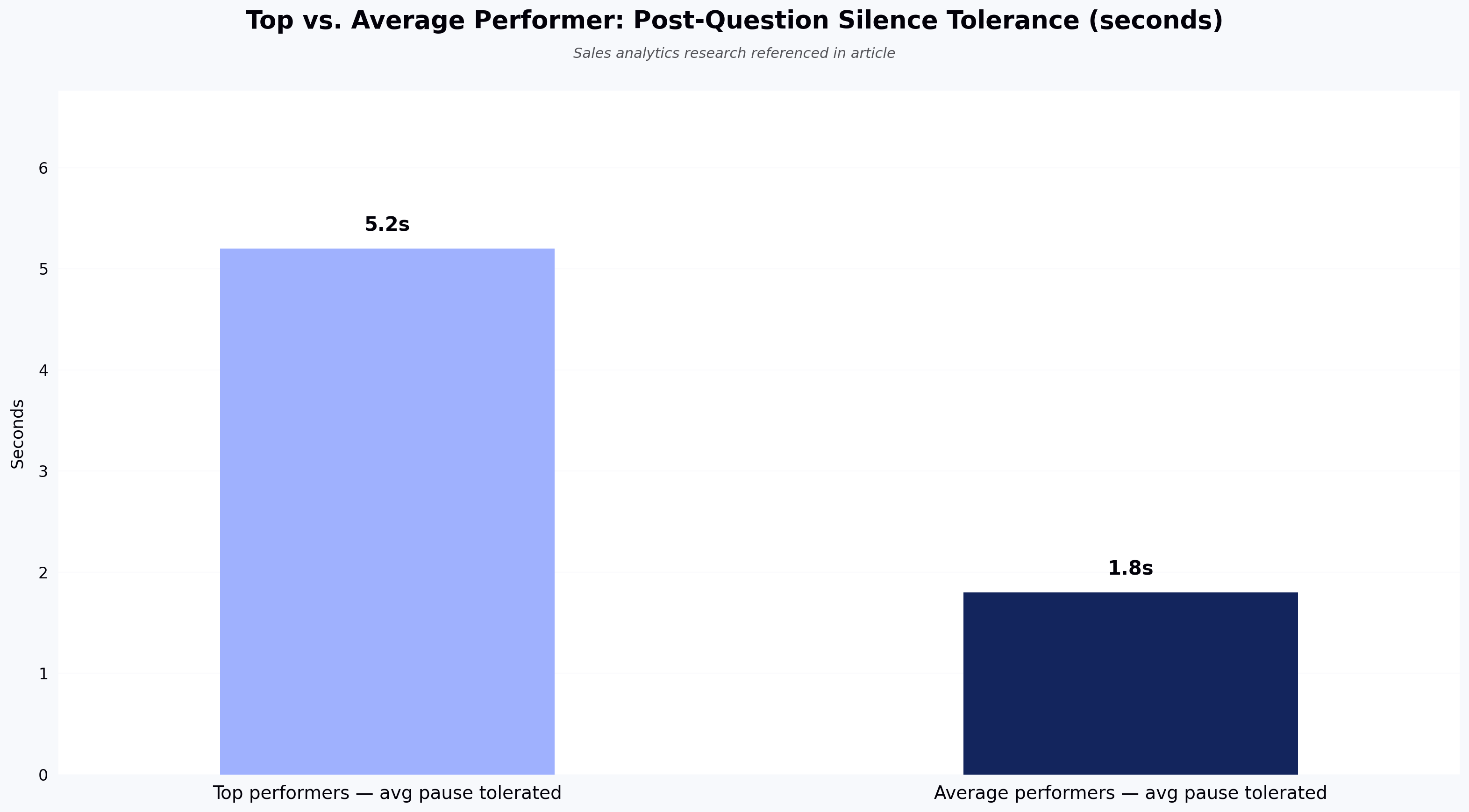
The mechanism here is different from Habits 1 and 2. Those habits create silence intentionally. This habit is about not collapsing silence that the conversation produced on its own. As an editorial observation — not a platform-derived finding — candidates who can sit with a three- to five-second post-answer pause in a behavioral round tend to come across as more composed and clearer than those who immediately add qualifiers. Chris Voss's practitioner framework in Never Split the Difference (2016) argues that the side that breaks silence first tends to concede ground; this is a practitioner observation rather than a peer-reviewed finding, and we cite it here as one framing among several.

A concrete threshold: if you've answered a question and the other person hasn't responded within three seconds, resist the urge to add a qualifier, restate the point, or fill the gap. Let them respond first. This applies in performance reviews, salary discussions, and design critiques where the temptation to over-explain is highest.

Here's a debatable angle: asking one question in a meeting is often more memorable than making three points, because a question transfers ownership of the idea to the room. The same logic applies to silence — restraint is a form of presence.

Top vs. Average Performers: Post-Question Pause Tolerance
Source: Sales analytics research referenced in article
Top vs. Average Performer: Post-Question Silence Tolerance (seconds)
Source: Sales analytics research referenced in article

4. Asking one load-bearing question

Asking one load-bearing question is the habit of replacing a long explanation with a single, well-framed question that does more work than the explanation would. A well-framed question may surface assumptions the group hadn't examined.

What makes a question load-bearing? It typically does one of three things: exposes a hidden constraint ("What happens if the volume doubles?"), reframes the problem ("Are we solving the right problem, or the visible one?"), or forces a prioritization ("If we could only ship one of these, which matters more?"). Generic questions like "What do you think?" don't qualify.

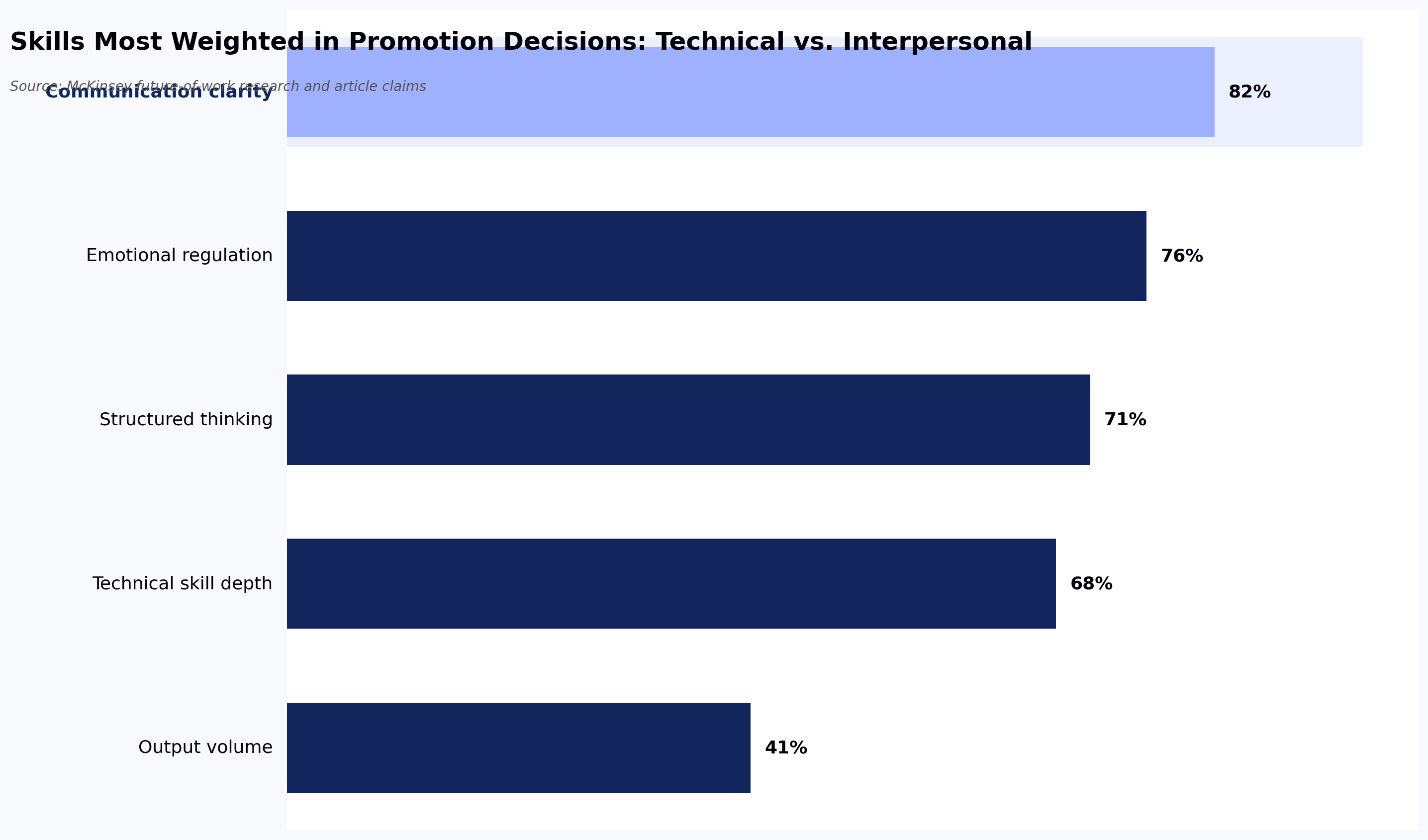
A useful framework here is the Pyramid Principle, developed by former McKinsey consultant Barbara Minto and originally published in 1978 (with revised editions since) in her book The Pyramid Principle, which structures communication by leading with the conclusion and supporting it with grouped, mutually exclusive arguments. McKinsey's Defining the skills citizens will need in the future world of work (2021) identifies communication and self-leadership as foundational skill categories employers increasingly screen for — a direct argument for scoring question quality, not just answer quality, in a rubric.

For interview contexts specifically, the STAR method (Situation, Task, Action, Result) is the standard framework for structuring responses — and the best candidates often ask the interviewer one STAR-shaped question in return to demonstrate the same structured thinking. In our view, when designing rubrics, the quality of candidate questions is often a more reliable leveling signal than the polish of their answers. For more on rubric design, see HackerEarth's guide to designing technical interview rubrics.

Skills Most Weighted in Promotion Decisions: Technical vs. Interpersonal
Source: McKinsey future-of-work research and article claims

5. Communicating with structure and brevity

Communicating with structure and brevity is the habit that ties the others together — and it is often the most visible reason technical candidates stand out at work. High performers communicate by focusing on what matters, why it matters, and what action is needed — without adding qualifying clauses that dilute the point.

In practice, this means leading with the conclusion in written updates (a pattern the Pyramid Principle formalizes), capping verbal updates at the length that respects the listener's attention, and resisting the impulse to demonstrate effort through volume. This is the habit most directly tied to the communication and self-leadership skill categories named in the McKinsey 2021 future-of-work research cited above.

The trade-off worth naming: brevity can read as curt in cultures or relationships where context-setting is the social norm. In cross-cultural teams, in early relationships with a new manager, or in sensitive feedback conversations, leading with the conclusion without sufficient framing can damage trust. Calibrate to audience.

How hiring teams can screen for these habits

Screening for these habits in a hiring pipeline requires designing the interview itself to surface them — not relying on interviewer instinct after the fact. The point of control for recruiters and engineering managers is the rubric: which behaviors get scored, by which interviewer, against which benchmark. This is where teams decide whether they are actually screening for the habits that help technical candidates stand out at work, or just hoping to notice them.

The strongest screens share a few traits. They use open-ended behavioral prompts that don't reward pattern-matched answers — in our editorial review of behavioral transcripts on the platform, a candidate who returns a polished response to a complex situational question in under two seconds is often pulling from a script rather than reasoning in the moment. They include a structured summarization task: asking a candidate to summarize a complex project in under 90 seconds tells you more about how they think than the project itself, because conclusion-first structure is harder to replicate under time pressure than rehearsed answers. They also leave deliberate room for candidate questions at the end, because the questions a candidate asks are a stronger leveling signal than the answers they give.

The practical challenge for teams running this at scale is calibration: making sure two interviewers score the same candidate response the same way. Without recorded, standardized conditions, calibration drift compounds — interviewer A scores composure generously on Tuesday, interviewer B scores it strictly on Friday, and the same candidate behavior gets two different ratings. HackerEarth OnScreen addresses this specifically: it is an AI-led structured screening product with a deterministic evaluation framework, KYC-grade identity verification, and built-in enterprise-grade proctoring, so candidate responses are captured under comparable conditions across the pipeline. (For live multi-interviewer panel evaluation, HackerEarth's FaceCode is the companion product; OnScreen is the asynchronous structured-screening layer.)

Frequently asked questions

How should hiring teams weigh these habits against technical skill? Treat them as parallel signals, not substitutes. A common pattern in well-designed rubrics is to score communication and judgment criteria on a separate axis from technical depth, with explicit calibration anchors for each level. A senior hire who scores high on technical depth but low on these behavioral signals is often a sign the leveling band is wrong, not that the criteria should be dropped.

What interview formats best surface these habits? Structured behavioral rounds with open-ended prompts, a timed summarization task, and explicit space for candidate questions tend to surface these habits more reliably than unstructured conversations. Recording the session for calibration review reduces interviewer-to-interviewer variance, which is usually a larger source of scoring error than the rubric itself.

Which of these five habits is hardest to screen for in a 45-minute interview? Tolerating silence — because the format itself pressures both interviewer and candidate to keep the conversation moving. Most interview loops accidentally select against this habit by penalizing the candidate who pauses and rewarding the one who fills the air. If you want to actually screen for it, build a prompt that includes a deliberate silence after the candidate answers, and instruct interviewers not to break it for at least five seconds.

Next steps

For hiring teams looking to operationalize the habits that help technical candidates stand out at work, the practical step is tightening the rubric and the recording layer that supports it.

See it in action. If you're calibrating interview rubrics across a distributed hiring team, HackerEarth OnScreen captures structured screening sessions under comparable conditions so reviewers can score response structure and question quality against the same rubric anchors. Request a pilot of HackerEarth OnScreen →

AI Resumes Are Killing Hiring Signal Now What?

RIP to the resume? Why AI is making every candidate look the same

Estimated read time: 7 minutes

Recruiters are reporting a new pattern in 2024: stacks of applications where nearly every resume reads like it was written by the same person. That's because, increasingly, they were — at least in part. The rise of AI resume builders like Teal, Kickresume, Rezi, and general-purpose tools like ChatGPT has flattened the resume into a near-uniform document, and it's forcing hiring teams to rethink what an "AI resume" (a CV generated, rewritten, or heavily optimized by generative AI tools) actually signals about a candidate.

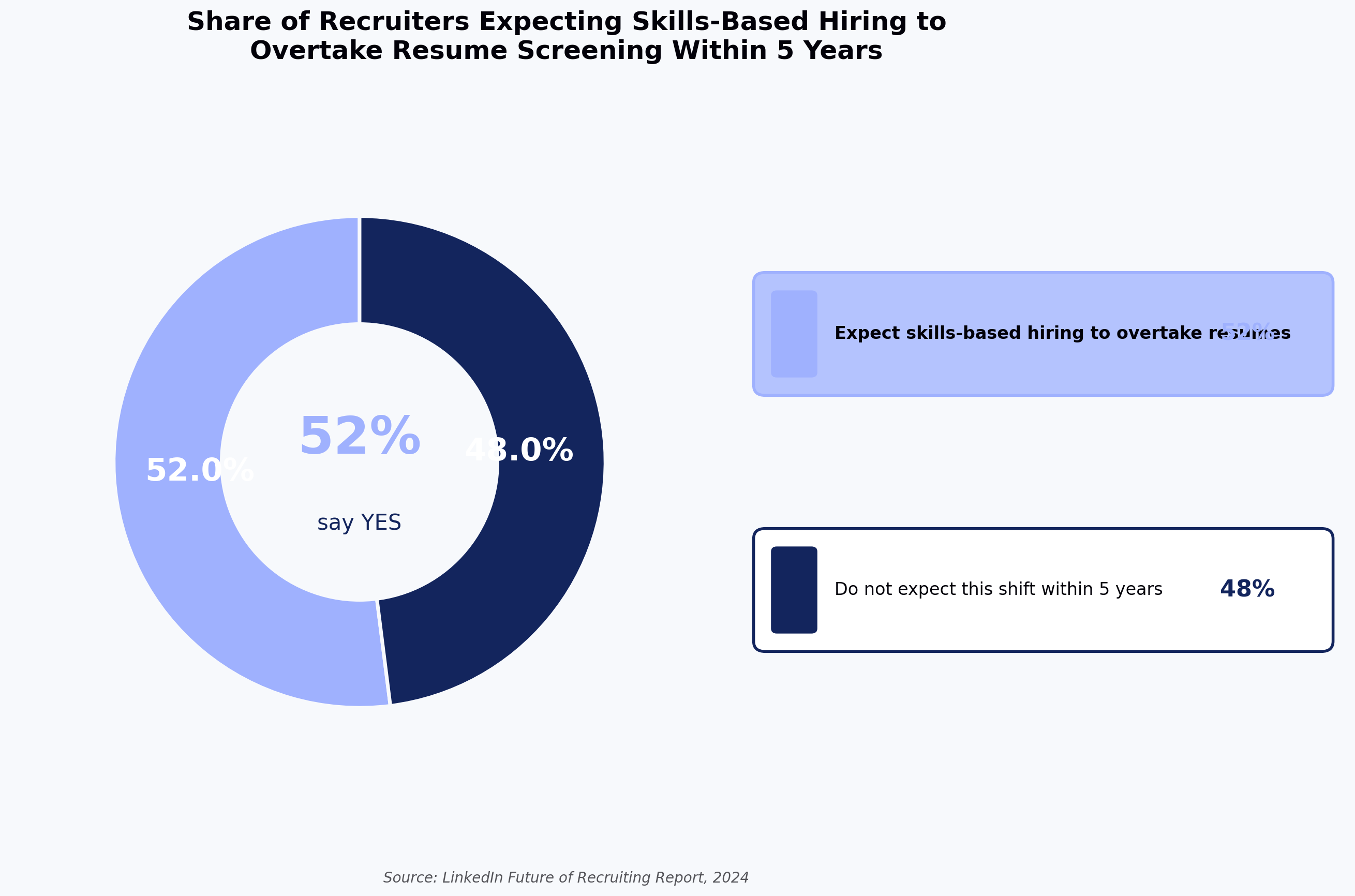
According to LinkedIn's 2024 Future of Recruiting report, more than half of recruiters say they expect skills-based hiring to overtake traditional resume screening within five years. The shift is already underway — and AI-generated resumes are accelerating it.

Share of Recruiters Expecting Skills-Based Hiring to Overtake Resume Screening Within 5 Years
Source: LinkedIn Future of Recruiting Report, 2024

How AI resume builders are reshaping applications

Not long ago, creating a strong professional resume required effort. Candidates had to think carefully about how to present their experience, structure achievements, and communicate impact clearly. A well-written resume stood out because it reflected both experience and clarity of thought.

Today, generative AI tools have changed that. Candidates can rewrite bullet points instantly, tailor resumes for every job description, optimize for ATS platforms like Workday and Greenhouse, and generate polished applications in minutes.

At first glance, this seems like progress. Better-written resumes should lead to better hiring outcomes. But when everyone uses the same handful of tools — ChatGPT, Teal, Kickresume — the outputs start to converge. Consider a realistic scenario: a recruiter screening 400 applications for a senior backend engineer role runs a similarity check and finds that 340 use nearly identical phrasing for ownership, scope, and impact bullets. The differentiation that resumes were designed to provide collapses.

Why AI-generated resumes weaken the hiring signal

The purpose of a resume has always been differentiation — helping recruiters quickly decide who moves forward. When AI standardizes how resumes are written, that differentiation weakens.

Two candidates with very different skill levels can now submit equally polished resumes. Both can use similar professional language, present achievements in comparable ways, and match job descriptions almost word for word. From a recruiter's perspective, the problem is no longer finding qualified-looking candidates — it's identifying who is actually qualified.

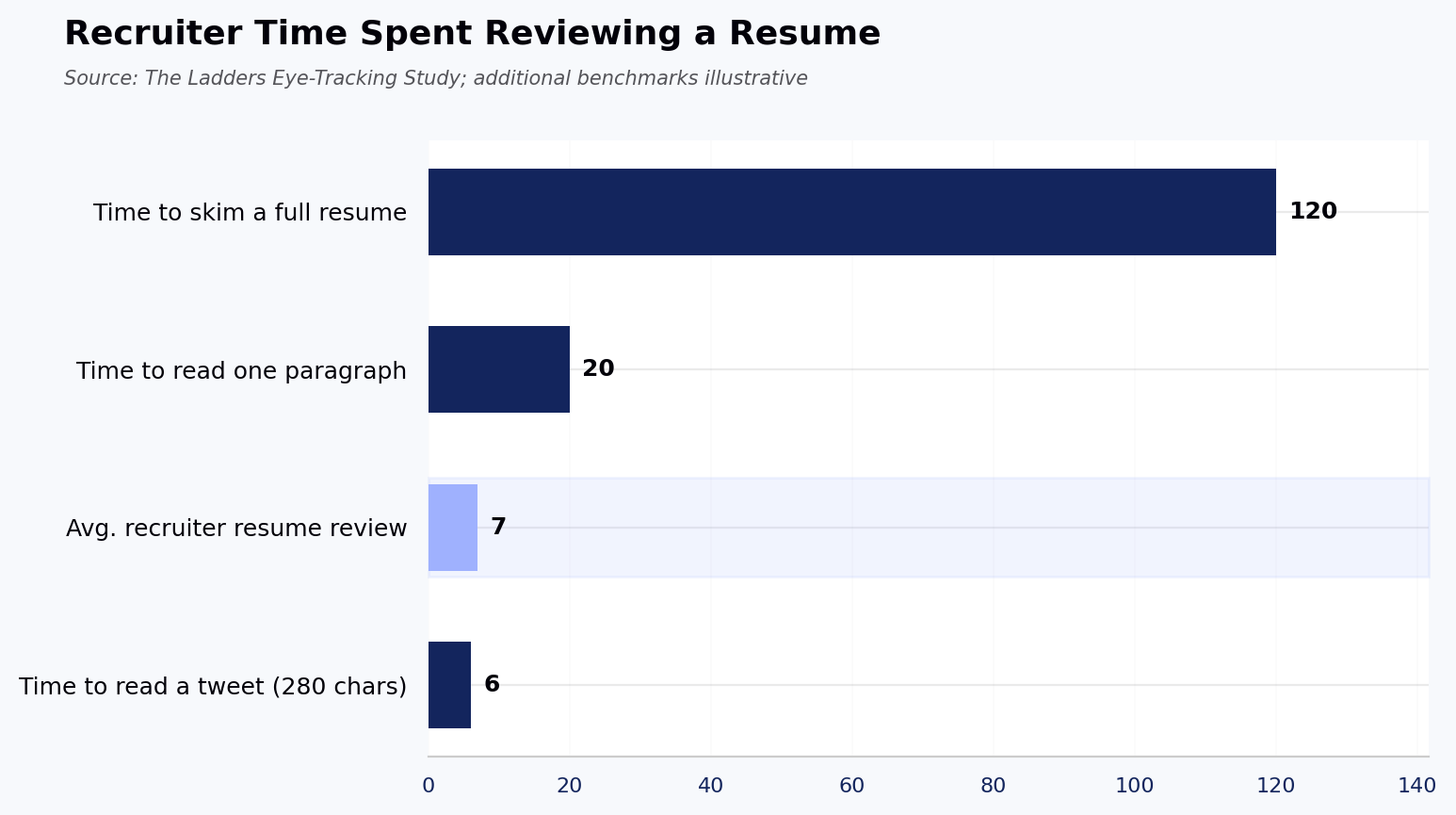
There is a counter-argument worth naming here: the deeper issue may not be AI resumes at all. Recruiters spend an average of 7.4 seconds reviewing a resume, according to a well-known Ladders eye-tracking study. If resumes were never read carefully in the first place, AI is exposing a screening process that was already broken, not breaking one that worked.

Recruiter Time Spent Reviewing a Resume
Source: The Ladders Eye-Tracking Study; additional benchmarks illustrative

Are resumes becoming obsolete in modern hiring?

Not entirely. Resumes still provide useful context — career progression, work history, exposure to specific tools and industries, and the types of environments a candidate has operated in.

But in many organizations, the role of the resume is changing. It is increasingly a starting point rather than a primary decision-making tool. A resume tells you where someone has worked. It does not reliably tell you how well they can perform.

The shift toward skills-based hiring and AI-driven assessment

As resumes become less reliable, more companies are turning to skills-based hiring, structured interviews, and practical assessments. SHRM research on skills-based hiring indicates a growing share of employers are dropping degree requirements and prioritizing demonstrated capability instead.

What someone can demonstrate often matters more than what they can describe. Here's how hiring teams are adapting.

Reviewing portfolios and real work samples

Recruiters and talent acquisition teams are looking beyond resumes to evaluate candidates through GitHub repositories, live projects, technical assignments, case studies, and design portfolios. Portfolios show how candidates think, how they solve problems, and the depth of their technical and communication ability — they reflect real work, not summaries rewritten by AI tools.

Prioritizing demonstrated skills over written claims

The biggest shift in recruitment is happening at the evaluation level. Hiring is moving from "what does this resume say?" to "what can this candidate actually prove?" In a world where anyone can generate a polished AI resume, demonstrated skills become the real differentiator. This is why more companies are investing in skills assessments, structured interviews, technical evaluations, and job simulations. Specifically, that means moving timed coding tests, scenario-based questions, and structured rubrics earlier in the funnel — before the recruiter screen, not after.

Where AI fits into hiring the right way

AI is not only creating the resume homogenization problem — it is also helping solve it. While candidates use AI to optimize resumes, hiring teams can use AI-driven interview platforms to evaluate skills more consistently at scale.

This is where HackerEarth's OnScreen AI Interviewer fits in. OnScreen is an AI-powered interview tool — meaning it conducts structured interview conversations using a deterministic rubric trained on a defined library of technical and non-technical questions, and is bounded to interview evaluation rather than general candidate scoring or sourcing.

OnScreen shifts hiring focus from what candidates say to how they perform. It creates two-way interview conversations using lifelike video avatars, so candidates engage in structured interactions rather than static screening questions. Every interview follows a deterministic framework, ensuring consistent and comparable evaluations across all candidates. It also includes KYC-grade identity verification and built-in proctoring — directly relevant in an era when AI-generated CVs and candidate misrepresentation are rising concerns.

As one HackerEarth customer, Discover Dollar Inc., put it: "HackerEarth's OnScreen AI Interviewer has significantly reduced our screening time while improving the quality of candidates moving forward in the hiring process."

Compared with human-led phone screens, OnScreen applies the same rubric to every candidate, producing evaluations that don't vary by interviewer mood, fatigue, or time of day. It is not a replacement for final-round judgment — it is a more consistent first-round filter.

Where AI interviews and skills-based hiring fall short

AI interview platforms are not a universal answer. They tend to work best for roles where capability can be observed through structured tasks — engineering, data, customer support, and similar functions. They are a weaker fit for senior executive hiring, where judgment, leadership history, and stakeholder context matter more than any single interview signal. They also struggle with highly creative roles and positions where contextual decision-making and long-arc strategic thinking are the core of the job.

There are real candidate-side trade-offs as well. Avatar-based interviews can introduce bias against candidates with strong accents, non-native English speakers, or candidates with disabilities affecting speech or vision — risks that responsible deployments need to mitigate through accommodations and human review. Some candidates also report that AI interviews feel impersonal compared with a live conversation, which can affect candidate experience and offer-acceptance rates. Hiring teams adopting these tools should pair them with human interviewers for later rounds and provide clear accommodations on request.

Is this the end of the resume?

Not completely. But in many hiring processes, the traditional resume is fading as the strongest signal. It is becoming a first touchpoint rather than a final decision-making factor — closer to a formality than a true indicator of capability. The hiring decisions that matter most will increasingly be made on what candidates can demonstrate, not what they can describe.

Frequently asked questions

Are AI resumes hurting job seekers?

AI resumes can help candidates pass initial ATS filters, but they may hurt differentiation at the human review stage. When most applicants use similar tools, polished phrasing stops being a competitive advantage and recruiters shift weight toward portfolios, assessments, and interviews.

How do companies detect AI-written resumes?

Some companies use similarity-detection tools and AI-text classifiers, but most identify AI-generated resumes indirectly — through patterns like near-identical phrasing across applications, generic accomplishment statements, or mismatches between resume claims and interview performance. Structured assessments are a more reliable signal than detection tools.

What is skills-based hiring?

Skills-based hiring is a recruiting approach that evaluates candidates primarily on demonstrated abilities — through assessments, work samples, or structured interviews — rather than on credentials like degrees or job titles. It is associated with broader candidate pools and, in some studies, better retention.

Will resumes become obsolete?

Resumes are unlikely to disappear entirely, but their role is narrowing. In many hiring funnels they are shifting from a primary screening tool to a contextual document, with assessments and structured interviews carrying more weight in the decision.

Can AI interview platforms replace human interviewers?

No. AI interview platforms like OnScreen are best used for early-stage structured screening, not for final hiring decisions. Senior, leadership, and highly contextual roles still require human judgment, and human review is important for handling accommodations and edge cases.

Next steps

If your team is dealing with rising application volumes and lookalike resumes, see how structured AI interviews can sharpen your top-of-funnel signal. Request a demo of HackerEarth's OnScreen AI Interviewer to see how it works on a role you're actively hiring for.

How HR Can Encourage Teamwork: A System Design Guide

How HR Can Encourage Teamwork: A System Design Guide

6 min read

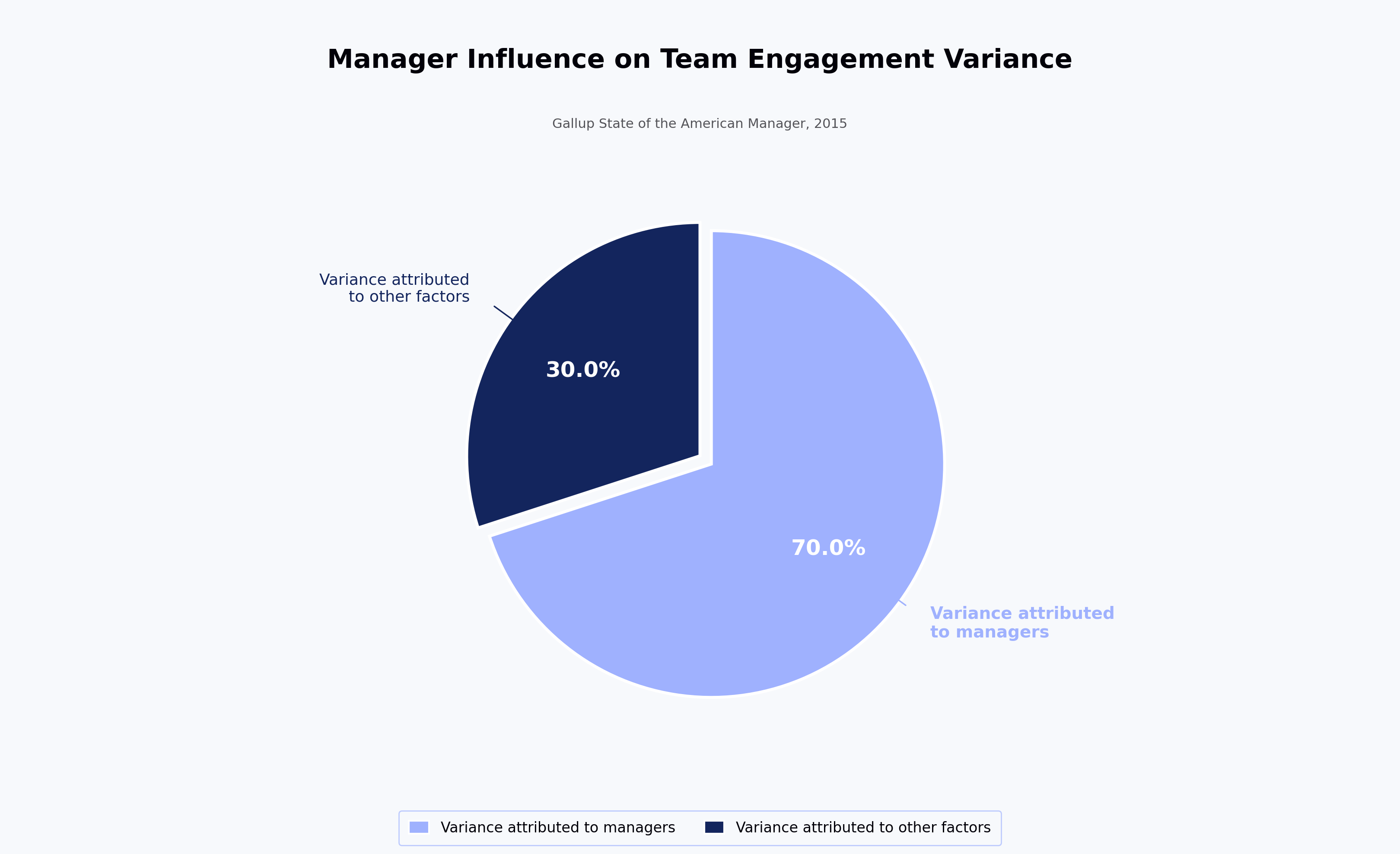
Most teamwork problems are incentive problems — fix the performance review and you often fix the collaboration. As a CHRO or senior HR leader, you can encourage teamwork most effectively by redesigning the systems — hiring, incentives, manager enablement, and performance management — that determine whether collaboration actually happens. Research from Gallup's State of the Global Workplace report consistently links team engagement to measurable gains in productivity and retention, yet teamwork is still frequently treated as an organic outcome rather than a deliberately designed system. For HR leaders, that gap is a missed opportunity to influence performance management, employee engagement, and cross-functional collaboration at the structural level.

Suggested featured image: a four-lever framework diagram (clarity, incentives, communication, hiring). Alt text: "Framework showing four HR levers for encouraging teamwork: role clarity, team-based incentives, structured communication, collaboration-focused hiring."

Why team collaboration breaks down in most organizations

Teamwork most often fails because of system design, not employee effort. In many cases, organizations struggle not because employees lack skill or intent, but because the surrounding system — incentives, communication norms, manager behavior — does not support collaboration. Google's Project Aristotle identified five factors behind team effectiveness and reported psychological safety as the strongest of the five.

Common issues include:

  • Unclear roles and responsibilities
  • Misaligned goals across teams
  • Lack of trust or psychological safety
  • Overemphasis on individual performance metrics
  • Poor communication structures

When these gaps exist, even high-performing individuals can drift into silos, which often leads to delays, duplicated effort, and unnecessary friction.

This is where HR plays a critical role — not as a facilitator of activities, but as a designer of systems. One contested but increasingly defensible view: most teamwork training is wasted spend if the underlying incentive structure is not changed first. For a deeper look at building hiring systems around capability rather than credentials, see our guide to skills-based hiring.

Reframing teamwork as a system, not a skill

Teamwork is more structural than behavioral, though both matter. Collaboration rarely thrives in environments where incentives reward individual output, communication is fragmented, and decision-making is unclear. Some practitioners argue teamwork is primarily a skills problem solved by training; the structural view, supported by McKinsey research on organizational health, suggests that sustained behavioral change typically requires reshaping the systems around it.

For HR leaders, the shift is from encouraging teamwork to enabling it through hiring, performance management, and team dynamics by design.

1. Start with clarity, not chemistry

Clarity beats chemistry when teams are struggling. Many organizations focus on team bonding before addressing clarity, but without clarity even cohesive teams struggle. HR can drive alignment by ensuring:

  • Every role has clearly defined outcomes, often documented through OKRs or a shared role charter
  • Teams understand how their work connects to broader goals
  • Dependencies between teams are visible in shared workforce planning and execution platforms

When people know who is responsible for what, collaboration becomes more intentional and less reactive.

Limitation to acknowledge: Heavy clarity exercises can slow teams down if overdone, and rigid role definitions may discourage the informal helping behavior that strong teams rely on. Balance is required.

2. Align incentives to encourage collaboration

If employees are only rewarded for individual achievements, teamwork will remain secondary. HR can rethink performance management systems to reflect how work actually gets done. This includes incorporating team-based goals, recognizing collaborative behavior, and rewarding cross-team support.

Illustrative scenario (hypothetical): Consider a 200-person SaaS company that restructures its quarterly OKRs so every department carries one shared cross-team metric (e.g., engineering and customer success co-own a time-to-resolution target). In a scenario like this, cross-functional escalations drop within two quarters and handoff delays become visible in the metric itself. This pattern reflects what many practitioners report, but the example here is illustrative rather than a documented case study.

Limitation to acknowledge: Poorly designed team incentives can create free-rider problems or shift competition from individuals to teams, which is not always an improvement. Pilot before scaling.

3. Structure communication effectively

More communication does not mean better team collaboration; clearer communication does. In many organizations, confusion stems from too many tools, too many meetings, and unclear decision-making. HR can partner with operations to define when to use synchronous versus async communication, how decisions are documented (e.g., a lightweight RACI or decision log), and how information flows across teams.

Limitation to acknowledge: Standardizing communication norms can feel bureaucratic, especially to senior individual contributors who prefer informal channels. Introduce structure where coordination cost is highest, not everywhere.

4. Hire and onboard for collaboration

Teamwork starts before day one. HR and TA teams can assess collaboration signals during hiring through structured behavioral interviews, and separately use structured skill assessments as a complementary input on candidate capability. For organizations evaluating soft skills as part of a broader assessment program, HackerEarth's soft-skills assessment is a distinct product that evaluates candidates across personality dimensions; it sits alongside, rather than inside, the behavioral interview process. For practical guidance on the post-hire side, see our onboarding best practices and our perspective on building a skills-first talent strategy.

Early connections tend to drive faster alignment, and cross-functional shadowing during onboarding is often associated with stronger collaboration outcomes later on.

Limitation to acknowledge: Assessing collaboration in interviews is harder than assessing technical skill, and over-indexing on "culture fit" can narrow diversity. Use structured rubrics, not gut calls.

How high-performing organizations encourage teamwork differently

High-performing organizations treat collaboration as an operating practice, not a value statement. The strategies above build the foundation. Companies that excel go further by making collaboration visible, equipping managers, and measuring what actually happens between teams.

Make team collaboration visible

Visibility changes behavior. Recognition systems that surface team contributions, not just individual ones, shift what employees optimize for. In many companies, individual achievements are highlighted while team efforts go unnoticed. HR can shift this by building recognition programs that surface cross-functional wins, sharing collaboration stories in internal communications, and celebrating outcomes achieved through teams.

Limitation to acknowledge: Public recognition of team wins can feel performative if not paired with real changes to how performance is reviewed and compensated.

Redefine the role of managers

Managers shape day-to-day collaboration more than any policy does. Gallup's State of the American Manager report (2015) reported that managers account for roughly 70% of the variance in employee engagement at the team level. The figure is from 2015 but has remained directionally stable in subsequent Gallup research. Policies set direction, but managers shape behavior.

If managers collaborate openly and align with other teams, that behavior spreads. If they operate in silos, the same pattern follows. HR can enable managers to lead collaboratively by setting clear expectations in performance reviews, providing manager training on facilitation and conflict, and reinforcing shared ownership of outcomes.

Limitation to acknowledge: Manager development is a multi-year investment, and many organizations promote individual contributors into management without ever resourcing the transition.

Manager Influence on Team Engagement Variance
Source: Gallup State of the American Manager, 2015

Measure collaboration, not just output

Most organizations measure individual performance well but rarely measure collaboration. HR can close this gap by tracking signals like cross-team project success rates, employee feedback on alignment via pulse surveys, and the frequency of delays caused by misalignment. Even simple indicators can reveal how effectively teams work together.

Skills intelligence platforms can also help HR leaders see capability and collaboration patterns at the workforce level, rather than relying on anecdote alone.

Limitation to acknowledge: Measuring collaboration can feel surveillance-like to employees, especially if it relies on monitoring communication tools. Be transparent about what is measured and why, and prefer aggregated team-level signals over individual tracking.

Where to start: four levers in order of impact

For HR leaders deciding where to begin, the four levers above can be prioritized by likely near-term impact:

  1. Align incentives and performance management. This is usually the highest-leverage change. If reviews and compensation reward only individual output, no amount of training or tooling will produce durable collaboration. Start here.
  2. Equip and develop managers. Managers account for the largest share of variance in team engagement, and their behavior cascades into team norms. Manager enablement is the second-highest lever, though it pays off over a longer horizon.
  3. Establish role and goal clarity. Shared OKRs, explicit dependencies, and visible decision rights remove the structural ambiguity that creates silos. This is faster to implement than incentive change but has lower ceiling impact on its own.
  4. Hire and onboard for collaboration. Compounding rather than immediate impact. Each cohort hired and onboarded with collaboration in mind raises the baseline, but the change is gradual and visible only over multiple quarters.

Encouraging teamwork is less about asking people to collaborate more and more about removing the structural reasons they do not. Organizations that get this right do not just build better teams — they build ways of working that hold up as headcount grows past 500, with measurable improvements in employee engagement and execution speed.

Frequently asked questions

What metrics can HR use to measure teamwork?

HR can measure teamwork using a mix of outcome and process signals: cross-team project completion rates, pulse survey scores on alignment and psychological safety, frequency of handoff delays, peer recognition volume, and the share of goals that are shared across teams. No single metric is sufficient; the value comes from tracking 3–4 indicators over time.

When does psychological safety stop helping, and start being misused?

Psychological safety is the shared belief that a team is safe for interpersonal risk-taking. Most of the discussion around it focuses on its benefits, but there are real tensions to manage: when psychological safety is measured via survey and turned into a manager scorecard, teams often learn to game the score rather than improve the underlying dynamic. Some research also suggests psychological safety without accountability can tip into low-performance comfort. HR's job is not just to raise psychological safety scores but to pair them with clear performance expectations.

How can HR encourage teamwork in hybrid or remote teams?

In hybrid and remote settings, teamwork depends more on explicit norms than on proximity. HR can encourage teamwork by standardizing async communication practices, scheduling intentional synchronous time for relationship-building, equipping managers to run effective distributed meetings, and ensuring shared goal-tracking platforms are used consistently.

Does team-building activity actually improve teamwork?

Off-site activities can build short-term rapport but rarely change collaboration outcomes if the underlying system — incentives, role clarity, manager behavior — remains unchanged. Practitioner consensus, and limited controlled research, suggests that structural interventions (shared goals, performance management changes, manager development) produce more durable improvements than event-based team building.

How long does it take to see results from these changes?

Timelines vary widely. Practitioners often describe visible changes in collaboration metrics within a few quarters of structural interventions like revised OKRs or updated performance reviews, while manager-led behavior changes are typically reported as taking a year or more because they depend on coaching, hiring decisions, and reinforcement cycles. These ranges reflect practitioner observation rather than a single authoritative study, and outcomes will differ by organization.

Timeline to See Results from Structural vs. Event-Based Interventions
Source: Practitioner timelines cited in article (quarters to visible impact)

Next steps: see it in action

If you are rethinking how your organization hires and develops collaborative teams, structured skill assessments are a practical starting point.

Schedule a demo of HackerEarth Assessments to evaluate collaboration and capability signals as part of your hiring process.

10 AI Interview Agent Platforms Compared (2026)

Best AI interview agent platforms compared for technical hiring in 2026

Estimated read time: 15 minutes

Editorial disclosure: This guide is published by HackerEarth. HackerEarth's OnScreen is one of the platforms reviewed below. Competitor product descriptions and feature claims are drawn from publicly available vendor documentation and G2 reviews captured in Q1 2025; ratings and feature parity may have shifted since capture and should be re-verified against current vendor documentation before procurement decisions.

Forty-two percent of candidates who report a negative interview experience say they would reject a subsequent offer (BCG, Decoding Global Talent, 2023) — which means the AI interview agent platforms compared in this guide are not just productivity tools; they directly shape whether your top technical hires accept. AI interview agent platforms compared here are software tools that automate candidate screening, conduct adaptive technical and behavioral interviews, evaluate code quality, and generate structured scorecards that flow into your ATS. This guide helps technical recruiters and engineering managers choose the right tool for their hiring workflow by evaluating each platform on technical assessment depth, scoring transparency, compliance readiness, and integration quality.

According to Aptitude Research data (2023) referenced by SHRM, 62% of HR leaders surveyed were using AI to enhance talent acquisition, but only 6% had automated 75% of their processes. The gap between adoption and automation maturity is why choosing the right platform for automated technical screening matters. Your team needs a platform that engineering managers trust and candidates complete.

In this comparison, we evaluate 10 AI interview agent platforms with technical assessment capabilities. You will see features, assessment depth, pricing, verified user reviews, and enterprise readiness compared side by side so you can choose the right structured interviewing software for your hiring team.

Note on competitor claims: All competitor product descriptions, feature lists, and pricing references in this article are drawn from publicly available vendor documentation and G2 reviews. G2 ratings cited below were captured in Q1 2025 and may not reflect current scores. Specific compliance certifications attributed to competitors (e.g., WCAG 2.2) reflect vendor-reported claims and should be independently verified before procurement.

AI in Talent Acquisition: Adoption vs. Full Automation Maturity
Source: Aptitude Research, 2023, via SHRM

The 10 best AI interview agent platforms compared: side-by-side reference

If you are a technical recruiter or engineering manager evaluating AI interview agent platforms compared in this guide, the table below gives you a quick reference across all 10 tools before you dive into the detailed reviews. AI in the table refers to platform-specific machine learning, NLP, and rubric-applied scoring engines whose scope is described in each platform's review.

Tool Best for Technical assessment depth Compliance readiness Key features G2 rating (Q1 2025)
HackerEarth OnScreen Autonomous AI interviewing with deep technical assessment Project-type questions; integrates alongside Skill Assessments and FaceCode Rubric-applied evaluation, KYC-grade identity verification, audit-ready scorecards Autonomous video-avatar interviewer, enterprise-grade proctoring, ATS integrations 4.5/5
HireVue High-volume enterprise async video interviewing Limited; behavioral focus Audit trails, structured evaluation records NLP-driven interview insights, searchable transcripts, competency validation, Zoom/Teams integration 4.1/5
Codility Live coding fidelity and accessibility-focused programs Live IDE, pair programming, system design whiteboard WCAG 2.2 compliant (vendor-reported); structured rubrics Live IDE, pair programming, whiteboard, Cody assistant 4.6/5
CoderPad Collaborative real-time pair-programming interviews Multi-file IDE, take-home auto-grading Integrity toolkit, keystroke playback (vendor-reported) Multi-file IDE, project-style work, integrity toolkit, auto-grading 4.4/5
Mercer Mettl Campus recruitment and large-scale proctored assessments 26+ question formats; limited live coding Live and recorded proctoring with tab-switch and webcam monitoring (vendor-reported) Scalable online exams, proctoring, multi-language support 4.4/5
iMocha Skills intelligence across hiring and upskilling Multi-format questions; weaker for live coding Candidate authentication and tab-switch detection (vendor-reported) Tara conversational interface, role-specific tests, ATS/HR integration 4.4/5
Crosschq ATS-native (Workday) structured interview workflows Limited deep technical assessment Compliance messaging, structured evaluation (vendor-reported) Structured interviews, behavioral question scoring, Workday integration 4.2/5
Talview Ivy Customizable AI interviewer personas for campus hiring Limited depth for senior engineering Structured assessment workflows (vendor-reported) Conversational agent, real-time interaction, customizable personas 4.2/5
BrightHire Interview intelligence and structured note-taking Not a coding assessment tool Interview design, note auditability (vendor-reported) NLP-driven notes, summaries, transcripts, clip sharing 4.8/5
Interviewer.AI Async video screening with explainable scoring Limited for live technical evaluation Explainable scoring, ATS integration (vendor-reported) Async interviews, AI avatars, automated scoring, dynamic follow-ups 4.6/5
G2 Ratings of AI Interview Platforms (Q1 2025)
Source: G2, Q1 2025

How we evaluated these AI interview agent platforms

This evaluation was based on real-world performance indicators, verified user reviews, and compliance readiness. The seven criteria discussed below reflect what determines whether AI interview agent platforms compared in any rigorous review will deliver results for your hiring team. For teams ready to benchmark options, our AI interview agent product page details how these criteria map to platform capabilities.

  1. Technical assessment depth: We measured the breadth and rigor of coding challenges, system design evaluation, project-based simulations, and the number of supported programming languages and skill domains each platform offers. If you want a deeper look at how AI interviewers work at the technical level, that context is useful before comparing individual tools.

  2. AI scoring transparency and explainability: We assessed whether each platform provides a detailed scoring rationale for every evaluation dimension, or delivers opaque pass/fail scores that hiring managers cannot interpret or defend. Platforms that cannot produce transparent, dimension-level scoring rationale undermine the trust that makes structured interview processes effective in the first place.

  3. Enterprise readiness and ATS integration: We evaluated the number and quality of native ATS integrations, API availability, SSO support, and documented integration timelines for each platform. A platform that claims fast integration but takes weeks or months longer than scoped to implement creates data integrity problems and rework costs that erase efficiency gains. Your team should verify integration timelines with vendor references before committing.

  4. Candidate experience and completion rates: We measured interface clarity, developer-friendliness of coding environments, mobile accessibility, and whether each platform's design minimizes candidate drop-off. The BCG finding cited earlier — that 42% of candidates who experienced a negative interview process said they would reject a subsequent offer — makes this a measurable business metric tied directly to offer-acceptance and employer brand outcomes, not a soft one.

  5. Anti-cheating and assessment integrity: We assessed proctoring capabilities including tab-switch detection, webcam monitoring, plagiarism detection, copy-paste prevention, and IP-based geofencing where vendors support them. Platforms without strong integrity measures expose your organization to evaluation fraud that undermines the screening investment. The strongest platforms in this comparison generate per-candidate integrity signals that your hiring managers can reference alongside technical performance data.

  6. Regulatory compliance and bias mitigation: We evaluated whether each platform supports privacy controls, provides auditable evaluation frameworks, and addresses the requirements of NYC Local Law 144, the EU AI Act, and EEOC guidance on AI in employment selection. According to the EEOC's January 31, 2023 public meeting on AI and automated systems, EEOC guidance suggests employers may be held responsible for discriminatory outcomes from third-party AI hiring tools used in employment decisions. The practical implication is that your organization may bear compliance responsibility regardless of which platform you select. Importantly, AI systems do not eliminate bias — they exhibit different bias profiles than human screeners, which is why auditable scoring and ongoing fairness testing matter more than vendor claims of neutrality.

  7. Verified user reviews and adoption evidence: We cross-referenced customer reviews from G2, Capterra, and TrustRadius, focusing on platforms with an average rating above 4.0 stars and a minimum of 50 verified reviews. Published case studies with measurable outcomes and documented client logos confirmed real-world adoption at enterprise scale.

An in-depth look at each AI interview agent platform compared

Each platform below is reviewed against the seven criteria above. The order reflects fit for autonomous technical interviewing depth specifically; each platform wins different dimensions, which we call out in the comparative judgments at the end of each review.

1. HackerEarth OnScreen: strongest fit for autonomous technical interviewing depth

HackerEarth OnScreen dashboard showing an autonomous AI interviewer conducting a role-calibrated technical interview with a candidate avatar and live scoring panel

HackerEarth's OnScreen runs autonomous technical and behavioral interviews with role-calibrated conversations and structured scorecards.

HackerEarth OnScreen is built for hiring teams that need to consolidate screening, autonomous interviewing, and structured scoring on a single platform. OnScreen conducts structured, role-specific technical and behavioral interviews autonomously using a video avatar. It integrates directly into HackerEarth's existing platform alongside Skill Assessments, FaceCode, and Hiring Challenges, drawing on HackerEarth's broader SkillsGraph data (150M+ assessment signals, per HackerEarth internal data) to inform question selection and scoring calibration rather than replacing rubric-based evaluation.

The platform applies a consistent rubric to each candidate. This produces rubric-applied evaluation that does not vary by interviewer mood, fatigue, or calibration drift — a bounded claim, not a claim of zero bias. AI scoring engines have their own bias profiles that require ongoing fairness testing.

OnScreen generates dimension-level scoring rationale on every interview and ships with built-in enterprise-grade proctoring that monitors for irregularities, alongside KYC-grade candidate identity verification. Specific ATS integrations, programming-language enumeration, session-recording capabilities, and EEOC/NYC Local Law 144 compliance posture should be confirmed with HackerEarth product and legal teams for your deployment.

Comparative note: OnScreen is purpose-built for autonomous interviewing depth. Codility and CoderPad outperform it on live pair-programming fidelity for senior engineering panels, while HireVue handles higher async-only video volumes for non-technical roles. OnScreen's advantage is consolidating autonomous interviewing with rubric-applied scoring inside the broader HackerEarth platform.

Best for: Technical recruiters, enterprise hiring managers, engineering managers, and campus recruitment teams at companies hiring 50+ technical roles per quarter.

Cons: Does not offer a stripped-down free tier or low-cost plan for very small teams or startups with fewer than 10 hires per year (G2 reviews). The breadth of platform capabilities can require onboarding time for teams that only need a single module.

Pricing: Contact HackerEarth for current OnScreen and Enterprise plan rates.

Case studies: See HackerEarth's published customer stories for verified outcomes and named customers.

2. HireVue: best for high-volume enterprise video interviewing at scale

HireVue interface displaying an async video interview with AI-generated transcript, competency scoring panel, and structured interview insights

HireVue combines NLP-driven interview insights with structured async video interviewing for high-volume enterprise hiring.

HireVue is best for high-volume behavioral and operational screening at enterprise scale, not for deep technical engineering roles. The platform is an established async video interviewing tool designed for enterprises managing high-volume hiring campaigns across customer service, retail, sales, and operational roles. Its Interview Insights feature uses natural language processing trained on transcribed interview responses to generate transcripts, summaries, and competency flags against structured rubrics. The NLP does not score candidates autonomously; it surfaces evidence interviewers review, and the model's signal quality varies by role type and language. The platform integrates with Zoom and Teams.

Teams hiring for senior engineering or system design roles should pair HireVue with a dedicated coding assessment tool — HireVue's behavioral focus is a poor fit for evaluating code quality or architectural reasoning.

Key features

  1. Interviewer benchmarking: Compares interviewer scoring patterns to surface calibration gaps — useful when your hiring panel is distributed across regions, less useful if you only have two or three regular interviewers.
  2. Candidate scheduling automation: Self-scheduling reduces recruiter coordination overhead for large candidate volumes; the productivity gain compounds above roughly 200 candidates per role and is marginal below it.
  3. Compliance documentation: Audit trails and structured evaluation records support regulatory requirements, but the records are only as defensible as the rubrics you load into them.

Comparative note: HireVue beats OnScreen and Codility on async throughput for non-technical, high-volume roles. It loses to both on technical assessment depth.

Best for: Enterprise recruiters and talent teams conducting high-volume hiring campaigns (500+ candidates per role) for customer service, retail, sales, and operational roles. Less suitable for deep technical hiring requiring code evaluation or system design assessment.

Pros: Easy to schedule and manage candidate interviews at enterprise scale. Standardized, data-driven evaluation improves fairness and consistency across distributed hiring teams.

Cons: Hybrid interview workflows can be inflexible when customization is needed (G2 review). Users report audio/video quality issues with certain setups. Recruiters report difficulty explaining AI rankings to hiring managers (G2 review, Q2 2024).

Pricing: Custom pricing only. Contact sales for plan details.

3. Codility: best for science-backed live coding assessments

Codility interview environment showing a live coding session with integrated IDE, video chat, and the Cody AI assistant analyzing candidate code in real time

Codility accelerates hiring with live coding interviews, pair programming workflows, and AI-assisted evaluation through Cody.

Codility is best for engineering teams that prioritize high-fidelity live coding interviews over async top-of-funnel screening. The platform's Interview product combines video chat, an integrated IDE, pair programming, and whiteboard functionality into a single environment where candidates demonstrate problem-solving, logic, and architectural thinking in real time. Learn more about structured technical interviewing before evaluating live-coding tools.

Codility introduced Cody, an assistant trained to observe how candidates collaborate with generative AI tools during interviews and flag patterns interviewers can review; the assistant does not score candidates and its detection signal is most useful in mid-difficulty interviews rather than senior architecture rounds. Codility is not designed for autonomous async screening at the top of the funnel.

Key features

  1. Structured and free-flowing interview workflows: Interviewers can run formal or open formats with consensus-based scoring — the structured mode reduces calibration drift, but only when teams actually load and enforce a shared rubric.
  2. Candidate-facing experience: Interactive onboarding, instant feedback, and vendor-reported WCAG 2.2 accessibility compliance reduce drop-off for candidates with accessibility needs.
  3. Predefined scoring rubrics: Reduce calibration drift across interviewers, but require investment to tune to your engineering levels.

Comparative note: Codility outperforms CoderPad on accessibility compliance signals and structured rubric tooling. CoderPad tends to feel more natural to engineering interviewers who want pair-programming flexibility. Codility's annual contracts can cost more per seat for organizations with seasonal hiring cycles.

Best for: Technical recruiters and engineering managers conducting specialized technical interviews where live coding fidelity, pair programming evaluation, and accessibility compliance are priorities.

Pros: High-fidelity live coding environment with an intuitive UI. Positive candidate experience with instant feedback and vendor-reported WCAG 2.2 accessibility compliance.

Cons: Pricing can be prohibitive for seasonal or internship-heavy hiring cycles (G2 review). Limited flexibility in annual plans for organizations with unpredictable hiring volumes.

Pricing: Contact Codility sales for current Starter, Scale, and Custom plan rates.

4. CoderPad: best for collaborative real-time coding interviews

CoderPad multi-file IDE showing a live pair-programming interview with keystroke playback timeline and integrity toolkit indicators

CoderPad provides a collaborative pair-programming environment with multi-file IDE support and an integrity toolkit for technical interviews.

CoderPad is best for engineering managers who want to conduct live, pair-programming-style technical interviews. The platform offers a multi-file IDE, AI-integrated project work, auto-grading on take-home assignments, an integrity toolkit, and keystroke playback so interviewers can review how a candidate approached a problem after the session ends. Language coverage and specific capability claims should be confirmed via CoderPad's product documentation.

Key features

  1. Multi-file IDE: Supports realistic project-style coding rather than single-file snippets — closer to how engineers actually work, which produces better signal on senior candidates.
  2. Integrity toolkit: Flags tab switches and external paste activity during live sessions; treat the signal as a flag for follow-up, not as evidence of cheating on its own.
  3. Keystroke playback: Lets interviewers review the path a candidate took to a solution — particularly useful for debugging interviews where process matters more than the final answer.

Comparative note: CoderPad feels more natural than Codility to engineers running pair-programming rounds but has less mature accessibility and structured-rubric tooling. Both lose to OnScreen on autonomous interviewing depth.

Best for: Engineering managers running live pair-programming interviews who want collaborative coding fidelity over autonomous screening.

Pros: Smooth real-time collaboration; broad language support.

Cons: Basic UI; limited advanced editor and reporting features compared with dedicated assessment platforms.

Pricing: Contact CoderPad sales for current plan rates.

5. Mercer Mettl: best for campus recruitment and large-scale proctored assessments

Mercer Mettl is best for campus hiring teams that need to administer proctored, high-volume assessments across multiple geographies. The platform supports 26+ question formats, multi-language proctoring with live and recorded webcam monitoring (vendor-reported), and tab-switch detection (vendor-reported) across high-volume online exams.

Key features

  1. High-volume proctored exam delivery: Designed for campus and graduate-program assessment loads where parallel sessions matter more than per-interview depth.
  2. Multi-language and multi-geography support: Useful for global campus programs; less relevant for North America-only enterprise hiring.
  3. Live and recorded proctoring (vendor-reported): Webcam monitoring, tab-switch detection, and candidate identity verification across high-volume online exams.

Comparative note: Mercer Mettl beats OnScreen and Codility on raw proctored-

In the Spotlight

Technical Screening Guide: All You Need To Know

Read this guide and learn how you can establish a less frustrating developer hiring workflow for both hiring teams and candidates.
Read More
Top Products

Explore HackerEarth’s top products for Hiring & Innovation

Discover powerful tools designed to streamline hiring, assess talent efficiently, and run seamless hackathons. Explore HackerEarth’s top products that help businesses innovate and grow.
Frame
Hackathons
Engage global developers through innovation
Arrow
Frame 2
Assessments
AI-driven advanced coding assessments
Arrow
Frame 3
FaceCode
Real-time code editor for effective coding interviews
Arrow
Frame 4
L & D
Tailored learning paths for continuous assessments
Arrow
Authors

Meet our Authors

Get to know the experts behind our content. From industry leaders to tech enthusiasts, our authors share valuable insights, trends, and expertise to keep you informed and inspired.
Ruehie Jaiya Karri
Kumari Trishya

7 Tech Recruiting Trends To Watch Out For In 2024

The last couple of years transformed how the world works and the tech industry is no exception. Remote work, a candidate-driven market, and automation are some of the tech recruiting trends born out of the pandemic.

While accepting the new reality and adapting to it is the first step, keeping up with continuously changing hiring trends in technology is the bigger challenge right now.

What does 2024 hold for recruiters across the globe? What hiring practices would work best in this post-pandemic world? How do you stay on top of the changes in this industry?

The answers to these questions will paint a clearer picture of how to set up for success while recruiting tech talent this year.

7 tech recruiting trends for 2024

6 Tech Recruiting Trends To Watch Out For In 2022

Recruiters, we’ve got you covered. Here are the tech recruiting trends that will change the way you build tech teams in 2024.

Trend #1—Leverage data-driven recruiting

Data-driven recruiting strategies are the answer to effective talent sourcing and a streamlined hiring process.

Talent acquisition leaders need to use real-time analytics like pipeline growth metrics, offer acceptance rates, quality and cost of new hires, and candidate feedback scores to reduce manual work, improve processes, and hire the best talent.

The key to capitalizing on talent market trends in 2024 is data. It enables you to analyze what’s working and what needs refinement, leaving room for experimentation.

Trend #2—Have impactful employer branding

98% of recruiters believe promoting company culture helps sourcing efforts as seen in our 2021 State Of Developer Recruitment report.

Having a strong employer brand that supports a clear Employer Value Proposition (EVP) is crucial to influencing a candidate’s decision to work with your company. Perks like upskilling opportunities, remote work, and flexible hours are top EVPs that attract qualified candidates.

A clear EVP builds a culture of balance, mental health awareness, and flexibility—strengthening your employer brand with candidate-first policies.

Trend #3—Focus on candidate-driven market

The pandemic drastically increased the skills gap, making tech recruitment more challenging. With the severe shortage of tech talent, candidates now hold more power and can afford to be selective.

Competitive pay is no longer enough. Use data to understand what candidates want—work-life balance, remote options, learning opportunities—and adapt accordingly.

Recruiters need to think creatively to attract and retain top talent.


Recommended read: What NOT To Do When Recruiting Fresh Talent


Trend #4—Have a diversity and inclusion oriented company culture

Diversity and inclusion have become central to modern recruitment. While urgent hiring can delay D&I efforts, long-term success depends on inclusive teams. Our survey shows that 25.6% of HR professionals believe a diverse leadership team helps build stronger pipelines and reduces bias.

McKinsey’s Diversity Wins report confirms this: top-quartile gender-diverse companies see 25% higher profitability, and ethnically diverse teams show 36% higher returns.

It's refreshing to see the importance of an inclusive culture increasing across all job-seeking communities, especially in tech. This reiterates that D&I is a must-have, not just a good-to-have.

—Swetha Harikrishnan, Sr. HR Director, HackerEarth

Recommended read: Diversity And Inclusion in 2022 - 5 Essential Rules To Follow


Trend #5—Embed automation and AI into your recruitment systems

With the rise of AI tools like ChatGPT, automation is being adopted across every business function—including recruiting.

Manual communication with large candidate pools is inefficient. In 2024, recruitment automation and AI-powered platforms will automate candidate nurturing and communication, providing a more personalized experience while saving time.

Trend #6—Conduct remote interviews

With 32.5% of companies planning to stay remote, remote interviewing is here to stay.

Remote interviews expand access to global talent, reduce overhead costs, and increase flexibility—making the hiring process more efficient for both recruiters and candidates.

Trend #7—Be proactive in candidate engagement

Delayed responses or lack of updates can frustrate candidates and impact your brand. Proactive communication and engagement with both active and passive candidates are key to successful recruiting.

As recruitment evolves, proactive candidate engagement will become central to attracting and retaining talent. In 2023 and beyond, companies must engage both active and passive candidates through innovative strategies and technologies like chatbots and AI-powered systems. Building pipelines and nurturing relationships will enhance employer branding and ensure long-term hiring success.

—Narayani Gurunathan, CEO, PlaceNet Consultants

Recruiting Tech Talent Just Got Easier With HackerEarth

Recruiting qualified tech talent is tough—but we’re here to help. HackerEarth for Enterprises offers an all-in-one suite that simplifies sourcing, assessing, and interviewing developers.

Our tech recruiting platform enables you to:

  • Tap into a 6 million-strong developer community
  • Host custom hackathons to engage talent and boost your employer brand
  • Create online assessments to evaluate 80+ tech skills
  • Use dev-friendly IDEs and proctoring for reliable evaluations
  • Benchmark candidates against a global community
  • Conduct live coding interviews with FaceCode, our collaborative coding interview tool
  • Guide upskilling journeys via our Learning and Development platform
  • Integrate seamlessly with all leading ATS systems
  • Access 24/7 support with a 95% satisfaction score

Recommended read: The A-Zs Of Tech Recruiting - A Guide


Staying ahead of tech recruiting trends, improving hiring processes, and adapting to change is the way forward in 2024. Take note of the tips in this article and use them to build a future-ready hiring strategy.

Ready to streamline your tech recruiting? Try HackerEarth for Enterprises today.

(Part 2) Essential Questions To Ask When Interviewing Developers In 2021

The first part of this blog stresses the importance of asking the right technical interview questions to assess a candidate’s coding skills. But that alone is not enough. If you want to hire the crème de la crème of the developer talent out there, you have to look for a well-rounded candidate.

Honest communication, empathy, and passion for their work are equally important as a candidate’s technical knowledge. Soft skills are like the cherry on top. They set the best of the candidates apart from the rest.

Re-examine how you are vetting your candidates. Identify the gaps in your interviews. Once you start addressing these gaps, you find developers who have the potential to be great. And those are exactly the kind of people that you want to work with!

Let’s get to it, shall we?

Hire great developers

What constitutes a good interview question?

An ideal interview should reveal a candidate’s personality along with their technical knowledge. To formulate a comprehensive list of questions, keep in mind three important characteristics.

  • Questions are open-ended – questions like, “What are some of the programming languages you’re comfortable with,” instead of “Do you know this particular programming language” makes the candidate feel like they’re in control. It is also a chance to let them reply to your question in their own words.
  • They address the behavioral aspects of a candidate – ensure you have a few questions on your list that allow a candidate to describe a situation. A situation where a client was unhappy or a time when the developer learned a new technology. Such questions help you assess if the candidate is a good fit for the team.
  • There is no right or wrong answer – it is important to have a structured interview process in place. But this does not mean you have a list of standard answers in mind that you’re looking for. How candidates approach your questions shows you whether they have the makings of a successful candidate. Focus on that rather than on the actual answer itself.

Designing a conversation around these buckets of interview questions brings you to my next question, “What should you look for in each candidate to spot the best ones?”

Hire GREAT developers by asking the right questions

Before we dive deep into the interview questions, we have to think about a few things that have changed. COVID-19 has rendered working from home the new normal for the foreseeable future. As a recruiter, the onus falls upon you to understand whether the developer is comfortable working remotely and has the relevant resources to achieve maximum productivity.

#1 How do you plan your day?

Remote work gives employees the option to be flexible. You don’t have to clock in 9 hours a day as long as you get everything done on time. A developer who hasn’t always been working remotely, but has a routine in place, understands the pitfalls of working from home. It is easy to get distracted and having a schedule to fall back on ensures good productivity.

#2 Do you have experience using tools for collaboration and remote work?

Working from home reduces human interaction heavily. There is no way to just go up to your teammate’s desk and clarify issues. Virtual communication is key to getting work done. Look for what kind of remote working tools your candidate is familiar with and if they know what collaborative tools to use for different tasks.

Value-based interview questions to ask

We went around and spoke to our engineering team, and the recruiting team to see what questions they abide by; what they think makes any candidate tick.

The result? – a motley group of questions that aim to reveal the candidate’s soft skills, in addition to typical technical interview questions and test tasks.


Recommended read: How Recruiting The Right Tech Talent Can Solve Tech Debt


#3 Please describe three recent projects that you worked on. What were the most interesting and challenging parts?

This is an all-encompassing question in that it lets the candidate explain at length about their work ethic—thought process, handling QA, working with a team, and managing user feedback. This also lets you dig enough to assess whether the candidate is taking credit for someone else's work or not.

#4 You’ve worked long and hard to deliver a complex feature for a client and they say it’s not what they asked for. How would you take it?

A good developer will take it in their stride, work closely with the client to find the point of disconnect, and sort out the issue. There are so many things that could go wrong or not be to the client’s liking, and it falls on the developer to remain calm and create solutions.

#5 What new programming languages or technologies have you learned recently?

While being certified in many programming languages doesn't guarantee a great developer, it still is an important technical interview question to ask. It helps highlight a thirst for knowledge and shows that the developer is eager to learn new things.

#6 What does the perfect release look like? Who is involved and what is your role?

Have the developer take you through each phase of a recent software development lifecycle. Ask them to explain their specific role in each phase in this release. This will give you an excellent perspective into a developer’s mind. Do they talk about the before and after of the release? A skilled developer would. The chances of something going wrong in a release are very high. How would the developer react? Will they be able to handle the pressure?


SUBSCRIBE to the HackerEarth blog and enrich your monthly reading with our free e-newsletter – Fresh, insightful and awesome articles straight into your inbox from around the tech recruiting world!


#7 Tell me about a time when you had to convince your lead to try a different approach?

As an example of a behavioral interview question, this is a good one. The way a developer approaches this question speaks volumes about how confident they are expressing their views, and how succinct they are in articulating those views.

#8 What have you done with all the extra hours during the pandemic?

Did you binge-watch your way through the pandemic? I’m sure every one of us has done this. Indulge in a lighthearted conversation with your candidate. This lets them talk about something they are comfortable with. Maybe they learned a new skill or took up a hobby. Get to know a candidate’s interests and little pleasures for a more rounded evaluation.

Over to you! Now that you know what aspects of a candidate to focus on, you are well-equipped to bring out the best in each candidate in their interviews. A mix of strong technical skills and interpersonal qualities is how you spot good developers for your team.

If you have more pressing interview questions to add to this list of ours, please write to us at contact@hackerearth.com.

(Part 1) Essential Questions To Ask When Recruiting Developers In 2021

The minute a developer position opens up, recruiters feel a familiar twinge of fear run down their spines. They recall their previous interview experiences, and how there seems to be a blog post a month that goes viral about bad developer interviews.

While hiring managers, especially the picky ones, would attribute this to a shortage of talented developers, what if the time has come to rethink your interview process? What if recruiters and hiring managers put too much stock into bringing out the technical aspects of each candidate and don’t put enough emphasis on their soft skills?

A report by Robert Half shows that 86% of technology leaders say it’s challenging to find IT talent. Interviewing developers should be a rewarding experience, not a challenging one. If you don’t get caught up in asking specific questions and instead design a simple conversation to gauge a candidate’s way of thinking, it throws up a lot of good insight and makes it fun too.

Developer Hiring Statistics

Asking the right technical interview questions when recruiting developers is important but so is clear communication, good work ethic, and alignment with your organization’s goals.

Let us first see what kind of technical interview questions are well-suited to revealing the coding skills and knowledge of any developer, and then tackle the behavioral aspects of the candidate that sets them apart from the rest.

Recruit GREAT developers by asking the right questions

Here are some technical interview questions that you should ask potential software engineers when interviewing.

#1 Write an algorithm for the following

  1. Minimum Stack - Design a stack that provides 4 functions - push(item), pop, peek, and minimum, all in constant order time complexity. Then move on to coding the actual solution.
  2. Kth Largest Element in an array - This is a standard problem with multiple solutions of best time complexity orders where N log(K) is a common one and O(N) + K log(N) is a lesser-known order. Both solutions are acceptable, not directly comparable to each other, and better than N log(N), which is sorting an array and fetching the Kth element.
  3. Top View of a Binary Tree - Given a root node of the binary tree, return the set of all elements that will get wet if it rains on the tree. Nodes having any nodes directly above them will not get wet.
  4. Internal implementation of a hashtable like a map/dictionary - A candidate needs to specify how key-value pairs are stored, hashing is used and collisions are handled. A good developer not only knows how to use this concept but also how it works. If the developer also knows how the data structure scales when the number of records increases in the hashtable, that is a bonus.

Algorithms demonstrate a candidate’s ability to break down a complex problem into steps. Reasoning and pattern recognition capabilities are some more factors to look for when assessing a candidate. A good candidate can code his thought process of the algorithm finalized during the discussion.


Looking for a great place to hire developers in the US? Try Jooble!


#2 Formulate solutions for the below low-level design (LLD) questions

  • What is LLD? In your own words, specify the different aspects covered in LLD.
  • Design a movie ticket booking application like BookMyShow. Ensure that your database schema is tailored for a theatre with multiple screens and takes care of booking, seat availability, seat arrangement, and seat locking. Your solution does not have to extend to the payment option.
  • Design a basic social media application. Design database schema and APIs for a platform like Twitter with features for following a user, tweeting a post, seeing your tweet, and seeing a user's tweet.

Such questions do not have a right or wrong answer. They primarily serve to reveal a developer’s thought process and the way they approach a problem.


Recommended read: Hardest Tech Roles to Fill (+ solutions!)


#3 Some high-level design (HLD) questions

  • What do you understand by HLD? Can you specify the difference between LLD and HLD?
  • Design a social media application. In addition to designing a platform like Twitter with features for following a user, tweeting a post, seeing your tweet, and seeing a user's tweet, design a timeline. After designing a timeline where you can see your followers’ tweets, scale it for a larger audience. If you still have time, try to scale it for a celebrity use case.
  • Design for a train ticket booking application like IRCTC. Incorporate auth, features to choose start and end stations, view available trains and available seats between two stations, save reservation of seats from start to end stations, and lock them till payment confirmation.
  • How will you design a basic relational database? The database should support tables, columns, basic field types like integer and text, foreign keys, and indexes. The way a developer approaches this question is important. A good developer designs a solution around storage and memory management.
Here’s a pro-tip for you. LLD questions can be answered by both beginners and experienced developers. Mostly, senior developers can be expected to answer HLD questions. Choose your interview questions set wisely, and ask questions relevant to your candidate’s experience.

#4 Have you ever worked with SQL? Write queries for a specific use case that requires multiple joins.

Example: Create a table with separate columns for student name, subject, and marks scored. Return student names and ranks of each student. The rank of a student depends on the total of marks in all subjects.

Not all developers would have experience working with SQL but some knowledge about how data is stored/structured is useful. Developers should be familiar with simple concepts like joins, retrieval queries, and the basics of DBMS.

#5 What do you think is wrong with this code?

Instead of asking developer candidates to write code on a piece of paper (which is outdated, anyway), ask them to debug existing code. This is another way to assess their technical skills. Place surreptitious errors in the code and evaluate their attention to detail.

Now that you know exactly what technical skills to look for and when questions to ask when interviewing developers, the time has come to assess the soft skills of these candidates. Part 2 of this blog throws light on the how and why of evaluating candidates based on their communication skills, work ethic, and alignment with the company’s goals.

View all

Best Pre-Employment Assessments: Optimizing Your Hiring Process for 2024

In today's competitive talent market, attracting and retaining top performers is crucial for any organization's success. However, traditional hiring methods like relying solely on resumes and interviews may not always provide a comprehensive picture of a candidate's skills and potential. This is where pre-employment assessments come into play.

What is Pre-Employement Assessment?

Pre-employment assessments are standardized tests and evaluations administered to candidates before they are hired. These assessments can help you objectively measure a candidate's knowledge, skills, abilities, and personality traits, allowing you to make data-driven hiring decisions.

By exploring and evaluating the best pre-employment assessment tools and tests available, you can:

  • Improve the accuracy and efficiency of your hiring process.
  • Identify top talent with the right skills and cultural fit.
  • Reduce the risk of bad hires.
  • Enhance the candidate experience by providing a clear and objective evaluation process.

This guide will provide you with valuable insights into the different types of pre-employment assessments available and highlight some of the best tools, to help you optimize your hiring process for 2024.

Why pre-employment assessments are key in hiring

While resumes and interviews offer valuable insights, they can be subjective and susceptible to bias. Pre-employment assessments provide a standardized and objective way to evaluate candidates, offering several key benefits:

  • Improved decision-making:

    By measuring specific skills and knowledge, assessments help you identify candidates who possess the qualifications necessary for the job.

  • Reduced bias:

    Standardized assessments mitigate the risks of unconscious bias that can creep into traditional interview processes.

  • Increased efficiency:

    Assessments can streamline the initial screening process, allowing you to focus on the most promising candidates.

  • Enhanced candidate experience:

    When used effectively, assessments can provide candidates with a clear understanding of the required skills and a fair chance to showcase their abilities.

Types of pre-employment assessments

There are various types of pre-employment assessments available, each catering to different needs and objectives. Here's an overview of some common types:

1. Skill Assessments:

  • Technical Skills: These assessments evaluate specific technical skills and knowledge relevant to the job role, such as programming languages, software proficiency, or industry-specific expertise. HackerEarth offers a wide range of validated technical skill assessments covering various programming languages, frameworks, and technologies.
  • Soft Skills: These employment assessments measure non-technical skills like communication, problem-solving, teamwork, and critical thinking, crucial for success in any role.

2. Personality Assessments:

These employment assessments can provide insights into a candidate's personality traits, work style, and cultural fit within your organization.

3. Cognitive Ability Tests:

These tests measure a candidate's general mental abilities, such as reasoning, problem-solving, and learning potential.

4. Integrity Assessments:

These employment assessments aim to identify potential risks associated with a candidate's honesty, work ethic, and compliance with company policies.

By understanding the different types of assessments and their applications, you can choose the ones that best align with your specific hiring needs and ensure you hire the most qualified and suitable candidates for your organization.

Leading employment assessment tools and tests in 2024

Choosing the right pre-employment assessment tool depends on your specific needs and budget. Here's a curated list of some of the top pre-employment assessment tools and tests available in 2024, with brief overviews:

  • HackerEarth:

    A comprehensive platform offering a wide range of validated skill assessments in various programming languages, frameworks, and technologies. It also allows for the creation of custom assessments and integrates seamlessly with various recruitment platforms.

  • SHL:

    Provides a broad selection of assessments, including skill tests, personality assessments, and cognitive ability tests. They offer customizable solutions and cater to various industries.

  • Pymetrics:

    Utilizes gamified assessments to evaluate cognitive skills, personality traits, and cultural fit. They offer a data-driven approach and emphasize candidate experience.

  • Wonderlic:

    Offers a variety of assessments, including the Wonderlic Personnel Test, which measures general cognitive ability. They also provide aptitude and personality assessments.

  • Harver:

    An assessment platform focusing on candidate experience with video interviews, gamified assessments, and skills tests. They offer pre-built assessments and customization options.

Remember: This list is not exhaustive, and further research is crucial to identify the tool that aligns best with your specific needs and budget. Consider factors like the types of assessments offered, pricing models, integrations with your existing HR systems, and user experience when making your decision.

Choosing the right pre-employment assessment tool

Instead of full individual tool reviews, consider focusing on 2–3 key platforms. For each platform, explore:

  • Target audience: Who are their assessments best suited for (e.g., technical roles, specific industries)?
  • Types of assessments offered: Briefly list the available assessment categories (e.g., technical skills, soft skills, personality).
  • Key features: Highlight unique functionalities like gamification, custom assessment creation, or seamless integrations.
  • Effectiveness: Briefly mention the platform's approach to assessment validation and reliability.
  • User experience: Consider including user reviews or ratings where available.

Comparative analysis of assessment options

Instead of a comprehensive comparison, consider focusing on specific use cases:

  • Technical skills assessment:

    Compare HackerEarth and Wonderlic based on their technical skill assessment options, focusing on the variety of languages/technologies covered and assessment formats.

  • Soft skills and personality assessment:

    Compare SHL and Pymetrics based on their approaches to evaluating soft skills and personality traits, highlighting any unique features like gamification or data-driven insights.

  • Candidate experience:

    Compare Harver and Wonderlic based on their focus on candidate experience, mentioning features like video interviews or gamified assessments.

Additional tips:

  • Encourage readers to visit the platforms' official websites for detailed features and pricing information.
  • Include links to reputable third-party review sites where users share their experiences with various tools.

Best practices for using pre-employment assessment tools

Integrating pre-employment assessments effectively requires careful planning and execution. Here are some best practices to follow:

  • Define your assessment goals:

    Clearly identify what you aim to achieve with assessments. Are you targeting specific skills, personality traits, or cultural fit?

  • Choose the right assessments:

    Select tools that align with your defined goals and the specific requirements of the open position.

  • Set clear expectations:

    Communicate the purpose and format of the assessments to candidates in advance, ensuring transparency and building trust.

  • Integrate seamlessly:

    Ensure your chosen assessment tool integrates smoothly with your existing HR systems and recruitment workflow.

  • Train your team:

    Equip your hiring managers and HR team with the knowledge and skills to interpret assessment results effectively.

Interpreting assessment results accurately

Assessment results offer valuable data points, but interpreting them accurately is crucial for making informed hiring decisions. Here are some key considerations:

  • Use results as one data point:

    Consider assessment results alongside other information, such as resumes, interviews, and references, for a holistic view of the candidate.

  • Understand score limitations:

    Don't solely rely on raw scores. Understand the assessment's validity and reliability and the potential for cultural bias or individual test anxiety.

  • Look for patterns and trends:

    Analyze results across different assessments and identify consistent patterns that align with your desired candidate profile.

  • Focus on potential, not guarantees:

    Assessments indicate potential, not guarantees of success. Use them alongside other evaluation methods to make well-rounded hiring decisions.

Choosing the right pre-employment assessment tools

Selecting the most suitable pre-employment assessment tool requires careful consideration of your organization's specific needs. Here are some key factors to guide your decision:

  • Industry and role requirements:

    Different industries and roles demand varying skill sets and qualities. Choose assessments that target the specific skills and knowledge relevant to your open positions.

  • Company culture and values:

    Align your assessments with your company culture and values. For example, if collaboration is crucial, look for assessments that evaluate teamwork and communication skills.

  • Candidate experience:

    Prioritize tools that provide a positive and smooth experience for candidates. This can enhance your employer brand and attract top talent.

Budget and accessibility considerations

Budget and accessibility are essential factors when choosing pre-employment assessments:

  • Budget:

    Assessment tools come with varying pricing models (subscriptions, pay-per-use, etc.). Choose a tool that aligns with your budget and offers the functionalities you need.

  • Accessibility:

    Ensure the chosen assessment is accessible to all candidates, considering factors like language options, disability accommodations, and internet access requirements.

Additional Tips:

  • Free trials and demos: Utilize free trials or demos offered by assessment platforms to experience their functionalities firsthand.
  • Consult with HR professionals: Seek guidance from HR professionals or recruitment specialists with expertise in pre-employment assessments.
  • Read user reviews and comparisons: Gain insights from other employers who use various assessment tools.

By carefully considering these factors, you can select the pre-employment assessment tool that best aligns with your organizational needs, budget, and commitment to an inclusive hiring process.

Remember, pre-employment assessments are valuable tools, but they should not be the sole factor in your hiring decisions. Use them alongside other evaluation methods and prioritize building a fair and inclusive hiring process that attracts and retains top talent.

Future trends in pre-employment assessments

The pre-employment assessment landscape is constantly evolving, with innovative technologies and practices emerging. Here are some potential future trends to watch:

  • Artificial intelligence (AI):

    AI-powered assessments can analyze candidate responses, written work, and even resumes, using natural language processing to extract relevant insights and identify potential candidates.

  • Adaptive testing:

    These assessments adjust the difficulty level of questions based on the candidate's performance, providing a more efficient and personalized evaluation.

  • Micro-assessments:

    Short, focused assessments delivered through mobile devices can assess specific skills or knowledge on-the-go, streamlining the screening process.

  • Gamification:

    Engaging and interactive game-based elements can make the assessment experience more engaging and assess skills in a realistic and dynamic way.

Conclusion

Pre-employment assessments, when used thoughtfully and ethically, can be a powerful tool to optimize your hiring process, identify top talent, and build a successful workforce for your organization. By understanding the different types of assessments available, exploring top-rated tools like HackerEarth, and staying informed about emerging trends, you can make informed decisions that enhance your ability to attract, evaluate, and hire the best candidates for the future.

Tech Layoffs: What To Expect In 2024

Layoffs in the IT industry are becoming more widespread as companies fight to remain competitive in a fast-changing market; many turn to layoffs as a cost-cutting measure. Last year, 1,000 companies including big tech giants and startups, laid off over two lakhs of employees. But first, what are layoffs in the tech business, and how do they impact the industry?

Tech layoffs are the termination of employment for some employees by a technology company. It might happen for various reasons, including financial challenges, market conditions, firm reorganization, or the after-effects of a pandemic. While layoffs are not unique to the IT industry, they are becoming more common as companies look for methods to cut costs while remaining competitive.

The consequences of layoffs in technology may be catastrophic for employees who lose their jobs and the firms forced to make these difficult decisions. Layoffs can result in the loss of skill and expertise and a drop in employee morale and productivity. However, they may be required for businesses to stay afloat in a fast-changing market.

This article will examine the reasons for layoffs in the technology industry, their influence on the industry, and what may be done to reduce their negative impacts. We will also look at the various methods for tracking tech layoffs.

What are tech layoffs?

The term "tech layoff" describes the termination of employees by an organization in the technology industry. A company might do this as part of a restructuring during hard economic times.

In recent times, the tech industry has witnessed a wave of significant layoffs, affecting some of the world’s leading technology companies, including Amazon, Microsoft, Meta (formerly Facebook), Apple, Cisco, SAP, and Sony. These layoffs are a reflection of the broader economic challenges and market adjustments facing the sector, including factors like slowing revenue growth, global economic uncertainties, and the need to streamline operations for efficiency.

Each of these tech giants has announced job cuts for various reasons, though common themes include restructuring efforts to stay competitive and agile, responding to over-hiring during the pandemic when demand for tech services surged, and preparing for a potentially tough economic climate ahead. Despite their dominant positions in the market, these companies are not immune to the economic cycles and technological shifts that influence operational and strategic decisions, including workforce adjustments.

This trend of layoffs in the tech industry underscores the volatile nature of the tech sector, which is often at the mercy of rapid changes in technology, consumer preferences, and the global economy. It also highlights the importance of adaptability and resilience for companies and employees alike in navigating the uncertainties of the tech landscape.

Causes for layoffs in the tech industry

Why are tech employees suffering so much?

Yes, the market is always uncertain, but why resort to tech layoffs?

Various factors cause tech layoffs, including company strategy changes, market shifts, or financial difficulties. Companies may lay off employees if they need help to generate revenue, shift their focus to new products or services, or automate certain jobs.

In addition, some common reasons could be:

Financial struggles

Currently, the state of the global market is uncertain due to economic recession, ongoing war, and other related phenomena. If a company is experiencing financial difficulties, only sticking to pay cuts may not be helpful—it may need to reduce its workforce to cut costs.


Also, read: 6 Steps To Create A Detailed Recruiting Budget (Template Included)


Changes in demand

The tech industry is constantly evolving, and companies would have to adjust their workforce to meet changing market conditions. For instance, companies are adopting remote work culture, which surely affects on-premises activity, and companies could do away with some number of tech employees at the backend.

Restructuring

Companies may also lay off employees as part of a greater restructuring effort, such as spinning off a division or consolidating operations.

Automation

With the advancement in technology and automation, some jobs previously done by human labor may be replaced by machines, resulting in layoffs.

Mergers and acquisitions

When two companies merge, there is often overlap in their operations, leading to layoffs as the new company looks to streamline its workforce.

But it's worth noting that layoffs are not exclusive to the tech industry and can happen in any industry due to uncertainty in the market.

Will layoffs increase in 2024?

It is challenging to estimate the rise or fall of layoffs. The overall state of the economy, the health of certain industries, and the performance of individual companies will play a role in deciding the degree of layoffs in any given year.

But it is also seen that, in the first 15 days of this year, 91 organizations laid off over 24,000 tech workers, and over 1,000 corporations cut down more than 150,000 workers in 2022, according to an Economic Times article.

The COVID-19 pandemic caused a huge economic slowdown and forced several businesses to downsize their employees. However, some businesses rehired or expanded their personnel when the world began to recover.

So, given the current level of economic uncertainty, predicting how the situation will unfold is difficult.


Also, read: 4 Images That Show What Developers Think Of Layoffs In Tech


What types of companies are prone to tech layoffs?

2023 Round Up Of Layoffs In Big Tech

Tech layoffs can occur in organizations of all sizes and various areas.

Following are some examples of companies that have experienced tech layoffs in the past:

Large tech firms

Companies such as IBM, Microsoft, Twitter, Better.com, Alibaba, and HP have all experienced layoffs in recent years as part of restructuring initiatives or cost-cutting measures.

Market scenarios are still being determined after Elon Musk's decision to lay off employees. Along with tech giants, some smaller companies and startups have also been affected by layoffs.

Startups

Because they frequently work with limited resources, startups may be forced to lay off staff if they cannot get further funding or need to pivot due to market downfall.

Small and medium-sized businesses

Small and medium-sized businesses face layoffs due to high competition or if the products/services they offer are no longer in demand.

Companies in certain industries

Some sectors of the technological industry, such as the semiconductor industry or automotive industry, may be more prone to layoffs than others.

Companies that lean on government funding

Companies that rely significantly on government contracts may face layoffs if the government cuts technology spending or contracts are not renewed.

How to track tech layoffs?

You can’t stop tech company layoffs, but you should be keeping track of them. We, HR professionals and recruiters, can also lend a helping hand in these tough times by circulating “layoff lists” across social media sites like LinkedIn and Twitter to help people land jobs quicker. Firefish Software put together a master list of sources to find fresh talent during the layoff period.

Because not all layoffs are publicly disclosed, tracking tech industry layoffs can be challenging, and some may go undetected. There are several ways to keep track of tech industry layoffs:

Use tech layoffs tracker

Layoff trackers like thelayoff.com and layoffs.fyi provide up-to-date information on layoffs.

In addition, they aid in identifying trends in layoffs within the tech industry. It can reveal which industries are seeing the most layoffs and which companies are the most affected.

Companies can use layoff trackers as an early warning system and compare their performance to that of other companies in their field.

News articles

Because many news sites cover tech layoffs as they happen, keeping a watch on technology sector stories can provide insight into which organizations are laying off employees and how many individuals have been affected.

Social media

Organizations and employees frequently publish information about layoffs in tech on social media platforms; thus, monitoring companies' social media accounts or following key hashtags can provide real-time updates regarding layoffs.

Online forums and communities

There are online forums and communities dedicated to discussing tech industry news, and they can be an excellent source of layoff information.

Government reports

Government agencies such as the Bureau of Labor Statistics (BLS) publish data on layoffs and unemployment, which can provide a more comprehensive picture of the technology industry's status.

How do companies reduce tech layoffs?

Layoffs in tech are hard – for the employee who is losing their job, the recruiter or HR professional who is tasked with informing them, and the company itself. So, how can we aim to avoid layoffs? Here are some ways to minimize resorting to letting people go:

Salary reductions

Instead of laying off employees, businesses can lower the salaries or wages of all employees. It can be accomplished by instituting compensation cuts or salary freezes.

Implementing a hiring freeze

Businesses can halt employing new personnel to cut costs. It can be a short-term solution until the company's financial situation improves.


Also, read: What Recruiters Can Focus On During A Tech Hiring Freeze


Non-essential expense reduction

Businesses might search for ways to cut or remove non-essential expenses such as travel, training, and office expenses.

Reducing working hours

Companies can reduce employee working hours to save money, such as implementing a four-day workweek or a shorter workday.

These options may not always be viable and may have their problems, but before laying off, a company owes it to its people to consider every other alternative, and formulate the best solution.

Tech layoffs to bleed into this year

While we do not know whether this trend will continue or subside during 2023, we do know one thing. We have to be prepared for a wave of layoffs that is still yet to hit. As of last month, Layoffs.fyi had already tracked 170+ companies conducting 55,970 layoffs in 2023.

So recruiters, let’s join arms, distribute those layoff lists like there’s no tomorrow, and help all those in need of a job! :)

What is Headhunting In Recruitment?: Types & How Does It Work?

In today’s fast-paced world, recruiting talent has become increasingly complicated. Technological advancements, high workforce expectations and a highly competitive market have pushed recruitment agencies to adopt innovative strategies for recruiting various types of talent. This article aims to explore one such recruitment strategy – headhunting.

What is Headhunting in recruitment?

In headhunting, companies or recruitment agencies identify, engage and hire highly skilled professionals to fill top positions in the respective companies. It is different from the traditional process in which candidates looking for job opportunities approach companies or recruitment agencies. In headhunting, executive headhunters, as recruiters are referred to, approach prospective candidates with the hiring company’s requirements and wait for them to respond. Executive headhunters generally look for passive candidates, those who work at crucial positions and are not on the lookout for new work opportunities. Besides, executive headhunters focus on filling critical, senior-level positions indispensable to companies. Depending on the nature of the operation, headhunting has three types. They are described later in this article. Before we move on to understand the types of headhunting, here is how the traditional recruitment process and headhunting are different.

How do headhunting and traditional recruitment differ from each other?

Headhunting is a type of recruitment process in which top-level managers and executives in similar positions are hired. Since these professionals are not on the lookout for jobs, headhunters have to thoroughly understand the hiring companies’ requirements and study the work profiles of potential candidates before creating a list.

In the traditional approach, there is a long list of candidates applying for jobs online and offline. Candidates approach recruiters for jobs. Apart from this primary difference, there are other factors that define the difference between these two schools of recruitment.

AspectHeadhuntingTraditional RecruitmentCandidate TypePrimarily passive candidateActive job seekersApproachFocused on specific high-level rolesBroader; includes various levelsScopeproactive outreachReactive: candidates applyCostGenerally more expensive due to expertise requiredTypically lower costsControlManaged by headhuntersManaged internally by HR teams

All the above parameters will help you to understand how headhunting differs from traditional recruitment methods, better.

Types of headhunting in recruitment

Direct headhunting: In direct recruitment, hiring teams reach out to potential candidates through personal communication. Companies conduct direct headhunting in-house, without outsourcing the process to hiring recruitment agencies. Very few businesses conduct this type of recruitment for top jobs as it involves extensive screening across networks outside the company’s expanse.

Indirect headhunting: This method involves recruiters getting in touch with their prospective candidates through indirect modes of communication such as email and phone calls. Indirect headhunting is less intrusive and allows candidates to respond at their convenience.Third-party recruitment: Companies approach external recruitment agencies or executive headhunters to recruit highly skilled professionals for top positions. This method often leverages the company’s extensive contact network and expertise in niche industries.

How does headhunting work?

Finding highly skilled professionals to fill critical positions can be tricky if there is no system for it. Expert executive headhunters employ recruitment software to conduct headhunting efficiently as it facilitates a seamless recruitment process for executive headhunters. Most software is AI-powered and expedites processes like candidate sourcing, interactions with prospective professionals and upkeep of communication history. This makes the process of executive search in recruitment a little bit easier. Apart from using software to recruit executives, here are the various stages of finding high-calibre executives through headhunting.

Identifying the role

Once there is a vacancy for a top job, one of the top executives like a CEO, director or the head of the company, reach out to the concerned personnel with their requirements. Depending on how large a company is, they may choose to headhunt with the help of an external recruiting agency or conduct it in-house. Generally, the task is assigned to external recruitment agencies specializing in headhunting. Executive headhunters possess a database of highly qualified professionals who work in crucial positions in some of the best companies. This makes them the top choice of conglomerates looking to hire some of the best talents in the industry.

Defining the job

Once an executive headhunter or a recruiting agency is finalized, companies conduct meetings to discuss the nature of the role, how the company works, the management hierarchy among other important aspects of the job. Headhunters are expected to understand these points thoroughly and establish a clear understanding of their expectations and goals.

Candidate identification and sourcing

Headhunters analyse and understand the requirements of their clients and begin creating a pool of suitable candidates from their database. The professionals are shortlisted after conducting extensive research of job profiles, number of years of industry experience, professional networks and online platforms.

Approaching candidates

Once the potential candidates have been identified and shortlisted, headhunters move on to get in touch with them discreetly through various communication channels. As such candidates are already working at top level positions at other companies, executive headhunters have to be low-key while doing so.

Assessment and Evaluation

In this next step, extensive screening and evaluation of candidates is conducted to determine their suitability for the advertised position.

Interviews and negotiations

Compensation is a major topic of discussion among recruiters and prospective candidates. A lot of deliberation and negotiation goes on between the hiring organization and the selected executives which is facilitated by the headhunters.

Finalizing the hire

Things come to a close once the suitable candidates accept the job offer. On accepting the offer letter, headhunters help finalize the hiring process to ensure a smooth transition.

The steps listed above form the blueprint for a typical headhunting process. Headhunting has been crucial in helping companies hire the right people for crucial positions that come with great responsibility. However, all systems have a set of challenges no matter how perfect their working algorithm is. Here are a few challenges that talent acquisition agencies face while headhunting.

Common challenges in headhunting

Despite its advantages, headhunting also presents certain challenges:

Cost Implications: Engaging headhunters can be more expensive than traditional recruitment methods due to their specialized skills and services.

Time-Consuming Process: While headhunting can be efficient, finding the right candidate for senior positions may still take time due to thorough evaluation processes.

Market Competition: The competition for top talent is fierce; organizations must present compelling offers to attract passive candidates away from their current roles.

Although the above mentioned factors can pose challenges in the headhunting process, there are more upsides than there are downsides to it. Here is how headhunting has helped revolutionize the recruitment of high-profile candidates.

Advantages of Headhunting

Headhunting offers several advantages over traditional recruitment methods:

Access to Passive Candidates: By targeting individuals who are not actively seeking new employment, organisations can access a broader pool of highly skilled professionals.

Confidentiality: The discreet nature of headhunting protects both candidates’ current employment situations and the hiring organisation’s strategic interests.

Customized Search: Headhunters tailor their search based on the specific needs of the organization, ensuring a better fit between candidates and company culture.

Industry Expertise: Many headhunters specialise in particular sectors, providing valuable insights into market dynamics and candidate qualifications.

Conclusion

Although headhunting can be costly and time-consuming, it is one of the most effective ways of finding good candidates for top jobs. Executive headhunters face several challenges maintaining the g discreetness while getting in touch with prospective clients. As organizations navigate increasingly competitive markets, understanding the nuances of headhunting becomes vital for effective recruitment strategies. To keep up with the technological advancements, it is better to optimise your hiring process by employing online recruitment software like HackerEarth, which enables companies to conduct multiple interviews and evaluation tests online, thus improving candidate experience. By collaborating with skilled headhunters who possess industry expertise and insights into market trends, companies can enhance their chances of securing high-caliber professionals who drive success in their respective fields.

View all