AI Recruiting

Thank you! Your submission has been received!
Oops! Something went wrong while submitting the form.

10 Best AI Interview Platforms for QA Engineers (2026)

10 best AI interview agent platforms for hiring QA engineers in 2026

Most AI interview platforms can run a polished behavioral screen — but ask them to evaluate a Selenium script or a CI/CD failure, and the conversation ends. That gap matters: Checkr's 2025 Manager-Employee AI Divide Report found a wide split between manager adoption of AI in hiring and employee confidence in AI's ability to evaluate candidate quality (figures paraphrased from the linked report; verify exact percentages against the source before quoting). For QA hiring, that gap is the whole story.

AI interview agents — software tools that conduct structured candidate interviews, evaluate responses against a rubric, and deliver scored reports — are reshaping how QA engineering teams screen technical talent. But screening a QA engineer requires evaluating automation frameworks, testing strategy thinking, debugging methodology, and pipeline integration knowledge. That is where an AI interview agent platform built for technical depth matters, and where the manager-employee confidence gap from the Checkr data becomes operationally relevant: if your screening signal is shallow, neither side trusts the outcome.

Editorial disclosure: This article is published by HackerEarth. Our platform appears in this list, and we have reviewed it using the same criteria applied to competitors. Where claims about HackerEarth's product capabilities are not yet confirmed against our public product documentation, we have flagged them as pending verification.

An AI interview agent automates candidate screening, conducts structured interviews, evaluates technical competency, and delivers scored reports. For QA roles — covering automated technical interviewing, AI-powered candidate screening for QA, and SDET hiring automation — the platforms that work are those that can assess test automation scripting, API testing proficiency, pipeline familiarity, edge-case identification, and debugging approach.

In this article, we compare the 10 best AI interview agent platforms for hiring QA engineers in 2026, evaluating their features, pros, cons, and pricing to help recruiters and engineering hiring managers choose the right technical screening platform.

The 10 best AI interview agent platforms for hiring QA engineers: side-by-side comparison

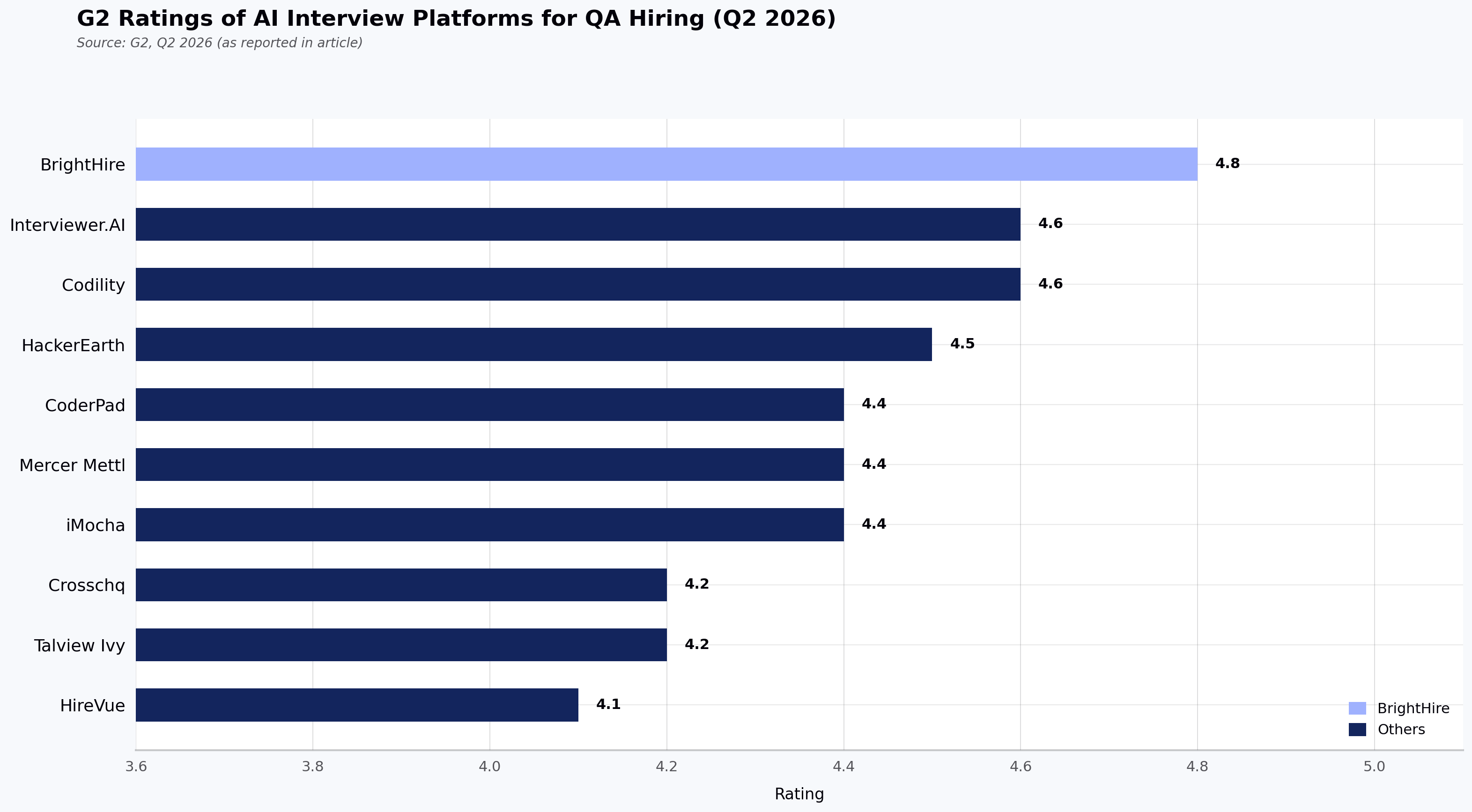
This table gives you a scannable overview of each tool's positioning, strengths, limitations, and verified G2 rating (ratings retrieved Q2 2026; values may change over time). Use it to identify which platforms warrant a deeper look based on your team's specific QA hiring requirements.

Tool name Best for Key features Pros Cons G2 rating (Q2 2026)
HackerEarth (OnScreen AI Interview Agent) Full-lifecycle QA technical hiring teams that need adaptive AI interviewing paired with QA coding assessment in a single workflow OnScreen lifelike AI video avatar interviews, QA-focused assessment library, FaceCode live coding, proctoring under OnScreen Adapts QA-specific questioning; applies structured rubric-based evaluation that is more consistent across candidates than human-led screens; integrates with common ATS platforms Lacks free tier or per-interview pricing for low-volume teams; requires onboarding support for deep configuration 4.5/5
Crosschq Structured behavioral interviews with authenticity signals AI-led interviews, structured planning, fraud detection, ATS integration, compliance reporting Adds a reference intelligence layer absent in most competitors; ships Workday Marketplace–native Cannot evaluate QA coding or test automation scripts; reportedly requires extended configuration for Greenhouse ATS sync (G2 reviews, 2024) 4.2/5
Talview Ivy High-volume behavioral screening with a conversational AI persona Customizable AI personas, multi-language support, structured evaluation, real-time interaction Supports conversational interviews in multiple languages for global BPO/banking hiring (specific language count per Talview's published documentation) Lacks a coding environment; cannot probe automation framework, API testing, or pipeline knowledge for QA roles 4.2/5
HireVue Enterprise video interviewing at scale AI summaries, searchable transcripts, competency validation, Zoom/Teams integration Integrates natively with Zoom/Teams; standardizes behavioral evaluation for high-volume hiring Lacks a coding IDE; cannot evaluate test automation or pipeline knowledge; audio/video issues reported in G2 reviews 4.1/5
CoderPad Collaborative live coding interviews for developers Multi-file IDE, AI-integrated projects, integrity toolkit, auto-grading, keystroke playback Provides real-time multi-file IDE supporting many languages (per current CoderPad documentation); keystroke playback useful for QA scripting review Lacks pre-built QA test automation libraries; provides minimal post-interview analytics for cross-candidate trends 4.4/5
Codility Technical assessment science for engineering teams Live coding IDE, pair programming, whiteboard, structured workflows, instant feedback Accessibility-conscious IDE (per current Codility documentation); measures candidate collaboration with its in-product AI assistant Lacks pre-built automation/API testing assessments; annual-only pricing inflexible for seasonal QA hiring 4.6/5
BrightHire Interview intelligence and AI note-taking AI notes, transcripts, summaries, interview design, clip sharing, ATS sync Captures every live interview with shareable clips for hiring committees Does not conduct interviews autonomously; lacks coding assessment; scorecard automation setup reported as unintuitive 4.8/5
Mercer Mettl Campus recruitment and large-scale assessment Online exams, AI proctoring, multiple question formats, multi-language registration Handles thousands of simultaneous test-takers; offers a wide range of question formats for campus QA drives (specific count per Mercer Mettl's published documentation) Runs expensive for off-season hiring; limits custom report flexibility for deep QA performance insights 4.4/5
iMocha Skills intelligence beyond basic hiring Conversational AI interviewing module, multi-format questions, role-specific assessments, ATS/HR integration Offers pre-built assessment categories spanning manual, automation, API, and performance testing (specific module names per iMocha's published documentation) Non-intuitive test setup; requires extra configuration for advanced reporting on QA insights 4.4/5
Interviewer.AI Async video screening with AI scoring Async interviews, AI avatars, automated scoring, ATS integration Suits distributed QA pre-screens with an asynchronous format; integrates with ATS/admissions systems Lacks coding evaluation for QA scripting; requires manual override for nuanced senior-role reviews 4.6/5
G2 Ratings of AI Interview Platforms for QA Hiring (Q2 2026)
Source: G2, Q2 2026 (as reported in article)
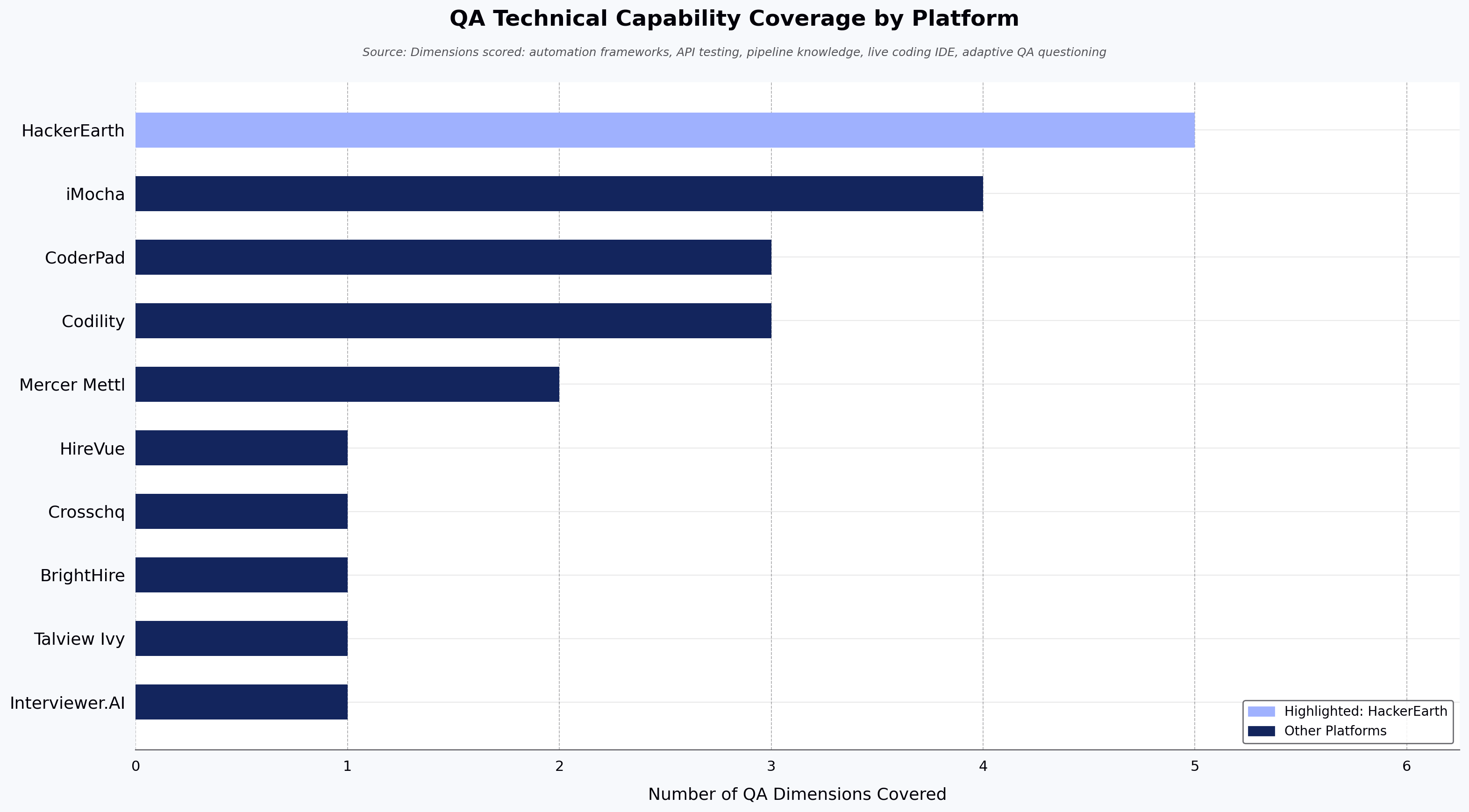
QA Technical Capability Coverage by Platform
Source: Dimensions scored: automation frameworks, API testing, pipeline knowledge, live coding IDE, adaptive QA questioning

How we evaluated these AI interview agent platforms for hiring QA engineers

Our evaluation drew on hands-on analysis, verified user reviews from G2 and Capterra (2024 to 2026), and hiring criteria specific to QA engineering roles. The eight criteria below shaped our review; each is illustrated in the individual platform write-ups rather than restated separately, so the criteria here are kept brief. The 4.0-rating and 50-review thresholds reflect our editorial cutoff for this comparison rather than an independently audited industry standard.

  • QA-specific assessment depth: whether the platform can evaluate common automation frameworks, API testing tools, pipeline knowledge, and test strategy design.
  • AI interview adaptiveness: whether follow-up questions adapt to candidate responses and probe for depth. See our guide on how to create a structured interview process.
  • Technical interview capability: whether the platform supports live coding, pair programming, code playback, and real-time evaluation for QA scripting tasks, or only behavioral video.
  • Proctoring and assessment integrity: depth of anti-cheating measures, including tab-switching detection, webcam monitoring, plagiarism signals, copy-paste prevention, and browser lockdown. The EEOC's May 2023 guidance on AI selection tools recommends employers analyze AI selection tools for adverse impact; confirm the current operative version of this guidance before relying on it for compliance work.
  • Enterprise readiness and ATS integration: native integration with common ATS platforms, SSO, API access, and enterprise security certifications. Integration friction is commonly reported in G2 and Capterra user reviews as a hidden cost that can delay ROI. For teams exploring automation in talent acquisition, a platform that creates a new data silo defeats the purpose of adopting AI.
  • Candidate experience quality: interface clarity, mobile accessibility, scheduling flexibility, and employer brand impact. In our editorial assessment, based on reviewed user feedback, async AI video screening can be a net positive for QA candidate experience when paired with a coding evaluation stage, but used in isolation it may under-serve senior SDETs whose strongest signal is technical depth, not on-camera polish.
  • Pricing transparency and ROI: public availability of pricing, billing frequency, and recruiter efficiency considerations.
  • Verified user reviews: customer reviews from G2, Capterra, and TrustRadius, focusing on platforms with an average rating above 4.0 stars and at least 50 verified reviews from 2024 through 2026.

The 10 best AI interview agent platforms for hiring QA engineers: an in-depth comparison

Let's start with the platform that combines AI interviewing with deep technical assessment capability and take a closer look at each.

1. HackerEarth: AI interview agent for full-lifecycle QA technical hiring

Best for: full-lifecycle QA technical hiring teams that need adaptive AI interviewing paired with QA-specific coding assessment in a single workflow.

HackerEarth's AI interviewing product is OnScreen, which conducts technical and behavioral interviews through lifelike AI video avatars and ships alongside FaceCode (live coding) and enterprise-grade proctoring. For QA hiring managers and TA leaders running concurrent open technical roles, the combination is designed to screen QA engineers on real testing competency rather than on-camera presentation alone.

HackerEarth's OnScreen AI Interview Agent delivers adaptive, rubric-based technical interviews.

OnScreen adapts follow-up questions in real time based on each candidate's responses, which means a senior SDET candidate can be probed on framework design while a junior QA candidate is probed on test-case fundamentals — within the same configured interview. The QA-relevant assessment depth (specific frameworks and tools covered) is configured against the HackerEarth assessment library, which spans 1,000+ skills and 40+ programming languages, with customers including Google, Microsoft, Amazon, Elastic, Flipkart, and Brillio. (Specific tools named on this page — automation frameworks, API testing tools, and pipeline knowledge areas — are pending product team confirmation before publication.)

Used together, OnScreen and FaceCode are intended to give engineering teams more consistent first-round screening across candidates than human-led screens alone. Note for editor: a specific named case study with attributed time-to-hire reduction should be added here, or this sentence further softened.

You can learn more about how HackerEarth fits into the broader landscape of top online technical interview platforms, or explore the underlying HackerEarth Assessments used by enterprise QA teams. For a deeper view on how AI is reshaping technical interviews, see our AI Interviewer guide.

Why HackerEarth: product capability summary (not a comprehensive editorial review)

The capabilities below describe HackerEarth's product positioning. Specific tool names (automation frameworks, API testing tools, pipeline components), scorecard dimensions, sandboxed-environment claims, plagiarism detection mechanics, "Smart Browser" feature naming, "private interviewer chat rooms," "code replay," and "AI-generated summaries" within FaceCode are pending verification against the product catalog before publication.

OnScreen adapts follow-up questions based on candidate responses, probing test automation thinking, edge-case identification, and debugging methodology at different depths for different candidate seniorities. Every interview generates a structured scorecard with dimension-level scoring and written rationale (specific dimensions to be confirmed). Candidates can write and execute code in HackerEarth's assessment environment with code quality analysis (specific dimensions to be confirmed). After AI screening, shortlisted candidates can move into FaceCode live coding interviews with QA leads.

For proctoring, HackerEarth's enterprise-grade proctoring under OnScreen uses AI-based webcam monitoring. The AI here uses computer vision trained to flag visual anomalies such as multiple faces in frame or repeated off-screen glances; it surfaces signals of possible integrity issues, not confirmed misconduct, and is intended as input to human review rather than as an autonomous decision.

Who HackerEarth is best for

If you are a technical recruiter, QA hiring manager, or engineering leader running a high volume of concurrent open QA and developer reqs, HackerEarth is built for your pipeline. It is particularly relevant if you are hiring QA automation engineers, SDETs, or QA leads where testing framework expertise must be calibrated before the live interview stage.

Campus recruitment teams screening candidates for QA aptitude across multiple universities can use the same assessment infrastructure for scale. Teams that need structured, rubric-applied evaluation for downstream review will find OnScreen's scorecards and reporting useful.

HackerEarth's pros

  • Automates first-level QA screening with structured, rubric-based evaluation
  • Combines AI interviewing (OnScreen) with live coding (FaceCode) in one workflow
  • Provides enterprise-grade proctoring for compliance reviews

HackerEarth's cons

  • Lacks a free tier or per-interview pricing for low-volume use
  • Requires onboarding support for first-time administrators given configuration depth
  • Centers on adaptive AI interviewing rather than pair programming; teams that need pair programming as the primary signal may prefer CoderPad or Codility

HackerEarth's pricing

Confirmed public pricing: HackerEarth's Skill Assessments Growth tier is listed at $99/month for 10 assessments on the HackerEarth pricing page (retrieved Q2 2026; confirm against the live pricing page before publication).

Pricing not publicly disclosed: Pricing for OnScreen (AI Interview Agent) and FaceCode is not publicly disclosed as of Q2 2026; contact HackerEarth sales for a quote based on interview volume and integration scope. Annual pricing equivalents, Enterprise tier add-ons, and specific support tier features should be confirmed directly with HackerEarth sales.

📌 Related read: How to create a structured interview process: a step-by-step guide for hiring managers

2. Crosschq: AI interview agent for behavioral QA screening with reference intelligence

Best for: TA teams that prioritize behavioral screening and reference intelligence for non-technical or hybrid roles, where coding evaluation is not required.

Crosschq is an AI interview agent platform rooted in reference intelligence and structured behavioral interviewing. The platform conducts AI-led interviews with structured planning, fraud detection through behavioral authenticity signals, compliance reporting, and reference intelligence integration. Its heritage in reference checking gives it credibility in the "quality of hire" conversation, and its Workday Marketplace presence means organizations already running Workday can discover and evaluate it within their existing ecosystem.

Crosschq positions its AI interview agent around structured behavioral interviews and reference intelligence.

However, Crosschq focuses entirely on behavioral interviews and reference verification. It does not evaluate QA automation scripting, testing framework knowledge, API testing methodology, or any form of coding ability.

Key features of Crosschq

  • Compliance and reporting: Supports audit trails and regulatory requirements for organizations with strict hiring governance mandates.
  • ATS integration with Workday focus: Integrates with Workday Marketplace and other ATS platforms so interview data can flow into existing recruitment workflows.
  • Structured interview planning tools: Allows hiring managers to build interview plans with predetermined questions, scoring rubrics, and evaluation criteria before the first candidate is screened.

Who Crosschq is best for

If you are a TA leader or HR director at a mid-to-large enterprise focused on behavioral screening and reference verification for non-technical or hybrid roles, Crosschq fits your pipeline.

Crosschq's pros

  • Applies a structured behavioral framework so every candidate is assessed against the same criteria
  • Adds reference intelligence as a data layer that most AI interview platforms do not provide
  • Integrates natively with Workday to reduce configuration friction in that ecosystem

Crosschq's cons

  • According to G2 reviewers in 2024, ATS sync with Greenhouse can require extended configuration and multiple support calls, with data mapping that is not plug-and-play
  • G2 reviewers have noted that AI scoring transparency for technical roles can make it difficult to explain why one candidate scored higher than another (G2, 2024)

Crosschq's pricing

Pricing is not publicly disclosed as of Q2 2026; contact Crosschq's sales team for a quote. Pricing conversations typically cover interview volume, ATS integration requirements, and reference intelligence module access.

3. Talview Ivy: AI interview agent for high-volume multilingual screening of QA-adjacent roles

Best for: high-volume behavioral screening in banking, IT services, and BPO where multilingual conversational interviews are the primary requirement.

Talview Ivy is an AI interview agent that conducts real-time conversational interviews with customizable personas across multiple languages (specific language count per Talview's published documentation). It is designed for high-volume behavioral screening, particularly in banking, IT services, and business process outsourcing where organizations need to screen thousands of candidates in multiple languages simultaneously.
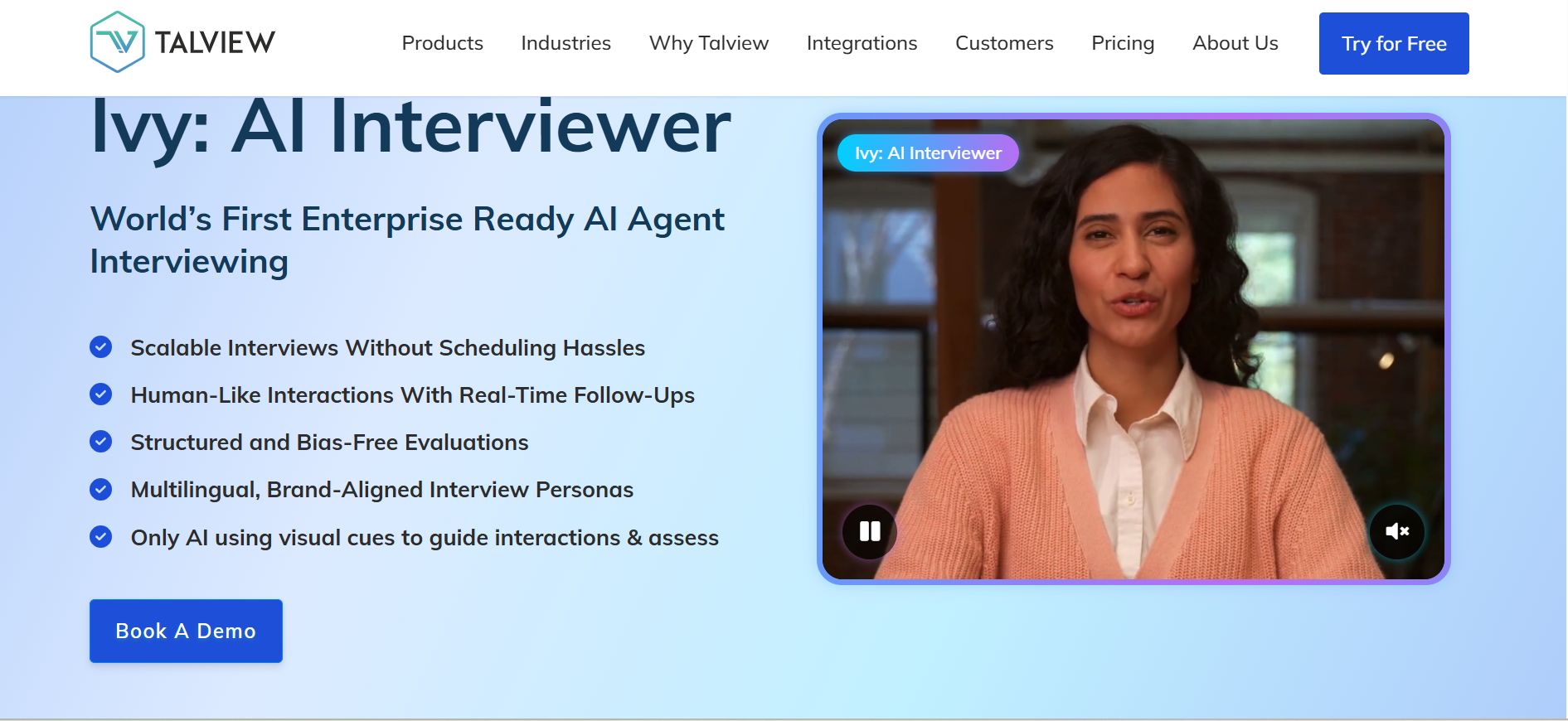
Talview positions Ivy as a conversational AI interview agent with customizable personas.

For QA hiring specifically, Talview Ivy's limitations are significant. The platform cannot probe QA technical depth. It does not evaluate automation scripting, test architecture, API testing methodology, pipeline integration knowledge, or any form of coding competency.

Key features of Talview Ivy

  • Real-time conversational interaction: Engages candidates in dynamic, back-and-forth conversation rather than static one-way video recording.
  • Structured evaluation with scoring rubrics: Produces a scored evaluation against predefined behavioral criteria for consistent comparison across candidates.
  • Fraud detection signals: Flags potential interview fraud or coached responses during the screening process.

Who Talview Ivy is best for

Talview Ivy fits your pipeline if you are in banking, insurance, IT services, or BPO and hiring customer-facing or operations roles across multiple countries and languages.

Talview Ivy's pros

  • Supports multi-language behavioral screening for global hiring programs
  • Offers a conversational interface designed to create a more engaging candidate experience
  • Includes structured rubrics that enable consistent evaluation across high candidate volumes

Talview Ivy's cons

  • Lacks any coding environment, so it cannot evaluate automation frameworks, API testing, or pipeline knowledge
  • Limits suitability for senior SDET or QA lead hiring where technical depth is the primary signal

Talview Ivy's pricing

Pricing is not publicly disclosed as of Q2 2026; contact Talview's sales team for a quote based on candidate volume, languages required, and integration scope.

4. HireVue: AI interview agent for enterprise video interviewing at scale

Best for: enterprise TA teams running large-volume behavioral video interviews with native Zoom and Teams integration.

HireVue is an enterprise video interviewing platform that uses AI to generate interview summaries, searchable transcripts, and competency validation against structured rubrics. It is widely adopted in Fortune 500 hiring programs for high-volume behavioral screening.

For QA hiring, HireVue does not provide a coding IDE and cannot evaluate automation scripts or pipeline knowledge. It is best deployed as a behavioral screening layer ahead of a separate technical assessment stage.

Key features of HireVue

  • AI interview summaries: Generates summaries and searchable transcripts from recorded interviews.
  • Competency validation: Maps candidate responses to defined competencies for consistent scoring.
  • Zoom and Teams integration: Plugs into the video tools enterprise hiring teams already use.

Who HireVue is best for

Enterprise TA
How an AI Interview Agent Evaluates Selenium and QA Automation Skills

Most QA automation interviews test the wrong things. On one hand, candidates are increasingly using AI to shape their applications. iHire’s 2024 survey found 17.3% of job seekers used AI to write a resume or cover letter, up from 2.8% in 2023. 

On the other hand, employers are evaluating AI-assisted candidates with generic screens, while candidates can easily use generative AI to answer standard Selenium questions. The result is resume keyword inflation, where every applicant lists Selenium, TestNG, Cucumber, and Jenkins, but recruiters still cannot tell who has built a production-grade automation framework versus who only completed a tutorial.

That is why a purpose-built AI interview agent matters. It shifts screening from keyword matching to live evaluation of real automation skills. This guide shows how HackerEarth’s AI Interview Agent applies structured rubrics, adaptive follow-ups, real-time code evaluation, and proctoring to screen QA automation candidates more accurately.

Why QA Automation Hiring Is Broken (And Why Generic AI Tools Don't Fix It)

Open any QA automation job listing, and you will receive hundreds of applications that look functionally identical. Every candidate claims expertise in Selenium WebDriver, proficiency with TestNG or JUnit, familiarity with Cucumber BDD, and hands-on experience with Jenkins pipelines. 

Your recruiters cannot distinguish between a candidate who designed and maintained a scalable Page Object Model framework in production and one who followed a YouTube tutorial series last month. Without a structured, domain-specific evaluation layer, these resume keywords become noise that drains your team's screening hours without producing a reliable signal.

Where Do Most AI Tools Go Wrong?

Many AI interview platforms available today do not address this disconnect. They focus on behavioral interview questions or general algorithmic coding challenges, the kind of problems you'd find on competitive programming sites. These tools can verify whether a candidate writes syntactically correct Python.

They cannot evaluate whether that same candidate understands how to architect a test framework, can diagnose a StaleElementReferenceException in a CI pipeline, or knows the practical difference between a fluent wait and an explicit wait. 

For QA automation hiring specifically, the gap between what generic tools assess and what the job actually requires makes AI-assisted screening feel no more useful than random filtering.

The situation worsens when you factor in candidate-side AI use. QA automation engineers are technically proficient enough to paste a Selenium scripting prompt into ChatGPT and receive a working, well-commented answer within seconds.

If your AI interview tool relies on static question banks with predictable coding exercises, you are measuring the quality of the candidate's AI assistant. This dynamic turns every static coding assessment into a test of prompt engineering.

How does a domain-specific AI interview agent help?

A domain-specific AI interview agent takes a fundamentally different approach. It decomposes QA automation evaluation into discrete skill dimensions, deploys adaptive follow-up questions that require genuine real-time technical reasoning, and simultaneously evaluates code quality across correctness, maintainability, and readability.

Building a structured interview process around these capabilities replaces keyword-based guesswork with competency-based evidence. The question is: what exactly does the AI evaluate, and how deep does it go?

The Seven QA Automation Skill Dimensions an AI Interview Agent Evaluates

A well-designed AI interview agent does not treat QA automation as a single, monolithic skill to be scored as a single number. Instead, it decomposes the role into discrete, measurable competency dimensions that map directly to what your QA engineers do every day on the job. 

HackerEarth's AI Interview Agent evaluates candidates across these seven dimensions, drawing from a technical assessment library of 25,000+ curated questions spanning 1,000+ skills to generate a structured, dimension-by-dimension scorecard with scoring rationale for every assessment point.

1. Selenium WebDriver Core Competency

This dimension covers the fundamentals every QA automation engineer must demonstrate: locator strategies (CSS selectors, XPath, relative locators, and chained locators), browser interaction patterns, dynamic element handling, and WebDriver architecture. The AI starts with practical scenarios. A candidate who mentions XPath will face follow-up questions about when XPath is the wrong choice, what alternatives offer better performance, and how they handle locator stability in rapidly changing UIs.

2. Test Framework Architecture and Design Patterns

Framework design is what separates production-ready QA engineers from tutorial followers. The AI evaluates understanding of Page Object Model implementation, factory patterns, test data management strategies, and the ability to architect a framework that scales to hundreds of test cases without becoming brittle. Scenario-based questions probe why the candidate chose specific design patterns for specific situations.

3. Synchronization and Wait Strategies

Timing issues cause more flaky tests than any other single factor in Selenium automation. This dimension assesses whether candidates understand the practical differences between implicit, explicit, fluent, and custom waits. It also evaluates their ability to handle AJAX-heavy applications and dynamic content loading. The AI presents debugging scenarios containing code snippets with timing-related failures and evaluates the candidate's diagnostic approach step by step.

4. CI/CD Pipeline Integration

The AI also evaluates candidates on Jenkins and GitHub Actions configuration for test execution, parallel test execution strategies, containerized browser environments using Docker, and how to design a test suite that provides fast feedback loops without becoming a pipeline bottleneck. Candidates who claim CI/CD experience are asked how they triage a test that passes locally but fails consistently in the pipeline.

5. Cross-Browser and Cross-Platform Testing Strategy

This dimension goes beyond knowing that Selenium Grid exists. The AI assesses understanding of Grid architecture and hub-node configuration, cloud testing platform integration with services such as BrowserStack or Sauce Labs, mobile web testing considerations, and handling browser-specific rendering differences in test assertions.

Candidates with real cross-platform experience can articulate the tradeoffs between running a self-hosted Grid and using a cloud provider at scale.

6. Debugging and Failure Analysis

When a test fails at 2 AM in the CI pipeline, your QA engineer needs to diagnose it quickly. The AI evaluates exception-handling strategies, implementation of screenshot and log capture, root-cause analysis methodology, and how candidates communicate findings to the development team. It presents real-world failure scenarios with stack traces and assesses whether the candidate can trace the failure back to a code change, an environment issue, or a genuine product defect.

7. Test Data Management and API-Layer Testing

Senior QA engineers understand the test pyramid and know that not every validation belongs in the UI layer. This dimension evaluates how candidates manage test data across environments, integrate API testing into their automation strategy, decide when to push validation from the UI layer down to the API or unit layer, and balance test coverage against execution speed. 

A candidate who defaults to UI-level testing for everything reveals weak strategic thinking that no amount of Selenium syntax knowledge can compensate for. 

How the AI Interview Agent's Adaptive Questioning Works

The seven skill dimensions define what gets evaluated. But the real differentiator is not the dimensions themselves. It is how the AI adapts its questioning in real time based on each candidate's responses. The adaptive questioning model determines whether that evaluation captures genuine expertise or rehearsed answers.

Evolving Line of Questioning

Traditional AI interview platforms pull questions from a fixed pool in a predetermined order. HackerEarth's AI Interview Agent takes a fundamentally different approach, evolving its line of questioning based on each candidate's responses in real time. 

If a candidate demonstrates strong knowledge of explicit waits, the AI escalates to custom wait conditions and AJAX polling strategies. If a candidate struggles with basic locator strategies, the agent adjusts the difficulty downward to map their proficiency floor accurately.

This branching dialogue means no two QA automation interviews follow the same path, making it structurally impossible for candidates to prepare by memorizing a question bank.

Live Environment Tests

Candidates also write actual Selenium code in a live environment. The AI evaluates submissions across correctness, maintainability, security, and readability simultaneously. 

QA automation roles require evaluating whether a candidate’s Page Object Model implementation follows clean abstraction principles or creates tightly coupled dependencies that will break at scale. 

Multi-Dimensional Scorecard

After every interview, the AI generates a dimension-by-dimension scorecard that goes beyond a single numeric score. Each of the seven skill dimensions receives its own assessment, along with a written rationale explaining what the candidate demonstrated and where weaknesses appeared.

Your hiring manager sees exactly why a candidate scored at the 85th percentile in debugging but at the 50th percentile in CI/CD integration, rather than receiving a single opaque number that tells them nothing actionable.

Adaptive Follow-up Questioning 

Smart Browser technology, tab-switch detection, audio monitoring, and extension detection form the proctoring layer. But adaptive follow-up questioning is the strongest anti-gaming mechanism. When a candidate provides a polished answer about Selenium Grid architecture, the AI immediately probes with a contextual follow-up: "Your Grid configuration uses four nodes.

How would you handle a scenario where one node consistently produces different test results than the others?" That kind of real-time, context-dependent dialogue requires genuine technical thinking that cannot be outsourced to ChatGPT mid-conversation.

Where AI Evaluation Excels and Where Human Judgment Is Still Essential

An AI interview agent delivers its strongest value where consistency, scale, and objectivity matter most. It evaluates foundational QA automation competency with zero variation between candidates, applies identical scoring rubrics at 2 PM and 2 AM, provides structured, comparable scorecards across all time zones, and saves your engineering team 15+ hours per week that would otherwise be spent on first-round interviews. 

For filtering candidates who lack core Selenium knowledge, understanding of synchronization, awareness of framework design, or CI/CD competency, AI outperforms human interviewers in speed, consistency, cost, and objectivity.

But an honest evaluation of any AI interview tool requires acknowledging where it falls short today. Architectural judgment calls remain difficult for AI to assess reliably. Deciding when to invest in UI automation versus API testing for a specific product, designing a test data strategy for a microservices migration, evaluating whether a legacy test suite should be refactored or replaced, or balancing test coverage against pipeline speed in a resource-constrained sprint: these decisions depend on accumulated context that no question bank can fully replicate. As one senior QA lead noted on Reddit's r/ExperiencedDevs: "The AI was great for eliminating obviously unqualified candidates. It was terrible at distinguishing between the top 30%."

The optimal workflow uses both layers in sequence. 

  • Deploy the AI Interview Agent for the first 80% of your evaluation, establishing a reliable technical competency baseline across all seven QA automation dimensions. 
  • Then reserve FaceCode live coding interviews for the final 20%, where a senior QA engineer on your team evaluates architectural thinking, system design decisions, test strategy tradeoffs, and team collaboration dynamics in real time. 

This combination gives you the AI's strengths in structured, scalable first-pass filtering while preserving human judgment where it genuinely adds irreplaceable value.

Implementing AI-Driven QA Automation Interviews in Your Hiring Workflow

Moving from manual QA screening to AI-driven evaluation does not require a multi-month implementation project. Here is a practical five-step workflow for getting started.

Step 1: Define Role Requirements

Identify which of the seven QA automation skill dimensions matter most for your open role. A mid-level Selenium engineer may need deep evaluation across WebDriver competency, synchronization, framework architecture, and cross-browser testing. A senior QA lead role likely requires heavier weighting on CI/CD integration, test data strategy, debugging methodology, and API-layer testing. HackerEarth's JD-to-test generation feature lets you upload a job description and auto-generate a role-specific assessment in minutes.

Step 2: Configure for Your Tech Stack

Your team may work with Selenium, Playwright, Cypress, and Appium, or a mix of multiple frameworks. Configure the AI evaluation to match the specific frameworks, languages, tools, and environments your role requires. HackerEarth supports 40+ programming languages and 1,000+ skills, so the assessment reflects your actual engineering environment.

Step 3: Integrate with Your ATS

Connect the AI Interview Agent to your existing applicant tracking system. HackerEarth integrates natively with Greenhouse, Lever, SAP SuccessFactors, iCIMS, Workable, and 10+ other platforms. A Recruit API is available for custom integrations. Scorecards and candidate reports flow directly into your system of record without creating a new data silo.

Step 4: Run and Review

The AI conducts evaluations autonomously. Candidates complete their interview on their own schedule, and your hiring manager receives a structured scorecard with dimension-level scoring and written rationale before they ever speak to the candidate. No engineering hours are consumed until a candidate has cleared the AI competency baseline.

Step 5: Measure and Optimize

Track four key metrics after implementation: time-to-hire reduction, interview-to-offer ratio, engineering hours saved per hire, and post-hire performance correlation with AI scores. These data points indicate whether the AI is filtering effectively and where you may need to adjust dimension weights or difficulty thresholds for specific roles.

Once your workflow is live, one question remains: what does this evaluation process look like from the candidate's perspective, and how can QA automation engineers prepare for it?

What QA Automation Candidates Should Know About AI Interviews

If you are sharing this guide with QA automation candidates (or if you are a QA engineer reading this yourself), here is what the evaluation actually looks like from the other side of the screen.

The AI interview agent evaluates your skills across the seven dimensions covered earlier in this guide: WebDriver core competency, framework architecture, synchronization strategies, CI/CD integration, cross-browser testing, debugging methodology, and test data management.

 It is not a trivia quiz. 

You will not be asked to recite the difference between findElement and findElements from memory. Instead, you will work through real-world scenarios that mirror the problems you solve on the job, write actual code in a live environment, and explain your reasoning as you go. The AI adapts its follow-up questions based on your responses, so the interview naturally finds your proficiency level.

Preparation matters, but the right kind of preparation matters more. 

Focus on articulating why you make specific technical decisions, not just what those decisions are. Practice explaining your framework design choices, walking through your debugging methodology step by step, and describing how your test automation strategy fits into a CI/CD pipeline. HackerEarth's AI Practice Agent (Helix) lets you practice mock interviews with instant AI feedback, so you can calibrate your responses and identify blind spots before the real evaluation.

When the interview starts, you will interact with a lifelike video avatar in a conversational format. The evaluation scores you on genuine skill across multiple competency dimensions, not on keyword density, verbal polish, or how confidently you present rehearsed answers. Candidates with real production experience consistently perform well because the adaptive questioning rewards depth of understanding over surface-level familiarity.

The Regulatory Context: Why Explainable AI Evaluation Matters

Your legal and compliance teams will eventually ask a pointed question about any AI interview tool you adopt: Can you explain and defend every hiring decision the AI influenced?

Regulatory requirements are making this question unavoidable. New York City's Local Law 144, effective since July 2023, requires independent bias audits of automated employment decision tools and mandates that employers notify candidates when AI is used in their evaluation. The EU AI Act, which took effect in August 2024, classifies AI used in hiring as "high-risk," requiring conformity assessments, human oversight mechanisms, and transparency documentation. These are current obligations for companies hiring in those jurisdictions.

HackerEarth supports compliance through structural design. Structured scorecards with dimension-by-dimension rationale create an audit trail that documents exactly what the AI evaluated, how it scored each competency, and why it reached its conclusions. PII masking removes bias-triggering personal information entirely from the evaluation process. ISO 27001, 27017, 27018, and 27701 certifications, combined with participation in the EU-US Data Privacy Framework, meet the security and data governance standards that enterprise procurement teams require before approving any AI tool that handles candidate data.

Conclusion

When evaluating an AI interview tool for QA automation roles, prioritize four capabilities: domain-specific question depth, adaptive follow-up questioning, structured scorecards, and regulatory-compliance infrastructure that meets your legal and procurement teams' requirements. 

The right tool should reduce your engineering team's interview burden without sacrificing the evaluation rigor that distinguishes a production-ready QA engineer from a tutorial follower. If the AI cannot clearly explain why it scored a candidate the way it did, it will not survive your first compliance audit or your first skeptical engineering manager.

HackerEarth's AI Interview Agent evaluates QA automation candidates across all seven competency dimensions covered in this guide, drawing from 25,000+ curated questions and insights from 100M+ assessment signals to generate dimension-level scorecards with written rationale for every evaluation point. 

The distance between what generic AI tools evaluate and what QA automation roles actually demand will only widen as test frameworks, CI/CD pipelines, and browser environments grow more complex.

Organizations that invest in domain-specific AI evaluation now will build a compounding advantage in hiring speed, evaluation consistency, and engineering team productivity. See how HackerEarth's AI Interview Agent evaluates QA automation skills in your specific hiring context. Try HackerEarth out now.

FAQs

1. Can an AI interview tool replace human recruiters entirely?

No. AI interview tools automate structured first-pass technical screening and scoring, but human recruiters remain essential for candidate relationship building, offer negotiation, and evaluating cultural alignment within your hiring teams.

2. Do AI interview tools introduce bias into the hiring process?

Well-designed platforms reduce bias by applying identical evaluation criteria to every candidate, masking personally identifiable information, and generating structured scorecards that remove subjective judgment from the initial screening stage.

3. How much does a typical AI interview tool cost for employers?

Pricing varies widely, from $99 per month for entry-level plans with limited interview credits to custom enterprise agreements based on hiring volume, integration requirements, and dedicated support needs.

4. Can AI interview tools handle assessments in multiple programming languages?

Leading platforms support 30 to 40 or more programming languages, allowing candidates to complete coding evaluations in the language most relevant to their role and your engineering team's technology stack.

5. What is the difference between an AI interview tool and a standard video interview platform?

AI interview tools actively evaluate candidate responses, generate structured scores, and adapt questions in real time, whereas standard video platforms simply record conversations without providing automated technical assessment.

AI Interview Agent vs One-Way Video Interview: Which Is Better for Technical Hiring?

AI is interviewing your candidates. But which AI? A 2024 Resume Builder survey found that 24% of companies were using AI to conduct the entire interview process. However, 88% of HR leaders acknowledge their AI hiring tools have rejected qualified candidates (Harvard Business School's Hidden Workers report).

The term AI interview spans very different tools, from autonomous agents that run adaptive technical conversations to one-way video recordings scored by sentiment models. For teams hiring developers, treating these systems as interchangeable creates problems. Each one measures different capabilities, shapes the candidate experience in different ways, introduces distinct compliance considerations, and offers varying levels of predictive value for hiring decisions.

In this guide, we compare the two main categories of AI interviews through the lens of technical recruiting. You’ll learn how each model works, what users on G2 and Reddit say about them, where current research points, and which option best fits your engineering hiring pipeline based on reliability, fairness, auditability, and hiring accuracy.

What Are AI Interview Agents and One-Way Video Interviews?

The term AI interview has become an umbrella label for fundamentally different technologies. Before comparing them, you need to understand how each category works and what it actually measures.

AI Interview Agents: How They Work

AI Interview Agents are autonomous AI systems that conduct real-time, interactive interviews with candidates. They ask questions, evaluate responses, adapt follow-up questions based on answers, and generate structured scorecards without human involvement.

The technology uses a curated question library, adaptive branching logic, evaluation matrices, and historical assessment data to simulate a structured technical conversation. For engineering roles, this includes live code evaluation, architecture discussion, system design probing, and debugging walkthroughs. 

Candidates experience a two-way interaction in which their answers directly shape the interview's direction, producing structured outputs such as scorecards, transcripts, code replays, and question-by-question breakdowns.

G2 reviewers and Reddit users consistently describe AI Interview Agents as more engaging than static recording tools because their adaptive conversations mirror real interview dynamics.

One-Way Video Interviews: How They Work

One-way video interviews are asynchronous recording platforms in which candidates receive preset questions, prepare during a brief window, record their responses within a time limit, and submit their recordings for AI or human review.

The typical flow works like this: a candidate sees a question on screen, gets 30 to 60 seconds of preparation time, then records a 1- to 3-minute response. Some platforms analyze facial expressions, vocal tone, word choice, and response structure using AI. 

Others simply store recordings for human reviewers to watch later. One-way video tools are one-directional with no follow-up questions, asynchronous with no real-time interaction, focused on delivery style rather than technical content, and limited in their code-evaluation capabilities. Platforms in this category include HireVue, Spark Hire, myInterview, and Interviewer.AI.

G2 reviewers of platforms in this category note that AI competency scores tend to be "directional but not granular enough" for technical roles. TrustRadius reviewers have found that AI scoring from one-way video tools didn't correlate strongly with on-the-job performance for engineering positions, raising important questions about predictive validity when your team is evaluating developers. 

For a deeper look at how AI interviewers are evolving across both categories, see the AI Interviewer Guide 2026.

Side-by-Side Comparison: AI Interview Agent vs One-Way Video Interview

This table provides technical recruiters and engineering managers with a quick reference for how these two approaches differ across the dimensions that matter most in developer hiring.

Criterion AI Interview Agent One-Way Video Interview
Interaction Model Two-way, adaptive, conversational One-directional, pre-recorded, static
Technical Evaluation Depth Code execution, system design, architecture probing, adaptive follow-ups Behavioral and situational responses; limited or no code evaluation
Candidate Experience Conversational and dynamic; closer to a real interview Frequently described as "talking to a wall" on Reddit and G2
Bias Risk Profile Evaluates code output and reasoning; PII masking available Often analyzes facial expressions, tone, and accent, with documented bias concerns
Cheating Resistance Proctored code execution, tab-switch detection, AI tool detection Limited; candidates can prepare and rehearse recordings
Predictive Validity for Technical Roles High. Skills-based assessment is 29% more predictive of job performance (Sackett et al., 2023) Lower. Evaluates interview performance, not job performance
Scalability Unlimited concurrent interviews, 24/7 availability High. Asynchronous by nature
Regulatory Compliance Skills-based evaluation is less exposed to facial analysis bias audit requirements NYC Local Law 144 and similar regulations specifically target automated tools using biometric analysis
Integration with Hiring Workflow Generates structured scorecards, code replays, and transcripts for downstream rounds Generates video recordings and AI scores; limited integration with technical evaluation workflows

AI Interview Agents evaluate technical ability directly. They execute candidate code, probe system design decisions, and adapt questions based on the depth of each response. The output is a structured assessment of a candidate's ability to build, debug, and reason about software in real time.

One-way video interviews evaluate how candidates present their answers. Facial expression analysis, vocal tone scoring, and keyword detection are the most common evaluation mechanisms. For communication-heavy roles, those signals carry genuine weight. For engineering roles that involve writing code and designing systems, those signals measure something fundamentally different from day-to-day job performance.

How We Evaluated These Two Approaches

We did not evaluate these categories based on vendor feature checklists or marketing claims. Instead, we applied six criteria designed specifically for technical hiring outcomes, informed by I/O psychology research, real user reviews from G2 and Capterra, and community feedback from Reddit and developer forums.

These six criteria frame every argument in the sections that follow: 

1. Technical Assessment Depth

Can the tool evaluate code quality, algorithmic thinking, system design, and debugging, or does it only assess verbal communication and behavioral responses? For developer roles, the ability to execute and score candidate code is the minimum bar for a meaningful technical evaluation.

2. Predictive Validity

Does the evaluation method correlate with actual on-the-job performance? We used Sackett et al.'s 2023 meta-analysis as the benchmark for comparing skills-based assessment approaches against behavioral interview scoring methods.

3. Candidate Experience and Completion Rates

What do candidates actually report about the experience? We analyzed G2 reviews from 2024 to 2026, Capterra reviews, and Reddit threads across r/recruitinghell, r/cscareerquestions, r/ExperiencedDevs, and r/recruiting to identify sentiment patterns for both categories.

4. Bias Resistance and Compliance

Does the evaluation method rely on facial analysis, vocal tone, or accent scoring? All of these carry documented bias risks and growing regulatory exposure. We factored in NYC Local Law 144 requirements and the broader trend toward mandatory bias audits for automated hiring tools.

5. Cheating and Integrity Resistance

With candidates increasingly using AI copilots during interviews, how well does each approach resist gaming? AI-Powered Interviews that include proctored environments, such as HackerEarth's Smart Browser technology, detect tab switching, screen capture, AI tool usage, extension activity (including ChatGPT), and copy-paste attempts. One-way video platforms offer minimal resistance to rehearsed or AI-generated responses.

6. Enterprise Workflow Integration

Does the tool produce outputs useful for downstream interview rounds and final hiring decisions? Structured scorecards, code replays, transcripts, and ATS-compatible reports create an evidence trail your engineering managers can act on. A video recording paired with a single AI-generated score does not serve the same purpose. For more on how these workflows are evolving across technical hiring, see our guide on AI for Recruiting.

The Case for AI Interview Agents in Technical Hiring

Technical hiring breaks down when the evaluation method measures the wrong signal. AI Interview Agents address this problem by anchoring every assessment to what candidates can actually build, debug, and reason through. 

The following sections examine why this category consistently outperforms static alternatives across four dimensions your engineering pipeline depends on: 

They Evaluate What Candidates Can Build, Not How They Sound

The core distinction between AI Interview Agents and other AI interview approaches lies in what is measured. AI Interview Agents that include live code evaluation, project simulations, and adaptive technical questioning assess the skill that actually predicts whether someone will succeed in an engineering role. Structured skills-based assessments have decades of I/O psychology research confirming their superiority over presentation-focused evaluation methods when predicting on-the-job engineering performance.

Adaptive Follow-Ups Expose Depth That Static Questions Cannot

The most revealing moment in a technical interview is the follow-up question. When a candidate explains a design decision, a skilled interviewer probes the trade-offs. When a solution has an edge case, a strong interviewer asks about it. One-way video interviews, by their very structure, cannot do this. Every candidate receives the same static questions regardless of how they respond.

They Resist the "AI vs. AI" Problem

Employers now face an arms race where candidates use AI copilots and preparation tools to generate polished, template-perfect responses. The question becomes unavoidable: is your AI interview tool evaluating the candidate's ability, or the AI assistant's output? AI Interview Agents that evaluate code execution in proctored environments measure genuine ability rather than AI-assisted performance. 

Structured Scorecards Create an Evidence Trail Engineering Managers Trust

Engineering managers need more than a pass/fail score or an opaque AI rating. They need code replays, question-by-question breakdowns, and structured reasoning assessments to make confident hiring decisions, calibrate their interview panels, and diagnose evaluation errors when a hire doesn't work out.

The Case Against One-Way Video Interviews for Technical Hiring

One-way video interviews screen at scale, with no scheduling overhead. That efficiency advantage is genuine. But for technical hiring specifically, the evidence from review platforms, developer communities, regulatory bodies, and I/O psychology research shows that the trade-offs outweigh the convenience. 

Here is where one-way video falls short across four critical areas:

They Measure Interview Performance, Not Job Performance

One-way video tools analyze how a candidate delivers their answer using vocal confidence, eye contact, keyword usage, and response structure. For roles where communication style is the primary job requirement, these signals carry weight.

For engineering roles, the daily work involves writing code, debugging systems, and designing architecture. Scoring a developer on vocal tone and facial expressions measures something disconnected from what they will actually do on the job.

Employers using one-way video AI scoring for technical roles consistently report a weaker correlation between assessment scores and post-hire performance than those using skills-based evaluation methods. The predictive validity gap is the difference between hiring developers who interview well and those who build well.

Candidate Experience Is Actively Harmful to Employer Brand

Multiple G2 reviewers describe one-way video interview experiences as "dehumanizing" and "robotic." Reddit r/recruitinghell threads describe the process as "talking to the void." This sentiment is consistent across platforms, years, and geographies.

For your team, the candidate experience problem creates a selection problem. Top developers with multiple competing offers are the most likely to abandon an application that feels impersonal or disrespectful of their time. 

Candidates who undergo a dehumanizing process tend to be those with fewer options. Adverse selection degrades the quality of your shortlist before a human interviewer ever sees it, meaning your engineering managers are reviewing a pool that has already lost its strongest candidates.

Bias Risk Is Structurally Higher When AI Analyses Faces and Voices

Regulatory scrutiny is intensifying around AI tools that use biometric analysis in hiring decisions. Reddit r/jobs includes accounts from candidates with accents, speech impediments, and autism spectrum traits who report being systematically screened out by tools that score vocal tone and facial expressions. These are not hypothetical risks. They are documented patterns with real legal exposure.

AI Interview Agents that evaluate code output, technical reasoning, and problem-solving approach are structurally less exposed to this category of bias. When the evaluation input is code that either works or doesn't, and system design reasoning that holds up or doesn't, the surface area for discrimination based on appearance, accent, or neurotype shrinks dramatically.

They Are Easy to Game and Impossible to Probe

The combination of pre-set questions, preparation windows, and no follow-up mechanism makes one-way video interviews vulnerable to AI-assisted gaming. Reddit r/cscareerquestions users describe how AI prep tools generate "perfect-sounding but shallow answers" that score well on delivery metrics but collapse when anyone asks a probing follow-up question.

A one-way video interview cannot ask that follow-up. It structurally cannot distinguish between a candidate who deeply understands a topic and one who recited an AI-generated summary 30 seconds before pressing record.

For your engineering hiring, this means the tool designed to save time may actually increase downstream interview load by passing through candidates who cannot survive a live technical conversation.

The Contrarian Take: The Real Problem Is Not Bias or Candidate Experience, It Is Measuring the Wrong Thing

Most debates about AI interviews center on bias, candidate experience, and efficiency. Those concerns are real. But the most consequential failure of many AI interview tools is more fundamental: they optimize for interview performance instead of job performance.

85% of employers using structured, skills-based assessments report improved quality of hire compared with those relying on unstructured or presentation-focused evaluation methods (ResearchGate). 

Reddit r/recruiting users describe an "AI vs. AI" absurdity where candidates use generative AI to produce polished video responses, AI tools score those responses highly based on delivery metrics, and nobody involved in the process can answer the most basic question: "What is actually being measured?"

The reframe is straightforward. The first question you should ask about any AI interview tool is not "Is it fast?" or "Is it fair?" It is: "Does this tool measure the thing that predicts whether this person will succeed in the role?" 

If the answer involves facial expressions, vocal confidence, or eye contact for a software engineering position, you are measuring the wrong thing entirely. Speed and fairness matter, but only after you have confirmed that the underlying measurement is connected to job performance.

When One-Way Video Interviews Still Make Sense

One-way video interviews are not inherently broken. They solve real problems in specific contexts:

  • Non-technical, high-volume roles where communication style, customer-facing presence, and verbal clarity are genuinely job-relevant evaluation criteria.
  • Initial culture and communication screening after candidates have already passed a skills-based technical assessment, functioning as a supplementary layer rather than a primary filter.
  • Resource-constrained teams with no technical assessment infrastructure in place, where one-way video serves as a temporary screening mechanism while the team builds a more skills-focused pipeline.
  • Customer-facing engineering roles where presentation ability is a meaningful component of day-to-day responsibilities, alongside technical competency.

How HackerEarth's AI Interview Agent Bridges the Gap

The gap between what most AI interview tools measure and what actually predicts engineering success is the problem HackerEarth's AI Interview Agent was built to close. 

The platform addresses every evaluation criterion discussed earlier in this article. Here is what that looks like in practice.

Autonomous Technical Interviews at Scale

The AI Interview Agent conducts structured, role-specific technical and behavioral interviews without human intervention. Trained on 25,000+ questions and insights from 100M+ assessments, it uses a lifelike AI video avatar for natural candidate engagement and covers 30+ programming languages, including Python, Java, JavaScript, Go, Rust, and C++. 

Adaptive follow-up questioning ensures every interview reflects the candidate's actual depth rather than following a scripted, one-size-fits-all path.

Bias-Resistant, Compliance-Ready Evaluation

The platform evaluates code output, technical reasoning, and problem-solving, and not just facial expressions or vocal tone. PII masking removes gender, accent, and appearance from the evaluation process. HackerEarth holds ISO 27001, 27017, 27018, and 27701 certifications and maintains EEOC and OFCCP compliance. 

Every evaluation generates a comprehensive scoring matrix with auditable rationale, giving your compliance team the documentation trail they require.

Enterprise-Grade Proctoring and Integrity

Smart Browser technology detects tab switching, AI tool usage, copy-pasting, and impersonation. Every evaluation receives an Assessment Integrity Score, giving your team confidence that results reflect genuine candidate ability rather than AI-assisted performance.

Seamless Workflow Integration

Results integrate with 15+ ATS platforms, including Greenhouse, SAP SuccessFactors, iCIMS, Lever, and Workable. Structured scorecards, code replays, transcripts, and PDF reports flow directly into your hiring workflow without requiring manual data entry or platform switching.

Results at Scale

The platform has delivered measurable outcomes across enterprise deployments. Amazon assessed 1,000+ candidates simultaneously and evaluated 60,000+ developers total. Trimble achieved a 66% reduction in candidate pool per hire, from 30 to 10 candidates per position. GlobalLogic screened candidates from 25 universities in a single year with a 20-minute evaluation time per candidate. Engineering teams using the platform save 15+ hours weekly on interview-related work.

📌 Related read: Automation in Talent Acquisition: A Comprehensive Guide

Explore HackerEarth's AI Interview Agent to see how it fits your technical hiring pipeline.

How to Choose the Right AI Interview Approach for Your Technical Hiring

Here’s a step-by-step process you can follow to choose the right AI interview approach for your hiring process: 

Step 1: Start with the Role Requirements

If the role involves writing code, designing systems, debugging production issues, or reasoning about architecture, your evaluation tool must assess those skills directly. Communication-focused evaluation tools measure something adjacent to the job, not the job itself. Match the evaluation mechanism to the daily work the role demands.

Step 2: Assess Your Compliance Exposure

If your current AI interview tool analyzes facial expressions, vocal tone, or accent as part of its scoring, check whether your organization is subject to regulations such as NYC Local Law 144 or similar emerging frameworks. Skills-based evaluation tools that score code output and technical reasoning face significantly less regulatory scrutiny than tools that rely on biometric analysis.

Step 3: Measure Candidate Completion Rates, Not Just Efficiency

A screening tool that processes 1,000 candidates per day delivers zero value if your best candidates abandon the process halfway through. Track completion rates, candidate sentiment, and application withdrawal patterns alongside throughput metrics. Ask whether the experience would make a top-tier developer want to join your team or walk away. 

Step 4: Demand Predictive Validity Data

Ask every AI interview vendor one direct question: "Can you show me data proving that candidates who score highly on your tool perform better on the job?" If the answer is vague or deflects to efficiency metrics, the tool is optimizing for speed without evidence that it improves hiring outcomes. 

Skills-based, structured assessments have decades of I/O psychology research supporting their predictive validity. Any vendor tool your team evaluates.

The Method of AI Evaluation Matters More Than Whether You Use AI at All

The question facing your technical hiring team is no longer whether to use AI in your interview process. It is whether the AI you choose measures the skill that actually predicts engineering success.

The evidence from I/O psychology research, G2 and Reddit user feedback, and the regulatory landscape all converge on the same conclusion: for developer roles, tools that evaluate code execution, system design reasoning, and adaptive problem-solving outperform tools that score vocal tone, eye contact, and presentation confidence.

Your evaluation method shapes the quality of every shortlist your engineering managers see, so aligning that method with what the job actually demands is the highest-leverage decision you can make.

HackerEarth's AI Interview Agent was built around this principle. It evaluates candidates across 30+ programming languages using adaptive follow-up questioning, real-time code evaluation, PII masking, and enterprise-grade proctoring, then delivers structured scorecards that integrate with 15+ ATS platforms. 

The AI interview landscape will continue to evolve as regulations tighten around biometric analysis, candidate use of AI expands, and employers demand stronger connections between assessment scores and on-the-job outcomes. Teams that anchor their evaluation infrastructure to skills-based, structured assessment now will be best positioned as those pressures compound.

Book a demo today to see how HackerEarth's AI Interview Agent evaluates technical candidates for your engineering pipeline.

FAQs

Q1: How should candidates prepare for an AI-powered interview?

Candidates should practice coding in a timed environment, review system design fundamentals, and articulate their reasoning process clearly. Familiarity with live coding tools and structured problem-solving approaches helps build confidence and improve performance.

Q2: Do AI interview tools fully replace human interviewers?

No. AI interview tools handle first-level screening and structured evaluation at scale, but human interviewers remain essential for final-round assessments, culture fit conversations, and nuanced judgment calls that require contextual understanding.

Q3: How long does it take to implement an AI interview platform?

Most AI interview platforms can be configured and running within two to four weeks, depending on ATS integration complexity, question library customization, and internal stakeholder alignment on evaluation rubrics and scoring criteria.

Q4: Can candidates tell when a company uses AI to evaluate their interview?

Many companies now disclose AI usage in their hiring process, and some regulations require it. Candidates can often identify AI interviews by the structured format, timed responses, and automated follow-up patterns during the session.

Q5: What is the typical cost of AI interview software for employers?

Pricing varies widely. Entry-level plans for AI interview platforms typically start around $99 per month, while enterprise solutions with custom integrations, advanced proctoring, and dedicated support involve custom pricing based on hiring volume.

AI Interview Agent for Automation Testing Screening

How to use an AI interview agent to screen automation testing candidates

Read time: 10 minutes

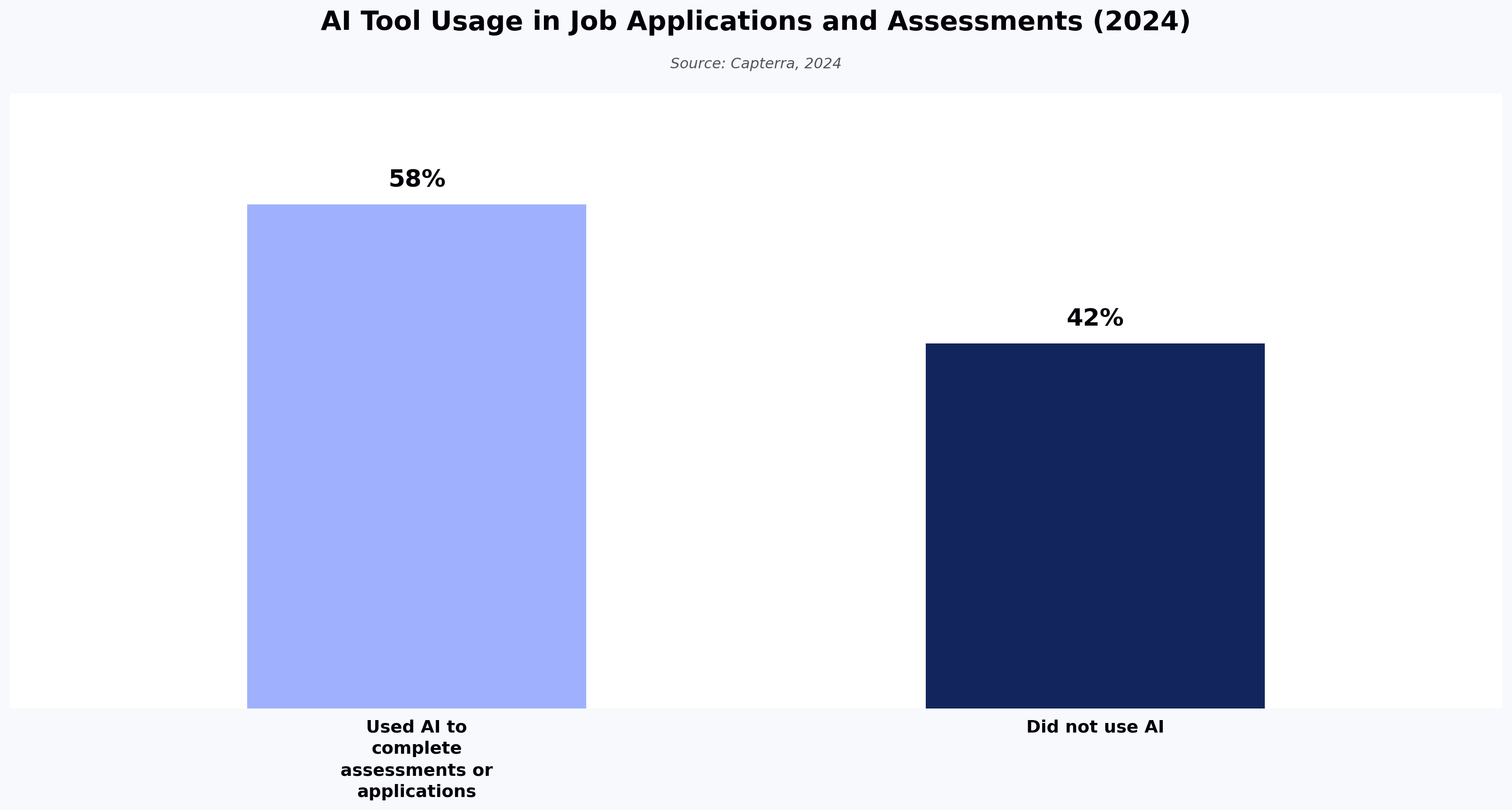
An AI interview agent is an autonomous system that conducts structured first-round technical interviews — asking role-specific questions, evaluating live code, and generating scored reports — without human involvement. For automation testing roles, an AI interview agent to screen automation testing candidates augments manual resume reviews and phone screens with skill-specific evaluations that surface genuine framework proficiency. Recruiters tell us roughly half the candidates who list Selenium on their resume cannot write a working test script — less a matter of dishonesty than of how dramatically the barrier to looking qualified has dropped. According to Capterra, 58% of candidates used AI tools to complete job assessments or applications in 2024, and the Identity Theft Resource Center reported a sharp rise in resume and application fraud over the same period. When AI can generate a polished application in minutes, credentials and self-reported experience stop functioning as reliable filters for automation testing screening — and recruiters cannot validate framework depth from a resume alone, while engineering managers cannot screen every applicant.

This guide gives you a step-by-step implementation path for using an AI interview agent to screen automation testing candidates. You will learn how to design a skill rubric, configure question types, set up integrity safeguards, and integrate the agent into your existing ATS workflow for technical screening and candidate evaluation.

AI Tool Usage in Job Applications and Assessments (2024)
Source: Capterra, 2024

Why automation testing roles are uniquely hard to screen

Automation testing resumes are keyword-dense by nature. A candidate who completed a weekend course may list Selenium, Cypress, TestNG, Jenkins, and Docker on their resume. Another candidate with five years of Page Object Model (a test design pattern that wraps UI elements into reusable classes) and CI/CD pipeline integration experience may list many of the same terms. Keywords tell you little about proficiency level, and resumes are often where the signal ends.

1. Recruiters cannot reliably validate technical depth

Your recruiters compound the problem through no fault of their own. Most technical recruiters can confirm that a candidate has used Selenium. They cannot confidently assess whether that candidate understands dynamic wait strategies, data-driven testing patterns, element locator design (how tests find and target UI components), or cross-browser test orchestration.

This is not a recruiter skills gap. It is a structural mismatch between recruiter expertise and what automation testing roles actually demand.

2. Traditional screening methods are losing effectiveness

Take-home assignments once helped bridge this gap, but they are weakening under two pressures. Completion rates drop sharply when candidates face lengthy exercises. AI-generated submissions are also becoming harder to distinguish from genuine work without live verification.

Companies that rely on phone screens face a similar issue. A 30-minute call can gauge communication and enthusiasm, but it cannot reveal whether someone can debug a flaky test suite or architect a maintainable automation framework.

3. AI has flattened candidate differentiation

There is also a convergence problem. AI-prepped candidates now deliver polished, STAR-formatted answers to behavioral questions about automation testing experience. When every candidate sounds rehearsed and uses similar structure, polish stops being a useful signal. Your interview automation process must shift from what candidates say to what they can demonstrably build and explain in real time.

4. Structured interviews create better hiring signals

Some meta-analytic research, including widely cited work by Frank Schmidt and John Hunter, suggests structured interviews can yield meaningfully higher predictive validity for job performance compared to unstructured interviews, as summarized by SHRM. An AI interview agent brings that structure to the screening stage, where it has historically been absent.

What an AI interview agent actually does (and doesn't do) to screen automation testing candidates

Before you configure anything, you need a clear picture of what an AI interview agent handles and where its limits are.

An AI interview agent is an autonomous system that conducts structured technical and behavioral interviews without human involvement. It evaluates candidate responses against predefined rubrics, generates scored, evidence-based reports, and delivers the results to your hiring team. Think of it as a consistent, always-available first-round interviewer that applies the same standard to every candidate regardless of time zone, hiring volume, or interviewer availability.

The table below summarizes the core capabilities and explicit limits of an AI interview agent in an automation testing context.

What It Does What It Does Not Do
Runs structured first-round interviews Replace final-round human interviews
Tests role-specific automation skills Guarantee a perfect hire
Evaluates coding performance against a rubric Work well with generic setup
Generates scored reports Replace manager judgment
Supports asynchronous screening across time zones Measure presentation over substance
Applies a consistent rubric to every candidate Remove all hiring risk

For automation testing screening, a well-configured agent handles several critical functions.

  • It conducts role-calibrated conversations that adapt to candidate responses, asking Selenium, Cypress, or API testing questions and adjusting the line of inquiry as the candidate answers.
  • It evaluates submitted code against a configured rubric — typically through a combination of automated test case execution, static analysis, and LLM-assisted rubric matching against criteria you define — assessing logic, efficiency, and adherence to common patterns.
  • It generates structured scorecards with scoring rationale for every evaluation dimension, giving your engineering manager reviewable evidence instead of a vague thumbs-up.
  • And it does all of this at scale, running many simultaneous interviews with rubric-applied evaluation that does not vary by interviewer mood or fatigue. While no automated system is free of bias, applying the same rubric to every candidate is typically more consistent across candidates than human-led screens.

What the agent does not do is equally important.

  • It does not replace final-round human interviews for senior roles where architecture discussions and team-fit evaluation require human judgment.
  • It does not guarantee a perfect hire; it improves signal quality at the screening stage, not at the offer stage.
  • It does not produce useful results without proper configuration, because a generic rubric produces generic evaluations.
  • And it does not measure presentation over substance. Some AI video interview tools assess surface-level proxies like eye contact and speech cadence.

The better-configured agents evaluate output, not optics. If your candidate writes a working Selenium script that handles dynamic waits correctly, that matters far more than their webcam posture.

When an AI interview agent is the wrong tool

AI interview agents are not the right fit for every hiring scenario. If your annual automation testing hiring volume is in the single digits, the configuration effort may outweigh the time savings. Roles where the primary signal is a portfolio of prior work (e.g., open-source test framework contributions) are better evaluated through code review than synchronous assessment. And in jurisdictions with specific AI hiring regulations — such as New York City Local Law 144 or Illinois' AI Video Interview Act — you may need bias audits, disclosures, or candidate consent workflows before deploying any automated screening tool. Confirm legal requirements with counsel before rollout.

One concern deserves honest acknowledgment. A 2024 Tidio survey reported that a majority of job seekers expressed reservations about AI-driven video interviews lacking human interaction. (Tidio is a vendor rather than an independent research body; treat the figure as directional and consider supplementing with independent HR research before publication.) The response is not to avoid AI screening but to design the candidate experience deliberately around it: provide clear instructions before the assessment begins, explain how the evaluation will be used, allow candidates to retake practice questions, offer a human point of contact for technical issues, and share scorecard summaries where policy allows. When the agent handles first-round verification well, your engineering manager spends their limited interview time on system design philosophy and problem-solving approach instead of retesting Selenium basics — which often improves the candidate experience in the rounds that matter most.

HackerEarth's AI Interview Agent (OnScreen) puts this approach into practice, using role-calibrated conversations to conduct structured AI interviews and drawing on HackerEarth's broader assessment library, which covers 40+ programming languages and 1,000+ skills. For a broader look at how AI interviewers fit into modern recruiting workflows, see this Complete Guide for Recruiters.

Step-by-step: configuring an AI interview agent to screen automation testing candidates

Configuring an AI interview agent for automation testing roles requires intentional choices at four stages: rubric design, question selection, integrity safeguards, and workflow integration. Shortcut any of these, and the agent will underperform.

Step 1: Define the automation testing skill rubric

Your job description says "3+ years Selenium experience." Your rubric needs to define what that means in evaluative terms. Map the dimensions your AI interview agent will assess. For a mid-level automation testing role, these typically include:

  • Core framework proficiency: Selenium WebDriver, Cypress, Playwright, or Appium, depending on the tech stack
  • Test architecture: Page Object Model, Screenplay Pattern (a design pattern that separates actors, tasks, and abilities), data-driven testing, and keyword-driven frameworks
  • Programming language depth: Java, Python, JavaScript, or TypeScript as applied specifically to test automation
  • CI/CD integration: Jenkins, GitHub Actions, GitLab CI, or CircleCI pipeline configuration and test execution
  • API testing: REST Assured, Postman/Newman, or framework-native API testing capabilities
  • Debugging and maintenance: Flaky test handling, dynamic waits, element locator strategies, and test data management

Weigh these dimensions according to the role's actual priorities. For a mid-level position, framework proficiency and test architecture might carry 40% of the total score, CI/CD integration 20%, and communication skills 10%. Avoid the common mistake of using a generic QA assessment that evaluates manual testing concepts, such as the defect lifecycle, rather than automation-specific skills. The wrong rubric will screen for the wrong profile, no matter how capable the AI agent is. Platforms like HackerEarth's Technical Assessments let you upload a job description, auto-generate a role-specific assessment, and customize it from a library spanning a wide range of skills and languages — useful when you need to translate a generic rubric into role-calibrated questions quickly.

Step 2: Select and configure the right question types to screen automation testing candidates

The rubric tells the agent what to evaluate. Question types determine how. When you select question types for your AI interview agent to screen automation testing candidates, you are deciding what evidence the scorecard will rest on.

Coding challenges place the candidate in a sandboxed IDE to write real automation test code. Example: "Write a Selenium WebDriver script that navigates to a login page, enters credentials from a data file, and verifies the dashboard loads within 3 seconds." The AI evaluates code quality, logic, efficiency, and adherence to common automation patterns.

Architecture questions test structural thinking. Ask the candidate to design a test automation framework for a microservices application with 15 services and independent deployment pipelines. The agent evaluates depth of reasoning, not keyword density.

Debugging scenarios present broken test scripts with common automation issues: stale element references, incorrect locator strategies, misused implicit waits, and hardcoded test data. The candidate identifies and fixes each problem, while the agent tracks the candidate's diagnostic approach.

Behavioral questions surface real-world experience. "Describe a time you maintained a large test suite that became unreliable" reveals communication clarity and problem-solving methodology beyond what any resume conveys.

The critical differentiator across all question types is the agent's role-calibrated conversation. When a candidate mentions Page Object Model, the agent can probe further: "What are its limitations, and when would you choose an alternative pattern?" This is where memorized definitions tend to fail. Candidates who prepped with ChatGPT can recite textbook answers, but they often cannot navigate unpredictable follow-up depth. Recruiters worry that AI screening tools miss qualified candidates due to rigid filtering. Calibrated follow-ups address this concern directly by finding each candidate's actual proficiency boundary rather than applying a binary pass/fail on a single answer.

Step 3: Set up integrity and proctoring safeguards

For roles where AI-generated submissions are a real risk, this step determines whether the assessment measures automation skill or prompt-engineering ability. AI-assisted cheating on coding assessments is now well-documented — candidates can paste a prompt into ChatGPT and receive working Selenium code in seconds. Without proctoring, your assessment may measure prompt-engineering ability rather than automation-testing competency.

Layer your defenses in two tiers.

Must-have (table stakes):

  • Tab-switching detection flags when candidates navigate away from the assessment environment.
  • AI-based plagiarism detection compares submitted code against known AI-generated patterns and other submissions.
  • Copy-paste prevention blocks externally generated code from entering the IDE.

Nice-to-have (higher-stakes or senior roles):

  • Webcam monitoring and screen capture verify identity and detect suspicious behavior.
  • Extension detection identifies browser tools providing real-time AI assistance.

Balance firmness with candidate experience. Proctoring that feels like interrogation drives top candidates out of your pipeline.

Prioritize code replay capability across both tiers. After the assessment, your team watches a keystroke-by-keystroke playback of how the candidate built their solution. Fluent, iterative typing signals genuine knowledge. Large pasted code blocks or sudden jumps in complexity signal external help. This evidence trail gives engineering managers confidence before they invest their own time in a live interview.

Step 4: Integrate the AI agent into your existing hiring workflow

Results that live in a separate platform will not be used. The output of an AI interview agent to screen automation testing candidates must flow directly into the systems your team already works in.

ATS integration

Connections to your applicant tracking system ensure candidate scores, code replays, and AI-generated summaries appear inside your recruiter's existing workflow without manual data transfer or platform switching. Confirm which ATS integrations are available for your plan with your vendor.

Workflow placement

The AI interview agent supplements the manual phone screen rather than replacing the final-round interview. Your funnel becomes: Application → AI interview agent screening → Recruiter reviews shortlisted candidates → Live technical interview with engineering → Offer. This preserves the human touchpoints candidates value while removing the bottleneck that slows your pipeline.

Asynchronous scheduling

This eliminates timezone coordination entirely. Candidates receive a link, complete the interview on their own schedule, and results appear in your dashboard within minutes. For global automation testing hiring, this alone can shave days off the screening cycle.

Stakeholder visibility

Give engineering managers read access to scorecards and code replays before the live interview. With that context, the live conversation focuses on architecture decisions and cross-team collaboration style rather than retesting framework fundamentals.

Screening automation testers with confidence starts with the right setup

The gap between an automation testing job posting and a qualified hire is a screening problem. Resumes overstate proficiency, take-home assignments invite AI-generated submissions, and phone screens filter for confidence rather than competency. Every day your team spends on manual screening is a day the role stays open, and release cycles slow down.

An AI interview agent helps close that gap when you configure it with intention. Define a rubric that maps to real automation testing work — not just resume keywords. Select question types that force candidates to write, debug, and explain code under observed conditions. Layer proctoring safeguards that verify authenticity without alienating strong candidates. Then integrate the agent directly into the ATS your recruiters already use so that results reach the right stakeholders without extra steps.

If you want to compare your current screening setup against the four steps above, start by auditing your existing automation testing rubric for the dimensions listed in Step 1 — most teams find at least two gaps on first review.

Next steps: see it in action

Book a demo to see how HackerEarth's AI Interview Agent fits your open automation testing roles.

FAQs

1. How long does it take to configure an AI interview agent for an automation testing role?

In our experience working with hiring teams, most can go from job description to live assessment in roughly an hour, though actual timing depends on team familiarity and role complexity. Setup time typically breaks down across JD upload and auto-generation, rubric weighting, question customization from the library, and proctoring configuration. The longest stage tends to be question customization for niche roles — mobile automation with Appium, for example, or specialized API testing frameworks — where you may want to review or supplement library questions to match your stack precisely.

2. Can an AI interview agent evaluate both junior and senior automation testers?

Yes, if you configure separate rubrics for each level. A junior rubric might focus on core Selenium scripting and basic locator strategies, while a senior rubric emphasizes framework architecture, CI/CD pipeline design, cross-browser orchestration, and mentoring approach. Role-calibrated conversations automatically adjust depth based on candidate responses.

3. When should you NOT share automated candidate feedback?

Sharing automated feedback sounds candidate-friendly, but it carries trade-offs worth weighing. In regulated industries or jurisdictions with AI hiring laws (e.g., NYC Local Law 144, Illinois AI Video Interview Act, EU AI Act), automated scoring rationale shared with candidates may become discoverable in adverse-action disputes — and any ambiguity in the rubric language becomes a legal exposure. Detailed feedback can also coach future candidates on how to game the rubric if leaked. The pragmatic middle ground: share high-level performance summaries and let recruiters deliver specific feedback verbally, where context and tone can be managed. Run any candidate-facing automated feedback past legal before turning it on.

4. How do you measure the ROI of AI interview screening for automation testing hires?

Track four metrics before and after implementation: time from application to shortlist, engineering hours spent on screening interviews, interview-to-offer ratio, and 90-day performance scores for new hires. The cumulative effect is recovered recruiter capacity and a meaningful reduction in hours engineering spends on first-round interviews — both of which can be measured directly inside your ATS reporting once the workflow has been in place for a full hiring cycle.

5. Can an AI interview agent screen for niche frameworks like Appium or Playwright?

Yes. The key is rubric specificity. If you are hiring for mobile automation, your rubric should include Appium-specific dimensions like device farm configuration, gesture handling, and hybrid app testing. Platforms with deep question libraries spanning a wide range of skills and programming languages support these niche configurations out of the box.


Editorial notes for publication:

  • Meta title and description are not present in the draft and must be locked before publishing. Suggested meta title (under 60 chars): "How to Use an AI Interview Agent for Automation Testers". Suggested meta description: trim the opening definition sentence to ~155 characters.
  • Target word count is a metadata constraint not addressed here; confirm the displayed "10 minutes" read time matches the final word count at 250 wpm before publishing.
  • Verify all external links (Capterra, ITRC, SHRM, Tidio) are live and that cited figures match the linked sources. The ITRC reference has been softened pending confirmation that the 118% figure refers specifically to resume/application fraud rather than identity fraud broadly. The Schmidt & Hunter "2x" framing has been softened to a directional claim pending source confirmation.
  • The "150M+ assessment signals" claim has been removed from the body pending proper attribution to a HackerEarth data page or named report with year anchor.
  • Confirm OnScreen capability claims (real-time code evaluation mechanism, sandboxed IDE) with product before publication; the body has been softened to describe rubric-based evaluation generally rather than asserting OnScreen-specific behavior.
  • The "Page Object Model" internal link in Step 1 was a placeholder pointing to the blog root and has been removed; replace with a specific article URL if one exists.

AI in Hiring: Benefits, Risks & How to Implement It

AI in the Hiring Process: Benefits, Risks & Step-by-Step Implementation Guide (2026)

43% of organizations used AI for HR tasks in 2026, up from 26% in 2024 (SHRM). 64% of companies using HR AI apply it specifically to recruiting - making talent acquisition the primary entry point for enterprise AI adoption. The pitch is compelling: faster screening, better matching, lower cost-per-hire. The reality is more complicated.

AI in the hiring process delivers real efficiency gains, but it also introduces bias risks, legal obligations, and candidate trust problems that most implementation guides gloss over. This article covers how ai in hiring and recruiting actually works across the funnel, what the measurable benefits and risks look like, what compliance requirements apply in 2025, and a six-step framework for implementing it responsibly. Platforms like HackerEarth apply AI specifically to skills-based technical assessments - one of the highest-signal, lowest-risk applications covered here.

What Is AI in Hiring - and Why Does It Matter Now?

Defining AI in the Hiring Context

"AI in hiring" covers a wider spectrum than most vendors admit, and conflating the categories leads to buying the wrong tools. At one end is rule-based automation - fixed logic like auto-rejecting applications missing a required field. In the middle is machine learning, which improves from data patterns to score resumes or predict fit. At the far end is generative AI - large language models that draft job descriptions, generate outreach, or summarize interview notes. Most platforms market themselves as "AI-powered" while running rule-based logic; when evaluating any tool, ask which layer it operates at, what data trained it, and how it explains its outputs.

Key Market Drivers in 2025

Three pressures are making adoption urgent rather than optional. AI screening reduces time-to-shortlist by up to 40% and automation adopters fill 64% more jobs per recruiter (Eightfold AI and Indeed/Bluehorn, 2024-2025). AI reduces cost-per-hire by up to 30% at scale (DemandSage, 2025). And 65% of hiring managers have now caught candidates using AI deceptively in applications (High5Test, 2026) - making resume credentials even less reliable and skills-based assessment more necessary.

(Visual callout: "AI Hiring at a Glance" - 43% of orgs use AI for HR; 64% apply it to recruiting; 40% faster time-to-shortlist; 30% cost-per-hire reduction.)

How Is AI Used in the Hiring Process?

How is ai used in hiring in practice? AI in hiring and recruiting now touches every funnel stage:

  • Job description optimization: NLP tools remove biased language and improve keyword targeting
  • Candidate sourcing and outreach: AI searches databases and drafts personalized messages
  • Resume screening and shortlisting: ML-based parsing ranks applicants against role criteria
  • Skills assessments and coding tests: AI administers, grades, and proctors technical evaluations
  • Interview scheduling and chatbots: Conversational AI handles calendar coordination and candidate Q&A

AI for Job Description Optimization

This is one of the lowest-risk, highest-ROI places to start - the tool never touches a candidate, just the text that attracts them. AI-generated job descriptions reduce time-to-publish by approximately 40% and decrease biased language by 25 to 50% (LinkedIn Talent Solutions, 2025), with measurable downstream impact on applicant diversity for technical roles.

AI for Candidate Sourcing and Outreach

AI sourcing cuts time on top-of-funnel prospecting by approximately 50% (Fetcher, 2024-2025) and AI-personalized outreach increases positive response rates by 5 to 12% (LinkedIn Talent Solutions, 2025). The limitation worth stating plainly: these tools surface candidates who look like your past hires, which reinforces existing team homogeneity unless you actively counterbalance it.

AI for Resume Screening and Shortlisting

This is simultaneously the most widely used and most legitimately criticized AI hiring application. 56% of companies use AI for screening (DemandSage), but keyword-matching logic rejects qualified candidates who describe skills differently - a senior engineer who writes "built distributed systems" may score below someone who wrote the phrase verbatim. The communities calling it "keyword matching on steroids" are not entirely wrong about the weaker implementations.

AI for Skills-Based Assessments and Coding Tests

This is where AI produces its clearest signal in technical hiring, because it tests what candidates can actually do instead of predicting it from resume proxies. HackerEarth administers AI-proctored coding assessments across 40-plus programming languages and 1,000-plus skills, with automated scoring that removes both human inconsistency and keyword-matching limitations. A candidate either solves the problem or does not - that output is objective and defensible in a way that resume ranking scores simply are not.

See how HackerEarth's AI-powered coding assessments help you evaluate developer skills objectively - [Request a Free Demo]

AI for Interview Scheduling and Chatbots

Conversational AI reduces candidate response times from 7 days to under 24 hours (Paradox/Olivia, 2025), and 40% of firms used AI chatbots with candidates in 2024 (NYSSCPA). This is where the ATS black hole gets solved: automated communication ensures no application disappears without acknowledgment.

AI for Video Interview Analysis

AI sentiment and facial expression analysis in video interviews is technically possible and legally hazardous - several active discrimination lawsuits name these tools specifically. Treat this application as requiring legal review before deployment, not a standard hiring workflow.

(Visual callout: Comparison table - "AI vs. Manual Processes Across the Hiring Funnel" covering time saved, accuracy, and risk level per stage.)

Benefits of AI in Hiring and Recruiting

Speed and Efficiency Gains

Automation adopters fill 64% more jobs and submit 33% more candidates per recruiter than non-adopters (Indeed/Bluehorn, 2024). The practical outcome is that hiring managers review fewer applications, but better ones.

Cost Reduction

Companies using AI in recruitment reduce cost-per-hire by up to 30% (DemandSage, 2025), driven by reduced agency dependency, lower job board spend, and fewer unqualified interviews consuming hiring manager time.

Improved Quality of Hire

Candidates selected through AI processes are 14% more likely to receive an offer than those selected by manual screening (Forbes/Carv). For technical roles, skills-based assessments produce the strongest quality signal because they evaluate demonstrated ability rather than claimed credentials.

Enhanced Candidate Experience

79% of candidates want transparency when AI is used in their evaluation (HireVue, 2024-2025). Faster responses and automated status updates improve satisfaction - but only when the AI is disclosed, which most candidates currently do not realize has happened.

Scalability for High-Volume Hiring

Campus drives and hackathon-based recruiting that require evaluating thousands of candidates become operationally feasible with automated grading and proctoring. HackerEarth's hackathon platform sources and evaluates passive technical talent at scale, turning a months-long manual sourcing exercise into a structured, measurable pipeline event.

(Visual callout: Risk-benefit matrix - 2x2 grid showing benefit magnitude vs. implementation complexity for each AI use case.)

AI Bias in Hiring: Risks and Ethical Concerns

Bias is the section most AI vendor content buries - which is exactly why it belongs near the front of any honest implementation guide.

How AI Bias Enters the Hiring Pipeline

AI systems learn from historical data, so if your past hiring decisions favored certain backgrounds or demographic profiles, the AI replicates those preferences at scale. Amazon's internal resume screener - trained on a decade of male-dominated applications - learned to penalize references to women's colleges; Amazon abandoned it. A Stanford study from October 2025 found AI screening tools still rated older male candidates higher than female candidates with identical qualifications. The bias does not cut one direction; it reflects whatever patterns existed in the training data.

Transparency, Explainability, and Privacy

Black-box AI hiring tools cannot explain why a specific applicant ranked where they did - and humans reviewing AI recommendations accept them without challenge approximately 90% of the time (NYC compliance research). This is both a governance failure and a legal exposure: the EU AI Act and NYC Local Law 144 both require explainable outputs and audit trails. Separately, video interview tools, behavioral assessments, and keystroke monitoring collect biometric data subject to GDPR and CCPA - before deploying any tool capturing video or audio, document what is collected, how long it is retained, and how candidates are notified.

The Risk of Over-Automation

The r/humanresources communities raise this correctly: fully automated screening produces fully automated errors at scale. AI-assisted, human-decided is the only configuration that lets you catch the tool's mistakes before they compound into discriminatory patterns.

AI Hiring Laws and Compliance: What HR Teams Must Know in 2025

The legal landscape is specific, enforceable, and expanding faster than most HR teams realize.

NYC Local Law 144 (Automated Employment Decision Tools)

In effect since January 2023 and enforced since July 2023, NYC LL 144 requires annual bias audits by independent third-party auditors, public posting of audit results, and candidate notification at least 10 business days before an AEDT is used - for any role performed in New York City, including remote roles associated with an NYC location. Penalties reach $1,500 per day per violation. A December 2025 audit by the NY State Comptroller found enforcement weak due to self-reporting challenges, but that does not reduce employer legal exposure.

EU AI Act - High-Risk Classification for Hiring AI

The EU AI Act classifies AI used in employment decisions as high-risk, triggering obligations for technical documentation, decision logging, human oversight by at least two qualified individuals, and conformity assessments before deployment. Partial effect began February 2025; full effect is August 2026. It applies to any company using these tools to evaluate EU-based candidates, regardless of where the employer is headquartered.

EEOC Guidance and Federal Landscape

The EEOC's 2023 guidance confirmed that Title VII anti-discrimination law applies to AI hiring tools, and a 2025 federal case (Mobley v. Workday) ruled that AI tools can be treated as "agents" of the employer - raising the stakes for vendor due diligence. State-level laws are accelerating: Illinois AI Video Interview Act requires candidate consent for AI video analysis; Colorado AI Act takes effect June 2026; California regulations effective October 2025 require four-year retention of AI decision records.

Building a Compliance Checklist

  1. Inventory every AI tool in your hiring workflow and determine whether it qualifies as an AEDT under applicable law.
  2. Engage an independent third-party auditor for annual bias audits; do not rely on vendor-provided reports.
  3. Implement candidate disclosure notices covering what tool is used, what data it collects, and how it affects evaluation.
  4. For video or behavioral tools, obtain explicit opt-in consent and document retention and deletion policies.
  5. Ensure all AI tools produce explainable outputs - if you cannot justify a ranking to a regulator, the tool is a liability.
  6. Establish a quarterly internal review cadence; annual audits are the legal minimum, not the operational standard.
  7. Brief your legal team on state-specific obligations if you hire in NY, IL, CO, or CA.

(Visual callout: Downloadable compliance checklist graphic.)

How to Implement AI in Your Hiring Process - A Step-by-Step Framework

Most content on how to use ai in hiring stops at benefits and risks. This section is the roadmap.

Step 1 - Audit Your Current Hiring Workflow

Map your current process stage by stage and identify where candidates drop off, where recruiter time disappears, and where decision quality varies most. AI applied to the wrong bottleneck produces efficiency in the wrong place.

Step 2 - Define Clear Objectives and KPIs

Name the specific outcome you are improving before selecting a tool - reduce time-to-shortlist by 30%, increase diversity of technical shortlists by 20%, decrease unqualified first-round interviews by 40%. Without a defined KPI, you cannot tell whether the AI is working or quietly causing harm.

Step 3 - Select the Right AI Tools for Each Stage

Match tool category to the bottleneck: NLP writing tools for job descriptions, AI talent search for passive sourcing, ML-based ATS with explainable scoring for resume screening, HackerEarth for technical evaluation, conversational AI for scheduling. The platforms best at one stage are rarely best at all of them.

Step 4 - Run a Controlled Pilot

Start with one role family or one hiring stage, tracking KPIs against a control group. A pilot of 30 to 50 candidates produces enough data to evaluate signal quality and test candidate notification workflows before they apply at full volume.

Step 5 - Train Your Hiring Team

Without training, hiring managers rubber-stamp AI recommendations - which is exactly how bias amplification becomes a legal problem. Recruiters need to know how to read AI outputs, flag anomalies, and document the cases where they override the tool.

Step 6 - Monitor, Audit, and Iterate

Set a quarterly review cadence to examine pass rates by demographic group and candidate experience scores. HackerEarth's built-in analytics surface assessment performance by candidate cohort, giving HR generalists visibility into whether the evaluation process is producing equitable outcomes before the annual audit requires them to prove it.

The Future of AI in Hiring: Trends to Watch

Understanding the future of ai in hiring matters now because the tools and regulations shaping the next two years are already in early deployment.

Generative AI for Hyper-Personalized Candidate Journeys

Generative AI is moving from drafting job descriptions to contextual personalization across the full candidate journey - career site content, chatbot responses, and offer communications that adapt to individual profiles. This will become standard practice for competitive employers within 12 to 18 months.

Agentic AI and Autonomous Recruiting Workflows

Agentic AI systems that orchestrate multi-step hiring tasks end-to-end are moving from experimental to early adoption. LinkedIn's first true AI recruiter agent, launched in 2024, drafts job descriptions, sources candidates, and initiates outreach as a sequential workflow - what used to take a sourcer a full day now runs in the background.

Skills Ontologies and Dynamic Job Matching

AI is increasingly able to map transferable skills across roles, identifying that a candidate's experience in one domain covers requirements in another they would never have thought to apply for. This directly supports the skills-first movement by reducing dependence on job title matching and credential proxies.

Regulatory Evolution and Responsible AI as a Competitive Advantage

The EU AI Act, California, Colorado, and Illinois have all established enforceable AI hiring obligations in the last 18 months. Companies that invest in transparent, auditable AI practices now will face lower legal exposure and stronger candidate trust than those treating compliance as a future problem.

Frequently Asked Questions

How is AI used in the hiring process?

AI in hiring spans five stages: job description optimization, candidate sourcing, resume screening, skills-based assessments, and interview scheduling - with 64% of organizations that use HR AI applying it specifically to recruiting (SHRM, 2025). Skills assessments carry the strongest signal quality and lowest bias risk; fully automated resume rejection carries the highest.

How does AI reduce bias in the hiring process?

Properly designed AI reduces bias by applying consistent evaluation criteria to every candidate and enabling blind assessment formats that remove identity signals - HackerEarth's coding assessments evaluate code quality alone. The caveat that never appears in vendor marketing: AI trained on historically biased data replicates those biases at scale, so bias reduction requires ongoing audit, not just initial design.

What are the legal risks of using AI in hiring?

NYC Local Law 144 requires annual independent bias audits and candidate notification with penalties reaching $1,500 per day; the EU AI Act classifies hiring AI as high-risk effective August 2026; California, Colorado, and Illinois each have separate, enforceable requirements. The legal landscape is expanding state by state faster than most HR teams are tracking it.

How are companies using AI in the hiring process in 2025?

43% of organizations used AI for HR tasks in 2025 (SHRM), up from 26% the prior year. Unilever used AI video analysis and gamified assessments to screen 250,000 applicants per year, cutting time-to-hire by 75%; HackerEarth customers run AI-proctored assessments and hackathons that cut cost-per-hire for technical roles by more than 75%. The consistent pattern in successful deployments is AI for volume and initial filtering, humans for relationships and final decisions.

Will AI replace human recruiters?

No - 74% of candidates still prefer human interaction for final hiring decisions even as they accept AI assistance in earlier stages (Insight Global, 2025). The stages where AI adds the most value are exactly the stages where recruiters least want to spend time; the stages where human judgment is irreplaceable - offer negotiation, cultural fit, hiring manager alignment - are where recruiters add the most value.

Conclusion

The efficiency case for AI in hiring is real: faster screening, lower cost-per-hire, and better quality signals for technical roles. So is the risk: bias amplified at algorithmic speed, legal exposure growing as regulation matures, and the genuine harm of automated rejection for candidates who deserved a human look.

The companies that get this right treat AI as the narrowing layer and humans as the deciding layer - and invest specifically in tools, like HackerEarth's skills-based assessments, where the AI evaluates demonstrated ability rather than predicting it from proxies that have always been unreliable.

Ready to remove guesswork from technical hiring? Start your free trial of HackerEarth's assessment platform and experience AI-driven candidate evaluation firsthand.

AI Assistant for Interviews: How It Works and When to Use One?

AI Assistant for Interviews: How It Works and When to Use One?

If you are evaluating an AI assistant for interview processes at your organization, the market has already made the decision easier by eliminating the "whether" question. About 87% of companies use some form of AI recruiting software as of 2025. The real question is which tool fits your hiring volume, your technical role mix, and your compliance obligations - and whether the vendor you are talking to has actually built for technical hiring or just bolted a coding question onto a generic screening product.

This guide skips the basics. It is written for HR generalists and talent leaders who are ready to evaluate tools, justify investment to stakeholders, and ask the right questions before signing a contract.

What Is an AI Assistant for Interviews?

Definition and Core Concept

An AI assistant for interviews is any software that uses machine learning, natural language processing, or automated scoring to replace or support a step in candidate evaluation. The category ranges from a chatbot that handles scheduling to a full AI interview evaluation tool that conducts a structured technical conversation and returns a scorecard with no human involvement. The core promise is consistent: hand the repetitive, high-volume parts of interviewing to a system that applies the same standard to every candidate, every time.

The AI recruitment market stood at USD 596.16 million in 2025 and is forecast to reach USD 860.96 million by 2030, with 92% of organizations claiming measurable benefits. 

Types of AI Interview Assistants

Not every tool in this category solves the same problem, and conflating them is how procurement mistakes happen.

A standalone virtual interview assistant may handle scheduling without evaluating skills at all. A smart interview assistant that only scores behavioral responses is not a substitute for a code evaluation engine. The tools that deliver the most value to technical hiring teams are AI candidate interviewers and end-to-end platforms that combine automated screening, structured interviews, and analytics in one place.

HackerEarth falls into that final category. Its platform includes AI-powered technical assessments, an AI Screener, an AI Interviewer for end-to-end structured interviews, and FaceCode, a live coding interview platform with AI-assisted insights and advanced proctoring.

How Does an AI-Powered Interview Tool Work?

The Technology Behind AI Interview Software

The plumbing matters here because it determines what the tool can actually evaluate. Most platforms combine natural language processing for text and speech analysis, machine learning models for scoring against benchmarks, and a code execution engine that runs submitted code against test cases. Platforms that lack that last component cannot genuinely evaluate engineering candidates. Surveys and multiple choice questions are not code evaluation.

NLP accounted for 35.09% of AI recruitment revenue in 2024, while robotic process automation is projected to grow at 13.30% per year as scheduling and administrative tasks shift to automation.HackerEarth's assessments cover 1,000+ skills and 40+ programming languages across a library of 40,000+ problems, including real-world project simulations that evaluate code quality, logic, efficiency, and technical depth. 

Step-by-Step: What Happens During an AI-Assisted Interview

The workflow for a well-designed automated interview assistant runs roughly like this: a job requisition triggers question selection and rubric configuration; the AI generates role-specific questions or selects from a validated library; the candidate completes the interview on their own schedule; the system processes responses in real time, executing code and analyzing verbal answers; and the platform returns a structured scorecard for human review. HackerEarth's AI Interview Agent can tailor interviews for architecture, coding, and system design by role and seniority level, customizing questions based on the job description and the candidate's resume. 

The final decision stays with a human. That is not just good practice. In most regulated jurisdictions, it is a legal requirement.

AI Scoring vs. Human Scoring

Human interviewers score the same candidate differently depending on who is in the room, what mood they are in, and whether the candidate reminds them of someone they already hired. AI scoring does not fix everything, but it applies one rubric to every candidate without variation. Coding interview AI tools cut grading time by more than 50% while increasing rubric adherence, and video interview summarization reduces review time per candidate by approximately 60%. 

Key Benefits of Using an AI Interview Assistant

Drastically Reduced Time-to-Hire

Speed is the most immediate return, and the numbers are not marginal. AI tools can reduce time-to-hire by 50%. Each additional day in the hiring cycle increases cost per hire by an average of $98, and 57% of candidates lose interest in companies that take longer than two weeks to respond. An AI hiring assistant processes hundreds of candidates simultaneously and surfaces only the top performers for human review, which means your engineering team is not spending its afternoons on first-round phone screens.

More Consistent and Objective Candidate Evaluation

Consistency is also a legal asset, not just an operational one. When you cannot explain why one candidate scored differently from another, you have a defensibility problem. 68% of recruiters say AI could remove biases from hiring, and nearly half of hiring managers admit to having some form of bias that negatively impacts interviews.A well-configured AI interview evaluation tool does not eliminate bias, but it makes evaluation criteria explicit, auditable, and consistent across every interviewer and every location.

Scalability and Data-Driven Decisions

The math on manual technical hiring does not work at scale. Hiring an engineer requires approximately 14 more interview hours than filling a non-technical position, and the average cost per hire has reached $4,700, with senior technical hires often exceeding $28,000. An automated interview assistant absorbs the volume that would otherwise require three times the recruiter headcount. And every session generates structured data: over time, advanced analytics can predict job performance with 78% accuracy and retention with 83% accuracy.

When Should You Use an AI Interview Assistant?

High-Volume Technical Recruitment

If your team is processing more than fifty technical candidates per month, the first-round interview is your bottleneck. An AI-powered interview tool with a real code evaluation engine removes it without sacrificing signal quality. HackerEarth has assessed over 5.5 million developers and supported 6,000 companies with 43,000 coding tests, which means the benchmarks reflect real population-level data rather than a proprietary rubric someone built last quarter.

Standardizing Interviews Across Distributed Teams and Reducing Bias

These two problems share the same root cause: different people applying different standards. A candidate evaluated in Singapore should clear the same bar as one evaluated in London. An AI candidate interviewer enforces that by making the rubric the same regardless of who is running the process. 72% of companies using AI interview tools report a reduction in hiring bias, and 58% say AI-powered interviews have helped them achieve greater diversity.

When NOT to Use AI (Honest Take)

For highly senior hires, small candidate pools, or roles where cultural judgment and leadership presence are primary criteria, AI is a support tool at best. 74% of candidates still prefer human interaction for final decisions. Use AI for early and mid-funnel screening. Keep humans at the close.

How to Evaluate and Choose the Right AI Interview Software

Must-Have Features Checklist

Before requesting a demo, run every vendor against this list. Gaps here are not roadmap items to accept on faith.

  • AI-powered question generation and a validated question library: Role-specific, not generic.
  • Automated scoring with transparent rubrics: If you cannot see what drove a score, you cannot defend it to a candidate or a regulator.
  • Code evaluation engine: Non-negotiable for technical roles. The system must execute code, not just score a written description of code.
  • ATS and HRIS integration: Native sync with Greenhouse, Lever, Workday, or your existing stack. Manual data entry at this stage defeats the purpose.
  • Anti-cheating and proctoring: Browser lockdown, plagiarism detection, and identity verification for async assessments.
  • Bias auditing and fairness reporting: Demographic outcome monitoring is no longer optional given the regulatory landscape.
  • Analytics dashboard with exportable reports: You need to measure what is working without filing a support ticket.
  • Customization for role-specific criteria: One rubric for all engineering roles is not a rubric. It is a guess.

Questions to Ask Vendors Before You Buy

How was your AI model trained, and on what data? Historical hiring data that reflects past discrimination will reproduce it.

What bias mitigation measures are built in? Ask for specifics: demographic parity testing, outcome analysis, validation methodology.

Can we customize scoring rubrics per role? If the answer is no, you are buying a screening tool, not a technical interview platform.

How does this integrate with our existing ATS? Get the specific integration method and the list of supported versions before the demo ends.

What compliance certifications do you hold? SOC 2 Type II, ISO 27001, GDPR, and NYC Local Law 144 support are the minimum checkboxes.

What support and onboarding do you provide? Time-to-value depends almost entirely on implementation quality, not the feature list.

Why HR Teams Choose HackerEarth for AI-Powered Technical Interviews

Most general-purpose AI interview tools were designed for behavioral hiring and added technical evaluation later. That sequence produces a weak code evaluation layer on top of a survey engine. HackerEarth was built the other way around.

The AI Screener evaluates candidates with auto-graded coding tests, AI evaluations, and personality assessments, ensuring a consistent hiring bar across teams. The AI Interviewer conducts structured role-specific conversations that assess both technical competence and communication. FaceCode supports live coding interviews with an integrated IDE, pair-programming workflows, AI-assisted insights, and panels for up to five interviewers.

Where HireVue focuses primarily on behavioral video assessment and TestGorilla covers broad skills testing, HackerEarth gives technical hiring teams the complete stack: automated screening, structured AI interviewing, live collaborative coding, and analytics in one platform backed by over a decade of developer evaluation data.

Real-World Use Cases: AI Interview Assistants in Action

Campus and University Hiring at Scale

University hiring is the use case where the ROI argument writes itself. Hundreds of candidates, a two-to-four-week window, limited recruiter bandwidth, and a legal obligation to treat every applicant fairly. An AI interview platform runs all candidates through the same structured technical screen simultaneously. The team reviews ranked, scored results and moves the top cohort forward before the recruiting season closes. A BCG survey of chief human resources officers in 2024 found that 92% of organizations using AI in HR report real benefits, with talent acquisition as the top use case.

Remote-First Technical Hiring

A virtual interview assistant solves the time zone problem that makes remote technical hiring logistically brutal. Candidates in any geography complete a structured evaluation without waiting for a senior engineer in another region to be free. 70% of recruiters using AI interview tools say that 24/7 availability has significantly expanded their talent pool. For distributed teams, this is not a convenience. It is how global hiring becomes operationally viable.

Diversity Hiring Initiatives

A well-configured AI interview evaluation tool makes bias visible rather than invisible. Consistent rubric application reduces evaluator-level variation, and demographic outcome reporting lets teams catch and correct patterns before they become hiring decisions. AI-driven diversity sourcing has improved representation in shortlists by 8 to 14% when properly configured and monitored. The operative phrase is "properly configured." AI does not produce fair outcomes by default. It produces auditable ones, which gives you something to act on.

Addressing Common Concerns About AI in Interviews

"Will AI Make Hiring Feel Impersonal?"

The candidates who have actually completed a well-designed AI interview are less concerned about this than those who have not. In a large-scale field experiment at the University of Chicago's Booth School of Business involving approximately 70,000 candidates, 78% preferred AI interviews over human ones, and 71% of candidates in the AI-led group gave positive feedback compared to 52% in the human-led group. The impersonality concern is real for a poorly designed process. For a well-designed one with clear communication and a human decision at the end, most candidates adapt quickly.

"Is AI Interview Software Biased?"

It can be, and any vendor who says otherwise is not worth your time. A 2025 University of Washington study found that certain AI screening tools favored white-associated names in 85.1% of cases. The solution is not to avoid AI but to demand transparent rubrics, demographic outcome reporting, and regular independent bias audits. Ask HackerEarth or any vendor you are evaluating to show you specifically how they monitor for and report on scoring disparities across candidate groups.

"What About Legal Compliance?"

This is moving fast and the risk is real. NYC Local Law 144 requires annual independent bias audits of automated employment decision tools, public disclosure of results, and advance candidate notification, with penalties up to $1,500 per violation. The EU AI Act classifies AI systems used in hiring as high-risk, requiring transparency, documentation, and human oversight. More than ten US states are enacting or drafting similar legislation. Before you deploy any tool, confirm which regulations apply to your hiring locations and what the vendor provides to support compliance documentation.

"How Do Candidates Feel About AI Interviews?"

Mixed, with an important caveat. In a Gartner 3Q 2025 survey of 2,901 candidates, 68% said they prefer human interactions over AI. But 79% of candidates want transparency when AI is used in hiring. The discomfort is mostly with surprise, not with AI itself. Tell candidates upfront what the AI evaluates, confirm a human reviews the results, and the drop-off and trust concerns diminish substantially.

The Future of AI Interview Assistants

The next generation of tools is already visible in early deployments. Generative AI is enabling dynamic follow-up questioning rather than fixed sequences. Multimodal assessment is combining coding, verbal explanation, and behavioral signals into a single session. Predictive analytics are improving: advanced models can already predict job performance with 78% accuracy and retention with 83% accuracy. In 2025, skills sought by employers changed 66% faster in occupations most exposed to AI, which means platforms with large, actively maintained question libraries will pull further ahead of those that update quarterly.

HackerEarth's architecture is built for where this is going: a single platform that handles the full technical evaluation workflow while generating the longitudinal data needed to continuously improve hiring decisions.

Conclusion

87% of companies now use AI in their hiring process, up from 30% in early 2024. For technical hiring teams still running manual first-round screens, the gap is no longer just an efficiency problem. It is a competitive one. The candidates you are slow to evaluate are accepting offers from organizations that moved faster.

The right platform depends on your volume, your role mix, and your compliance obligations. If you are hiring engineers at scale, you need a tool built for technical evaluation from the ground up, not a behavioral interviewing platform with a coding question appended.

HackerEarth is that platform. The combination of AI-powered assessment, automated AI interviewing, live coding with FaceCode, and deep analytics gives technical hiring teams a complete workflow rather than a collection of point solutions. See it working on your actual roles before you decide.

See how HackerEarth's AI-powered technical interview platform works in practice. Request a free demo and let the team walk you through the full candidate evaluation workflow for your specific roles.

Ready to cut your technical screening time in half? Start a free trial of HackerEarth Assessments and run your first AI-assisted interview within the week.

Explore HackerEarth's pricing plans for teams of every size. From startup to enterprise, find the right tier for your hiring volume.

In the Spotlight

Technical Screening Guide: All You Need To Know

Read this guide and learn how you can establish a less frustrating developer hiring workflow for both hiring teams and candidates.
Read More
Top Products

Explore HackerEarth’s top products for Hiring & Innovation

Discover powerful tools designed to streamline hiring, assess talent efficiently, and run seamless hackathons. Explore HackerEarth’s top products that help businesses innovate and grow.
Frame
Hackathons
Engage global developers through innovation
Arrow
Frame 2
Assessments
AI-driven advanced coding assessments
Arrow
Frame 3
FaceCode
Real-time code editor for effective coding interviews
Arrow
Frame 4
L & D
Tailored learning paths for continuous assessments
Arrow
Authors

Meet our Authors

Get to know the experts behind our content. From industry leaders to tech enthusiasts, our authors share valuable insights, trends, and expertise to keep you informed and inspired.
Ruehie Jaiya Karri
Kumari Trishya

7 Tech Recruiting Trends To Watch Out For In 2024

The last couple of years transformed how the world works and the tech industry is no exception. Remote work, a candidate-driven market, and automation are some of the tech recruiting trends born out of the pandemic.

While accepting the new reality and adapting to it is the first step, keeping up with continuously changing hiring trends in technology is the bigger challenge right now.

What does 2024 hold for recruiters across the globe? What hiring practices would work best in this post-pandemic world? How do you stay on top of the changes in this industry?

The answers to these questions will paint a clearer picture of how to set up for success while recruiting tech talent this year.

7 tech recruiting trends for 2024

6 Tech Recruiting Trends To Watch Out For In 2022

Recruiters, we’ve got you covered. Here are the tech recruiting trends that will change the way you build tech teams in 2024.

Trend #1—Leverage data-driven recruiting

Data-driven recruiting strategies are the answer to effective talent sourcing and a streamlined hiring process.

Talent acquisition leaders need to use real-time analytics like pipeline growth metrics, offer acceptance rates, quality and cost of new hires, and candidate feedback scores to reduce manual work, improve processes, and hire the best talent.

The key to capitalizing on talent market trends in 2024 is data. It enables you to analyze what’s working and what needs refinement, leaving room for experimentation.

Trend #2—Have impactful employer branding

98% of recruiters believe promoting company culture helps sourcing efforts as seen in our 2021 State Of Developer Recruitment report.

Having a strong employer brand that supports a clear Employer Value Proposition (EVP) is crucial to influencing a candidate’s decision to work with your company. Perks like upskilling opportunities, remote work, and flexible hours are top EVPs that attract qualified candidates.

A clear EVP builds a culture of balance, mental health awareness, and flexibility—strengthening your employer brand with candidate-first policies.

Trend #3—Focus on candidate-driven market

The pandemic drastically increased the skills gap, making tech recruitment more challenging. With the severe shortage of tech talent, candidates now hold more power and can afford to be selective.

Competitive pay is no longer enough. Use data to understand what candidates want—work-life balance, remote options, learning opportunities—and adapt accordingly.

Recruiters need to think creatively to attract and retain top talent.


Recommended read: What NOT To Do When Recruiting Fresh Talent


Trend #4—Have a diversity and inclusion oriented company culture

Diversity and inclusion have become central to modern recruitment. While urgent hiring can delay D&I efforts, long-term success depends on inclusive teams. Our survey shows that 25.6% of HR professionals believe a diverse leadership team helps build stronger pipelines and reduces bias.

McKinsey’s Diversity Wins report confirms this: top-quartile gender-diverse companies see 25% higher profitability, and ethnically diverse teams show 36% higher returns.

It's refreshing to see the importance of an inclusive culture increasing across all job-seeking communities, especially in tech. This reiterates that D&I is a must-have, not just a good-to-have.

—Swetha Harikrishnan, Sr. HR Director, HackerEarth

Recommended read: Diversity And Inclusion in 2022 - 5 Essential Rules To Follow


Trend #5—Embed automation and AI into your recruitment systems

With the rise of AI tools like ChatGPT, automation is being adopted across every business function—including recruiting.

Manual communication with large candidate pools is inefficient. In 2024, recruitment automation and AI-powered platforms will automate candidate nurturing and communication, providing a more personalized experience while saving time.

Trend #6—Conduct remote interviews

With 32.5% of companies planning to stay remote, remote interviewing is here to stay.

Remote interviews expand access to global talent, reduce overhead costs, and increase flexibility—making the hiring process more efficient for both recruiters and candidates.

Trend #7—Be proactive in candidate engagement

Delayed responses or lack of updates can frustrate candidates and impact your brand. Proactive communication and engagement with both active and passive candidates are key to successful recruiting.

As recruitment evolves, proactive candidate engagement will become central to attracting and retaining talent. In 2023 and beyond, companies must engage both active and passive candidates through innovative strategies and technologies like chatbots and AI-powered systems. Building pipelines and nurturing relationships will enhance employer branding and ensure long-term hiring success.

—Narayani Gurunathan, CEO, PlaceNet Consultants

Recruiting Tech Talent Just Got Easier With HackerEarth

Recruiting qualified tech talent is tough—but we’re here to help. HackerEarth for Enterprises offers an all-in-one suite that simplifies sourcing, assessing, and interviewing developers.

Our tech recruiting platform enables you to:

  • Tap into a 6 million-strong developer community
  • Host custom hackathons to engage talent and boost your employer brand
  • Create online assessments to evaluate 80+ tech skills
  • Use dev-friendly IDEs and proctoring for reliable evaluations
  • Benchmark candidates against a global community
  • Conduct live coding interviews with FaceCode, our collaborative coding interview tool
  • Guide upskilling journeys via our Learning and Development platform
  • Integrate seamlessly with all leading ATS systems
  • Access 24/7 support with a 95% satisfaction score

Recommended read: The A-Zs Of Tech Recruiting - A Guide


Staying ahead of tech recruiting trends, improving hiring processes, and adapting to change is the way forward in 2024. Take note of the tips in this article and use them to build a future-ready hiring strategy.

Ready to streamline your tech recruiting? Try HackerEarth for Enterprises today.

(Part 2) Essential Questions To Ask When Interviewing Developers In 2021

The first part of this blog stresses the importance of asking the right technical interview questions to assess a candidate’s coding skills. But that alone is not enough. If you want to hire the crème de la crème of the developer talent out there, you have to look for a well-rounded candidate.

Honest communication, empathy, and passion for their work are equally important as a candidate’s technical knowledge. Soft skills are like the cherry on top. They set the best of the candidates apart from the rest.

Re-examine how you are vetting your candidates. Identify the gaps in your interviews. Once you start addressing these gaps, you find developers who have the potential to be great. And those are exactly the kind of people that you want to work with!

Let’s get to it, shall we?

Hire great developers

What constitutes a good interview question?

An ideal interview should reveal a candidate’s personality along with their technical knowledge. To formulate a comprehensive list of questions, keep in mind three important characteristics.

  • Questions are open-ended – questions like, “What are some of the programming languages you’re comfortable with,” instead of “Do you know this particular programming language” makes the candidate feel like they’re in control. It is also a chance to let them reply to your question in their own words.
  • They address the behavioral aspects of a candidate – ensure you have a few questions on your list that allow a candidate to describe a situation. A situation where a client was unhappy or a time when the developer learned a new technology. Such questions help you assess if the candidate is a good fit for the team.
  • There is no right or wrong answer – it is important to have a structured interview process in place. But this does not mean you have a list of standard answers in mind that you’re looking for. How candidates approach your questions shows you whether they have the makings of a successful candidate. Focus on that rather than on the actual answer itself.

Designing a conversation around these buckets of interview questions brings you to my next question, “What should you look for in each candidate to spot the best ones?”

Hire GREAT developers by asking the right questions

Before we dive deep into the interview questions, we have to think about a few things that have changed. COVID-19 has rendered working from home the new normal for the foreseeable future. As a recruiter, the onus falls upon you to understand whether the developer is comfortable working remotely and has the relevant resources to achieve maximum productivity.

#1 How do you plan your day?

Remote work gives employees the option to be flexible. You don’t have to clock in 9 hours a day as long as you get everything done on time. A developer who hasn’t always been working remotely, but has a routine in place, understands the pitfalls of working from home. It is easy to get distracted and having a schedule to fall back on ensures good productivity.

#2 Do you have experience using tools for collaboration and remote work?

Working from home reduces human interaction heavily. There is no way to just go up to your teammate’s desk and clarify issues. Virtual communication is key to getting work done. Look for what kind of remote working tools your candidate is familiar with and if they know what collaborative tools to use for different tasks.

Value-based interview questions to ask

We went around and spoke to our engineering team, and the recruiting team to see what questions they abide by; what they think makes any candidate tick.

The result? – a motley group of questions that aim to reveal the candidate’s soft skills, in addition to typical technical interview questions and test tasks.


Recommended read: How Recruiting The Right Tech Talent Can Solve Tech Debt


#3 Please describe three recent projects that you worked on. What were the most interesting and challenging parts?

This is an all-encompassing question in that it lets the candidate explain at length about their work ethic—thought process, handling QA, working with a team, and managing user feedback. This also lets you dig enough to assess whether the candidate is taking credit for someone else's work or not.

#4 You’ve worked long and hard to deliver a complex feature for a client and they say it’s not what they asked for. How would you take it?

A good developer will take it in their stride, work closely with the client to find the point of disconnect, and sort out the issue. There are so many things that could go wrong or not be to the client’s liking, and it falls on the developer to remain calm and create solutions.

#5 What new programming languages or technologies have you learned recently?

While being certified in many programming languages doesn't guarantee a great developer, it still is an important technical interview question to ask. It helps highlight a thirst for knowledge and shows that the developer is eager to learn new things.

#6 What does the perfect release look like? Who is involved and what is your role?

Have the developer take you through each phase of a recent software development lifecycle. Ask them to explain their specific role in each phase in this release. This will give you an excellent perspective into a developer’s mind. Do they talk about the before and after of the release? A skilled developer would. The chances of something going wrong in a release are very high. How would the developer react? Will they be able to handle the pressure?


SUBSCRIBE to the HackerEarth blog and enrich your monthly reading with our free e-newsletter – Fresh, insightful and awesome articles straight into your inbox from around the tech recruiting world!


#7 Tell me about a time when you had to convince your lead to try a different approach?

As an example of a behavioral interview question, this is a good one. The way a developer approaches this question speaks volumes about how confident they are expressing their views, and how succinct they are in articulating those views.

#8 What have you done with all the extra hours during the pandemic?

Did you binge-watch your way through the pandemic? I’m sure every one of us has done this. Indulge in a lighthearted conversation with your candidate. This lets them talk about something they are comfortable with. Maybe they learned a new skill or took up a hobby. Get to know a candidate’s interests and little pleasures for a more rounded evaluation.

Over to you! Now that you know what aspects of a candidate to focus on, you are well-equipped to bring out the best in each candidate in their interviews. A mix of strong technical skills and interpersonal qualities is how you spot good developers for your team.

If you have more pressing interview questions to add to this list of ours, please write to us at contact@hackerearth.com.

(Part 1) Essential Questions To Ask When Recruiting Developers In 2021

The minute a developer position opens up, recruiters feel a familiar twinge of fear run down their spines. They recall their previous interview experiences, and how there seems to be a blog post a month that goes viral about bad developer interviews.

While hiring managers, especially the picky ones, would attribute this to a shortage of talented developers, what if the time has come to rethink your interview process? What if recruiters and hiring managers put too much stock into bringing out the technical aspects of each candidate and don’t put enough emphasis on their soft skills?

A report by Robert Half shows that 86% of technology leaders say it’s challenging to find IT talent. Interviewing developers should be a rewarding experience, not a challenging one. If you don’t get caught up in asking specific questions and instead design a simple conversation to gauge a candidate’s way of thinking, it throws up a lot of good insight and makes it fun too.

Developer Hiring Statistics

Asking the right technical interview questions when recruiting developers is important but so is clear communication, good work ethic, and alignment with your organization’s goals.

Let us first see what kind of technical interview questions are well-suited to revealing the coding skills and knowledge of any developer, and then tackle the behavioral aspects of the candidate that sets them apart from the rest.

Recruit GREAT developers by asking the right questions

Here are some technical interview questions that you should ask potential software engineers when interviewing.

#1 Write an algorithm for the following

  1. Minimum Stack - Design a stack that provides 4 functions - push(item), pop, peek, and minimum, all in constant order time complexity. Then move on to coding the actual solution.
  2. Kth Largest Element in an array - This is a standard problem with multiple solutions of best time complexity orders where N log(K) is a common one and O(N) + K log(N) is a lesser-known order. Both solutions are acceptable, not directly comparable to each other, and better than N log(N), which is sorting an array and fetching the Kth element.
  3. Top View of a Binary Tree - Given a root node of the binary tree, return the set of all elements that will get wet if it rains on the tree. Nodes having any nodes directly above them will not get wet.
  4. Internal implementation of a hashtable like a map/dictionary - A candidate needs to specify how key-value pairs are stored, hashing is used and collisions are handled. A good developer not only knows how to use this concept but also how it works. If the developer also knows how the data structure scales when the number of records increases in the hashtable, that is a bonus.

Algorithms demonstrate a candidate’s ability to break down a complex problem into steps. Reasoning and pattern recognition capabilities are some more factors to look for when assessing a candidate. A good candidate can code his thought process of the algorithm finalized during the discussion.


Looking for a great place to hire developers in the US? Try Jooble!


#2 Formulate solutions for the below low-level design (LLD) questions

  • What is LLD? In your own words, specify the different aspects covered in LLD.
  • Design a movie ticket booking application like BookMyShow. Ensure that your database schema is tailored for a theatre with multiple screens and takes care of booking, seat availability, seat arrangement, and seat locking. Your solution does not have to extend to the payment option.
  • Design a basic social media application. Design database schema and APIs for a platform like Twitter with features for following a user, tweeting a post, seeing your tweet, and seeing a user's tweet.

Such questions do not have a right or wrong answer. They primarily serve to reveal a developer’s thought process and the way they approach a problem.


Recommended read: Hardest Tech Roles to Fill (+ solutions!)


#3 Some high-level design (HLD) questions

  • What do you understand by HLD? Can you specify the difference between LLD and HLD?
  • Design a social media application. In addition to designing a platform like Twitter with features for following a user, tweeting a post, seeing your tweet, and seeing a user's tweet, design a timeline. After designing a timeline where you can see your followers’ tweets, scale it for a larger audience. If you still have time, try to scale it for a celebrity use case.
  • Design for a train ticket booking application like IRCTC. Incorporate auth, features to choose start and end stations, view available trains and available seats between two stations, save reservation of seats from start to end stations, and lock them till payment confirmation.
  • How will you design a basic relational database? The database should support tables, columns, basic field types like integer and text, foreign keys, and indexes. The way a developer approaches this question is important. A good developer designs a solution around storage and memory management.
Here’s a pro-tip for you. LLD questions can be answered by both beginners and experienced developers. Mostly, senior developers can be expected to answer HLD questions. Choose your interview questions set wisely, and ask questions relevant to your candidate’s experience.

#4 Have you ever worked with SQL? Write queries for a specific use case that requires multiple joins.

Example: Create a table with separate columns for student name, subject, and marks scored. Return student names and ranks of each student. The rank of a student depends on the total of marks in all subjects.

Not all developers would have experience working with SQL but some knowledge about how data is stored/structured is useful. Developers should be familiar with simple concepts like joins, retrieval queries, and the basics of DBMS.

#5 What do you think is wrong with this code?

Instead of asking developer candidates to write code on a piece of paper (which is outdated, anyway), ask them to debug existing code. This is another way to assess their technical skills. Place surreptitious errors in the code and evaluate their attention to detail.

Now that you know exactly what technical skills to look for and when questions to ask when interviewing developers, the time has come to assess the soft skills of these candidates. Part 2 of this blog throws light on the how and why of evaluating candidates based on their communication skills, work ethic, and alignment with the company’s goals.

View all

Best Pre-Employment Assessments: Optimizing Your Hiring Process for 2024

In today's competitive talent market, attracting and retaining top performers is crucial for any organization's success. However, traditional hiring methods like relying solely on resumes and interviews may not always provide a comprehensive picture of a candidate's skills and potential. This is where pre-employment assessments come into play.

What is Pre-Employement Assessment?

Pre-employment assessments are standardized tests and evaluations administered to candidates before they are hired. These assessments can help you objectively measure a candidate's knowledge, skills, abilities, and personality traits, allowing you to make data-driven hiring decisions.

By exploring and evaluating the best pre-employment assessment tools and tests available, you can:

  • Improve the accuracy and efficiency of your hiring process.
  • Identify top talent with the right skills and cultural fit.
  • Reduce the risk of bad hires.
  • Enhance the candidate experience by providing a clear and objective evaluation process.

This guide will provide you with valuable insights into the different types of pre-employment assessments available and highlight some of the best tools, to help you optimize your hiring process for 2024.

Why pre-employment assessments are key in hiring

While resumes and interviews offer valuable insights, they can be subjective and susceptible to bias. Pre-employment assessments provide a standardized and objective way to evaluate candidates, offering several key benefits:

  • Improved decision-making:

    By measuring specific skills and knowledge, assessments help you identify candidates who possess the qualifications necessary for the job.

  • Reduced bias:

    Standardized assessments mitigate the risks of unconscious bias that can creep into traditional interview processes.

  • Increased efficiency:

    Assessments can streamline the initial screening process, allowing you to focus on the most promising candidates.

  • Enhanced candidate experience:

    When used effectively, assessments can provide candidates with a clear understanding of the required skills and a fair chance to showcase their abilities.

Types of pre-employment assessments

There are various types of pre-employment assessments available, each catering to different needs and objectives. Here's an overview of some common types:

1. Skill Assessments:

  • Technical Skills: These assessments evaluate specific technical skills and knowledge relevant to the job role, such as programming languages, software proficiency, or industry-specific expertise. HackerEarth offers a wide range of validated technical skill assessments covering various programming languages, frameworks, and technologies.
  • Soft Skills: These employment assessments measure non-technical skills like communication, problem-solving, teamwork, and critical thinking, crucial for success in any role.

2. Personality Assessments:

These employment assessments can provide insights into a candidate's personality traits, work style, and cultural fit within your organization.

3. Cognitive Ability Tests:

These tests measure a candidate's general mental abilities, such as reasoning, problem-solving, and learning potential.

4. Integrity Assessments:

These employment assessments aim to identify potential risks associated with a candidate's honesty, work ethic, and compliance with company policies.

By understanding the different types of assessments and their applications, you can choose the ones that best align with your specific hiring needs and ensure you hire the most qualified and suitable candidates for your organization.

Leading employment assessment tools and tests in 2024

Choosing the right pre-employment assessment tool depends on your specific needs and budget. Here's a curated list of some of the top pre-employment assessment tools and tests available in 2024, with brief overviews:

  • HackerEarth:

    A comprehensive platform offering a wide range of validated skill assessments in various programming languages, frameworks, and technologies. It also allows for the creation of custom assessments and integrates seamlessly with various recruitment platforms.

  • SHL:

    Provides a broad selection of assessments, including skill tests, personality assessments, and cognitive ability tests. They offer customizable solutions and cater to various industries.

  • Pymetrics:

    Utilizes gamified assessments to evaluate cognitive skills, personality traits, and cultural fit. They offer a data-driven approach and emphasize candidate experience.

  • Wonderlic:

    Offers a variety of assessments, including the Wonderlic Personnel Test, which measures general cognitive ability. They also provide aptitude and personality assessments.

  • Harver:

    An assessment platform focusing on candidate experience with video interviews, gamified assessments, and skills tests. They offer pre-built assessments and customization options.

Remember: This list is not exhaustive, and further research is crucial to identify the tool that aligns best with your specific needs and budget. Consider factors like the types of assessments offered, pricing models, integrations with your existing HR systems, and user experience when making your decision.

Choosing the right pre-employment assessment tool

Instead of full individual tool reviews, consider focusing on 2–3 key platforms. For each platform, explore:

  • Target audience: Who are their assessments best suited for (e.g., technical roles, specific industries)?
  • Types of assessments offered: Briefly list the available assessment categories (e.g., technical skills, soft skills, personality).
  • Key features: Highlight unique functionalities like gamification, custom assessment creation, or seamless integrations.
  • Effectiveness: Briefly mention the platform's approach to assessment validation and reliability.
  • User experience: Consider including user reviews or ratings where available.

Comparative analysis of assessment options

Instead of a comprehensive comparison, consider focusing on specific use cases:

  • Technical skills assessment:

    Compare HackerEarth and Wonderlic based on their technical skill assessment options, focusing on the variety of languages/technologies covered and assessment formats.

  • Soft skills and personality assessment:

    Compare SHL and Pymetrics based on their approaches to evaluating soft skills and personality traits, highlighting any unique features like gamification or data-driven insights.

  • Candidate experience:

    Compare Harver and Wonderlic based on their focus on candidate experience, mentioning features like video interviews or gamified assessments.

Additional tips:

  • Encourage readers to visit the platforms' official websites for detailed features and pricing information.
  • Include links to reputable third-party review sites where users share their experiences with various tools.

Best practices for using pre-employment assessment tools

Integrating pre-employment assessments effectively requires careful planning and execution. Here are some best practices to follow:

  • Define your assessment goals:

    Clearly identify what you aim to achieve with assessments. Are you targeting specific skills, personality traits, or cultural fit?

  • Choose the right assessments:

    Select tools that align with your defined goals and the specific requirements of the open position.

  • Set clear expectations:

    Communicate the purpose and format of the assessments to candidates in advance, ensuring transparency and building trust.

  • Integrate seamlessly:

    Ensure your chosen assessment tool integrates smoothly with your existing HR systems and recruitment workflow.

  • Train your team:

    Equip your hiring managers and HR team with the knowledge and skills to interpret assessment results effectively.

Interpreting assessment results accurately

Assessment results offer valuable data points, but interpreting them accurately is crucial for making informed hiring decisions. Here are some key considerations:

  • Use results as one data point:

    Consider assessment results alongside other information, such as resumes, interviews, and references, for a holistic view of the candidate.

  • Understand score limitations:

    Don't solely rely on raw scores. Understand the assessment's validity and reliability and the potential for cultural bias or individual test anxiety.

  • Look for patterns and trends:

    Analyze results across different assessments and identify consistent patterns that align with your desired candidate profile.

  • Focus on potential, not guarantees:

    Assessments indicate potential, not guarantees of success. Use them alongside other evaluation methods to make well-rounded hiring decisions.

Choosing the right pre-employment assessment tools

Selecting the most suitable pre-employment assessment tool requires careful consideration of your organization's specific needs. Here are some key factors to guide your decision:

  • Industry and role requirements:

    Different industries and roles demand varying skill sets and qualities. Choose assessments that target the specific skills and knowledge relevant to your open positions.

  • Company culture and values:

    Align your assessments with your company culture and values. For example, if collaboration is crucial, look for assessments that evaluate teamwork and communication skills.

  • Candidate experience:

    Prioritize tools that provide a positive and smooth experience for candidates. This can enhance your employer brand and attract top talent.

Budget and accessibility considerations

Budget and accessibility are essential factors when choosing pre-employment assessments:

  • Budget:

    Assessment tools come with varying pricing models (subscriptions, pay-per-use, etc.). Choose a tool that aligns with your budget and offers the functionalities you need.

  • Accessibility:

    Ensure the chosen assessment is accessible to all candidates, considering factors like language options, disability accommodations, and internet access requirements.

Additional Tips:

  • Free trials and demos: Utilize free trials or demos offered by assessment platforms to experience their functionalities firsthand.
  • Consult with HR professionals: Seek guidance from HR professionals or recruitment specialists with expertise in pre-employment assessments.
  • Read user reviews and comparisons: Gain insights from other employers who use various assessment tools.

By carefully considering these factors, you can select the pre-employment assessment tool that best aligns with your organizational needs, budget, and commitment to an inclusive hiring process.

Remember, pre-employment assessments are valuable tools, but they should not be the sole factor in your hiring decisions. Use them alongside other evaluation methods and prioritize building a fair and inclusive hiring process that attracts and retains top talent.

Future trends in pre-employment assessments

The pre-employment assessment landscape is constantly evolving, with innovative technologies and practices emerging. Here are some potential future trends to watch:

  • Artificial intelligence (AI):

    AI-powered assessments can analyze candidate responses, written work, and even resumes, using natural language processing to extract relevant insights and identify potential candidates.

  • Adaptive testing:

    These assessments adjust the difficulty level of questions based on the candidate's performance, providing a more efficient and personalized evaluation.

  • Micro-assessments:

    Short, focused assessments delivered through mobile devices can assess specific skills or knowledge on-the-go, streamlining the screening process.

  • Gamification:

    Engaging and interactive game-based elements can make the assessment experience more engaging and assess skills in a realistic and dynamic way.

Conclusion

Pre-employment assessments, when used thoughtfully and ethically, can be a powerful tool to optimize your hiring process, identify top talent, and build a successful workforce for your organization. By understanding the different types of assessments available, exploring top-rated tools like HackerEarth, and staying informed about emerging trends, you can make informed decisions that enhance your ability to attract, evaluate, and hire the best candidates for the future.

Tech Layoffs: What To Expect In 2024

Layoffs in the IT industry are becoming more widespread as companies fight to remain competitive in a fast-changing market; many turn to layoffs as a cost-cutting measure. Last year, 1,000 companies including big tech giants and startups, laid off over two lakhs of employees. But first, what are layoffs in the tech business, and how do they impact the industry?

Tech layoffs are the termination of employment for some employees by a technology company. It might happen for various reasons, including financial challenges, market conditions, firm reorganization, or the after-effects of a pandemic. While layoffs are not unique to the IT industry, they are becoming more common as companies look for methods to cut costs while remaining competitive.

The consequences of layoffs in technology may be catastrophic for employees who lose their jobs and the firms forced to make these difficult decisions. Layoffs can result in the loss of skill and expertise and a drop in employee morale and productivity. However, they may be required for businesses to stay afloat in a fast-changing market.

This article will examine the reasons for layoffs in the technology industry, their influence on the industry, and what may be done to reduce their negative impacts. We will also look at the various methods for tracking tech layoffs.

What are tech layoffs?

The term "tech layoff" describes the termination of employees by an organization in the technology industry. A company might do this as part of a restructuring during hard economic times.

In recent times, the tech industry has witnessed a wave of significant layoffs, affecting some of the world’s leading technology companies, including Amazon, Microsoft, Meta (formerly Facebook), Apple, Cisco, SAP, and Sony. These layoffs are a reflection of the broader economic challenges and market adjustments facing the sector, including factors like slowing revenue growth, global economic uncertainties, and the need to streamline operations for efficiency.

Each of these tech giants has announced job cuts for various reasons, though common themes include restructuring efforts to stay competitive and agile, responding to over-hiring during the pandemic when demand for tech services surged, and preparing for a potentially tough economic climate ahead. Despite their dominant positions in the market, these companies are not immune to the economic cycles and technological shifts that influence operational and strategic decisions, including workforce adjustments.

This trend of layoffs in the tech industry underscores the volatile nature of the tech sector, which is often at the mercy of rapid changes in technology, consumer preferences, and the global economy. It also highlights the importance of adaptability and resilience for companies and employees alike in navigating the uncertainties of the tech landscape.

Causes for layoffs in the tech industry

Why are tech employees suffering so much?

Yes, the market is always uncertain, but why resort to tech layoffs?

Various factors cause tech layoffs, including company strategy changes, market shifts, or financial difficulties. Companies may lay off employees if they need help to generate revenue, shift their focus to new products or services, or automate certain jobs.

In addition, some common reasons could be:

Financial struggles

Currently, the state of the global market is uncertain due to economic recession, ongoing war, and other related phenomena. If a company is experiencing financial difficulties, only sticking to pay cuts may not be helpful—it may need to reduce its workforce to cut costs.


Also, read: 6 Steps To Create A Detailed Recruiting Budget (Template Included)


Changes in demand

The tech industry is constantly evolving, and companies would have to adjust their workforce to meet changing market conditions. For instance, companies are adopting remote work culture, which surely affects on-premises activity, and companies could do away with some number of tech employees at the backend.

Restructuring

Companies may also lay off employees as part of a greater restructuring effort, such as spinning off a division or consolidating operations.

Automation

With the advancement in technology and automation, some jobs previously done by human labor may be replaced by machines, resulting in layoffs.

Mergers and acquisitions

When two companies merge, there is often overlap in their operations, leading to layoffs as the new company looks to streamline its workforce.

But it's worth noting that layoffs are not exclusive to the tech industry and can happen in any industry due to uncertainty in the market.

Will layoffs increase in 2024?

It is challenging to estimate the rise or fall of layoffs. The overall state of the economy, the health of certain industries, and the performance of individual companies will play a role in deciding the degree of layoffs in any given year.

But it is also seen that, in the first 15 days of this year, 91 organizations laid off over 24,000 tech workers, and over 1,000 corporations cut down more than 150,000 workers in 2022, according to an Economic Times article.

The COVID-19 pandemic caused a huge economic slowdown and forced several businesses to downsize their employees. However, some businesses rehired or expanded their personnel when the world began to recover.

So, given the current level of economic uncertainty, predicting how the situation will unfold is difficult.


Also, read: 4 Images That Show What Developers Think Of Layoffs In Tech


What types of companies are prone to tech layoffs?

2023 Round Up Of Layoffs In Big Tech

Tech layoffs can occur in organizations of all sizes and various areas.

Following are some examples of companies that have experienced tech layoffs in the past:

Large tech firms

Companies such as IBM, Microsoft, Twitter, Better.com, Alibaba, and HP have all experienced layoffs in recent years as part of restructuring initiatives or cost-cutting measures.

Market scenarios are still being determined after Elon Musk's decision to lay off employees. Along with tech giants, some smaller companies and startups have also been affected by layoffs.

Startups

Because they frequently work with limited resources, startups may be forced to lay off staff if they cannot get further funding or need to pivot due to market downfall.

Small and medium-sized businesses

Small and medium-sized businesses face layoffs due to high competition or if the products/services they offer are no longer in demand.

Companies in certain industries

Some sectors of the technological industry, such as the semiconductor industry or automotive industry, may be more prone to layoffs than others.

Companies that lean on government funding

Companies that rely significantly on government contracts may face layoffs if the government cuts technology spending or contracts are not renewed.

How to track tech layoffs?

You can’t stop tech company layoffs, but you should be keeping track of them. We, HR professionals and recruiters, can also lend a helping hand in these tough times by circulating “layoff lists” across social media sites like LinkedIn and Twitter to help people land jobs quicker. Firefish Software put together a master list of sources to find fresh talent during the layoff period.

Because not all layoffs are publicly disclosed, tracking tech industry layoffs can be challenging, and some may go undetected. There are several ways to keep track of tech industry layoffs:

Use tech layoffs tracker

Layoff trackers like thelayoff.com and layoffs.fyi provide up-to-date information on layoffs.

In addition, they aid in identifying trends in layoffs within the tech industry. It can reveal which industries are seeing the most layoffs and which companies are the most affected.

Companies can use layoff trackers as an early warning system and compare their performance to that of other companies in their field.

News articles

Because many news sites cover tech layoffs as they happen, keeping a watch on technology sector stories can provide insight into which organizations are laying off employees and how many individuals have been affected.

Social media

Organizations and employees frequently publish information about layoffs in tech on social media platforms; thus, monitoring companies' social media accounts or following key hashtags can provide real-time updates regarding layoffs.

Online forums and communities

There are online forums and communities dedicated to discussing tech industry news, and they can be an excellent source of layoff information.

Government reports

Government agencies such as the Bureau of Labor Statistics (BLS) publish data on layoffs and unemployment, which can provide a more comprehensive picture of the technology industry's status.

How do companies reduce tech layoffs?

Layoffs in tech are hard – for the employee who is losing their job, the recruiter or HR professional who is tasked with informing them, and the company itself. So, how can we aim to avoid layoffs? Here are some ways to minimize resorting to letting people go:

Salary reductions

Instead of laying off employees, businesses can lower the salaries or wages of all employees. It can be accomplished by instituting compensation cuts or salary freezes.

Implementing a hiring freeze

Businesses can halt employing new personnel to cut costs. It can be a short-term solution until the company's financial situation improves.


Also, read: What Recruiters Can Focus On During A Tech Hiring Freeze


Non-essential expense reduction

Businesses might search for ways to cut or remove non-essential expenses such as travel, training, and office expenses.

Reducing working hours

Companies can reduce employee working hours to save money, such as implementing a four-day workweek or a shorter workday.

These options may not always be viable and may have their problems, but before laying off, a company owes it to its people to consider every other alternative, and formulate the best solution.

Tech layoffs to bleed into this year

While we do not know whether this trend will continue or subside during 2023, we do know one thing. We have to be prepared for a wave of layoffs that is still yet to hit. As of last month, Layoffs.fyi had already tracked 170+ companies conducting 55,970 layoffs in 2023.

So recruiters, let’s join arms, distribute those layoff lists like there’s no tomorrow, and help all those in need of a job! :)

What is Headhunting In Recruitment?: Types & How Does It Work?

In today’s fast-paced world, recruiting talent has become increasingly complicated. Technological advancements, high workforce expectations and a highly competitive market have pushed recruitment agencies to adopt innovative strategies for recruiting various types of talent. This article aims to explore one such recruitment strategy – headhunting.

What is Headhunting in recruitment?

In headhunting, companies or recruitment agencies identify, engage and hire highly skilled professionals to fill top positions in the respective companies. It is different from the traditional process in which candidates looking for job opportunities approach companies or recruitment agencies. In headhunting, executive headhunters, as recruiters are referred to, approach prospective candidates with the hiring company’s requirements and wait for them to respond. Executive headhunters generally look for passive candidates, those who work at crucial positions and are not on the lookout for new work opportunities. Besides, executive headhunters focus on filling critical, senior-level positions indispensable to companies. Depending on the nature of the operation, headhunting has three types. They are described later in this article. Before we move on to understand the types of headhunting, here is how the traditional recruitment process and headhunting are different.

How do headhunting and traditional recruitment differ from each other?

Headhunting is a type of recruitment process in which top-level managers and executives in similar positions are hired. Since these professionals are not on the lookout for jobs, headhunters have to thoroughly understand the hiring companies’ requirements and study the work profiles of potential candidates before creating a list.

In the traditional approach, there is a long list of candidates applying for jobs online and offline. Candidates approach recruiters for jobs. Apart from this primary difference, there are other factors that define the difference between these two schools of recruitment.

AspectHeadhuntingTraditional RecruitmentCandidate TypePrimarily passive candidateActive job seekersApproachFocused on specific high-level rolesBroader; includes various levelsScopeproactive outreachReactive: candidates applyCostGenerally more expensive due to expertise requiredTypically lower costsControlManaged by headhuntersManaged internally by HR teams

All the above parameters will help you to understand how headhunting differs from traditional recruitment methods, better.

Types of headhunting in recruitment

Direct headhunting: In direct recruitment, hiring teams reach out to potential candidates through personal communication. Companies conduct direct headhunting in-house, without outsourcing the process to hiring recruitment agencies. Very few businesses conduct this type of recruitment for top jobs as it involves extensive screening across networks outside the company’s expanse.

Indirect headhunting: This method involves recruiters getting in touch with their prospective candidates through indirect modes of communication such as email and phone calls. Indirect headhunting is less intrusive and allows candidates to respond at their convenience.Third-party recruitment: Companies approach external recruitment agencies or executive headhunters to recruit highly skilled professionals for top positions. This method often leverages the company’s extensive contact network and expertise in niche industries.

How does headhunting work?

Finding highly skilled professionals to fill critical positions can be tricky if there is no system for it. Expert executive headhunters employ recruitment software to conduct headhunting efficiently as it facilitates a seamless recruitment process for executive headhunters. Most software is AI-powered and expedites processes like candidate sourcing, interactions with prospective professionals and upkeep of communication history. This makes the process of executive search in recruitment a little bit easier. Apart from using software to recruit executives, here are the various stages of finding high-calibre executives through headhunting.

Identifying the role

Once there is a vacancy for a top job, one of the top executives like a CEO, director or the head of the company, reach out to the concerned personnel with their requirements. Depending on how large a company is, they may choose to headhunt with the help of an external recruiting agency or conduct it in-house. Generally, the task is assigned to external recruitment agencies specializing in headhunting. Executive headhunters possess a database of highly qualified professionals who work in crucial positions in some of the best companies. This makes them the top choice of conglomerates looking to hire some of the best talents in the industry.

Defining the job

Once an executive headhunter or a recruiting agency is finalized, companies conduct meetings to discuss the nature of the role, how the company works, the management hierarchy among other important aspects of the job. Headhunters are expected to understand these points thoroughly and establish a clear understanding of their expectations and goals.

Candidate identification and sourcing

Headhunters analyse and understand the requirements of their clients and begin creating a pool of suitable candidates from their database. The professionals are shortlisted after conducting extensive research of job profiles, number of years of industry experience, professional networks and online platforms.

Approaching candidates

Once the potential candidates have been identified and shortlisted, headhunters move on to get in touch with them discreetly through various communication channels. As such candidates are already working at top level positions at other companies, executive headhunters have to be low-key while doing so.

Assessment and Evaluation

In this next step, extensive screening and evaluation of candidates is conducted to determine their suitability for the advertised position.

Interviews and negotiations

Compensation is a major topic of discussion among recruiters and prospective candidates. A lot of deliberation and negotiation goes on between the hiring organization and the selected executives which is facilitated by the headhunters.

Finalizing the hire

Things come to a close once the suitable candidates accept the job offer. On accepting the offer letter, headhunters help finalize the hiring process to ensure a smooth transition.

The steps listed above form the blueprint for a typical headhunting process. Headhunting has been crucial in helping companies hire the right people for crucial positions that come with great responsibility. However, all systems have a set of challenges no matter how perfect their working algorithm is. Here are a few challenges that talent acquisition agencies face while headhunting.

Common challenges in headhunting

Despite its advantages, headhunting also presents certain challenges:

Cost Implications: Engaging headhunters can be more expensive than traditional recruitment methods due to their specialized skills and services.

Time-Consuming Process: While headhunting can be efficient, finding the right candidate for senior positions may still take time due to thorough evaluation processes.

Market Competition: The competition for top talent is fierce; organizations must present compelling offers to attract passive candidates away from their current roles.

Although the above mentioned factors can pose challenges in the headhunting process, there are more upsides than there are downsides to it. Here is how headhunting has helped revolutionize the recruitment of high-profile candidates.

Advantages of Headhunting

Headhunting offers several advantages over traditional recruitment methods:

Access to Passive Candidates: By targeting individuals who are not actively seeking new employment, organisations can access a broader pool of highly skilled professionals.

Confidentiality: The discreet nature of headhunting protects both candidates’ current employment situations and the hiring organisation’s strategic interests.

Customized Search: Headhunters tailor their search based on the specific needs of the organization, ensuring a better fit between candidates and company culture.

Industry Expertise: Many headhunters specialise in particular sectors, providing valuable insights into market dynamics and candidate qualifications.

Conclusion

Although headhunting can be costly and time-consuming, it is one of the most effective ways of finding good candidates for top jobs. Executive headhunters face several challenges maintaining the g discreetness while getting in touch with prospective clients. As organizations navigate increasingly competitive markets, understanding the nuances of headhunting becomes vital for effective recruitment strategies. To keep up with the technological advancements, it is better to optimise your hiring process by employing online recruitment software like HackerEarth, which enables companies to conduct multiple interviews and evaluation tests online, thus improving candidate experience. By collaborating with skilled headhunters who possess industry expertise and insights into market trends, companies can enhance their chances of securing high-caliber professionals who drive success in their respective fields.

View all