Hiring Tools

Thank you! Your submission has been received!
Oops! Something went wrong while submitting the form.

How to Create a Structured Interview Process: Step-by-Step Guide for Hiring Managers

How to Create a Structured Interview Process: A Step-by-Step Guide for Hiring Managers

Most interview processes feel broken

You’ve seen it before. One interviewer digs into technical details, another chats about career goals, and a third just vibes out “culture fit.” At the end, you’re left with a pile of inconsistent notes, gut-feel opinions, and a decision that’s more art than science. Maybe you miss out on a great hire or worse, bring on someone who just doesn’t work out. Meanwhile, your engineers grumble about wasted time, and your hiring process drags on for weeks.

If this sounds familiar, you’re not alone. Even at top tech companies, interview outcomes can hinge on which interviewer happens to be in the room or what questions someone happens to ask. The result? Inconsistent hiring, unconscious bias, and a process that drains resources with little to show for it.

But there’s a better way. Decades of research and the experience of the world’s best hiring teams point to one approach that consistently improves hiring quality, reduces bias, and saves time: the structured interview process.

In this article, you’ll get more than just theory. You’ll walk away with a strategy to standardize your interviews and make every hire count.

What is a structured interview?

A structured interview is more than just having a list of questions. It’s a systematic approach to interviewing, built on three core pillars:

  1. Predetermined, job-relevant questions: Every question is carefully crafted to assess specific competencies required for the role.
  2. Consistent process for all candidates: Every candidate is asked the same questions, in the same order, by every interviewer.
  3. Standardized evaluation criteria: Every answer is scored against a clear, pre-defined rubric, eliminating gut-feel decisions.

What sets structured interviewing apart is not just the questions, but the discipline: every candidate, every time, measured by the same yardstick. This enables apples-to-apples comparison and exposes true differences in candidate ability, not just who “clicked” with which interviewer.

Structured vs. semi-Structured vs. unstructured Interviews

Many hiring managers think they’re “structured” because they have some questions prepared. But there’s a spectrum:

Unstructured interviews:

  • Ad-hoc, resume-driven.
  • Each interviewer goes their own way, following threads that feel interesting.
  • Evaluation is based on overall impressions or “gut feel.”
  • Feels natural, but leads to bias, inconsistency, and poor predictive power.

Semi-structured interviews:

  • Some questions are prepared, but interviewers deviate with follow-ups.
  • Evaluation criteria are vague or flexible.
  • Better than nothing, but bias creeps back in through unplanned questions and subjective scoring.

Structured interviews (the gold standard):

  • All questions and follow-ups are predetermined.
  • Scoring is based on anchored rubrics, not impressions.
  • Consistency is enforced across all interviewers and candidates.
  • More upfront work, but dramatically better outcomes.

Key insights:
Most organizations get stuck in the “semi-structured” middle ground. The biggest gains come from going the last mile, fully standardizing both questions and scoring.

Why structured interviews work: The science behind it

Cognitive bias reduction
Unstructured interviews are breeding grounds for confirmation bias (“they went to my college, must be good”), halo effect (“they’re confident, so they must be smart”), and similarity bias (“they’re just like me!”). Structured interviews force interviewers to focus on evidence, not impressions, mitigating these biases at every stage.

Predictive validity
Structured interviews do a better job of predicting who will succeed. Multiple studies show that when you standardize questions and scoring, your interview scores correlate much more strongly with on-the-job performance than unstructured approaches. 

Legal protection
Standardization means every candidate is evaluated on the same criteria, supporting compliance with anti-discrimination laws. This isn’t just about risk avoidance. It’s about fairness and consistency.

Candidate experience
Contrary to the myth that structure feels robotic, candidates actually appreciate a fair, transparent process. They’re more likely to trust your decision even when rejected, when they see everyone is held to the same standards.

Step-by-step guide to building a structured interview process

Step 1: Conduct a job analysis and define success criteria

Structure starts before the interview.
The foundation of a great structured interview isn’t a question bank. It’s a clear understanding of what success in the role actually looks like.

How to identify key competencies:

  • Interview your top performers. What do they do differently?
  • Analyze actual job tasks. What skills and behaviors are required daily?
  • Consult hiring managers. What distinguishes high performers from average ones?
  • Distinguish must-haves from nice-to-haves. Focus on what’s truly essential.

Define success across time:

  • What should a new hire accomplish in the first 30, 90, and 180 days?
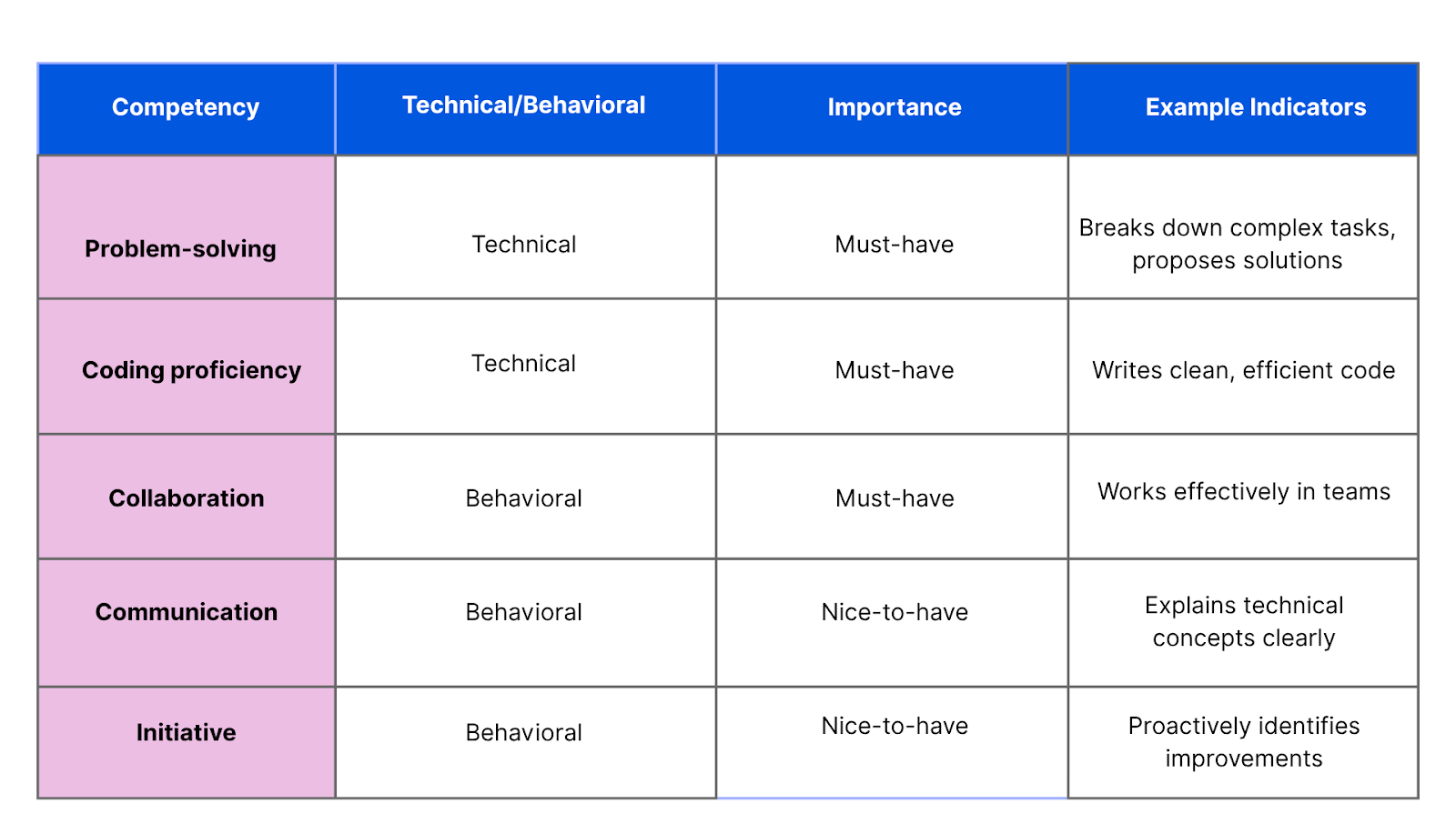
Every question, rubric, and evaluation should map back to these competencies. Get this step wrong, and everything that follows is compromised.

Step 2: Design job-relevant interview questions

Every question must tie directly to a competency. If you can’t explain what skill a question evaluates, cut it.

Types of questions:

  • Behavioral: “Tell me about a time you debugged a complex system.”
    Assesses past performance and approach to problems.
  • Situational: “What would you do if your code review revealed a major bug right before release?”
    Assesses judgment and decision-making.
  • Technical/Job Knowledge: “How does garbage collection work in Java?”
    Assesses expertise.
  • Problem-Solving: “Here’s a code sample with a hidden bug. Can you find and fix it?”
    Assesses analytical approach.

What makes a question effective?

  • Specific: Elicits detailed, job-relevant responses.
  • Open-ended: Allows for different valid approaches.
  • Consistent: Can be asked verbatim to every candidate.

Follow-up questions: Predetermine your follow-ups. Unplanned probing (“Can you elaborate?”) reintroduces bias. Prepare 1-2 clarifying prompts per question.

Legal considerations: Avoid asking questions about age, marital status, family plans, or anything not directly job-relevant.

It’s not the questions themselves that drive value. It’s that every candidate gets exactly the same questions, enabling true comparison.

Step 3: Create a standardized scoring rubric

Most teams with “standard questions” still get inconsistent results because they lack a rubric.

Anchored Rating Scales: Ditch vague rubrics (“1 = poor, 5 = excellent”). Instead, define what each score actually means for each question.

How to build behavioral anchors

  • Strong answer (5): Candidate describes a complex bug, details their systematic approach, explains trade-offs, and shares results.
  • Average answer (3): Candidate gives a general description, some steps, but lacks depth or specifics.
  • Weak answer (1): Candidate struggles to recall an example, focuses on blame, or skips steps.

Weighting Competencies: Not all competencies matter equally. For a software engineer, “coding proficiency” might be weighted twice as heavily as “initiative.”

Red Flags and Knockouts: Define criteria that indicate an automatic concern (e.g., “Refused to seek help when stuck,” “Breached security protocols”).
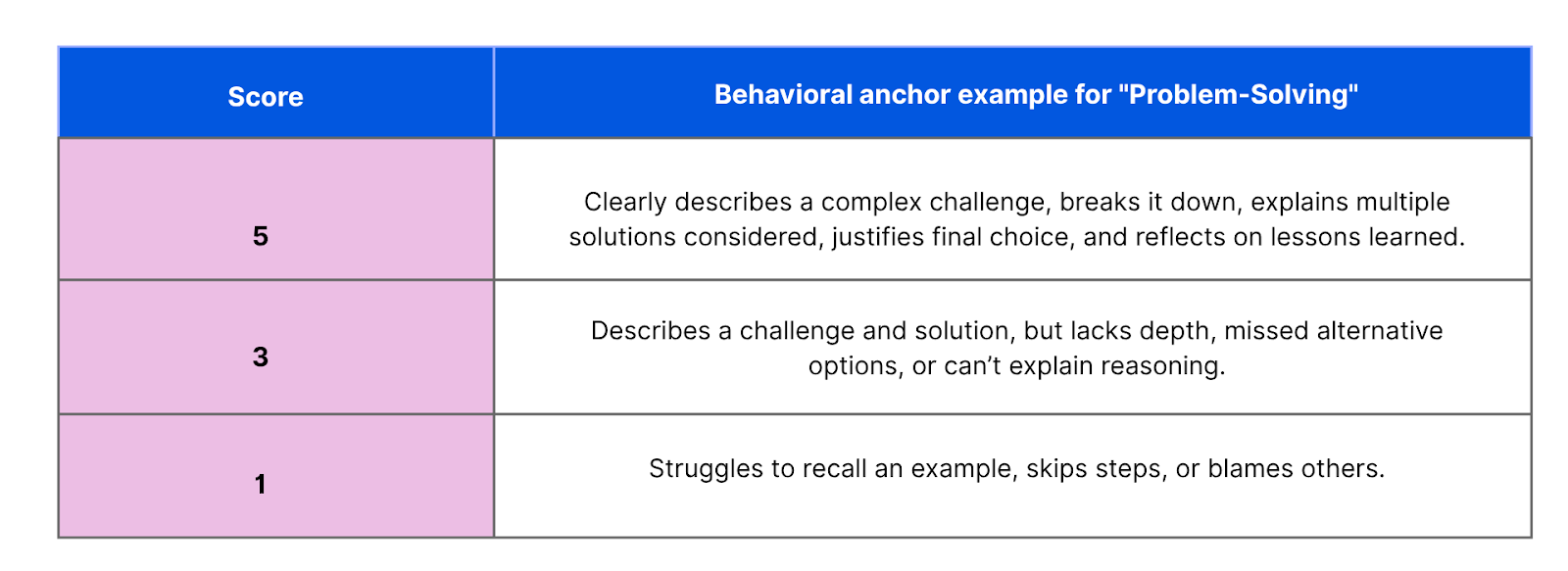
A good rubric makes scoring obvious. If interviewers are debating what score to give, your rubric isn’t specific enough.

Step 4: Train your interviewers

Even the perfect process fails if interviewers aren’t trained to use it. Many experienced interviewers feel structure constrains them or implies a lack of trust. The truth is, structure is about consistency, not micromanagement.

What training should cover:

  • Consistent delivery: Ask questions verbatim, no leading or significant rephrasing.
  • Scoring rubric: How to use anchors, not impressions.
  • Evidence-based notes: Document what was said, not how you “felt.”
  • Bias recognition: Train interviewers to spot and mitigate their own biases.
  • Legal boundaries: What’s off-limits in questioning.
  • Calibration exercises: Regular practice sessions to align scoring standards.

Ongoing vs. one-time training: Calibration isn’t a “set and forget” task. Run sessions regularly, especially when adding new questions or interviewers.

Key insight: Training builds interviewer confidence. Structured processes free up bandwidth to focus on evaluation, not improvisation.

Step 5: Standardize the interview day experience

Consistent format: Same interview duration, structure, and number of interviewers for every candidate in the same role.

Interview flow:

  1. Rapport building (5 min): Brief introduction, outline the process.
  2. Core questions (30-40 min): Ask predetermined questions in order.
  3. Candidate questions (10-15 min): Allow the candidate to ask about the role, team, or company.
  4. Close (5 min): Explain next steps and timeline.

Handling candidate Q&A: While not scripted, interviewers should prep standard answers to common questions for consistency.

Panel interviews: Assign questions in advance to avoid overlap. Ensure smooth handoffs and avoid cross-talk.

Sample interview flow

Segment Time Allocation
Welcome & rapport 5 min
Core questions 35 min
Candidate questions 10 min
Close & next steps 5 min

Key insight: A structured, organized interview experience not only improves evaluation quality but also boosts your employer brand.

Step 6: Evaluate candidates using evidence, not gut feeling

Each interviewer completes their scorecard independently, before any group discussion. This prevents groupthink and anchoring.

Running effective debriefs:

  • Each interviewer shares scores and evidence.
  • Discussion focuses on what was observed, not impressions.
  • Discrepancies are discussed in terms of evidence (“What led you to rate that answer as a 5?”), not opinions.

Common pitfalls to avoid:

  • Vague language (“great culture fit”) without behavioral examples.
  • Letting one strong opinion dominate.
  • Comparing candidates to each other rather than to the rubric.
  • Failing to document the rationale for the final decision.

Documentation: Capture key evidence and the reasoning behind each decision. This is crucial for legal defensibility and process improvement.

You can have the world’s best questions and rubrics, but if the decision at the end is based on “vibes,” you’re back where you started.

Common mistakes to avoid during structured interviews

  • Going off-script with follow-ups: Unplanned probing reintroduces bias. Prepare follow-ups in advance.
  • Skipping training (or retraining): Without reinforcement, interviewers revert to old habits.
  • Using generic questions: Role-specific questions are a must. Generic banks defeat the purpose.
  • Never refreshing questions: Candidates share questions. Rotate regularly to maintain effectiveness.
  • Discussing candidates before scoring: Even a casual pre-scoring chat can anchor opinions.
  • Treating structure as a one-time setup: Ongoing calibration, updates, and audits are essential.

These are common organizational patterns that quietly undermine the process of structured interviews.

How to measure structured interview effectiveness

Structured interviews generate consistent, comparable data.  But the implementation is just the start. How do you know it’s actually working?

Key metrics to track

  • Time-to-hire: Structure may feel slower at first, but decisions come faster once implemented.
  • Quality of hire: Are structured hires performing better than previous cohorts? Track interview scores against performance reviews.
  • Interviewer consistency: Compare scoring patterns across interviewers. Wide discrepancies signal calibration gaps.
  • Candidate experience: Survey both successful and rejected candidates. Are they reporting a fair, positive process?
  • Offer acceptance rates: Structured, transparent interviews can improve candidate trust and acceptance.
  • Pipeline diversity: Are you seeing improved representation at each hiring stage?

Automate structured interviews with HackerEarth

HackerEarth’s suite of tools is designed to help tech hiring teams implement structured interviews at scale without sacrificing quality.

AI Interview Agent

  • Delivers structured, role-specific interviews with consistent questions and rubrics
  • Masks candidate's personal information for bias-free evaluation
  • Evaluates technical depth across programming languages and skill areas
  • Generates detailed, comparable evaluation reports
  • Frees engineering time for high-value work instead of repetitive interviews

Supporting Products

  • FaceCode: Live coding interviews with real-time evaluation
  • Technical and non-technical assessments: Pre-built and custom skills tests
  • Soft skills assessments: Evaluate behavioral competencies alongside technical ones

With these tools, you can standardize your interview process end-to-end, ensure fairness, and scale your hiring without losing rigor.

Conclusion 

A structured interview process is the single most effective way to reduce bias, improve hiring outcomes, and build high-performing teams, especially in technical roles. The right technology makes it achievable at any scale.

FAQs

How long does it take to implement a structured interview process?
Implementation can take as little as a few weeks for a single role, but expect a few months for full rollout and calibration—especially in larger organizations.

Can structured interviews be used for all roles?
Yes, though the competencies and questions will differ by role. The framework applies to technical, behavioral, and leadership positions alike.

Do candidates dislike structured interviews?
Most candidates appreciate the fairness and transparency. Even rejected candidates report a better experience when the process is consistent.

How do structured interviews reduce bias specifically?
By standardizing questions, order, and scoring, structured interviews eliminate many opportunities for unconscious bias to slip in—such as going off-script or relying on impressions.

What's the difference between a structured interview and a behavioral interview?
A behavioral interview is a type of question (“Tell me about a time…”). A structured interview is a process: every candidate gets the same questions (behavioral, technical, etc.) and is scored by the same rubric.

How often should we update our interview questions?
Refresh questions at least once a year, or whenever you see evidence that candidates are sharing them widely. Regular audits help maintain effectiveness and fairness.

Online Recruitment Software: 2026 Buyer's Guide

Online recruitment software: how to choose the right platform in 2026

Meta title: Online Recruitment Software: 2026 Buyer's Guide (under 60 chars) Meta description: Compare ATS, CRM, and end-to-end online recruitment software in 2026. Features, pricing, vendor examples, and trade-offs for recruiters and TA leaders.

Online recruitment software — the cloud-based systems recruiters use to source, screen, assess, and hire candidates — has shifted from a system of record to a system of decision. For recruiters and heads of talent acquisition managing dozens of reqs and competing for tight slates, the question in 2026 is no longer "do we need an ATS?" but "which combination of ATS, CRM, and assessment tools actually shortens time-to-fill without degrading quality of hire?" According to LinkedIn's Future of Recruiting report, many talent teams report missing hiring targets when their tech stack cannot keep up with req volume — a pattern this guide is built to address.

What is online recruitment software?

Online recruitment software is a cloud-hosted platform that centralizes sourcing, candidate relationship management, screening, assessment, interviewing, and offer workflows in one system. It replaces the patchwork of inboxes, spreadsheets, and standalone tools that fragment a recruiter's pipeline.

Core purpose

These platforms keep req data, candidate records, assessment results, and interview feedback in one place so a recruiter is not retyping notes across tools or losing slates in email threads. For a recruiter carrying 20–30 open reqs, that consolidation directly affects pass-through rates and TTF. The software handles multi-board job distribution, interview scheduling across time zones, and automated status updates — tasks that otherwise consume the bulk of a recruiter's day.

How online recruitment software has evolved

Recruitment technology has moved from a passive system of record to an active decision layer in the hiring workflow. Leading platforms increasingly offer AI assistants that can draft outreach, transcribe interview notes, surface silver-medalist candidates from prior reqs, and flag pipeline risk in real time. Vendors such as Ashby, Gem, and Eightfold now ship agentic features alongside core ATS functionality, though capabilities and accuracy vary widely between vendors.

The table below reflects broad industry patterns observed by analysts such as Josh Bersin and Gartner; specific timelines vary by market segment.

Era Primary focus Technology shift Candidate experience
2010–2018 Compliance and storage Cloud-based databases Transactional and slow
2019–2023 Efficiency and volume Automated resume parsing Improved but often robotic
2024–2026 Quality of hire and skills Agentic AI and skills-mapping Personalized and high-touch

Types of online recruitment software: ATS vs. CRM vs. end-to-end platforms

The category is segmented into three system types, each addressing a different stage of the funnel.

Applicant tracking system (ATS)

An ATS manages active candidates against open reqs — pipeline stages, compliance data, interview feedback, and offer status. Tools like Greenhouse, Lever, and Workday Recruiting anchor this category. The trade-off: an ATS optimizes for applied candidates, not for proactive sourcing.

Recruitment CRM

A recruitment CRM manages passive talent — candidates you are nurturing for future reqs. Tools like Gem, Beamery, and hireEZ sit here. CRMs are most valuable for hard-to-fill engineering, clinical, or executive roles where pipeline must be built months ahead of req approval. The trade-off is real: CRMs carry steep ramp-up costs, require dedicated sourcer headcount to operate well, and underperform if your team is reactive rather than proactive.

End-to-end recruitment platforms

Many organizations are moving toward end-to-end platforms that combine ATS, CRM, and assessment in one system — iCIMS, Ashby, and Eightfold are common examples. The benefit is unified candidate data; the trade-off is that all-in-one suites often lag best-in-class point solutions on specific capabilities (sourcing, assessment depth, scheduling). Teams with fewer than 10 hires per year may find these platforms overbuilt for their volume.

10 must-have features in online recruitment software

Treat the list below as an evaluation rubric, not a wish list. For each feature, ask the vendor to demo it against one of your live reqs.

  1. Job posting and multi-board distribution. One-click syndication to LinkedIn, Indeed, niche boards, and your careers site. Ask vendors how they handle duplicate-application logic across boards — a frequent source of dirty pipeline data.
  2. Applicant tracking and pipeline management. A kanban or stage-based view of every candidate against every req, with bulk actions for stage moves, rejections, and outreach. Look for configurable stage gates that match your hiring process, not the vendor's default.
  3. Resume parsing and screening. Accurate extraction of skills, titles, tenure, and education. Parsing accuracy varies — request error rates on a sample of your own resumes before signing.
  4. Skills assessment integration. Built-in or integrated assessments that measure capability rather than credentials. For technical hiring, platforms like HackerEarth Assessments provide real-time skill intelligence and role-fit scoring that plug into the ATS pipeline, so recruiters can shortlist on validated skill data instead of resume keywords.
  5. Interview scheduling and automation. Self-serve candidate booking against interviewer calendars, with panel coordination and time-zone handling. Reclaims 3–5 hours per recruiter per week in most TA orgs.
  6. Collaboration and structured feedback. Scorecards tied to job competencies, with required ratings before stage advance. Reduces hiring manager bias and supports adverse-impact review.
  7. Workflow automation. Triggered reminders, nudges to hiring managers on aging candidates, and SLA tracking on feedback turnaround.
  8. Analytics and reporting. Source-of-hire, pass-through by stage, TTF by req owner, and quality-of-hire correlations. Confirm whether reports are configurable or vendor-locked.
  9. Candidate communication. Two-way SMS, mobile-optimized application forms, and templated email sequences. A growing share of candidates apply via mobile, so mobile UX is no longer optional.
  10. Integrations and API access. Open APIs and pre-built connectors to HRIS, payroll, background-check vendors, and assessment tools. Closed ecosystems become tax later.
Recruiter Time Saved Per Week by Feature
Source: Illustrative based on article claims (interview scheduling cited as 3–5 hrs/week; others estimated proportionally)

How to evaluate and choose the right online recruitment platform

Use these five steps in order.

  1. Audit your current hiring workflow. Map every stage from req intake to offer accept. Identify where TTF stalls and where candidates drop. You cannot fix what you have not measured.
  2. Define hiring volume, team size, and budget. Match the platform to your actual req load. Public pricing benchmarks from analysts such as G2 and Gartner suggest ATS pricing typically ranges from roughly $15 per user per month for SMB tools to several hundred dollars per user per month — or per-requisition and flat-fee models — for enterprise platforms. Confirm exact pricing directly with vendors, since published rates are often outdated.
  3. Shortlist on must-have features, not feature count. A platform with 200 features you will not use is a liability, not an asset.
  4. Run trials against live reqs. Demos are sales theater. Request a 30-day trial and route a real open role through the system to test parsing, scheduling, and hiring manager UX.
  5. Assess vendor support, security, and scalability. Confirm SOC 2 Type II, GDPR posture, data residency, and the named SLAs in your contract. Reference-check two current customers at your company size.

Common mistakes recruiting teams make when choosing recruitment software

  • Choosing on feature count alone. Bloated platforms slow recruiter adoption.
  • Ignoring candidate experience. A 30-field application form will kill your top-of-funnel conversion regardless of how good the back end is.
  • Overlooking integrations. If the ATS does not talk to your HRIS, background-check vendor, and assessment platform, you will rebuild the manual work the software was supposed to eliminate.
  • Skipping hiring manager buy-in. Hiring managers who were not consulted will not use the scorecards, which breaks your reporting.
  • Underestimating implementation. Plan 6–12 weeks for mid-market ATS rollout, longer for enterprise. Budget for change management, not just license fees.

When these recommendations do not apply

Not every team needs a full platform. If you hire fewer than 10 people per year, a lightweight ATS or even a structured spreadsheet plus a scheduling tool may outperform a six-figure suite. AI screening carries documented bias risk — the EEOC's guidance on AI in hiring and ongoing state-level regulation (NYC Local Law 144, Illinois AI Video Interview Act) require adverse-impact testing and candidate notice that not all vendors support out of the box. CRMs underperform without dedicated sourcer capacity. And end-to-end platforms can lock you into mediocre point capabilities; some high-performing TA orgs deliberately run best-in-breed stacks instead.

Online recruitment software trends to watch in 2026

  • AI-powered screening and matching. Vendors increasingly use large language models and embeddings to rank candidates against job descriptions. What "AI" means varies sharply: some tools score on keyword overlap, others on validated skill assessments, others on opaque proprietary models. Ask vendors what their models are trained on, what their false-negative rates are on protected-class subgroups, and what human-in-the-loop controls exist. The final hiring decision should remain with a person.
  • Skills-based hiring over resume-based hiring. A growing number of employers — documented in LinkedIn's 2024 Future of Recruiting and SHRM research — are weighting validated skill data over degree pedigree. Platforms that surface skill evidence (assessments, code samples, portfolio work) at the screening stage benefit most.
  • DEI as measurement, not cosmetics. Mature DEI tooling goes beyond name-blind resume review to include adverse-impact analysis on each pipeline stage, assessment validity studies, structured-interview rubrics, and audit trails for regulators. Treat any vendor that reduces DEI to "hide the name field" as immature on this dimension.
  • Mobile-first candidate experience. A significant share of applications now originate on mobile devices, according to SHRM and recruitment industry surveys. Application flows over five minutes lose candidates.

FAQ

What is the best online recruitment software for small businesses? For teams hiring fewer than 50 people per year, lightweight ATS tools such as Workable, BambooHR Hiring, or Recruitee typically offer the best balance of cost and functionality. Larger SMBs scaling past 100 hires per year often graduate to Greenhouse, Lever, or Ashby.

How much does online recruitment software cost? Pricing varies by billing model. Per-user SMB tools commonly start around $15–$50 per user per month. Mid-market platforms range from roughly $100–$300 per user per month or use per-requisition pricing. Enterprise suites such as Workday and iCIMS are typically negotiated as annual contracts in the five- to six-figure range. Always confirm pricing directly with the vendor.

What is the difference between an ATS and a recruitment CRM? An ATS manages candidates who have applied to open reqs. A CRM manages passive talent you are nurturing for future reqs. Most mature TA orgs need both, either as integrated point solutions or as part of one end-to-end platform.

Do I need an end-to-end platform or best-in-breed tools? End-to-end platforms reduce data fragmentation; best-in-breed stacks deliver stronger capability per tool. Choose end-to-end if your team values unified reporting over depth, and best-in-breed if specific stages (sourcing, technical assessment) are where you win or lose hires.

How long does implementation take? Plan 6–12 weeks for a mid-market ATS, 4–6 months for enterprise suites. Allocate time for data migration, integration setup, workflow configuration, and hiring manager training.

Does AI screening introduce bias? It can. AI models inherit bias from training data and from the historical hiring decisions they learn from. Required practice in 2026: ask vendors for adverse-impact data by protected class, validation studies, and human-review checkpoints. Regulations such as NYC Local Law 144 require independent bias audits for many automated employment decision tools.

Next steps

Audit your current funnel against the 10-feature rubric above, then shortlist two or three platforms for trial. If technical roles dominate your req load, evaluate HackerEarth Assessments against your current screening process — running one open engineering req through validated skill assessments will show you, on real candidates, whether skills-based screening changes your slate quality. Request a demo or explore the assessment library to start.

The 15 best recruitment analytics tools for smarter hiring

The global recruitment landscape in 2026 has reached a definitive turning point where the traditional reliance on intuition and manual resume screening is no longer sufficient to meet the demands of a high-velocity, skills-based economy. As organizations grapple with the dual challenges of talent scarcity and the rapid lifecycle of technical skills, recruitment analytics software has emerged as the critical infrastructure for strategic talent acquisition. The current hiring environment is characterized by a significant performance gap; data from the previous year indicates that 90% of companies missed their hiring goals, with 34% hitting less than half of their targets.This systemic struggle is compounded by a 60% increase in time-to-hire across most organizations, highlighting an urgent need for tools that can identify bottlenecks and optimize the funnel through predictive intelligence.

Why recruitment analytics is crucial in 2026

The increasing reliance on data for effective hiring decisions is not merely a trend but a response to a global recruitment market projected to reach $1.06 trillion by 2030. In 2026, the shift from traditional recruiting methods to data-driven, predictive analytics is driven by the erosion of the university degree as a primary signal of candidate quality. Employers are now prioritizing demonstrable skills, practical experience, and cognitive adaptability over formal credentials, with 70% of organizations deploying skills-based hiring practices an increase from 65% in the prior year. This shift requires a sophisticated analytical layer that can parse complex competency data and predict a candidate's long-term success and retention likelihood.

The link between recruitment analytics and business outcomes is quantifiable through key metrics such as time-to-hire, quality of hire, and overall return on investment. Organizations that successfully implement these tools report up to 50% faster time-to-hire by automating repetitive sourcing and screening tasks. Furthermore, the financial impact of improved hiring accuracy is substantial; reducing "mis-hires" can lower recruiting costs by up to 30%, as the cost of a failed hire often exceeds twice the employee's annual salary. Successful companies like Tesla, Nvidia, and McDonald's have already integrated these advanced analytics into their talent pipelines to maintain a competitive advantage in the global labor market.

What is recruitment analytics software?

Recruitment analytics software represents a specialized category of human resources technology designed to ingest, process, and visualize data throughout the entire hiring lifecycle. While an applicant tracking system (ATS) focuses on the administrative workflow of moving a candidate from application to offer, and a human resource information system (HRIS) manages post-hire employee data, recruitment analytics software acts as the intelligence layer that connects these disparate systems. It identifies patterns within the hiring funnel, such as where high-quality candidates drop off or which interview stages are most predictive of performance.

This software integrates with existing HR systems to provide actionable insights by centralizing data from sourcing channels, job boards, assessment platforms, and internal workforce records. By applying machine learning and predictive modeling, it shifts the recruiting function from a reactive process to a proactive strategic tool. For instance, it can alert recruiters to hiring slowdowns in specific regions or suggest budget reallocations toward sourcing channels that historically yield higher retention rates.

Key features to look for in recruitment analytics software

Selecting the appropriate recruitment analytics platform in 2026 requires an understanding of several foundational features that define modern talent intelligence. Dashboard capabilities remain central; teams need real-time insights and customizable reports that track KPIs such as source of hire, offer acceptance rates, and candidate Net Promoter Scores. Effective dashboards must go beyond simple counts to show conversion ratios across every stage of the funnel.

Predictive analytics for candidate success and diversity metrics are equally vital. These tools use historical performance data to identify the traits most associated with long-term success in specific roles, while simultaneously tracking representation to ensure the organization meets its diversity, equity, and inclusion goals. AI-powered tools play a critical role here by providing objective match scores and reducing human bias through “blind” screening and standardized assessment criteria. Finally, robust integration capabilities with existing tech stacks, including ATS, job boards, and learning and development platforms, are non-negotiable for maintaining a “single source of truth” for all talent data.

Feature Description Business Impact
Real-time dashboards Instant visibility into pipeline health and KPIs Faster identification of process bottlenecks
Predictive matching AI models that score candidates based on fit Higher quality of hire and reduced turnover
Skills assessments Objective testing of technical and soft skills Reduced bias and better competency alignment
Outreach analytics Tracking engagement on email/SMS sequences Optimized sourcing spend and improved branding
DEI tracking Monitoring representation throughout the funnel Ensured compliance and more inclusive culture

The 15 best recruitment analytics tools (ranked and reviewed)

The market for recruitment analytics in 2026 is diverse, with tools tailored to various company sizes, industries, and specific hiring needs.

1. HackerEarth SmartHire Analytics

HackerEarth SmartHire Analytics is the industry benchmark for organizations prioritizing technical and skills-based recruitment. It is designed to replace manual, inefficient resume screening with data-driven technical assessments that evaluate candidate competence with high precision. The platform is built upon a library of over 40,000 questions covering full-stack, devops, data science, and generative ai topics.

  • Overview: A comprehensive technical screening and engagement suite that leverages data to identify top-performing developers.
  • Pros: Advanced proctoring features, the unique "codeplayer" for replaying candidate logic, and deep reporting on question and test effectiveness.
  • Cons: Primarily focused on technical roles, though it is expanding into soft skill evaluation.
  • Best for: Tech-heavy organizations, fast-growing startups, and enterprises scaling their engineering teams.
  • Pricing: Tiered based on assessment volume; offers high roi by increasing assessment-to-hire conversion rates 10-fold.
  • Why it made the list: Its ability to record every keystroke through codeplayer provides an unparalleled look into a candidate's problem-solving process, making it essential for high-quality technical hiring.

2. Visier

Visier is a people analytics platform that provides an expansive view of the workforce by connecting recruiting data to employee performance and retention outcomes. It is designed to act as the "brain" of the hr department, answering thousands of pre-built business questions using the organization's existing data.

  • Overview: A mature people analytics solution that focuses on predictive forecasting and industry benchmarking.
  • Pros: Deep analytical depth, business-user friendly dashboards, and strong predictive capabilities for turnover and skill gaps.
  • Cons: High total cost of ownership and lengthy implementation cycles for large enterprises.
  • Best for: Large, data-mature enterprises with complex global reporting needs.
  • Pricing: Custom enterprise pricing.
  • Why it made the list: It is the only platform that effectively bridges the gap between pre-hire analytics and long-term workforce planning at scale.

3. Greenhouse Recruiting Analytics

Greenhouse is a leader in "structured hiring," a methodology that uses data to ensure every interview is consistent and objective. Its analytics suite is deeply embedded into its ats, providing granular visibility into interviewer performance and funnel drop-offs.

  • Overview: An ats-first platform with built-in analytics focused on process optimization and dei.
  • Pros: Excellent interview scorecards, robust diversity reporting, and a large marketplace of integrated tools.
  • Cons: Pricing can be high for smaller teams, and the mobile app is limited for end-to-end setup.
  • Best for: Mid-market to enterprise companies that value process consistency and bias reduction.
  • Pricing: Custom pricing, often in the mid-to-enterprise tier.
  • Why it made the list: It excels at providing data that helps teams "structure" their way to better, more equitable hiring decisions.

4. Manatal

Manatal is an AI-powered, cloud-based platform that has become a preferred choice for recruitment agencies and SMBs due to its affordability and ease of use. It offers a unified ATS and CRM with built-in candidate enrichment.

  • Overview: A cost-effective, ai-driven recruiting solution with automated candidate scoring and social media enrichment.
  • Pros: Very fast setup, built-in "ai interviewer," and seamless integration with over 2,500 job boards.
  • Cons: Customization and reporting depth are less advanced compared to enterprise tools like Visier.
  • Best for: Small to mid-sized recruitment agencies and growing startups.
  • Pricing: Starts at $15 per user per month.
  • Why it made the list: It provides powerful ai tools, such as candidate scoring and automated formatting, at a price point accessible to small teams.

5. Eightfold AI

Eightfold AI is a talent intelligence platform that uses deep learning to match candidates to roles based on their potential and transferable skills. It is particularly effective for large-scale talent reskilling and internal mobility.

  • Overview: A predictive analytics platform that evaluates candidates based on their total "skills profile" and future potential.
  • Pros: Strong bias-mitigation tools, superior skills-matching intelligence, and an end-to-end view of the talent lifecycle.
  • Cons: Ai models can be complex to explain to non-technical stakeholders.
  • Best for: Enterprises undergoing digital transformation or those with high internal mobility needs.
  • Pricing: Custom enterprise quotes.
  • Why it made the list: Its focus on "potential over pedigree" is perfectly aligned with the 2026 shift toward skills-based hiring.

6. Bullhorn Analytics

Bullhorn is the dominant platform for staffing and recruitment firms, with a specific focus on consultant productivity and agency revenue tracking.

  • Overview: A dedicated analytics suite for recruitment agencies to track placements, billings, and pipeline efficiency.
  • Pros: Deep integration with Bullhorn ATS, real-time dashboards for recruiter performance, and agency-specific kpis.
  • Cons: Not designed for in-house corporate recruiting teams.
  • Best for: Third-party staffing agencies and executive search firms.
  • Pricing: Custom based on agency size.
  • Why it made the list: It is the industry standard for firms that need to treat recruitment as a sales and revenue-generating engine.

7. Jobvite Analytics

Jobvite is an end-to-end talent acquisition suite known for its "evp-to-onboarding" focus and strong referral management analytics.

  • Overview: A comprehensive suite that provides actionable intelligence across the entire recruitment lifecycle.
  • Pros: Powerful employee referral tracking, branded career site analytics, and robust hiring manager dashboards.
  • Cons: The breadth of the platform can lead to a steep learning curve for smaller teams.
  • Best for: Mid-to-large enterprises focused on building talent communities and referral networks.
  • Pricing: Enterprise custom pricing.
  • Why it made the list: It effectively tracks the "candidate journey," from first interaction on a career site to day one of employment.

8. Tableau for HR

Tableau is a leading data visualization tool that allows hr departments to build completely bespoke dashboards by blending data from multiple recruitment sources.

  • Overview: A business intelligence platform used by data-mature organizations to create interactive recruiting reports.
  • Pros: Unlimited flexibility in dashboard design, the ability to connect to any data source (ATS, HRIS, spreadsheets), and powerful visualization.
  • Cons: Requires technical data science or analytics skills to build and maintain.
  • Best for: Large organizations with dedicated people analytics teams.
  • Pricing: Tiered based on role (Creator $75/mo, Explorer $42/mo, Viewer $15/mo).
  • Why it made the list: It is the "gold standard" for companies that have outgrown the native reporting capabilities of their ATS.

9. IBM Watson Recruitment

IBM Watson Recruitment uses cognitive computing to help recruiters prioritize candidates by predicting their performance and cultural fit.

  • Overview: An ai-powered platform that analyzes candidate data and workforce trends to support evidence-based decisions.
  • Pros: Advanced predictive matching, automated candidate scoring, and industry-wide market intelligence analysis.
  • Cons: Implementation and integration are most effective within the broader IBM ecosystem.
  • Best for: Enterprises looking for "big data" insights and advanced ai assistance in high-volume screening.
  • Pricing: Custom enterprise pricing.
  • Why it made the list: Its "adverse impact analysis" is one of the most sophisticated tools for identifying and mitigating bias in recruitment.

10. TalentLyft

TalentLyft is a user-friendly, all-in-one recruiting software that specializes in recruitment marketing and sourcing analytics.

  • Overview: A suite that combines an ats, crm, and recruitment marketing tools to attract and track talent.
  • Pros: Excellent for tracking job board performance, branded career pages, and candidate engagement levels.
  • Cons: Lacks the deep "post-hire" performance analytics found in tools like Visier.
  • Best for: Mid-sized companies that want to focus on their employer brand and sourcing efficiency.
  • Pricing: Custom quotes, generally mid-market affordable.
  • Why it made the list: It simplifies the complex world of recruitment marketing into actionable data for non-technical recruiters.

11. Ashby

Ashby has gained rapid popularity among tech-centric startups and mid-market teams for its "all-in-one" approach that prioritizes data above all else.

  • Overview: A modern recruiting platform that combines an ats, crm, scheduling, and bi-level analytics in one tool.
  • Pros: Native "bi-tool" quality reports, extremely fast scheduling UI, and highly customizable pipelines.
  • Cons: Steep learning curve and a higher entry price point for smaller teams.
  • Best for: Data-driven startups and mid-market tech companies.
  • Pricing: Starts around $300-$400 per month for foundational plans.
  • Why it made the list: It eliminates the need for separate reporting tools by building enterprise-grade analytics directly into the recruiter's daily workflow.

12. Gem

Gem is a recruitment crm that focuses on passive candidate outreach and pipeline analytics, typically layering on top of an existing ats.

  • Overview: A sourcing-first platform that tracks conversion rates for email sequences and identifies drop-offs in the pre-hire funnel.
  • Pros: Best-in-class outreach analytics, excellent for diverse candidate sourcing, and strong "talent pooling" features.
  • Cons: High cost and potential redundancy for teams that rely solely on inbound applicants.
  • Best for: Sourcing-heavy teams and companies focused on "headhunting" passive talent.
  • Pricing: Starting around $405/month for startups, with custom enterprise tiers.
  • Why it made the list: It provides the most detailed data on "outreach roi," helping teams understand which messages and channels actually lead to hires.

13. iCIMS Talent Cloud

iCIMS is a robust, global enterprise platform that handles massive hiring volumes with advanced ai and deep reporting capabilities.

  • Overview: An established talent cloud that manages the end-to-end recruitment process for global organizations.
  • Pros: Massive marketplace of 800+ integrations, advanced compliance features, and high configurability.
  • Cons: The interface can feel dated and overwhelming without significant training.
  • Best for: Global enterprises and high-volume hiring environments.
  • Pricing: Enterprise-level custom pricing, typically starting at $15,000/year.
  • Why it made the list: It is the definitive choice for large organizations that need a highly secure, audit-ready global talent system.

14. Recruit CRM

Recruit CRM is designed specifically for headhunters and executive search firms, offering a high-speed interface and powerful automation.

  • Overview: An all-in-one ats and recruitment crm focused on scale and recruiter productivity.
  • Pros: Built-in chrome sourcing extension, radius and "x-ray" search features, and automated email sequences.
  • Cons: Some advanced analytics and linkedin integrations require additional paid add-ons.
  • Best for: Staffing agencies and independent executive recruiters.
  • Pricing: Plans range from $85 to $165 per user per month.
  • Why it made the list: It consistently receives the highest ratings for ease of setup and customer support in the agency space.

15. MokaHR

MokaHR is an ai-powered, data-driven platform trusted by global brands to make hiring more efficient and bias-resistant.

  • Overview: An enterprise-grade platform that unifies ai automation with end-to-end recruitment analytics.
  • Pros: Full-funnel visibility, real-time "ai match scores" for applicants, and high accuracy in automated screening.
  • Cons: Best suited for high-volume, enterprise environments; may be complex for small teams.
  • Best for: Multinational corporations and rapidly scaling enterprise teams.
  • Pricing: Custom enterprise pricing.
  • Why it made the list: It has been benchmarked to deliver up to 3x faster screening with 87% accuracy, dramatically improving recruiter bandwidth.

How to choose the right recruitment analytics software for your company

Selecting the appropriate software requires a strategic alignment between the tool's capabilities and the company's operational maturity. Small businesses and startups (smbs) often benefit most from "all-in-one" platforms like Manatal or Ashby that provide basic analytics and a clean ui without requiring a dedicated data scientist. These organizations should prioritize ease of setup and time-to-value.

Mid-market companies typically have more structured hiring processes and a greater need for process optimization. For these teams, Greenhouse or Gem provide the necessary depth to identify funnel bottlenecks and track diverse candidate flow. Enterprise-level organizations require a "talent intelligence" layer that integrates with complex hr tech stacks. Visier, Eightfold AI, or iCIMS are better suited for this scale, as they offer predictive modeling and cross-functional reporting that can connect hiring to overall business growth.

Before implementation, talent leaders should ask three fundamental questions:

  1. What data needs to be integrated? Ensure the tool can ingest data from your current job boards, ats, and slack.
  2. How fast can we get results? Look for tools that offer pre-built dashboards for immediate visibility.
  3. Does it support our specific hiring goals? For example, HackerEarth SmartHire Analytics is ideal for fast-growing tech teams that need to verify skills rather than just resumes.

Pricing: How much should recruitment analytics software cost?

Recruitment software pricing in 2026 generally falls into three models: subscription-based, per-user/seat-based, or volume-based pricing. Subscription models are dominant, with costs scaling based on the number of active job slots or the company's total headcount.

Tier Monthly Cost (Est.) Target Company Size Common Pricing Model
Foundational $15 – $100 SMBs & solo recruiters Per user/month
Growth/Mid-market $150 – $400 Companies with 50–250 employees Per user/month or tiered
Enterprise $500 – $1,250+ Large organizations (250+ employees) Custom annual contracts

Beyond the base subscription, organizations must account for hidden costs such as implementation fees (averaging one month of data migration), training for hiring managers, and premium integrations. However, these costs are often offset by a high roi; for example, organizations using ai-driven scheduling report that the 38% of recruiter time saved on administrative tasks directly correlates to higher goal attainment.

Implementation: Getting the most out of recruitment analytics software

The primary reason for recruitment analytics failure is not the software itself, but poor data hygiene at the start of the project. Before launching a new tool, teams must perform a comprehensive "data clean-up," ensuring that historical candidate records and job statuses are accurate.

Common pitfalls include:

  • Ignoring the hiring manager: If hiring managers do not use the tool to provide feedback, the "quality of hire" metrics will be incomplete.
  • Over-reliance on automation: AI should assist decisions, not replace human judgment. Organizations must maintain a "human-in-the-loop" to ensure ethical standards are met.
  • Measuring too many metrics: Teams should focus on 3-5 "north star" kpis, such as time-to-offer, funnel conversion, and retention, to avoid "data noise".

Success is measured by setting benchmarks. For instance, a leading technology company reported that by utilizing sourcing performance dashboards, they cut underperforming channels and dropped their cost-per-hire by 18% in just two quarters.

Trends in recruitment analytics for 2025 and beyond

The recruitment landscape is evolving toward "talent intelligence," where data is used to predict rather than just track. The rise of ai in predictive hiring means that by late 2026, autonomous ai agents will likely handle over 70% of early-stage candidate engagement and scheduling.

Skills-based recruitment analytics will become the "default" operating model. Instead of searching for "software engineers with 5 years of experience," recruiters will use data to find "candidates with verified proficiency in python, rag, and prompt engineering". Cross-platform data analytics will also play a larger role, as organizations integrate data from learning platforms and external portfolios to create a 360-degree view of candidate potential. Finally, real-time, mobile-first dashboards will ensure that hiring managers can review candidates and approve offers on the go, further reducing time-to-hire.

Why HackerEarth SmartHire Analytics is your best choice

HackerEarth SmartHire Analytics stands out in 2026 as the most rigorous and data-rich platform for technical recruitment. While other tools offer general tracking, HackerEarth provides deep, logical insights into developer ability through features like Codeplayer and question-based health analytics. It effectively addresses the "trust gap" in remote hiring by providing the industry's best plagiarism detection and ai-powered proctoring.

The platform is enterprise-ready, offering iso-certified security and seamless integrations with major ats providers. By focusing on "skill-based" rather than "credential-based" hiring, HackerEarth helps organizations build high-performing, future-proof tech teams. Organizations looking to reduce their candidate-shortlisted-to-hired ratio and maximize recruiter bandwidth by over 60% will find that HackerEarth delivers the highest return on investment in the technical hiring space.

Conclusion: Driving strategic value through data

In 2026, recruitment analytics has matured from a luxury into a core business imperative. As hiring becomes more selective and skills-focused, the organizations that leverage these 15 tools to optimize their funnels and reduce bias will attract the world's top talent The key to success lies in choosing a platform that fits your current needs while providing the scalability to grow with your data maturity. By prioritizing human-centered AI, rigorous skills assessment, and data-driven decision-making, talent acquisition teams can transition from reactive cost centers into the most strategic drivers of organizational growth.

HackerRank vs HackerEarth: Which Rules Coding Interviews?

Technical hiring has changed dramatically over the last few years. Recruiters face more applicants per role, developers expect faster feedback, and teams need tools that do more than just run coding tests. As a result, large companies are rethinking how they assess engineers. 

Modern talent‑acquisition platforms that combine live interviewing, structured scoring, and detailed analytics are helping organizations make better decisions faster. In fact, nearly 60% of HR leaders say AI‑powered tools have improved talent acquisition by reducing bias and accelerating hiring, highlighting how technology is reshaping recruiting workflows and outcomes.

In this article, we'll do a HackerRank vs HackerEarth comparison and see how these online coding interview platforms perform against key criteria like interview workflows, integrations, analytics, and candidate experience to help you make the right choice.

What are Coding Interview Platforms?

A coding interview platform is software that helps companies evaluate candidates' technical skills during the hiring process. These tools provide coding tests, live interview environments, scoring tools, candidate dashboards, and integrations with HR systems. 

Additionally, they help recruiters and engineering managers assess candidates fairly, consistently, and with objective data.

What is HackerRank?

HackerRank delivers a full suite of coding assessments, live interviews, and workflow tools for recruiters and engineering teams. It handles large volumes of technical tests daily and supports 55+ programming languages, making it a reliable option for enterprises facing heavy hiring needs.

The platform extends beyond simple coding tests. It includes advanced proctoring, adaptive AI interview tools, and the ability to simulate real-world tasks that reflect on-the-job coding challenges. Its question library spans thousands of challenges, enabling recruiters to build customized assessments for screening, take-home projects, and live interviews.

Recruiters use HackerRank for:

  • High-volume screening campaigns, such as campus hiring or global rollouts
  • Structured technical assessments that filter candidates before human interviews
  • Supporting engineering managers in live pair-programming interviews

The platform’s scoring features allow weighted grading and custom test creation. It integrates with major ATS systems, enabling automated workflows that seamlessly move candidates from online tests to interview stages.

That said, HackerRank's depth of features can come with a steeper onboarding curve, and some smaller teams have noted that the platform's workflows feel designed more for high-volume hiring than lightweight interview schedules.

What is HackerEarth?

Known as one of the best HackerRank alternatives, HackerEarth is an all-in-one coding interview platform that combines technical assessments with recruiting workflows. It combines coding tests with virtual interviewing via FaceCode, reporting dashboards, and structured analytics. 

It brings screening and interview tools together, allowing hiring teams to move candidates smoothly from initial assessments to live technical interviews and final review stages. HackerEarth also emphasizes ease of use for recruiters and candidates. It has built-in ATS connectors and reporting that help teams track candidate pipelines and recruiter performance across interviews.

Some of its core capabilities include:

  • FaceCode interviews: Browser-based coding challenges with live audio/video
  • ATS integration: Seamless connections with applicant tracking for smoother recruiter workflows
  • Analytics dashboards: Structured insights into test performance and interview outcomes
  • Custom question library: Recruiters can build tests tailored to specific roles and skills

The platform suits small to mid-sized companies and teams that want a balanced mix of screening and interviewing tools with intuitive workflows. It works well for companies that need clear candidate pipelines with structured steps from test invitation to interview completion. That said, HackerEarth is primarily developer-focused and may not be the best fit for teams that need broad psychometric, behavioral, or cognitive assessments alongside technical screening.

Feature Comparison: HackerRank vs HackerEarth

To help you decide which platform fits your hiring needs, we’ll dive into a HackerEarth vs HackerRank coding interview tool comparison. We’ll compare both tools side by side on the basis of workflows, integrations, analytics, and the candidate experience.

Side‑by‑Side Feature Deep Dive: HackerRank vs HackerEarth

Now that we understand what each platform offers, it’s time to dive deeper into a technical interview software comparison to see how they perform in real-world hiring scenarios.

Live coding & collaboration

Ever wondered how a developer really thinks under pressure? Real-time coding reveals problem-solving instincts, collaboration style, and adaptability in ways a resume can’t. 

Here’s how HackerRank and HackerEarth tackle this critical part of technical hiring:

HackerRank

HackerRank lets you run live coding interviews in a shared, real-time environment that mirrors how developers work daily. You can review code, debug issues, or build features alongside candidates. Pair programming gives a clear sense of how well you might collaborate with someone on your team. 

The platform also includes code repository questions, realistic coding challenges, and built-in AI assistants that let you see how candidates interact with modern developer tools. Security features track tab switches, multiple monitors, and outside help, helping maintain trust in the interview results.

HackerEarth

HackerEarth’s FaceCode offers a collaborative real-time editor that supports over 40 programming languages. You can run live-coding interviews with panels of up to 5 interviewers and integrate diagram boards for systems design. Its Coding Assessment Test and library of 40,000+ pre-built questions let you tailor interviews to your job requirements while evaluating candidates objectively. 

FaceCode also uses AI to generate detailed session summaries that cover technical skills, problem-solving approach, and collaboration style. The platform records interviews for later review, masks candidate information to support unbiased evaluations, and securely handles high-volume hiring, all while keeping the candidate experience smooth and professional.

🏆Winner: HackerEarth

While HackerRank provides a realistic coding workflow, HackerEarth gives teams more tools to evaluate, record, and analyze performance across multiple dimensions, making it the stronger choice for structured and scalable hiring.

Structured evaluation & scoring

Live coding is one thing, but structured evaluation turns raw performance into hiring decisions you can trust. 

This section looks at how HackerRank and HackerEarth measure, score, and analyze candidate results:

HackerRank

HackerRank automatically scores coding tests against predefined unit tests and lets you build flexible scorecards with custom criteria you define. You can benchmark candidate results against a global developer pool and see weighted scoring rather than just pass/fail outputs. 

Meanwhile, advanced evaluation features show code quality, efficiency, and AI fluency, giving you a richer view of how a candidate approaches problems from multiple angles. Reports capture detailed analytics and highlight performance across coding, logic, and higher‑order skills.

HackerEarth

HackerEarth auto‑evaluates coding assessments using test cases and supports partial scoring, so candidates earn points for solving components of a problem. The platform generates leaderboards and analytics that show metrics such as accuracy, speed, and problem‑solving trends. 

Its assessment dashboard makes it easy to compare candidates at a glance, spot performance patterns, and refine future tests based on real data. Teams can also tap into AI‑generated summaries and performance trends to help make decisions faster. 

🏆Winner: HackerEarth

HackerEarth’s scoring and analytics feel more complete for structured evaluation because they combine large‑scale automated scoring, partial credit, and ready dashboards that hiring teams actually use to compare and iterate.

Candidate experience

How your candidates feel during and after an interview matters as much as how well they perform in it. 

Research shows that around 77 % of candidates who have a negative experience will share it with their networks, potentially harming your employer brand and future recruiting efforts. In contrast, about 65% of candidates who have a positive experience are likely to engage with that company again, whether as future applicants or even as customers.

Let’s look at how HackerRank and HackerEarth shape the candidate experience:

HackerRank

HackerRank gives candidates a familiar coding environment with a fully featured IDE based on the Monaco Editor, the same editor that powers Visual Studio Code, offering things like autocomplete, real‑time linting, and IntelliSense across many languages. This lets candidates code in a workspace that mirrors professional tools rather than a barebones test box. 

The platform also includes preparation resources and compatibility checks to help candidates familiarize themselves with it before their interview or test. It supports real‑time communication with interviewers during live sessions and collects feedback on performance, helping both sides communicate clearly throughout the process.

HackerEarth

HackerEarth focuses on a smooth and intuitive coding experience with an IDE designed for clarity and usability. Candidates see inline error messages and detailed feedback as they code, can choose from more than 40 programming languages, and access practice tests and assessments that help them get comfortable before the real interview. 

The platform also lets candidates take tests in multiple regional languages and invites them to provide feedback after assessments to help recruiters improve future experiences. These elements work together to reduce friction and make the overall process feel respectful and engaging.

🏆Winner: HackerRank

HackerRank edges ahead here with its Monaco Editor-based IDE, which gives candidates the same autocomplete, linting, and IntelliSense experience they use in professional development environments like VS Code. This familiarity reduces friction and lets candidates focus on problem-solving rather than adjusting to an unfamiliar interface. HackerEarth offers strong candidate-centric features like multi-language support and practice tests, but HackerRank's IDE experience is hard to beat for developer comfort during high-pressure interviews. 

Integrations & hiring workflows

Integrating assessments with applicant tracking systems and workflow tools keeps recruiters focused on hiring rather than hopping between apps.

HackerRank

HackerRank connects directly with a broad ecosystem of ATS, scheduling, and productivity tools. It supports 40+ ATS integrations, including Greenhouse, Ashby, BreezyHR, Darwinbox, Freshteam, and more, allowing recruiters to send coding tests, schedule live interviews, and view results all from within their existing systems. Recruiters can use a REST API to build custom workflows and push assessment invites, test results, and interview links into internal HR systems. 

These integrations also help keep scorecards, interview notes, and candidate records synchronized without manual data entry. HackerRank includes scheduling tool integrations and single sign-on options to help teams manage user access and streamline authentication.

HackerEarth

HackerEarth also fits into your existing hiring stack and helps recruiters automate assessment tasks across systems. It provides direct ATS integrations with popular platforms, including Greenhouse, LinkedIn Talent Hub, Lever, iCIMS, Workable, JazzHR, SmartRecruiters, Zoho Recruit, and Recruiterbox. 

These connections let teams create assessments, invite candidates, and view detailed reports without switching apps. In addition to pre‑built ATS connectors, HackerEarth offers a Recruit API so teams can manage tests, invites, and results from custom internal systems. This API supports webhook‑style event flows that help embed coding assessments and live interviews into your broader HRIS workflows. 

🏆Winner: Tie

Both HackerRank and HackerEarth connect with major ATS platforms, support APIs for custom workflow automation, and offer secure single sign-on. HackerEarth adds extensive webhook support, while HackerRank has a broad ecosystem of integrations, including scheduling tools. Either platform can integrate smoothly into modern hiring stacks, making them equally strong choices for managing recruitment workflows.

Analytics & reporting

Hiring decisions should rest on solid data. Analytics help you understand what worked, what didn’t, and why across your assessments and interviews:

HackerRank

HackerRank offers a range of analytics tools that help you measure candidate performance and hiring funnel metrics. Recruiters can access dashboards showing test usage, interview usage, and question‑level insights, and they can create custom reports combining selected data points from tests, candidate attempts, and invites. These reports give you the flexibility to export and analyze data in formats like Excel to support deeper evaluation and external sharing. 

It also provides structured interview scorecards that map performance to predefined skills, allowing you to compare evaluator feedback consistently across interviews. Recruiters can view detailed candidate reports that include problem‑solving scores, code-quality indicators, session-integrity markers, and more, helping teams make informed decisions based on both quantitative and qualitative signals.

HackerEarth

HackerEarth delivers in‑depth, data‑driven analytics to identify top performers and assess test effectiveness. The platform’s Codeplayer records every keystroke and replays sessions, helping you see how candidates approached a problem, shifting analysis from scores to reasoning patterns. 

Alongside this, HackerEarth offers question‑based analytics and a health score for each question based on difficulty, language choice, and historical data, helping teams build better assessments over time. Test analytics include metrics on score distributions, test completion times, and candidate funnel performance, giving recruiters a clear picture of how assessments perform and where adjustments make the most impact.

🏆Winner: HackerEarth

HackerRank provides robust dashboards and custom reports, but HackerEarth’s combination of detailed session replay, question analytics, and test effectiveness metrics gives hiring teams richer insight into both candidate behavior and assessment quality.

Pricing & Packaging Signals

Hiring teams vary widely in size, technical needs, and hiring volume, so choosing the right plan comes down to which features and flexibility matter most. Pricing transparency and scalability also shape the overall value a platform delivers.

HackerRank

Here’s a quick look at how HackerRank structures its plans for teams of all sizes:

  • Starter: $199/month
    • 1 user
    • 2000+ questions
    • Access to Screen + Interview
    • Advanced plagiarism detection
    • Leaked question protection
    • Multi-file project questions
    • 10 assessment attempts per month ($20/additional attempt)
  • Pro: $449/month
    • Unlimited users
    • 4000+ questions
    • Three-star AI features
    • AI-assisted IDE
    • AI proctoring & identity verification
    • Advanced evaluation & scorecard assist
    • Integrations: ATS (Greenhouse, Lever, Ashby), Calendar (Google & Outlook)
    • 25 assessment attempts per month ($20/additional attempt)
  • Enterprise: Custom Pricing
    • Full library of 7500+ questions
    • 40+ integrations (including Workday, Oracle, Eightfold)
    • Test up to 100k candidates at once
    • Advanced user roles and permissions
    • Designated account manager and professional services
    • SSO/SCIM support and premium support

HackerEarth

HackerEarth offers clear, tiered pricing that scales from small teams to large enterprises:

A] Skill Assessments

  • Growth ($99/month)
    • Basic assessment credits
    • Coding questions
    • Plagiarism detection
  • Scale ($399/month)
  • 20,000+ question library
  • Advanced analytics
  • Video response support
  • Calendar and ATS integrations
  • Enterprise (Custom Pricing)
  • Full access to 40,000+ question library
  • API & SSO support
  • Professional services and global benchmarking
  • Premium support

B] AI Interviewer 

  • Growth ($99/month)
    • AI-driven interviews
    • Real-time code evaluation
    • Screening templates and analytics
  • Enterprise (Custom Pricing)
  • Enterprise-grade SSO
  • Custom roles & permissions
  • Professional services

C] Talent Engagement & Hackathons: Custom Pricing

  • Hackathons, community challenges, and brand engagement

D] Learning & Development: Business Tier (~$15/month per user)

  • Developer upskilling
  • Competency mapping
  • Insights and analytics
  • Free developer practice content available

Here’s a side-by-side summary for quick comparison:

Feature/ Tier HackerRank HackerEarth
Entry Level Starter $199/month, 1 user, 2000+ questions, basic AI & plagiarism tools Growth $99/month, basic assessment credits, coding questions, plagiarism detection
Mid Tier Pro $449/month, unlimited users, 4000+ questions, AI-assisted IDE, ATS & calendar integrations Scale $399/month, 20,000+ questions, advanced analytics, video response, ATS/calendar integrations
Enterprise Custom, 7500+ questions, 40+ integrations, SSO/SCIM, account manager Custom, 40,000+ questions, API & SSO, professional services, global benchmarking, premium support
Annual Discounts 2 months free, pre-purchase attempts ~2 months free, flexible modules for team needs

Which One Should You Choose?

After exploring features, workflows, pricing, and candidate experience, it’s clear that both HackerRank and HackerEarth offer powerful solutions. However, your final decision comes down to your team’s priorities, hiring volume, and workflow needs.

Here's when to choose HackerRank:

  • You want a professional-grade IDE experience that mirrors tools like VS Code, helping candidates perform at their best during live coding sessions.
  • Your team runs high-volume screening campaigns such as campus hiring or global rollouts and needs a platform built to handle scale efficiently.
  • You prefer structured technical assessments with global benchmarking, weighted scoring, and AI-assisted evaluation to compare candidates objectively.
  • You already use an ATS or scheduling tool that HackerRank integrates with, and you want a straightforward plug-and-play setup..

Here's when to choose HackerEarth:

  • You need structured interviews at scale, with access to 40,000+ questions and customizable Coding Assessment Tests tailored to specific roles.
  • Your hiring process requires enterprise-grade workflow automation, API support, and detailed analytics for data-driven decisions.
  • You want candidate-centric experiences that include multi-language assessments, practice tests, and AI-generated session summaries.
  • Your team values modular product offerings that cover AI Interviewer, Talent Engagement, and Learning & Development in addition to assessments.

Ultimately, your choice depends on your team’s priorities, whether you value real-time coding simplicity, structured assessment depth, or enterprise-scale workflows.

HackerEarth is one of the most comprehensive coding interview platforms available, helping teams hire faster, evaluate candidates more thoroughly, and deliver a better candidate experience. Get started with a demo today and see how it fits your hiring needs.

FAQs

Is HackerRank better than HackerEarth?

It depends on your priorities. HackerRank works well for teams that want simple, real-time coding interviews, a strong IDE, and structured assessments. HackerEarth wins for teams that need large-scale structured evaluations, extensive question libraries, modular features, and advanced analytics.

Which has better interview analytics?

HackerEarth provides more detailed, actionable analytics, including Codeplayer session replays, question health scores, and candidate funnel metrics. HackerRank offers dashboards, custom reports, and skill-based benchmarking, but HackerEarth’s approach gives deeper insight into both candidate behavior and assessment quality.

Can HackerEarth replace HackerRank?

For most technical hiring needs, yes. HackerEarth covers coding assessments, live interviews, and candidate analytics with comparable depth. It also adds features like multi-language assessments, AI interview summaries, and modular tools for engagement and upskilling. However, teams that heavily depend on HackerRank's Monaco Editor IDE or its specific global benchmarking data may want to evaluate both before switching.

Which platform is more scalable?

HackerEarth scales better for high-volume hiring, enterprise workflows, and large question libraries (40,000+ questions). HackerRank can also support enterprise needs, but HackerEarth’s modular offerings, APIs, and automation give it a slight edge for large organizations.

Do both support remote hiring?

Yes. Both platforms fully support remote coding interviews with live collaboration, real-time IDEs, AI-assisted evaluation, and proctoring features. HackerEarth emphasizes candidate experience and session recordings, while HackerRank focuses on real-time coding and structured evaluation.

How to create a structured interview process: a step-by-step guide for hiring managers

The prevailing architecture of technical recruitment in the modern corporate environment often rests upon a surprisingly fragile foundation of intuition and unstructured conversation. Despite the significant financial and operational stakes associated with engineering hires, many organizations continue to rely on a process where different interviewers ask disparate questions, evaluate candidates based on subjective impressions, and reach conclusions fueled by internal heuristics rather than objective data. This systemic inconsistency represents a primary drain on engineering resources, as it leads to high variability in hire quality, increased time-to-hire, and the unchecked proliferation of unconscious bias. The solution to this diagnostic failure lies in the rigorous implementation of a structured interview process, a methodology supported by over eighty-five years of industrial-organizational psychology research. By transforming the interview from a casual dialogue into a standardized assessment, firms can achieve a level of predictive validity that is unattainable through traditional means.

The definition and core components of structured interviewing

A structured interview is fundamentally distinct from the common practice of simply having a prepared list of questions. It is a systematic employment assessment approach where every component of the candidate evaluation is kept entirely consistent. To qualify as a truly structured process, an interview must adhere to three non-negotiable pillars: the use of predetermined, job-relevant questions; a consistent delivery process for all candidates; and the application of standardized evaluation criteria. If any of these elements are absent, the process reverts to a state of semi-structured or unstructured evaluation, significantly diluting the predictive accuracy of the hire.

The first pillar, predetermined questions, requires that every candidate for a specific role encounters the exact same queries in the same sequence. This eliminates the variable of interviewer influence on the conversational flow, ensuring that the differences in candidate responses reflect differences in their actual abilities rather than differences in the questions asked. The second pillar involves a consistent process, which encompasses the interview length, the number of interviewers, and the format (whether remote, in-person, or hybrid). The third pillar, standardized evaluation, is perhaps the most frequently overlooked. It necessitates the use of a formal scoring system, such as a rubric or scorecard, created alongside the job description to evaluate every candidate against the same "rulebook".

Component Structured Interview Requirement Impact on Assessment
Question Set Identical questions in identical order for all candidates Ensures horizontal comparability across the candidate pool.
Delivery Process Consistent timing, format, and interviewer count Reduces environmental variables that can skew performance.
Evaluation Standardized scoring rubrics (e.g., BARS) Eliminates subjective "gut feelings" in favor of evidence-based ratings.

The taxonomy of interview formats and hiring outcomes

In technical hiring, interviews exist on a spectrum ranging from entirely ad-hoc to fully standardized. Understanding where an organization currently lands on this spectrum is the first step toward optimization. Research indicates that the move from unstructured to structured formats is not a marginal improvement but a doubling of the tool's effectiveness.

The failure of unstructured interviews

Unstructured interviews, characterized by an informal or casual tone, involve hiring managers asking unplanned questions based on a candidate’s skills or even personal interests. While this format feels natural and allows for a sense of "personal connection," it is objectively the least reliable method of selection. The validity coefficient of an unstructured interview is approximately 0.20, meaning it explains only about 4% of the variance in actual job performance. This is barely superior to a random selection process and leaves the organization vulnerable to legal challenges because there is no documented, consistent process to defend.

The ambiguity of semi-structured interviews

The semi-structured or "hybrid" format is common in mid-sized tech companies. It involves preparing some questions in advance but allows the interviewer to go "off-script" to explore various topics. While this offers more flexibility, it still lacks the objectivity of a fully structured approach. The danger of the semi-structured format lies in the "last mile" of evaluation; when interviewers deviate from the script, they often introduce bias through leading questions or by over-weighting information that is irrelevant to the job requirements.

The predictive power of structured interviews

Structured interviews reach a validity coefficient of 0.51, explaining roughly 26% of the variance in job performance. This makes them one of the best predictors of success available to hiring teams, particularly when combined with General Mental Ability (GMA) tests. Interestingly, a single structured interview has been shown to yield the same level of validity in predicting job performance as three or four unstructured interviews, representing a massive efficiency gain for engineering teams whose time is a premium resource.

Interview Type Validity Coefficient (r) Performance Variance Explained (r²) Research Source
Unstructured 0.20 4% Wiesner and Cronshaw
Semi-structured 0.38 14.4% Schmidt and Hunter
Structured 0.51 26% Journal of Applied Psychology

The science of structured interviews: bias and prediction

The transition to a structured process is not merely an administrative preference; it is a psychological intervention designed to counteract the flaws of human cognition. The human brain is naturally inclined toward heuristics that simplify decision-making but often lead to erroneous conclusions in a professional context.

Cognitive bias reduction

Unconscious bias remains a significant barrier to effective technical hiring. Without a structured framework, interviewers are susceptible to several documented biases. Affinity bias, for instance, leads interviewers to favor candidates who remind them of themselves or share common hobbies, regardless of skill level. The halo effect occurs when an interviewer allows one positive trait—such as a candidate having attended a prestigious university—to color the entire assessment. Confirmation bias drives interviewers to spend the session seeking out information that confirms their first impression, which is usually formed within the first thirty seconds.

Structured interviews mitigate these biases by forcing the focus onto job-relevant criteria. By requiring every candidate to answer the same questions and assessing those answers against a fixed rubric, the process reduces the "noise" created by personal impressions. Research demonstrates that structured interviews can slash bias by up to 85% compared to unstructured methods.

Predictive validity and general mental ability

The work of Schmidt and Hunter is foundational to understanding the predictive power of selection tools. Their meta-analysis of eighty-five years of research identified that General Mental Ability (GMA) is the primary predictor of performance in all types of jobs.6 However, the combination of a GMA test and a structured interview reaches a composite validity of 0.63, providing a highly accurate view of a candidate's future potential. For technical roles, where both cognitive ability and specific behavioral competencies are required, this combination is the most defensible and effective strategy for minimizing "bad hires".

Candidate perception and legal defense

A common misconception is that candidates dislike the rigidity of structured interviews. On the contrary, research suggests that candidates are up to 35% more likely to perceive the process as fair, even when they are rejected, if the process is consistent and standardized. This perception of fairness directly impacts an organization’s employer brand and offer acceptance rates. From a legal standpoint, the lack of objectivity in unstructured interviews makes them vulnerable to discrimination claims. A structured process, which relies on documented job analysis and consistent scoring, provides the legal defensibility required by enterprise-level organizations.

Step 1: conduct a job analysis and define success criteria

The architecture of a successful interview process must be built before a single candidate is met. The most common mistake hiring managers make is jumping directly to question design without first understanding the fundamental requirements of the role. This foundational step involves a deep dive into the specific competencies that drive success within the organization's unique environment.

Identifying core competencies

Hiring teams must move beyond generic job descriptions to identify the 5 to 8 core competencies that truly define success in the role. This is best achieved by analyzing actual job tasks and interviewing top performers to determine what behaviors lead to excellence versus those that lead to struggle. For a software engineer, these competencies often include a mix of technical scope, problem-solving, ownership, and collaboration.

Defining the engineering ladder

Success criteria should be mapped to the specific level of the role, as expectations for a junior engineer differ significantly from those of a principal architect. A structured skill matrix helps by mapping observable behaviors to each level of the engineering ladder.

Competency Junior (IC1) Focus Mid-Level (IC3) Focus Staff/Principal (IC5+) Focus
Technical Scope Completes well-defined tasks under close guidance Implements complete features independently Steers architectural vision and anticipates shifts
Problem Solving Fixes straightforward bugs in familiar code Debugs cross-module issues and adapts architecture Identifies systemic bottlenecks and leads evolution
Ownership Takes responsibility for assigned tasks Owns a module or feature end-to-end Refactors legacy code to reduce long-term debt

This level of specificity ensures that the evaluation is grounded in the actual needs of the team, preventing the common pitfall of hiring for "general talent" that may not fit the specific requirements of the current project horizon.

Step 2: design job-relevant interview questions

The effectiveness of a structured interview rests on the "mapping principle": every question must tie directly back to a competency identified in the job analysis phase. If a question cannot be clearly linked to a success criterion, it should be removed from the process.

Categories of structured questions

There are four primary types of questions used in a structured technical interview, each serving a distinct diagnostic purpose.

  1. Behavioral questions: These ask candidates to describe past actions (e.g., "Tell me about a time you had to explain something complex to a non-technical stakeholder"). They are based on the premise that past behavior is the best predictor of future behavior.
  2. Situational (hypothetical) questions: These present a hypothetical scenario to assess judgment (e.g., "What would you do if you were assigned multiple projects with conflicting tight deadlines?").
  3. Job knowledge questions: These assess domain-specific expertise (e.g., "What are the differences between SQL and NoSQL databases?").
  4. Problem-solving/technical questions: These assess analytical approach and technical proficiency through coding challenges or system design discussions.

Anatomy of a high-quality question

A good question is specific enough to elicit detailed responses but open enough to allow for different valid approaches. It should encourage the candidate to use the STAR (Situation, Task, Action, Result) format to provide a comprehensive answer. For example, instead of asking, "Are you good at debugging?" a structured question would be: "Describe a difficult bug you were tasked with fixing in a large application. How did you identify the root cause, and what was the final result?".

Crucially, follow-up questions must also be predetermined. Going off-script with spontaneous probing is where bias often re-enters the conversation. Pre-written prompts such as "What was the biggest challenge in that situation?" or "How did your actions impact the team?" ensure that every candidate is pushed to the same level of depth.

Step 3: Create a standardized scoring rubric

Standardized questions are only half of the solution; without a consistent way to evaluate the answers, the process remains subjective. The gold standard for evaluation is the Behaviorally Anchored Rating Scale (BARS), which links numerical ratings to specific, observable behaviors.

The mechanics of bars

Unlike vague scales (e.g., 1 = poor, 5 = excellent), a BARS provides descriptors for what each score looks like for a specific competency. This eliminates the "rater drift" that occurs when two interviewers interpret an "average" performance differently.

Score Label Behavioral Indicator for Collaboration
5 Exceptional Consistently promotes a highly motivated, growth-driven environment; mentors peers and resolves conflict effectively.
3 Successful Participates in teamwork; honors commitments; treats others with respect but may need guidance in complex group dynamics.
1 Unsatisfactory Resistant to collaborating; breaks team unity; waits to be asked before responding to customer or team needs.

Weighting and knockouts

Not all competencies are equal. For some roles, technical depth may be weighted more heavily than leadership potential. The rubric should reflect these priorities, ensuring that the final score aligns with the most critical requirements of the role. Additionally, clear "knockout" criteria should be established for non-negotiable standards, such as ethical dilemmas or fundamental technical gaps.

Step 4: train your interviewers

The human element is the most significant variable in the interview process. Even the most perfect questions and rubrics will fail if the interviewers are not trained to deliver them correctly. Training is not just about compliance; it is about building interviewer confidence and reducing the perceived burden of the process.

Addressing interviewer resistance

Many experienced engineers feel that structure is too robotic or that it implies their professional judgment is not trusted. Training must address this by framing structure as a tool that amplifies their expertise. When interviewers don't have to worry about what to ask next, they can focus entirely on active listening and evaluating the candidate's responses against the rubric.

Calibration exercises

Calibration is the process of ensuring that different interviewers apply the rubric in the same way. Recommended exercises include:

  • Shadowing: New interviewers observe experienced ones to learn the rhythm of a structured interview.
  • Reverse shadowing: A veteran observes a new interviewer and provides feedback on their delivery and note-taking.
  • Mock scoring: The team watches a recorded interview and scores it individually, then discusses their ratings to align on the standards for a "3" versus a "4".

Regular calibration prevents "rater inflation" and ensures that the hiring bar remains consistent across different teams and departments.

Step 5: standardize the interview day experience

Candidate experience is a critical, yet often overlooked, part of structured interviewing. A chaotic or inconsistent process damages an organization's employer brand and can lead to top talent dropping out of the pipeline.

The ideal interview flow

Every candidate for a specific role should experience the same timeline and agenda. This prevents fatigue or "warm-up" advantages from skewing the results.

Time Segment Activity Purpose
0–5 mins Introductions & rapport Setting the tone and putting the candidate at ease
5–45 mins Core question framework Asking the structured behavioral, situational, and technical questions
45–55 mins Candidate questions Allowing the candidate to assess the company and team
55–60 mins Wrap-up & next steps Clearly explaining the timeline for a decision

Panel coordination

In panel interviews, it is essential to divide the focus areas beforehand. One interviewer may be assigned to assess technical proficiency, while another focuses on collaboration and communication. This prevents the interview from feeling like an interrogation and ensures that all core competencies are covered without unnecessary duplication.

Step 6: evaluate candidates using evidence, not gut feeling

The decision-making process after the interview is where bias most commonly re-enters the system. Many teams do excellent work in the interview itself, only to make the final choice based on who they "liked" most in the debrief room.

Independent scoring first

To prevent groupthink and anchoring, every interviewer must complete their individual scorecard before any group discussion occurs. This ensures that each person's perspective is based solely on their interaction with the candidate, rather than being swayed by the opinions of more senior colleagues.

Evidence-based debriefs

The debrief meeting should be a structured review of the data, not a casual discussion of impressions. Each interviewer should share their scores and provide specific evidence—actual things the candidate said or did—to support those ratings. For example, instead of saying, "They seemed smart," an interviewer should say, "They demonstrated high problem-solving ability by breaking down the system design into three modular components and explaining the trade-offs of each".

If there is a disagreement in scores, the facilitator should ask, "What specific observation led to that rating?" This keeps the conversation focused on objective data and helps the team identify if one interviewer missed a key detail or if another was influenced by an unconscious bias.

Common mistakes that undermine structured Interviews

Even with a well-intentioned process, organizational habits can erode the benefits of structure. Recognizing these pitfalls is essential for long-term success.

  • Going off-script with follow-ups: The temptation to probe with unplanned questions is high, but it reintroduces variability. All probing questions should be pre-set in the interview kit.
  • Failing to retrain: Interviewer habits naturally drift over time. Organizations need regular "refresher" calibration sessions to keep the team aligned.
  • Using generic question banks: A question that works for a Product Manager may not work for a DevOps Engineer. Questions must be mapped to role-specific competencies.
  • Discussing candidates in the "hallway": Casual comments before individual scoring is complete can anchor opinions and undermine the independence of the evaluation.
  • Treating culture fit as a vibe: "Culture fit" is often a mask for affinity bias. It should be replaced with "culture add," assessed through specific behavioral questions tied to company values.

How to measure structured interview effectiveness

Without measurement, an organization cannot know if its structured process is actually delivering better results. Structured interviews generate consistent data, which enables continuous improvement through several key metrics.

Quality of hire (qoh)

Quality of Hire is the ultimate test of any recruitment process. It measures the value a new hire brings to the organization compared to pre-hire expectations. This is calculated by correlating interview scores with post-hire performance data, such as first-year performance reviews, ramp-up time, and retention rates.

Time-to-hire and efficiency

While building a structured process takes more time upfront, it often reduces the overall time-to-hire by speeding up the decision-making phase. Teams should track how long it takes from the initial interview to the final offer. Additionally, monitoring "interviewer load" helps prevent burnout among top engineers.

Pipeline diversity

A primary benefit of structure is the reduction of bias, which should manifest in a more diverse candidate pipeline at the offer stage. Tracking whether underrepresented candidates are being evaluated fairly based on the same rubric as their peers is a crucial metric for modern talent teams.

Metric What It Measures Goal
Quality of Hire Index Correlation of interview scores to actual performance Increase the percentage of "high-performer" hires
Interviewer Consistency Variation in scores between different raters for the same candidate Reduce "rater drift" through calibration
Candidate NPS Perception of fairness and professionalism among all candidates Maintain high employer brand reputation

How technology can scale structured interviewing

For enterprise-level tech companies, the manual execution of structured interviews at high volume is often the biggest bottleneck in the hiring process. Technology serves as the "human amplifier," ensuring the methodology is followed without draining engineering resources.

challenges of manual scaling

Every structured interview requires significant time from trained engineers and recruiters. Coordinating schedules, ensuring consistency across hundreds of interviewers, and managing the documentation burden often leads to "process decay," where the team reverts to unstructured habits to save time.

The role of automation

Modern technical assessment platforms, such as HackerEarth, address these scaling challenges by automating the delivery and evaluation of the interview. Standardized delivery platforms ensure every candidate gets identical questions, while AI-powered screening handles the initial evaluation at scale, identifying the top 20% of candidates in minutes rather than weeks.

Automated scheduling removes the coordination friction that often delays the process, and built-in recording and transcript features ensure that the evidence is captured accurately for the final debrief. Technology doesn't replace the structured methodology; it makes it executable at the speed of a high-growth tech business.

Automate structured interviews with hackerearth

HackerEarth’s suite of tools is designed to help engineering leaders implement a structured interview process with precision and efficiency.

AI interview agent

The AI Interview Agent is the world’s most advanced technical interviewer, capable of conducting end-to-end technical and behavioral interviews without bottlenecks.

  • Expert technical knowledge: Backed by a library of 25,000+ curated questions, it evaluates depth across 30+ programming languages and complex system design.
  • Bias elimination: The agent masks personal information and uses standardized rubrics to achieve near-zero unconscious bias in the evaluation process.
  • Adaptive questioning: It uses candidate responses to shape follow-up questions, creating a natural flow that ensures candidates are neither over-challenged nor under-tested.

Facecode for live interviews

When human intervention is needed for the final rounds, FaceCode provides an intelligent live coding platform that supports structured evaluation. It features collaborative code editing, PII masking, and AI-powered interview summaries that highlight not just technical performance but also behavioral insights like communication clarity and problem-solving approach.

HackerEarth Feature Benefit to the Structured Process
Technical Assessment Library Provides vetted, role-specific questions across 900+ skills
Blind Hiring Mode Masks candidate PII to ensure merit-based evaluation
Interview Recordings Allows for post-interview review and consistent calibration
AI Interview Summaries Generates detailed reports to support evidence-based debriefs

By leveraging these technologies, organizations can move from an ad-hoc hiring culture to a scalable, data-driven engine that consistently identifies and attracts the best technical talent in the world. The structured interview is not just a better way to hire; it is a competitive advantage in the race for engineering excellence.

How to Build a Candidate Pipeline That Cuts Your Cost and Time to Hire

In 2026, companies are facing a new hiring challenge: there are more job applications than ever, but it’s still hard to find people with the right skills. The traditional way of hiring, where you wait for a job to open before searching, slows things down. The Society for Human Resource Management (SHRM) reports that 56% of recruiting leaders identify talent shortages as their biggest challenge, and one in five consider it a serious economic concern. Unfilled jobs can cost businesses an average of $500 per day in lost productivity. To solve this, more organizations are using proactive candidate pipelining to reduce hiring costs and speed up the process.

Understanding the architecture of a talent pipeline

A talent pipeline is more than just a collection of resumes. It’s a way to build relationships with potential candidates, even when there are no immediate job openings. By engaging with people early, companies have a group of qualified candidates ready when a job opens. It’s important to know the difference between a talent pool and a talent pipeline. A talent pool is typically a database of names and contacts gathered from past applicants or referrals. A talent pipeline is an active group of people being considered and prepared for specific roles.

Feature Talent pool Talent pipeline
Nature Static and broad Dynamic and targeted
Engagement Reactive or minimal Proactive and continuous
Candidate status Expressive of past interest Vetted and "ready now"
Primary use Database for searching Streamlined path to hire
Relationship focus Repository Long-term cultivation

Pipelining is about building relationships, not just filling jobs quickly. This approach helps recruiters move away from rushing to fill roles and instead focus on finding top-quality candidates who may not be actively looking for a job. By building connections early, companies don’t have to rely on luck to find the right person when a position opens.

The economic imperative: Cost and time efficiency in 2025

Rising hiring costs are making companies turn to pipelining. In 2025, hiring someone in the U.S. ranges between $4,000 and $5,000, while technical roles often exceed $6,000. Engineering and tech hires can reach up to $9,000, and executive searches may cost close to $15,000. These costs include job ads, recruiter pay, interviews, and training. Companies using skills-based pipelining platforms have cut their recruitment costs by 30%.

Industry sector Average time to hire (days) Average cost per hire (USD)
Information technology 33.0 6,000 - 9,000
Manufacturing 30.7 3,000 - 4,500
Professional services 31.2 4,000 - 6,000
Financial services 44.7 7,000 - 8,500
Healthcare 49.0 7,500 - 10,000
Retail & hospitality 25.0 - 35.0 3,000 - 4,000

Time-to-fill has changed as well. Now, it takes about six weeks on average to hire for both executive and non-executive roles, which is faster than before. In healthcare, it takes about 49 days, and government or defense jobs can take up to 60 days because of strict screening. Building a pipeline helps companies hire much faster. Some have reduced their hiring process from 170 days to just 60, giving them a big advantage in landing top talent before competitors.

Defining the target audience for pipeline implementation

Large companies have used talent pipelines for a while, but small and mid-sized tech firms, especially in SaaS or product sectors, can benefit just as much. For startups, building a pipeline on a tight budget is essential. Hosting technical workshops or sharing detailed blog posts about real challenges can attract people who care about making an impact, not just big events. HR professionals, talent managers, and recruiters each have a role in managing the pipeline. General HR staff often focus on roles that are consistently in demand, while specialized recruiters look for hard-to-find skills. Hiring managers are also important because they help define what the ideal candidate looks like.

Step 1: Connecting talent needs to the business strategy

A strong pipeline starts with workforce planning. This means ensuring hiring goals align with the company’s broader plans, such as launching new products or expanding into new markets. Recruiters need to think ahead and hire for the challenges the company is expected to face in the coming year. This requires a comprehensive review of current capabilities and future skill requirements.

A skills gap analysis examines the difference between what employees can do now and what the company needs to succeed. Based on this, HR can choose to train current staff, hire new people, or bring in freelancers and contractors. The 2025 In-Demand Skills report shows that 29% of top executives see freelancers as essential, so today’s pipelines should include flexible talent as well as permanent hires.

Step 2: Mapping the ideal candidate profile and pipeline segments

Once you know what’s needed, recruiters should define what makes someone successful in each role. This means creating a success profile that covers key behaviors, motivations, and company values, not just job duties. Recruiters can build candidate personas by talking to top employees and reviewing hiring data.

These profiles should focus on skills instead of job titles. Studies show that looking for transferable skills gives you access to a larger and more flexible group of candidates. It’s also important to include diversity and inclusion by writing job descriptions that avoid biased language. Recruiters should organize the pipeline into groups such as 'ready now,' 'ready in 6-12 months,' or 'high potential,' so they can engage each group appropriately.

Step 3: Building and filling the pipeline through sourcing and branding

To fill the pipeline, recruiters should use several channels and prioritize the channels that deliver the strongest results. Direct outreach to candidates is five times more likely to result in a hire than waiting for people to apply through job boards. In 2025, job boards and social media bring in about half of all applications but less than a quarter of hires, which shows that just posting jobs isn’t very effective.

Effective sourcing channels include:

  • Employee referrals: These often lead to faster, more cost-effective hires who fit the company culture well.
  • Niche communities: Engaging with developers on platforms like GitHub or in technical chats on Discord allows recruiters to find talent in the places they actually congregate.
  • Alumni networks: Reconnecting with former employees who may be interested in returning or referring others.
  • Employer branding: A strong brand acts as a passive sourcing engine. Sharing employee spotlight content, which is 3 times more credible than a CEO's voice, can generate 800% more engagement than standard brand accounts.

Employer branding should show company culture with real videos, 'day in the life' blogs, and clear details about pay and benefits. Companies that are open about salaries or have a clear employee value proposition are much more attractive to top candidates who aren’t actively looking for a job.

Step 4: Engagement and the science of warming the pipeline

A pipeline only works if candidates stay interested and engaged. It can take up to eight interactions with your brand before someone decides to join. Engagement should feel personal and genuine, treating each candidate as an individual and not just a name on a list.

Some of the best ways to keep candidates engaged are through virtual talent events and 'chat & learn' webinars. These online events convert candidates 2.6 times better than in-person ones and save companies about $42,000 per event. Another good tactic is to reconnect with strong candidates who just missed out on a job, so they stay interested in future roles. Using mobile-friendly communication is also important, as texting between candidates and employers has increased by 74% recently. Job seekers today prefer quick, conversational contact.

Engagement activity Purpose Key metric
Webinars/summits Build brand authority & affinity Participant involvement rate
Employee spotlights Humanize the brand Engagement on social media
SMS/text updates Urgent or casual check-ins Response time
Personalized newsletters Long-term nurturing Click-through rate
Automated feedback Improve candidate experience Net promoter score (NPS)

Step 5: Metrics and the math of pipeline coverage

To prove that a talent pipeline works, recruiters need to track key metrics. One important measure is the application-to-interview conversion rate. While the industry average is about 12-15%, top companies reach over 18% by targeting the right candidates. Time-to-hire has also improved with better technology, dropping from 41 days in 2024 to 33 days in early 2025 for the best teams.

One of the most critical metrics for future-proofing is the pipeline coverage ratio. Adapted from sales operations, this ratio compares the volume of opportunities in the pipeline to the revenue or hiring targets. In a recruitment context, the formula is:

image.png

The best coverage ratio depends on how often your interviews lead to hires. For example, if you hire 25% of the people you interview, you need a ratio of at least 4 to hit your goals. Sales and technical roles often need higher ratios, like 3 to 5, because they take longer to fill. Entry-level roles can work with a ratio of 2 to 3.

Hiring type Target pipeline coverage ratio Typical hire rate (%)
Enterprise/executive 3x - 5x 20% - 33%
Mid-market/technical 2.5x - 4x 25% - 40%
High-velocity/SMB 2x - 3x 33% - 50%

If your coverage ratio is below 2, it’s a warning sign that you may not be reaching enough good candidates or your goals are too high. If it’s above 5, your pipeline might be full of candidates who are unlikely to move forward or are stuck in the process.

The role of technology: Leveraging HackerEarth for technical pipelines

For tech hiring, platforms like HackerEarth are essential for finding and assessing candidates. HackerEarth connects recruiters to over 9.6 million developers worldwide, making it easy to post jobs and reach a wide range of interested candidates.

HackerEarth features support three primary use cases:

  1. Tech-talent sourcing: Using global hackathons and university hiring challenges to engage developers in real-world coding problems.
  2. Passive candidate nurturing: Built-in tools for automated email campaigns and CRM integrations help maintain long-term relationships without overwhelming the team.
  3. Internal mobility: The platform’s learning and development modules allow companies to identify skill gaps within their current workforce and provide structured training paths for upskilling.

Automated monitoring and smart browser tools help keep the assessment process fair and reliable, which is important for building a trustworthy pipeline.

Internal mobility and the "succession" pipeline

One part of the talent pipeline that’s often missed is the internal workforce. In 2025, 35% of companies used an internal talent marketplace, up from 25% the year before. Training current employees saves money and keeps them engaged, since they already know the company well.

Managing an internal pipeline involves:

  • Succession planning: Identifying critical roles and forecasting gaps caused by departures or growth.
  • Internal mobility: Regularly posting roles internally and offering cross-departmental opportunities to broaden employee skill sets.
  • Coaching and mentoring: Pairing potential successors with experienced leaders to accelerate their development.

Investing in your own employees lowers the risk that comes from depending only on outside hires. People promoted from within usually get up to speed faster and stay with the company longer than new hires.

Common mistakes that derail candidate pipelines

Even with a good plan, pipelines can fail if basic recruiting steps are missed. One common mistake is waiting until a job opens to start looking for candidates. This reactive approach often means hiring the first available person instead of the best one. Another mistake is making big lists of names but not staying in touch, which leads to a cold pipeline that doesn’t respond when you need it.

Mistake Actionable fix
Lengthy application process Simplify forms; target completion under 5 minutes
Ignoring candidate experience Provide feedback within 48 hours; communicate timelines
Over-reliance on one channel Diversify through referrals, social, and niche sites
"Gut feeling" hiring Use structured interviews and objective skill tests
Manual data entry Implement an ATS/CRM to automate record-keeping

A poor candidate experience, such as "ghosting" or lack of feedback, can seriously damage an employer's brand. 60% of candidates who have a negative experience will share that impression with others, making future pipelining even harder. High-performers often have multiple offers and will drop out of a pipeline if it is disorganized or slow.

The future of talent acquisition: AI and automation

AI is changing how recruiting works. Teams are getting smaller, dropping from 31 people in 2022 to 24 in 2024, but each recruiter is handling 56% more job openings. In this environment, using AI and automation is a must. These tools can now take care of repetitive tasks like scheduling interviews, screening resumes, and sending personalized messages.

Today’s platforms can automatically check whether candidates meet job requirements using AI, allowing recruiters to spend more time on important conversations and building relationships. These tools also offer predictive analytics to help companies plan for future hiring needs. Looking ahead to 2026, the best talent pipelines will combine smart automation with personal, human interaction.

Using specialized platforms like HackerEarth helps ensure your pipeline is filled with top, pre-screened talent. Whether you’re hiring from outside or promoting from within, a good pipeline is a long-term investment that boosts your company’s flexibility and overall performance. Recruiters who use this approach won’t have to scramble for talent. They’ll have a steady stream of great candidates ready to help the company grow. Building a pipeline isn’t a one-time job; it’s an ongoing effort that shows commitment to both excellence and respect for candidates.

In the Spotlight

Technical Screening Guide: All You Need To Know

Read this guide and learn how you can establish a less frustrating developer hiring workflow for both hiring teams and candidates.
Read More
Top Products

Explore HackerEarth’s top products for Hiring & Innovation

Discover powerful tools designed to streamline hiring, assess talent efficiently, and run seamless hackathons. Explore HackerEarth’s top products that help businesses innovate and grow.
Frame
Hackathons
Engage global developers through innovation
Arrow
Frame 2
Assessments
AI-driven advanced coding assessments
Arrow
Frame 3
FaceCode
Real-time code editor for effective coding interviews
Arrow
Frame 4
L & D
Tailored learning paths for continuous assessments
Arrow
Authors

Meet our Authors

Get to know the experts behind our content. From industry leaders to tech enthusiasts, our authors share valuable insights, trends, and expertise to keep you informed and inspired.
Ruehie Jaiya Karri
Kumari Trishya

7 Tech Recruiting Trends To Watch Out For In 2024

The last couple of years transformed how the world works and the tech industry is no exception. Remote work, a candidate-driven market, and automation are some of the tech recruiting trends born out of the pandemic.

While accepting the new reality and adapting to it is the first step, keeping up with continuously changing hiring trends in technology is the bigger challenge right now.

What does 2024 hold for recruiters across the globe? What hiring practices would work best in this post-pandemic world? How do you stay on top of the changes in this industry?

The answers to these questions will paint a clearer picture of how to set up for success while recruiting tech talent this year.

7 tech recruiting trends for 2024

6 Tech Recruiting Trends To Watch Out For In 2022

Recruiters, we’ve got you covered. Here are the tech recruiting trends that will change the way you build tech teams in 2024.

Trend #1—Leverage data-driven recruiting

Data-driven recruiting strategies are the answer to effective talent sourcing and a streamlined hiring process.

Talent acquisition leaders need to use real-time analytics like pipeline growth metrics, offer acceptance rates, quality and cost of new hires, and candidate feedback scores to reduce manual work, improve processes, and hire the best talent.

The key to capitalizing on talent market trends in 2024 is data. It enables you to analyze what’s working and what needs refinement, leaving room for experimentation.

Trend #2—Have impactful employer branding

98% of recruiters believe promoting company culture helps sourcing efforts as seen in our 2021 State Of Developer Recruitment report.

Having a strong employer brand that supports a clear Employer Value Proposition (EVP) is crucial to influencing a candidate’s decision to work with your company. Perks like upskilling opportunities, remote work, and flexible hours are top EVPs that attract qualified candidates.

A clear EVP builds a culture of balance, mental health awareness, and flexibility—strengthening your employer brand with candidate-first policies.

Trend #3—Focus on candidate-driven market

The pandemic drastically increased the skills gap, making tech recruitment more challenging. With the severe shortage of tech talent, candidates now hold more power and can afford to be selective.

Competitive pay is no longer enough. Use data to understand what candidates want—work-life balance, remote options, learning opportunities—and adapt accordingly.

Recruiters need to think creatively to attract and retain top talent.


Recommended read: What NOT To Do When Recruiting Fresh Talent


Trend #4—Have a diversity and inclusion oriented company culture

Diversity and inclusion have become central to modern recruitment. While urgent hiring can delay D&I efforts, long-term success depends on inclusive teams. Our survey shows that 25.6% of HR professionals believe a diverse leadership team helps build stronger pipelines and reduces bias.

McKinsey’s Diversity Wins report confirms this: top-quartile gender-diverse companies see 25% higher profitability, and ethnically diverse teams show 36% higher returns.

It's refreshing to see the importance of an inclusive culture increasing across all job-seeking communities, especially in tech. This reiterates that D&I is a must-have, not just a good-to-have.

—Swetha Harikrishnan, Sr. HR Director, HackerEarth

Recommended read: Diversity And Inclusion in 2022 - 5 Essential Rules To Follow


Trend #5—Embed automation and AI into your recruitment systems

With the rise of AI tools like ChatGPT, automation is being adopted across every business function—including recruiting.

Manual communication with large candidate pools is inefficient. In 2024, recruitment automation and AI-powered platforms will automate candidate nurturing and communication, providing a more personalized experience while saving time.

Trend #6—Conduct remote interviews

With 32.5% of companies planning to stay remote, remote interviewing is here to stay.

Remote interviews expand access to global talent, reduce overhead costs, and increase flexibility—making the hiring process more efficient for both recruiters and candidates.

Trend #7—Be proactive in candidate engagement

Delayed responses or lack of updates can frustrate candidates and impact your brand. Proactive communication and engagement with both active and passive candidates are key to successful recruiting.

As recruitment evolves, proactive candidate engagement will become central to attracting and retaining talent. In 2023 and beyond, companies must engage both active and passive candidates through innovative strategies and technologies like chatbots and AI-powered systems. Building pipelines and nurturing relationships will enhance employer branding and ensure long-term hiring success.

—Narayani Gurunathan, CEO, PlaceNet Consultants

Recruiting Tech Talent Just Got Easier With HackerEarth

Recruiting qualified tech talent is tough—but we’re here to help. HackerEarth for Enterprises offers an all-in-one suite that simplifies sourcing, assessing, and interviewing developers.

Our tech recruiting platform enables you to:

  • Tap into a 6 million-strong developer community
  • Host custom hackathons to engage talent and boost your employer brand
  • Create online assessments to evaluate 80+ tech skills
  • Use dev-friendly IDEs and proctoring for reliable evaluations
  • Benchmark candidates against a global community
  • Conduct live coding interviews with FaceCode, our collaborative coding interview tool
  • Guide upskilling journeys via our Learning and Development platform
  • Integrate seamlessly with all leading ATS systems
  • Access 24/7 support with a 95% satisfaction score

Recommended read: The A-Zs Of Tech Recruiting - A Guide


Staying ahead of tech recruiting trends, improving hiring processes, and adapting to change is the way forward in 2024. Take note of the tips in this article and use them to build a future-ready hiring strategy.

Ready to streamline your tech recruiting? Try HackerEarth for Enterprises today.

(Part 2) Essential Questions To Ask When Interviewing Developers In 2021

The first part of this blog stresses the importance of asking the right technical interview questions to assess a candidate’s coding skills. But that alone is not enough. If you want to hire the crème de la crème of the developer talent out there, you have to look for a well-rounded candidate.

Honest communication, empathy, and passion for their work are equally important as a candidate’s technical knowledge. Soft skills are like the cherry on top. They set the best of the candidates apart from the rest.

Re-examine how you are vetting your candidates. Identify the gaps in your interviews. Once you start addressing these gaps, you find developers who have the potential to be great. And those are exactly the kind of people that you want to work with!

Let’s get to it, shall we?

Hire great developers

What constitutes a good interview question?

An ideal interview should reveal a candidate’s personality along with their technical knowledge. To formulate a comprehensive list of questions, keep in mind three important characteristics.

  • Questions are open-ended – questions like, “What are some of the programming languages you’re comfortable with,” instead of “Do you know this particular programming language” makes the candidate feel like they’re in control. It is also a chance to let them reply to your question in their own words.
  • They address the behavioral aspects of a candidate – ensure you have a few questions on your list that allow a candidate to describe a situation. A situation where a client was unhappy or a time when the developer learned a new technology. Such questions help you assess if the candidate is a good fit for the team.
  • There is no right or wrong answer – it is important to have a structured interview process in place. But this does not mean you have a list of standard answers in mind that you’re looking for. How candidates approach your questions shows you whether they have the makings of a successful candidate. Focus on that rather than on the actual answer itself.

Designing a conversation around these buckets of interview questions brings you to my next question, “What should you look for in each candidate to spot the best ones?”

Hire GREAT developers by asking the right questions

Before we dive deep into the interview questions, we have to think about a few things that have changed. COVID-19 has rendered working from home the new normal for the foreseeable future. As a recruiter, the onus falls upon you to understand whether the developer is comfortable working remotely and has the relevant resources to achieve maximum productivity.

#1 How do you plan your day?

Remote work gives employees the option to be flexible. You don’t have to clock in 9 hours a day as long as you get everything done on time. A developer who hasn’t always been working remotely, but has a routine in place, understands the pitfalls of working from home. It is easy to get distracted and having a schedule to fall back on ensures good productivity.

#2 Do you have experience using tools for collaboration and remote work?

Working from home reduces human interaction heavily. There is no way to just go up to your teammate’s desk and clarify issues. Virtual communication is key to getting work done. Look for what kind of remote working tools your candidate is familiar with and if they know what collaborative tools to use for different tasks.

Value-based interview questions to ask

We went around and spoke to our engineering team, and the recruiting team to see what questions they abide by; what they think makes any candidate tick.

The result? – a motley group of questions that aim to reveal the candidate’s soft skills, in addition to typical technical interview questions and test tasks.


Recommended read: How Recruiting The Right Tech Talent Can Solve Tech Debt


#3 Please describe three recent projects that you worked on. What were the most interesting and challenging parts?

This is an all-encompassing question in that it lets the candidate explain at length about their work ethic—thought process, handling QA, working with a team, and managing user feedback. This also lets you dig enough to assess whether the candidate is taking credit for someone else's work or not.

#4 You’ve worked long and hard to deliver a complex feature for a client and they say it’s not what they asked for. How would you take it?

A good developer will take it in their stride, work closely with the client to find the point of disconnect, and sort out the issue. There are so many things that could go wrong or not be to the client’s liking, and it falls on the developer to remain calm and create solutions.

#5 What new programming languages or technologies have you learned recently?

While being certified in many programming languages doesn't guarantee a great developer, it still is an important technical interview question to ask. It helps highlight a thirst for knowledge and shows that the developer is eager to learn new things.

#6 What does the perfect release look like? Who is involved and what is your role?

Have the developer take you through each phase of a recent software development lifecycle. Ask them to explain their specific role in each phase in this release. This will give you an excellent perspective into a developer’s mind. Do they talk about the before and after of the release? A skilled developer would. The chances of something going wrong in a release are very high. How would the developer react? Will they be able to handle the pressure?


SUBSCRIBE to the HackerEarth blog and enrich your monthly reading with our free e-newsletter – Fresh, insightful and awesome articles straight into your inbox from around the tech recruiting world!


#7 Tell me about a time when you had to convince your lead to try a different approach?

As an example of a behavioral interview question, this is a good one. The way a developer approaches this question speaks volumes about how confident they are expressing their views, and how succinct they are in articulating those views.

#8 What have you done with all the extra hours during the pandemic?

Did you binge-watch your way through the pandemic? I’m sure every one of us has done this. Indulge in a lighthearted conversation with your candidate. This lets them talk about something they are comfortable with. Maybe they learned a new skill or took up a hobby. Get to know a candidate’s interests and little pleasures for a more rounded evaluation.

Over to you! Now that you know what aspects of a candidate to focus on, you are well-equipped to bring out the best in each candidate in their interviews. A mix of strong technical skills and interpersonal qualities is how you spot good developers for your team.

If you have more pressing interview questions to add to this list of ours, please write to us at contact@hackerearth.com.

(Part 1) Essential Questions To Ask When Recruiting Developers In 2021

The minute a developer position opens up, recruiters feel a familiar twinge of fear run down their spines. They recall their previous interview experiences, and how there seems to be a blog post a month that goes viral about bad developer interviews.

While hiring managers, especially the picky ones, would attribute this to a shortage of talented developers, what if the time has come to rethink your interview process? What if recruiters and hiring managers put too much stock into bringing out the technical aspects of each candidate and don’t put enough emphasis on their soft skills?

A report by Robert Half shows that 86% of technology leaders say it’s challenging to find IT talent. Interviewing developers should be a rewarding experience, not a challenging one. If you don’t get caught up in asking specific questions and instead design a simple conversation to gauge a candidate’s way of thinking, it throws up a lot of good insight and makes it fun too.

Developer Hiring Statistics

Asking the right technical interview questions when recruiting developers is important but so is clear communication, good work ethic, and alignment with your organization’s goals.

Let us first see what kind of technical interview questions are well-suited to revealing the coding skills and knowledge of any developer, and then tackle the behavioral aspects of the candidate that sets them apart from the rest.

Recruit GREAT developers by asking the right questions

Here are some technical interview questions that you should ask potential software engineers when interviewing.

#1 Write an algorithm for the following

  1. Minimum Stack - Design a stack that provides 4 functions - push(item), pop, peek, and minimum, all in constant order time complexity. Then move on to coding the actual solution.
  2. Kth Largest Element in an array - This is a standard problem with multiple solutions of best time complexity orders where N log(K) is a common one and O(N) + K log(N) is a lesser-known order. Both solutions are acceptable, not directly comparable to each other, and better than N log(N), which is sorting an array and fetching the Kth element.
  3. Top View of a Binary Tree - Given a root node of the binary tree, return the set of all elements that will get wet if it rains on the tree. Nodes having any nodes directly above them will not get wet.
  4. Internal implementation of a hashtable like a map/dictionary - A candidate needs to specify how key-value pairs are stored, hashing is used and collisions are handled. A good developer not only knows how to use this concept but also how it works. If the developer also knows how the data structure scales when the number of records increases in the hashtable, that is a bonus.

Algorithms demonstrate a candidate’s ability to break down a complex problem into steps. Reasoning and pattern recognition capabilities are some more factors to look for when assessing a candidate. A good candidate can code his thought process of the algorithm finalized during the discussion.


Looking for a great place to hire developers in the US? Try Jooble!


#2 Formulate solutions for the below low-level design (LLD) questions

  • What is LLD? In your own words, specify the different aspects covered in LLD.
  • Design a movie ticket booking application like BookMyShow. Ensure that your database schema is tailored for a theatre with multiple screens and takes care of booking, seat availability, seat arrangement, and seat locking. Your solution does not have to extend to the payment option.
  • Design a basic social media application. Design database schema and APIs for a platform like Twitter with features for following a user, tweeting a post, seeing your tweet, and seeing a user's tweet.

Such questions do not have a right or wrong answer. They primarily serve to reveal a developer’s thought process and the way they approach a problem.


Recommended read: Hardest Tech Roles to Fill (+ solutions!)


#3 Some high-level design (HLD) questions

  • What do you understand by HLD? Can you specify the difference between LLD and HLD?
  • Design a social media application. In addition to designing a platform like Twitter with features for following a user, tweeting a post, seeing your tweet, and seeing a user's tweet, design a timeline. After designing a timeline where you can see your followers’ tweets, scale it for a larger audience. If you still have time, try to scale it for a celebrity use case.
  • Design for a train ticket booking application like IRCTC. Incorporate auth, features to choose start and end stations, view available trains and available seats between two stations, save reservation of seats from start to end stations, and lock them till payment confirmation.
  • How will you design a basic relational database? The database should support tables, columns, basic field types like integer and text, foreign keys, and indexes. The way a developer approaches this question is important. A good developer designs a solution around storage and memory management.
Here’s a pro-tip for you. LLD questions can be answered by both beginners and experienced developers. Mostly, senior developers can be expected to answer HLD questions. Choose your interview questions set wisely, and ask questions relevant to your candidate’s experience.

#4 Have you ever worked with SQL? Write queries for a specific use case that requires multiple joins.

Example: Create a table with separate columns for student name, subject, and marks scored. Return student names and ranks of each student. The rank of a student depends on the total of marks in all subjects.

Not all developers would have experience working with SQL but some knowledge about how data is stored/structured is useful. Developers should be familiar with simple concepts like joins, retrieval queries, and the basics of DBMS.

#5 What do you think is wrong with this code?

Instead of asking developer candidates to write code on a piece of paper (which is outdated, anyway), ask them to debug existing code. This is another way to assess their technical skills. Place surreptitious errors in the code and evaluate their attention to detail.

Now that you know exactly what technical skills to look for and when questions to ask when interviewing developers, the time has come to assess the soft skills of these candidates. Part 2 of this blog throws light on the how and why of evaluating candidates based on their communication skills, work ethic, and alignment with the company’s goals.

View all

Best Pre-Employment Assessments: Optimizing Your Hiring Process for 2024

In today's competitive talent market, attracting and retaining top performers is crucial for any organization's success. However, traditional hiring methods like relying solely on resumes and interviews may not always provide a comprehensive picture of a candidate's skills and potential. This is where pre-employment assessments come into play.

What is Pre-Employement Assessment?

Pre-employment assessments are standardized tests and evaluations administered to candidates before they are hired. These assessments can help you objectively measure a candidate's knowledge, skills, abilities, and personality traits, allowing you to make data-driven hiring decisions.

By exploring and evaluating the best pre-employment assessment tools and tests available, you can:

  • Improve the accuracy and efficiency of your hiring process.
  • Identify top talent with the right skills and cultural fit.
  • Reduce the risk of bad hires.
  • Enhance the candidate experience by providing a clear and objective evaluation process.

This guide will provide you with valuable insights into the different types of pre-employment assessments available and highlight some of the best tools, to help you optimize your hiring process for 2024.

Why pre-employment assessments are key in hiring

While resumes and interviews offer valuable insights, they can be subjective and susceptible to bias. Pre-employment assessments provide a standardized and objective way to evaluate candidates, offering several key benefits:

  • Improved decision-making:

    By measuring specific skills and knowledge, assessments help you identify candidates who possess the qualifications necessary for the job.

  • Reduced bias:

    Standardized assessments mitigate the risks of unconscious bias that can creep into traditional interview processes.

  • Increased efficiency:

    Assessments can streamline the initial screening process, allowing you to focus on the most promising candidates.

  • Enhanced candidate experience:

    When used effectively, assessments can provide candidates with a clear understanding of the required skills and a fair chance to showcase their abilities.

Types of pre-employment assessments

There are various types of pre-employment assessments available, each catering to different needs and objectives. Here's an overview of some common types:

1. Skill Assessments:

  • Technical Skills: These assessments evaluate specific technical skills and knowledge relevant to the job role, such as programming languages, software proficiency, or industry-specific expertise. HackerEarth offers a wide range of validated technical skill assessments covering various programming languages, frameworks, and technologies.
  • Soft Skills: These employment assessments measure non-technical skills like communication, problem-solving, teamwork, and critical thinking, crucial for success in any role.

2. Personality Assessments:

These employment assessments can provide insights into a candidate's personality traits, work style, and cultural fit within your organization.

3. Cognitive Ability Tests:

These tests measure a candidate's general mental abilities, such as reasoning, problem-solving, and learning potential.

4. Integrity Assessments:

These employment assessments aim to identify potential risks associated with a candidate's honesty, work ethic, and compliance with company policies.

By understanding the different types of assessments and their applications, you can choose the ones that best align with your specific hiring needs and ensure you hire the most qualified and suitable candidates for your organization.

Leading employment assessment tools and tests in 2024

Choosing the right pre-employment assessment tool depends on your specific needs and budget. Here's a curated list of some of the top pre-employment assessment tools and tests available in 2024, with brief overviews:

  • HackerEarth:

    A comprehensive platform offering a wide range of validated skill assessments in various programming languages, frameworks, and technologies. It also allows for the creation of custom assessments and integrates seamlessly with various recruitment platforms.

  • SHL:

    Provides a broad selection of assessments, including skill tests, personality assessments, and cognitive ability tests. They offer customizable solutions and cater to various industries.

  • Pymetrics:

    Utilizes gamified assessments to evaluate cognitive skills, personality traits, and cultural fit. They offer a data-driven approach and emphasize candidate experience.

  • Wonderlic:

    Offers a variety of assessments, including the Wonderlic Personnel Test, which measures general cognitive ability. They also provide aptitude and personality assessments.

  • Harver:

    An assessment platform focusing on candidate experience with video interviews, gamified assessments, and skills tests. They offer pre-built assessments and customization options.

Remember: This list is not exhaustive, and further research is crucial to identify the tool that aligns best with your specific needs and budget. Consider factors like the types of assessments offered, pricing models, integrations with your existing HR systems, and user experience when making your decision.

Choosing the right pre-employment assessment tool

Instead of full individual tool reviews, consider focusing on 2–3 key platforms. For each platform, explore:

  • Target audience: Who are their assessments best suited for (e.g., technical roles, specific industries)?
  • Types of assessments offered: Briefly list the available assessment categories (e.g., technical skills, soft skills, personality).
  • Key features: Highlight unique functionalities like gamification, custom assessment creation, or seamless integrations.
  • Effectiveness: Briefly mention the platform's approach to assessment validation and reliability.
  • User experience: Consider including user reviews or ratings where available.

Comparative analysis of assessment options

Instead of a comprehensive comparison, consider focusing on specific use cases:

  • Technical skills assessment:

    Compare HackerEarth and Wonderlic based on their technical skill assessment options, focusing on the variety of languages/technologies covered and assessment formats.

  • Soft skills and personality assessment:

    Compare SHL and Pymetrics based on their approaches to evaluating soft skills and personality traits, highlighting any unique features like gamification or data-driven insights.

  • Candidate experience:

    Compare Harver and Wonderlic based on their focus on candidate experience, mentioning features like video interviews or gamified assessments.

Additional tips:

  • Encourage readers to visit the platforms' official websites for detailed features and pricing information.
  • Include links to reputable third-party review sites where users share their experiences with various tools.

Best practices for using pre-employment assessment tools

Integrating pre-employment assessments effectively requires careful planning and execution. Here are some best practices to follow:

  • Define your assessment goals:

    Clearly identify what you aim to achieve with assessments. Are you targeting specific skills, personality traits, or cultural fit?

  • Choose the right assessments:

    Select tools that align with your defined goals and the specific requirements of the open position.

  • Set clear expectations:

    Communicate the purpose and format of the assessments to candidates in advance, ensuring transparency and building trust.

  • Integrate seamlessly:

    Ensure your chosen assessment tool integrates smoothly with your existing HR systems and recruitment workflow.

  • Train your team:

    Equip your hiring managers and HR team with the knowledge and skills to interpret assessment results effectively.

Interpreting assessment results accurately

Assessment results offer valuable data points, but interpreting them accurately is crucial for making informed hiring decisions. Here are some key considerations:

  • Use results as one data point:

    Consider assessment results alongside other information, such as resumes, interviews, and references, for a holistic view of the candidate.

  • Understand score limitations:

    Don't solely rely on raw scores. Understand the assessment's validity and reliability and the potential for cultural bias or individual test anxiety.

  • Look for patterns and trends:

    Analyze results across different assessments and identify consistent patterns that align with your desired candidate profile.

  • Focus on potential, not guarantees:

    Assessments indicate potential, not guarantees of success. Use them alongside other evaluation methods to make well-rounded hiring decisions.

Choosing the right pre-employment assessment tools

Selecting the most suitable pre-employment assessment tool requires careful consideration of your organization's specific needs. Here are some key factors to guide your decision:

  • Industry and role requirements:

    Different industries and roles demand varying skill sets and qualities. Choose assessments that target the specific skills and knowledge relevant to your open positions.

  • Company culture and values:

    Align your assessments with your company culture and values. For example, if collaboration is crucial, look for assessments that evaluate teamwork and communication skills.

  • Candidate experience:

    Prioritize tools that provide a positive and smooth experience for candidates. This can enhance your employer brand and attract top talent.

Budget and accessibility considerations

Budget and accessibility are essential factors when choosing pre-employment assessments:

  • Budget:

    Assessment tools come with varying pricing models (subscriptions, pay-per-use, etc.). Choose a tool that aligns with your budget and offers the functionalities you need.

  • Accessibility:

    Ensure the chosen assessment is accessible to all candidates, considering factors like language options, disability accommodations, and internet access requirements.

Additional Tips:

  • Free trials and demos: Utilize free trials or demos offered by assessment platforms to experience their functionalities firsthand.
  • Consult with HR professionals: Seek guidance from HR professionals or recruitment specialists with expertise in pre-employment assessments.
  • Read user reviews and comparisons: Gain insights from other employers who use various assessment tools.

By carefully considering these factors, you can select the pre-employment assessment tool that best aligns with your organizational needs, budget, and commitment to an inclusive hiring process.

Remember, pre-employment assessments are valuable tools, but they should not be the sole factor in your hiring decisions. Use them alongside other evaluation methods and prioritize building a fair and inclusive hiring process that attracts and retains top talent.

Future trends in pre-employment assessments

The pre-employment assessment landscape is constantly evolving, with innovative technologies and practices emerging. Here are some potential future trends to watch:

  • Artificial intelligence (AI):

    AI-powered assessments can analyze candidate responses, written work, and even resumes, using natural language processing to extract relevant insights and identify potential candidates.

  • Adaptive testing:

    These assessments adjust the difficulty level of questions based on the candidate's performance, providing a more efficient and personalized evaluation.

  • Micro-assessments:

    Short, focused assessments delivered through mobile devices can assess specific skills or knowledge on-the-go, streamlining the screening process.

  • Gamification:

    Engaging and interactive game-based elements can make the assessment experience more engaging and assess skills in a realistic and dynamic way.

Conclusion

Pre-employment assessments, when used thoughtfully and ethically, can be a powerful tool to optimize your hiring process, identify top talent, and build a successful workforce for your organization. By understanding the different types of assessments available, exploring top-rated tools like HackerEarth, and staying informed about emerging trends, you can make informed decisions that enhance your ability to attract, evaluate, and hire the best candidates for the future.

Tech Layoffs: What To Expect In 2024

Layoffs in the IT industry are becoming more widespread as companies fight to remain competitive in a fast-changing market; many turn to layoffs as a cost-cutting measure. Last year, 1,000 companies including big tech giants and startups, laid off over two lakhs of employees. But first, what are layoffs in the tech business, and how do they impact the industry?

Tech layoffs are the termination of employment for some employees by a technology company. It might happen for various reasons, including financial challenges, market conditions, firm reorganization, or the after-effects of a pandemic. While layoffs are not unique to the IT industry, they are becoming more common as companies look for methods to cut costs while remaining competitive.

The consequences of layoffs in technology may be catastrophic for employees who lose their jobs and the firms forced to make these difficult decisions. Layoffs can result in the loss of skill and expertise and a drop in employee morale and productivity. However, they may be required for businesses to stay afloat in a fast-changing market.

This article will examine the reasons for layoffs in the technology industry, their influence on the industry, and what may be done to reduce their negative impacts. We will also look at the various methods for tracking tech layoffs.

What are tech layoffs?

The term "tech layoff" describes the termination of employees by an organization in the technology industry. A company might do this as part of a restructuring during hard economic times.

In recent times, the tech industry has witnessed a wave of significant layoffs, affecting some of the world’s leading technology companies, including Amazon, Microsoft, Meta (formerly Facebook), Apple, Cisco, SAP, and Sony. These layoffs are a reflection of the broader economic challenges and market adjustments facing the sector, including factors like slowing revenue growth, global economic uncertainties, and the need to streamline operations for efficiency.

Each of these tech giants has announced job cuts for various reasons, though common themes include restructuring efforts to stay competitive and agile, responding to over-hiring during the pandemic when demand for tech services surged, and preparing for a potentially tough economic climate ahead. Despite their dominant positions in the market, these companies are not immune to the economic cycles and technological shifts that influence operational and strategic decisions, including workforce adjustments.

This trend of layoffs in the tech industry underscores the volatile nature of the tech sector, which is often at the mercy of rapid changes in technology, consumer preferences, and the global economy. It also highlights the importance of adaptability and resilience for companies and employees alike in navigating the uncertainties of the tech landscape.

Causes for layoffs in the tech industry

Why are tech employees suffering so much?

Yes, the market is always uncertain, but why resort to tech layoffs?

Various factors cause tech layoffs, including company strategy changes, market shifts, or financial difficulties. Companies may lay off employees if they need help to generate revenue, shift their focus to new products or services, or automate certain jobs.

In addition, some common reasons could be:

Financial struggles

Currently, the state of the global market is uncertain due to economic recession, ongoing war, and other related phenomena. If a company is experiencing financial difficulties, only sticking to pay cuts may not be helpful—it may need to reduce its workforce to cut costs.


Also, read: 6 Steps To Create A Detailed Recruiting Budget (Template Included)


Changes in demand

The tech industry is constantly evolving, and companies would have to adjust their workforce to meet changing market conditions. For instance, companies are adopting remote work culture, which surely affects on-premises activity, and companies could do away with some number of tech employees at the backend.

Restructuring

Companies may also lay off employees as part of a greater restructuring effort, such as spinning off a division or consolidating operations.

Automation

With the advancement in technology and automation, some jobs previously done by human labor may be replaced by machines, resulting in layoffs.

Mergers and acquisitions

When two companies merge, there is often overlap in their operations, leading to layoffs as the new company looks to streamline its workforce.

But it's worth noting that layoffs are not exclusive to the tech industry and can happen in any industry due to uncertainty in the market.

Will layoffs increase in 2024?

It is challenging to estimate the rise or fall of layoffs. The overall state of the economy, the health of certain industries, and the performance of individual companies will play a role in deciding the degree of layoffs in any given year.

But it is also seen that, in the first 15 days of this year, 91 organizations laid off over 24,000 tech workers, and over 1,000 corporations cut down more than 150,000 workers in 2022, according to an Economic Times article.

The COVID-19 pandemic caused a huge economic slowdown and forced several businesses to downsize their employees. However, some businesses rehired or expanded their personnel when the world began to recover.

So, given the current level of economic uncertainty, predicting how the situation will unfold is difficult.


Also, read: 4 Images That Show What Developers Think Of Layoffs In Tech


What types of companies are prone to tech layoffs?

2023 Round Up Of Layoffs In Big Tech

Tech layoffs can occur in organizations of all sizes and various areas.

Following are some examples of companies that have experienced tech layoffs in the past:

Large tech firms

Companies such as IBM, Microsoft, Twitter, Better.com, Alibaba, and HP have all experienced layoffs in recent years as part of restructuring initiatives or cost-cutting measures.

Market scenarios are still being determined after Elon Musk's decision to lay off employees. Along with tech giants, some smaller companies and startups have also been affected by layoffs.

Startups

Because they frequently work with limited resources, startups may be forced to lay off staff if they cannot get further funding or need to pivot due to market downfall.

Small and medium-sized businesses

Small and medium-sized businesses face layoffs due to high competition or if the products/services they offer are no longer in demand.

Companies in certain industries

Some sectors of the technological industry, such as the semiconductor industry or automotive industry, may be more prone to layoffs than others.

Companies that lean on government funding

Companies that rely significantly on government contracts may face layoffs if the government cuts technology spending or contracts are not renewed.

How to track tech layoffs?

You can’t stop tech company layoffs, but you should be keeping track of them. We, HR professionals and recruiters, can also lend a helping hand in these tough times by circulating “layoff lists” across social media sites like LinkedIn and Twitter to help people land jobs quicker. Firefish Software put together a master list of sources to find fresh talent during the layoff period.

Because not all layoffs are publicly disclosed, tracking tech industry layoffs can be challenging, and some may go undetected. There are several ways to keep track of tech industry layoffs:

Use tech layoffs tracker

Layoff trackers like thelayoff.com and layoffs.fyi provide up-to-date information on layoffs.

In addition, they aid in identifying trends in layoffs within the tech industry. It can reveal which industries are seeing the most layoffs and which companies are the most affected.

Companies can use layoff trackers as an early warning system and compare their performance to that of other companies in their field.

News articles

Because many news sites cover tech layoffs as they happen, keeping a watch on technology sector stories can provide insight into which organizations are laying off employees and how many individuals have been affected.

Social media

Organizations and employees frequently publish information about layoffs in tech on social media platforms; thus, monitoring companies' social media accounts or following key hashtags can provide real-time updates regarding layoffs.

Online forums and communities

There are online forums and communities dedicated to discussing tech industry news, and they can be an excellent source of layoff information.

Government reports

Government agencies such as the Bureau of Labor Statistics (BLS) publish data on layoffs and unemployment, which can provide a more comprehensive picture of the technology industry's status.

How do companies reduce tech layoffs?

Layoffs in tech are hard – for the employee who is losing their job, the recruiter or HR professional who is tasked with informing them, and the company itself. So, how can we aim to avoid layoffs? Here are some ways to minimize resorting to letting people go:

Salary reductions

Instead of laying off employees, businesses can lower the salaries or wages of all employees. It can be accomplished by instituting compensation cuts or salary freezes.

Implementing a hiring freeze

Businesses can halt employing new personnel to cut costs. It can be a short-term solution until the company's financial situation improves.


Also, read: What Recruiters Can Focus On During A Tech Hiring Freeze


Non-essential expense reduction

Businesses might search for ways to cut or remove non-essential expenses such as travel, training, and office expenses.

Reducing working hours

Companies can reduce employee working hours to save money, such as implementing a four-day workweek or a shorter workday.

These options may not always be viable and may have their problems, but before laying off, a company owes it to its people to consider every other alternative, and formulate the best solution.

Tech layoffs to bleed into this year

While we do not know whether this trend will continue or subside during 2023, we do know one thing. We have to be prepared for a wave of layoffs that is still yet to hit. As of last month, Layoffs.fyi had already tracked 170+ companies conducting 55,970 layoffs in 2023.

So recruiters, let’s join arms, distribute those layoff lists like there’s no tomorrow, and help all those in need of a job! :)

What is Headhunting In Recruitment?: Types & How Does It Work?

In today’s fast-paced world, recruiting talent has become increasingly complicated. Technological advancements, high workforce expectations and a highly competitive market have pushed recruitment agencies to adopt innovative strategies for recruiting various types of talent. This article aims to explore one such recruitment strategy – headhunting.

What is Headhunting in recruitment?

In headhunting, companies or recruitment agencies identify, engage and hire highly skilled professionals to fill top positions in the respective companies. It is different from the traditional process in which candidates looking for job opportunities approach companies or recruitment agencies. In headhunting, executive headhunters, as recruiters are referred to, approach prospective candidates with the hiring company’s requirements and wait for them to respond. Executive headhunters generally look for passive candidates, those who work at crucial positions and are not on the lookout for new work opportunities. Besides, executive headhunters focus on filling critical, senior-level positions indispensable to companies. Depending on the nature of the operation, headhunting has three types. They are described later in this article. Before we move on to understand the types of headhunting, here is how the traditional recruitment process and headhunting are different.

How do headhunting and traditional recruitment differ from each other?

Headhunting is a type of recruitment process in which top-level managers and executives in similar positions are hired. Since these professionals are not on the lookout for jobs, headhunters have to thoroughly understand the hiring companies’ requirements and study the work profiles of potential candidates before creating a list.

In the traditional approach, there is a long list of candidates applying for jobs online and offline. Candidates approach recruiters for jobs. Apart from this primary difference, there are other factors that define the difference between these two schools of recruitment.

AspectHeadhuntingTraditional RecruitmentCandidate TypePrimarily passive candidateActive job seekersApproachFocused on specific high-level rolesBroader; includes various levelsScopeproactive outreachReactive: candidates applyCostGenerally more expensive due to expertise requiredTypically lower costsControlManaged by headhuntersManaged internally by HR teams

All the above parameters will help you to understand how headhunting differs from traditional recruitment methods, better.

Types of headhunting in recruitment

Direct headhunting: In direct recruitment, hiring teams reach out to potential candidates through personal communication. Companies conduct direct headhunting in-house, without outsourcing the process to hiring recruitment agencies. Very few businesses conduct this type of recruitment for top jobs as it involves extensive screening across networks outside the company’s expanse.

Indirect headhunting: This method involves recruiters getting in touch with their prospective candidates through indirect modes of communication such as email and phone calls. Indirect headhunting is less intrusive and allows candidates to respond at their convenience.Third-party recruitment: Companies approach external recruitment agencies or executive headhunters to recruit highly skilled professionals for top positions. This method often leverages the company’s extensive contact network and expertise in niche industries.

How does headhunting work?

Finding highly skilled professionals to fill critical positions can be tricky if there is no system for it. Expert executive headhunters employ recruitment software to conduct headhunting efficiently as it facilitates a seamless recruitment process for executive headhunters. Most software is AI-powered and expedites processes like candidate sourcing, interactions with prospective professionals and upkeep of communication history. This makes the process of executive search in recruitment a little bit easier. Apart from using software to recruit executives, here are the various stages of finding high-calibre executives through headhunting.

Identifying the role

Once there is a vacancy for a top job, one of the top executives like a CEO, director or the head of the company, reach out to the concerned personnel with their requirements. Depending on how large a company is, they may choose to headhunt with the help of an external recruiting agency or conduct it in-house. Generally, the task is assigned to external recruitment agencies specializing in headhunting. Executive headhunters possess a database of highly qualified professionals who work in crucial positions in some of the best companies. This makes them the top choice of conglomerates looking to hire some of the best talents in the industry.

Defining the job

Once an executive headhunter or a recruiting agency is finalized, companies conduct meetings to discuss the nature of the role, how the company works, the management hierarchy among other important aspects of the job. Headhunters are expected to understand these points thoroughly and establish a clear understanding of their expectations and goals.

Candidate identification and sourcing

Headhunters analyse and understand the requirements of their clients and begin creating a pool of suitable candidates from their database. The professionals are shortlisted after conducting extensive research of job profiles, number of years of industry experience, professional networks and online platforms.

Approaching candidates

Once the potential candidates have been identified and shortlisted, headhunters move on to get in touch with them discreetly through various communication channels. As such candidates are already working at top level positions at other companies, executive headhunters have to be low-key while doing so.

Assessment and Evaluation

In this next step, extensive screening and evaluation of candidates is conducted to determine their suitability for the advertised position.

Interviews and negotiations

Compensation is a major topic of discussion among recruiters and prospective candidates. A lot of deliberation and negotiation goes on between the hiring organization and the selected executives which is facilitated by the headhunters.

Finalizing the hire

Things come to a close once the suitable candidates accept the job offer. On accepting the offer letter, headhunters help finalize the hiring process to ensure a smooth transition.

The steps listed above form the blueprint for a typical headhunting process. Headhunting has been crucial in helping companies hire the right people for crucial positions that come with great responsibility. However, all systems have a set of challenges no matter how perfect their working algorithm is. Here are a few challenges that talent acquisition agencies face while headhunting.

Common challenges in headhunting

Despite its advantages, headhunting also presents certain challenges:

Cost Implications: Engaging headhunters can be more expensive than traditional recruitment methods due to their specialized skills and services.

Time-Consuming Process: While headhunting can be efficient, finding the right candidate for senior positions may still take time due to thorough evaluation processes.

Market Competition: The competition for top talent is fierce; organizations must present compelling offers to attract passive candidates away from their current roles.

Although the above mentioned factors can pose challenges in the headhunting process, there are more upsides than there are downsides to it. Here is how headhunting has helped revolutionize the recruitment of high-profile candidates.

Advantages of Headhunting

Headhunting offers several advantages over traditional recruitment methods:

Access to Passive Candidates: By targeting individuals who are not actively seeking new employment, organisations can access a broader pool of highly skilled professionals.

Confidentiality: The discreet nature of headhunting protects both candidates’ current employment situations and the hiring organisation’s strategic interests.

Customized Search: Headhunters tailor their search based on the specific needs of the organization, ensuring a better fit between candidates and company culture.

Industry Expertise: Many headhunters specialise in particular sectors, providing valuable insights into market dynamics and candidate qualifications.

Conclusion

Although headhunting can be costly and time-consuming, it is one of the most effective ways of finding good candidates for top jobs. Executive headhunters face several challenges maintaining the g discreetness while getting in touch with prospective clients. As organizations navigate increasingly competitive markets, understanding the nuances of headhunting becomes vital for effective recruitment strategies. To keep up with the technological advancements, it is better to optimise your hiring process by employing online recruitment software like HackerEarth, which enables companies to conduct multiple interviews and evaluation tests online, thus improving candidate experience. By collaborating with skilled headhunters who possess industry expertise and insights into market trends, companies can enhance their chances of securing high-caliber professionals who drive success in their respective fields.

View all